SMALL
GROUP
TEACHING
PRESENTOR: DR. ABDUL HAMID
Department of Community Medicine
Govt. Medical College Srinagar
Methods of teaching
 Demonstration
 Panel discussion
 Symposium
 Seminar
 Lecture
lecture
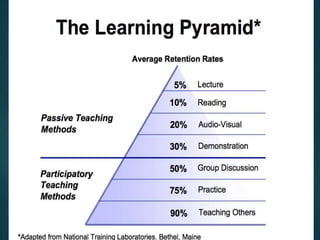
 Lectures are the oldest method of learning in
medicine and allied subjects
 Simple , economical , commonly used, one way
method.
 Chalk and talk
 The main purposes of lectures are
 Coverage of a topic or theme,
 Understanding of processes and phenomena
 Motivation .
 Coverage =>the most common,
the most common weakness
 Lectures can be boring and, worse, useless
 lectures can induce passivity =>as learning
is passive
 Prevents thinking
Brown GA, Manogue M: AMEE medical education guide No 22. Refreshing
lecturing: a guide for lecturers, Medical Teacher 24:231–244, 2001
WHAT IS A SMALL GROUP
• There is no one right size for a group
• The size of the small group can vary greatly
in healthcare education.
• Five to eight learners are optimal.
• Small groups are instructional settings that
better optimize the instructor-to-learner ratio.
• The number of participants will also depends
upon the teacher.
• Experienced teacher will facilitate larger
group than less experienced one.
Characteristics of small group teaching
Active participation
Purposeful activity
Face-to-face
contact.
ADVANTAGES
Small-group instructors can become more familiar with
learners’ knowledge, skills and experiences with the content
being discussed than in larger group teaching settings
The teacher has more opportunity for individualized feedback
Learners have the opportunity to get to know their classmates
and may be more comfortable asking questions.
ADVANTAGES
Learners can become familiar with adult learning
principles, which are something they will be encouraged
to apply for the rest of their professional lives.
Learners have the opportunity to develop important
interpersonal and communication skills that they will use
in their future practice
Offers the opportunity for teachers to model
professionalism, respect for different opinions and time
management.
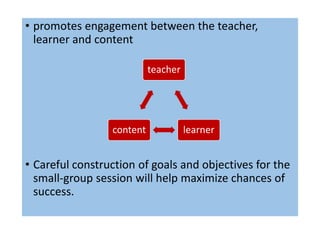
• promotes engagement between the teacher,
learner and content
• Careful construction of goals and objectives for the
small-group session will help maximize chances of
success.
teacher
learnercontent
FORMAT OF SMALL-GROUP TEACHING
Problem based learning (PBL)
Case-based learning (CBL)
Team-based learning (TBL).
Problem based learning
 A small group of students is presented
with a problem to solve and an approach
used.
 A problem usually centers on the clinical
presentation of one or a few patients
 ‘Problem’ may be introduced as a real
patient or as a hypothetical case
Problem based learning
 The main objectives of PBL are
 To develop group learning practices; assist
students in understanding and learning
content;
 Support students in gaining skills for problem-
solving and reasoning that they will be able to
apply in their professional lives.
 Enhance the quality of professional
communication and collegial interaction
Problem based learning
Roll of teacher
 Tutor sits in with each group of students for
some or all of the problem solving process.
 Monitors
 Facilitates
 Assists the group learning process
 Acts as a resource.
A PBL group: possible interactions
Team-based learning (TBL)
 Team-based learning (TBL) is an active
learning and strategy that provides
students with opportunities to apply
conceptual knowledge through a
sequence of events that includes
o individual work,
o teamwork and
o immediate feedback.”
TBL recurring steps
Step 1 – Advance Assignment
Students receive a list of learning activities,
accompanied by a set of learning goals.
 Students study materials in preparation for
the TBL session.
 Learning activities may include readings,
videos, labs, tutorials, lectures, etc.
TBL recurring steps
Step 2 – iRAT – Individual Readiness
Assurance Test
Each student completes a set (10–20) of
multiple choice questions that focus on
the concepts they need to master in
order to be able to solve the Team
Application (tAPP) problems.
TBL recurring steps
Step 3 – tRAT – Team Readiness
Assurance Test
This is the same set of questions that
each student has answered individually!
 But now the team must answer them
through a consensus-building
discussion
TBL recurring steps
Step 4 – Instructor Clarification
Review
Students get clarification from the
instructor on the concepts they
have been struggling with during
the tRAT.
TBL recurring steps
Step 5 – tAPP – Team Application
 This is the most important step!
 Students, in teams, are presented with a
scenario that is similar to the type of problem
that they will be grappling with in their careers.
 They are challenged to make interpretations,
calculations, predictions, analyses
 Able explain or defend their choice to the class
if asked to do.
Tips for a successful small-group session
Define the problem and purposes of the
session
Seek information (request facts from
learners) and opinions
Give information (fill in gaps in group
knowledge)
Test feasibility (challenge practicality and
correctness of suggested solutions)
Facilitate a positive learning environment
Give students positive feedback
Don’t provide too much information
Probe thinking process:Encourage participation of all group members and
prevent monopolization of the session by one or
two students
Stress the value of diversity of opinions and respect for peers
Facilitate learner interaction
Review and reinforce teaching goals and objectives
Keep time constraints (time management skills)
Provide regular and timely feedback
PREPARING FOR THE SMALL-GROUP SESSION
Determine the learning
objectives for the session
Know what ‘success looks like’ for
the session.,
Know your audience (the
learners) and the curriculum..
Become familiar with the
structure of the small group
teaching
To develop Instructional agenda
LEADING THE SMALL-GROUP SESSION
• Teaching style and the dynamics of the group are
important elements.
• The attitude and behavior (both verbal and nonverbal)
of the instructor is one of the most critical elements for
small-group teaching success
• Each small group can be different based on the
dynamics of the group members and the content being
covered
Jaques D: Teaching small groups, British Medical Journal 326:492–494, 2003.
CONDITIONS FOR AN EFFECTIVE SESSION
• The beginning of the small-group session is very
important
• Basic ‘ground rules’ which outline what is
acceptable and unacceptable behavior.
• Discuss about evaluation
• Generate a learning environment that is
cooperative rather than competitive,
• This will avoid participation by most dominant
members.
• Teacher as lecturer is replaced with the
teacher as facilitator.
• Do not assume that a teacher’s success in
large-group teaching will equate to effective
small-group teaching.
Stages of small group teaching
Forming: group members feel excitement and
anticipation; some experience anxiety (develop
relationships and establish rules)
Storming: feel more comfortable expressing opinions
internal conflict emerge within the group
Norming: team members become increasingly
positive about the team as a whole,
group members actively acknowledge each
other’s talents, skills and experience.
Performing: group’s ability to work through
problems; understanding of strengths and
weaknesses of group members
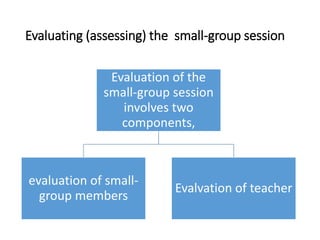
Evaluating (assessing) the small-group session
Evaluation of the
small-group session
involves two
components,
evaluation of small-
group members
Evalvation of teacher
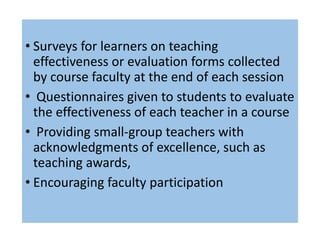
• Surveys for learners on teaching
effectiveness or evaluation forms collected
by course faculty at the end of each session
• Questionnaires given to students to evaluate
the effectiveness of each teacher in a course
• Providing small-group teachers with
acknowledgments of excellence, such as
teaching awards,
• Encouraging faculty participation
THANK YOU

Small Group Teaching

  • 1.
    SMALL GROUP TEACHING PRESENTOR: DR. ABDULHAMID Department of Community Medicine Govt. Medical College Srinagar
  • 2.
    Methods of teaching Demonstration  Panel discussion  Symposium  Seminar  Lecture
  • 3.
    lecture  Lectures arethe oldest method of learning in medicine and allied subjects  Simple , economical , commonly used, one way method.  Chalk and talk  The main purposes of lectures are  Coverage of a topic or theme,  Understanding of processes and phenomena  Motivation .
  • 4.
     Coverage =>themost common, the most common weakness  Lectures can be boring and, worse, useless  lectures can induce passivity =>as learning is passive  Prevents thinking Brown GA, Manogue M: AMEE medical education guide No 22. Refreshing lecturing: a guide for lecturers, Medical Teacher 24:231–244, 2001
  • 6.
    WHAT IS ASMALL GROUP • There is no one right size for a group • The size of the small group can vary greatly in healthcare education. • Five to eight learners are optimal.
  • 7.
    • Small groupsare instructional settings that better optimize the instructor-to-learner ratio. • The number of participants will also depends upon the teacher. • Experienced teacher will facilitate larger group than less experienced one.
  • 8.
    Characteristics of smallgroup teaching Active participation Purposeful activity Face-to-face contact.
  • 9.
    ADVANTAGES Small-group instructors canbecome more familiar with learners’ knowledge, skills and experiences with the content being discussed than in larger group teaching settings The teacher has more opportunity for individualized feedback Learners have the opportunity to get to know their classmates and may be more comfortable asking questions.
  • 10.
    ADVANTAGES Learners can becomefamiliar with adult learning principles, which are something they will be encouraged to apply for the rest of their professional lives. Learners have the opportunity to develop important interpersonal and communication skills that they will use in their future practice Offers the opportunity for teachers to model professionalism, respect for different opinions and time management.
  • 11.
    • promotes engagementbetween the teacher, learner and content • Careful construction of goals and objectives for the small-group session will help maximize chances of success. teacher learnercontent
  • 12.
    FORMAT OF SMALL-GROUPTEACHING Problem based learning (PBL) Case-based learning (CBL) Team-based learning (TBL).
  • 13.
    Problem based learning A small group of students is presented with a problem to solve and an approach used.  A problem usually centers on the clinical presentation of one or a few patients  ‘Problem’ may be introduced as a real patient or as a hypothetical case
  • 14.
    Problem based learning The main objectives of PBL are  To develop group learning practices; assist students in understanding and learning content;  Support students in gaining skills for problem- solving and reasoning that they will be able to apply in their professional lives.  Enhance the quality of professional communication and collegial interaction
  • 15.
    Problem based learning Rollof teacher  Tutor sits in with each group of students for some or all of the problem solving process.  Monitors  Facilitates  Assists the group learning process  Acts as a resource.
  • 16.
    A PBL group:possible interactions
  • 17.
    Team-based learning (TBL) Team-based learning (TBL) is an active learning and strategy that provides students with opportunities to apply conceptual knowledge through a sequence of events that includes o individual work, o teamwork and o immediate feedback.”
  • 18.
    TBL recurring steps Step1 – Advance Assignment Students receive a list of learning activities, accompanied by a set of learning goals.  Students study materials in preparation for the TBL session.  Learning activities may include readings, videos, labs, tutorials, lectures, etc.
  • 19.
    TBL recurring steps Step2 – iRAT – Individual Readiness Assurance Test Each student completes a set (10–20) of multiple choice questions that focus on the concepts they need to master in order to be able to solve the Team Application (tAPP) problems.
  • 20.
    TBL recurring steps Step3 – tRAT – Team Readiness Assurance Test This is the same set of questions that each student has answered individually!  But now the team must answer them through a consensus-building discussion
  • 21.
    TBL recurring steps Step4 – Instructor Clarification Review Students get clarification from the instructor on the concepts they have been struggling with during the tRAT.
  • 22.
    TBL recurring steps Step5 – tAPP – Team Application  This is the most important step!  Students, in teams, are presented with a scenario that is similar to the type of problem that they will be grappling with in their careers.  They are challenged to make interpretations, calculations, predictions, analyses  Able explain or defend their choice to the class if asked to do.
  • 23.
    Tips for asuccessful small-group session Define the problem and purposes of the session Seek information (request facts from learners) and opinions Give information (fill in gaps in group knowledge) Test feasibility (challenge practicality and correctness of suggested solutions)
  • 24.
    Facilitate a positivelearning environment Give students positive feedback Don’t provide too much information Probe thinking process:Encourage participation of all group members and prevent monopolization of the session by one or two students
  • 25.
    Stress the valueof diversity of opinions and respect for peers Facilitate learner interaction Review and reinforce teaching goals and objectives Keep time constraints (time management skills) Provide regular and timely feedback
  • 26.
    PREPARING FOR THESMALL-GROUP SESSION Determine the learning objectives for the session Know what ‘success looks like’ for the session., Know your audience (the learners) and the curriculum.. Become familiar with the structure of the small group teaching To develop Instructional agenda
  • 27.
    LEADING THE SMALL-GROUPSESSION • Teaching style and the dynamics of the group are important elements. • The attitude and behavior (both verbal and nonverbal) of the instructor is one of the most critical elements for small-group teaching success • Each small group can be different based on the dynamics of the group members and the content being covered Jaques D: Teaching small groups, British Medical Journal 326:492–494, 2003.
  • 28.
    CONDITIONS FOR ANEFFECTIVE SESSION • The beginning of the small-group session is very important • Basic ‘ground rules’ which outline what is acceptable and unacceptable behavior. • Discuss about evaluation • Generate a learning environment that is cooperative rather than competitive, • This will avoid participation by most dominant members.
  • 29.
    • Teacher aslecturer is replaced with the teacher as facilitator. • Do not assume that a teacher’s success in large-group teaching will equate to effective small-group teaching.
  • 30.
    Stages of smallgroup teaching Forming: group members feel excitement and anticipation; some experience anxiety (develop relationships and establish rules) Storming: feel more comfortable expressing opinions internal conflict emerge within the group
  • 31.
    Norming: team membersbecome increasingly positive about the team as a whole, group members actively acknowledge each other’s talents, skills and experience. Performing: group’s ability to work through problems; understanding of strengths and weaknesses of group members
  • 32.
    Evaluating (assessing) thesmall-group session Evaluation of the small-group session involves two components, evaluation of small- group members Evalvation of teacher
  • 33.
    • Surveys forlearners on teaching effectiveness or evaluation forms collected by course faculty at the end of each session • Questionnaires given to students to evaluate the effectiveness of each teacher in a course • Providing small-group teachers with acknowledgments of excellence, such as teaching awards, • Encouraging faculty participation
  • 35.

Editor's Notes

  • #3 Demonstration ; means showing by action stepwise , the procedure to be followed eg ORS makig Panel discussion ; in this small gp of persons 4-6 who are expert in the subject get around the table in presence of audience. One being the chairman there is no scope of audience to participate ( but can participate in panel discussion forum) Symposium : different speakers give lectures on different aspects of the same subject eg symposium on TB anaytomy physiology. No discussion Seminar one expert speaks about the different components of the same topic to a group having a common interest or discipline
  • #5  Understanding, the creation of new connections in the minds of the learners, and motivating students to learn are twin priorities. Beneath these priorities is a hidden purpose of developing one’s own understanding of a subject and of the way students learn. Docemur docemus: we learn as we teach. Lectures can be boring and, worse, useless. If they are merely recitations of standard texts, then they are not fulfilling adequately their functions of developing understanding and motivating students to learn
  • #7 The larger the group, the more complicated the dynamics and the likelihood that some remain silent. Smaller groups can mean less opportunity for individuals to benefit from each other’s knowledge and experience Small group teaching is not defined by numbers. We define it as any teaching situation in which dialogue and collaboration within the group are integral to learning. The teacher is still key to this learning. But now their role is to facilitate rather than to direct, to coordinate as much as to communicate, to inspire rather than to inform
  • #10  1..Instruction can therefore be more customized or tailored to the learners’ needs in small groups.
  • #11 1..For example, learners are encouraged to take responsibility for their own learning (self-directed learning or self-regulation, e.g. adequate preparation for the small group, asking questions during the session, follow-up readings after the small-group session has concluded
  • #12 1.THUS enabling the instructor to reinforce concepts that move beyond recalling content and asking trainees to apply this content in a more meaningful manner than in larger group settings. Therefore, small-group sessions should challenge the learner to apply what is learned in larger settings and/ or from textbook readings.
  • #22 There must be a mechanism so that the team knows, as immediately as possible, whether or not they have selected the correct answers because they need this immediate feedback to help them improve their decision-making process.
  • #23  At the end of the Clarification Review, students should feel confident that they are adequately prepared to solve more complex problems for the next TBL step:
  • #24 The tAPP’s structure follows the 4 S’s Significant problem: Students solve problems that are as realistic as possible. Problems must authentically represent the type of situation that the students are about to face in the workplace or are foundational to the next level of study. The answers must not be able to be found in any source (internet, textbook), but can only be discerned through in-depth discussion, debate, and dialogue within a team. • Same problem: Every team works on the same problem at the same time. Ideally, different teams will select different options for solutions. • Specific choice: Each team must make a specific choice through their intra-team discussion. They should never be asked to produce a lengthy document. Teams should be able to display their choices easily so that all teams can see them. • Simultaneous report: When it is time for teams to display their specific choices to a particular question, they do so at the same time. This way, everyone gets immediate feedback on where they might stand in the posting and they are then accountable to explain and defend their decisi
  • #26 1DO NOT PROVIDE TOO MUCH(don’t lecture, and encourage students to follow up on questions raised during the  session to enhance their learning  2. PROBE try to think out loud, providing explanations to help students with complex tasks like clinical  reasoning; ask students to explain their underlying thought process as well as the concepts they are applying,  assumptions they are making and approach to the problem
  • #28 2.This can be done by completing the statement, ‘By the end of the session, learners will be able to…’ 3 KNOW YOUR LEARNER .For example, what has been the learners’ prior experience with the content to be discussed in the small-group session in the curriculum Think about the activities and methods needed to achieve success. For example, is a review of a pertinent case from the last session or beginning the session with one or more multiple choice or open-ended questions needed 5 agenda provided by the course director (e.g. key teaching points and students’ strengths or difficulties with the content from other aspects of the course
  • #29  1. The time that the instructor spends preparing in advance should improve the organization and flow of the session. 3. so careful attention to the group dynamics as well as your own teaching strengths and weaknesses is important for success. Emphasizing the learner-centred approach is necessary for effective small-group sessions. In this approach, the teacher seeks understanding and provides frequent feedback to help the individual learner and the group to improve.
  • #30 In effective sessions, the instructor will typically set the learning climate, state the goals and objectives and provide some basic ‘ground rules’ This is important, as studies suggest that when learners are aware of evaluation criteria, they are likely to be more willing to participate
  • #31  in a highly effective small-group session it may at times be difficult to distinguish the teacher from the learners. Some teachers who are highly effective in large-group settings (e.g. lectures) are not skilled at small-group teaching
  • #32 Forming stage This is the stage when your group come together for the first time, the focus should be to build relationships within the team and clarify the mission or end result. The forming stage signifies a time where the group is just starting to come together and is characterized with both anxiety and uncertainty. In newly formed teams, relationships often are guarded, cautious and noncommittal. Group members tend to act independently and are cautious with their behaviour, which is driven by the want to be accepted by all members of the group. Any conflict, controversy or personal opinions are often avoided, as team members form impressions of each other and gain an understanding of what the group will do together. Understanding leadership roles and getting acquainted with other team members facilitate develop Storming stage During this second stage, team members feel more comfortable expressing opinions and you’ll see some internal conflict emerge within the group. Storming often starts where there is a conflict between team member’s natural working styles or a disagreement of opinion or values. Everyone works differently and has their own style, but this can sometimes cause personalities to clash and affect how a team works. During the conflict, team members will become increasingly frustrated and will lose motivation for the task or project. Although conflict resolution is often the goal of work teams during the storming stage, conflict management is generally what is achieved.
  • #33 Norming stage In the norming stage, team members become increasingly positive about the team as a whole, the other members as individuals and what the team is doing. Morale is high as group members actively acknowledge each other’s talents, skills and experience. Team relationships are better than ever, they respect and trust each other and the group remains focused on the purpose and end result. Members become more flexible and interdependent on each other and communication improves. Performing stage At this stage, team members have usually come to trust and accept each other. Individuals are now competent, autonomous and able to handle the decision making process without need of the leaders supervision. Leadership within the team is flexible and may shift among members in terms of who is most capable of solving a particular problem. The team is more strategically aware; the team knows clearly the purpose and why they are doing what they’re doing. The team has a shared vision and able to work independently and with no interference or participation from the leader.