LAYOUT
What is pit loom
Structure of pit loom
Types of pit loom
Feature of pit loom
Advantages of pit loom
Disadvantages of pit loom
Uses of pit loom
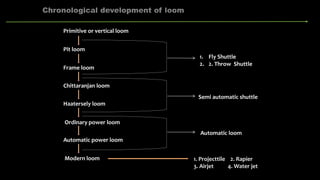
Primitive or vertical loom
Pit loom
Frame loom
Chittaranjan loom
Haatersely loom
Ordinary power loom
Automatic power loom
Modern loom 1. Projecttile 2. Rapier
3. Airjet 4. Water jet
Automatic loom
Semi automatic shuttle
1. Fly Shuttle
2. 2. Throw Shuttle
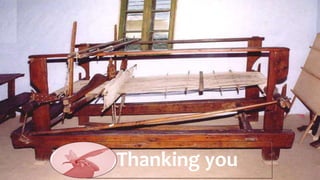
WHAT IS PITLOOM?
• This loom invented in 1766 B.C in egypt,.
• The weaver sites his or her legs in the pit where there were two
pedals which open the wrap threads allowing the weft shuttle to
pass through freely.
• This type of loom leaves the weavers hands free to pass the wefpes
of looms at shuttle from side to side and compress the weaving as
they go.
• In this loom, the combination of slay and shuttle boxes.
• For this reason this types of looms also called as THROW SHUTTLE
LOOM
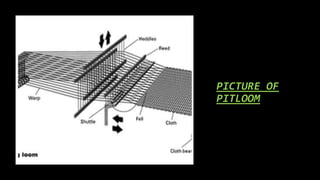
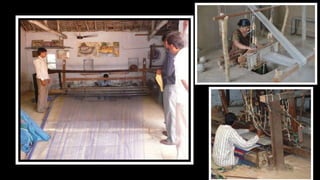
PICTURE OF
PITLOOM
Structure and parts of pit loom
Structure of pit loom
It is basically a weft carrier and helps in interlacement of the
weft with the warp threads to form cloth. The shuttle which is made
of wood passes from one end of the loom to the other. . A shuttle
normally weighs about 0.45 kgs.
It is the housing for the shuttle and is made of wood. It has a
spindle and a picker. It may also accommodate the picker without a
spindle. The top and side of the box towards the sley race are open.
The shuttle dwells inside the box for the intermediate period
between two successive picks.
This is also known as the weaver’s beam. It is fixed at the
back of the loom. The warp sheet is wound on to this beam. The
length of warp in the beam may be more than a thousand meters
It is also known as the cloth roller. The woven cloth is
wound on to this roller. This roller is placed below the front rest.
Heddles are made of cord or wire and are attached to the
shaft of the loom. The warp threads pass through the heddles,
separating the warp threads to allow the weft threads to pass
between them easily.
It is a metallic comb that is fixed to the sley with a reed cap. The
reed is made of a number of wires and the gap between wires is known
as dents. Each dent can accommodate one, two or more warp ends. The
count of the reed is decided by the number of dents in two inches. The
reed performs a number of functions which are enumerated as follows:
• It pushes the lastly laid pick of weft to the cloth fell
• It helps to maintain the position of the warp threads
• It acts as a guide to the shuttle which passes from one end of the loom
to the other.
• It determines the fineness of the cloth in conjunction with the healds.
• It determines the openness or closeness of the fabric. There are
various types of reed such as ordinary reed, gauze reed,
expandingreed, V reed etc. reed, V reed etc.
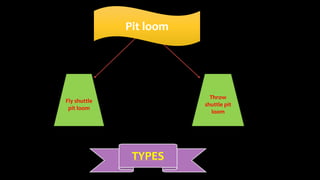
Fly shuttle
pit loom
Throw
shuttle pit
loom
Pit loom
TYPES
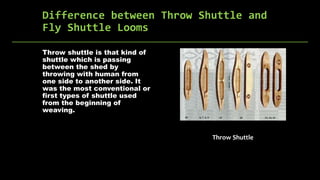
Difference between Throw Shuttle and
Fly Shuttle Looms
Throw shuttle is that kind of
shuttle which is passing
between the shed by
throwing with human from
one side to another side. It
was the most conventional or
first types of shuttle used
from the beginning of
weaving.
Throw Shuttle
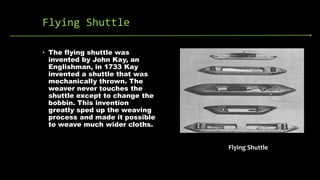
Flying Shuttle
• The flying shuttle was
invented by John Kay, an
Englishman, in 1733 Kay
invented a shuttle that was
mechanically thrown. The
weaver never touches the
shuttle except to change the
bobbin. This invention
greatly sped up the weaving
process and made it possible
to weave much wider cloths.
Flying Shuttle
Features of Pit Loom in Weaving:
• We can achieve texture fabric by using this type of loom.
• An average weaver can weave a medium width fly shuttle loom at
80-110 pics per minute.
• It is a fly shuttle loom.
• Here, shuttle is transferred from one box to another.
• To control moisture, looms are settled in floor that way yarn can get
moisture.
• Production quantity of this loom is double than primitive loom or
vertical loom.
Advantages of Pit Loom:
Those are-
• Texture fabric is produced by using this loom.
• Higher production in pit loom.
• It can accommodate a great quality of weft yarn in the pirn winding
package.
• An average weaver can weave in case of pit loom.
• Easy control of moisture here.
• Flu shuttle and back beams have been introduced here to remove
some fabric faults such as yarn breakage, knot etc.
Disadvantages of Pit Loom:
Those are-
• Too tough to control more number of heald shaft.
• This types of loom set up is difficult.
• Pit loom is one types of hand loom, so it’s tough to achieve higher
production from here.
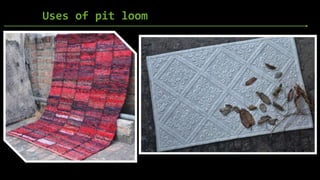
Uses of pit loom
Thanking you

Pitloom

  • 2.
    LAYOUT What is pitloom Structure of pit loom Types of pit loom Feature of pit loom Advantages of pit loom Disadvantages of pit loom Uses of pit loom
  • 3.
    Primitive or verticalloom Pit loom Frame loom Chittaranjan loom Haatersely loom Ordinary power loom Automatic power loom Modern loom 1. Projecttile 2. Rapier 3. Airjet 4. Water jet Automatic loom Semi automatic shuttle 1. Fly Shuttle 2. 2. Throw Shuttle
  • 4.
    WHAT IS PITLOOM? •This loom invented in 1766 B.C in egypt,. • The weaver sites his or her legs in the pit where there were two pedals which open the wrap threads allowing the weft shuttle to pass through freely. • This type of loom leaves the weavers hands free to pass the wefpes of looms at shuttle from side to side and compress the weaving as they go. • In this loom, the combination of slay and shuttle boxes. • For this reason this types of looms also called as THROW SHUTTLE LOOM
  • 5.
  • 7.
    Structure and partsof pit loom Structure of pit loom It is basically a weft carrier and helps in interlacement of the weft with the warp threads to form cloth. The shuttle which is made of wood passes from one end of the loom to the other. . A shuttle normally weighs about 0.45 kgs. It is the housing for the shuttle and is made of wood. It has a spindle and a picker. It may also accommodate the picker without a spindle. The top and side of the box towards the sley race are open. The shuttle dwells inside the box for the intermediate period between two successive picks.
  • 8.
    This is alsoknown as the weaver’s beam. It is fixed at the back of the loom. The warp sheet is wound on to this beam. The length of warp in the beam may be more than a thousand meters It is also known as the cloth roller. The woven cloth is wound on to this roller. This roller is placed below the front rest. Heddles are made of cord or wire and are attached to the shaft of the loom. The warp threads pass through the heddles, separating the warp threads to allow the weft threads to pass between them easily.
  • 9.
    It is ametallic comb that is fixed to the sley with a reed cap. The reed is made of a number of wires and the gap between wires is known as dents. Each dent can accommodate one, two or more warp ends. The count of the reed is decided by the number of dents in two inches. The reed performs a number of functions which are enumerated as follows: • It pushes the lastly laid pick of weft to the cloth fell • It helps to maintain the position of the warp threads • It acts as a guide to the shuttle which passes from one end of the loom to the other. • It determines the fineness of the cloth in conjunction with the healds. • It determines the openness or closeness of the fabric. There are various types of reed such as ordinary reed, gauze reed, expandingreed, V reed etc. reed, V reed etc.
  • 10.
    Fly shuttle pit loom Throw shuttlepit loom Pit loom TYPES
  • 11.
    Difference between ThrowShuttle and Fly Shuttle Looms Throw shuttle is that kind of shuttle which is passing between the shed by throwing with human from one side to another side. It was the most conventional or first types of shuttle used from the beginning of weaving. Throw Shuttle
  • 12.
    Flying Shuttle • Theflying shuttle was invented by John Kay, an Englishman, in 1733 Kay invented a shuttle that was mechanically thrown. The weaver never touches the shuttle except to change the bobbin. This invention greatly sped up the weaving process and made it possible to weave much wider cloths. Flying Shuttle
  • 13.
    Features of PitLoom in Weaving: • We can achieve texture fabric by using this type of loom. • An average weaver can weave a medium width fly shuttle loom at 80-110 pics per minute. • It is a fly shuttle loom. • Here, shuttle is transferred from one box to another. • To control moisture, looms are settled in floor that way yarn can get moisture. • Production quantity of this loom is double than primitive loom or vertical loom.
  • 14.
    Advantages of PitLoom: Those are- • Texture fabric is produced by using this loom. • Higher production in pit loom. • It can accommodate a great quality of weft yarn in the pirn winding package. • An average weaver can weave in case of pit loom. • Easy control of moisture here. • Flu shuttle and back beams have been introduced here to remove some fabric faults such as yarn breakage, knot etc.
  • 15.
    Disadvantages of PitLoom: Those are- • Too tough to control more number of heald shaft. • This types of loom set up is difficult. • Pit loom is one types of hand loom, so it’s tough to achieve higher production from here.
  • 16.
  • 18.