Welcome to My
Presentation
Presented By
Abdullah Al Rakib Shikder
Lecturer
Department of Textile Engineering
Mawlana Bhashani Science and Technology University
1
Content of the Presentation
 Introduction
 Motions of Loom
 Picking
 Types of Loom
 Comparison
 Rapier Loom
 Projectile Loom
 Air Jet Loom
 Water Jet Loom
 Future Development
Presentation On
Introduction to Shuttle ess Loom
2
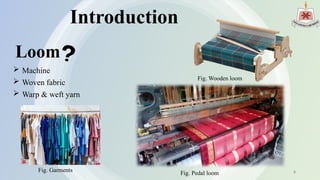
Introduction
 Machine
 Woven fabric
 Warp & weft yarn
Loom
Fig. Wooden loom
Fig. Pedal loom
Fig. Garments 3
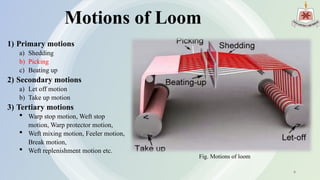
Motions of Loom
1) Primary motions
a) Shedding
b) Picking
c) Beating up
2) Secondary motions
a) Let off motion
b) Take up motion
3) Tertiary motions
 Warp stop motion, Weft stop
motion, Warp protector motion,
 Weft mixing motion, Feeler motion,
Break motion,
 Weft replenishment motion etc.
Fig. Motions of loom
4
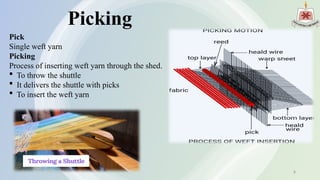
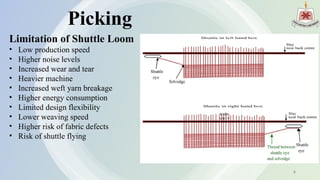
Picking
Pick
Single weft yarn
Picking
Process of inserting weft yarn through the shed.
 To throw the shuttle
 It delivers the shuttle with picks
 To insert the weft yarn
5
Picking
Limitation of Shuttle Loom
• Low production speed
• Higher noise levels
• Increased wear and tear
• Heavier machine
• Increased weft yarn breakage
• Higher energy consumption
• Limited design flexibility
• Lower weaving speed
• Higher risk of fabric defects
• Risk of shuttle flying
6
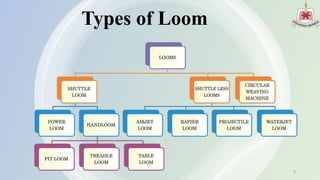
Types of Loom
7
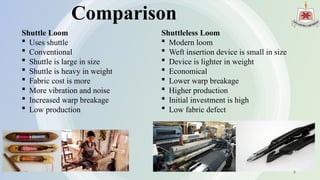
Comparison
Shuttle Loom
 Uses shuttle
 Conventional
 Shuttle is large in size
 Shuttle is heavy in weight
 Fabric cost is more
 More vibration and noise
 Increased warp breakage
 Low production
Shuttleless Loom
 Modern loom
 Weft insertion device is small in size
 Device is lighter in weight
 Economical
 Lower warp breakage
 Higher production
 Initial investment is high
 Low fabric defect
8
Shuttleless Loom
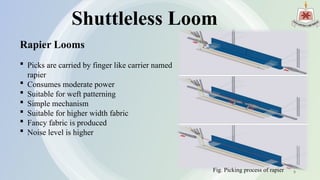
Rapier Looms
 Picks are carried by finger like carrier named
rapier
 Consumes moderate power
 Suitable for weft patterning
 Simple mechanism
 Suitable for higher width fabric
 Fancy fabric is produced
 Noise level is higher
Fig. Picking process of rapier 9
Shuttleless Loom
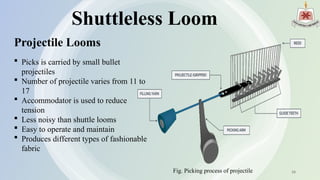
Projectile Looms
 Picks is carried by small bullet
projectiles
 Number of projectile varies from 11 to
17
 Accommodator is used to reduce
tension
 Less noisy than shuttle looms
 Easy to operate and maintain
 Produces different types of fashionable
fabric
Fig. Picking process of projectile 10
Shuttleless Loom
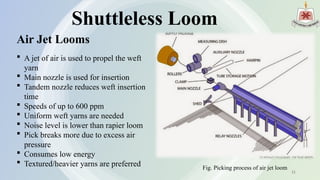
Air Jet Looms
 A jet of air is used to propel the weft
yarn
 Main nozzle is used for insertion
 Tandem nozzle reduces weft insertion
time
 Speeds of up to 600 ppm
 Uniform weft yarns are needed
 Noise level is lower than rapier loom
 Pick breaks more due to excess air
pressure
 Consumes low energy
 Textured/heavier yarns are preferred Fig. Picking process of air jet loom
11
Shuttleless Loom
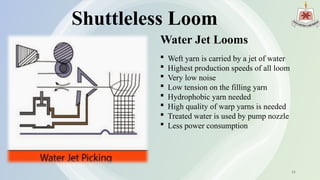
Water Jet Looms
 Weft yarn is carried by a jet of water
 Highest production speeds of all loom
 Very low noise
 Low tension on the filling yarn
 Hydrophobic yarn needed
 High quality of warp yarns is needed
 Treated water is used by pump nozzle
 Less power consumption
12
Limitation of Shuttleless Loom
• Higher initial cost
• Complex maintenance
• Requires skilled operators
• Limited fabric width
• Sensitivity to yarn quality
• Higher air or energy consumption (in air-jet and water-jet looms)
• Limited versatility in certain fabric types
• Higher noise (in some types, e.g., rapier looms)
• Increased capital investment for setup
• More delicate handling of weft insertion
13
Future Development
• Economic machine design
• Elimination of sizing process
• Yarn breakage rate reduction
• Incorporation of automation
• Better control of process parameters
• Remote monitoring
• Energy reduction
14
N.B. Image source is google.com 15

Presentation on Introduction to shuttle less loom.ppt

  • 1.
    Welcome to My Presentation PresentedBy Abdullah Al Rakib Shikder Lecturer Department of Textile Engineering Mawlana Bhashani Science and Technology University 1
  • 2.
    Content of thePresentation  Introduction  Motions of Loom  Picking  Types of Loom  Comparison  Rapier Loom  Projectile Loom  Air Jet Loom  Water Jet Loom  Future Development Presentation On Introduction to Shuttle ess Loom 2
  • 3.
    Introduction  Machine  Wovenfabric  Warp & weft yarn Loom Fig. Wooden loom Fig. Pedal loom Fig. Garments 3
  • 4.
    Motions of Loom 1)Primary motions a) Shedding b) Picking c) Beating up 2) Secondary motions a) Let off motion b) Take up motion 3) Tertiary motions  Warp stop motion, Weft stop motion, Warp protector motion,  Weft mixing motion, Feeler motion, Break motion,  Weft replenishment motion etc. Fig. Motions of loom 4
  • 5.
    Picking Pick Single weft yarn Picking Processof inserting weft yarn through the shed.  To throw the shuttle  It delivers the shuttle with picks  To insert the weft yarn 5
  • 6.
    Picking Limitation of ShuttleLoom • Low production speed • Higher noise levels • Increased wear and tear • Heavier machine • Increased weft yarn breakage • Higher energy consumption • Limited design flexibility • Lower weaving speed • Higher risk of fabric defects • Risk of shuttle flying 6
  • 7.
  • 8.
    Comparison Shuttle Loom  Usesshuttle  Conventional  Shuttle is large in size  Shuttle is heavy in weight  Fabric cost is more  More vibration and noise  Increased warp breakage  Low production Shuttleless Loom  Modern loom  Weft insertion device is small in size  Device is lighter in weight  Economical  Lower warp breakage  Higher production  Initial investment is high  Low fabric defect 8
  • 9.
    Shuttleless Loom Rapier Looms Picks are carried by finger like carrier named rapier  Consumes moderate power  Suitable for weft patterning  Simple mechanism  Suitable for higher width fabric  Fancy fabric is produced  Noise level is higher Fig. Picking process of rapier 9
  • 10.
    Shuttleless Loom Projectile Looms Picks is carried by small bullet projectiles  Number of projectile varies from 11 to 17  Accommodator is used to reduce tension  Less noisy than shuttle looms  Easy to operate and maintain  Produces different types of fashionable fabric Fig. Picking process of projectile 10
  • 11.
    Shuttleless Loom Air JetLooms  A jet of air is used to propel the weft yarn  Main nozzle is used for insertion  Tandem nozzle reduces weft insertion time  Speeds of up to 600 ppm  Uniform weft yarns are needed  Noise level is lower than rapier loom  Pick breaks more due to excess air pressure  Consumes low energy  Textured/heavier yarns are preferred Fig. Picking process of air jet loom 11
  • 12.
    Shuttleless Loom Water JetLooms  Weft yarn is carried by a jet of water  Highest production speeds of all loom  Very low noise  Low tension on the filling yarn  Hydrophobic yarn needed  High quality of warp yarns is needed  Treated water is used by pump nozzle  Less power consumption 12
  • 13.
    Limitation of ShuttlelessLoom • Higher initial cost • Complex maintenance • Requires skilled operators • Limited fabric width • Sensitivity to yarn quality • Higher air or energy consumption (in air-jet and water-jet looms) • Limited versatility in certain fabric types • Higher noise (in some types, e.g., rapier looms) • Increased capital investment for setup • More delicate handling of weft insertion 13
  • 14.
    Future Development • Economicmachine design • Elimination of sizing process • Yarn breakage rate reduction • Incorporation of automation • Better control of process parameters • Remote monitoring • Energy reduction 14
  • 15.
    N.B. Image sourceis google.com 15