





MY PROFILE
Name : Abdullah Al Mahfuj
Department : Textile.
Program : B.Sc. in Textile Engineering .
ID : 142014007
Green University of Bangladesh
Name of My Presentation
Rapier Loom
Introduction
Loom:
Loom is machine or device which is used to
produce woven fabric. It is the central point of whole
process of cloth production.
In other word,
a loom is a mechanism or tool used for
weaving yarn and thread into textiles.
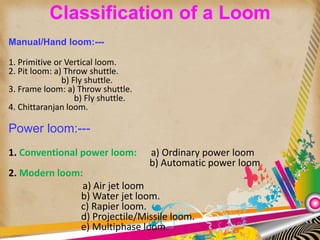
Classification of a Loom
Manual/Hand loom:---
1. Primitive or Vertical loom.
2. Pit loom: a) Throw shuttle.
b) Fly shuttle.
3. Frame loom: a) Throw shuttle.
b) Fly shuttle.
4. Chittaranjan loom.
Power loom:---
1. Conventional power loom: a) Ordinary power loom
b) Automatic power loom
2. Modern loom:
a) Air jet loom
b) Water jet loom.
c) Rapier loom.
d) Projectile/Missile loom.
e) Multiphase loom.
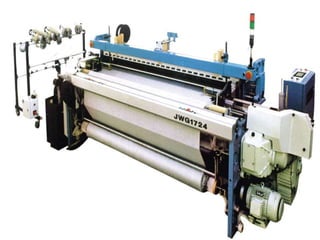
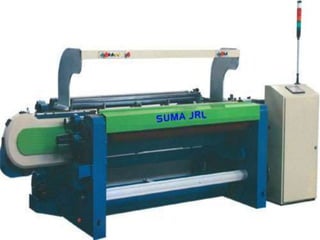
Rapier Loom
 A rapier loom uses a rapier to pull the weft yarn across
the loom.
 It can be a single rapier or double rapier.
 For a single rapier, a long rapier device is required to
extend across the full width of warp.
 For a double rapier loom, two rapiers enter the shed
from opposite sides of the loom and transfer the weft
from one rapier head to the other near the center of the
loom
 The advantage of two rapier system is only 50% of the
rapier movement is utilized in the weft insertion of
single rapier loom
Rapier Loom
– Very light fabrics with 20 GSM to heavy fabrics with
around 850 GSM are produced by rapier.
– Rapier machines are widely used for household textiles
and industrial fabrics.
– Rapier machines are designed for universal uses like
– Weave classic Wool, Cotton, Man-made fibres, fine
Silk and Fancy yarns.
-- These loom are competitors to the missille Loom
Types
• There are two types of rapier looms.
1.Long rapier
2.double rapier
long/single rapier that carries the weft across
the width from one side of the loom to another.
Double rapier that is one on each side of the
loom . One rapier feed the filling yarn half way through
the shed of warp yarn to the arm the other side , which
reach in and takes it across the rest of the way.
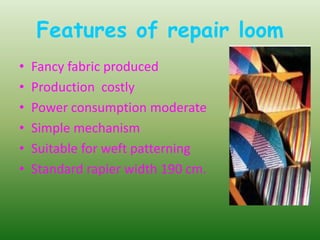
Features of repair loom
• Fancy fabric produced
• Production costly
• Power consumption moderate
• Simple mechanism
• Suitable for weft patterning
• Standard rapier width 190 cm.
Control panel:
The loom is controlled by the control panel with a micro-
computer, the lcd display provides a very user-friendly human-
machine interface, which shows the production statistic data
of each shift and provides the weft color programming
function.
Weft color selection:
The machine adopts electronic color selector up to 8 colors,
and the color selection pattern is programmed directly on the
machine control panel.
Wefting:
Wefting mechanism adopts 6-lever wefting
structure and can ensure the adjustment of the rapier
entry and exit time and ensure stable wefting and
insertion motion. This machine adopts 4 levers, short
connectors and short slay to complete the beating
motion, the rock shaft adopts 110mm(diameter)
seamless tube to ensure the beating strength and can
be suitable for high-speed motion and weaving of
heavy and high density fabrics. The rapier transmission
box adopts the advanced helix umbrella gears to
ensure stable transmission. The tension device adopts
3-rear-beam tension structure, which is specially
designed for balancing the warp tension of high-density
weaving and can improve the quality of the weaving
fabrics.
• Pick finding mechanism:
The machine adopts electronic let-off
mechanism with a high-accuracy step motor
and the optimized mechanical take-up system for
stable and accurate pick finding motion. The pick
finding motion is very stable and proved to be
very successful and reliable.
The adoption of two pressing rollers on the fabric
winding roller enables the worker to unload the
fabric from the fabric roller without stop. The
frequent adoption of bearings for the major moving
parts provides better performance and easier
maintenance.
Advantage
 Fancy fabric produced
 Production costly
 Suitable for weft patterning
 Power consumption moderate
 Simple mechanism
 Production speed (200-260 ppm)
Disadvantage
•
o Noise level is high then jet loom
o Production speed is less then jet loom.
Rapier loom
Rapier loom
Rapier loom

Rapier loom

  • 2.
    MY PROFILE Name :Abdullah Al Mahfuj Department : Textile. Program : B.Sc. in Textile Engineering . ID : 142014007 Green University of Bangladesh
  • 3.
    Name of MyPresentation Rapier Loom
  • 4.
    Introduction Loom: Loom is machineor device which is used to produce woven fabric. It is the central point of whole process of cloth production. In other word, a loom is a mechanism or tool used for weaving yarn and thread into textiles.
  • 5.
    Classification of aLoom Manual/Hand loom:--- 1. Primitive or Vertical loom. 2. Pit loom: a) Throw shuttle. b) Fly shuttle. 3. Frame loom: a) Throw shuttle. b) Fly shuttle. 4. Chittaranjan loom. Power loom:--- 1. Conventional power loom: a) Ordinary power loom b) Automatic power loom 2. Modern loom: a) Air jet loom b) Water jet loom. c) Rapier loom. d) Projectile/Missile loom. e) Multiphase loom.
  • 6.
    Rapier Loom  Arapier loom uses a rapier to pull the weft yarn across the loom.  It can be a single rapier or double rapier.  For a single rapier, a long rapier device is required to extend across the full width of warp.  For a double rapier loom, two rapiers enter the shed from opposite sides of the loom and transfer the weft from one rapier head to the other near the center of the loom  The advantage of two rapier system is only 50% of the rapier movement is utilized in the weft insertion of single rapier loom
  • 7.
    Rapier Loom – Verylight fabrics with 20 GSM to heavy fabrics with around 850 GSM are produced by rapier. – Rapier machines are widely used for household textiles and industrial fabrics. – Rapier machines are designed for universal uses like – Weave classic Wool, Cotton, Man-made fibres, fine Silk and Fancy yarns. -- These loom are competitors to the missille Loom
  • 8.
    Types • There aretwo types of rapier looms. 1.Long rapier 2.double rapier long/single rapier that carries the weft across the width from one side of the loom to another. Double rapier that is one on each side of the loom . One rapier feed the filling yarn half way through the shed of warp yarn to the arm the other side , which reach in and takes it across the rest of the way.
  • 9.
    Features of repairloom • Fancy fabric produced • Production costly • Power consumption moderate • Simple mechanism • Suitable for weft patterning • Standard rapier width 190 cm.
  • 12.
    Control panel: The loomis controlled by the control panel with a micro- computer, the lcd display provides a very user-friendly human- machine interface, which shows the production statistic data of each shift and provides the weft color programming function. Weft color selection: The machine adopts electronic color selector up to 8 colors, and the color selection pattern is programmed directly on the machine control panel.
  • 13.
    Wefting: Wefting mechanism adopts6-lever wefting structure and can ensure the adjustment of the rapier entry and exit time and ensure stable wefting and insertion motion. This machine adopts 4 levers, short connectors and short slay to complete the beating motion, the rock shaft adopts 110mm(diameter) seamless tube to ensure the beating strength and can be suitable for high-speed motion and weaving of heavy and high density fabrics. The rapier transmission box adopts the advanced helix umbrella gears to ensure stable transmission. The tension device adopts 3-rear-beam tension structure, which is specially designed for balancing the warp tension of high-density weaving and can improve the quality of the weaving fabrics.
  • 14.
    • Pick findingmechanism: The machine adopts electronic let-off mechanism with a high-accuracy step motor and the optimized mechanical take-up system for stable and accurate pick finding motion. The pick finding motion is very stable and proved to be very successful and reliable. The adoption of two pressing rollers on the fabric winding roller enables the worker to unload the fabric from the fabric roller without stop. The frequent adoption of bearings for the major moving parts provides better performance and easier maintenance.
  • 15.
    Advantage  Fancy fabricproduced  Production costly  Suitable for weft patterning  Power consumption moderate  Simple mechanism  Production speed (200-260 ppm)
  • 16.
    Disadvantage • o Noise levelis high then jet loom o Production speed is less then jet loom.