Diversity of Life:
Introduction to
Biological
Classification
By Deanne Erdmann, MS
BioEd Online
Why Do We Classify Organisms?
 Biologists group organisms to represent
similarities and proposed relationships.
 Classification systems change with
expanding knowledge about new and
well-known organisms.
Tacitus bellus
BioEd Online
Leucaena leucocephala
Lead tree
Classification
 Binomial Nomenclature
 Two part name (Genus, species)
 Hierarchical Classification
 Seven Taxonomic Catagroies
 Systematics
 Study of the evolution of biological diversity
BioEd Online
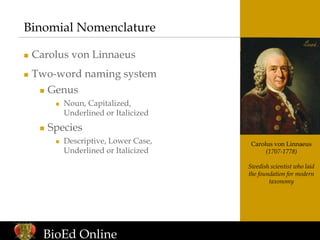
Carolus von Linnaeus
(1707-1778)
Swedish scientist who laid
the foundation for modern
taxonomy
Binomial Nomenclature
 Carolus von Linnaeus
 Two-word naming system
 Genus
 Noun, Capitalized,
Underlined or Italicized
 Species
 Descriptive, Lower Case,
Underlined or Italicized
BioEd Online
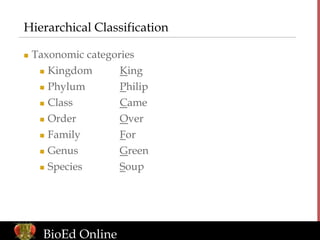
Hierarchical Classification
 Taxonomic categories
 Kingdom King
 Phylum Philip
 Class Came
 Order Over
 Family For
 Genus Green
 Species Soup
BioEd Online
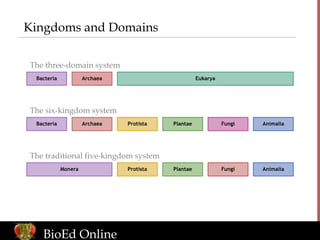
Kingdoms and Domains
Bacteria Archaea Eukarya
Bacteria Archaea Protista Plantae Fungi Animalia
Monera Protista Plantae Fungi Animalia
The three-domain system
The six-kingdom system
The traditional five-kingdom system
BioEd Online
Systematics:
Evolutionary Classification of Organisms
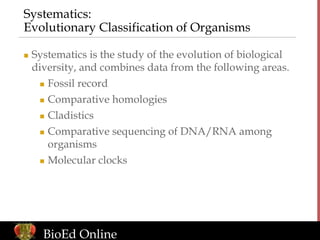
 Systematics is the study of the evolution of biological
diversity, and combines data from the following areas.
 Fossil record
 Comparative homologies
 Cladistics
 Comparative sequencing of DNA/RNA among
organisms
 Molecular clocks
BioEd Online
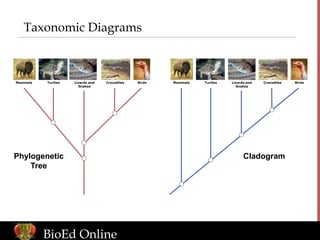
Taxonomic Diagrams
Mammals Turtles Lizards and
Snakes
Crocodiles Birds Mammals Turtles Lizards and
Snakes
Crocodiles Birds
Cladogram
Phylogenetic
Tree
BioEd Online
Dichotomous Keys Identify Organisms
 Dichotomous keys versus evolutionary classification
 Dichotomous keys contain pairs of contrasting
descriptions.
 After each description, the key directs the user to
another pair of descriptions or identifies the organism.
Example:
1. a) Is the leaf simple? Go to 2
b) Is the leaf compound? Go to 3
2. a) Are margins of the leaf jagged? Go to 4
b) Are margins of the leaf smooth? Go to 5
BioEd Online
Thank You
 This concludes a brief review of biological
classification.
 You may find additional information on this section of
in the expanded content talks and in the notes below
each slide in the slide library.
BioEd Online

introduction to biological classification

  • 1.
    Diversity of Life: Introductionto Biological Classification By Deanne Erdmann, MS BioEd Online
  • 2.
    Why Do WeClassify Organisms?  Biologists group organisms to represent similarities and proposed relationships.  Classification systems change with expanding knowledge about new and well-known organisms. Tacitus bellus BioEd Online
  • 3.
    Leucaena leucocephala Lead tree Classification Binomial Nomenclature  Two part name (Genus, species)  Hierarchical Classification  Seven Taxonomic Catagroies  Systematics  Study of the evolution of biological diversity BioEd Online
  • 4.
    Carolus von Linnaeus (1707-1778) Swedishscientist who laid the foundation for modern taxonomy Binomial Nomenclature  Carolus von Linnaeus  Two-word naming system  Genus  Noun, Capitalized, Underlined or Italicized  Species  Descriptive, Lower Case, Underlined or Italicized BioEd Online
  • 5.
    Hierarchical Classification  Taxonomiccategories  Kingdom King  Phylum Philip  Class Came  Order Over  Family For  Genus Green  Species Soup BioEd Online
  • 6.
    Kingdoms and Domains BacteriaArchaea Eukarya Bacteria Archaea Protista Plantae Fungi Animalia Monera Protista Plantae Fungi Animalia The three-domain system The six-kingdom system The traditional five-kingdom system BioEd Online
  • 7.
    Systematics: Evolutionary Classification ofOrganisms  Systematics is the study of the evolution of biological diversity, and combines data from the following areas.  Fossil record  Comparative homologies  Cladistics  Comparative sequencing of DNA/RNA among organisms  Molecular clocks BioEd Online
  • 8.
    Taxonomic Diagrams Mammals TurtlesLizards and Snakes Crocodiles Birds Mammals Turtles Lizards and Snakes Crocodiles Birds Cladogram Phylogenetic Tree BioEd Online
  • 9.
    Dichotomous Keys IdentifyOrganisms  Dichotomous keys versus evolutionary classification  Dichotomous keys contain pairs of contrasting descriptions.  After each description, the key directs the user to another pair of descriptions or identifies the organism. Example: 1. a) Is the leaf simple? Go to 2 b) Is the leaf compound? Go to 3 2. a) Are margins of the leaf jagged? Go to 4 b) Are margins of the leaf smooth? Go to 5 BioEd Online
  • 10.
    Thank You  Thisconcludes a brief review of biological classification.  You may find additional information on this section of in the expanded content talks and in the notes below each slide in the slide library. BioEd Online