Biological Classification
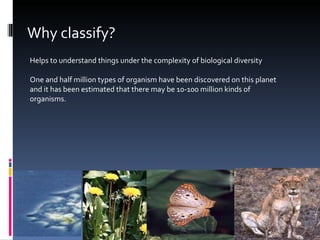
Why classify? Helps to understand things under the complexity of biological diversity One and half million types of organism have been discovered on this planet and it has been estimated that there may be 10-100 million kinds of organisms.
How Classification Began? Classification began By ancient people that observed nature and had a desire to organize the knowledge gained. Classification- the grouping of objects based on similarities ex:: baseball cards, coins, shoes, etc Ancient Chinese classification of dogs Stray Dogs Those have broken flower vase Resemble flies at a distance
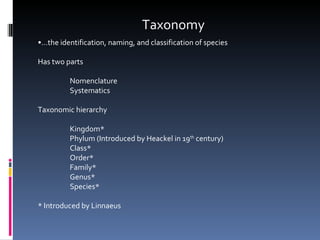
Taxonomy •… the identification, naming, and classification of species Has two parts Nomenclature Systematics Taxonomic hierarchy Kingdom* Phylum (Introduced by Heackel in 19 th  century) Class* Order* Family* Genus* Species* * Introduced by Linnaeus
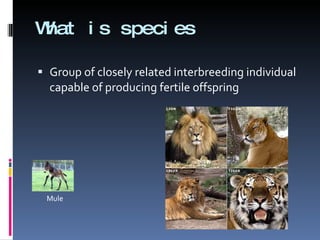
What is species Group of closely related interbreeding individual capable of producing fertile offspring Mule
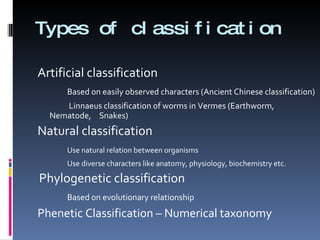
Types of classification Artificial classification Based on easily observed characters (Ancient Chinese classification)   Linnaeus classification of worms in Vermes (Earthworm, Nematode,  Snakes) Natural classification Use natural relation between organisms Use diverse characters like anatomy, physiology, biochemistry etc. Phylogenetic classification Based on evolutionary relationship Phenetic Classification – Numerical taxonomy
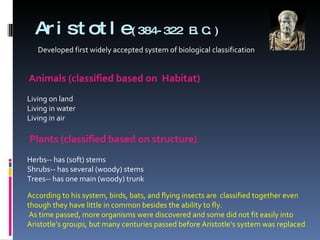
Aristotle (384-322 B.C.) Developed first widely accepted system of biological classification According to his system, birds, bats, and flying insects are  classified together even though they have little in common besides the ability to fly. As time passed, more organisms were discovered and some did not fit easily into Aristotle’s groups, but many centuries passed before Aristotle’s system was replaced Animals (classified based on  Habitat) Living on land Living in water Living in air Plants (classified based on structure) Herbs-- has (soft) stems Shrubs-- has several (woody) stems Trees-- has one main (woody) trunk
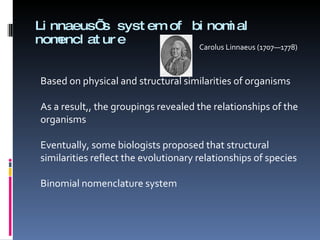
Linnaeus’s system of binomial nomenclature Carolus Linnaeus (1707—1778) Based on physical and structural similarities of organisms As a result,, the groupings revealed the relationships of the organisms Eventually, some biologists proposed that structural similarities reflect the evolutionary relationships of species  Binomial nomenclature system
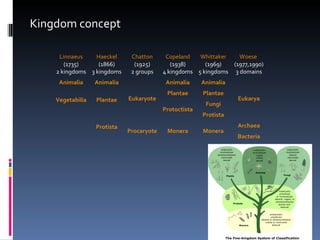
Kingdom concept Linnaeus (1735) 2 kingdoms Haeckel (1866) 3 kingdoms Chatton (1925) 2 groups Copeland (1938) 4 kingdoms Whittaker  (1969) 5 kingdoms Woese   (1977,1990) 3 domains Animalia Animalia Eukaryote Animalia Animalia Eukarya Vegetabilia Plantae Plantae Plantae Protoctista Fungi Protista Protista Procaryote Monera Monera Archaea Bacteria
 
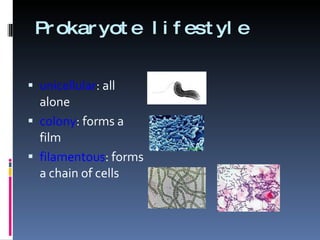
Prokaryote lifestyle unicellular : all alone colony : forms a film filamentous : forms a chain of cells
Prokaryote Feeding Photosynthetic : energy from sunlight Disease-causing : feed on living things Decomposers : feed on dead things
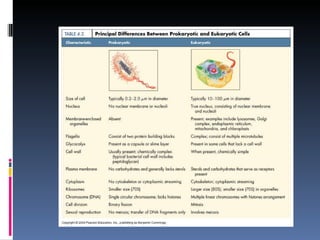
Eukaryotes are bigger and more complicated Have  organelles Have  chromosomes can be  multicellular
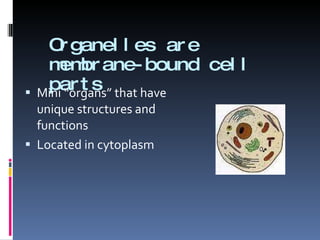
Organelles are membrane-bound cell parts Mini “organs” that have unique structures and functions Located in cytoplasm
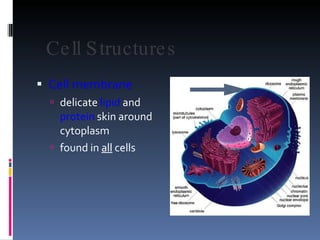
Cell membrane delicate  lipid  and  protein  skin around cytoplasm found in  all  cells Cell Structures
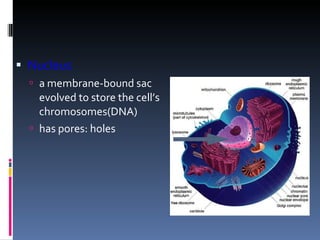
Nucleus a membrane-bound sac evolved to store the cell’s chromosomes(DNA) has pores: holes
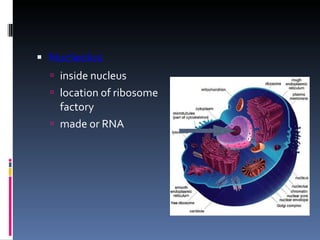
Nucleolus inside nucleus location of ribosome factory made or RNA
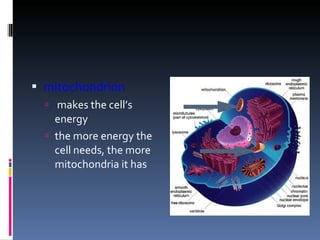
mitochondrion makes the cell’s energy the more energy the cell needs, the more mitochondria it has
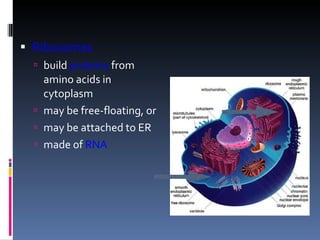
Ribosomes build  proteins  from amino acids in cytoplasm may be free-floating, or may be attached to ER made of  RNA
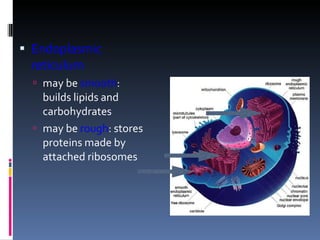
Endoplasmic reticulum may be  smooth : builds lipids and carbohydrates may be  rough : stores proteins made by attached ribosomes
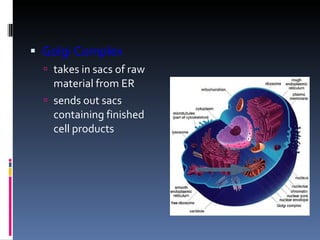
Golgi Complex takes in sacs of raw material from ER sends out sacs containing finished cell products
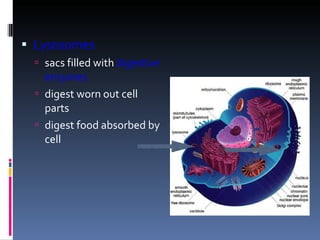
Lysosomes sacs filled with  digestive   enzymes digest worn out cell parts digest food absorbed by cell
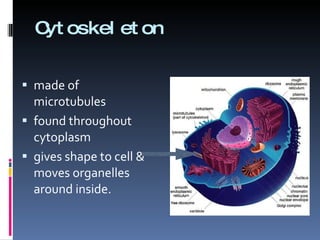
Cytoskeleton made of microtubules found throughout cytoplasm gives shape to cell & moves organelles around inside.
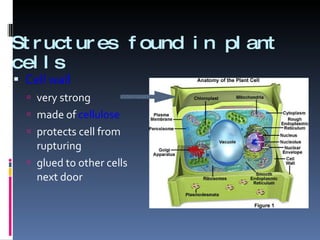
Structures found in plant cells Cell wall very strong made of  cellulose protects cell from rupturing glued to other cells next door
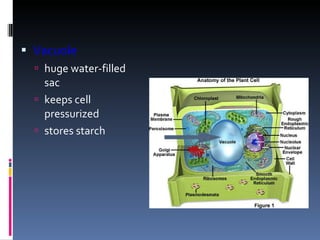
Vacuole huge water-filled sac keeps cell pressurized stores starch
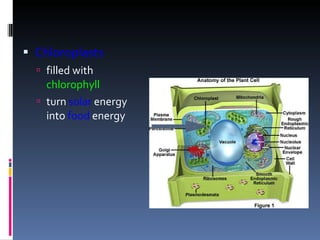
Chloroplasts filled with  chlorophyll turn  solar  energy into  food  energy
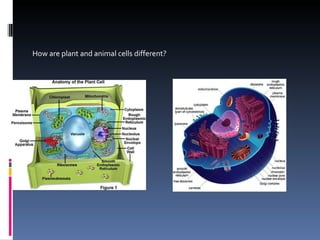
How are plant and animal cells different?
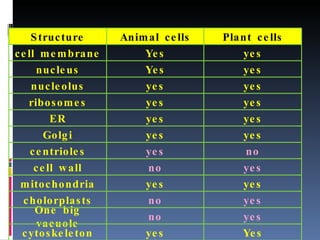
Structure Animal cells Plant cells cell membrane Yes yes nucleus Yes yes nucleolus yes yes ribosomes yes yes ER yes yes Golgi yes yes centrioles yes no cell wall no yes mitochondria yes yes cholorplasts no yes One big vacuole no yes cytoskeleton yes Yes
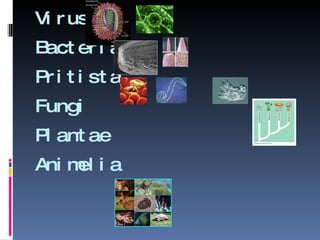
Virus Bacteria Pritista Fungi Plantae Animelia

Biological Classification

  • 1.
  • 2.
    Why classify? Helpsto understand things under the complexity of biological diversity One and half million types of organism have been discovered on this planet and it has been estimated that there may be 10-100 million kinds of organisms.
  • 3.
    How Classification Began?Classification began By ancient people that observed nature and had a desire to organize the knowledge gained. Classification- the grouping of objects based on similarities ex:: baseball cards, coins, shoes, etc Ancient Chinese classification of dogs Stray Dogs Those have broken flower vase Resemble flies at a distance
  • 4.
    Taxonomy •… theidentification, naming, and classification of species Has two parts Nomenclature Systematics Taxonomic hierarchy Kingdom* Phylum (Introduced by Heackel in 19 th century) Class* Order* Family* Genus* Species* * Introduced by Linnaeus
  • 5.
    What is speciesGroup of closely related interbreeding individual capable of producing fertile offspring Mule
  • 6.
    Types of classificationArtificial classification Based on easily observed characters (Ancient Chinese classification) Linnaeus classification of worms in Vermes (Earthworm, Nematode, Snakes) Natural classification Use natural relation between organisms Use diverse characters like anatomy, physiology, biochemistry etc. Phylogenetic classification Based on evolutionary relationship Phenetic Classification – Numerical taxonomy
  • 7.
    Aristotle (384-322 B.C.)Developed first widely accepted system of biological classification According to his system, birds, bats, and flying insects are classified together even though they have little in common besides the ability to fly. As time passed, more organisms were discovered and some did not fit easily into Aristotle’s groups, but many centuries passed before Aristotle’s system was replaced Animals (classified based on Habitat) Living on land Living in water Living in air Plants (classified based on structure) Herbs-- has (soft) stems Shrubs-- has several (woody) stems Trees-- has one main (woody) trunk
  • 8.
    Linnaeus’s system ofbinomial nomenclature Carolus Linnaeus (1707—1778) Based on physical and structural similarities of organisms As a result,, the groupings revealed the relationships of the organisms Eventually, some biologists proposed that structural similarities reflect the evolutionary relationships of species Binomial nomenclature system
  • 9.
    Kingdom concept Linnaeus(1735) 2 kingdoms Haeckel (1866) 3 kingdoms Chatton (1925) 2 groups Copeland (1938) 4 kingdoms Whittaker (1969) 5 kingdoms Woese (1977,1990) 3 domains Animalia Animalia Eukaryote Animalia Animalia Eukarya Vegetabilia Plantae Plantae Plantae Protoctista Fungi Protista Protista Procaryote Monera Monera Archaea Bacteria
  • 10.
  • 11.
    Prokaryote lifestyle unicellular: all alone colony : forms a film filamentous : forms a chain of cells
  • 12.
    Prokaryote Feeding Photosynthetic: energy from sunlight Disease-causing : feed on living things Decomposers : feed on dead things
  • 13.
    Eukaryotes are biggerand more complicated Have organelles Have chromosomes can be multicellular
  • 14.
    Organelles are membrane-boundcell parts Mini “organs” that have unique structures and functions Located in cytoplasm
  • 15.
    Cell membrane delicate lipid and protein skin around cytoplasm found in all cells Cell Structures
  • 16.
    Nucleus a membrane-boundsac evolved to store the cell’s chromosomes(DNA) has pores: holes
  • 17.
    Nucleolus inside nucleuslocation of ribosome factory made or RNA
  • 18.
    mitochondrion makes thecell’s energy the more energy the cell needs, the more mitochondria it has
  • 19.
    Ribosomes build proteins from amino acids in cytoplasm may be free-floating, or may be attached to ER made of RNA
  • 20.
    Endoplasmic reticulum maybe smooth : builds lipids and carbohydrates may be rough : stores proteins made by attached ribosomes
  • 21.
    Golgi Complex takesin sacs of raw material from ER sends out sacs containing finished cell products
  • 22.
    Lysosomes sacs filledwith digestive enzymes digest worn out cell parts digest food absorbed by cell
  • 23.
    Cytoskeleton made ofmicrotubules found throughout cytoplasm gives shape to cell & moves organelles around inside.
  • 24.
    Structures found inplant cells Cell wall very strong made of cellulose protects cell from rupturing glued to other cells next door
  • 25.
    Vacuole huge water-filledsac keeps cell pressurized stores starch
  • 26.
    Chloroplasts filled with chlorophyll turn solar energy into food energy
  • 27.
    How are plantand animal cells different?
  • 28.
    Structure Animal cellsPlant cells cell membrane Yes yes nucleus Yes yes nucleolus yes yes ribosomes yes yes ER yes yes Golgi yes yes centrioles yes no cell wall no yes mitochondria yes yes cholorplasts no yes One big vacuole no yes cytoskeleton yes Yes
  • 29.
    Virus Bacteria PritistaFungi Plantae Animelia