FACULTY OF VETERINARY MEDICINE AND
ANIMAL PRODUCTION
COURSE: PASTORAL BOTANY
CHAPTER ONE
INTRODUCTION
What are the botany, plant and
pasture?
Botany is a branch of biology
that deals with the study of plants including their
structure ,classification ,properties and plant
diseases
A plant is a living organism that has the capacity to
make its own food through a process known as
photosynthesis
 Pastures are plant resources that serve as food for
livestock: either directly (in grazing) or as fodder”.
Different pasture
plant are Differences
They are different shape
Different environment
Different climate
They are different color
They grow at different heights
They have a different name
What are the Similarities?
• Eukaryotic cells
• Autotrophic
• Mostly green
Vocabulary of plants
• Common names
• Dichotomous key
• Kingdom
• Morphology
• Plant
• Scientific names
• Species
• Taxonomy
What is a plant and why
are they important?
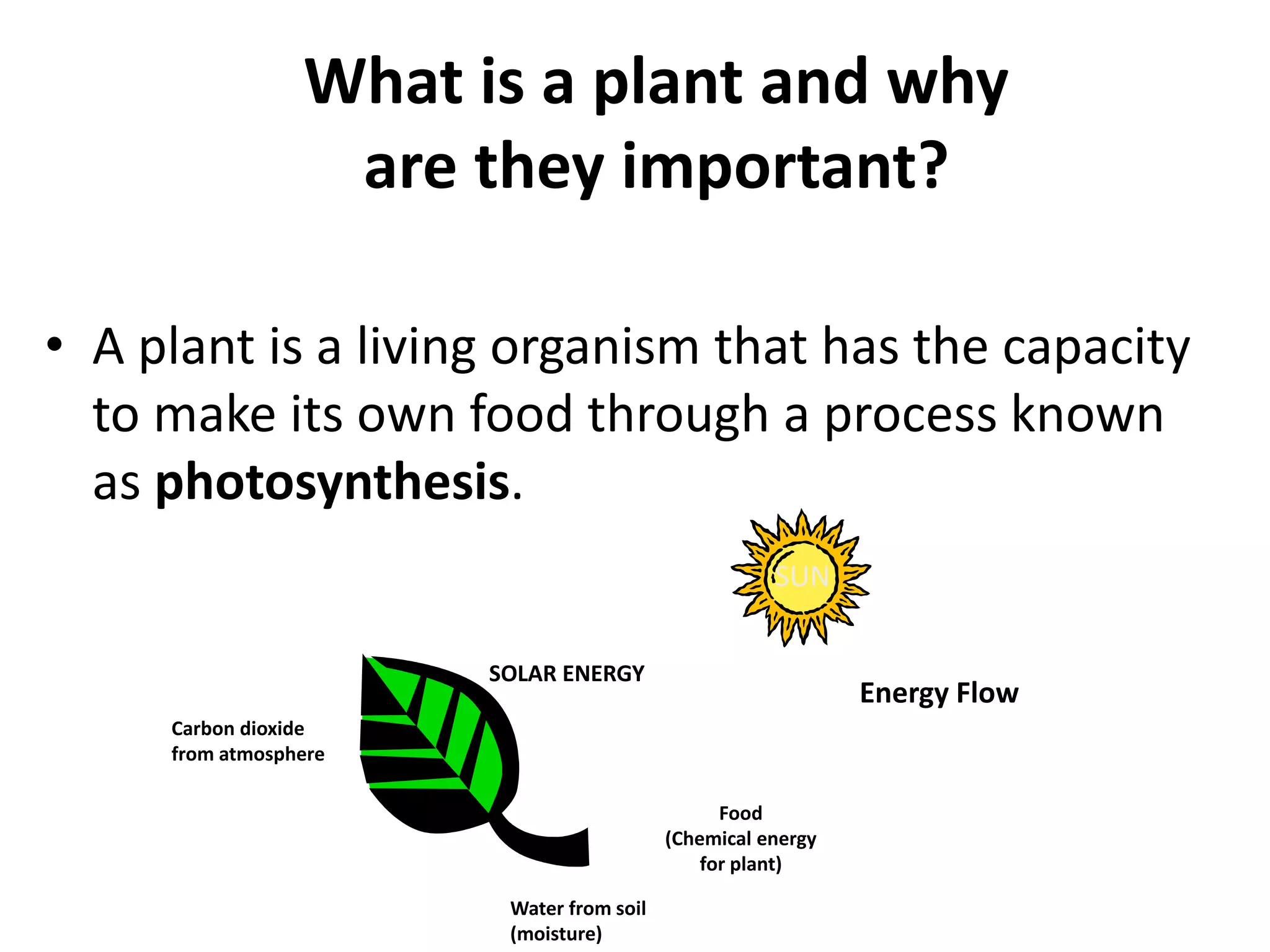
• A plant is a living organism that has the capacity
to make its own food through a process known
as photosynthesis.
Energy Flow
SOLAR ENERGY
SUN
Food
(Chemical energy
for plant)
Water from soil
(moisture)
Carbon dioxide
from atmosphere
Photosynthetic Autotrophs
Characteristics of Land Plants
• Eukaryotic
• Autotrophs
• Cell Wall - cellulose
• Alternation of Generations(sexual and a
sexual phase of life cycle )
• Embryophytes – protected embryo
Plants are found in varying climates.
• Some 350,000 different species of plants have
been identified.
• Knowing the requirements of a particular
plant helps in successfully growing it.
Plants are made of many cells.
• Some plants, such as trees, grow quite large
and live for many years.
• Some plants are small and may live for only
one year, with lettuce and petunias being
examples.
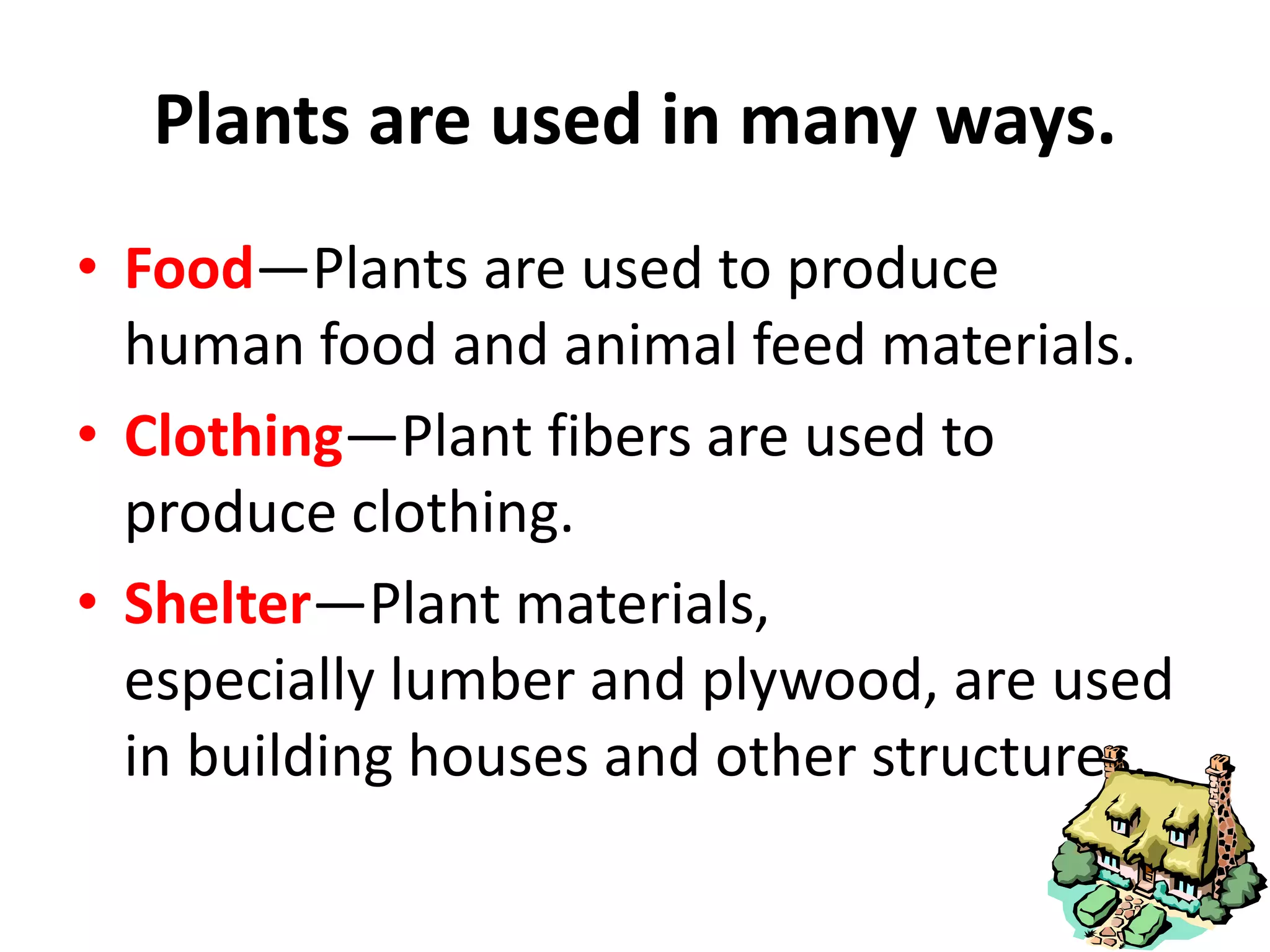
Plants are used in many ways.
• Food—Plants are used to produce
human food and animal feed materials.
• Clothing—Plant fibers are used to
produce clothing.
• Shelter—Plant materials,
especially lumber and plywood, are used
in building houses and other structures.
Plants are used in many ways
• Paper - Many kinds of plants are used in
manufacturing paper, with pine trees being
widely used.
• Human appeal - Some plants are used for
their beauty in landscaping and preparing
floral displays.
• Others - Plants have many uses in the lives
of humans, ranging from fuel sources, to
medical applications, and in hobbies like
gardening.
How are plants named?
• Common names are the “everyday”
names that people use.
• Scientific names are the names of plants
based on taxonomy.
Greek taxis- (arrangement )
Nomos- law
The classification of plants and other
living things is known as taxonomy.
The first efforts in taxonomy began over 2,000
years ago in Greece.
• Modern taxonomy uses seven divisions or
stages in classification, with each stage being
more specific than the previous stage.
• These stages form a taxonomic hierarchy.
Taxonomy is the branch of biology that names
and groups organisms according to their
characteristics and evolutionary history.
Organisms were first classified more than
2,000 years ago by the Greek philosopher
Aristotle
Modern System:Hierarchy
Seven Levels of Organization
• Carolus Linnaeus (mid-1700’)s was a Swedish
biologist who established a simple system for
classifying and naming organisms.
• He developed a Hierarchy (a ranking system) for
classifying organisms that is the Basis for Modern
Taxonomy.
• For this reason, he is considered to be father” of
modern taxonomy “.
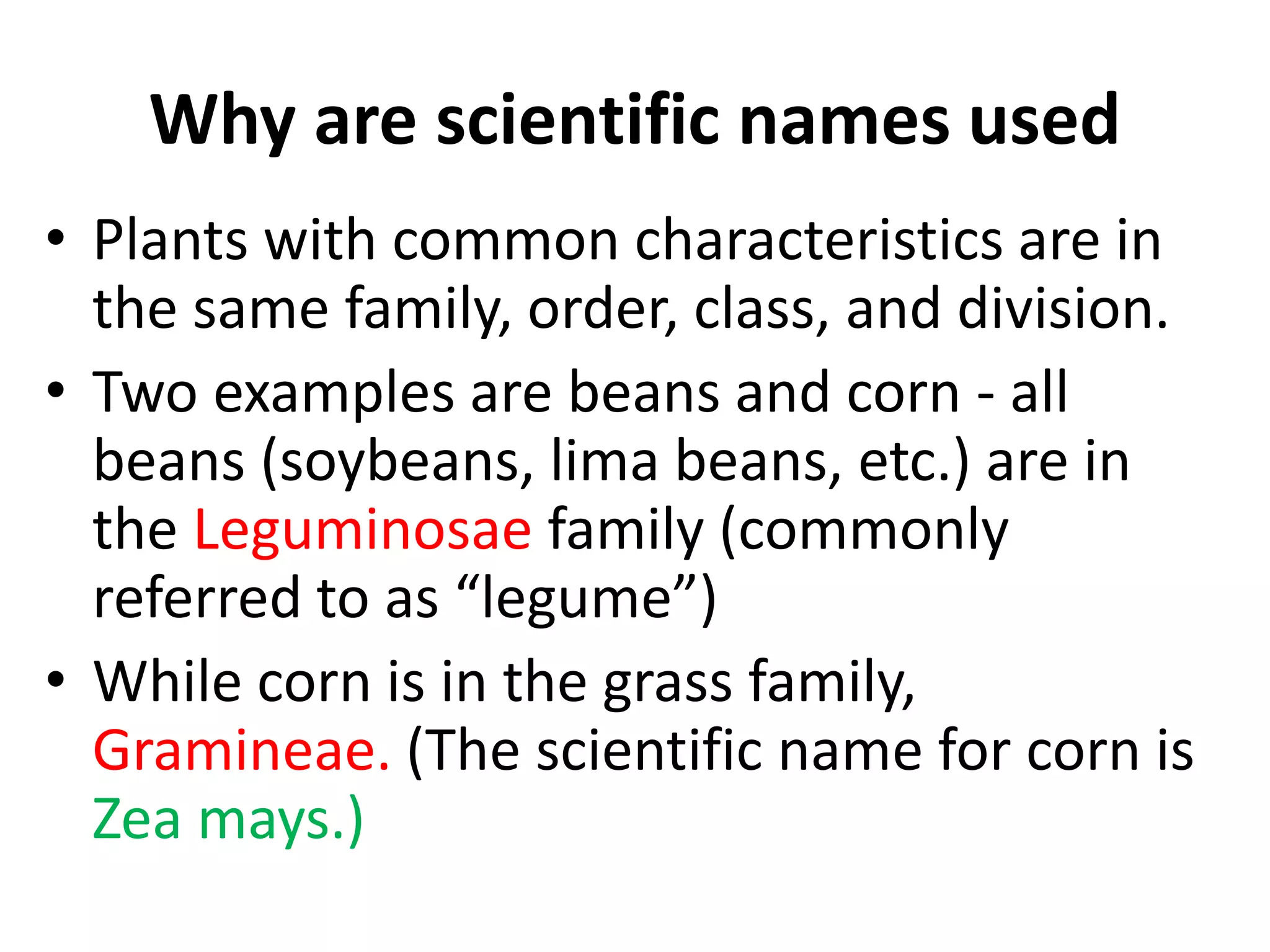
The seven stages in the hierarchy
• Kingdom - Kingdom is the first stage, with all
living organisms fitting into one of five stages:
five kingdoms
Plantia- all plants
Animalia- all animals
Fungi- mash room
Protista- amoeba
Monera- bacteria
Seven living things classifications
 Remember: King Philip Came Over For Grape Soda.
Kingdom
Phylum
Class
Order
Family
Genus
Species
Six kingdom system
The seven stages in the hierarchy
• Division - Ten divisions are used in the
plant kingdom. (This stage in animal
classification is known as phylum.)
• Class - Members of a class have more
common characteristics than those of a
division.
• Order - Members of an order are more
alike than those of a class.
The seven stages in the hierarchy
• Family - Members of a family are more alike
than those of an order.
• Genus - Members of a genus are very similar.
The seven stages in the hierarchy
• Species - The species is the most specific stage
in the taxonomic hierarchy for an organism.
• Members of a species can be bred and
produce offspring similar to their parents.
• No two species have the same scientific name.
Species
• Groups within a species that have unique
traits may be formed into subspecies or
varieties.
• Species names are comprised of the genus
and species.
Stages in Plant Classification
Plant classification uses of a
dichotomous key.
• A dichotomous key is a written set of choices
that leads to the name of a plant or other
organism.
• The choices are sequential and involve
determining if a plant fits a group with specific
characteristics.
Morphology
• Is the study of the internal and external
appearance of an organism.
• Most plants are identified by external
appearance.
• Internal appearance of plant growth
structures will help verify classification and
may be needed with some species.
• The characteristics observed are often
referred to as evidence in classification.
Scientists look for similarities and
differences in organisms.
• Common characteristics with plants
include leaf shape and arrangement;
stem structure, including exterior bark or
epidermis; root system, such as fibrous
or tap;and flower color, structure, and
other features.
• Scientists may also use chromosomes,
embryo growth, and biochemistry of a
plant in its classification.
Common names
• Common names may vary from one region or
location to another.
• One plant species may be known by several
different common names.
• An example is the lima bean, which is also
known as a butter bean.
Scientific names
• A scientific name is often comprised of two
words—the genus and species of the plant.
• Scientific names are written in italics or are
underlined.
• The first letter of the genus is capitalized;
no other letters are in capital letters.
• An example is Phaseolus limensis - which is
the lima bean or butter bean.
Examples of Common and Scientific
Names
• Butterfly Orchid - Orchis Papilionacea
• Dreamland Zinnia - Zinnia elegans
• Norway Spruce - Picea abies
• Soybean - Glycine max
Why are scientific names used
• enhance communication about plants.
• are based on relationships among different
species of plants.
Why are scientific names used
• Plants with common characteristics are in
the same family, order, class, and division.
• Two examples are beans and corn - all
beans (soybeans, lima beans, etc.) are in
the Leguminosae family (commonly
referred to as “legume”)
• While corn is in the grass family,
Gramineae. (The scientific name for corn is
Zea mays.)
Scientific names illustrate differences
between plants.
• Differences should be obvious from the names
of plants.
• Corn, wheat, and oats are in the grass family
and are obviously different from strawberries
and apples in the rose family, Rosaceae.
Scientific names are universally
accepted
• By scientists and agriculturalist use
• Using the scientific name assures that there is
no confusion about which crop is being
discussed.
• Using scientific names enhances the exchange
of research information.

introduction of botany-1.pptx

  • 1.
    FACULTY OF VETERINARYMEDICINE AND ANIMAL PRODUCTION COURSE: PASTORAL BOTANY CHAPTER ONE INTRODUCTION
  • 2.
    What are thebotany, plant and pasture? Botany is a branch of biology that deals with the study of plants including their structure ,classification ,properties and plant diseases A plant is a living organism that has the capacity to make its own food through a process known as photosynthesis  Pastures are plant resources that serve as food for livestock: either directly (in grazing) or as fodder”.
  • 3.
  • 4.
    plant are Differences Theyare different shape Different environment Different climate They are different color They grow at different heights They have a different name
  • 5.
    What are theSimilarities? • Eukaryotic cells • Autotrophic • Mostly green
  • 6.
    Vocabulary of plants •Common names • Dichotomous key • Kingdom • Morphology • Plant • Scientific names • Species • Taxonomy
  • 7.
    What is aplant and why are they important? • A plant is a living organism that has the capacity to make its own food through a process known as photosynthesis. Energy Flow SOLAR ENERGY SUN Food (Chemical energy for plant) Water from soil (moisture) Carbon dioxide from atmosphere
  • 8.
  • 9.
    Characteristics of LandPlants • Eukaryotic • Autotrophs • Cell Wall - cellulose • Alternation of Generations(sexual and a sexual phase of life cycle ) • Embryophytes – protected embryo
  • 10.
    Plants are foundin varying climates. • Some 350,000 different species of plants have been identified. • Knowing the requirements of a particular plant helps in successfully growing it.
  • 11.
    Plants are madeof many cells. • Some plants, such as trees, grow quite large and live for many years. • Some plants are small and may live for only one year, with lettuce and petunias being examples.
  • 12.
    Plants are usedin many ways. • Food—Plants are used to produce human food and animal feed materials. • Clothing—Plant fibers are used to produce clothing. • Shelter—Plant materials, especially lumber and plywood, are used in building houses and other structures.
  • 13.
    Plants are usedin many ways • Paper - Many kinds of plants are used in manufacturing paper, with pine trees being widely used. • Human appeal - Some plants are used for their beauty in landscaping and preparing floral displays. • Others - Plants have many uses in the lives of humans, ranging from fuel sources, to medical applications, and in hobbies like gardening.
  • 14.
    How are plantsnamed? • Common names are the “everyday” names that people use. • Scientific names are the names of plants based on taxonomy. Greek taxis- (arrangement ) Nomos- law
  • 15.
    The classification ofplants and other living things is known as taxonomy. The first efforts in taxonomy began over 2,000 years ago in Greece. • Modern taxonomy uses seven divisions or stages in classification, with each stage being more specific than the previous stage. • These stages form a taxonomic hierarchy.
  • 16.
    Taxonomy is thebranch of biology that names and groups organisms according to their characteristics and evolutionary history. Organisms were first classified more than 2,000 years ago by the Greek philosopher Aristotle
  • 17.
    Modern System:Hierarchy Seven Levelsof Organization • Carolus Linnaeus (mid-1700’)s was a Swedish biologist who established a simple system for classifying and naming organisms. • He developed a Hierarchy (a ranking system) for classifying organisms that is the Basis for Modern Taxonomy. • For this reason, he is considered to be father” of modern taxonomy “.
  • 18.
    The seven stagesin the hierarchy • Kingdom - Kingdom is the first stage, with all living organisms fitting into one of five stages: five kingdoms Plantia- all plants Animalia- all animals Fungi- mash room Protista- amoeba Monera- bacteria
  • 19.
    Seven living thingsclassifications  Remember: King Philip Came Over For Grape Soda. Kingdom Phylum Class Order Family Genus Species
  • 22.
  • 23.
    The seven stagesin the hierarchy • Division - Ten divisions are used in the plant kingdom. (This stage in animal classification is known as phylum.) • Class - Members of a class have more common characteristics than those of a division. • Order - Members of an order are more alike than those of a class.
  • 24.
    The seven stagesin the hierarchy • Family - Members of a family are more alike than those of an order. • Genus - Members of a genus are very similar.
  • 25.
    The seven stagesin the hierarchy • Species - The species is the most specific stage in the taxonomic hierarchy for an organism. • Members of a species can be bred and produce offspring similar to their parents. • No two species have the same scientific name.
  • 26.
    Species • Groups withina species that have unique traits may be formed into subspecies or varieties. • Species names are comprised of the genus and species.
  • 27.
    Stages in PlantClassification
  • 28.
    Plant classification usesof a dichotomous key. • A dichotomous key is a written set of choices that leads to the name of a plant or other organism. • The choices are sequential and involve determining if a plant fits a group with specific characteristics.
  • 29.
    Morphology • Is thestudy of the internal and external appearance of an organism. • Most plants are identified by external appearance. • Internal appearance of plant growth structures will help verify classification and may be needed with some species. • The characteristics observed are often referred to as evidence in classification.
  • 30.
    Scientists look forsimilarities and differences in organisms. • Common characteristics with plants include leaf shape and arrangement; stem structure, including exterior bark or epidermis; root system, such as fibrous or tap;and flower color, structure, and other features. • Scientists may also use chromosomes, embryo growth, and biochemistry of a plant in its classification.
  • 31.
    Common names • Commonnames may vary from one region or location to another. • One plant species may be known by several different common names. • An example is the lima bean, which is also known as a butter bean.
  • 32.
    Scientific names • Ascientific name is often comprised of two words—the genus and species of the plant. • Scientific names are written in italics or are underlined. • The first letter of the genus is capitalized; no other letters are in capital letters. • An example is Phaseolus limensis - which is the lima bean or butter bean.
  • 33.
    Examples of Commonand Scientific Names • Butterfly Orchid - Orchis Papilionacea • Dreamland Zinnia - Zinnia elegans • Norway Spruce - Picea abies • Soybean - Glycine max
  • 34.
    Why are scientificnames used • enhance communication about plants. • are based on relationships among different species of plants.
  • 35.
    Why are scientificnames used • Plants with common characteristics are in the same family, order, class, and division. • Two examples are beans and corn - all beans (soybeans, lima beans, etc.) are in the Leguminosae family (commonly referred to as “legume”) • While corn is in the grass family, Gramineae. (The scientific name for corn is Zea mays.)
  • 36.
    Scientific names illustratedifferences between plants. • Differences should be obvious from the names of plants. • Corn, wheat, and oats are in the grass family and are obviously different from strawberries and apples in the rose family, Rosaceae.
  • 37.
    Scientific names areuniversally accepted • By scientists and agriculturalist use • Using the scientific name assures that there is no confusion about which crop is being discussed. • Using scientific names enhances the exchange of research information.