Asexual Propagation Techniques
in Horticultural Crops
Group Members
Muhammad Ozair 09-arid-345
Adnan Saleem 05-arid-23
Syed Ali Ameer 09-arid-344
Why is plant propagation
important?
 Plant propagation- reproduction of new
plants from seeds and vegetative
parts, such as leaves, stems, or roots
 Produce new and better breeds of
plants faster
 Can reproduce exact duplicates of
desirable plants
 Can increase quality of plants
Asexual propagation?
 Asexual propagation
 Reproduction of new plants from existing
stem, leaf or root of parent plant
 No seed is formed
 Produces an exact duplicate of the parent
plant called a clone
 Can produce new plants from plants that
are difficult to produce from seed
What are types of Asexual
propagation?
 Stem cuttings
 Leaf cuttings
 Leaf-bud cuttings
 Budding
 Layering
 Separation and division
 Tissue culture
 Grafting
What are stem cuttings?
 Stem cuttings:
A portion of the stem that contains a
terminal bud or lateral buds is cut and
placed in growing media to produce
roots.
Stem Cutting with terminal growing area.
Stem Cutting
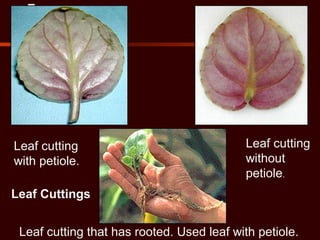
Leaf cuttings
 Consists of a leaf blade or leaf blade
with petiole attached
Leaf cutting
with petiole.
Leaf cutting
without
petiole.
Leaf cutting that has rooted. Used leaf with petiole.
Leaf Cuttings
Leaf-bud cuttings
 Consists of a leaf blade, petiole and a
short piece of stem with the lateral bud
Leaf-bud cutting
Budding
 Budding is a grafting technique in
which a single bud from the desired
scion is used rather than an entire
scion containing many buds.
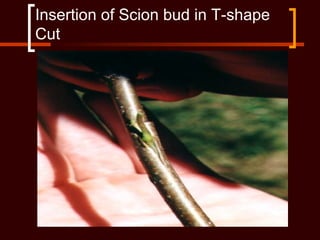
Preparation of Scion Bud
Insertion of Scion bud in T-shape
Cut
Rapping of Inserted bud
Bud sprouting
Pruning of Rootstock
Layering
 Layering is a mean of
plant propagation in which a portion of
an aerial stem grow roots while still
attached to the parent plant and then
detaches as an independent plant
Removing epidermis for
layering.
Air Layering
Packing moss around
area to provide moisture.
Wrap in saran wrap to
keep moisture in.
Removing saran wrap to
see new roots and bud.
New bud with roots.
Layering – taking a branch and placing it
on the soil.
Layering – Simple or mound
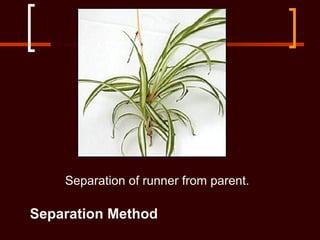
Separation Method
Separation
 Take mature plants that were
stolons or offspring from a parent
plant and separate.
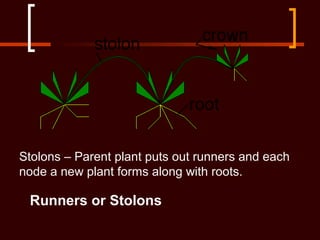
Stolons – Parent plant puts out runners and each
node a new plant forms along with roots.
Runners or Stolons
Separation of runner from parent.
Separation Method
Tissue culture (often called micropropagation) is a
special type of asexual propagation where a very small
piece of tissue (shoot apex, leaf section, or even an
individual cell) is excised (cut-out) and placed in sterile
(aseptic) culture in a test tube, Petri dish or tissue
culture container containing a special culture medium.
Tissue culture
Areas of Tissue Culture Collection
Overview of the Tissue Culture
Process
1.    It can create a large number of clones from a single 
explant.
2.    It is easy to select desirable traits directly from the 
culture setup (in vitro), thereby decreasing the amount of 
space required for field trials.
3.    The time required is much shortened, no need to wait 
for the whole life cycle of seed development.
4.    For species that have long generation time, low levels 
of seed production, or seeds that do not readily germinate, 
rapid propagation is possible.
The advantages of plant tissue culture
5.     It overcomes seasonal restrictions for seed 
germination.
6.    It enables the preservation of pollen and cell 
collections form which plants may be propagated.
7.    It helps to eliminate plant diseases through careful 
stock selection and sterile techniques.
The advantages of plant tissue culture
Grafting is a method of asexual plant propagation 
widely used in agriculture and horticulture where the 
tissues of one plant are encouraged to fuse with those 
of another in such a way so that maximum cambial 
contact takes place.
Grafting 
Rootstock:
That part of a tree which becomes the root system 
of a grafted or budded tree.
Scion:
A piece of last year's growth with three or four buds; 
the part inserted on the understock.
To understand Grafting
Cambium:
The growing part of the tree; located between the 
wood and bark.
Types of Grafting
  Cleft Graft 
  Bark Graft 
  Side-Veneer Graft 
  Splice Graft 
  Whip and Tongue Graft 
  Saddle Graft 
  Bridge Graft 
  Inarch Graft
  Approach Graft
  One of the simplest and most popular forms of grafting, cleft 
grafting  is a method for top working both flowering and fruiting trees 
(apples, cherries, pears, and peaches) in order to change varieties.
Cleft Graft
   The rootstock used for cleft grafting should range from 1 to 4 
inches in diameter and should be straight.
   The scion should be about 1
/4 inch in diameter, straight, and long 
enough to have at least three buds.
Cleft Graft
Bark Graft
 This technique can be applied to rootstock of larger 
diameter (4 to 12 inches).
 
 Cut surface of the rootstock and make a vertical slit 
through the bark where each scion can be inserted (2 
inches long and spaced 1 inch apart).
  Prepare several scions for each graft. Cut the base of 
each scion to a 1 ½- to 2-inch tapered wedge on one side 
only.
 
Bark Graft
Side-Veneer Graft
  Side-veneer grafting is usually done on potted rootstock.
 
  Make a shallow downward cut about 3/4 inch to 1 inch long at 
the base of the stem on the potted rootstock to expose a flap of 
bark with some wood still attached. 
  Make an inward cut at the base so that the flap of bark and wood 
can be removed from the rootstock. 
  Choose a scion with a diameter the same as or slightly smaller 
than the rootstock. Make a sloping cut 3/4 to 1 inch long at the base 
Side-Veneer Graft
Splice Graft
   In splice grafting, both the stock and scion must be of the same 
diameter.
   Cut off the rootstock using a diagonal cut 3/4 to 1 inch long. 
   Make the same type of cut at the base of the scion. Fit the scion 
to the stock. 
  Wrap this junction securely with a rubber grafting strip or twine.
 
Splice Graft
Whip and Tongue Graft
 Both the rootstock and scion should be of equal size and
preferably no more than 1/2 inch in diameter.
 Cut off the stock using a diagonal cut. The cut should be four to
five times longer than the diameter of the stock to be grafted.
 Make the same kind of cut at the base of the scion.
Whip and Tongue Graft
Saddle Graft
 Both rootstock and scion should be the same diameter.
 Stock should not be more than 1 inch in diameter.
 Using two opposing upward strokes of the grafting knife, sever
the top from the rootstock. The resulting cut should resemble an
inverted V, with the surface of the cuts ranging from 1/2 to 1 inch
long.
 Now reverse the technique to prepare the base of the scion
Saddle Graft
Bridge Graft
 Bridge grafting is used to "bridge" a diseased or damaged area
of a plant, usually at or near the base of the trunk.
 Select scions that are straight and about twice as long as the
damaged area to be bridged. Make a 1 1/2- to 2-inch-long tapered
cut on the same plane at each end of the scion.
 Cut a flap in the bark on the rootstock the same width as the
scion and below the injury to be repaired.
Bridge Graft
Inarch Graft
 Inarching, like bridge grafting, is used to bypass or support a
damaged or weakened area of a plant stem.
 Unlike bridge grafting, the scion can be an existing shoot,
sucker, or watersprout that is already growing below and
extending above the injury.
 The scion may also be a shoot of the same species as the
injured plant growing on its own root system next to the main
trunk of the damaged tree.
Inarch Graft
 Approach grafting is a method used to propagate plants in
which one independent plant is fused with another independent
plant. It is usually done when the two plants grow close to each
other.
 At the point where the two plants will join, a 1- 2 inch long slice
of bark is cut on each stem.
 The two stems are bound together, with the cut areas touching,
using any wrapping material.
Approach Graft
Approach Graft
Dwarfing: To induce dwarfing or cold tolerance or other characteristics to
the scion
Ease of propagation: Because the scion is difficult to propagate
vegetatively by other means, such as by cuttings.
Hybrid breeding: To speed maturity of hybrids in fruit tree breeding
programs. Hybrid seedlings may take ten or more years to flower and fruit on
their own roots. Grafting can reduce the time to flowering and shorten the
breeding program.
Hardiness: Because the scion has weak roots or the roots of the stock
plants have roots tolerant of difficult conditions.
Sturdiness: To provide a strong, tall trunk for certain ornamental shrubs
and trees.
Advantages of Grafting
Repair: To repair damage to the trunk of a tree that would prohibit nutrient
flow, such as stripping of the bark by rodents that completely girdles the trunk.
Changing cultivars: To change the cultivar in a fruit orchard to a more
profitable cultivar, called topworking. It may be faster to graft a new cultivar
onto existing limbs of established trees than to replant an entire orchard.
Maintain consistency: Apples are notorious for their genetic variability,
even differing in multiple characteristics, such as, size, color, and flavor, of
fruits located on the same tree.
Pollen source: To provide pollenizers. For example, in tightly planted or
badly planned apple orchards of a single variety, limbs of crab apple may be
grafted at regularly spaced intervals onto trees down rows, say every fourth
tree.
Advantages of Grafting
Plant propagation techniques

Plant propagation techniques