Soil
 Wide range of soil including Deep sandy loam, clay and clay
loam soil
 Very heavy, sandy, alkaline and waterlogged soils not suitable
 Thrive best in sandy loam or loamy soils
 Tolerate pH range of 5.5-8.5
 Soil type correlated to rootstock
 Punjab………………….Rough lemon
 KPK………………………..Sour orange
Propagation
 Asexual methods
 Sexual methods
 Rootstock propagated sexually by seed
 Seeds germination percentage
 Rough lemon 70-80%
 Sour orange 60%
 Seeds sown on seedbed in September or Feb-Mar
 Ready for transplanting after 6-12 months
 1-year after transplanting seedlings are ready to transplant
Grafting and Budding
 Budding and grafting done during active growth period
 Spring or Autumn
 T-Budding
 T-Grafting
Scion
 Mature wood with white streaks
Cutting…………….Sweet lime
Layering…….Kaghzi Lime
Planting system and planting time
 Planting time Spring and autumn
 Spring March-April
 Autumn August-September
 Commonly plated in square system (21 or 18 feet)
 High density citrus plantation (14 feet)
 However rectangle system and hexagonal system also
followed in some area
 No. of plant per acre
Irrigation time
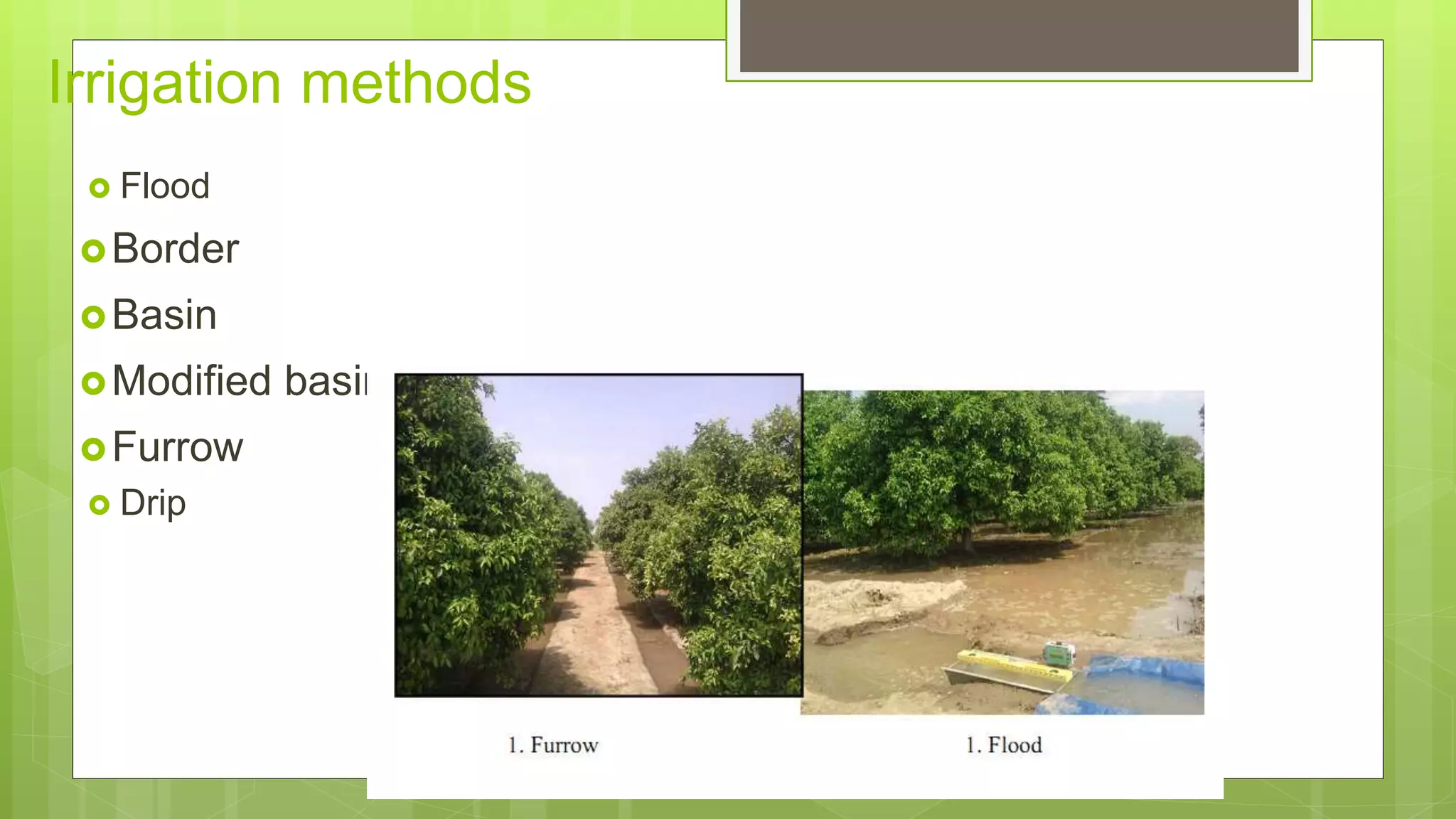
Irrigation methods
 Flood
Border
Basin
Modified basin
Furrow
 Drip
Modified basin system
Drip irrigation
Diseases of citrus
1. Citrus scab
2. Citrus wither-tip / Dieback
3. Citrus greening
4. Citrus canker
Citrus scab (Elsinoë fawcettii)
 Fungal disease
 Spores are dispersed to healthy tissues by water splash
 Infects young shoots, leaves, and fruits
of susceptible cultivars
 The yield and quality of juice can be reduced
in highly susceptible cultivars (sour orange)
 Copper based fungicides
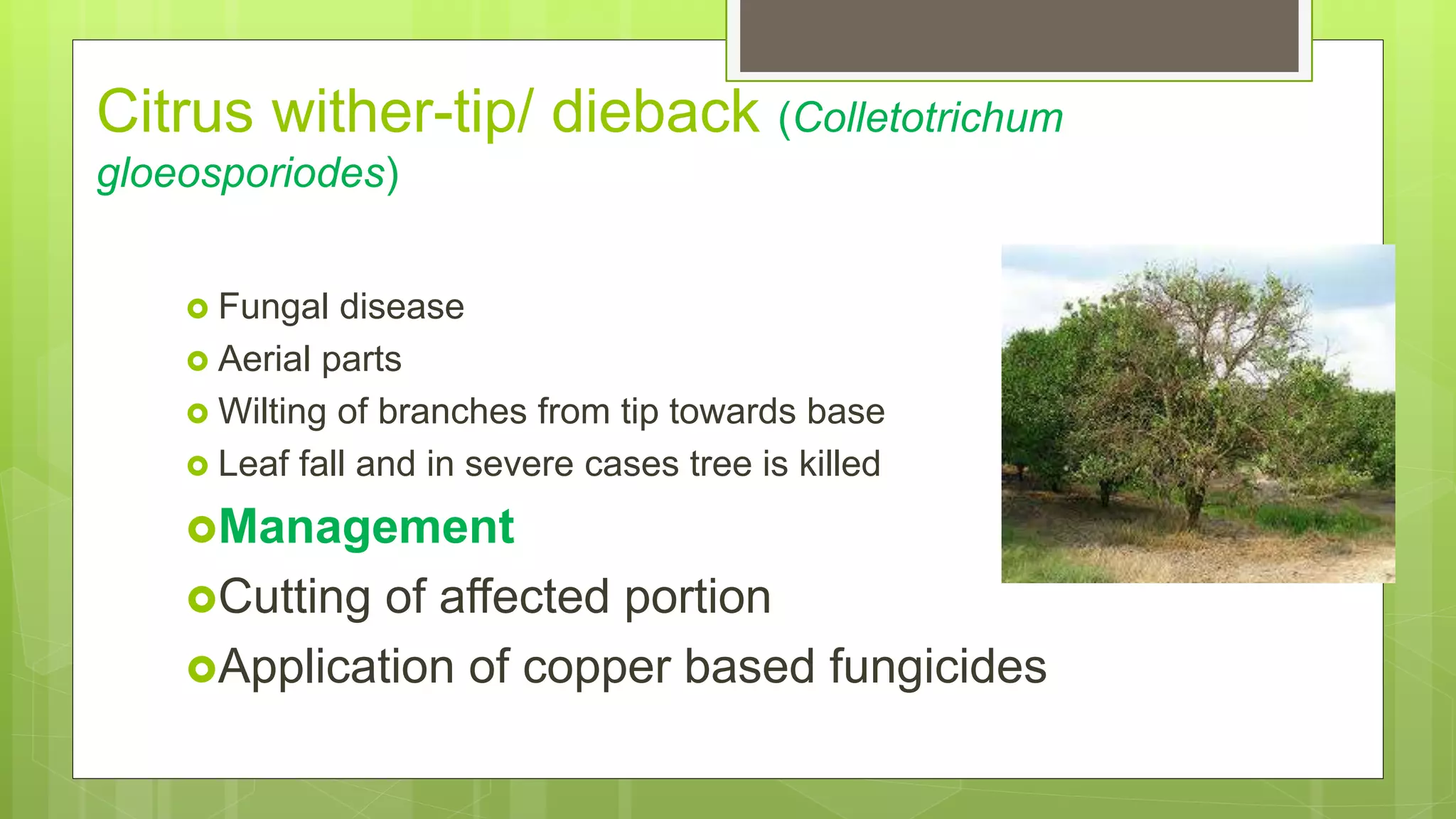
Citrus wither-tip/ dieback (Colletotrichum
gloeosporiodes)
 Fungal disease
 Aerial parts
 Wilting of branches from tip towards base
 Leaf fall and in severe cases tree is killed
Management
Cutting of affected portion
Application of copper based fungicides
Citrus greening (Huanglongbing)
Candidatus Liberibacter africanus
CandidatusLiberibacter asiaticus
Candidatus Liberibacter americanus
 Bacterial disease
 Vector Asian citrus psyllid
 Leaves of newly infected trees develop a
blotchy mottle appearance.
 Control of the disease is based on
planting HLB-free citrus germplasm
 Eradication of infected citrus plants
 Control of the vector with systemic insecticides
Citrus canker (Xanthomonas compestris pv
citri)
 Bacterial disease
 Symptoms appear on leaves, branches and fruit
 Small yellowish spots on leaf
 These spots were turned hard and brown
 Kaghzi lime, grapefruit and lemons are very susceptible
 Management
 Healthy nursery
 Control of insect vector
 Spray of Bordeaux mixture
Chemical control
Physiological problems
 Alternate bearing
 Fruit drop
 Granulation
 Unfruitfulness
Alternate bearing
 Habit of bearing heavy crop in one year and very little or not at
all in the second year
 On-year and Off-year
 Mandarin
 Kinnow, Wilking
 Sweet orange
 Valencia Late, Washington Navel
 Grapefruit
 Marsh seedless
Management
• Improving the C:N ratio
• Heavy manuring during off-year
• Thinning of fruit during on-year
• Delayed and early harvest during off- and on-
year, respectively
Fruit drop
1. Flower drop
2. Pearl drop
3. June or young fruit drop
4. Pre-mature drop
 Management
 Spraying growth regulators
 Gibrellic acid
 2,4-D (2,4- Dichlorophenoxy acetic acid)
 2,4,5-T (2,4,5-Trichlorophenoxy acetic acid
 NAA (Naphthalene acetic acid)
Granulation
 Characterized by enlarged, hardened and dry juice vesicles
 Large fruit are more prune to granulation than smaller fruit
 Delayed harvest also increases the intensity of granulation
 Frequent irrigation also intensify this disorder
 Mosambi, Valencia Late, Washington Navel and Fuetrell’s
Early
 Management
 Spot picking
 Spray of 2,4-D
Unfruitfulness
 Citrus do not produce a commercial crop for many years
 Incompatibility
 Heterostyly
 Ovule abortion
 Hormonal or nutritional imbalance
 Management
 Root pruning
 Ringing of main branches
 Exposure of tree to drought stress or withholding nutrition
• Climatic conditions also
affect the tree physiology
FLOW CHART OF KINNOW
PRE-HARVEST FACTORS
Physiological disorders:
 Potassium deficiency resulting in poor growth.
 Calcium deficiency reduces citrus fruit color.
High temperature stress:
 High temperature stress effect damage to cellular membranes, proteins,
and nucleic acids.
Light intensity:
 Excess solar energy initially results in degradation of the pigmentation in
the affected area.
MATURITY ASSESMENT
 Fruit colour:
Golden orange
 Flesh colour
Pale yellow or whitish
 TSS/acid ratio
8 or higher with yellow-orange color at least on 25% of the fruit
surface
OR
10 or higher and green-yellow color on 25% or greater of the fruit
surface.
Quality Indices
 Color intensity and uniformity
 Firmness, size, shape, smoothness
 freedom from defects including physical damage (abrasions and
bruising), skin blemishes and discoloration, decay, freezing damage,
chilling injury, and insect damage
 Flavor quality is related to soluble solids/acid ratio and absence of
off-flavor-causing compounds including fermentative metabolites.
HARVESTING METHOD
 Fruits are harvested by clipping the
stem with the help of sharp clippers
 The stem is cut as short as possible
to avoid mechanical injury.
PACKING
 Jute bag
 Wooden boxes
 Cardboard boxes
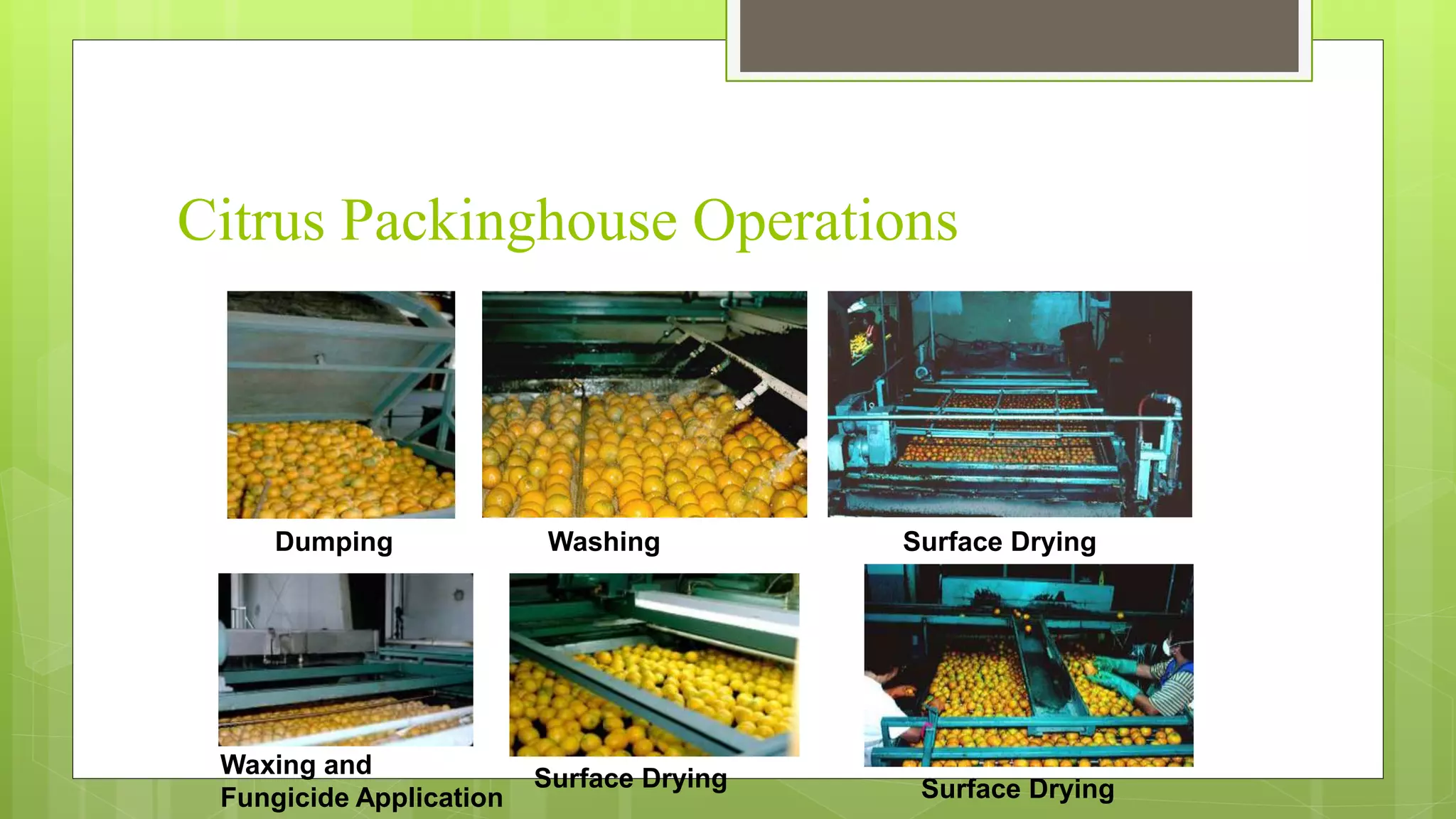
Citrus Packinghouse Operations
Dumping Washing Surface Drying
Waxing and
Fungicide Application
Surface Drying Surface Drying
Citrus Packinghouse Operations
Stamping Individual Fruits Volumetric Sizer Machine Vision (Electronic) Sizer
Sorted Under UV Light to Eliminate Defects Sorting Into Quality Grades Sorting By Quality
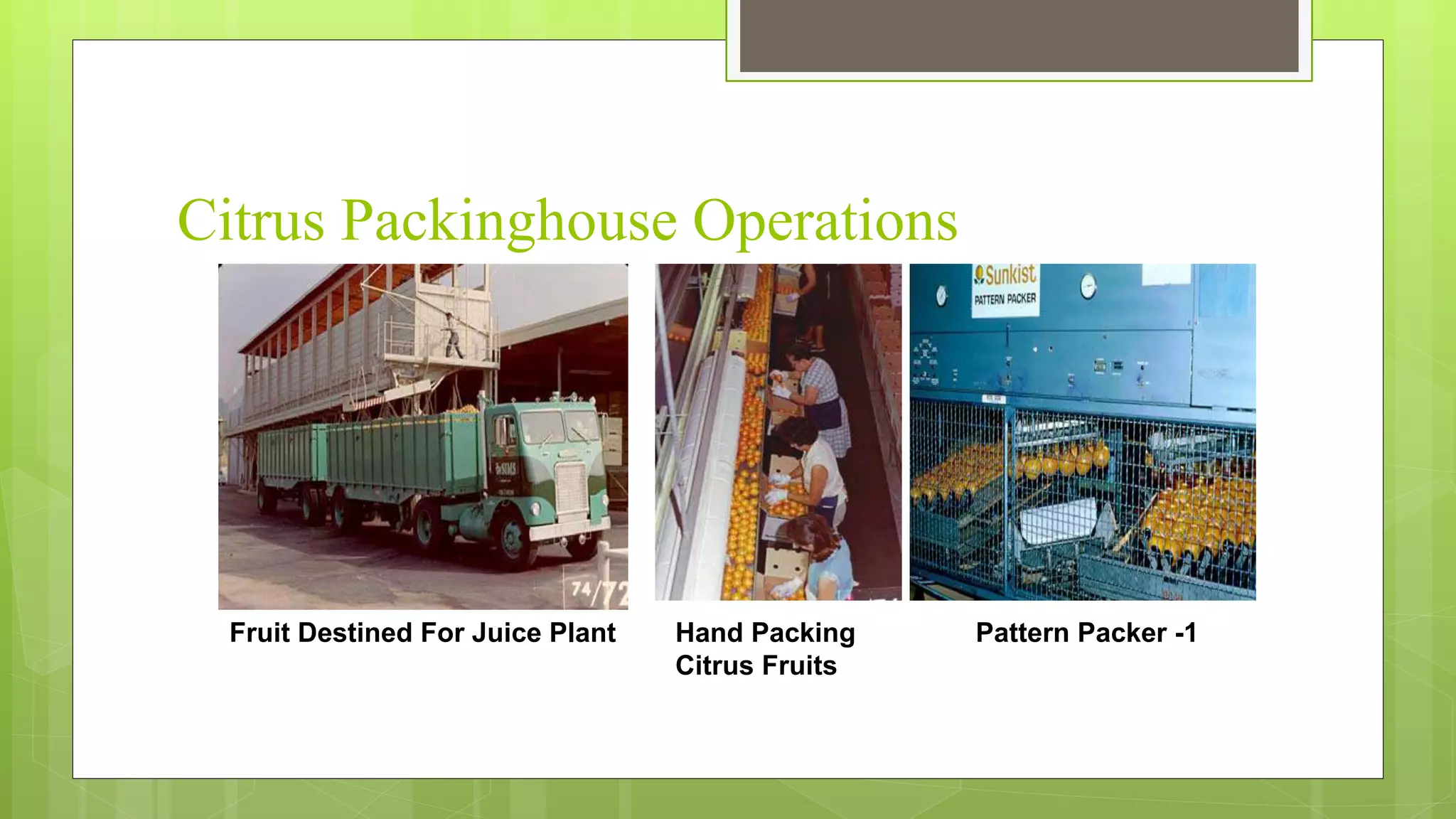
Citrus Packinghouse Operations
Fruit Destined For Juice Plant Hand Packing
Citrus Fruits
Pattern Packer -1
Citrus Packinghouse Operations
Pattern Packer -2 Packing Into Consumer Bags
Citrus Packinghouse Operations
Packed Boxes May Be Slightly Vibrated
to Settle Fruits With the Box
Palletized Boxes In Storage Room
POSTHARVEST HANDLING
Storage Temperature:
 3-8 ° C up to 3 months depending on cultivar, ripeness of the harvest
and production area.
 Optimum relative humidity: 90-95%.
Responses to Controlled Atmospheres (CA)
 5-10% O2 and 0-5% CO2 can be useful for delaying senescence and
for firmness.
 Ethylene production rate: <0.1 mL / kg • hr at 20 ° C.
 The fruit can be stored in cold storage at a temperature of 4-5°C and
a relative humidity of 85-90%.
 Exposure to 1-10ppm ethylene for 1-3 days at 20-30°C (68-86°F)
may be used for degreening oranges
Physiological disorders
 Chilling injury
 Stem-end rind breakdown
 Rind staining.
 Oil spotting (Oleocellosis)
Chilling injury Stem-end rind breakdown
Physiological disorders
Rind staining.Oil spotting (Oleocellosis)
Postharvest diseases
 Green mold
 Blue mold
 Phomopsis stem-end rot
 Stem end rot
 Brown rot
 Sour rot
Green mold Blue mold
Postharvest diseases
Brown rot Phomopsis stem-end rot
Postharvest diseases
Sour rot Stem end rot
Postharvest diseases
Control Strategies
 Minimizing physical damage during harvesting and handling.
 Treatment with postharvest fungicides and/or biological antagonists.
Also, heat treatments may be used.
 Prompt cooling and subsequent maintenance of optimum temperature
and relative humidity throughout marketing operations.
 Removal and/or exclusion of ethylene.
 Effective sanitation procedures throughout postharvest handling.

Production Technology of Citrus

  • 1.
    Soil  Wide rangeof soil including Deep sandy loam, clay and clay loam soil  Very heavy, sandy, alkaline and waterlogged soils not suitable  Thrive best in sandy loam or loamy soils  Tolerate pH range of 5.5-8.5  Soil type correlated to rootstock  Punjab………………….Rough lemon  KPK………………………..Sour orange
  • 2.
    Propagation  Asexual methods Sexual methods  Rootstock propagated sexually by seed  Seeds germination percentage  Rough lemon 70-80%  Sour orange 60%  Seeds sown on seedbed in September or Feb-Mar  Ready for transplanting after 6-12 months  1-year after transplanting seedlings are ready to transplant
  • 3.
    Grafting and Budding Budding and grafting done during active growth period  Spring or Autumn  T-Budding  T-Grafting Scion  Mature wood with white streaks Cutting…………….Sweet lime Layering…….Kaghzi Lime
  • 4.
    Planting system andplanting time  Planting time Spring and autumn  Spring March-April  Autumn August-September  Commonly plated in square system (21 or 18 feet)  High density citrus plantation (14 feet)  However rectangle system and hexagonal system also followed in some area  No. of plant per acre
  • 5.
  • 6.
  • 7.
  • 8.
  • 21.
    Diseases of citrus 1.Citrus scab 2. Citrus wither-tip / Dieback 3. Citrus greening 4. Citrus canker
  • 22.
    Citrus scab (Elsinoëfawcettii)  Fungal disease  Spores are dispersed to healthy tissues by water splash  Infects young shoots, leaves, and fruits of susceptible cultivars  The yield and quality of juice can be reduced in highly susceptible cultivars (sour orange)  Copper based fungicides
  • 23.
    Citrus wither-tip/ dieback(Colletotrichum gloeosporiodes)  Fungal disease  Aerial parts  Wilting of branches from tip towards base  Leaf fall and in severe cases tree is killed Management Cutting of affected portion Application of copper based fungicides
  • 24.
    Citrus greening (Huanglongbing) CandidatusLiberibacter africanus CandidatusLiberibacter asiaticus Candidatus Liberibacter americanus  Bacterial disease  Vector Asian citrus psyllid  Leaves of newly infected trees develop a blotchy mottle appearance.  Control of the disease is based on planting HLB-free citrus germplasm  Eradication of infected citrus plants  Control of the vector with systemic insecticides
  • 25.
    Citrus canker (Xanthomonascompestris pv citri)  Bacterial disease  Symptoms appear on leaves, branches and fruit  Small yellowish spots on leaf  These spots were turned hard and brown  Kaghzi lime, grapefruit and lemons are very susceptible  Management  Healthy nursery  Control of insect vector  Spray of Bordeaux mixture
  • 26.
  • 27.
    Physiological problems  Alternatebearing  Fruit drop  Granulation  Unfruitfulness
  • 28.
    Alternate bearing  Habitof bearing heavy crop in one year and very little or not at all in the second year  On-year and Off-year  Mandarin  Kinnow, Wilking  Sweet orange  Valencia Late, Washington Navel  Grapefruit  Marsh seedless Management • Improving the C:N ratio • Heavy manuring during off-year • Thinning of fruit during on-year • Delayed and early harvest during off- and on- year, respectively
  • 29.
    Fruit drop 1. Flowerdrop 2. Pearl drop 3. June or young fruit drop 4. Pre-mature drop  Management  Spraying growth regulators  Gibrellic acid  2,4-D (2,4- Dichlorophenoxy acetic acid)  2,4,5-T (2,4,5-Trichlorophenoxy acetic acid  NAA (Naphthalene acetic acid)
  • 30.
    Granulation  Characterized byenlarged, hardened and dry juice vesicles  Large fruit are more prune to granulation than smaller fruit  Delayed harvest also increases the intensity of granulation  Frequent irrigation also intensify this disorder  Mosambi, Valencia Late, Washington Navel and Fuetrell’s Early  Management  Spot picking  Spray of 2,4-D
  • 31.
    Unfruitfulness  Citrus donot produce a commercial crop for many years  Incompatibility  Heterostyly  Ovule abortion  Hormonal or nutritional imbalance  Management  Root pruning  Ringing of main branches  Exposure of tree to drought stress or withholding nutrition • Climatic conditions also affect the tree physiology
  • 32.
  • 33.
    PRE-HARVEST FACTORS Physiological disorders: Potassium deficiency resulting in poor growth.  Calcium deficiency reduces citrus fruit color. High temperature stress:  High temperature stress effect damage to cellular membranes, proteins, and nucleic acids. Light intensity:  Excess solar energy initially results in degradation of the pigmentation in the affected area.
  • 34.
    MATURITY ASSESMENT  Fruitcolour: Golden orange  Flesh colour Pale yellow or whitish  TSS/acid ratio 8 or higher with yellow-orange color at least on 25% of the fruit surface OR 10 or higher and green-yellow color on 25% or greater of the fruit surface.
  • 35.
    Quality Indices  Colorintensity and uniformity  Firmness, size, shape, smoothness  freedom from defects including physical damage (abrasions and bruising), skin blemishes and discoloration, decay, freezing damage, chilling injury, and insect damage  Flavor quality is related to soluble solids/acid ratio and absence of off-flavor-causing compounds including fermentative metabolites.
  • 36.
    HARVESTING METHOD  Fruitsare harvested by clipping the stem with the help of sharp clippers  The stem is cut as short as possible to avoid mechanical injury.
  • 37.
    PACKING  Jute bag Wooden boxes  Cardboard boxes
  • 38.
    Citrus Packinghouse Operations DumpingWashing Surface Drying Waxing and Fungicide Application Surface Drying Surface Drying
  • 39.
    Citrus Packinghouse Operations StampingIndividual Fruits Volumetric Sizer Machine Vision (Electronic) Sizer Sorted Under UV Light to Eliminate Defects Sorting Into Quality Grades Sorting By Quality
  • 40.
    Citrus Packinghouse Operations FruitDestined For Juice Plant Hand Packing Citrus Fruits Pattern Packer -1
  • 41.
    Citrus Packinghouse Operations PatternPacker -2 Packing Into Consumer Bags
  • 42.
    Citrus Packinghouse Operations PackedBoxes May Be Slightly Vibrated to Settle Fruits With the Box Palletized Boxes In Storage Room
  • 43.
    POSTHARVEST HANDLING Storage Temperature: 3-8 ° C up to 3 months depending on cultivar, ripeness of the harvest and production area.  Optimum relative humidity: 90-95%. Responses to Controlled Atmospheres (CA)  5-10% O2 and 0-5% CO2 can be useful for delaying senescence and for firmness.  Ethylene production rate: <0.1 mL / kg • hr at 20 ° C.  The fruit can be stored in cold storage at a temperature of 4-5°C and a relative humidity of 85-90%.  Exposure to 1-10ppm ethylene for 1-3 days at 20-30°C (68-86°F) may be used for degreening oranges
  • 44.
    Physiological disorders  Chillinginjury  Stem-end rind breakdown  Rind staining.  Oil spotting (Oleocellosis)
  • 45.
    Chilling injury Stem-endrind breakdown Physiological disorders
  • 46.
  • 47.
    Postharvest diseases  Greenmold  Blue mold  Phomopsis stem-end rot  Stem end rot  Brown rot  Sour rot
  • 48.
    Green mold Bluemold Postharvest diseases
  • 49.
    Brown rot Phomopsisstem-end rot Postharvest diseases
  • 50.
    Sour rot Stemend rot Postharvest diseases
  • 51.
    Control Strategies  Minimizingphysical damage during harvesting and handling.  Treatment with postharvest fungicides and/or biological antagonists. Also, heat treatments may be used.  Prompt cooling and subsequent maintenance of optimum temperature and relative humidity throughout marketing operations.  Removal and/or exclusion of ethylene.  Effective sanitation procedures throughout postharvest handling.