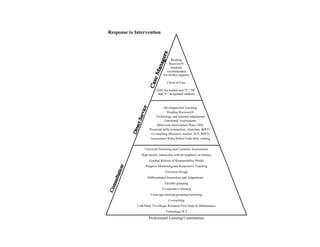
Class	
  Review:	
  	
  Reflec.ons	
  and	
  
             Next	
  Steps	
  
           St.	
  James-­‐Assiniboia	
  
          September	
  21st,	
  2011	
  
                  Faye	
  Brownlie	
  
Care	
  

Collabora.on	
  

  Curiosity	
  
What	
  worked?	
  

What	
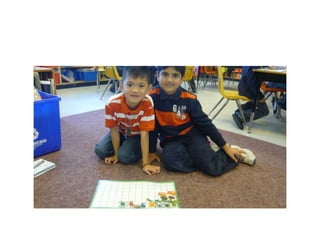
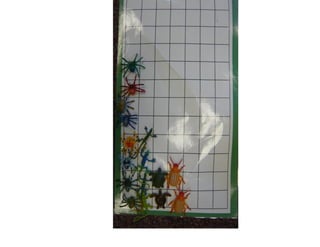
  do	
  we	
  wonder?	
  

     What’s	
  next?	
  
Standard	
  Reading	
  Assessment	
  Ques.ons	
  
 Student	
  Diversity	
  –	
  Brownlie,	
  Feniak,	
  Schnellert,	
  
                                2006	
  

•  Connec.ons:	
  	
  How	
  does	
  what	
  you	
  read	
  connect	
  with	
  what	
  
   you	
  know?	
  
•  Summarizing:	
  	
  Choose	
  a	
  way	
  to	
  show	
  the	
  main	
  ideas	
  and	
  
   details	
  of	
  this	
  text.	
  
•  Vocabulary:	
  	
  Here	
  are	
  2	
  challenging	
  words	
  ________	
  	
  What	
  
   do	
  they	
  mean?	
  	
  What	
  strategies	
  did	
  you	
  use	
  to	
  determine	
  
   their	
  meaning?	
  
•  Inferring:	
  	
  Read	
  between	
  the	
  lines	
  to	
  find	
  something	
  that	
  
   you	
  believe	
  to	
  be	
  true	
  but	
  that	
  it	
  not	
  actually	
  said.	
  	
  What	
  is	
  
   your	
  evidence	
  that	
  it	
  is	
  true?	
  
•  Reflec.on:	
  	
  What	
  this	
  easy	
  or	
  hard?	
  	
  Why?	
  
Early	
  Years	
  –	
  Belonging,	
  Respect,	
  
         Understanding	
  Differences	
  
•  Lile	
  Beauty	
  –	
  Anthony	
  Browne	
  
•  Stellaluna	
  –	
  Janell	
  Cannon	
  
•  Scaredy	
  Squirrel	
  –	
  Melanie	
  Wa	
  
•  Hunter’s	
  Best	
  Friend	
  at	
  School	
  –	
  Laura	
  Malone	
  
   Ellio	
  
•  Wemberley	
  Worried	
  –	
  Kevin	
  Henkes	
  
•  How	
  Full	
  Is	
  Your	
  Bucket?	
  For	
  Kids	
  –	
  Rath	
  &	
  
   Reckmeyer	
  
•  What’s	
  Next	
  for	
  This	
  Beginning	
  Writer?	
  	
  
–	
  Reid,	
  Schultz,	
  Peterson	
  2005	
  	
  (Pembroke	
  Pub)	
  
•  sd72.bc.ca	


  (Campbell	
  River	
  SD)	
  

•  Literacy	
  videos	
  

•  It’s	
  all	
  in	
  the	
  bag	
  
•  Squiggles	
  
•  Clustering	
  from	
  text	
  
•  Grade	
  5	
  Canadian	
  History	
  –	
  	
  
    –  Orca	
  Books	
  
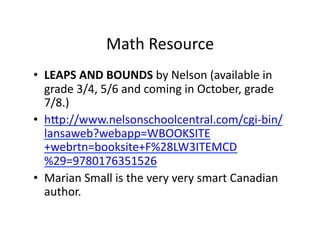
Math	
  Resource	
  
•  LEAPS	
  AND	
  BOUNDS	
  by	
  Nelson	
  (available	
  in	
  
   grade	
  3/4,	
  5/6	
  and	
  coming	
  in	
  October,	
  grade	
  
   7/8.)	
  
•  hp://www.nelsonschoolcentral.com/cgi-­‐bin/
   lansaweb?webapp=WBOOKSITE
   +webrtn=booksite+F%28LW3ITEMCD
   %29=9780176351526	
  
•  Marian	
  Small	
  is	
  the	
  very	
  very	
  smart	
  Canadian	
  
   author.	
  
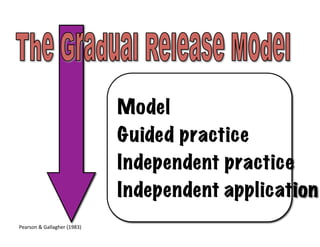
Model
                                          Guided practice
                                          Independent practice
                                          Independent application	
  
Pearson	
  &	
  Gallagher	
  (1983)	
  
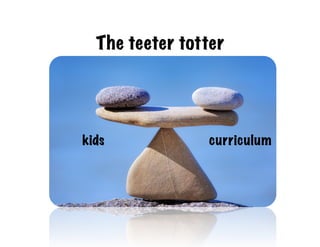
The teeter totter


  kids                curriculum


kids
Universal Design for Learning
Mul.ple	
  means:	
  
-­‐to	
  tap	
  into	
  background	
  knowledge,	
  to	
  ac.vate	
  
        prior	
  knowledge,	
  to	
  increase	
  engagement	
  and	
  
        mo.va.on	
  
-­‐to	
  acquire	
  the	
  informa.on	
  and	
  knowledge	
  to	
  
        process	
  new	
  ideas	
  and	
  informa.on	
  
-­‐to	
  express	
  what	
  they	
  know.	


  Rose	
  &	
  Meyer,	
  2002	
  
Backwards Design
•  What	
  important	
  ideas	
  and	
  enduring	
  
   understandings	
  do	
  you	
  want	
  the	
  students	
  to	
  
   know?	
  

•  What	
  thinking	
  strategies	
  will	
  students	
  need	
  to	
  
   demonstrate	
  these	
  understandings?	


  McTighe	
  &	
  Wiggins,	
  2001	
  
Co-­‐Teaching	
  
•  Begin	
  with	
  a	
  plan	
  
•  Know	
  your	
  purpose,	
  know	
  your	
  roles	
  

-­‐1	
  teacher	
  takes	
  the	
  strategic	
  lead,	
  the	
  other	
  
     provides	
  support	
  
-­‐working	
  with	
  different	
  groups	
  
-­‐both	
  teachers	
  providing	
  support/extension	
  in	
  
     small	
  group	
  work	
  
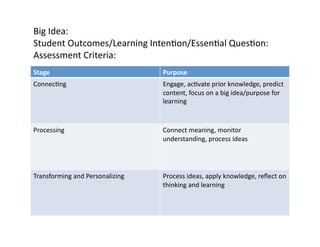
Big	
  Idea:	
  
Student	
  Outcomes/Learning	
  Inten.on/Essen.al	
  Ques.on:	
  
Assessment	
  Criteria:	
  
Stage	
                                    Purpose	
  
Connec.ng	
                                Engage,	
  ac.vate	
  prior	
  knowledge,	
  predict	
  
                                           content,	
  focus	
  on	
  a	
  big	
  idea/purpose	
  for	
  
                                           learning	


Processing	
                               Connect	
  meaning,	
  monitor	
  
                                           understanding,	
  process	
  ideas	


Transforming	
  and	
  Personalizing	
     Process	
  ideas,	
  apply	
  knowledge,	
  reflect	
  on	
  
                                           thinking	
  and	
  learning	
  
Math	
  Centres	
  –	
  gr.	
  1/2	
  
                 Michelle	
  Hikada	
  
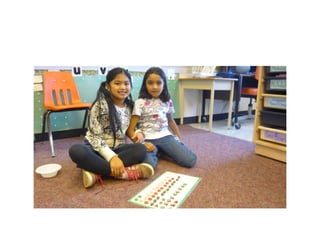
•  4	
  groups	
  
•  1	
  with	
  Michelle,	
  working	
  on	
  graphing	
  (direct	
  
   teaching,	
  new	
  material)	
  
•  1	
  making	
  paerns	
  with	
  different	
  materials	
  
   (prac.ce)	
  
•  1	
  making	
  paerns	
  with	
  s.ckers	
  (prac.ce)	
  
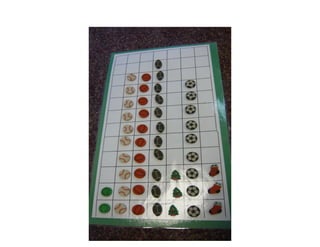
•  1	
  graphing	
  in	
  partners	
  (prac.ce)	
  
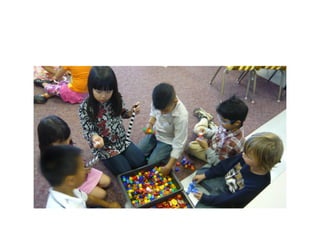
•  With	
  your	
  partner,	
  choose	
  a	
  bucket	
  of	
  
   materials	
  and	
  make	
  a	
  bar	
  graph.	
  
•  Ask	
  (and	
  answer)	
  at	
  least	
  3	
  ques.ons	
  about	
  
   your	
  graph.	
  
•  Make	
  another	
  graph	
  with	
  a	
  different	
  material.	
  
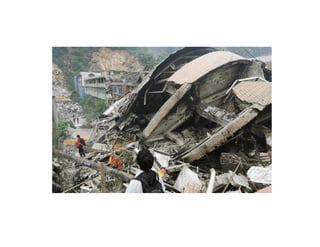
Ques.oning	
  	
  
Goal:	
  	
  crea.ng	
  real	
  ques.ons,	
  using	
  ques.ons	
  to	
  
        link	
  background	
  knowledge	
  with	
  new	
  
                informa.on,	
  create	
  curiosity	
  

•  Present	
  an	
  image	
  
•  Aqer	
  each	
  image,	
  ask	
  students	
  to	
  pose	
  
   ques.ons	
  about	
  the	
  image	
  and	
  to	
  resist	
  the	
  
   urge	
  to	
  answer	
  someone	
  else’s	
  ques.on	
  
•  Repeat	
  with	
  3-­‐4	
  images	
  
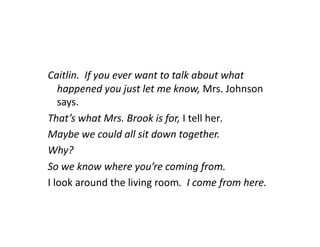
Caitlin.	
  	
  If	
  you	
  ever	
  want	
  to	
  talk	
  about	
  what	
  
      happened	
  you	
  just	
  let	
  me	
  know,	
  Mrs.	
  Johnson	
  
      says.	
  
That’s	
  what	
  Mrs.	
  Brook	
  is	
  for,	
  I	
  tell	
  her.	
  
Maybe	
  we	
  could	
  all	
  sit	
  down	
  together.	
  
Why?	
  
So	
  we	
  know	
  where	
  you’re	
  coming	
  from.	
  	
  
I	
  look	
  around	
  the	
  living	
  room.	
  	
  I	
  come	
  from	
  here.	
  
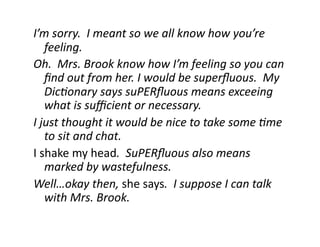
I’m	
  sorry.	
  	
  I	
  meant	
  so	
  we	
  all	
  know	
  how	
  you’re	
  
      feeling.	
  
Oh.	
  	
  Mrs.	
  Brook	
  know	
  how	
  I’m	
  feeling	
  so	
  you	
  can	
  
      find	
  out	
  from	
  her.	
  I	
  would	
  be	
  superfluous.	
  	
  My	
  
      DicJonary	
  says	
  suPERfluous	
  means	
  exceeing	
  
      what	
  is	
  sufficient	
  or	
  necessary.	
  
I	
  just	
  thought	
  it	
  would	
  be	
  nice	
  to	
  take	
  some	
  Jme	
  
      to	
  sit	
  and	
  chat.	
  
I	
  shake	
  my	
  head.	
  	
  SuPERfluous	
  also	
  means	
  
      marked	
  by	
  wastefulness.	
  
Well…okay	
  then,	
  she	
  says.	
  	
  I	
  suppose	
  I	
  can	
  talk	
  
      with	
  Mrs.	
  Brook.	
  
Resources	
  	
  
•  Grand	
  ConversaJons,	
  ThoughQul	
  Responses	
  –	
  a	
  unique	
  
   approach	
  to	
  literature	
  circles	
  –	
  Brownlie,	
  2005	
  
•  Student	
  Diversity,	
  2nd	
  ed.	
  –	
  Brownlie,	
  Feniak	
  &	
  Schnellert,	
  
   2006	
  
•  Reading	
  and	
  Responding,	
  gr.	
  4,5,&6	
  –	
  Brownlie	
  &	
  Jeroski,	
  
   2006	
  
•  It’s	
  All	
  about	
  Thinking	
  –	
  collaboraJng	
  to	
  support	
  all	
  learners	
  
   (in	
  English,	
  Social	
  Studies	
  and	
  HumaniJes)	
  –	
  Brownlie	
  &	
  
   Schnellert,	
  2009	
  
•  It’s	
  All	
  about	
  Thinking	
  –	
  collaboraJng	
  to	
  support	
  all	
  learners	
  
   (in	
  Math	
  and	
  Science)	
  -­‐	
  Brownlie,	
  Fullerton	
  &	
  Schnellert,	
  2011	
  
•  Learning	
  in	
  Safe	
  Schools,	
  2nd	
  ed	
  –	
  Brownlie	
  &	
  King,	
  Oct.,	
  2011	
  
•  Assessment	
  &	
  InstrucJon	
  of	
  ESL	
  Learners,	
  2nd	
  ed	
  –	
  Brownlie,	
  
   Feniak,	
  &	
  McCarthy,	
  in	
  press	
  

Class reviews.st.james.assiniboia

  • 1.
    Class  Review:    Reflec.ons  and   Next  Steps   St.  James-­‐Assiniboia   September  21st,  2011   Faye  Brownlie  
  • 2.
  • 3.
    What  worked?   What  do  we  wonder?   What’s  next?  
  • 6.
    Standard  Reading  Assessment  Ques.ons   Student  Diversity  –  Brownlie,  Feniak,  Schnellert,   2006   •  Connec.ons:    How  does  what  you  read  connect  with  what   you  know?   •  Summarizing:    Choose  a  way  to  show  the  main  ideas  and   details  of  this  text.   •  Vocabulary:    Here  are  2  challenging  words  ________    What   do  they  mean?    What  strategies  did  you  use  to  determine   their  meaning?   •  Inferring:    Read  between  the  lines  to  find  something  that   you  believe  to  be  true  but  that  it  not  actually  said.    What  is   your  evidence  that  it  is  true?   •  Reflec.on:    What  this  easy  or  hard?    Why?  
  • 7.
    Early  Years  –  Belonging,  Respect,   Understanding  Differences   •  Lile  Beauty  –  Anthony  Browne   •  Stellaluna  –  Janell  Cannon   •  Scaredy  Squirrel  –  Melanie  Wa   •  Hunter’s  Best  Friend  at  School  –  Laura  Malone   Ellio   •  Wemberley  Worried  –  Kevin  Henkes   •  How  Full  Is  Your  Bucket?  For  Kids  –  Rath  &   Reckmeyer  
  • 8.
    •  What’s  Next  for  This  Beginning  Writer?     –  Reid,  Schultz,  Peterson  2005    (Pembroke  Pub)  
  • 9.
    •  sd72.bc.ca            (Campbell  River  SD)   •  Literacy  videos   •  It’s  all  in  the  bag   •  Squiggles   •  Clustering  from  text  
  • 10.
    •  Grade  5  Canadian  History  –     –  Orca  Books  
  • 11.
    Math  Resource   • LEAPS  AND  BOUNDS  by  Nelson  (available  in   grade  3/4,  5/6  and  coming  in  October,  grade   7/8.)   •  hp://www.nelsonschoolcentral.com/cgi-­‐bin/ lansaweb?webapp=WBOOKSITE +webrtn=booksite+F%28LW3ITEMCD %29=9780176351526   •  Marian  Small  is  the  very  very  smart  Canadian   author.  
  • 12.
    Model Guided practice Independent practice Independent application   Pearson  &  Gallagher  (1983)  
  • 13.
    The teeter totter kids curriculum kids
  • 14.
    Universal Design forLearning Mul.ple  means:   -­‐to  tap  into  background  knowledge,  to  ac.vate   prior  knowledge,  to  increase  engagement  and   mo.va.on   -­‐to  acquire  the  informa.on  and  knowledge  to   process  new  ideas  and  informa.on   -­‐to  express  what  they  know.                        Rose  &  Meyer,  2002  
  • 15.
    Backwards Design •  What  important  ideas  and  enduring   understandings  do  you  want  the  students  to   know?   •  What  thinking  strategies  will  students  need  to   demonstrate  these  understandings?                      McTighe  &  Wiggins,  2001  
  • 16.
    Co-­‐Teaching   •  Begin  with  a  plan   •  Know  your  purpose,  know  your  roles   -­‐1  teacher  takes  the  strategic  lead,  the  other   provides  support   -­‐working  with  different  groups   -­‐both  teachers  providing  support/extension  in   small  group  work  
  • 17.
    Big  Idea:   Student  Outcomes/Learning  Inten.on/Essen.al  Ques.on:   Assessment  Criteria:   Stage   Purpose   Connec.ng   Engage,  ac.vate  prior  knowledge,  predict   content,  focus  on  a  big  idea/purpose  for   learning   Processing   Connect  meaning,  monitor   understanding,  process  ideas   Transforming  and  Personalizing   Process  ideas,  apply  knowledge,  reflect  on   thinking  and  learning  
  • 18.
    Math  Centres  –  gr.  1/2   Michelle  Hikada   •  4  groups   •  1  with  Michelle,  working  on  graphing  (direct   teaching,  new  material)   •  1  making  paerns  with  different  materials   (prac.ce)   •  1  making  paerns  with  s.ckers  (prac.ce)   •  1  graphing  in  partners  (prac.ce)  
  • 19.
    •  With  your  partner,  choose  a  bucket  of   materials  and  make  a  bar  graph.   •  Ask  (and  answer)  at  least  3  ques.ons  about   your  graph.   •  Make  another  graph  with  a  different  material.  
  • 25.
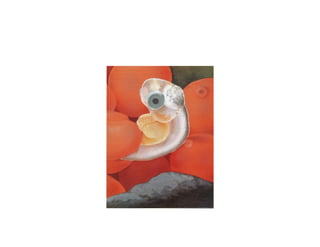
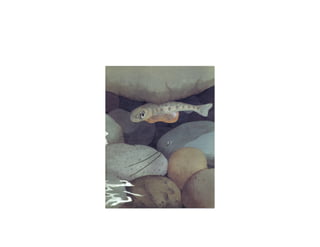
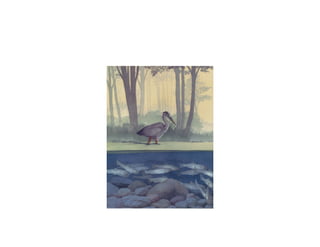
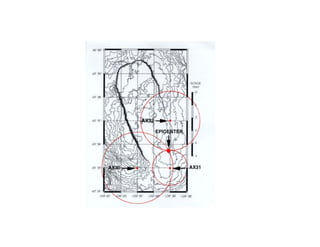
    Ques.oning     Goal:    crea.ng  real  ques.ons,  using  ques.ons  to   link  background  knowledge  with  new   informa.on,  create  curiosity   •  Present  an  image   •  Aqer  each  image,  ask  students  to  pose   ques.ons  about  the  image  and  to  resist  the   urge  to  answer  someone  else’s  ques.on   •  Repeat  with  3-­‐4  images  
  • 32.
    Caitlin.    If  you  ever  want  to  talk  about  what   happened  you  just  let  me  know,  Mrs.  Johnson   says.   That’s  what  Mrs.  Brook  is  for,  I  tell  her.   Maybe  we  could  all  sit  down  together.   Why?   So  we  know  where  you’re  coming  from.     I  look  around  the  living  room.    I  come  from  here.  
  • 33.
    I’m  sorry.    I  meant  so  we  all  know  how  you’re   feeling.   Oh.    Mrs.  Brook  know  how  I’m  feeling  so  you  can   find  out  from  her.  I  would  be  superfluous.    My   DicJonary  says  suPERfluous  means  exceeing   what  is  sufficient  or  necessary.   I  just  thought  it  would  be  nice  to  take  some  Jme   to  sit  and  chat.   I  shake  my  head.    SuPERfluous  also  means   marked  by  wastefulness.   Well…okay  then,  she  says.    I  suppose  I  can  talk   with  Mrs.  Brook.  
  • 34.
    Resources     • Grand  ConversaJons,  ThoughQul  Responses  –  a  unique   approach  to  literature  circles  –  Brownlie,  2005   •  Student  Diversity,  2nd  ed.  –  Brownlie,  Feniak  &  Schnellert,   2006   •  Reading  and  Responding,  gr.  4,5,&6  –  Brownlie  &  Jeroski,   2006   •  It’s  All  about  Thinking  –  collaboraJng  to  support  all  learners   (in  English,  Social  Studies  and  HumaniJes)  –  Brownlie  &   Schnellert,  2009   •  It’s  All  about  Thinking  –  collaboraJng  to  support  all  learners   (in  Math  and  Science)  -­‐  Brownlie,  Fullerton  &  Schnellert,  2011   •  Learning  in  Safe  Schools,  2nd  ed  –  Brownlie  &  King,  Oct.,  2011   •  Assessment  &  InstrucJon  of  ESL  Learners,  2nd  ed  –  Brownlie,   Feniak,  &  McCarthy,  in  press