PYP INDUCTION
American International School Dhaka
      August-December 2010
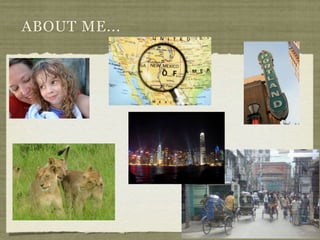
ABOUT ME...
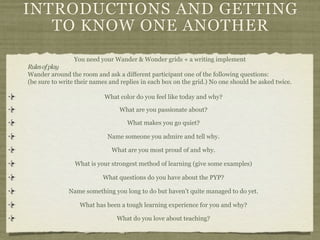
INTRODUCTIONS AND GETTING
   TO KNOW ONE ANOTHER
                 You need your Wander & Wonder grids + a writing implement
Rules of play
Wander around the room and ask a different participant one of the following questions:
(be sure to write their names and replies in each box on the grid.) No one should be asked twice.

                            What color do you feel like today and why?

                                 What are you passionate about?

                                    What makes you go quiet?

                             Name someone you admire and tell why.

                              What are you most proud of and why.

                 What is your strongest method of learning (give some examples)

                           What questions do you have about the PYP?

               Name something you long to do but haven’t quite managed to do yet.

                   What has been a tough learning experience for you and why?

                                What do you love about teaching?
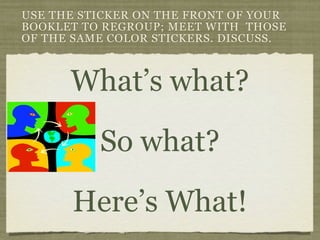
USE THE STICKER ON THE FRONT OF YOUR
BOOKLET TO REGROUP; MEET WITH THOSE
OF THE SAME COLOR STICKERS. DISCUSS.


      What’s what?

          So what?

      Here’s What!
ESSENTIAL AGREEMENTS


    Respect       Reflection

 Responsibility   Curiosity

 Cooperation      Creativity
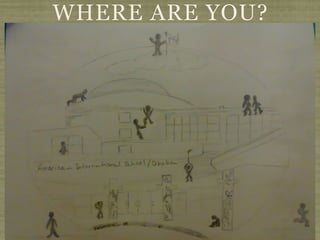
WHERE ARE YOU?
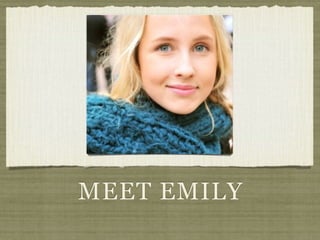
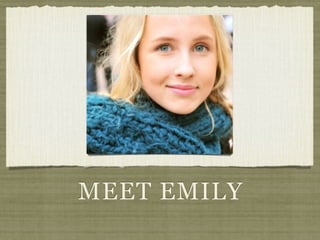
MEET EMILY
THE IDEAL LEARNER
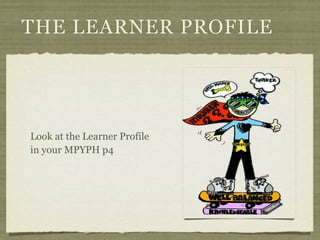
THE LEARNER PROFILE


Look at the Learner Profile
in your MPYPH p4
SESSION 2 -            IBPYP AND AISD
                    CONT’D
  Be sure to grab a number tag and sit at that table
The
Learner
Profile in
action at
  AISD
ACTIVE LEARNER PROFILE

Brainstorm ways you can think to use or
  integrate learning about the learner
      profile into your classroom.

         Share in your group.
TEACHER’S
 TOOLBOX
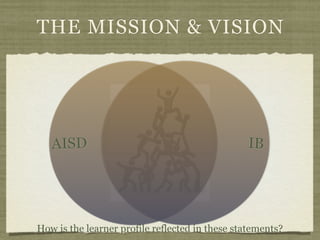
THE MISSION & VISION


   AISD                                         IB


How is the learner profile reflected in these statements?
IB Standards
 & Practices
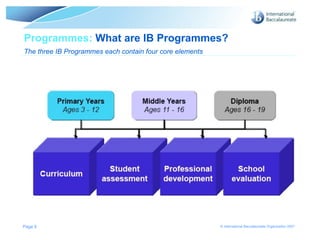
Programmes: What are IB Programmes?
The three IB Programmes each contain four core elements


Page 6                                                    © International Baccalaureate Organization 2007
Definition: How is the PYP defined?

 The IB Primary Years Programme, for students aged 3 to 12
  focuses on the development of the whole child as an inquirer, both
  in the classroom and in the world outside. It is a framework guided
  by six transdisciplinary themes of global significance, explored
  using knowledge and skills derived from six subjects areas, as well
  as transdisciplinary skills, with a powerful emphasis on inquiry-
  based learning.


                                                   © International Baccalaureate Organization 2007
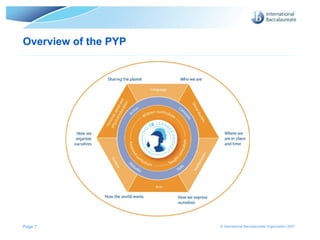
Overview of the PYP


Page 7                © International Baccalaureate Organization 2007
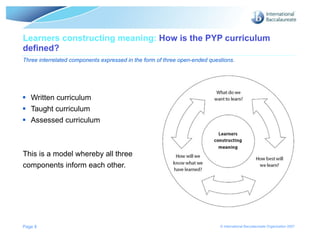
Learners constructing meaning: How is the PYP curriculum
defined?
Three interrelated components expressed in the form of three open-ended questions.


 Written curriculum
 Taught curriculum
 Assessed curriculum


This is a model whereby all three
components inform each other.


Page 8                                                                      © International Baccalaureate Organization 2007
WHAT IS CURRICULUM?
PYP defines curriculum as ‘broad and inclusive’
  – The Written Curriculum – commitment to continuous
    school improvement

  – The Taught Curriculum – equal emphasis to
    methodology

  – The Learned Curriculum – assesses the actual
    learning and reminds us of our original purpose


  The PYP definition of curriculum includes all three
                     components
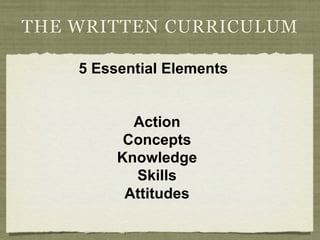
THE WRITTEN CURRICULUM

    5 Essential Elements


         Knowledge
          Concepts
           Skills
          Attitudes
           Action
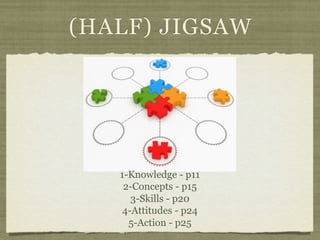
(HALF) JIGSAW


   1-Knowledge - p11
    2-Concepts - p15
      3-Skills - p20
    4-Attitudes - p24
     5-Action - p25
10:00 am
SESSION 3 -         INQUIRY &
            ASSESSMENT
Please sit in grade level or single subject groups
Assessment
 at AISD
1:00 pm
SESSION 4 -
  COLLABORATIVE PLANNING
Please regroup using the colored dots on your workshop
             booklets. (Red, Yellow, Blue)
Who will I be working with?

 Collaborative planning at
          AISD
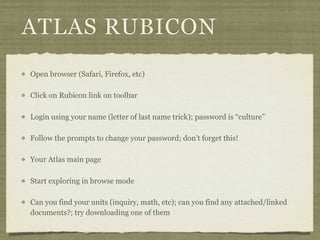
ATLAS RUBICON
Open browser (Safari, Firefox, etc)

Click on Rubicon link on toolbar

Login using your name (letter of last name trick); password is “culture”

Follow the prompts to change your password; don’t forget this!

Your Atlas main page

Start exploring in browse mode

Can you find your units (inquiry, math, etc); can you find any attached/linked
documents?; try downloading one of them
TEACHER’S
 TOOLBOX
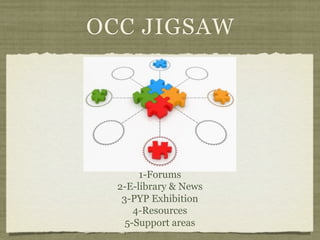
OCC JIGSAW


       1-Forums
  2-E-library & News
   3-PYP Exhibition
      4-Resources
    5-Support areas
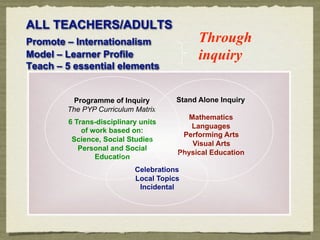
ALL TEACHERS/ADULTS
Promote – Internationalism                  Through
Model – Learner Profile                     inquiry
Teach – 5 essential elements


         Programme of Inquiry         Stand Alone Inquiry
        The PYP Curriculum Matrix
                                        Mathematics
        6 Trans-disciplinary units
                                         Languages
            of work based on:
                                       Performing Arts
         Science, Social Studies
                                         Visual Arts
           Personal and Social
                                      Physical Education
                Education
                           Celebrations
                           Local Topics
                            Incidental
SESSION 5 -       IB’S ONLINE
        CURRICULUM CENTER
Please sit in your ‘expert’ group: Forums, E-library/News,
           Exhibition, Resources, Support Areas
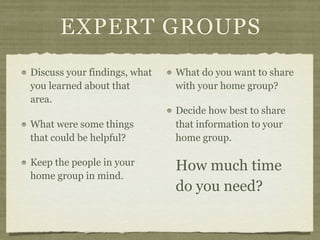
EXPERT GROUPS
Discuss your findings, what   What do you want to share
you learned about that        with your home group?
area.
                              Decide how best to share
What were some things         that information to your
that could be helpful?        home group.

Keep the people in your       How much time
home group in mind.
                              do you need?
SHARING WHAT WE
     LEARNED
Return to your home group

Take turns round the table to share the
area you explored on the OCC

Take notes on each section as your
group mates share what they learning;
something you could refer back to.
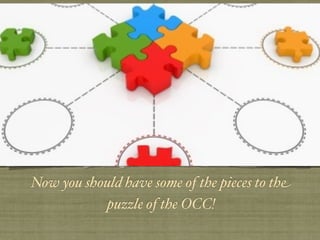
Now you should have some of the pieces to the
           puzzle of the OCC!
SESSION 6 INQUIRY
   Sit anywhere you like...
Donut
Discussion
Article reflections
The IB
perspective on
   inquiry


Read pp 28-30
 and pp 41-43
MPYPH for next
   session
Enj
Eid Mubarak       oy
              ho you
                lida r
                     y!
SESSION 7 INQUIRY
   Sit anywhere you like...
MODELS OF INQUIRY


Direct the inquiry

Help justify learning tasks

Build on experiences

Makes sense of learning to reach understandings
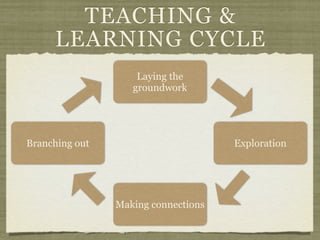
TEACHING &
     LEARNING CYCLE
                    Laying the
                   groundwork


Branching out                        Exploration


                Making connections
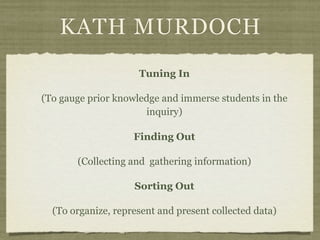
KATH MURDOCH
                     Tuning In

(To gauge prior knowledge and immerse students in the
                      inquiry)

                    Finding Out

       (Collecting and gathering information)

                    Sorting Out

  (To organize, represent and present collected data)
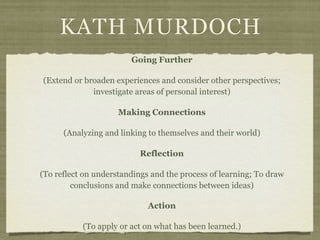
KATH MURDOCH
                        Going Further

(Extend or broaden experiences and consider other perspectives;
             investigate areas of personal interest)

                     Making Connections

      (Analyzing and linking to themselves and their world)

                           Reflection

(To reflect on understandings and the process of learning; To draw
         conclusions and make connections between ideas)

                             Action

           (To apply or act on what has been learned.)
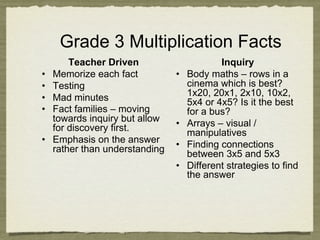
Grade 3 Multiplication Facts
         Teacher Driven                       Inquiry
•    Memorize each fact          •    Body maths – rows in a
•    Testing                          cinema which is best?
•    Mad minutes                      1x20, 20x1, 2x10, 10x2,
                                      5x4 or 4x5? Is it the best
•    Fact families – moving           for a bus?
     towards inquiry but allow   •    Arrays – visual /
     for discovery first.             manipulatives
•    Emphasis on the answer      •    Finding connections
     rather than understanding
                                      between 3x5 and 5x3
                                 •    Different strategies to find
                                      the answer
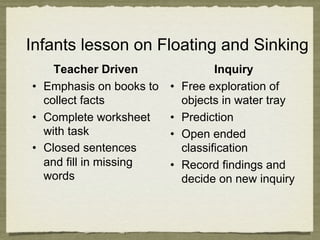
Infants lesson on Floating and Sinking
     Teacher Driven                   Inquiry
•  Emphasis on books to   •    Free exploration of
   collect facts               objects in water tray
•  Complete worksheet     •    Prediction
   with task              •    Open ended
•  Closed sentences            classification
   and fill in missing    •    Record findings and
   words                       decide on new inquiry
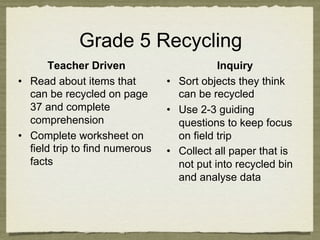
Grade 5 Recycling
        Teacher Driven                       Inquiry
•  Read about items that         •  Sort objects they think
   can be recycled on page          can be recycled
   37 and complete               •  Use 2-3 guiding
   comprehension                    questions to keep focus
•  Complete worksheet on            on field trip
   field trip to find numerous   •  Collect all paper that is
   facts                            not put into recycled bin
                                    and analyse data
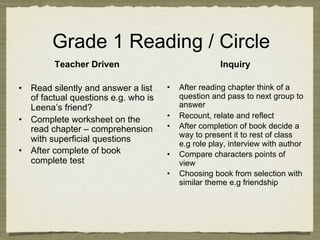
Grade 1 Reading / Circle
         Teacher Driven                               Inquiry

•  Read silently and answer a list    •    After reading chapter think of a
   of factual questions e.g. who is        question and pass to next group to
   Leena’s friend?                         answer
                                      •    Recount, relate and reflect
•  Complete worksheet on the
   read chapter – comprehension       •    After completion of book decide a
                                           way to present it to rest of class
   with superficial questions
                                           e.g role play, interview with author
•  After complete of book             •    Compare characters points of
   complete test                           view
                                      •    Choosing book from selection with
                                           similar theme e.g friendship
6 o’clock partners
SESSION 8 -
INTERNATIONAL MINDEDNESS
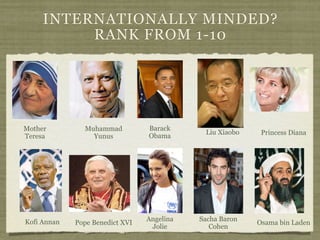
INTERNATIONALLY MINDED?
          RANK FROM 1-10


Mother         Muhammad          Barack
                                             Liu Xiaobo    Princess Diana
Teresa           Yunus           Obama


Kofi Annan                       Angelina   Sacha Baron
             Pope Benedict XVI                            Osama bin Laden
                                  Jolie        Cohen
BEYOND FOOD,
FESTIVALS AND FLAGS
How internationally minded is AISD?


How aware are our students locally?


How aware are they globally?
MEET THE WORLD
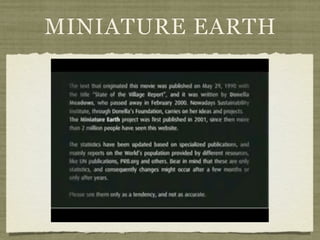
MINIATURE EARTH
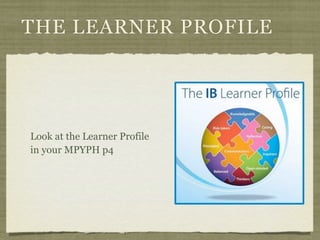
THE LEARNER PROFILE


Look at the Learner Profile
in your MPYPH p4
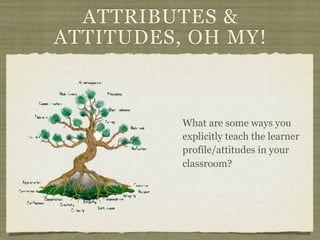
ATTRIBUTES &
ATTITUDES, OH MY!


          What are some ways you
          explicitly teach the learner
          profile/attitudes in your
          classroom?
SESSION 9 -  CONCEPTUALLY
   DRIVEN CURRICULUM
HOW DO STUDENTS RETAIN,
TRANSFER AND UNDERSTAND
      KNOWLEDGE?
WHAT IS CURRICULUM
PYP defines curriculum as ‘broad and inclusive’
  – The Written Curriculum – commitment to continuous
    school improvement

  – The Taught Curriculum – Equal emphasis to
    methodology

  – The Learned Curriculum – assessing the actual
    learning and reminds us of its purpose


  The PYP definition of curriculum includes all three
                     components
THE WRITTEN CURRICULUM

    5 Essential Elements


           Action
          Concepts
         Knowledge
           Skills
          Attitudes
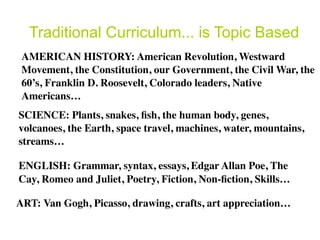
Traditional Curriculum... is Topic Based
 AMERICAN HISTORY: American Revolution, Westward
 Movement, the Constitution, our Government, the Civil War, the
 60’s, Franklin D. Roosevelt, Colorado leaders, Native
 Americans…
SCIENCE: Plants, snakes, fish, the human body, genes,
volcanoes, the Earth, space travel, machines, water, mountains,
streams…

ENGLISH: Grammar, syntax, essays, Edgar Allan Poe, The
Cay, Romeo and Juliet, Poetry, Fiction, Non-fiction, Skills…

ART: Van Gogh, Picasso, drawing, crafts, art appreciation…
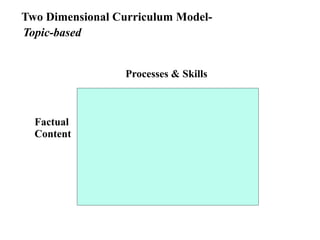
Two Dimensional Curriculum Model-
Topic-based


                  Processes & Skills


  Factual
  Content
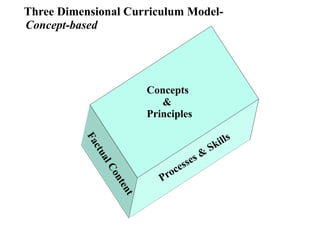
Three Dimensional Curriculum Model-
Concept-based


                           Concepts
                              &
                           Principles

                                                  lls
          Fa


                                            S   ki
             ctu


                                     ses&
                 a


                                  es
               lC


                                oc
                              Pr
                 on
                     ten
                      t
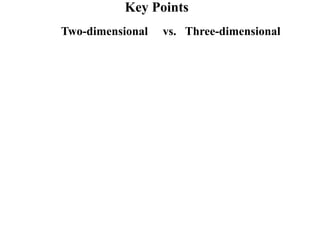
Key Points
Two-dimensional   vs. Three-dimensional
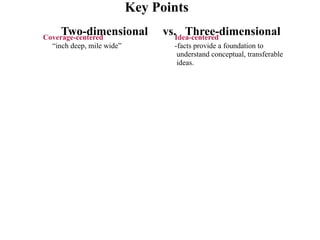
Key Points
     Two-dimensional
Coverage-centered
                                vs.Idea-centered
                                      Three-dimensional
  “inch deep, mile wide”          -facts provide a foundation to
                                   understand conceptual, transferable
                                   ideas.
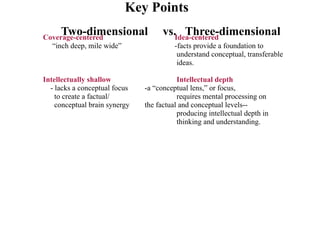
Key Points
     Two-dimensional
Coverage-centered
                                     vs.Idea-centered
                                           Three-dimensional
  “inch deep, mile wide”                 -facts provide a foundation to
                                          understand conceptual, transferable
                                          ideas.

Intellectually shallow                    Intellectual depth
  - lacks a conceptual focus   -a “conceptual lens,” or focus,
    to create a factual/                  requires mental processing on
    conceptual brain synergy   the factual and conceptual levels--
                                          producing intellectual depth in
                                          thinking and understanding.
Key Points
      Two-dimensional
Coverage-centered
                                      vs.Idea-centered
                                            Three-dimensional
  “inch deep, mile wide”                  -facts provide a foundation to
                                           understand conceptual, transferable
                                           ideas.

Intellectually shallow                     Intellectual depth
  - lacks a conceptual focus    -a “conceptual lens,” or focus,
    to create a factual/                   requires mental processing on
    conceptual brain synergy    the factual and conceptual levels--
                                           producing intellectual depth in
                                           thinking and understanding.

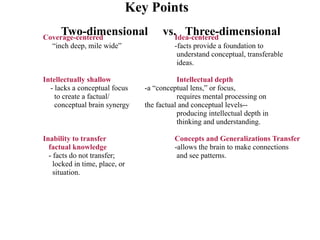
Inability to transfer                     Concepts and Generalizations Transfer
  factual knowledge                       -allows the brain to make connections
  - facts do not transfer;                 and see patterns.
    locked in time, place, or
    situation.
Key Points
      Two-dimensional
Coverage-centered
                                      vs.Idea-centered
                                            Three-dimensional
  “inch deep, mile wide”                  -facts provide a foundation to
                                           understand conceptual, transferable
                                           ideas.

Intellectually shallow                     Intellectual depth
  - lacks a conceptual focus    -a “conceptual lens,” or focus,
    to create a factual/                   requires mental processing on
    conceptual brain synergy    the factual and conceptual levels--
                                           producing intellectual depth in
                                           thinking and understanding.

Inability to transfer                     Concepts and Generalizations Transfer
  factual knowledge                       -allows the brain to make connections
  - facts do not transfer;                 and see patterns.
    locked in time, place, or
    situation.

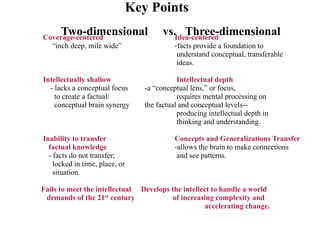
Fails to meet the intellectual Develops the intellect to handle a world
 demands of the 21st century             of increasing complexity and
                                                    accelerating change.
Barry’s clipart.com


The Structure
of Knowledge
KNOWLEDGE
                   Is it possible to identify
                   a particular body of
                   knowledge for
                   international schools?


The PYP recognizes that it would be
inappropriate to attempt to define any narrow,
fixed body of knowledge as essential content
which every student should know. Accepting
this, the task has been approached from a
different perspective.
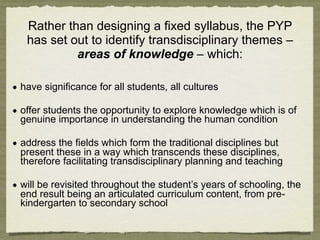
Rather than designing a fixed syllabus, the PYP
   has set out to identify transdisciplinary themes –
            areas of knowledge – which:

• have significance for all students, all cultures

• offer students the opportunity to explore knowledge which is of
  genuine importance in understanding the human condition

• address the fields which form the traditional disciplines but
  present these in a way which transcends these disciplines,
  therefore facilitating transdisciplinary planning and teaching

• will be revisited throughout the student’s years of schooling, the
  end result being an articulated curriculum content, from pre-
  kindergarten to secondary school
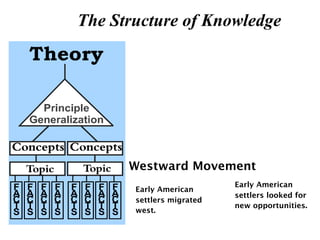
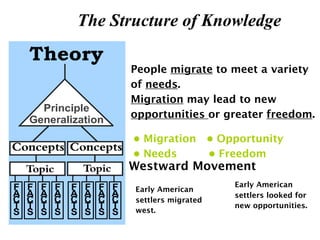
The Structure of Knowledge


      Westward Movement
                           Early American
       Early American
                           settlers looked for
       settlers migrated
                           new opportunities.
       west.
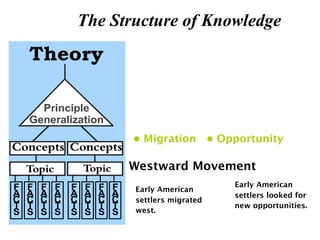
The Structure of Knowledge


       • Migration • Opportunity

      Westward Movement
                           Early American
       Early American
                           settlers looked for
       settlers migrated
                           new opportunities.
       west.
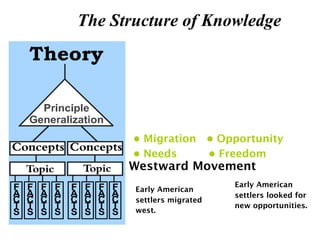
The Structure of Knowledge


       • Migration • Opportunity
       • Needs     • Freedom
      Westward Movement
                           Early American
       Early American
                           settlers looked for
       settlers migrated
                           new opportunities.
       west.
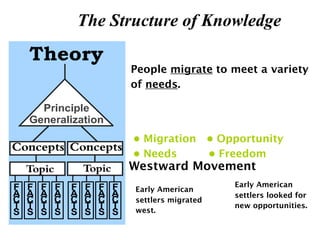
The Structure of Knowledge

      People migrate to meet a variety
      of needs.


       • Migration • Opportunity
       • Needs     • Freedom
      Westward Movement
                           Early American
       Early American
                           settlers looked for
       settlers migrated
                           new opportunities.
       west.
The Structure of Knowledge

      People migrate to meet a variety
      of needs.
      Migration may lead to new
      opportunities or greater freedom.

       • Migration • Opportunity
       • Needs     • Freedom
      Westward Movement
                           Early American
       Early American
                           settlers looked for
       settlers migrated
                           new opportunities.
       west.
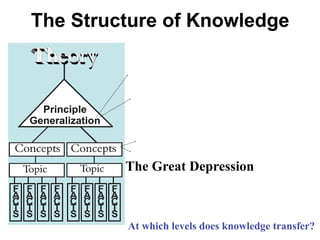
The Structure of Knowledge


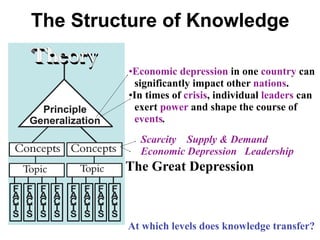
         The Great Depression


         At which levels does knowledge transfer?
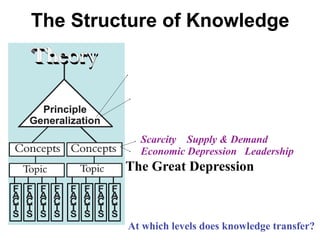
The Structure of Knowledge


           Scarcity Supply & Demand
           Economic Depression Leadership
         The Great Depression


         At which levels does knowledge transfer?
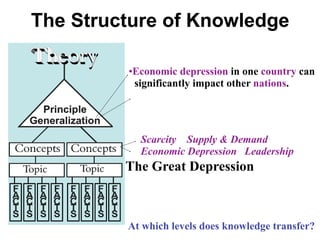
The Structure of Knowledge

         •Economic depression in one country can
          significantly impact other nations.


           Scarcity Supply & Demand
           Economic Depression Leadership
         The Great Depression


         At which levels does knowledge transfer?
The Structure of Knowledge

         •Economic depression in one country can
          significantly impact other nations.
         •In times of crisis, individual leaders can
          exert power and shape the course of
          events.
           Scarcity Supply & Demand
           Economic Depression Leadership
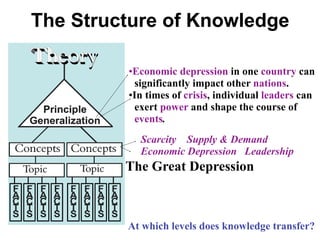
         The Great Depression


         At which levels does knowledge transfer?
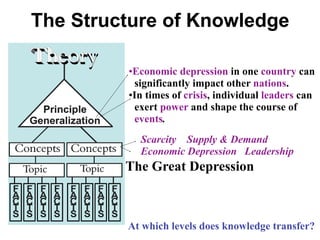
The Structure of Knowledge

         •Economic depression in one country can
          significantly impact other nations.
         •In times of crisis, individual leaders can
          exert power and shape the course of
          events.
           Scarcity Supply & Demand
           Economic Depression Leadership
         The Great Depression


         At which levels does knowledge transfer?
The Structure of Knowledge

         •Economic depression in one country can
          significantly impact other nations.
         •In times of crisis, individual leaders can
          exert power and shape the course of
          events.
           Scarcity Supply & Demand
           Economic Depression Leadership
         The Great Depression


         At which levels does knowledge transfer?
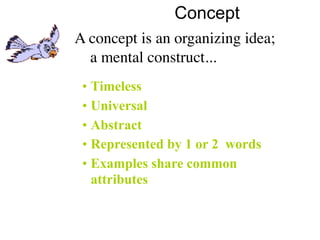
Concept
A concept is an organizing idea;
  a mental construct...
Concept
A concept is an organizing idea;
  a mental construct...
Concept
A concept is an organizing idea;
  a mental construct...
 • Timeless
Concept
A concept is an organizing idea;
  a mental construct...
 • Timeless
 • Universal
Concept
A concept is an organizing idea;
  a mental construct...
 • Timeless
 • Universal
 • Abstract
Concept
A concept is an organizing idea;
  a mental construct...
 • Timeless
 • Universal
 • Abstract
 • Represented by 1 or 2 words
Concept
A concept is an organizing idea;
  a mental construct...
 • Timeless
 • Universal
 • Abstract
 • Represented by 1 or 2 words
 • Examples share common
   attributes
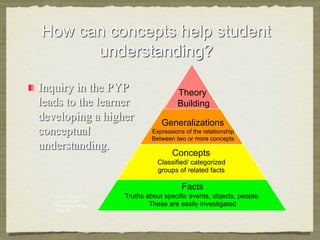
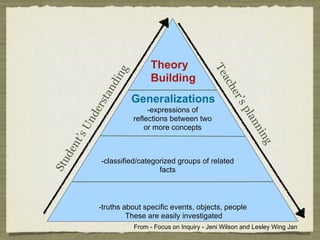
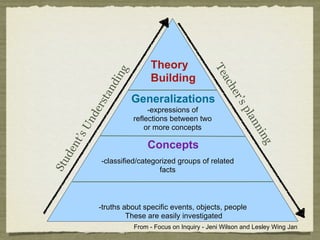
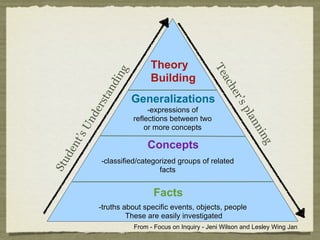
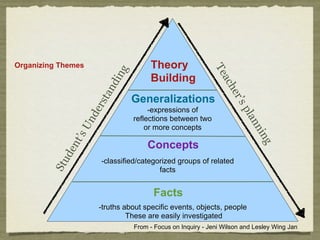
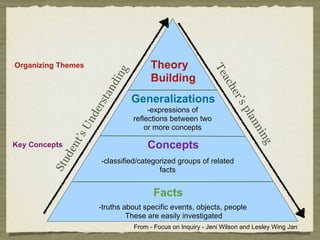
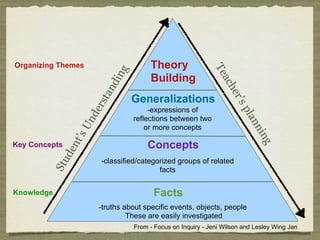
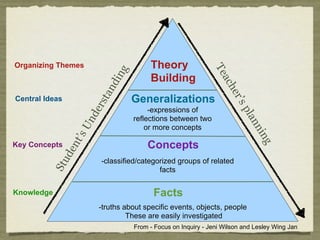
Theory
                                      Building

                                Generalizations
                             Expressions of the relationship
                             Between two or more concepts

                                    Concepts
                               Classified/ categorized
                               groups of related facts

                                        Facts
From: Focus on      Truths about specific events, objects, people.
Inquiry by Joni
Wilson and Lesley           These are easily investigated
Wing Jan
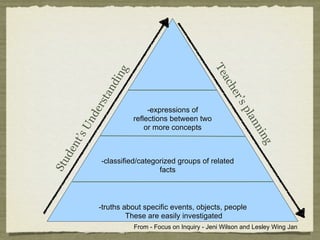
Te
                    g
                d in


                                                      ac
                                                         h
              an


                                                         er’
          rst


                                                            sp
                             -expressions of
        de


                                                              lan
                        reflections between two
      Un


                            or more concepts


                                                                 nin
     ’s
  nt


                                                                    g
 de


            -classified/categorized groups of related
Stu


                              facts


           -truths about specific events, objects, people
                    These are easily investigated
                        From - Focus on Inquiry - Jeni Wilson and Lesley Wing Jan
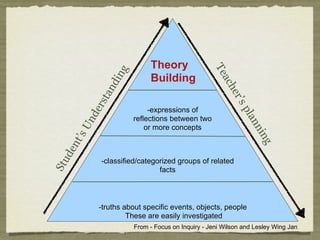
Theory


                                                   Te
                    g
                             Building


                d in


                                                      ac
                                                         h
              an


                                                         er’
          rst


                                                            sp
                             -expressions of
        de


                                                              lan
                        reflections between two
      Un


                            or more concepts


                                                                 nin
     ’s
  nt


                                                                    g
 de


            -classified/categorized groups of related
Stu


                              facts


           -truths about specific events, objects, people
                    These are easily investigated
                        From - Focus on Inquiry - Jeni Wilson and Lesley Wing Jan
Theory


                                                   Te
                    g
                             Building


                d in


                                                      ac
                                                         h
              an


                                                         er’
          rst           Generalizations


                                                            sp
                             -expressions of
        de


                                                              lan
                        reflections between two
      Un


                            or more concepts


                                                                 nin
     ’s
  nt


                                                                    g
 de


            -classified/categorized groups of related
Stu


                              facts


           -truths about specific events, objects, people
                    These are easily investigated
                        From - Focus on Inquiry - Jeni Wilson and Lesley Wing Jan
Theory


                                                   Te
                    g
                             Building


                d in


                                                      ac
                                                         h
              an


                                                         er’
          rst           Generalizations


                                                            sp
                             -expressions of
        de


                                                              lan
                        reflections between two
      Un


                            or more concepts


                                                                 nin
     ’s


                            Concepts
  nt


                                                                    g
 de


            -classified/categorized groups of related
Stu


                              facts


           -truths about specific events, objects, people
                    These are easily investigated
                        From - Focus on Inquiry - Jeni Wilson and Lesley Wing Jan
Theory


                                                   Te
                    g
                             Building


                d in


                                                      ac
                                                         h
              an


                                                         er’
          rst           Generalizations


                                                            sp
                             -expressions of
        de


                                                              lan
                        reflections between two
      Un


                            or more concepts


                                                                 nin
     ’s


                            Concepts
  nt


                                                                    g
 de


            -classified/categorized groups of related
Stu


                              facts


                              Facts
           -truths about specific events, objects, people
                    These are easily investigated
                        From - Focus on Inquiry - Jeni Wilson and Lesley Wing Jan
Organizing Themes                      Theory


                                                             Te
                              g
                                       Building


                          d in


                                                                ac
                                                                   h
                        an


                                                                   er’
                    rst           Generalizations


                                                                      sp
                                       -expressions of
                  de


                                                                        lan
                                  reflections between two
                Un


                                      or more concepts


                                                                           nin
               ’s


                                      Concepts
            nt


                                                                              g
           de


                      -classified/categorized groups of related
        Stu


                                        facts


                                        Facts
                     -truths about specific events, objects, people
                              These are easily investigated
                                  From - Focus on Inquiry - Jeni Wilson and Lesley Wing Jan
Organizing Themes                         Theory


                                                                Te
                                 g
                                          Building


                             d in


                                                                   ac
                                                                      h
                           an


                                                                      er’
                       rst           Generalizations


                                                                         sp
                                          -expressions of
                   de


                                                                           lan
                                     reflections between two
                 Un


                                         or more concepts


                                                                              nin
                  ’s


                                         Concepts
               nt


                                                                                 g
Key Concepts
           de


                         -classified/categorized groups of related
         Stu


                                           facts


                                           Facts
                        -truths about specific events, objects, people
                                 These are easily investigated
                                     From - Focus on Inquiry - Jeni Wilson and Lesley Wing Jan
Organizing Themes                         Theory


                                                                Te
                                 g
                                          Building


                             d in


                                                                   ac
                                                                      h
                           an


                                                                      er’
                       rst           Generalizations


                                                                         sp
                                          -expressions of
                   de


                                                                           lan
                                     reflections between two
                 Un


                                         or more concepts


                                                                              nin
                  ’s


                                         Concepts
               nt


                                                                                 g
Key Concepts
            de


                         -classified/categorized groups of related
         Stu


                                           facts


Knowledge                                  Facts
                        -truths about specific events, objects, people
                                 These are easily investigated
                                     From - Focus on Inquiry - Jeni Wilson and Lesley Wing Jan
Organizing Themes                          Theory


                                                                 Te
                                  g
                                           Building


                              d in


                                                                    ac
                                                                       h
                            an


                                                                       er’
Central Ideas           rst           Generalizations


                                                                          sp
                                           -expressions of
                    de


                                                                            lan
                                      reflections between two
                  Un


                                          or more concepts


                                                                               nin
                   ’s


                                          Concepts
                nt


                                                                                  g
Key Concepts
            de


                          -classified/categorized groups of related
         Stu


                                            facts


Knowledge                                   Facts
                         -truths about specific events, objects, people
                                  These are easily investigated
                                      From - Focus on Inquiry - Jeni Wilson and Lesley Wing Jan
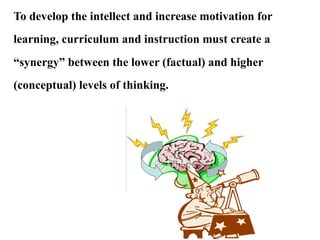
To develop the intellect and increase motivation for
learning, curriculum and instruction must create a
“synergy” between the lower (factual) and higher
(conceptual) levels of thinking.
The Conceptual
      Mind
  engages the
Personal Intellect
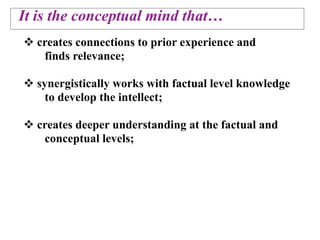
It is the conceptual mind that…
 creates connections to prior experience and
   finds relevance;
It is the conceptual mind that…
 creates connections to prior experience and
   finds relevance;

 synergistically works with factual level knowledge
    to develop the intellect;
It is the conceptual mind that…
 creates connections to prior experience and
   finds relevance;

 synergistically works with factual level knowledge
    to develop the intellect;

 creates deeper understanding at the factual and
   conceptual levels;
It is the conceptual mind that…
 creates connections to prior experience and
   finds relevance;

 synergistically works with factual level knowledge
    to develop the intellect;

 creates deeper understanding at the factual and
   conceptual levels;

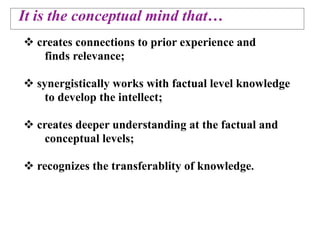
 recognizes the transferablity of knowledge.
It is the conceptual mind that…
 creates connections to prior experience and
   finds relevance;

 synergistically works with factual level knowledge
    to develop the intellect;

 creates deeper understanding at the factual and
   conceptual levels;

 recognizes the transferablity of knowledge.

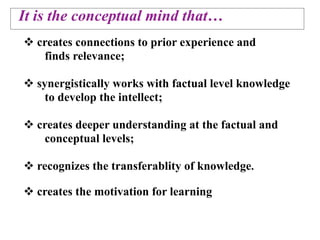
 creates the motivation for learning
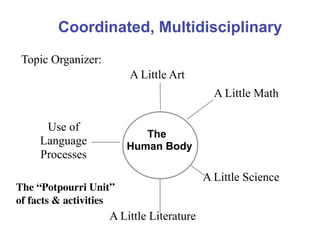
Coordinated, Multidisciplinary
 Topic Organizer:
                        A Little Art
                                            A Little Math

      Use of
                           The
     Language           Human Body
     Processes
                                          A Little Science
The “Potpourri Unit”
of facts & activities
                    A Little Literature
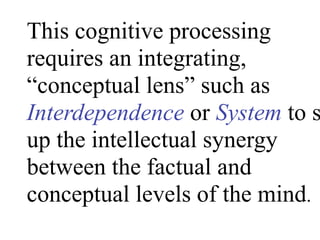
This cognitive processing
requires an integrating,
“conceptual lens” such as
Interdependence or System to s
up the intellectual synergy
between the factual and
conceptual levels of the mind.
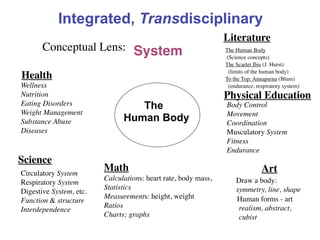
Integrated, Transdisciplinary
                                                                Literature
       Conceptual Lens: System                                  The Human Body
                                                                (Science concepts)
                                                                The Scarlet Ibis (J. Hurst)
                                                                 (limits of the human body)
Health                                                          To the Top: Annapurna (Blum)
Wellness                                                         (endurance, respiratory system)
Nutrition                                                       Physical Education
Eating Disorders                  The                           Body Control
Weight Management                                               Movement
Substance Abuse                Human Body                       Coordination
Diseases                                                        Musculatory System
                                                                Fitness
                                                                Endurance
Science
Circulatory System
                         Math                                                  Art
                         Calculations: heart rate, body mass,       Draw a body:
Respiratory System
                         Statistics                                 symmetry, line, shape
Digestive System, etc.
                         Measurements: height, weight               Human forms - art
Function & structure
                         Ratios                                      realism, abstract,
Interdependence
                         Charts; graphs                              cubist
Open the envelope on your table and have a
       look at the questions inside.


     What do you notice about them?

     How could you categorize them?
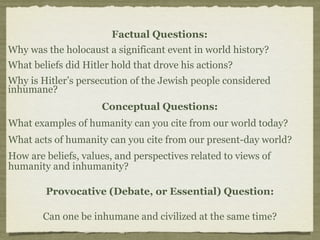
Factual Questions:
Why was the holocaust a significant event in world history?
What beliefs did Hitler hold that drove his actions?
Why is Hitler’s persecution of the Jewish people considered
inhumane?
                     Conceptual Questions:
What examples of humanity can you cite from our world today?
What acts of humanity can you cite from our present-day world?
How are beliefs, values, and perspectives related to views of
humanity and inhumanity?

        Provocative (Debate, or Essential) Question:

        Can one be inhumane and civilized at the same time?
1. Think of two specific topics you teach.

 2. Choose potential lenses for each topic (you can use the list on the
                                table)

Do the lenses change the focus or add a dimension for thinking about
                              the topic?

Which lens do you find most engaging (or challenging) for your topic?
When we teach to the levels
       of concepts and
   generalizations we are
      teaching for deep
understanding and the transfer
        of knowledge.
MEET EMILY
READINGS
 P 11 OR 12
Inquiry is like...

10 11 induction slides

  • 1.
    PYP INDUCTION American InternationalSchool Dhaka August-December 2010
  • 2.
  • 3.
    INTRODUCTIONS AND GETTING TO KNOW ONE ANOTHER You need your Wander & Wonder grids + a writing implement Rules of play Wander around the room and ask a different participant one of the following questions: (be sure to write their names and replies in each box on the grid.) No one should be asked twice. What color do you feel like today and why? What are you passionate about? What makes you go quiet? Name someone you admire and tell why. What are you most proud of and why. What is your strongest method of learning (give some examples) What questions do you have about the PYP? Name something you long to do but haven’t quite managed to do yet. What has been a tough learning experience for you and why? What do you love about teaching?
  • 4.
    USE THE STICKERON THE FRONT OF YOUR BOOKLET TO REGROUP; MEET WITH THOSE OF THE SAME COLOR STICKERS. DISCUSS. What’s what? So what? Here’s What!
  • 5.
    ESSENTIAL AGREEMENTS Respect Reflection Responsibility Curiosity Cooperation Creativity
  • 6.
  • 8.
  • 9.
  • 10.
    THE LEARNER PROFILE Lookat the Learner Profile in your MPYPH p4
  • 11.
    SESSION 2 - IBPYP AND AISD CONT’D Be sure to grab a number tag and sit at that table
  • 12.
  • 17.
    ACTIVE LEARNER PROFILE Brainstormways you can think to use or integrate learning about the learner profile into your classroom. Share in your group.
  • 18.
  • 19.
    THE MISSION &VISION AISD IB How is the learner profile reflected in these statements?
  • 20.
    IB Standards &Practices
  • 21.
    Programmes: What areIB Programmes? The three IB Programmes each contain four core elements Page 6 © International Baccalaureate Organization 2007
  • 22.
    Definition: How isthe PYP defined?  The IB Primary Years Programme, for students aged 3 to 12 focuses on the development of the whole child as an inquirer, both in the classroom and in the world outside. It is a framework guided by six transdisciplinary themes of global significance, explored using knowledge and skills derived from six subjects areas, as well as transdisciplinary skills, with a powerful emphasis on inquiry- based learning. © International Baccalaureate Organization 2007
  • 23.
    Overview of thePYP Page 7 © International Baccalaureate Organization 2007
  • 24.
    Learners constructing meaning:How is the PYP curriculum defined? Three interrelated components expressed in the form of three open-ended questions.  Written curriculum  Taught curriculum  Assessed curriculum This is a model whereby all three components inform each other. Page 8 © International Baccalaureate Organization 2007
  • 25.
    WHAT IS CURRICULUM? PYPdefines curriculum as ‘broad and inclusive’ – The Written Curriculum – commitment to continuous school improvement – The Taught Curriculum – equal emphasis to methodology – The Learned Curriculum – assesses the actual learning and reminds us of our original purpose The PYP definition of curriculum includes all three components
  • 26.
    THE WRITTEN CURRICULUM 5 Essential Elements Knowledge Concepts Skills Attitudes Action
  • 27.
    (HALF) JIGSAW 1-Knowledge - p11 2-Concepts - p15 3-Skills - p20 4-Attitudes - p24 5-Action - p25
  • 28.
  • 29.
    SESSION 3 - INQUIRY & ASSESSMENT Please sit in grade level or single subject groups
  • 35.
  • 36.
  • 37.
    SESSION 4 - COLLABORATIVE PLANNING Please regroup using the colored dots on your workshop booklets. (Red, Yellow, Blue)
  • 38.
    Who will Ibe working with? Collaborative planning at AISD
  • 39.
    ATLAS RUBICON Open browser(Safari, Firefox, etc) Click on Rubicon link on toolbar Login using your name (letter of last name trick); password is “culture” Follow the prompts to change your password; don’t forget this! Your Atlas main page Start exploring in browse mode Can you find your units (inquiry, math, etc); can you find any attached/linked documents?; try downloading one of them
  • 40.
  • 41.
    OCC JIGSAW 1-Forums 2-E-library & News 3-PYP Exhibition 4-Resources 5-Support areas
  • 42.
    ALL TEACHERS/ADULTS Promote –Internationalism Through Model – Learner Profile inquiry Teach – 5 essential elements Programme of Inquiry Stand Alone Inquiry The PYP Curriculum Matrix Mathematics 6 Trans-disciplinary units Languages of work based on: Performing Arts Science, Social Studies Visual Arts Personal and Social Physical Education Education Celebrations Local Topics Incidental
  • 44.
    SESSION 5 - IB’S ONLINE CURRICULUM CENTER Please sit in your ‘expert’ group: Forums, E-library/News, Exhibition, Resources, Support Areas
  • 45.
    EXPERT GROUPS Discuss yourfindings, what What do you want to share you learned about that with your home group? area. Decide how best to share What were some things that information to your that could be helpful? home group. Keep the people in your How much time home group in mind. do you need?
  • 46.
    SHARING WHAT WE LEARNED Return to your home group Take turns round the table to share the area you explored on the OCC Take notes on each section as your group mates share what they learning; something you could refer back to.
  • 47.
    Now you shouldhave some of the pieces to the puzzle of the OCC!
  • 48.
    SESSION 6 INQUIRY Sit anywhere you like...
  • 52.
  • 53.
  • 54.
    The IB perspective on inquiry Read pp 28-30 and pp 41-43 MPYPH for next session
  • 55.
    Enj Eid Mubarak oy ho you lida r y!
  • 56.
    SESSION 7 INQUIRY Sit anywhere you like...
  • 58.
    MODELS OF INQUIRY Directthe inquiry Help justify learning tasks Build on experiences Makes sense of learning to reach understandings
  • 59.
    TEACHING & LEARNING CYCLE Laying the groundwork Branching out Exploration Making connections
  • 60.
    KATH MURDOCH Tuning In (To gauge prior knowledge and immerse students in the inquiry) Finding Out (Collecting and gathering information) Sorting Out (To organize, represent and present collected data)
  • 61.
    KATH MURDOCH Going Further (Extend or broaden experiences and consider other perspectives; investigate areas of personal interest) Making Connections (Analyzing and linking to themselves and their world) Reflection (To reflect on understandings and the process of learning; To draw conclusions and make connections between ideas) Action (To apply or act on what has been learned.)
  • 62.
    Grade 3 MultiplicationFacts Teacher Driven Inquiry •  Memorize each fact •  Body maths – rows in a •  Testing cinema which is best? •  Mad minutes 1x20, 20x1, 2x10, 10x2, 5x4 or 4x5? Is it the best •  Fact families – moving for a bus? towards inquiry but allow •  Arrays – visual / for discovery first. manipulatives •  Emphasis on the answer •  Finding connections rather than understanding between 3x5 and 5x3 •  Different strategies to find the answer
  • 63.
    Infants lesson onFloating and Sinking Teacher Driven Inquiry •  Emphasis on books to •  Free exploration of collect facts objects in water tray •  Complete worksheet •  Prediction with task •  Open ended •  Closed sentences classification and fill in missing •  Record findings and words decide on new inquiry
  • 64.
    Grade 5 Recycling Teacher Driven Inquiry •  Read about items that •  Sort objects they think can be recycled on page can be recycled 37 and complete •  Use 2-3 guiding comprehension questions to keep focus •  Complete worksheet on on field trip field trip to find numerous •  Collect all paper that is facts not put into recycled bin and analyse data
  • 65.
    Grade 1 Reading/ Circle Teacher Driven Inquiry •  Read silently and answer a list •  After reading chapter think of a of factual questions e.g. who is question and pass to next group to Leena’s friend? answer •  Recount, relate and reflect •  Complete worksheet on the read chapter – comprehension •  After completion of book decide a way to present it to rest of class with superficial questions e.g role play, interview with author •  After complete of book •  Compare characters points of complete test view •  Choosing book from selection with similar theme e.g friendship
  • 67.
  • 68.
  • 69.
    INTERNATIONALLY MINDED? RANK FROM 1-10 Mother Muhammad Barack Liu Xiaobo Princess Diana Teresa Yunus Obama Kofi Annan Angelina Sacha Baron Pope Benedict XVI Osama bin Laden Jolie Cohen
  • 70.
    BEYOND FOOD, FESTIVALS ANDFLAGS How internationally minded is AISD? How aware are our students locally? How aware are they globally?
  • 71.
  • 72.
  • 73.
    THE LEARNER PROFILE Lookat the Learner Profile in your MPYPH p4
  • 74.
    ATTRIBUTES & ATTITUDES, OHMY! What are some ways you explicitly teach the learner profile/attitudes in your classroom?
  • 75.
    SESSION 9 - CONCEPTUALLY DRIVEN CURRICULUM
  • 76.
    HOW DO STUDENTSRETAIN, TRANSFER AND UNDERSTAND KNOWLEDGE?
  • 77.
    WHAT IS CURRICULUM PYPdefines curriculum as ‘broad and inclusive’ – The Written Curriculum – commitment to continuous school improvement – The Taught Curriculum – Equal emphasis to methodology – The Learned Curriculum – assessing the actual learning and reminds us of its purpose The PYP definition of curriculum includes all three components
  • 78.
    THE WRITTEN CURRICULUM 5 Essential Elements Action Concepts Knowledge Skills Attitudes
  • 79.
    Traditional Curriculum... isTopic Based AMERICAN HISTORY: American Revolution, Westward Movement, the Constitution, our Government, the Civil War, the 60’s, Franklin D. Roosevelt, Colorado leaders, Native Americans… SCIENCE: Plants, snakes, fish, the human body, genes, volcanoes, the Earth, space travel, machines, water, mountains, streams… ENGLISH: Grammar, syntax, essays, Edgar Allan Poe, The Cay, Romeo and Juliet, Poetry, Fiction, Non-fiction, Skills… ART: Van Gogh, Picasso, drawing, crafts, art appreciation…
  • 80.
    Two Dimensional CurriculumModel- Topic-based Processes & Skills Factual Content
  • 81.
    Three Dimensional CurriculumModel- Concept-based Concepts & Principles lls Fa S ki ctu ses& a es lC oc Pr on ten t
  • 82.
    Key Points Two-dimensional vs. Three-dimensional
  • 83.
    Key Points Two-dimensional Coverage-centered vs.Idea-centered Three-dimensional “inch deep, mile wide” -facts provide a foundation to understand conceptual, transferable ideas.
  • 84.
    Key Points Two-dimensional Coverage-centered vs.Idea-centered Three-dimensional “inch deep, mile wide” -facts provide a foundation to understand conceptual, transferable ideas. Intellectually shallow Intellectual depth - lacks a conceptual focus -a “conceptual lens,” or focus, to create a factual/ requires mental processing on conceptual brain synergy the factual and conceptual levels-- producing intellectual depth in thinking and understanding.
  • 85.
    Key Points Two-dimensional Coverage-centered vs.Idea-centered Three-dimensional “inch deep, mile wide” -facts provide a foundation to understand conceptual, transferable ideas. Intellectually shallow Intellectual depth - lacks a conceptual focus -a “conceptual lens,” or focus, to create a factual/ requires mental processing on conceptual brain synergy the factual and conceptual levels-- producing intellectual depth in thinking and understanding. Inability to transfer Concepts and Generalizations Transfer factual knowledge -allows the brain to make connections - facts do not transfer; and see patterns. locked in time, place, or situation.
  • 86.
    Key Points Two-dimensional Coverage-centered vs.Idea-centered Three-dimensional “inch deep, mile wide” -facts provide a foundation to understand conceptual, transferable ideas. Intellectually shallow Intellectual depth - lacks a conceptual focus -a “conceptual lens,” or focus, to create a factual/ requires mental processing on conceptual brain synergy the factual and conceptual levels-- producing intellectual depth in thinking and understanding. Inability to transfer Concepts and Generalizations Transfer factual knowledge -allows the brain to make connections - facts do not transfer; and see patterns. locked in time, place, or situation. Fails to meet the intellectual Develops the intellect to handle a world demands of the 21st century of increasing complexity and accelerating change.
  • 87.
  • 88.
    KNOWLEDGE Is it possible to identify a particular body of knowledge for international schools? The PYP recognizes that it would be inappropriate to attempt to define any narrow, fixed body of knowledge as essential content which every student should know. Accepting this, the task has been approached from a different perspective.
  • 89.
    Rather than designinga fixed syllabus, the PYP has set out to identify transdisciplinary themes – areas of knowledge – which: • have significance for all students, all cultures • offer students the opportunity to explore knowledge which is of genuine importance in understanding the human condition • address the fields which form the traditional disciplines but present these in a way which transcends these disciplines, therefore facilitating transdisciplinary planning and teaching • will be revisited throughout the student’s years of schooling, the end result being an articulated curriculum content, from pre- kindergarten to secondary school
  • 90.
    The Structure ofKnowledge Westward Movement Early American Early American settlers looked for settlers migrated new opportunities. west.
  • 91.
    The Structure ofKnowledge • Migration • Opportunity Westward Movement Early American Early American settlers looked for settlers migrated new opportunities. west.
  • 92.
    The Structure ofKnowledge • Migration • Opportunity • Needs • Freedom Westward Movement Early American Early American settlers looked for settlers migrated new opportunities. west.
  • 93.
    The Structure ofKnowledge People migrate to meet a variety of needs. • Migration • Opportunity • Needs • Freedom Westward Movement Early American Early American settlers looked for settlers migrated new opportunities. west.
  • 94.
    The Structure ofKnowledge People migrate to meet a variety of needs. Migration may lead to new opportunities or greater freedom. • Migration • Opportunity • Needs • Freedom Westward Movement Early American Early American settlers looked for settlers migrated new opportunities. west.
  • 95.
    The Structure ofKnowledge The Great Depression At which levels does knowledge transfer?
  • 96.
    The Structure ofKnowledge Scarcity Supply & Demand Economic Depression Leadership The Great Depression At which levels does knowledge transfer?
  • 97.
    The Structure ofKnowledge •Economic depression in one country can significantly impact other nations. Scarcity Supply & Demand Economic Depression Leadership The Great Depression At which levels does knowledge transfer?
  • 98.
    The Structure ofKnowledge •Economic depression in one country can significantly impact other nations. •In times of crisis, individual leaders can exert power and shape the course of events. Scarcity Supply & Demand Economic Depression Leadership The Great Depression At which levels does knowledge transfer?
  • 99.
    The Structure ofKnowledge •Economic depression in one country can significantly impact other nations. •In times of crisis, individual leaders can exert power and shape the course of events. Scarcity Supply & Demand Economic Depression Leadership The Great Depression At which levels does knowledge transfer?
  • 100.
    The Structure ofKnowledge •Economic depression in one country can significantly impact other nations. •In times of crisis, individual leaders can exert power and shape the course of events. Scarcity Supply & Demand Economic Depression Leadership The Great Depression At which levels does knowledge transfer?
  • 101.
    Concept A concept isan organizing idea; a mental construct...
  • 102.
    Concept A concept isan organizing idea; a mental construct...
  • 103.
    Concept A concept isan organizing idea; a mental construct... • Timeless
  • 104.
    Concept A concept isan organizing idea; a mental construct... • Timeless • Universal
  • 105.
    Concept A concept isan organizing idea; a mental construct... • Timeless • Universal • Abstract
  • 106.
    Concept A concept isan organizing idea; a mental construct... • Timeless • Universal • Abstract • Represented by 1 or 2 words
  • 107.
    Concept A concept isan organizing idea; a mental construct... • Timeless • Universal • Abstract • Represented by 1 or 2 words • Examples share common attributes
  • 108.
    Theory Building Generalizations Expressions of the relationship Between two or more concepts Concepts Classified/ categorized groups of related facts Facts From: Focus on Truths about specific events, objects, people. Inquiry by Joni Wilson and Lesley These are easily investigated Wing Jan
  • 109.
    Te g d in ac h an er’ rst sp -expressions of de lan reflections between two Un or more concepts nin ’s nt g de -classified/categorized groups of related Stu facts -truths about specific events, objects, people These are easily investigated From - Focus on Inquiry - Jeni Wilson and Lesley Wing Jan
  • 110.
    Theory Te g Building d in ac h an er’ rst sp -expressions of de lan reflections between two Un or more concepts nin ’s nt g de -classified/categorized groups of related Stu facts -truths about specific events, objects, people These are easily investigated From - Focus on Inquiry - Jeni Wilson and Lesley Wing Jan
  • 111.
    Theory Te g Building d in ac h an er’ rst Generalizations sp -expressions of de lan reflections between two Un or more concepts nin ’s nt g de -classified/categorized groups of related Stu facts -truths about specific events, objects, people These are easily investigated From - Focus on Inquiry - Jeni Wilson and Lesley Wing Jan
  • 112.
    Theory Te g Building d in ac h an er’ rst Generalizations sp -expressions of de lan reflections between two Un or more concepts nin ’s Concepts nt g de -classified/categorized groups of related Stu facts -truths about specific events, objects, people These are easily investigated From - Focus on Inquiry - Jeni Wilson and Lesley Wing Jan
  • 113.
    Theory Te g Building d in ac h an er’ rst Generalizations sp -expressions of de lan reflections between two Un or more concepts nin ’s Concepts nt g de -classified/categorized groups of related Stu facts Facts -truths about specific events, objects, people These are easily investigated From - Focus on Inquiry - Jeni Wilson and Lesley Wing Jan
  • 114.
    Organizing Themes Theory Te g Building d in ac h an er’ rst Generalizations sp -expressions of de lan reflections between two Un or more concepts nin ’s Concepts nt g de -classified/categorized groups of related Stu facts Facts -truths about specific events, objects, people These are easily investigated From - Focus on Inquiry - Jeni Wilson and Lesley Wing Jan
  • 115.
    Organizing Themes Theory Te g Building d in ac h an er’ rst Generalizations sp -expressions of de lan reflections between two Un or more concepts nin ’s Concepts nt g Key Concepts de -classified/categorized groups of related Stu facts Facts -truths about specific events, objects, people These are easily investigated From - Focus on Inquiry - Jeni Wilson and Lesley Wing Jan
  • 116.
    Organizing Themes Theory Te g Building d in ac h an er’ rst Generalizations sp -expressions of de lan reflections between two Un or more concepts nin ’s Concepts nt g Key Concepts de -classified/categorized groups of related Stu facts Knowledge Facts -truths about specific events, objects, people These are easily investigated From - Focus on Inquiry - Jeni Wilson and Lesley Wing Jan
  • 117.
    Organizing Themes Theory Te g Building d in ac h an er’ Central Ideas rst Generalizations sp -expressions of de lan reflections between two Un or more concepts nin ’s Concepts nt g Key Concepts de -classified/categorized groups of related Stu facts Knowledge Facts -truths about specific events, objects, people These are easily investigated From - Focus on Inquiry - Jeni Wilson and Lesley Wing Jan
  • 118.
    To develop theintellect and increase motivation for learning, curriculum and instruction must create a “synergy” between the lower (factual) and higher (conceptual) levels of thinking.
  • 119.
    The Conceptual Mind engages the Personal Intellect
  • 120.
    It is theconceptual mind that…
  • 121.
    It is theconceptual mind that…  creates connections to prior experience and finds relevance;
  • 122.
    It is theconceptual mind that…  creates connections to prior experience and finds relevance;  synergistically works with factual level knowledge to develop the intellect;
  • 123.
    It is theconceptual mind that…  creates connections to prior experience and finds relevance;  synergistically works with factual level knowledge to develop the intellect;  creates deeper understanding at the factual and conceptual levels;
  • 124.
    It is theconceptual mind that…  creates connections to prior experience and finds relevance;  synergistically works with factual level knowledge to develop the intellect;  creates deeper understanding at the factual and conceptual levels;  recognizes the transferablity of knowledge.
  • 125.
    It is theconceptual mind that…  creates connections to prior experience and finds relevance;  synergistically works with factual level knowledge to develop the intellect;  creates deeper understanding at the factual and conceptual levels;  recognizes the transferablity of knowledge.  creates the motivation for learning
  • 126.
    Coordinated, Multidisciplinary TopicOrganizer: A Little Art A Little Math Use of The Language Human Body Processes A Little Science The “Potpourri Unit” of facts & activities A Little Literature
  • 128.
    This cognitive processing requiresan integrating, “conceptual lens” such as Interdependence or System to s up the intellectual synergy between the factual and conceptual levels of the mind.
  • 129.
    Integrated, Transdisciplinary Literature Conceptual Lens: System The Human Body (Science concepts) The Scarlet Ibis (J. Hurst) (limits of the human body) Health To the Top: Annapurna (Blum) Wellness (endurance, respiratory system) Nutrition Physical Education Eating Disorders The Body Control Weight Management Movement Substance Abuse Human Body Coordination Diseases Musculatory System Fitness Endurance Science Circulatory System Math Art Calculations: heart rate, body mass, Draw a body: Respiratory System Statistics symmetry, line, shape Digestive System, etc. Measurements: height, weight Human forms - art Function & structure Ratios realism, abstract, Interdependence Charts; graphs cubist
  • 130.
    Open the envelopeon your table and have a look at the questions inside. What do you notice about them? How could you categorize them?
  • 131.
    Factual Questions: Why wasthe holocaust a significant event in world history? What beliefs did Hitler hold that drove his actions? Why is Hitler’s persecution of the Jewish people considered inhumane? Conceptual Questions: What examples of humanity can you cite from our world today? What acts of humanity can you cite from our present-day world? How are beliefs, values, and perspectives related to views of humanity and inhumanity? Provocative (Debate, or Essential) Question: Can one be inhumane and civilized at the same time?
  • 132.
    1. Think oftwo specific topics you teach. 2. Choose potential lenses for each topic (you can use the list on the table) Do the lenses change the focus or add a dimension for thinking about the topic? Which lens do you find most engaging (or challenging) for your topic?
  • 133.
    When we teachto the levels of concepts and generalizations we are teaching for deep understanding and the transfer of knowledge.
  • 134.
  • 135.
  • 137.

Editor's Notes

  • #2 \n
  • #3 I grew up in New Mexico, my parents were both in education TEFOL and Art. Family has now transplanted to Portland, OR which is where I spend most of my big holidays, visiting my niece. I taught for 5 years in NM in Santa Fe and Belen, my home town, in fact I taught 6th grad literature and science in one of my 6th grade classrooms. I discovered that I could teach overseas and never looked back. In 1997 I moved to Tanzania and worked at IST for 6 years, 5 of which were using using the PYP framework in a grade 5 classroom. I moved on to teach a combination 5/6 class, integrating technology at HKA in Hong Kong before moving into the PYP Coordinator’s position. Five years went by quickly but I grabbed the opportunity to work at AISD in Bangladesh as PYPC and IT Facilitator.\n
  • #4 \n
  • #5 in your new groups, debrief the activity by looking back on the answers that were collected. What does this information tell us about this group? How might this impact our learning on this workshop? What can we do about this?\n
  • #6 What can we each do to ensure that this workshop is a success? These words represents one of the main headings for our essential agreements. Work on a word in pairs, think about the word and create one or two brief but descriptive sentences to offer the group as potential agreements.\n\nRelate this to classroom use.\n
  • #7 Given some of the answers you gave to this activity plus your general feelings about the PYP at the moment (past readings, word of mouth, etc); a copy of this is sitting on your table, grab a copy and somehow identify which of these figures you feel best represents where you are at the moment. Put today’s date or color it, etc then look again at that sticker on your booklet and get together with the one other person in the room that has that exact same sticker. Discuss and share where you are at on the continuum.\n
  • #8 Give yourselves permission to not know everything at once. Teachers typically like control and they like to know what’s going on. Throughout the induction process you’ll have some time to reflect and organize your thoughts. There’s a lot of information, it’s the journey that counts not just the destination.\n
  • #9 Emily lives in London with her mom and dad, as well as a sister and brother. I knew her when she lived in Hong Kong, a student in my classroom. She is now 15 years old and will soon need to narrow down all the things she wants to do to just three subjects. Emily is thinking of Art, English Lit., and Sociology. She is already making plans to spend her gap year teaching English in China while she continues to improve her Mandarin in a local context. We’ll be learning more about Emily as we move through the induction program.\n
  • #10 Think about a child, a student you know, your own child, niece or nephew, a former student or Emily and visualize what qualities that individual is going to need in order to take his or her place in the world. What qualities are going to help them succeed? Take a moment to think about this yourself; you can use p6 in your booklet to help if needed. Then share your ideas with your table group and create a visual representation of the ideal learner. Please choose someone from the group to share that with everyone.\n
  • #11 These are attributes that an internationally minded person demonstrates. Notes the similarities between their ideal learners and the Learner Profile. \n\nFind a sticky and note it on page 4 in your MPYPH.\n\nTake a moment to reflect on the Learner Profile and yourself, which attributes are well developed? Which are challenging for you? What can you do to develop this further during the first year at a new school?\n\nTeachers at AISD are expected to actively display the Learner Profile in their classrooms. One of our Bangla teachers has spent some time translating the attributes into Bangla, as displayed here. These are available in Tagore, the school’s faculty server.\n
  • #12 \n
  • #13 These are attributes that an internationally minded person demonstrates. Note the similarities between their ideal learners and the Learner Profile. \n
  • #14 \n
  • #15 \n
  • #16 \n
  • #17 Teachers at AISD are expected to actively display the Learner Profile in their classrooms. These are available in Tagore, the school’s faculty server. \n\nIf you’d like a starter set printed for you, let me know.\n\n\n
  • #18 Take a moment to brainstorm ways you can use or integrate learning about the Learner Profile into your classroom. Use one of the blank sheets in your booklet to record your ideas.\n
  • #19 wander & wonder\nWhat’s what? So what? Here’s what!\nEssential Agreements\nAISD ‘tree’\n
  • #20 Compare the mission statements for the IB and AISD. How does the Mission reflect the Learner Profile or vice versa?\n\nThe learner profile is the expression of the philosophy of the PYP and contributes to the development of international awareness.\n
  • #21 Introduce the IB Standards and Practices document. A1 & 2\n\nThe PYP Standards & Practices describe a PYP school and provide focus for ongoing self-improvements in schools. It is the primary reference for school visits (pre-authorization, authorization, evaluation).\n
  • #22 \n
  • #23 \n
  • #24 Key features: Students will inquire, make connections, develop conceptual understanding, think critically, work collaboratively, consider multiple perspectives, construct meaning, reflect, take action \n\nRather than designing a fixed syllabus, the PYP has set out to identify transdisciplinary themes – areas of knowledge – which:\n\nhave significance for all students, all cultures\n\noffer students the opportunity to explore knowledge which is of genuine importance in understanding the human condition\n\naddress the fields which form the traditional disciplines but present these in a way which transcends these disciplines, therefore facilitating transdisciplinary planning and teaching\n\nwill be revisited throughout the student’s years of schooling, the end result being an articulated curriculum content, from pre-kindergarten to secondary school\n
  • #25 The PYP definition of curriculum comprises three interrelated componenets and can be expressed in the form of three open-ended questions. \n\nThe figure represents this model. The double headed arrows indicate that developing, implementing and assessing the school’s curriculum is an iterative process, whereby each component informs the other two. This is not a linear model that ends with assessment. \n
  • #26 \n
  • #27 \n
  • #28 \n
  • #29 \n
  • #30 \n
  • #31 \n
  • #32 \n
  • #33 \n
  • #34 \n
  • #35 \n
  • #36 Go through the ES Binder: Assessment section - look at the assessment calendar; review a report card, etc\n
  • #37 \n
  • #38 \n
  • #39 \n
  • #40 \n
  • #41 wander & wonder\nWhat’s what? So what? Here’s what!\nEssential Agreements\nAISD ‘tree’\n
  • #42  What were some things that could be particularly helpful?\n Keep the people in your home group in mind, looking for things that might be helpful\n Note any questions that arise, where can I find planners? etc if there are pressing questions\n Bookmark or record the url of pages that are particularly helpful, identify ways to return to places you found useful (to show others)\n
  • #43 \n
  • #44 \n
  • #45 \n
  • #46 \n
  • #47 \n
  • #48 \n
  • #49 \n
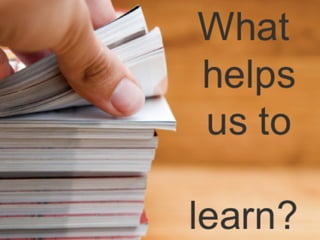
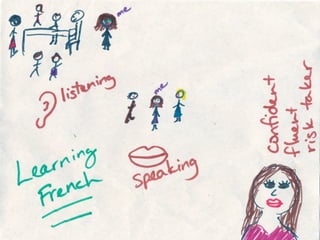
  • #50 Reflection – Take a moment to think of something that you feel you understand really well. It might be something that you can explain to others or something you have applied to solve a range of problems.\nWrite down or draw as much as you can about the learning experiences that you had, which contributed to this understanding.\n\n
  • #51 Reflection – Take a moment to think of something that you feel you understand really well. It might be something that you can explain to others or something you have applied to solve a range of problems.\nWrite down or draw as much as you can about the learning experiences that you had, which contributed to this understanding.\n\n\n
  • #52 Give time for participants to work.\n\nShare your experience with your table group and together identify any commonalities in your experiences then.\n\nAsk participants to share these commonalities and chart them while they share.\n
  • #53 Reflect on ideas/learning’s from Chapter 1 “Unpacking inquiry”\n
  • #54 Write down one thing you heard from one of your partners that you want to remember about the article.\n
  • #55 \n
  • #56 \n
  • #57 \n
  • #58 \n
  • #59 \n
  • #60 \n
  • #61 \n
  • #62 \n
  • #63 \n
  • #64 \n
  • #65 \n
  • #66 \n
  • #67 \n
  • #68 \n\n
  • #69 \n
  • #70 Mother Teresa - Indian nun, founded Missionaries of Charity in Calcutta, internationally known as a humanitarian and advocate for the poor and helpless, 1979 Nobel Peace Prize winner\nMohammed Yunis - Bangladeshi banker and economist who developed the concepts of microcredit and microfinance, advocating loans for entrepreneurs too poor to qualify for traditional loans, Nobel Peace Prize winner 2006 \nBarack Obama - American politician, President of United States, Winner of the Nobel Peace Prize 2009\nLiu Xiaobo - Chinese writer, human rights activist and political prisoner/dissident, just won the 2010 Nobel Peace Prize\nPrincess Diana - English aristocrat, campaigned against the use of landmines due the injuries they end of causing to children in war torn countries\nKofi Annan - Ghanaian diplomat who served as secretary general of the UN, 2001 Nobel Peace Prize, founded the Global AIDS and Health Fund to support developing countries in their struggle to care for their people\nPope Benedict XVI - Italian, Head of the Catholic church, founder and patron of the Ratzinger Foundation, a charitable organisation, which makes money from the sale of his books and essays in order to fund scholarships and bursaries for students across the world\nAngelina Jolie - American actress known for promoting humanitarian causes, and is noted for her work with refugees as a Goodwill Ambassador for the United Nations High Commissioner for Refugees\nSacha Baron Cohen-English comedian/actor best known as an agent provocateur in his portrayal of unorthodox characters.\nOsama bin Laden-Saudi Islamist extremist and founder of al-Qaeda.\n
  • #71 \n
  • #72 \n
  • #73 \n
  • #74 These are attributes that an internationally minded person demonstrates. Notes the similarities between their ideal learners and the Learner Profile. \n\nFind a sticky and note it on page 4 in your MPYPH.\n\nTake a moment to reflect on the Learner Profile and yourself, which attributes are well developed? Which are challenging for you? What can you do to develop this further during the first year at a new school?\n\nTeachers at AISD are expected to actively display the Learner Profile in their classrooms. One of our Bangla teachers has spent some time translating the attributes into Bangla, as displayed here. These are available in Tagore, the school’s faculty server.\n
  • #75 \n
  • #76 \n
  • #77 \n
  • #78 \n
  • #79 \n
  • #80 \n
  • #81 \n
  • #82 \n
  • #83 \n
  • #84 \n
  • #85 \n
  • #86 \n
  • #87 \n
  • #88 \n
  • #89 \n
  • #90 \n
  • #91 \n
  • #92 \n
  • #93 \n
  • #94 \n
  • #95 \n
  • #96 \n
  • #97 \n
  • #98 \n
  • #99 \n
  • #100 \n
  • #101 \n
  • #102 \n
  • #103 \n
  • #104 \n
  • #105 \n
  • #106 \n
  • #107 \n
  • #108 \n
  • #109 \n
  • #110 \n
  • #111 \n
  • #112 \n
  • #113 \n
  • #114 \n
  • #115 \n
  • #116 \n
  • #117 \n
  • #118 \n
  • #119 \n
  • #120 \n
  • #121 \n
  • #122 Sticking with “just the facts” is intellectually shallow and it fails to engage higher-order thinking.\nMemorization=lower-level cognitive work\n\n
  • #123 \n
  • #124 \n
  • #125 \n
  • #126 \n
  • #127 \n
  • #128 \n
  • #129 \n
  • #130 \n
  • #131 To stimulate more sophisticate, complex thinking, we need to create a synergy between the simple and more complex processing centers in the brain. This synergy means that information will be processed on two cognitive levels (factual and conceptual)\n\n
  • #132 \n
  • #133 \n
  • #134 \n
  • #135 \n
  • #136 \n
  • #137 \n
  • #138 \n
  • #139 \n
  • #140 \n
  • #141 \n
  • #142 \n
  • #143 \n
  • #144 \n
  • #145 Students retain the factual info longer because the use of the lens requires them to process what they know at a deeper level. Further, because students are invited to bring their own thinking to the facts at hand, they are better able to make personal meaning. The invitation involves them emotionally and the motivation for learning increases.\n
  • #146 Thinking reflectively (metacognitively), are you aware of how the lens invites you to bring your personal intellect to the study? Does the engagement of your personal intellect increase your motivation and interest in this study?\n
  • #147 \n
  • #148 \n
  • #149 The Futility of Trying to \n
  • #150 \n
  • #151 \n