Engaging Literacy:
Reading andWriting
Strategies for
Diverse and Inclusive
Classrooms
Faye Brownlie
May 22, 2025
Richmond’s Primary Bash
2.
Daily Literacy Goals– built on oral language
and joyful, engaging experiences
• Read aloud
• Independent reading
• Shared reading and response
• Write
• Word work
3.
Strategy Sequence
• Connecting
•Building motivation, accessing and building background knowledge,
asking questions, setting a purpose for reading
• Processing
• Making sense of new text, linking old information to new
• Transforming and personalizing
• Showing what you know
4.
Gradual Release ofResponsibility
• Teach the strategy or structure to the whole class, then move it to
a learning or literacy centre for those who need more practice.
• Not everybody needs the same skill at the same time.
• Plan for diversity with open-ended structures and strategies.
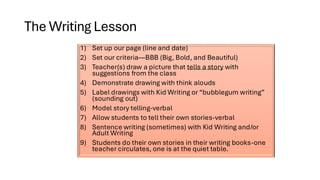
The Writing Lesson
1)Set up our page (line and date)
2) Set our criteria—BBB (Big, Bold, and Beautiful)
3) Teacher(s) draw a picture that tells a story with
suggestions from the class
4) Demonstrate drawing with think alouds
5) Label drawings with Kid Writing or “bubblegum writing”
(sounding out)
6) Model story telling-verbal
7) Allow students to tell their own stories-verbal
8) Sentence writing (sometimes) with Kid Writing and/or
Adult Writing
9) Students do their own stories in their writing books-one
teacher circulates, one is at the quiet table.
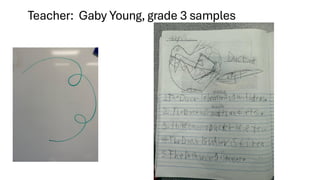
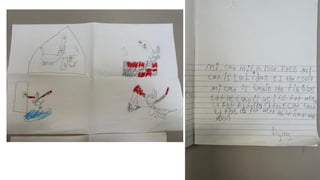
Squiggle Writing
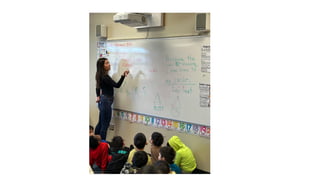
• Drawa squiggle on the whiteboard.
• Invite a child to make the squiggle into a picture, telling their story and
their thinking while they draw.
• Invite several children to show new drawings and stories, emphasizing
how different we can be, details in our stories, building on another’s
ideas…
• Model how you might begin your story, including how you get your
ideas, how the picture inspires your thinking, how you sound out
words…
• Children take their journals, draw the squiggle, add on to make a
picture and story, then write.
• Move among the children, conferencing as they write.
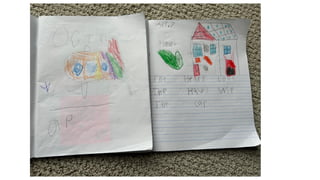
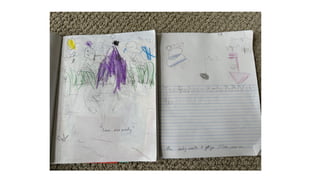
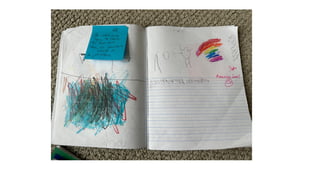
Teacher: Monica Lee,grades 1/2
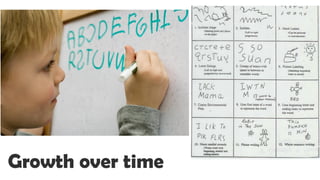
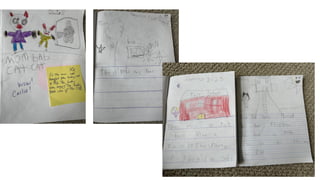
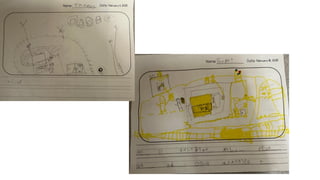
Squiggle – Feb 1. Notice the growth, 3 weeks later. Daily writing, lots of conversation, often starting with art.
26.
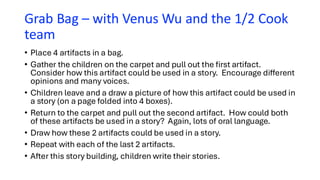
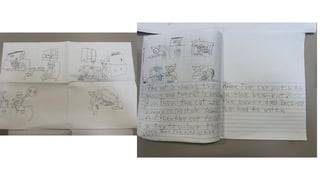
Grab Bag –with Venus Wu and the 1/2 Cook
team
• Place 4 artifacts in a bag.
• Gather the children on the carpet and pull out the first artifact.
Consider how this artifact could be used in a story. Encourage different
opinions and many voices.
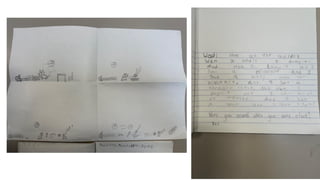
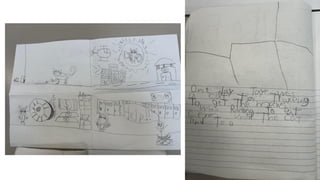
• Children leave and a draw a picture of how this artifact could be used in
a story (on a page folded into 4 boxes).
• Return to the carpet and pull out the second artifact. How could both
of these artifacts be used in a story? Again, lots of oral language.
• Draw how these 2 artifacts could be used in a story.
• Repeat with each of the last 2 artifacts.
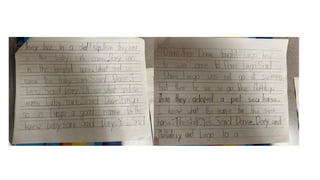
• After this story building, children write their stories.
31.
Embedding Phonics –beginning with words that
make sense, flexibly using word strategies
32.
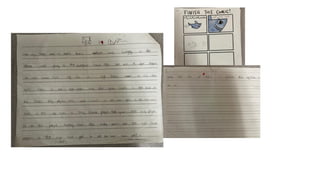
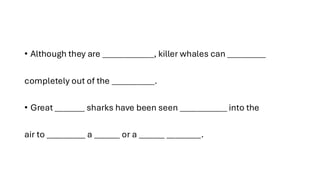
• Although theyare ____________, killer whales can _________
completely out of the __________.
• Great _______ sharks have been seen ___________ into the
air to _________ a ______ or a ______ ________.
33.
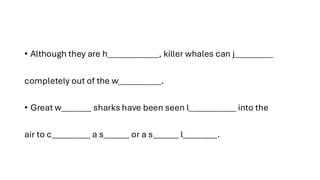
• Although theyare h____________, killer whales can j_________
completely out of the w__________.
• Great w_______ sharks have been seen l___________ into the
air to c_________ a s______ or a s______ l________.
34.
• Although theyare h____________, killer whales can j_________
(1 syllable, silent ‘e’) (1 syllable, short vowel)
completely out of the w__________.
(2 syllables)
• Great w_______ sharks have been seen l___________ into the
(1 syllable, silent ‘e’) (2 syllables, long vowel sound)
air to c_________ a s______ or a s______ l________.
(1 syllable)(1 syllable, long vowel) (same) (2 syllables, 1 long vowel)
36.
Adapted with permissionfrom the work of
Faye Brownlie, Harpreet Esmail, Erin Reid and
Deb Vanderwood
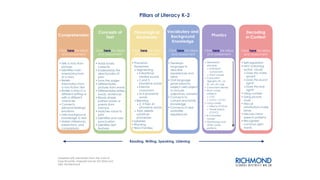
Comprehension
• Tells a story from
pictures
• Identifies main
events/structure
of a story
• Retells
information from
a non-fiction text
• Retells a story in a
different setting or
with a different
character
• Connects
personal feelings/
emotions
• Links background
knowledge to text
• Makes inferences,
predictions, and
comparisons
Decoding
In Context
Click here for ideas
and assessment
Phonological
Awareness
Click here for ideas
and assessment
• Develops
language to
describe
experiences and
ideas
• Oral language
grows beyond
subject-verb-object
to include
adjectives, adverbs
• Connects to
cultural and family
knowledge
• Connects to real
world/life
experiences
Vocabulary and
Background
Knowledge
Click here for ideas
and assessment
Phonics
• Alphabetic
principle
• Individual
consonants
• Short vowels
• Consonant
digraphs (th, ch,
sh, wh, ph, ing)
• Consonant blends
• Short vowel
patterns
• CVC
• CVCC, CCVC
• Long vowels
• Silent e (CVCe)
• Vowel teams
(CVVC)
• R controlled
vowels
• Diphthongs and
other vowel
patterns
Click here for ideas
and assessment
• Holds books
correctly
• Understands the
directionality of
print
• Turns the pages
• Differentiates
pictures from words
• Differentiates letters,
words, sentences
• Reads simple
pattern books or
poems from
memory
• Matches voice to
print
• Identifies and uses
punctuation
• Identifies text
features
Concepts of
Text
Click here for ideas
and assessment
• Self-regulation
• MSV (meaning,
syntax, visual):
• Does this make
sense?
• Does this sound
right?
• Does this look
right?
• Using context
• Using picture
clues
• Miscue
substitutions make
sense
• Miscues mirror
speech patterns
• Recognizes
common sight
words
• Phonemic
Awareness
• Segmenting
• Initial/final/
medial sounds
• 2 and 3
phoneme words
• Internal
consonant
• 4+5 phoneme
words
• Blending
• 2, 3 then 4+
phoneme words
• Add, delete,
substitute
phonemes
• Syllables
• Rhyming
• Word Families
Reading, Writing, Speaking, Listening
Pillars of Literacy K-2
Click here for ideas
and assessment
37.
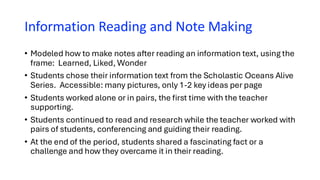
Information Reading andNote Making
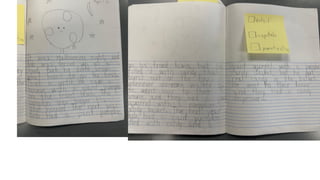
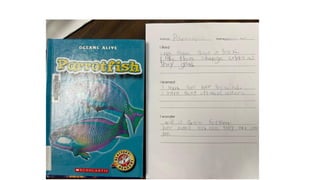
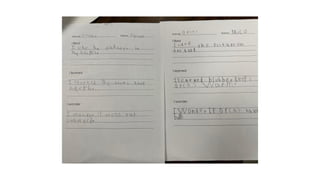
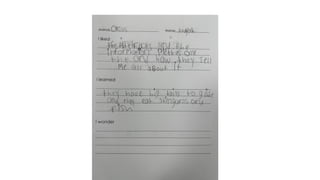
• Modeled how to make notes after reading an information text, using the
frame: Learned, Liked, Wonder
• Students chose their information text from the Scholastic Oceans Alive
Series. Accessible: many pictures, only 1-2 key ideas per page
• Students worked alone or in pairs, the first time with the teacher
supporting.
• Students continued to read and research while the teacher worked with
pairs of students, conferencing and guiding their reading.
• At the end of the period, students shared a fascinating fact or a
challenge and how they overcame it in their reading.
43.
Information Reading andNote Making
• Whole class read aloud.
• Connecting to prior knowledge.
• Introducing 3-5 new content vocabulary.
• Processing as a narrative – BME – and the big idea and watching
for embedded content.
• Transforming and Personalizing – something you now know about
bats.
44.
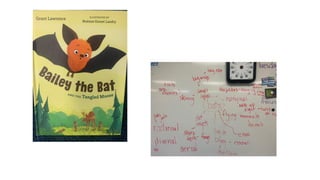
Lesson: Whole ClassRead-Aloud
Big Idea: non-fiction detail can be found
within a fiction story. Bats and moose are
both interesting animals. The skills of
someone small can help someone big.
Connecting: What do you know about bats?
Introduced 3 vocabulary: nocturnal, colony,
roost.
Processing: Read and discuss. What are we
finding out out about bats? Predicting events.
Searching for evidence to support predictions.
Hunter? Bird walk on hunters – Why? What?
Who? Different rules for Indigenous peoples.
Transforming/Personalizing: When the bats
worked together, they saved the moose. The
little bat saved the moose by finding him.
Both baby bat and baby moose disobeyed
their parents – lucky this time, but not good!
Class web as dismissed for hand washing –
one fact you know from the book about bats.
46.
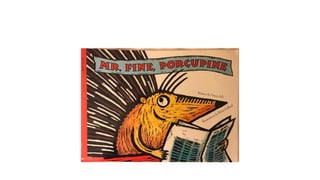
Writing in responseto a shared read – Gr K/1
Goals:
-recognition and generation of rhyme
-increase vocabulary
-collect information on independent, written sound/symbol
-connect with/respond to text
47.
Sequence
• Read thetext
• Emphasize the rhymes within Mr. Fine, Porcupine
• Draw and write the fruit Mr. Fine could have on his spikes
• Expand vocabulary, practice sound-symbol as children write
• Be prepared to change your plan and respond to your students!
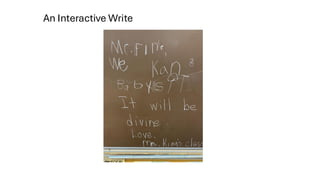
• Create a message for Mr. Fine using interactive writing
• Supports letter formation, sound-symbol development, spaces between
words – transcription
• Supports thinking beyond the text – what next?
• A teacher’sprofessional judgement is more important to a child’s
learning than any scripted programme.
51.
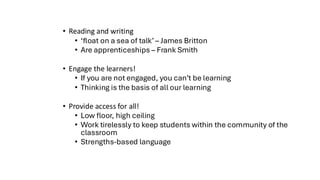
• Reading andwriting
• ‘float on a sea of talk’ – James Britton
• Are apprenticeships – Frank Smith
• Engage the learners!
• If you are not engaged, you can’t be learning
• Thinking is the basis of all our learning
• Provide access for all!
• Low floor, high ceiling
• Work tirelessly to keep students within the community of the
classroom
• Strengths-based language