Tuning	
  In:	
  	
  Engaging	
  All	
  Learners	
  
                 Nov.	
  21st,	
  2011	
  
                     Burnaby	
  
                 Faye	
  Brownlie	
  
               www.	
  slideshare.net	
  
Engagement
•  Schlechty:	
  	
  high	
  aCenDon	
  and	
  commitment	
  –	
  
   task	
  or	
  acDvity	
  has	
  inherent	
  meaning	
  or	
  value	
  
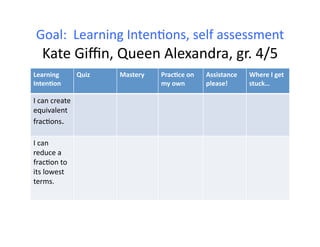
   to	
  the	
  student	
  
•  Stuart	
  Shanker	
  –	
  self-­‐regulaDon;	
  calmly	
  
   focused	
  and	
  alert	
  
•  Brownlie	
  and	
  Schnellert	
  –	
  voice	
  and	
  choice	
  
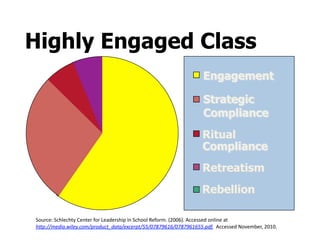
Highly Engaged Class


Source:	
  Schlechty	
  Center	
  for	
  Leadership	
  in	
  School	
  Reform.	
  (2006).	
  Accessed	
  online	
  at	
  
h"p://media.wiley.com/product_data/excerpt/55/07879616/0787961655.pdf.	
  	
  Accessed	
  November,	
  2010.	
  
Stuart Shanker:
          stages of arousal
InhibiDon	
  
  	
  asleep	
  
  	
  drowsy	
  
  	
  hypoalert	
  
  	
  calmly	
  focused	
  and	
  alert	
  ***	
  
  	
  hyperalert	
  
  	
  flooded	
  
AcDvaDon	
  
The	
  Progress	
  Principle:	
  Using	
  Small	
  
 Wins	
  to	
  Ignite	
  Joy,	
  Engagement,	
  and	
  
CreaDvity	
  at	
  Work	
  –	
  Amabile	
  &	
  Kramer	
  
•  Analyzed	
  238	
  electronic	
  daily	
  diaries	
  from	
  
   people	
  doing	
  innovaDve	
  work	
  in	
  7	
  companies	
  

•  What	
  was	
  the	
  #1	
  source	
  of	
  engagement?	
  
#1	
  source	
  of	
  engagement	


•  Making	
  progress	
  on	
  a	
  task	
  that	
  day,	
  no	
  maCer	
  
   how	
  trivial	
  
Causes	
  of	
  disengagement	
  
•  Micro-­‐management	
  or	
  a	
  lack	
  of	
  autonomy	
  

•  Failure	
  of	
  management	
  to	
  communicate	
  clear	
  
   goals	
  
BC Learning Principles

•  Learning	
  requires	
  the	
  acDve	
  parDcipaDon	
  of	
  the	
  
   learner	
  
•  People	
  learn	
  in	
  a	
  variety	
  of	
  ways	
  and	
  at	
  different	
  
   rates	
  
•  Learning	
  is	
  both	
  an	
  individual	
  and	
  a	
  group	
  
   process	


•  Ministry	
  of	
  EducaDon	
  
Frameworks


It’s All About Thinking – Brownlie & Schnellert, 2009
Universal Design for Learning
MulDple	
  means:	
  
-­‐to	
  tap	
  into	
  background	
  knowledge,	
  to	
  acDvate	
  
        prior	
  knowledge,	
  to	
  increase	
  engagement	
  and	
  
        moDvaDon	
  
-­‐to	
  acquire	
  the	
  informaDon	
  and	
  knowledge	
  to	
  
        process	
  new	
  ideas	
  and	
  informaDon	
  
-­‐to	
  express	
  what	
  they	
  know.	


  Rose	
  &	
  Meyer,	
  2002	
  
Backwards Design
•  What	
  important	
  ideas	
  and	
  enduring	
  
   understandings	
  do	
  you	
  want	
  the	
  students	
  to	
  
   know?	
  

•  What	
  thinking	
  strategies	
  will	
  students	
  need	
  to	
  
   demonstrate	
  these	
  understandings?	


  McTighe	
  &	
  Wiggins,	
  2001	


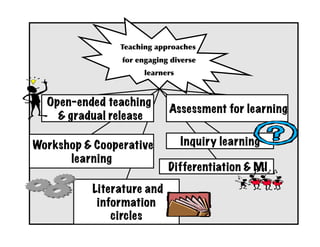
  Open-ended teaching
                                        Assessment for learning
    & gradual release

Workshop & Cooperative                              Inquiry learning
      learning
                                       Differentiation & MI
          Literature and
           information
              circles
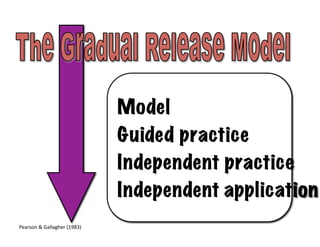
Model
                                          Guided practice
                                          Independent practice
                                          Independent application	
  
Pearson	
  &	
  Gallagher	
  (1983)	
  
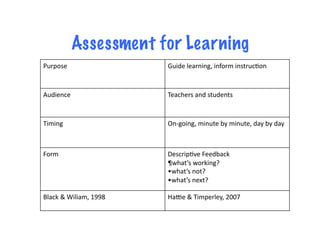
Assessment for Learning
Purpose	
                           Guide	
  learning,	
  inform	
  instrucDon	


Audience	
  	
                      Teachers	
  and	
  students	


Timing	
  	
                        On-­‐going,	
  minute	
  by	
  minute,	
  day	
  by	
  day	


Form	
  	
                          DescripDve	
  Feedback	
  
                                    ¶what’s	
  working?	
  
                                    •what’s	
  not?	
  
                                    •what’s	
  next?	
  

Black	
  &	
  Wiliam,	
  1998	
     Hake	
  &	
  Timperley,	
  2007	
  
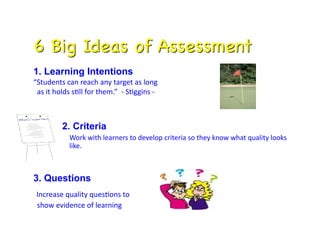
1. Learning Intentions
“Students	
  can	
  reach	
  any	
  target	
  as	
  long	


  as	
  it	
  holds	
  sDll	
  for	
  them.”	
  	
  -­‐	
  SDggins	
  -­‐	


                  2. Criteria
                      	
  Work	
  with	
  learners	
  to	
  develop	
  criteria	
  so	
  they	
  know	
  what	
  quality	
  looks	
  
                          like.	


3. Questions
	
  Increase	
  quality	
  quesDons	
  to	


  show	
  evidence	
  of	
  learning	
  
4.	
  Descrip+ve	
  Feedback	
  
Timely,	
  relevant	
  	
  descripDve	
  
feedback	
  contributes	
  most	
  	
  
powerfully	
  to	
  student	
  learning!	


5. Self & Peer Assessment
Involve	
  learners	
  more	
  in	
  self	
  &	
  peer	
  assessment


6. Ownership
Have	
  students	
  communicate	
  	
  
their	
  learning	
  with	
  others
Formative assessment
to determine students
 strengths and needs

   Brownlie, Feniak & Schnellert, 2006; Earl & Katz, 2005; Schnellert, Butler & Higginson, in press; Smith & Wilhelm, 2006
Teresa Fayant
          K
Stzuminus First Nation
Teaching	
  with	
  the	
  end	
  in	
  mind	
  
Goal:	
  	
  Learning	
  IntenDons,	
  self	
  assessment	
  
    Kate	
  Giffin,	
  Queen	
  Alexandra,	
  gr.	
  4/5	
  
Learning	
               Quiz	
     Mastery	
     Prac+ce	
  on	
     Assistance	
     Where	
  I	
  get	
  
Inten+on	
                                        my	
  own	
         please!	
        stuck…	
  

I	
  can	
  create	
  
equivalent	
  
fracDons.	

  

I	
  can	
  
reduce	
  a	
  
fracDon	
  to	
  
its	
  lowest	
  
terms.	
  
Math	
  Centres	
  –	
  gr.	
  1/2	
  
                 Michelle	
  Hikada	
  
•  4	
  groups	
  
•  1	
  with	
  Michelle,	
  working	
  on	
  graphing	
  (direct	
  
   teaching,	
  new	
  material)	
  
•  1	
  making	
  paCerns	
  with	
  different	
  materials	
  
   (pracDce)	
  
•  1	
  making	
  paCerns	
  with	
  sDckers	
  (pracDce)	
  
•  1	
  graphing	
  in	
  partners	
  (pracDce)	
  
•  With	
  your	
  partner,	
  choose	
  a	
  bucket	
  of	
  
   materials	
  and	
  make	
  a	
  bar	
  graph.	
  
•  Ask	
  (and	
  answer)	
  at	
  least	
  3	
  quesDons	
  about	
  
   your	
  graph.	
  
•  Make	
  another	
  graph	
  with	
  a	
  different	
  material.	
  
Goal: develop and apply mathematical
                language
•  Sit	
  back	
  to	
  back	
  with	
  a	
  partner	
  
•  Partner	
  A	
  observes	
  the	
  diagram	
  and	
  describes	
  
   it	
  to	
  partner	
  B	
  
•  Partner	
  B	
  draws	
  what	
  he	
  hears	
  Partner	
  A	
  
   describing	
  
•  Reflect:	
  	
  what	
  worked	
  in	
  the	
  partnership?	
  	
  
   What	
  didn’t?	
  	
  How	
  can	
  it	
  be	
  improved?	
  
Inuit	
  Study	
  
•  Now	
  try	
  the	
  same	
  strategy	
  with	
  content.	
  

•  Back	
  to	
  back	
  drawing.	
  
•  Ater	
  each	
  sketch,	
  check	
  out	
  the	
  image	
  and	
  write	
  
   a	
  one	
  sentence	
  synthesis	
  of	
  what	
  is	
  important	
  –	
  
   or	
  generate	
  5-­‐8	
  key	
  phrases	
  describing	
  the	
  
   picture.	
  
•  Students	
  walk	
  through	
  the	
  ‘gallery’	
  and	
  observe	
  
   the	
  other	
  pictures	
  and	
  statements/phrases.	
  
•  Students	
  web	
  what	
  they	
  now	
  know.	
  
Engaging	
  All	
  Learners	
  –	
  what	
  works?	
  
           Universal Design for Learning
                     Backwards Design
•    Open-­‐ended	
  teaching	
  and	
  gradual	
  release	
  
•    Assessment	
  for	
  learning	
  
•    Inquiry	
  
•    DifferenDaDon	
  and	
  mulDple	
  intelligences	
  
•    Literature	
  and	
  informaDon	
  circles	
  
•    Workshop	
  and	
  cooperaDve	
  learning	
  
Think	
  Aloud:	


                        Students	
  need	
  
•  A	
  model	
  
•  Guided	
  pracDce	
  in	
  following	
  the	
  model	
  
•  An	
  opportunity	
  to	
  pracDce	
  the	
  strategy,	
  with	
  
   support	
  as	
  needed	
  
•  Choice	
  in	
  the	
  degree	
  of	
  complexity	
  they	
  use	
  to	
  
   complete	
  the	
  task	
  
Sea	
  OCer	
  Pup	
  -­‐	
  Victoria	
  Miles	
  (Orca)	
  

There	
  is	
  a	
  forest	
  of	
  seaweed	
  in	
  the	
  ocean.	


It	
  is	
  a	
  forest	
  of	
  kelp.	
  	
  At	
  the	
  boCom	
  of	
  the	
  
	
  kelp	
  forest,	
  Mother	
  sea	
  oCer	
  searches	
  for	
  
	
  food.	
  
High	
  above,	
  her	
  pup	
  is	
  waiDng.	
  	
  He	
  is	
  
	
  wrapped	
  in	
  a	
  piece	
  of	
  kelp	
  so	
  he	
  can’t	
  
	
  drit	
  away	
  while	
  Mother	
  is	
  down	
  
	
  below.	
  
He	
  bobs,	
  floaDng	
  on	
  his	
  back	
  in	
  the	
  
	
  cold	
  waves,	
  holding	
  his	
  front	
  paws	
  and	
  
	
  hind	
  flippers	
  above	
  the	
  water	
  to	
  keep	
  
	
  them	
  dry.	
  
Resources	
  	
  
•  Grand	
  ConversaDons,	
  ThoughHul	
  Responses	
  –	
  a	
  unique	
  
   approach	
  to	
  literature	
  circles	
  –	
  Brownlie,	
  2005	
  
•  Student	
  Diversity,	
  2nd	
  ed.	
  –	
  Brownlie,	
  Feniak	
  &	
  Schnellert,	
  
   2006	
  
•  Reading	
  and	
  Responding,	
  gr.	
  4,5,&6	
  –	
  Brownlie	
  &	
  Jeroski,	
  
   2006	
  
•  It’s	
  All	
  about	
  Thinking	
  –	
  collaboraDng	
  to	
  support	
  all	
  learners	
  
   (in	
  English,	
  Social	
  Studies	
  and	
  HumaniDes)	
  –	
  Brownlie	
  &	
  
   Schnellert,	
  2009	
  
•  It’s	
  All	
  about	
  Thinking	
  –	
  collaboraDng	
  to	
  support	
  all	
  learners	
  
   (in	
  Math	
  and	
  Science)	
  -­‐	
  Brownlie,	
  Fullerton	
  &	
  Schnellert,	
  2011	
  
•  Learning	
  in	
  Safe	
  Schools,	
  2nd	
  ed	
  –	
  Brownlie	
  &	
  King,	
  Oct.,	
  2011	
  
•  Assessment	
  &	
  InstrucDon	
  of	
  ESL	
  Learners,	
  2nd	
  ed	
  –	
  Brownlie,	
  
   Feniak,	
  &	
  McCarthy,	
  in	
  press	
  

Burnaby.engagement.nov.2011

  • 1.
    Tuning  In:    Engaging  All  Learners   Nov.  21st,  2011   Burnaby   Faye  Brownlie   www.  slideshare.net  
  • 2.
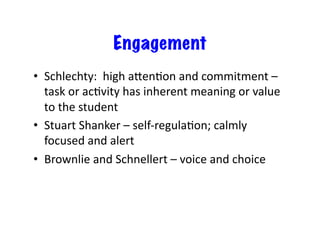
    Engagement •  Schlechty:    high  aCenDon  and  commitment  –   task  or  acDvity  has  inherent  meaning  or  value   to  the  student   •  Stuart  Shanker  –  self-­‐regulaDon;  calmly   focused  and  alert   •  Brownlie  and  Schnellert  –  voice  and  choice  
  • 3.
    Highly Engaged Class Source:  Schlechty  Center  for  Leadership  in  School  Reform.  (2006).  Accessed  online  at   h"p://media.wiley.com/product_data/excerpt/55/07879616/0787961655.pdf.    Accessed  November,  2010.  
  • 4.
    Stuart Shanker: stages of arousal InhibiDon    asleep    drowsy    hypoalert    calmly  focused  and  alert  ***    hyperalert    flooded   AcDvaDon  
  • 5.
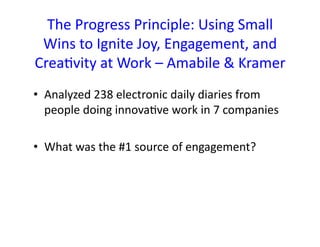
    The  Progress  Principle:  Using  Small   Wins  to  Ignite  Joy,  Engagement,  and   CreaDvity  at  Work  –  Amabile  &  Kramer   •  Analyzed  238  electronic  daily  diaries  from   people  doing  innovaDve  work  in  7  companies   •  What  was  the  #1  source  of  engagement?  
  • 6.
    #1  source  of  engagement   •  Making  progress  on  a  task  that  day,  no  maCer   how  trivial  
  • 7.
    Causes  of  disengagement   •  Micro-­‐management  or  a  lack  of  autonomy   •  Failure  of  management  to  communicate  clear   goals  
  • 8.
    BC Learning Principles • Learning  requires  the  acDve  parDcipaDon  of  the   learner   •  People  learn  in  a  variety  of  ways  and  at  different   rates   •  Learning  is  both  an  individual  and  a  group   process   •  Ministry  of  EducaDon  
  • 9.
    Frameworks It’s All AboutThinking – Brownlie & Schnellert, 2009
  • 10.
    Universal Design forLearning MulDple  means:   -­‐to  tap  into  background  knowledge,  to  acDvate   prior  knowledge,  to  increase  engagement  and   moDvaDon   -­‐to  acquire  the  informaDon  and  knowledge  to   process  new  ideas  and  informaDon   -­‐to  express  what  they  know.                        Rose  &  Meyer,  2002  
  • 11.
    Backwards Design •  What  important  ideas  and  enduring   understandings  do  you  want  the  students  to   know?   •  What  thinking  strategies  will  students  need  to   demonstrate  these  understandings?                      McTighe  &  Wiggins,  2001  
  • 12.
      Open-endedteaching Assessment for learning & gradual release Workshop & Cooperative Inquiry learning learning Differentiation & MI Literature and information circles
  • 13.
    Model Guided practice Independent practice Independent application   Pearson  &  Gallagher  (1983)  
  • 14.
    Assessment for Learning Purpose   Guide  learning,  inform  instrucDon   Audience     Teachers  and  students   Timing     On-­‐going,  minute  by  minute,  day  by  day   Form     DescripDve  Feedback   ¶what’s  working?   •what’s  not?   •what’s  next?   Black  &  Wiliam,  1998   Hake  &  Timperley,  2007  
  • 15.
    1. Learning Intentions “Students  can  reach  any  target  as  long        as  it  holds  sDll  for  them.”    -­‐  SDggins  -­‐   2. Criteria  Work  with  learners  to  develop  criteria  so  they  know  what  quality  looks   like.   3. Questions  Increase  quality  quesDons  to        show  evidence  of  learning  
  • 16.
    4.  Descrip+ve  Feedback   Timely,  relevant    descripDve   feedback  contributes  most     powerfully  to  student  learning!   5. Self & Peer Assessment Involve  learners  more  in  self  &  peer  assessment 6. Ownership Have  students  communicate     their  learning  with  others
  • 17.
    Formative assessment to determinestudents strengths and needs Brownlie, Feniak & Schnellert, 2006; Earl & Katz, 2005; Schnellert, Butler & Higginson, in press; Smith & Wilhelm, 2006
  • 18.
    Teresa Fayant K Stzuminus First Nation
  • 27.
    Teaching  with  the  end  in  mind  
  • 28.
    Goal:    Learning  IntenDons,  self  assessment   Kate  Giffin,  Queen  Alexandra,  gr.  4/5   Learning   Quiz   Mastery   Prac+ce  on   Assistance   Where  I  get   Inten+on   my  own   please!   stuck…   I  can  create   equivalent   fracDons.   I  can   reduce  a   fracDon  to   its  lowest   terms.  
  • 29.
    Math  Centres  –  gr.  1/2   Michelle  Hikada   •  4  groups   •  1  with  Michelle,  working  on  graphing  (direct   teaching,  new  material)   •  1  making  paCerns  with  different  materials   (pracDce)   •  1  making  paCerns  with  sDckers  (pracDce)   •  1  graphing  in  partners  (pracDce)  
  • 30.
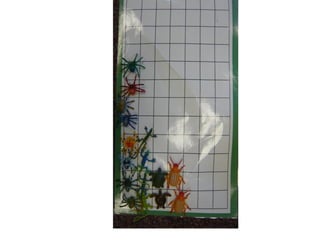
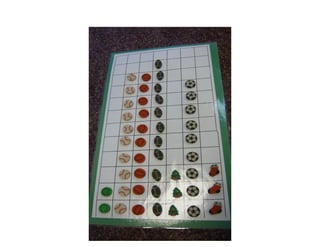
    •  With  your  partner,  choose  a  bucket  of   materials  and  make  a  bar  graph.   •  Ask  (and  answer)  at  least  3  quesDons  about   your  graph.   •  Make  another  graph  with  a  different  material.  
  • 33.
    Goal: develop andapply mathematical language •  Sit  back  to  back  with  a  partner   •  Partner  A  observes  the  diagram  and  describes   it  to  partner  B   •  Partner  B  draws  what  he  hears  Partner  A   describing   •  Reflect:    what  worked  in  the  partnership?     What  didn’t?    How  can  it  be  improved?  
  • 36.
    Inuit  Study   • Now  try  the  same  strategy  with  content.   •  Back  to  back  drawing.   •  Ater  each  sketch,  check  out  the  image  and  write   a  one  sentence  synthesis  of  what  is  important  –   or  generate  5-­‐8  key  phrases  describing  the   picture.   •  Students  walk  through  the  ‘gallery’  and  observe   the  other  pictures  and  statements/phrases.   •  Students  web  what  they  now  know.  
  • 39.
    Engaging  All  Learners  –  what  works?   Universal Design for Learning Backwards Design •  Open-­‐ended  teaching  and  gradual  release   •  Assessment  for  learning   •  Inquiry   •  DifferenDaDon  and  mulDple  intelligences   •  Literature  and  informaDon  circles   •  Workshop  and  cooperaDve  learning  
  • 40.
    Think  Aloud:       Students  need   •  A  model   •  Guided  pracDce  in  following  the  model   •  An  opportunity  to  pracDce  the  strategy,  with   support  as  needed   •  Choice  in  the  degree  of  complexity  they  use  to   complete  the  task  
  • 42.
    Sea  OCer  Pup  -­‐  Victoria  Miles  (Orca)   There  is  a  forest  of  seaweed  in  the  ocean.       It  is  a  forest  of  kelp.    At  the  boCom  of  the    kelp  forest,  Mother  sea  oCer  searches  for    food.  
  • 43.
    High  above,  her  pup  is  waiDng.    He  is    wrapped  in  a  piece  of  kelp  so  he  can’t    drit  away  while  Mother  is  down    below.  
  • 44.
    He  bobs,  floaDng  on  his  back  in  the    cold  waves,  holding  his  front  paws  and    hind  flippers  above  the  water  to  keep    them  dry.  
  • 45.
    Resources     • Grand  ConversaDons,  ThoughHul  Responses  –  a  unique   approach  to  literature  circles  –  Brownlie,  2005   •  Student  Diversity,  2nd  ed.  –  Brownlie,  Feniak  &  Schnellert,   2006   •  Reading  and  Responding,  gr.  4,5,&6  –  Brownlie  &  Jeroski,   2006   •  It’s  All  about  Thinking  –  collaboraDng  to  support  all  learners   (in  English,  Social  Studies  and  HumaniDes)  –  Brownlie  &   Schnellert,  2009   •  It’s  All  about  Thinking  –  collaboraDng  to  support  all  learners   (in  Math  and  Science)  -­‐  Brownlie,  Fullerton  &  Schnellert,  2011   •  Learning  in  Safe  Schools,  2nd  ed  –  Brownlie  &  King,  Oct.,  2011   •  Assessment  &  InstrucDon  of  ESL  Learners,  2nd  ed  –  Brownlie,   Feniak,  &  McCarthy,  in  press