

Why Workshop?
 Julie Buzza and Mindi Rench
Northbrook School District 28
What do teachers say about using
   a workshop framework?
When using the workshop format, I find that my kids write
better. I write better. I use the workshop model to teach them
specific strategies and when we explore these strategies
together, I find that I am learning right along with them. The
students are also more aware of the writing strategies that
we've discussed and they are pointing them out throughout
the day. They have become more purposeful writers.
In reading workshop, I find that I am doing a lot more 1:1
instruction, based on my reading conferences. Before, when I
taught a whole class novel, it was easier on me, but I don't
think it was as beneficial for the students. Now, when we read
novels in groups, I find they are learning through their
discussions - just like they will in the real world!

                   -Fifth grade teacher with twenty-five years of teaching experience
The greatest benefit of using the workshop model is that
I can focus on the student's individual needs. When I
confer, I can assess what they do, what they need, and
then guide my instruction according to what I see.
                           -First grade teacher with 10+ years of experience
How has my teaching changed?  I'm not the one in
control.  While I may assign specific genres for reading
and writing according to the district scope, the topics are
entirely up to the kids.  I also give them many
opportunities throughout the year to work on writing that
is entirely self-selected.  I find that the kids are much more
willing to write and revise pieces when they have that
choice.  I'm also finding kids are reading MUCH MORE
since we've moved away from assigned books.  Because of
the genres 7th grade is responsible for, most of our shared
texts are short.  This leaves plenty of opportunity for self-
selected independent reading.
                   -Seventh grade teacher with eighteen years experience
Guiding Principles 
                   of a Workshop Model


creating an environment conducive to reading and writing

includes a blend of whole-group, small-group, and individual instruction

includes opportunities for students to read and write independently

includes opportunities for choice within the workshop - this provides ownership
of learning for students


                                          Teaching For Deep Comprehension by Linda Dorn & Carla Soffos
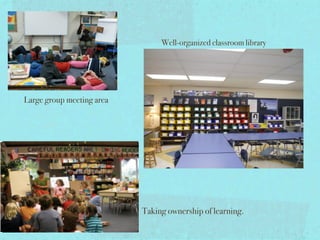
Well-organized classroom library


Large group meeting area


                           Taking ownership of learning.
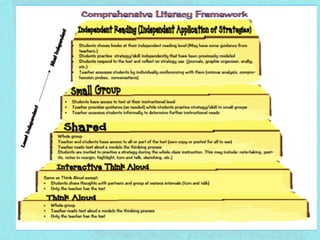
Workshop Framework (5 Components)


1. Mini-lessons

2. Small Group Instruction

3. One-to one or small group conferences

4. Share time


                         Teaching For Deep Comprehension by Linda Dorn & Carla Soffos, p. 66-67
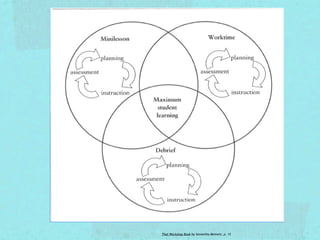
That Workshop Book by Samantha Bennett, p. 15
Planning
What do students need to know and
be able to do in order to be better
adults? How can I help students come
to know what they know and are able
to do? What will I do if they don't get

                           That Workshop Book by Samantha Bennett, p. 7
Instruction
What daily systems, structures, routines, and rituals
will help me uncover what my students know and are
able to do so I can teach them more today and teach
them better tomorrow? What will help students
know so they can become intrinsically motivated
agents of their own learning?


                                That Workshop Book by Samantha Bennett, p. 7
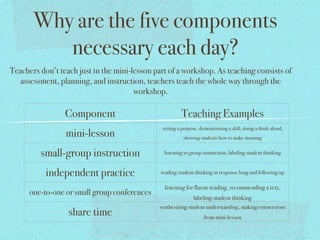
Why are the five components
          necessary each day?
Teachers don’t teach just in the mini-lesson part of a workshop. As teaching consists of
   assessment, planning, and instruction, teachers teach the whole way through the
                                       workshop.

                 Component                              Teaching Examples
                                               setting a purpose, demonstrating a skill, doing a think-aloud,
                 mini-lesson                             showing students how to make meaning


         small-group instruction                listening to group instruction, labeling student thinking


           independent practice                reading student thinking in response long and following up

                                                listening for fluent reading, recommending a text,
      one-to-one or small group conferences
                                                             labeling student thinking
                                              synthesizing student understanding, making connections
                  share time                                        from mini-lesson
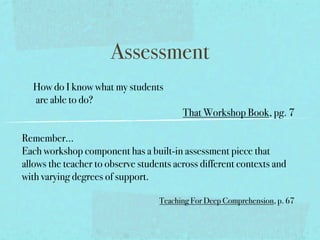
Assessment
      How do I know what my students 
       are able to do?
                                         That Workshop Book, pg. 7

Remember...
Each workshop component has a built-in assessment piece that
allows the teacher to observe students across different contexts and
with varying degrees of support.

                                   Teaching For Deep Comprehension, p. 67
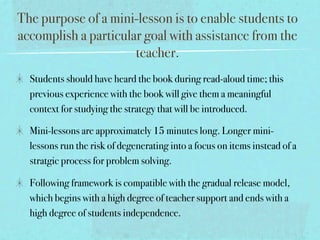
The purpose of a mini-lesson is to enable students to
accomplish a particular goal with assistance from the
                      teacher.
  Students should have heard the book during read-aloud time; this
  previous experience with the book will give them a meaningful
  context for studying the strategy that will be introduced.

  Mini-lessons are approximately 15 minutes long. Longer mini-
  lessons run the risk of degenerating into a focus on items instead of a
  stratgic process for problem solving.

  Following framework is compatible with the gradual release model,
  which begins with a high degree of teacher support and ends with a
  high degree of students independence.
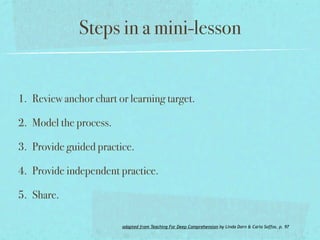
Steps in a mini-lesson


1. Review anchor chart or learning target.

2. Model the process.

3. Provide guided practice.

4. Provide independent practice.

5. Share.

                        adapted from Teaching For Deep Comprehension by Linda Dorn & Carla Soffos, p. 97
What happens after a mini-lesson?

Small Group Instruction

   Guided reading groups

   Literature circles

Practice to Promote Transfer

   Independently

   With a peer

Conferring With the Teacher

   One-to-one

   Small group conferences
A Closer Look at Small Groups

   Guided Reading Groups            Literature Discussion Groups

                                    "Small groups of students read
"The teacher selects a common       and discuss a common text.
                                 Text
text for a group of students with During the group discussion,
similar needs.  Each student        the teacher is a participant-
reads the entire text; the          observer, allowing the students
teacher circulates among the        to assume the major
group, prompting individual         responsibility for talking about
students to apply various           the book."
comprehending strategies." 
             Don't forget about small writing groups too!
                                    Teaching For Deep Comprehension by Linda Dorn & Carla Soffos, p. 67
So how does transfer happen?
"To promote transfer, teachers need to give students opportunities
         to apply their knowledge without guidance." 

     Independent:                                       With a peer:

Reading or a variety of tasks to support reading   Buddy reading
comprehension...                                   Paried reading
 • reflections in reading log                      Peer discussion groups
 • creating a text map                             Reader's theatre
                                                   Literature extensions
Writing or a variety of tasks to support the
writing process...                                 Peer writing conferences
 • entries in a notebook                           Co-writing with a peer
 • reading mentor texts

(The primary grades might have literacy
centers.)


                                                      Teaching For Deep Comprehension by Linda Dorn & Carla Soffos, p. 67
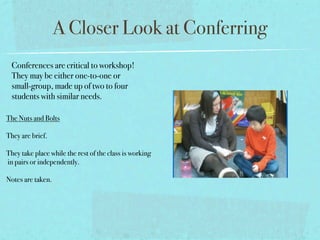
A Closer Look at Conferring
 Conferences are critical to workshop!
 They may be either one-to-one or
 small-group, made up of two to four
 students with similar needs.

The Nuts and Bolts

They are brief.

They take place while the rest of the class is working
in pairs or independently.

Notes are taken.
What were we thinking?
   Lab Teacher Conferring Study
            11-18-08
“Conferences work because
        I am showing the kids
I genuinely care about their learning
  and I can see what they need help
    with if they do and then plan
             accordingly.”
“They need a goal.
   That is a great way
to end the conference.”
“I am realizing that conferring at all
levels is valuable and important. First
 graders need it as well as junior high
               students.”
“At this moment, I am thinking
 that conferring with students is
one of the most powerful ways to
       get to know a child.“
“One has to be intentional
 in order to be successful
      in conferring.“
“We are facilitators in these
   conferences- allowing the
children to process and develop
        their thinking.”
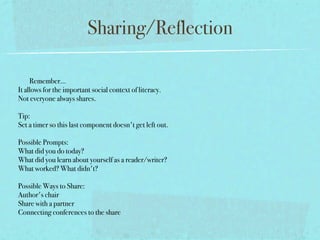
Sharing/Reflection

     Remember...
It allows for the important social context of literacy.
Not everyone always shares.

Tip: 
Set a timer so this last component doesn't get left out.  

Possible Prompts:
What did you do today?
What did you learn about yourself as a reader/writer?
What worked? What didn't?

Possible Ways to Share:
Author's chair
Share with a partner
Connecting conferences to the share
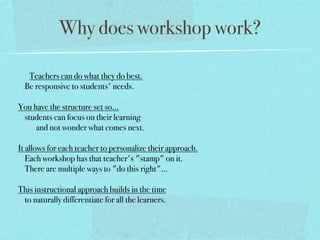
Why does workshop work?

     Teachers can do what they do best.
    Be responsive to students' needs.

You have the structure set so...
    students can focus on their learning 
           and not wonder what comes next.

It allows for each teacher to personalize their approach.
    Each workshop has that teacher's "stamp" on it.
    There are multiple ways to "do this right"... 

This instructional approach builds in the time
    to naturally differentiate for all the learners. 
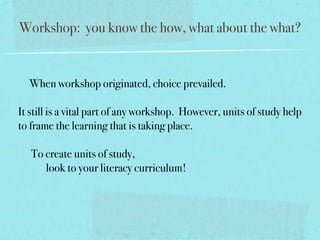
Workshop: you know the how, what about the what?


   When workshop originated, choice prevailed.

It still is a vital part of any workshop.  However, units of study help
to frame the learning that is taking place.

      To create units of study, 
             look to your literacy curriculum!
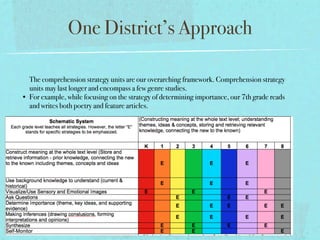
One District’s Approach

  The comprehension strategy units are our overarching framework. Comprehension strategy
  units may last longer and encompass a few genre studies.  
• For example, while focusing on the strategy of determining importance, our 7th grade reads
  and writes both poetry and feature articles.
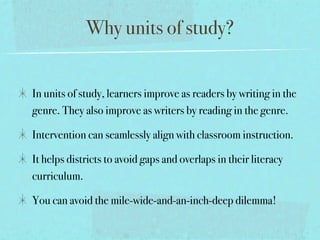
Why units of study?


In units of study, learners improve as readers by writing in the
genre. They also improve as writers by reading in the genre.

Intervention can seamlessly align with classroom instruction.

It helps districts to avoid gaps and overlaps in their literacy
curriculum.

You can avoid the mile-wide-and-an-inch-deep dilemma!
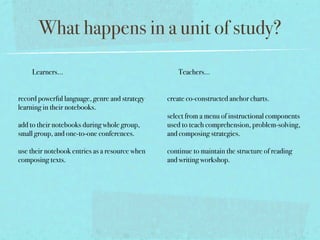
What happens in a unit of study?

    Learners...                                     Teachers...


record powerful language, genre and strategy    create co-constructed anchor charts.
learning in their notebooks.
                                                select from a menu of instructional components
add to their notebooks during whole group,      used to teach comprehension, problem-solving,
small group, and one-to-one conferences.        and composing strategies.

use their notebook entries as a resource when   continue to maintain the structure of reading
composing texts.                                and writing workshop. 

Why Workshop

  • 1.
    Why Workshop? JulieBuzza and Mindi Rench Northbrook School District 28
  • 2.
    What do teacherssay about using a workshop framework?
  • 3.
    When using theworkshop format, I find that my kids write better. I write better. I use the workshop model to teach them specific strategies and when we explore these strategies together, I find that I am learning right along with them. The students are also more aware of the writing strategies that we've discussed and they are pointing them out throughout the day. They have become more purposeful writers. In reading workshop, I find that I am doing a lot more 1:1 instruction, based on my reading conferences. Before, when I taught a whole class novel, it was easier on me, but I don't think it was as beneficial for the students. Now, when we read novels in groups, I find they are learning through their discussions - just like they will in the real world! -Fifth grade teacher with twenty-five years of teaching experience
  • 4.
    The greatest benefitof using the workshop model is that I can focus on the student's individual needs. When I confer, I can assess what they do, what they need, and then guide my instruction according to what I see. -First grade teacher with 10+ years of experience
  • 5.
    How has myteaching changed?  I'm not the one in control.  While I may assign specific genres for reading and writing according to the district scope, the topics are entirely up to the kids.  I also give them many opportunities throughout the year to work on writing that is entirely self-selected.  I find that the kids are much more willing to write and revise pieces when they have that choice.  I'm also finding kids are reading MUCH MORE since we've moved away from assigned books.  Because of the genres 7th grade is responsible for, most of our shared texts are short.  This leaves plenty of opportunity for self- selected independent reading. -Seventh grade teacher with eighteen years experience
  • 6.
    Guiding Principles  of a Workshop Model creating an environment conducive to reading and writing includes a blend of whole-group, small-group, and individual instruction includes opportunities for students to read and write independently includes opportunities for choice within the workshop - this provides ownership of learning for students Teaching For Deep Comprehension by Linda Dorn & Carla Soffos
  • 7.
    Well-organized classroom library Largegroup meeting area Taking ownership of learning.
  • 8.
    Workshop Framework (5Components) 1. Mini-lessons 2. Small Group Instruction 3. One-to one or small group conferences 4. Share time Teaching For Deep Comprehension by Linda Dorn & Carla Soffos, p. 66-67
  • 10.
    That Workshop Bookby Samantha Bennett, p. 15
  • 11.
    Planning What do students need toknow and be able to do in order to be better adults? How can I help students come to know what they know and are able to do? What will I do if they don't get That Workshop Book by Samantha Bennett, p. 7
  • 12.
    Instruction What daily systems,structures, routines, and rituals will help me uncover what my students know and are able to do so I can teach them more today and teach them better tomorrow? What will help students know so they can become intrinsically motivated agents of their own learning? That Workshop Book by Samantha Bennett, p. 7
  • 13.
    Why are thefive components necessary each day? Teachers don’t teach just in the mini-lesson part of a workshop. As teaching consists of assessment, planning, and instruction, teachers teach the whole way through the workshop. Component Teaching Examples setting a purpose, demonstrating a skill, doing a think-aloud, mini-lesson showing students how to make meaning small-group instruction listening to group instruction, labeling student thinking independent practice reading student thinking in response long and following up listening for fluent reading, recommending a text, one-to-one or small group conferences labeling student thinking synthesizing student understanding, making connections share time from mini-lesson
  • 14.
    Assessment How do I know what my students         are able to do? That Workshop Book, pg. 7 Remember... Each workshop component has a built-in assessment piece that allows the teacher to observe students across different contexts and with varying degrees of support. Teaching For Deep Comprehension, p. 67
  • 15.
    The purpose ofa mini-lesson is to enable students to accomplish a particular goal with assistance from the teacher. Students should have heard the book during read-aloud time; this previous experience with the book will give them a meaningful context for studying the strategy that will be introduced. Mini-lessons are approximately 15 minutes long. Longer mini- lessons run the risk of degenerating into a focus on items instead of a stratgic process for problem solving. Following framework is compatible with the gradual release model, which begins with a high degree of teacher support and ends with a high degree of students independence.
  • 16.
    Steps in amini-lesson 1. Review anchor chart or learning target. 2. Model the process. 3. Provide guided practice. 4. Provide independent practice. 5. Share. adapted from Teaching For Deep Comprehension by Linda Dorn & Carla Soffos, p. 97
  • 17.
    What happens aftera mini-lesson? Small Group Instruction Guided reading groups Literature circles Practice to Promote Transfer Independently With a peer Conferring With the Teacher One-to-one Small group conferences
  • 18.
    A Closer Lookat Small Groups Guided Reading Groups Literature Discussion Groups "Small groups of students read "The teacher selects a common and discuss a common text. Text text for a group of students with During the group discussion, similar needs.  Each student the teacher is a participant- reads the entire text; the observer, allowing the students teacher circulates among the to assume the major group, prompting individual responsibility for talking about students to apply various the book." comprehending strategies."  Don't forget about small writing groups too! Teaching For Deep Comprehension by Linda Dorn & Carla Soffos, p. 67
  • 19.
    So how doestransfer happen? "To promote transfer, teachers need to give students opportunities to apply their knowledge without guidance."  Independent: With a peer: Reading or a variety of tasks to support reading Buddy reading comprehension... Paried reading • reflections in reading log Peer discussion groups • creating a text map Reader's theatre Literature extensions Writing or a variety of tasks to support the writing process... Peer writing conferences • entries in a notebook Co-writing with a peer • reading mentor texts (The primary grades might have literacy centers.) Teaching For Deep Comprehension by Linda Dorn & Carla Soffos, p. 67
  • 20.
    A Closer Lookat Conferring Conferences are critical to workshop! They may be either one-to-one or small-group, made up of two to four students with similar needs. The Nuts and Bolts They are brief. They take place while the rest of the class is working in pairs or independently. Notes are taken.
  • 21.
    What were wethinking? Lab Teacher Conferring Study 11-18-08
  • 22.
    “Conferences work because I am showing the kids I genuinely care about their learning and I can see what they need help with if they do and then plan accordingly.”
  • 23.
    “They need agoal. That is a great way to end the conference.”
  • 24.
    “I am realizingthat conferring at all levels is valuable and important. First graders need it as well as junior high students.”
  • 25.
    “At this moment,I am thinking that conferring with students is one of the most powerful ways to get to know a child.“
  • 26.
    “One has tobe intentional in order to be successful in conferring.“
  • 27.
    “We are facilitatorsin these conferences- allowing the children to process and develop their thinking.”
  • 28.
    Sharing/Reflection Remember... It allows for the important social context of literacy. Not everyone always shares. Tip:  Set a timer so this last component doesn't get left out.   Possible Prompts: What did you do today? What did you learn about yourself as a reader/writer? What worked? What didn't? Possible Ways to Share: Author's chair Share with a partner Connecting conferences to the share
  • 29.
    Why does workshopwork? Teachers can do what they do best.     Be responsive to students' needs. You have the structure set so...     students can focus on their learning             and not wonder what comes next. It allows for each teacher to personalize their approach.     Each workshop has that teacher's "stamp" on it.     There are multiple ways to "do this right"...  This instructional approach builds in the time     to naturally differentiate for all the learners. 
  • 30.
    Workshop: you knowthe how, what about the what? When workshop originated, choice prevailed. It still is a vital part of any workshop.  However, units of study help to frame the learning that is taking place.       To create units of study,               look to your literacy curriculum!
  • 31.
    One District’s Approach The comprehension strategy units are our overarching framework. Comprehension strategy units may last longer and encompass a few genre studies.   • For example, while focusing on the strategy of determining importance, our 7th grade reads and writes both poetry and feature articles.
  • 32.
    Why units ofstudy? In units of study, learners improve as readers by writing in the genre. They also improve as writers by reading in the genre. Intervention can seamlessly align with classroom instruction. It helps districts to avoid gaps and overlaps in their literacy curriculum. You can avoid the mile-wide-and-an-inch-deep dilemma!
  • 33.
    What happens ina unit of study? Learners... Teachers... record powerful language, genre and strategy create co-constructed anchor charts. learning in their notebooks. select from a menu of instructional components add to their notebooks during whole group, used to teach comprehension, problem-solving, small group, and one-to-one conferences. and composing strategies. use their notebook entries as a resource when continue to maintain the structure of reading composing texts. and writing workshop.