Suppor&ng	
  Student	
  Diversity:	
  	
  
    Classroom	
  and	
  collabora&on	
  
strategies	
  that	
  meet	
  the	
  needs	
  of	
  all	
  
                   learners	
  
English	
  and	
  Humani&es	
  Dept.	
  Heads	
  
                     Surrey	
  
                   March	
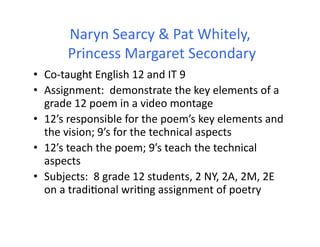
  2,	
  2011	
  
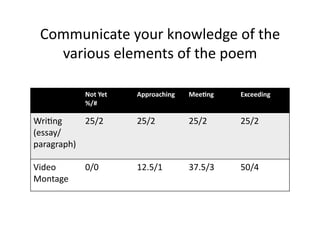
                   Faye	
  Brownlie	
  
How	
  the	
  world’	
  best	
  performing	
  
     school	
  systems	
  come	
  out	
  on	
  top	
  –	
  
        Sept.	
  2007,	
  McKinsey	
  &	
  Co.	
  
1.  GeLng	
  the	
  right	
  people	
  to	
  become	
  teachers	
  
2.  Developing	
  them	
  into	
  effec&ve	
  instructors	
  
3.  Ensuring	
  that	
  the	
  system	
  is	
  able	
  to	
  deliver	
  the	
  
    best	
  possible	
  instruc&on	
  for	
  every	
  child	
  
McKinsey	
  Report,	
  2007	
  
•  The	
  top-­‐performing	
  school	
  systems	
  recognise	
  
   that	
  the	
  only	
  way	
  to	
  improve	
  outcomes	
  is	
  to	
  
   improve	
  instruc&on:	
  	
  learning	
  occurs	
  when	
  
   students	
  and	
  teachers	
  interact,	
  and	
  thus	
  to	
  
   improve	
  learning	
  implies	
  improving	
  the	
  quality	
  
   of	
  that	
  interac&on.	
  
•    Coaching	
  classroom	
  prac&ce	
  
•    Moving	
  teacher	
  training	
  to	
  the	
  classroom	
  
•    Developing	
  stronger	
  school	
  leaders	
  
•    Enabling	
  teachers	
  to	
  learn	
  from	
  each	
  other	
  
Individual	
  teachers:	
  
•  Become	
  aware	
  of	
  areas	
  to	
  grow	
  in	
  their	
  prac&ce	
  
•  Gain	
  an	
  understanding	
  of	
  best	
  prac&ce	
  –	
  most	
  
   effec&ve	
  when	
  demonstrated	
  in	
  an	
  authen&c	
  
   seLng	
  
•  Are	
  mo&vated	
  to	
  improve	
  
    –  Teachers	
  have	
  high	
  expecta&ons	
  
    –  Share	
  a	
  common	
  purpose	
  
    –  Have	
  a	
  collec&ve	
  belief	
  in	
  their	
  ability	
  to	
  make	
  a	
  
       difference	
  
•  How	
  the	
  world’s	
  most	
  improved	
  school	
  
   systems	
  keep	
  geLng	
  beWer	
  
   –  Mourshed,	
  Chijioke,	
  Barber	
  
   –  McKinsey	
  &	
  Co.	
  
   –  Nov.,	
  2010	
  
Good	
  to	
  Great	
  Systems	
  
•  Focus	
  on	
  the	
  professionalism	
  of	
  teachers	
  
•  The	
  values	
  and	
  behaviors	
  of	
  the	
  educators	
  
   propel	
  the	
  system	
  forward	
  (not	
  centrally	
  
   controlled)	
  
•  Develop	
  common	
  language	
  about	
  the	
  cra	
  of	
  
   teaching	
  
•  Teacher	
  and	
  administrator	
  coaches	
  
Great	
  to	
  Excellent	
  Systems	
  
•  Learning	
  communi&es:	
  	
  peer-­‐led	
  support	
  and	
  
   accountability	
  
•  Focus	
  on	
  student	
  learning	
  	
  
•  Move	
  to	
  school	
  and	
  teacher	
  self-­‐evalua&on,	
  away	
  
   from	
  standardized	
  tests	
  
•  Open	
  up	
  classroom	
  prac&ce	
  –	
  de-­‐priva&ze	
  
•  Ac&on	
  research	
  
•  Collabora&ve	
  prac&ce	
  among	
  educators	
  
•  Encourage	
  innova&on	
  in	
  teaching	
  
Professional	
  Collabora&on	
  
•  Interac&ve	
  and	
  on-­‐going	
  process	
  
•  Mutually	
  agreed	
  upon	
  challenges	
  
•  Capitalizes	
  on	
  different	
  exper&se,	
  knowledge	
  
   and	
  experience	
  
•  Roles	
  are	
  blurred	
  
•  Mutual	
  trust	
  and	
  respect	
  
•  Create	
  and	
  deliver	
  targeted	
  instruc&on	
  
Together	
  we	
  are	
  beWer…	


By	
  sharing	
  our	
  collec&ve	
  
 knowledge	
  about	
  our	
  classes	
  of	
  
 students	
  and	
  developing	
  a	
  plan	
  of	
  
 ac&on	
  based	
  on	
  this,	
  we	
  can	
  
 beWer	
  meet	
  the	
  needs	
  of	
  all	
  
 students.	
  
Together	
  we	
  are	
  beWer…	


By	
  sharing	
  our	
  collec&ve	
  exper&se	
  
 about	
  teaching	
  and	
  learning	
  we	
  
 can	
  beWer	
  implement	
  plans	
  of	
  
 ac&on,	
  and	
  thus	
  we	
  can	
  beWer	
  
 meet	
  the	
  needs	
  of	
  all	
  students.	
  
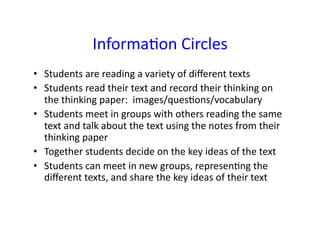
Informa&on	
  Circles	
  
•  Students	
  are	
  reading	
  a	
  variety	
  of	
  different	
  texts	
  
•  Students	
  read	
  their	
  text	
  and	
  record	
  their	
  thinking	
  on	
  
   the	
  thinking	
  paper:	
  	
  images/ques&ons/vocabulary	
  
•  Students	
  meet	
  in	
  groups	
  with	
  others	
  reading	
  the	
  same	
  
   text	
  and	
  talk	
  about	
  the	
  text	
  using	
  the	
  notes	
  from	
  their	
  
   thinking	
  paper	
  
•  Together	
  students	
  decide	
  on	
  the	
  key	
  ideas	
  of	
  the	
  text	
  
•  Students	
  can	
  meet	
  in	
  new	
  groups,	
  represen&ng	
  the	
  
   different	
  texts,	
  and	
  share	
  the	
  key	
  ideas	
  of	
  their	
  text	
  
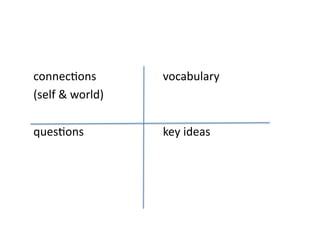
connec&ons 	


  vocabulary	
  
(self	
  &	
  world)	
  

ques&ons 	


  key	
  ideas	
  
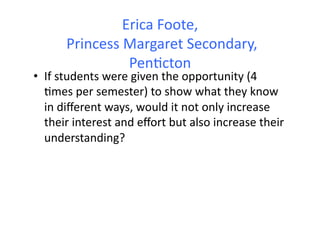
Erica	
  Foote,	
  
        	
  Princess	
  Margaret	
  Secondary,	
  
                        Pen&cton	
  
•  If	
  students	
  were	
  given	
  the	
  opportunity	
  (4	
  
   &mes	
  per	
  semester)	
  to	
  show	
  what	
  they	
  know	
  
   in	
  different	
  ways,	
  would	
  it	
  not	
  only	
  increase	
  
   their	
  interest	
  and	
  effort	
  but	
  also	
  increase	
  their	
  
   understanding?	
  	
  
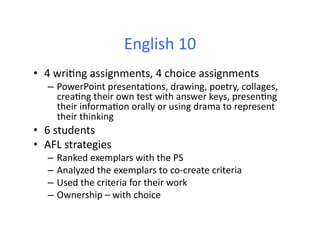
English	
  10	
  
•  4	
  wri&ng	
  assignments,	
  4	
  choice	
  assignments	
  
    –  PowerPoint	
  presenta&ons,	
  drawing,	
  poetry,	
  collages,	
  
       crea&ng	
  their	
  own	
  test	
  with	
  answer	
  keys,	
  presen&ng	
  
       their	
  informa&on	
  orally	
  or	
  using	
  drama	
  to	
  represent	
  
       their	
  thinking	
  	
  
•  6	
  students	
  	
  
•  AFL	
  strategies	
  
    –  Ranked	
  exemplars	
  with	
  the	
  PS	
  
    –  Analyzed	
  the	
  exemplars	
  to	
  co-­‐create	
  criteria	
  
    –  Used	
  the	
  criteria	
  for	
  their	
  work	
  
    –  Ownership	
  –	
  with	
  choice	
  
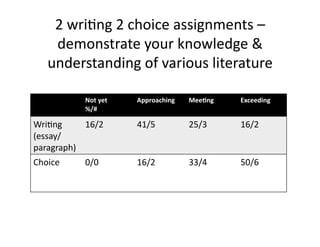
2	
  wri&ng	
  2	
  choice	
  assignments	
  –	
  	
  
     demonstrate	
  your	
  knowledge	
  &	
  
    understanding	
  of	
  various	
  literature	
  

                Not	
  yet	
     Approaching	
     Mee4ng	
     Exceeding	
  
                %/#	
  

Wri&ng	
       16/2	
            41/5	
            25/3	
       16/2	
  
(essay/
paragraph)	
  
Choice	
        0/0	
            16/2	
            33/4	
       50/6	
  
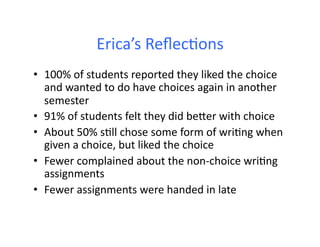
Erica’s	
  Reflec&ons	
  
•  100%	
  of	
  students	
  reported	
  they	
  liked	
  the	
  choice	
  
   and	
  wanted	
  to	
  do	
  have	
  choices	
  again	
  in	
  another	
  
   semester	
  
•  91%	
  of	
  students	
  felt	
  they	
  did	
  beWer	
  with	
  choice	
  
•  About	
  50%	
  s&ll	
  chose	
  some	
  form	
  of	
  wri&ng	
  when	
  
   given	
  a	
  choice,	
  but	
  liked	
  the	
  choice	
  
•  Fewer	
  complained	
  about	
  the	
  non-­‐choice	
  wri&ng	
  
   assignments	
  
•  Fewer	
  assignments	
  were	
  handed	
  in	
  late	
  
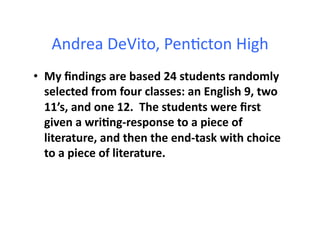
Andrea	
  DeVito,	
  Pen&cton	
  High	
  
•  My	
  findings	
  are	
  based	
  24	
  students	
  randomly	
  
   selected	
  from	
  four	
  classes:	
  an	
  English	
  9,	
  two	
  
   11’s,	
  and	
  one	
  12.	
  	
  The	
  students	
  were	
  first	
  
   given	
  a	
  wri4ng-­‐response	
  to	
  a	
  piece	
  of	
  
   literature,	
  and	
  then	
  the	
  end-­‐task	
  with	
  choice	
  
   to	
  a	
  piece	
  of	
  literature.	


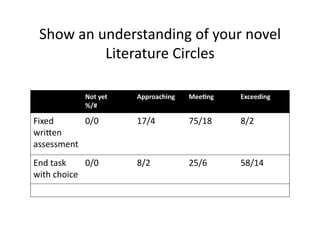
Show	
  an	
  understanding	
  of	
  your	
  novel	
  
                 Literature	
  Circles	
  

                   Not	
  yet	
     Approaching	
     Mee4ng	
     Exceeding	
  
                   %/#	


Fixed	
        0/0	
  	
            17/4	
            75/18	
      8/2	
  
wriWen	
  	
  
assessment	
  
End	
  task	
      0/0	
            8/2	
             25/6	
       58/14	
  
with	
  choice	
  
Andrea’s	
  reflec&ons	
  
•  Some	
  challenged	
  by	
  finding	
  a	
  meaningful	
  
   connec&on	
  between	
  themselves	
  and	
  the	
  novel	
  
•  Some	
  challenged	
  by	
  the	
  idea	
  of	
  students	
  doing	
  
   different	
  products	
  for	
  the	
  same	
  assignment	
  
•  Most	
  wanted	
  to	
  do	
  this	
  kind	
  of	
  assignment	
  
   again.	
  
Naryn	
  Searcy	
  &	
  Pat	
  Whitely,	
  
          	
  Princess	
  Margaret	
  Secondary	
  
•  Co-­‐taught	
  English	
  12	
  and	
  IT	
  9	
  
•  Assignment:	
  	
  demonstrate	
  the	
  key	
  elements	
  of	
  a	
  
   grade	
  12	
  poem	
  in	
  a	
  video	
  montage	
  
•  12’s	
  responsible	
  for	
  the	
  poem’s	
  key	
  elements	
  and	
  
   the	
  vision;	
  9’s	
  for	
  the	
  technical	
  aspects	
  
•  12’s	
  teach	
  the	
  poem;	
  9’s	
  teach	
  the	
  technical	
  
   aspects	
  
•  Subjects:	
  	
  8	
  grade	
  12	
  students,	
  2	
  NY,	
  2A,	
  2M,	
  2E	
  
   on	
  a	
  tradi&onal	
  wri&ng	
  assignment	
  of	
  poetry	
  	
  
•  Projects	
  shown	
  to	
  both	
  classes.	
  	
  Grade	
  12	
  
   students	
  introduced	
  and	
  explained	
  the	
  video	
  
•  AFL	
  strategies:	


    –  descrip&ve	
  feedback	
  at	
  each	
  stage	
  (i.e.,	
  
       storyboard)	
  
    –  ownership	
  
Communicate	
  your	
  knowledge	
  of	
  the	
  
    various	
  elements	
  of	
  the	
  poem	
  

                Not	
  Yet	
     Approaching	
     Mee4ng	
  	
     Exceeding	
  
                %/#	
  

Wri&ng	
       25/2	
            25/2	
            25/2	
           25/2	
  
(essay/
paragraph)	
  

Video	
         0/0	
            12.5/1	
          37.5/3	
         50/4	
  
Montage	
  
Naryn	
  and	
  Pat’s	
  Reflec&ons	
  
•  Increased	
  mo&va&on	
  and	
  increased	
  
   responsibility	
  for	
  all	
  students	
  in	
  both	
  grade	
  9	
  
   and	
  12	
  
•  Students	
  disappointed	
  when	
  the	
  collabora&on	
  
   ended	
  
•  Mo&va&on	
  con&nued	
  …	
  success	
  breeds	
  
   success	
  
References	
  
•  Grand Conversations, Thoughtful Responses –	
  
   Brownlie	
  (2005).	
  	
  Portage	
  and	
  Main	
  Press.	
  
•  Student Diversity, 2nd ed (2006)	
  –	
  Brownlie	
  and	
  
   Schnellert.	
  	
  Pembroke	
  Publishers	
  
•  It’s All about Thinking – Humanities, Social
   Studies and English (2009)	
  –	
  Brownlie	
  and	
  
   Schnellert.	
  	
  Portage	
  and	
  Main	
  Press.	
  
•  Assessment Instruction of ESL Learners –	
  
   Brownlie,	
  Feniak,	
  McCarthy.	
  	
  Portage	
  and	
  Main	
  
   Press.	
  

Surrey.english.hum.dept.heads.2011

  • 1.
    Suppor&ng  Student  Diversity:     Classroom  and  collabora&on   strategies  that  meet  the  needs  of  all   learners   English  and  Humani&es  Dept.  Heads   Surrey   March  2,  2011   Faye  Brownlie  
  • 2.
    How  the  world’  best  performing   school  systems  come  out  on  top  –   Sept.  2007,  McKinsey  &  Co.   1.  GeLng  the  right  people  to  become  teachers   2.  Developing  them  into  effec&ve  instructors   3.  Ensuring  that  the  system  is  able  to  deliver  the   best  possible  instruc&on  for  every  child  
  • 3.
    McKinsey  Report,  2007   •  The  top-­‐performing  school  systems  recognise   that  the  only  way  to  improve  outcomes  is  to   improve  instruc&on:    learning  occurs  when   students  and  teachers  interact,  and  thus  to   improve  learning  implies  improving  the  quality   of  that  interac&on.  
  • 4.
    •  Coaching  classroom  prac&ce   •  Moving  teacher  training  to  the  classroom   •  Developing  stronger  school  leaders   •  Enabling  teachers  to  learn  from  each  other  
  • 5.
    Individual  teachers:   • Become  aware  of  areas  to  grow  in  their  prac&ce   •  Gain  an  understanding  of  best  prac&ce  –  most   effec&ve  when  demonstrated  in  an  authen&c   seLng   •  Are  mo&vated  to  improve   –  Teachers  have  high  expecta&ons   –  Share  a  common  purpose   –  Have  a  collec&ve  belief  in  their  ability  to  make  a   difference  
  • 6.
    •  How  the  world’s  most  improved  school   systems  keep  geLng  beWer   –  Mourshed,  Chijioke,  Barber   –  McKinsey  &  Co.   –  Nov.,  2010  
  • 7.
    Good  to  Great  Systems   •  Focus  on  the  professionalism  of  teachers   •  The  values  and  behaviors  of  the  educators   propel  the  system  forward  (not  centrally   controlled)   •  Develop  common  language  about  the  cra  of   teaching   •  Teacher  and  administrator  coaches  
  • 8.
    Great  to  Excellent  Systems   •  Learning  communi&es:    peer-­‐led  support  and   accountability   •  Focus  on  student  learning     •  Move  to  school  and  teacher  self-­‐evalua&on,  away   from  standardized  tests   •  Open  up  classroom  prac&ce  –  de-­‐priva&ze   •  Ac&on  research   •  Collabora&ve  prac&ce  among  educators   •  Encourage  innova&on  in  teaching  
  • 9.
    Professional  Collabora&on   • Interac&ve  and  on-­‐going  process   •  Mutually  agreed  upon  challenges   •  Capitalizes  on  different  exper&se,  knowledge   and  experience   •  Roles  are  blurred   •  Mutual  trust  and  respect   •  Create  and  deliver  targeted  instruc&on  
  • 10.
    Together  we  are  beWer…   By  sharing  our  collec&ve   knowledge  about  our  classes  of   students  and  developing  a  plan  of   ac&on  based  on  this,  we  can   beWer  meet  the  needs  of  all   students.  
  • 11.
    Together  we  are  beWer…   By  sharing  our  collec&ve  exper&se   about  teaching  and  learning  we   can  beWer  implement  plans  of   ac&on,  and  thus  we  can  beWer   meet  the  needs  of  all  students.  
  • 12.
    Informa&on  Circles   • Students  are  reading  a  variety  of  different  texts   •  Students  read  their  text  and  record  their  thinking  on   the  thinking  paper:    images/ques&ons/vocabulary   •  Students  meet  in  groups  with  others  reading  the  same   text  and  talk  about  the  text  using  the  notes  from  their   thinking  paper   •  Together  students  decide  on  the  key  ideas  of  the  text   •  Students  can  meet  in  new  groups,  represen&ng  the   different  texts,  and  share  the  key  ideas  of  their  text  
  • 13.
    connec&ons          vocabulary   (self  &  world)   ques&ons            key  ideas  
  • 14.
    Erica  Foote,    Princess  Margaret  Secondary,   Pen&cton   •  If  students  were  given  the  opportunity  (4   &mes  per  semester)  to  show  what  they  know   in  different  ways,  would  it  not  only  increase   their  interest  and  effort  but  also  increase  their   understanding?    
  • 15.
    English  10   • 4  wri&ng  assignments,  4  choice  assignments   –  PowerPoint  presenta&ons,  drawing,  poetry,  collages,   crea&ng  their  own  test  with  answer  keys,  presen&ng   their  informa&on  orally  or  using  drama  to  represent   their  thinking     •  6  students     •  AFL  strategies   –  Ranked  exemplars  with  the  PS   –  Analyzed  the  exemplars  to  co-­‐create  criteria   –  Used  the  criteria  for  their  work   –  Ownership  –  with  choice  
  • 16.
    2  wri&ng  2  choice  assignments  –     demonstrate  your  knowledge  &   understanding  of  various  literature   Not  yet   Approaching   Mee4ng   Exceeding   %/#   Wri&ng   16/2   41/5   25/3   16/2   (essay/ paragraph)   Choice   0/0   16/2   33/4   50/6  
  • 17.
    Erica’s  Reflec&ons   • 100%  of  students  reported  they  liked  the  choice   and  wanted  to  do  have  choices  again  in  another   semester   •  91%  of  students  felt  they  did  beWer  with  choice   •  About  50%  s&ll  chose  some  form  of  wri&ng  when   given  a  choice,  but  liked  the  choice   •  Fewer  complained  about  the  non-­‐choice  wri&ng   assignments   •  Fewer  assignments  were  handed  in  late  
  • 18.
    Andrea  DeVito,  Pen&cton  High   •  My  findings  are  based  24  students  randomly   selected  from  four  classes:  an  English  9,  two   11’s,  and  one  12.    The  students  were  first   given  a  wri4ng-­‐response  to  a  piece  of   literature,  and  then  the  end-­‐task  with  choice   to  a  piece  of  literature.      
  • 19.
    Show  an  understanding  of  your  novel   Literature  Circles   Not  yet   Approaching   Mee4ng   Exceeding   %/#     Fixed   0/0     17/4   75/18   8/2   wriWen     assessment   End  task   0/0   8/2   25/6   58/14   with  choice  
  • 20.
    Andrea’s  reflec&ons   • Some  challenged  by  finding  a  meaningful   connec&on  between  themselves  and  the  novel   •  Some  challenged  by  the  idea  of  students  doing   different  products  for  the  same  assignment   •  Most  wanted  to  do  this  kind  of  assignment   again.  
  • 21.
    Naryn  Searcy  &  Pat  Whitely,    Princess  Margaret  Secondary   •  Co-­‐taught  English  12  and  IT  9   •  Assignment:    demonstrate  the  key  elements  of  a   grade  12  poem  in  a  video  montage   •  12’s  responsible  for  the  poem’s  key  elements  and   the  vision;  9’s  for  the  technical  aspects   •  12’s  teach  the  poem;  9’s  teach  the  technical   aspects   •  Subjects:    8  grade  12  students,  2  NY,  2A,  2M,  2E   on  a  tradi&onal  wri&ng  assignment  of  poetry    
  • 22.
    •  Projects  shown  to  both  classes.    Grade  12   students  introduced  and  explained  the  video   •  AFL  strategies:       –  descrip&ve  feedback  at  each  stage  (i.e.,   storyboard)   –  ownership  
  • 23.
    Communicate  your  knowledge  of  the   various  elements  of  the  poem   Not  Yet   Approaching   Mee4ng     Exceeding   %/#   Wri&ng   25/2   25/2   25/2   25/2   (essay/ paragraph)   Video   0/0   12.5/1   37.5/3   50/4   Montage  
  • 24.
    Naryn  and  Pat’s  Reflec&ons   •  Increased  mo&va&on  and  increased   responsibility  for  all  students  in  both  grade  9   and  12   •  Students  disappointed  when  the  collabora&on   ended   •  Mo&va&on  con&nued  …  success  breeds   success  
  • 25.
    References   •  GrandConversations, Thoughtful Responses –   Brownlie  (2005).    Portage  and  Main  Press.   •  Student Diversity, 2nd ed (2006)  –  Brownlie  and   Schnellert.    Pembroke  Publishers   •  It’s All about Thinking – Humanities, Social Studies and English (2009)  –  Brownlie  and   Schnellert.    Portage  and  Main  Press.   •  Assessment Instruction of ESL Learners –   Brownlie,  Feniak,  McCarthy.    Portage  and  Main   Press.