Evidence Guided Literacy
Instruction:
Closing Learning Gaps
MRLC in Portage
K-4 teams
Oct 9/10
Faye Brownlie with Catherine Feniak
Slideshare.net/fayebrownlie.evidenceguided.k-4, sept
Learning Intentions
• I can use my data to view my class in terms of literacy strengths and
stretches.
• I can use this data to develop a plan to support the literacy development of
all my learners.
• I have a plan to improve my formative assessment practices.
• I have a better idea of ‘what counts’ in effective literacy instruction.
• Every Child, Every Day
• CR4YR
• Burkins and Yaris
What counts?
In assessment
• Assessment is value driven.
• The assessment you choose must reflect what you value.
• So what do you value in reading?
• How does this match what the Manitoba Department of Education
ELA expectations?
• How does it match others in your school? Your division?
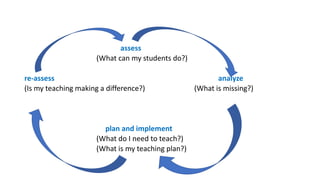
assess
(What can my students do?)
re-assess analyze
(Is my teaching making a difference?) (What is missing?)
plan and implement
(What do I need to teach?)
(What is my teaching plan?)
What kinds of data have you collected?
• What does this collection show you value?
• How long did it take to collect?
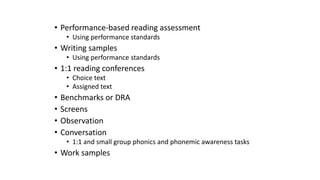
• Performance-based reading assessment
• Using performance standards
• Writing samples
• Using performance standards
• 1:1 reading conferences
• Choice text
• Assigned text
• Benchmarks or DRA
• Screens
• Observation
• Conversation
• 1:1 and small group phonics and phonemic awareness tasks
• Work samples
What do you know?
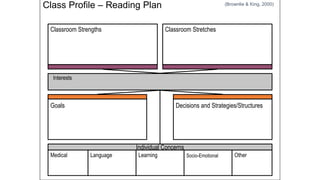
Class Profile – Reading Plan
Interests
Classroom Strengths Classroom Stretches
Individual Concerns
(Brownlie & King, 2000)
Goals Decisions and Strategies/Structures
Medical Language Learning Socio-Emotional Other
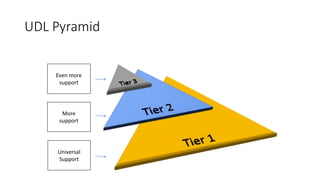
UDL Pyramid
Even more
support
More
support
Universal
Support
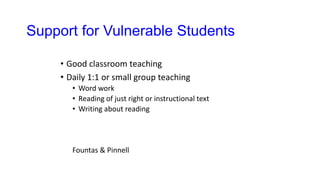
Support for Vulnerable Students
• Good classroom teaching
• Daily 1:1 or small group teaching
• Word work
• Reading of just right or instructional text
• Writing about reading
Fountas & Pinnell
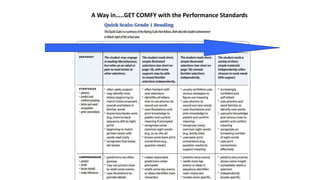
A Way in…..GET COMFY with the Performance Standards
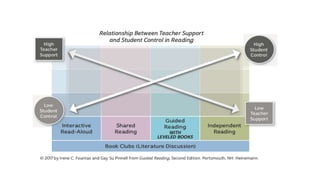
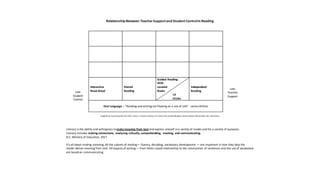
Relationship Between TeacherSupport and Student Controlin Reading
Interactive
Read-Aloud
Shared
Reading
Guided Reading
With
Leveled
Books
Lit
Circles
Independent
Reading
Oral Language – “Reading and writing are floating on a sea of talk” - James Britton
Adapted by Faye Brownlie from 2017 Irene C. Fountas and Gay Su Pinnell from Guided Reading, Second Edition Portsmouth, NH, Heinemann
Literacy is the ability and willingness tomake meaning from textand express oneself ina variety of modes and for a variety of purposes.
Literacy includes making connections, analyzing critically, comprehending, creating, and communicating.
B.C. Ministry of Education, 2017
It's all about making meaning. All the subsets of reading— fluency, decoding, vocabulary development — are important in how they help the
reader derive meaning from text. All aspects of writing — from letter-sound relationship to the construction of sentences and the use of vocabulary
are basedon communicating.
High
Student
Control
Low
Student
Control
High
Teacher
Support
Low
Teacher
Support
Fountas and Pinnell – Level BOOKS, Not
Children Jan/Feb 2019 Literacy Today
• Of the 5 contexts for reading that we describe in our work…only one
uses leveled books. Text levels play an important but quite limited role
in students’ literate lives in school.
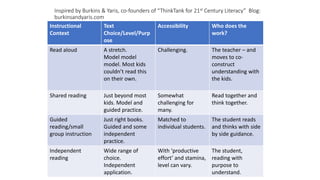
Instructional
Context
Text
Choice/Level/Purp
ose
Accessibility Who does the
work?
Read aloud A stretch.
Model model
model. Most kids
couldn’t read this
on their own.
Challenging. The teacher – and
moves to co-
construct
understanding with
the kids.
Shared reading Just beyond most
kids. Model and
guided practice.
Somewhat
challenging for
many.
Read together and
think together.
Guided
reading/small
group instruction
Just right books.
Guided and some
independent
practice.
Matched to
individual students.
The student reads
and thinks with side
by side guidance.
Independent
reading
Wide range of
choice.
Independent
application.
With ‘productive
effort’ and stamina,
level can vary.
The student,
reading with
purpose to
understand.
Inspired by Burkins & Yaris, co-founders of “ThinkTank for 21st Century Literacy” Blog:
burkinsandyaris.com
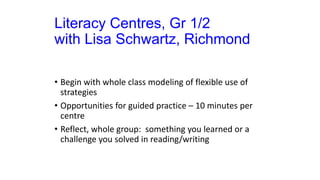
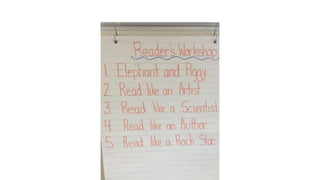
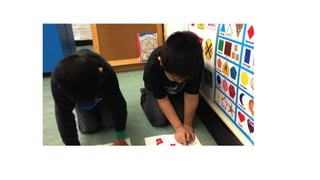
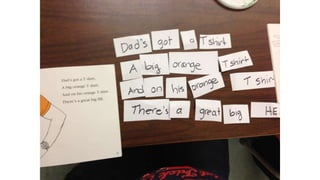
Literacy Centres, Gr 1/2
with Lisa Schwartz, Richmond
• Begin with whole class modeling of flexible use of
strategies
• Opportunities for guided practice – 10 minutes per
centre
• Reflect, whole group: something you learned or a
challenge you solved in reading/writing
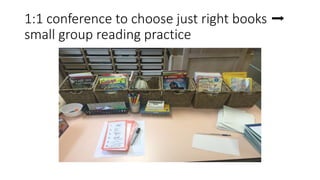
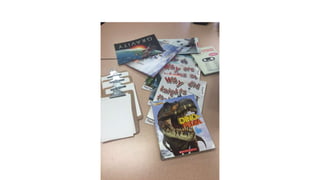
1:1 conference to choose just right books ➡️
small group reading practice
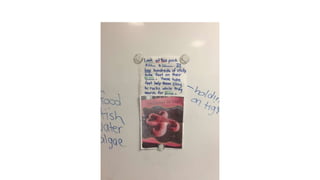
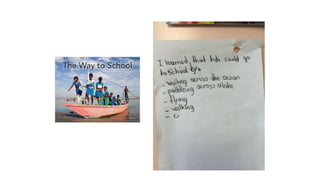
If we don’t have gravity, we will fly up to the sky
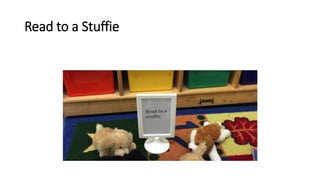
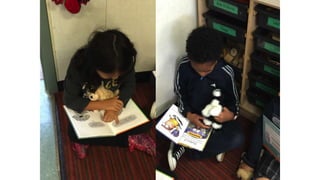
Read to a Stuffie
Standard Reading Assessment
• Choose a common piece of text.
• Build background for the reading.
• Have students respond to common prompts.
• Have students read a short section aloud and answer several interview
questions.
• Code using the Reading Performance Standards
• Described in Student Diversity, 3rd ed – Brownlie, Feniak, Schnellert & in It’s All about
Thinking – collaborating to support all learners in English, Social Studies and Humanities
– Brownlie & Schnellert & It’s All about Thinking – collaborating to support all learners in
Math & Science – Brownlie, Fullerton, Schnellert & It’s All about Thinking – creating
pathways for all learners in the middle years – Schnellert, Watson & Widdess
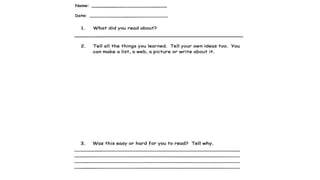
• Connections: How does what you read connect
with what you already knew?
• Summarizing: Choose a way to show the main
ideas and details in what you read.
• Inferencing: Read between the lines to find
something that you believe to be true, but that
isn’t actually said. Explain your reasoning.
• Vocabulary: Here are 3 challenging words from the
text. Explain what you think they mean.
• Reflecting: Was this easy or hard to understand?
How did you help your self understand?
(SD, p.27)

MRLC Evidence Based Literacy, Oct

  • 1.
    Evidence Guided Literacy Instruction: ClosingLearning Gaps MRLC in Portage K-4 teams Oct 9/10 Faye Brownlie with Catherine Feniak Slideshare.net/fayebrownlie.evidenceguided.k-4, sept
  • 2.
    Learning Intentions • Ican use my data to view my class in terms of literacy strengths and stretches. • I can use this data to develop a plan to support the literacy development of all my learners. • I have a plan to improve my formative assessment practices. • I have a better idea of ‘what counts’ in effective literacy instruction. • Every Child, Every Day • CR4YR • Burkins and Yaris
  • 3.
  • 4.
    • Assessment isvalue driven. • The assessment you choose must reflect what you value. • So what do you value in reading? • How does this match what the Manitoba Department of Education ELA expectations? • How does it match others in your school? Your division?
  • 5.
    assess (What can mystudents do?) re-assess analyze (Is my teaching making a difference?) (What is missing?) plan and implement (What do I need to teach?) (What is my teaching plan?)
  • 6.
    What kinds ofdata have you collected? • What does this collection show you value? • How long did it take to collect?
  • 7.
    • Performance-based readingassessment • Using performance standards • Writing samples • Using performance standards • 1:1 reading conferences • Choice text • Assigned text • Benchmarks or DRA • Screens • Observation • Conversation • 1:1 and small group phonics and phonemic awareness tasks • Work samples
  • 8.
  • 9.
    Class Profile –Reading Plan Interests Classroom Strengths Classroom Stretches Individual Concerns (Brownlie & King, 2000) Goals Decisions and Strategies/Structures Medical Language Learning Socio-Emotional Other
  • 10.
  • 11.
    Support for VulnerableStudents • Good classroom teaching • Daily 1:1 or small group teaching • Word work • Reading of just right or instructional text • Writing about reading Fountas & Pinnell
  • 12.
    A Way in…..GETCOMFY with the Performance Standards
  • 15.
    Relationship Between TeacherSupportand Student Controlin Reading Interactive Read-Aloud Shared Reading Guided Reading With Leveled Books Lit Circles Independent Reading Oral Language – “Reading and writing are floating on a sea of talk” - James Britton Adapted by Faye Brownlie from 2017 Irene C. Fountas and Gay Su Pinnell from Guided Reading, Second Edition Portsmouth, NH, Heinemann Literacy is the ability and willingness tomake meaning from textand express oneself ina variety of modes and for a variety of purposes. Literacy includes making connections, analyzing critically, comprehending, creating, and communicating. B.C. Ministry of Education, 2017 It's all about making meaning. All the subsets of reading— fluency, decoding, vocabulary development — are important in how they help the reader derive meaning from text. All aspects of writing — from letter-sound relationship to the construction of sentences and the use of vocabulary are basedon communicating. High Student Control Low Student Control High Teacher Support Low Teacher Support
  • 16.
    Fountas and Pinnell– Level BOOKS, Not Children Jan/Feb 2019 Literacy Today • Of the 5 contexts for reading that we describe in our work…only one uses leveled books. Text levels play an important but quite limited role in students’ literate lives in school.
  • 17.
    Instructional Context Text Choice/Level/Purp ose Accessibility Who doesthe work? Read aloud A stretch. Model model model. Most kids couldn’t read this on their own. Challenging. The teacher – and moves to co- construct understanding with the kids. Shared reading Just beyond most kids. Model and guided practice. Somewhat challenging for many. Read together and think together. Guided reading/small group instruction Just right books. Guided and some independent practice. Matched to individual students. The student reads and thinks with side by side guidance. Independent reading Wide range of choice. Independent application. With ‘productive effort’ and stamina, level can vary. The student, reading with purpose to understand. Inspired by Burkins & Yaris, co-founders of “ThinkTank for 21st Century Literacy” Blog: burkinsandyaris.com
  • 18.
    Literacy Centres, Gr1/2 with Lisa Schwartz, Richmond • Begin with whole class modeling of flexible use of strategies • Opportunities for guided practice – 10 minutes per centre • Reflect, whole group: something you learned or a challenge you solved in reading/writing
  • 21.
    1:1 conference tochoose just right books ➡️ small group reading practice
  • 27.
    If we don’thave gravity, we will fly up to the sky
  • 29.
    Read to aStuffie
  • 33.
    Standard Reading Assessment •Choose a common piece of text. • Build background for the reading. • Have students respond to common prompts. • Have students read a short section aloud and answer several interview questions. • Code using the Reading Performance Standards • Described in Student Diversity, 3rd ed – Brownlie, Feniak, Schnellert & in It’s All about Thinking – collaborating to support all learners in English, Social Studies and Humanities – Brownlie & Schnellert & It’s All about Thinking – collaborating to support all learners in Math & Science – Brownlie, Fullerton, Schnellert & It’s All about Thinking – creating pathways for all learners in the middle years – Schnellert, Watson & Widdess
  • 35.
    • Connections: Howdoes what you read connect with what you already knew? • Summarizing: Choose a way to show the main ideas and details in what you read. • Inferencing: Read between the lines to find something that you believe to be true, but that isn’t actually said. Explain your reasoning. • Vocabulary: Here are 3 challenging words from the text. Explain what you think they mean. • Reflecting: Was this easy or hard to understand? How did you help your self understand? (SD, p.27)