Agenda
❖ What is differentiation?
❖ How to use depth in the classroom
❖ How to use complexity in the classroom
❖ How to make sure your students understand how to use
both depth and complexity
Kimberley Moran
Increasing
Depth and Complexity
to Engage Students and
Increase Learning
Using Sandra Kaplan’s
prompts to challenge
every child.
Differentiation is not a product, but a process.
Differentiation is about providing multiple paths for
students to learn the required content.
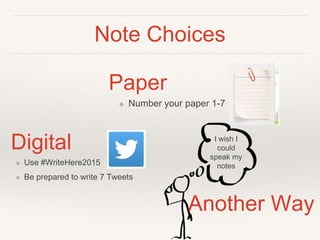
Note Choices
❖ Number your paper 1-7
Paper
Digital
❖ Use #WriteHere2015
❖ Be prepared to write 7 Tweets
I wish I
could
speak my
notes
Another Way
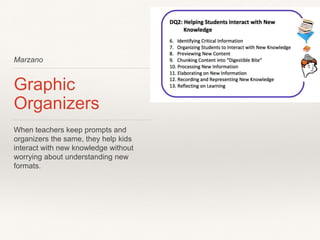
Marzano
Graphic
Organizers
When teachers keep prompts and
organizers the same, they help kids
interact with new knowledge without
worrying about understanding new
formats.
Refers to approaching or studying
something from the concrete to the abstract,
from the known to the unknown.
Requires students to examine topics by
determining the facts, concepts, generalization,
principles and theories related to them.
Depth
Depth
❖ Necessitates uncovering more details and new
knowledge related to a topic of study.
❖ Encourages students to adopt perspectives and
to see patterns in connections.
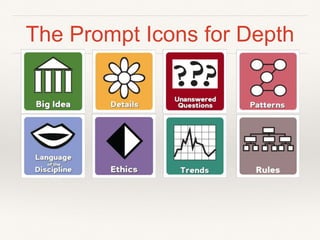
The Prompt Icons for Depth
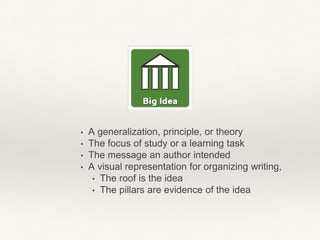
• A generalization, principle, or theory
• The focus of study or a learning task
• The message an author intended
• A visual representation for organizing writing,
• The roof is the idea
• The pillars are evidence of the idea
• Being able to discern important details of a story
is key to one’s ability to critically analyze that text.
• We can use the format of the daisy to put the Big
Idea in the center and add details to the petals
• These are questions about anything is unsolved,
unclear, or unproven.
• These can be ideas that have yet to be explored
or are unresolved.
• Unanswered questions are good!
• These are questions we need to pursue.
• These are typically questions that are not
answered quickly.
• Patterns are recurring elements or factors in
ideas, objects, stories, and events.
• They are predictable, repetitive and ordered.
• This prompt helps students take the time to use
the language that is typically used when
discussing this discipline.
• This includes key words, phrases, signs, symbols,
figures of speech, and abbreviations.
• Developing vocabulary is critical to using the
language of the discipline.
• This prompt represents conflicting points of view
on events, ideas or issues and involves bias,
values, or judgments.
• Right/Wrong, Good/Evil
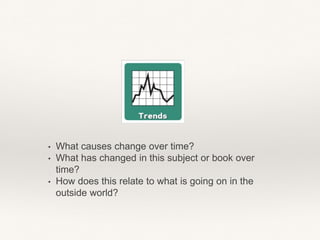
• What causes change over time?
• What has changed in this subject or book over
time?
• How does this relate to what is going on in the
outside world?
• Rules are the organizational elements that
create structure.
• This concept is an easy one for students, as
they are surrounded by rules (at home, school,
and in sports).
• Rules provide structure and represent
organization and hierarchy.
Complexity
❖ Includes making relationships, connecting other
concepts, and layering.
❖ Why/how approach that connects and bridges to other
disciplines to enhance the meaning of a unit of study.
Complexity encourages students to
❖ Relate concepts and ideas at a more sophisticated level
❖ See associations among diverse subjects, topics or
levels
❖ Find multiple solutions from multiple points of view
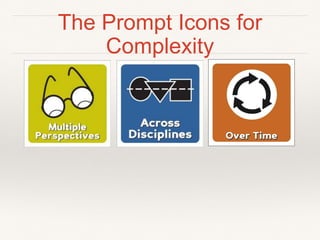
The Prompt Icons for
Complexity
• This icon represents different points of view on
ideas, events, people, and issues.
• It often represents an "expert" viewpoint, and is
dependent on time and place.
• How can the same topic be looked at from
different disciplines?
• Think like a Scientist
• Think like a Guidance Counselor
• How has this topic changed over time.
• This requires research.
• Historical perspective.
Dive Into Depth
and Complexity
An essential part of
differentiating the curriculum
through depth and
complexity is using the
icons, and ensuring that
students are familiar
with them.
Use the Icons Within Your Lessons
❖ “Look for (appropriate icon) in our lesson today on
(content area).”
❖ Use the Big Idea to summarize or end lessons.
❖ Label your daily agenda and lesson plans with the
icons.
❖ Have students label all work with the appropriate
icons.
❖ Label all classroom work and charts with the icons.
Post a set of the icons clearly in
your room
❖ This prompts integration into discussions, and
shows students you value the icons as
intellectual tools.
But remember,
we are not teaching the
icons, we are teaching
concepts to new levels of
depth and complexity
using pictures to stand for
the thinking strategies.
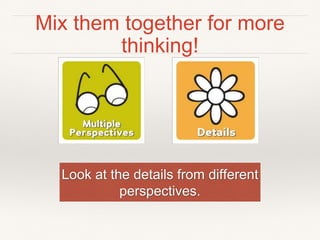
Mix them together for more
thinking!
Look at the details from different
perspectives.
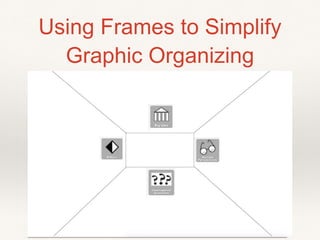
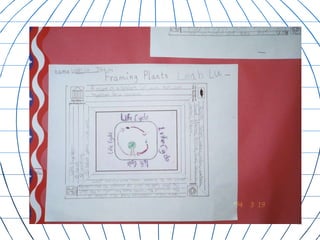
Using Frames to Simplify
Graphic Organizing
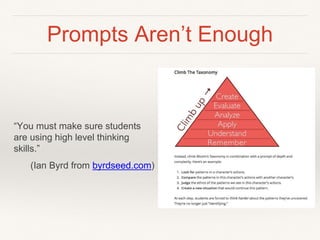
Prompts Aren’t Enough
“You must make sure students
are using high level thinking
skills.”
(Ian Byrd from byrdseed.com)
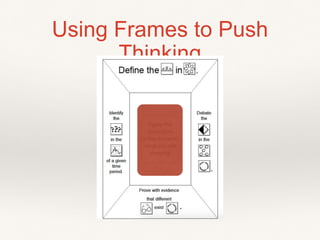
Using Frames to Push
Thinking
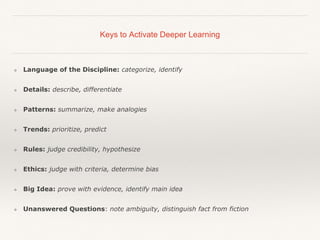
Keys to Activate Deeper Learning
❖ Language of the Discipline: categorize, identify
❖ Details: describe, differentiate
❖ Patterns: summarize, make analogies
❖ Trends: prioritize, predict
❖ Rules: judge credibility, hypothesize
❖ Ethics: judge with criteria, determine bias
❖ Big Idea: prove with evidence, identify main idea
❖ Unanswered Questions: note ambiguity, distinguish fact from fiction
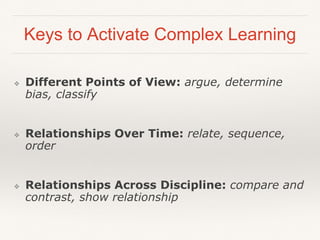
Keys to Activate Complex Learning
❖ Different Points of View: argue, determine
bias, classify
❖ Relationships Over Time: relate, sequence,
order
❖ Relationships Across Discipline: compare and
contrast, show relationship
34
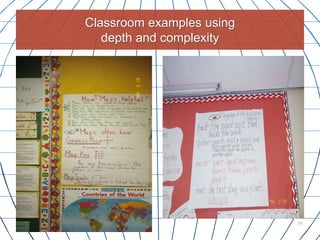
Classroom examples using
depth and complexity
35
Resources
J. Taylor Education http://www.jtayloreducation.com
Envision Gifted Differentiation
http://envisiongifted.com/understanding-depth-and-
complexity.html
The Differentiator
http://byrdseed.com/differentiator/

Depth and Complexity Workshop

  • 1.
    Agenda ❖ What isdifferentiation? ❖ How to use depth in the classroom ❖ How to use complexity in the classroom ❖ How to make sure your students understand how to use both depth and complexity
  • 2.
    Kimberley Moran Increasing Depth andComplexity to Engage Students and Increase Learning Using Sandra Kaplan’s prompts to challenge every child.
  • 3.
    Differentiation is nota product, but a process. Differentiation is about providing multiple paths for students to learn the required content.
  • 4.
    Note Choices ❖ Numberyour paper 1-7 Paper Digital ❖ Use #WriteHere2015 ❖ Be prepared to write 7 Tweets I wish I could speak my notes Another Way
  • 5.
    Marzano Graphic Organizers When teachers keepprompts and organizers the same, they help kids interact with new knowledge without worrying about understanding new formats.
  • 6.
    Refers to approachingor studying something from the concrete to the abstract, from the known to the unknown. Requires students to examine topics by determining the facts, concepts, generalization, principles and theories related to them. Depth
  • 7.
    Depth ❖ Necessitates uncoveringmore details and new knowledge related to a topic of study. ❖ Encourages students to adopt perspectives and to see patterns in connections.
  • 8.
  • 9.
    • A generalization,principle, or theory • The focus of study or a learning task • The message an author intended • A visual representation for organizing writing, • The roof is the idea • The pillars are evidence of the idea
  • 10.
    • Being ableto discern important details of a story is key to one’s ability to critically analyze that text. • We can use the format of the daisy to put the Big Idea in the center and add details to the petals
  • 11.
    • These arequestions about anything is unsolved, unclear, or unproven. • These can be ideas that have yet to be explored or are unresolved. • Unanswered questions are good! • These are questions we need to pursue. • These are typically questions that are not answered quickly.
  • 12.
    • Patterns arerecurring elements or factors in ideas, objects, stories, and events. • They are predictable, repetitive and ordered.
  • 13.
    • This prompthelps students take the time to use the language that is typically used when discussing this discipline. • This includes key words, phrases, signs, symbols, figures of speech, and abbreviations. • Developing vocabulary is critical to using the language of the discipline.
  • 14.
    • This promptrepresents conflicting points of view on events, ideas or issues and involves bias, values, or judgments. • Right/Wrong, Good/Evil
  • 16.
    • What causeschange over time? • What has changed in this subject or book over time? • How does this relate to what is going on in the outside world?
  • 17.
    • Rules arethe organizational elements that create structure. • This concept is an easy one for students, as they are surrounded by rules (at home, school, and in sports). • Rules provide structure and represent organization and hierarchy.
  • 18.
    Complexity ❖ Includes makingrelationships, connecting other concepts, and layering. ❖ Why/how approach that connects and bridges to other disciplines to enhance the meaning of a unit of study.
  • 19.
    Complexity encourages studentsto ❖ Relate concepts and ideas at a more sophisticated level ❖ See associations among diverse subjects, topics or levels ❖ Find multiple solutions from multiple points of view
  • 20.
    The Prompt Iconsfor Complexity
  • 21.
    • This iconrepresents different points of view on ideas, events, people, and issues. • It often represents an "expert" viewpoint, and is dependent on time and place.
  • 22.
    • How canthe same topic be looked at from different disciplines? • Think like a Scientist • Think like a Guidance Counselor
  • 23.
    • How hasthis topic changed over time. • This requires research. • Historical perspective.
  • 24.
    Dive Into Depth andComplexity An essential part of differentiating the curriculum through depth and complexity is using the icons, and ensuring that students are familiar with them.
  • 25.
    Use the IconsWithin Your Lessons ❖ “Look for (appropriate icon) in our lesson today on (content area).” ❖ Use the Big Idea to summarize or end lessons. ❖ Label your daily agenda and lesson plans with the icons. ❖ Have students label all work with the appropriate icons. ❖ Label all classroom work and charts with the icons.
  • 26.
    Post a setof the icons clearly in your room ❖ This prompts integration into discussions, and shows students you value the icons as intellectual tools.
  • 27.
    But remember, we arenot teaching the icons, we are teaching concepts to new levels of depth and complexity using pictures to stand for the thinking strategies.
  • 28.
    Mix them togetherfor more thinking! Look at the details from different perspectives.
  • 29.
    Using Frames toSimplify Graphic Organizing
  • 30.
    Prompts Aren’t Enough “Youmust make sure students are using high level thinking skills.” (Ian Byrd from byrdseed.com)
  • 31.
    Using Frames toPush Thinking
  • 32.
    Keys to ActivateDeeper Learning ❖ Language of the Discipline: categorize, identify ❖ Details: describe, differentiate ❖ Patterns: summarize, make analogies ❖ Trends: prioritize, predict ❖ Rules: judge credibility, hypothesize ❖ Ethics: judge with criteria, determine bias ❖ Big Idea: prove with evidence, identify main idea ❖ Unanswered Questions: note ambiguity, distinguish fact from fiction
  • 33.
    Keys to ActivateComplex Learning ❖ Different Points of View: argue, determine bias, classify ❖ Relationships Over Time: relate, sequence, order ❖ Relationships Across Discipline: compare and contrast, show relationship
  • 34.
  • 35.
  • 36.
    Resources J. Taylor Educationhttp://www.jtayloreducation.com Envision Gifted Differentiation http://envisiongifted.com/understanding-depth-and- complexity.html The Differentiator http://byrdseed.com/differentiator/

Editor's Notes

  • #3 This year I began working with gifted and talented students. One of the first things I realized was that differentiation should have a whole new feel. In past years, I differentiated for low-level kids. I’d tell them which parts they had to do and which they could ignore. Sometimes I used iPads or iPods to read out loud to them or help them record what they wanted to say.
  • #4 After some research, I redefined my concept of differentiation. Now I believe that it is a process that teachers teach and use in order to help students learn successfully regardless of who they are.
  • #5 I’m going to be asking you to reflect as we learn together. You have a couple of choices—on paper, you can number a page from 1 to 7, or open a tab to Twitter and be prepared to tweet to the hashtag #WriteHere2015, or if you don’t want to write because you prefer to use your voice, you could use the microphone feature in Notes or Voxer. Often I will allow a student to use their voice until writing becomes less of a threat.
  • #6 I need to front load some information before we can move to the active part of the workshop. Bear with me please. Let the prompts wash over you. As you use them today, they should become more clear. That said, I am always learning about the prompts since they are just that—prompts. They don’t tell you how to think, they just focus the direction of your thinking. You (and your students) must do the processing, thinking, and writing. Just like the prompts, I use graphic organizers as a way to keep the structure familiar so the learning is in helping students interact with new knowledge.
  • #9 There are 8 prompts or icons to help us remember depth. Depth icons are used to help kids go beneath the surface of what they are learning. I use them in so many ways throughout the day. I post them all over the classroom to get kids thinking about how they think. Metacognition is key. Stop here and record one or two sentences describing what you are thinking/learning or connecting to right now. Tweet it out if you are using Twitter.
  • #16 This is Sandra Kaplan herself sharing how she introduces the Ethics prompt to students. It’s just 4 minutes but the way she presents it has stuck with me. Pay close attention when she talks about how important it is to have kids know about the world outside of the classroom. Stop and jot your next thoughts about what we are learning.
  • #18 Before we move on to the three complexity prompts, I’d like everyone to do an activity. When we do the assignments we give our students, we stumble on the pitfalls and we use metacognitive strategies that may be useful in supporting students. I have several nonfiction picture books lying around. Pick one up and read it by yourself or with a group of people. There should be a book for nearly every discipline. Then find a prompt which appeals to your thinking and write a post it note with your thoughts about the book and stick it under the prompt on the wall. This is a great way to give kids real choice, in topic and in thinking path without compromising your mini-lesson. My lesson here is “How to read non-fiction, process it, and focus your thinking in a deep way.” Go back to your tables after and write one reflective sentence about this process.
  • #21 Once you introduce kids to the depth icons, you can move into complexity. Complexity icons help kids think about the bigger picture.
  • #24 Take the time to write one sentence about how you will explain the difference between depth and complexity.
  • #29 Once you introduce kids to all the icons, you can mix them together to add rigor and thoughtfulness.
  • #30 So, how can you start using these prompts in ways that make sense for kids? Frames are the starting point. Choose a frame on your table and revisit the book you already read. Working with your group, fill in the sections based on your thinking. There is no exact right way to do this, use the prompts to give your thinking focus.