Classroom
Literacy
Strategies to
Engage All
Learners
BCTELA
Oct 20, 2023
Faye Brownlie
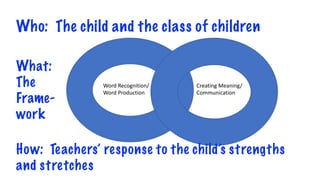
Who: The child and the class of children
Word Recognition/
Word Production
Creating Meaning/
Communication
How: Teachers’ response to the child’s strengths
and stretches
What:
The
Frame-
work
Planning in a Competency Based Curriculum
-based on students’ strengths and stretches
• Choose your Big Idea(s)
• Stories and other texts help us learn about ourselves, our families, and our communities (2-3) and make connections (4-5)
• Curiosity ad wonder lead us to new discoveries about ourselves and the world around us, (K-3) contributing to our ability to be informed and engaged citizens.(4-5)
• Choose your key curricular competency(ies)
• Access information and ideas for diverse purposes and from a variety of sources and evaluate their relevance, accuracy, and reliability. (6-9)
• Exchange ideas and viewpoints to build shared understanding and extend thinking. (6-9)
• Synthesize ideas from a variety of sources to build understanding. (5-9)
• Use writing and design processes to plan, develop, and create engaging and meaningful literacy and informational texts for a variety of purposes and audiences. (6-9)
• Choose your shared content (your provocation/text to develop the curricular competencies)
• Ancient Civilization/Early Man/hunters and gatherers – some practices still common today
• Choose your strategy sequence to teach
• Connecting: group cluster – what do you know?; rearrange cluster with new connections; timed write
• Processing: read, summarize, and share information tidbits
• Transforming and personalizing: in several days, create a time travel brochure: return to Neolithic period with increased survival skills
• Plan your teaching with gradual release “Do students OWN content information which they will need to transform into their brochure?”
• Building background information through slides, pictures, note-taking sheets, some text reading (read 3 times with different purposes).
• What do they know independently and collectively ? cluster
• Build specific vocabulary as students share.
• Quick write: begin with 2 words from the cluster, highlight a gem – specific information, share
• Add on information – highlight and share, write again – 2 minutes
• Consider if new information should be presented to the class or if students can research in pairs and independently, on questions they now have.
• Feedback
• For teacher: cluster, what do they know? What is their working knowledge?
• Notice and question as students are sharing to extend the thinking.
• Give feedback to students as they are writing and/or sharing their summaries.
• Begin to develop criteria for the brochure: content and style
Early Man – gr 6/7, Fraser Lake, Miranda Federici,
clustering, re-clustering, key words, response
• Clustering – what do you know about early man
• Re-clustering – mess it up, make new connections
• Timed write – choose two words/phrases and begin. What do you
know?
• Word count and underline significant/important phrase/sentence
• Share
• New information: read and summarize orally
• Add on: something significant you learned
• Strengths
• Think/pair/share
• Capable readers
• Strong at fill-in-the-blanks – and love it
• Stretches
• Shy in larger group
• Generally quiet
• Wide range of social-emotional response
• Preferred Greek myths to Early Man
4 picture write – Donri Helmer, 100 Mile House, and Duke of
Marlborough School, Churchill: Wendy Gauthier, Edina Preteau, George Power
• Divide a paper in 4 boxes. 4 words will be given, one at a time.
• Sketch all that you can think about
• the word – 1 minute. No talking. Share with a partner after some of the words.
• Be thinking of a story you can create, using all these words.
• Teacher modeling on the board, as students work.
• Before writing, brainstorm for different ways to begin a story. Explicit teaching
point!
• Timed write – 4 minutes, then added on 2, then 2-3 more.
• Underline your most powerful sentence.
• Writers’ mumble – sentences or spelling or transitions….
• Share.
• Day 2
• Review the criteria.
• Repeat the process with new words and sketches.
• Continue to write and conference.
• Practice 3-4 times with different words, then invite students to choose the piece
they are most invested in, review the criteria, edit and revise.
• Collect evidence of growth in students’ writing fluency, more sophisticated use of
the specific skill you taught, their attention to criteria to guide their writing, their
ability to take risks with their thinking, their perspective, and their language.
• Code using a single rubric from the BC Performance Srandards.
• Watch for evidence of the targeted competencies in their daily writing –
ownership and independence.
Building Criteria
• Read to see ’what works’. What strengths do you see in the writing?
• Collect
• Meaning
• Style
• Form
• Conventions
• Use as a guide when students are writing
• Have students ‘mark up’ their writing, identifying which criteria they have
met
• Use the criteria to help organize your conference
• What’s working?
• What’s not yet? With advice/hints to move on
Implementation
What has changed in your
literacy programming – or the
balance of your literacy
programming - in the past 2
years?
What would you like to
change?
What ideas are you taking away
from today?
What will you try?

BCTELA Inter 2023.pdf

  • 1.
  • 2.
    Who: The childand the class of children Word Recognition/ Word Production Creating Meaning/ Communication How: Teachers’ response to the child’s strengths and stretches What: The Frame- work
  • 3.
    Planning in aCompetency Based Curriculum -based on students’ strengths and stretches • Choose your Big Idea(s) • Stories and other texts help us learn about ourselves, our families, and our communities (2-3) and make connections (4-5) • Curiosity ad wonder lead us to new discoveries about ourselves and the world around us, (K-3) contributing to our ability to be informed and engaged citizens.(4-5) • Choose your key curricular competency(ies) • Access information and ideas for diverse purposes and from a variety of sources and evaluate their relevance, accuracy, and reliability. (6-9) • Exchange ideas and viewpoints to build shared understanding and extend thinking. (6-9) • Synthesize ideas from a variety of sources to build understanding. (5-9) • Use writing and design processes to plan, develop, and create engaging and meaningful literacy and informational texts for a variety of purposes and audiences. (6-9) • Choose your shared content (your provocation/text to develop the curricular competencies) • Ancient Civilization/Early Man/hunters and gatherers – some practices still common today • Choose your strategy sequence to teach • Connecting: group cluster – what do you know?; rearrange cluster with new connections; timed write • Processing: read, summarize, and share information tidbits • Transforming and personalizing: in several days, create a time travel brochure: return to Neolithic period with increased survival skills • Plan your teaching with gradual release “Do students OWN content information which they will need to transform into their brochure?” • Building background information through slides, pictures, note-taking sheets, some text reading (read 3 times with different purposes). • What do they know independently and collectively ? cluster • Build specific vocabulary as students share. • Quick write: begin with 2 words from the cluster, highlight a gem – specific information, share • Add on information – highlight and share, write again – 2 minutes • Consider if new information should be presented to the class or if students can research in pairs and independently, on questions they now have. • Feedback • For teacher: cluster, what do they know? What is their working knowledge? • Notice and question as students are sharing to extend the thinking. • Give feedback to students as they are writing and/or sharing their summaries. • Begin to develop criteria for the brochure: content and style
  • 4.
    Early Man –gr 6/7, Fraser Lake, Miranda Federici, clustering, re-clustering, key words, response • Clustering – what do you know about early man • Re-clustering – mess it up, make new connections • Timed write – choose two words/phrases and begin. What do you know? • Word count and underline significant/important phrase/sentence • Share • New information: read and summarize orally • Add on: something significant you learned
  • 5.
    • Strengths • Think/pair/share •Capable readers • Strong at fill-in-the-blanks – and love it • Stretches • Shy in larger group • Generally quiet • Wide range of social-emotional response • Preferred Greek myths to Early Man
  • 17.
    4 picture write– Donri Helmer, 100 Mile House, and Duke of Marlborough School, Churchill: Wendy Gauthier, Edina Preteau, George Power • Divide a paper in 4 boxes. 4 words will be given, one at a time. • Sketch all that you can think about • the word – 1 minute. No talking. Share with a partner after some of the words. • Be thinking of a story you can create, using all these words. • Teacher modeling on the board, as students work. • Before writing, brainstorm for different ways to begin a story. Explicit teaching point! • Timed write – 4 minutes, then added on 2, then 2-3 more. • Underline your most powerful sentence. • Writers’ mumble – sentences or spelling or transitions…. • Share.
  • 22.
    • Day 2 •Review the criteria. • Repeat the process with new words and sketches. • Continue to write and conference. • Practice 3-4 times with different words, then invite students to choose the piece they are most invested in, review the criteria, edit and revise. • Collect evidence of growth in students’ writing fluency, more sophisticated use of the specific skill you taught, their attention to criteria to guide their writing, their ability to take risks with their thinking, their perspective, and their language. • Code using a single rubric from the BC Performance Srandards. • Watch for evidence of the targeted competencies in their daily writing – ownership and independence.
  • 23.
    Building Criteria • Readto see ’what works’. What strengths do you see in the writing? • Collect • Meaning • Style • Form • Conventions • Use as a guide when students are writing • Have students ‘mark up’ their writing, identifying which criteria they have met • Use the criteria to help organize your conference • What’s working? • What’s not yet? With advice/hints to move on
  • 24.
    Implementation What has changedin your literacy programming – or the balance of your literacy programming - in the past 2 years? What would you like to change? What ideas are you taking away from today? What will you try?