Want to Understand More
  About Early Literacy
           &
  How You Can Help?
   Presentation by Jolene Dodd
        Walden University
   The Beginning Reader, PreK-3
          February 2012
Early Learners
o Reading should start very early in a child’s life.
o Read story books & ask questions.
o Talk, Talk, Talk about the books and the world
  around you!
o Expand on the student’s natural curiosity.
o Background knowledge is crucial
   o Experiences with print
   o Experiences with the world

   Laureatte, Inc. (2009). Perspectives on Early Learners. [Webcast]. Baltimore, MD: Author
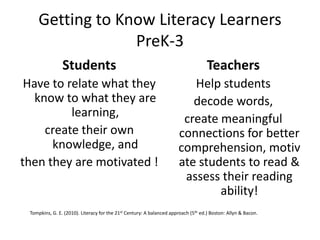
Getting to Know Literacy Learners
                  PreK-3
                Students                                                            Teachers
 Have to relate what they                                                Help students
   know to what they are                                                 decode words,
          learning,                                                    create meaningful
     create their own                                                 connections for better
      knowledge, and                                                  comprehension, motiv
then they are motivated !                                             ate students to read &
                                                                       assess their reading
                                                                              ability!
 Tompkins, G. E. (2010). Literacy for the 21st Century: A balanced approach (5th ed.) Boston: Allyn & Bacon.
Selecting Texts
o Readability
    o Sentence length
    o Number of syllables in words
    o Concept of the text
    o Singletons or unique words that only appear once
    o Length of text
    o Text structure
    o Size of print
    o Visual support
    Even though all these are critical to selecting a text, still
      keep in mind their motivation to read…their interest!
 Laureate Education, Inc. (2009). Analyzing and Selecting Text [webcast]. The beginning reader, PK-3. Baltimore, MD: Author.
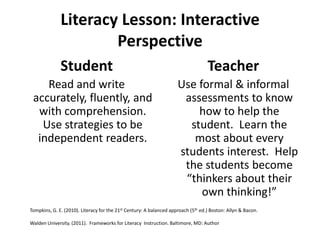
Literacy Lesson: Interactive
                      Perspective
              Student                                                              Teacher
    Read and write                                                   Use formal & informal
 accurately, fluently, and                                            assessments to know
  with comprehension.                                                    how to help the
   Use strategies to be                                                student. Learn the
  independent readers.                                                  most about every
                                                                     students interest. Help
                                                                      the students become
                                                                      “thinkers about their
                                                                          own thinking!”
Tompkins, G. E. (2010). Literacy for the 21st Century: A balanced approach (5th ed.) Boston: Allyn & Bacon.

Walden University. (2011). Frameworks for Literacy Instruction. Baltimore, MD: Author
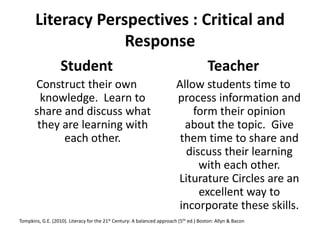
Literacy Perspectives : Critical and
                    Response
                   Student                                                             Teacher
       Construct their own                                               Allow students time to
         knowledge. Learn to                                             process information and
       share and discuss what                                                form their opinion
        they are learning with                                             about the topic. Give
             each other.                                                  them time to share and
                                                                           discuss their learning
                                                                              with each other.
                                                                         Liturature Circles are an
                                                                              excellent way to
                                                                         incorporate these skills.
Tompkins, G.E. (2010). Literacy for the 21st Century: A balanced approach (5th ed.) Boston: Allyn & Bacon
Feedback

Please provide feedback from the
questions listed on your handout.
            Thank you

Early Literacy

  • 1.
    Want to UnderstandMore About Early Literacy & How You Can Help? Presentation by Jolene Dodd Walden University The Beginning Reader, PreK-3 February 2012
  • 2.
    Early Learners o Readingshould start very early in a child’s life. o Read story books & ask questions. o Talk, Talk, Talk about the books and the world around you! o Expand on the student’s natural curiosity. o Background knowledge is crucial o Experiences with print o Experiences with the world Laureatte, Inc. (2009). Perspectives on Early Learners. [Webcast]. Baltimore, MD: Author
  • 3.
    Getting to KnowLiteracy Learners PreK-3 Students Teachers Have to relate what they Help students know to what they are decode words, learning, create meaningful create their own connections for better knowledge, and comprehension, motiv then they are motivated ! ate students to read & assess their reading ability! Tompkins, G. E. (2010). Literacy for the 21st Century: A balanced approach (5th ed.) Boston: Allyn & Bacon.
  • 4.
    Selecting Texts o Readability o Sentence length o Number of syllables in words o Concept of the text o Singletons or unique words that only appear once o Length of text o Text structure o Size of print o Visual support Even though all these are critical to selecting a text, still keep in mind their motivation to read…their interest! Laureate Education, Inc. (2009). Analyzing and Selecting Text [webcast]. The beginning reader, PK-3. Baltimore, MD: Author.
  • 5.
    Literacy Lesson: Interactive Perspective Student Teacher Read and write Use formal & informal accurately, fluently, and assessments to know with comprehension. how to help the Use strategies to be student. Learn the independent readers. most about every students interest. Help the students become “thinkers about their own thinking!” Tompkins, G. E. (2010). Literacy for the 21st Century: A balanced approach (5th ed.) Boston: Allyn & Bacon. Walden University. (2011). Frameworks for Literacy Instruction. Baltimore, MD: Author
  • 6.
    Literacy Perspectives :Critical and Response Student Teacher Construct their own Allow students time to knowledge. Learn to process information and share and discuss what form their opinion they are learning with about the topic. Give each other. them time to share and discuss their learning with each other. Liturature Circles are an excellent way to incorporate these skills. Tompkins, G.E. (2010). Literacy for the 21st Century: A balanced approach (5th ed.) Boston: Allyn & Bacon
  • 7.
    Feedback Please provide feedbackfrom the questions listed on your handout. Thank you