Formative Assessment and Quality
Teaching in Inclusive Classrooms and
     Schools: A Community of
            Professionals
               Coquitlam
            Sept. 24, 2010
       Presented by Faye Brownlie
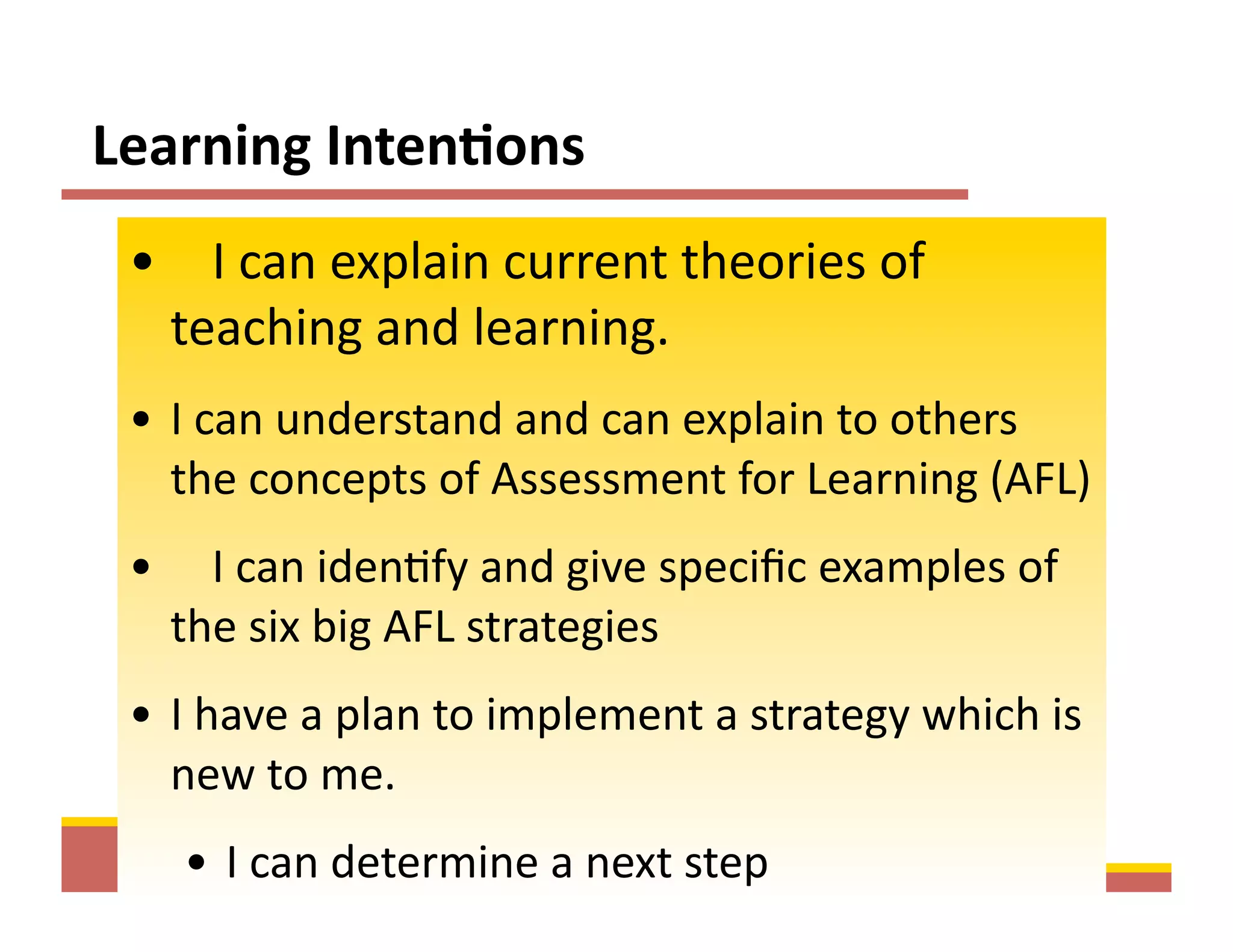
Learning	
  Inten+ons	
  
 •  	
   	
  I	
  can	
  explain	
  current	
  theories	
  of	
  
    teaching	
  and	
  learning.	
  
 •  I	
  can	
  understand	
  and	
  can	
  explain	
  to	
  others	
  
    the	
  concepts	
  of	
  Assessment	
  for	
  Learning	
  (AFL)	
  
 •  	
   	
  I	
  can	
  iden<fy	
  and	
  give	
  specific	
  examples	
  of	
  
    the	
  six	
  big	
  AFL	
  strategies	
  
 •  I	
  have	
  a	
  plan	
  to	
  implement	
  a	
  strategy	
  which	
  is	
  
    new	
  to	
  me.	
  	
  
     •  I	
  can	
  determine	
  a	
  next	
  step	
  
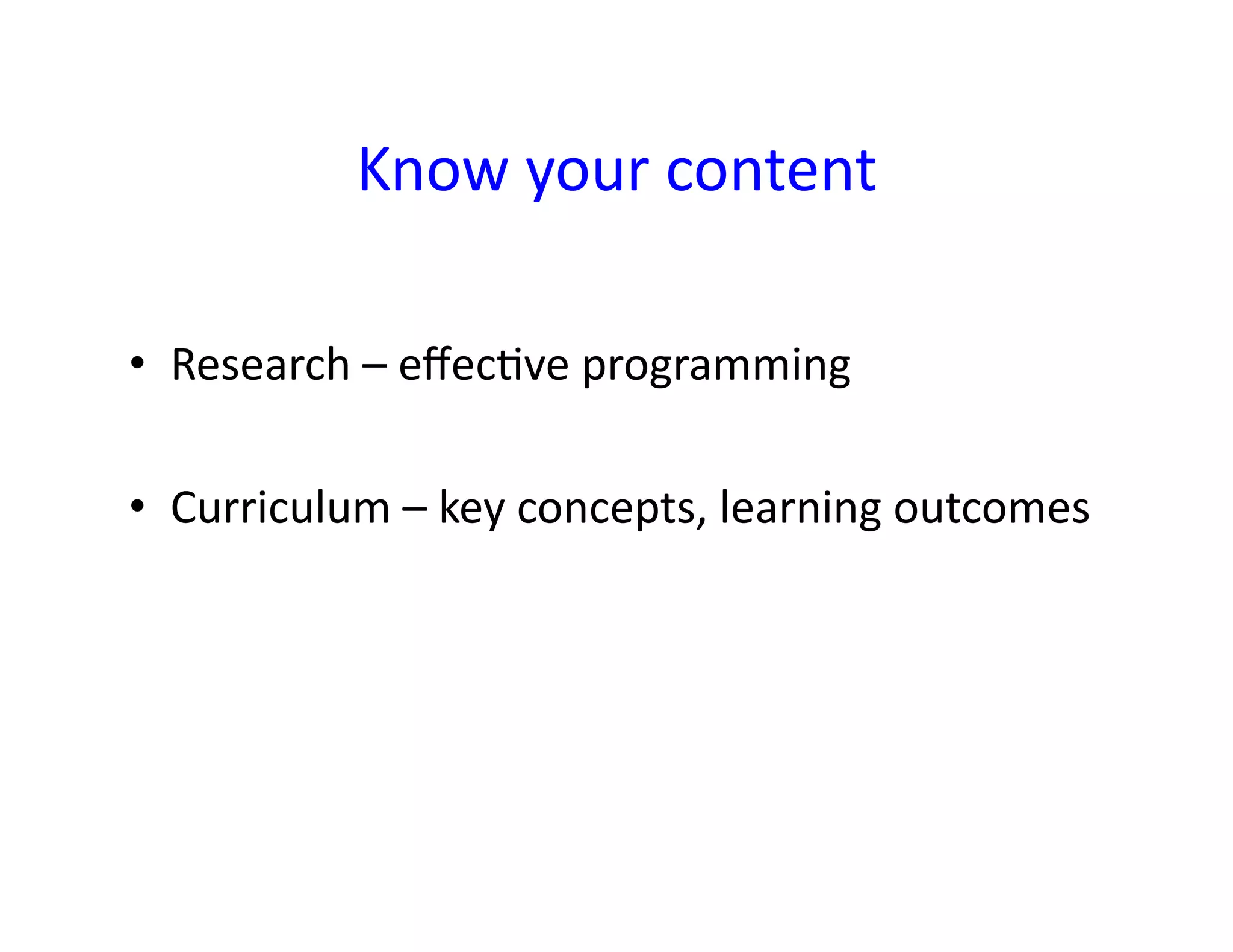
Know	
  your	
  content	
  

•  Research	
  –	
  effec<ve	
  programming	
  

•  Curriculum	
  –	
  key	
  concepts,	
  learning	
  outcomes	
  
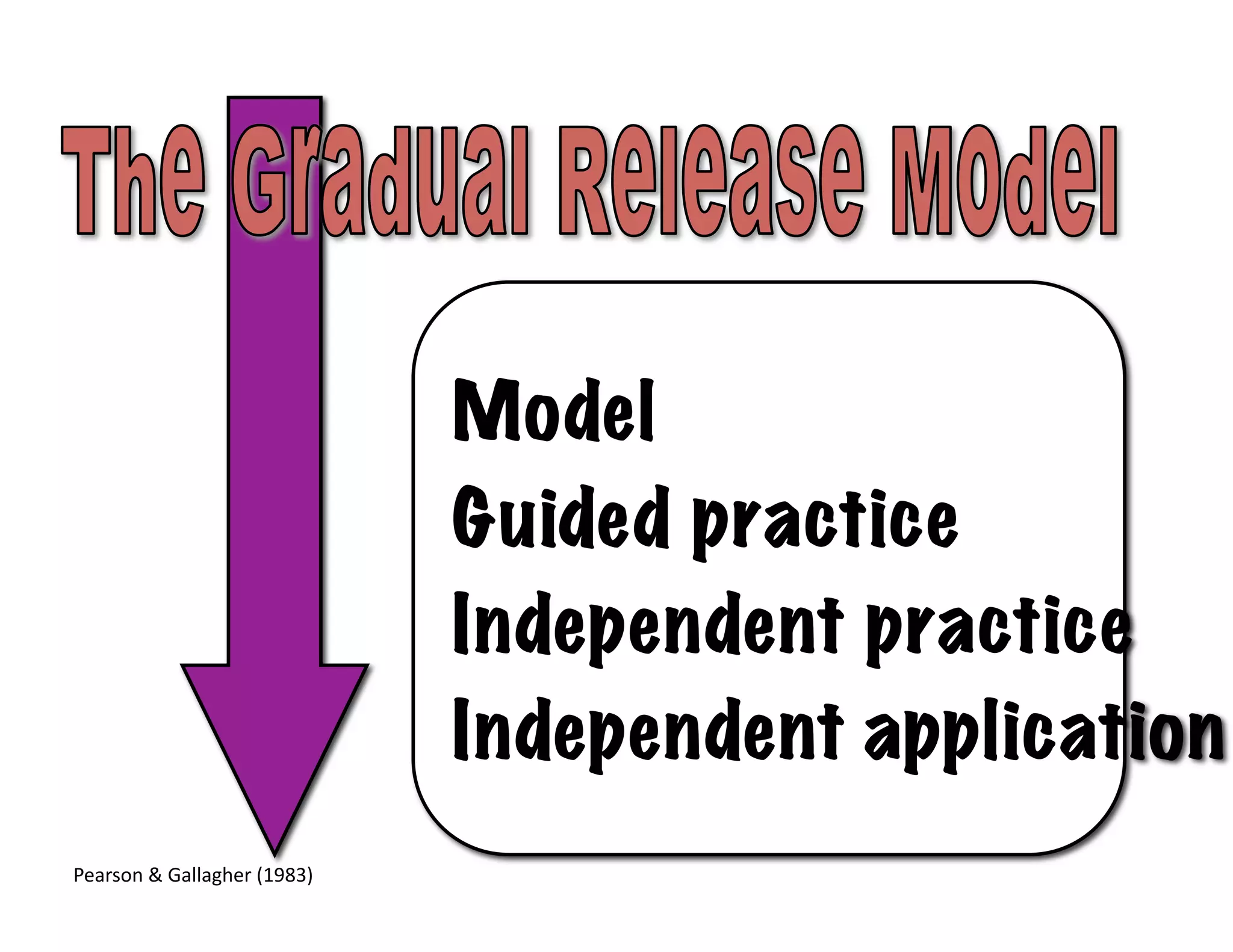
Model
                                          Guided practice
                                          Independent practice
                                          Independent application	
  
Pearson	
  &	
  Gallagher	
  (1983)	
  
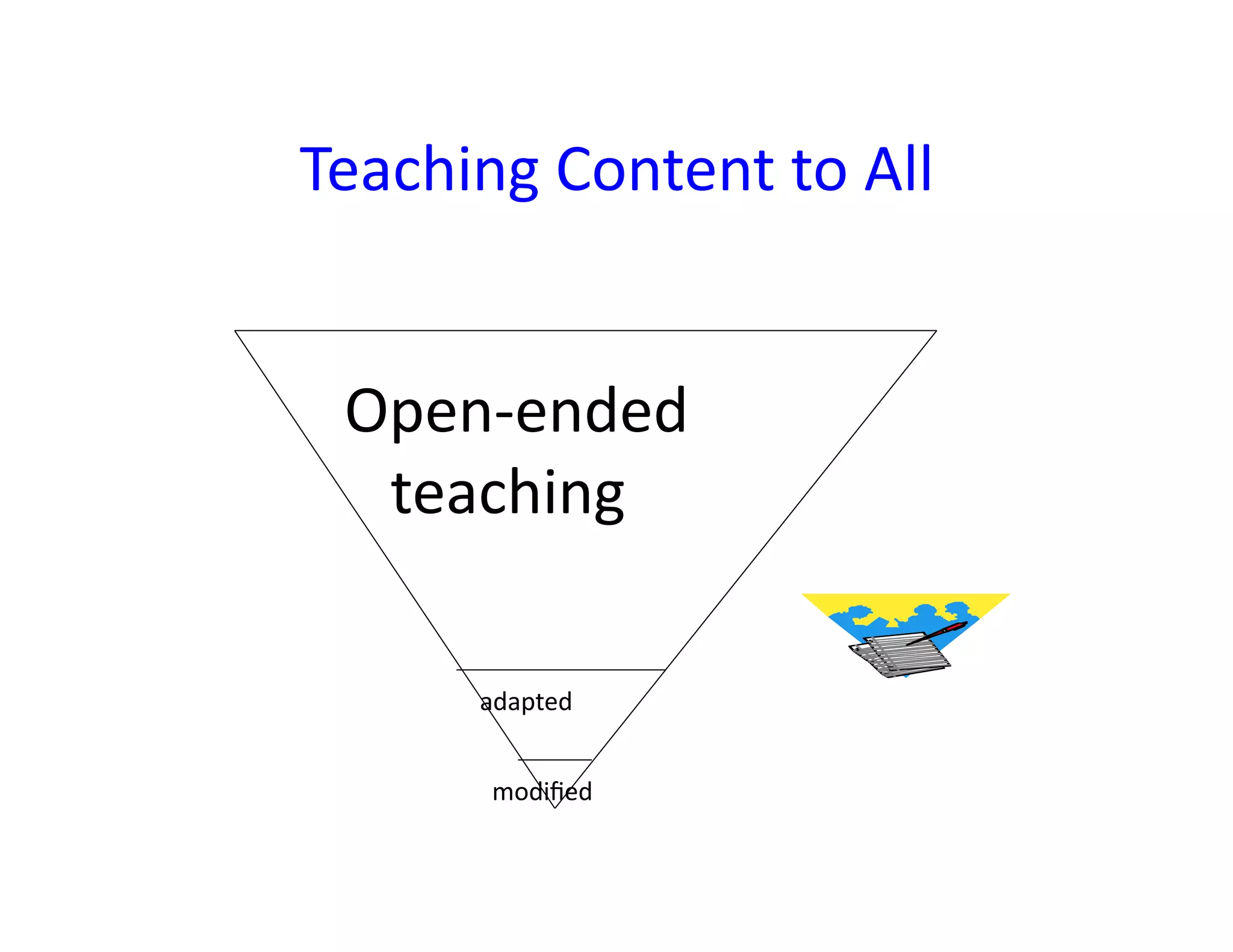
Teaching	
  Content	
  to	
  All	


  Open-­‐ended	


  teaching	
  

          adapted	


           modified	
  
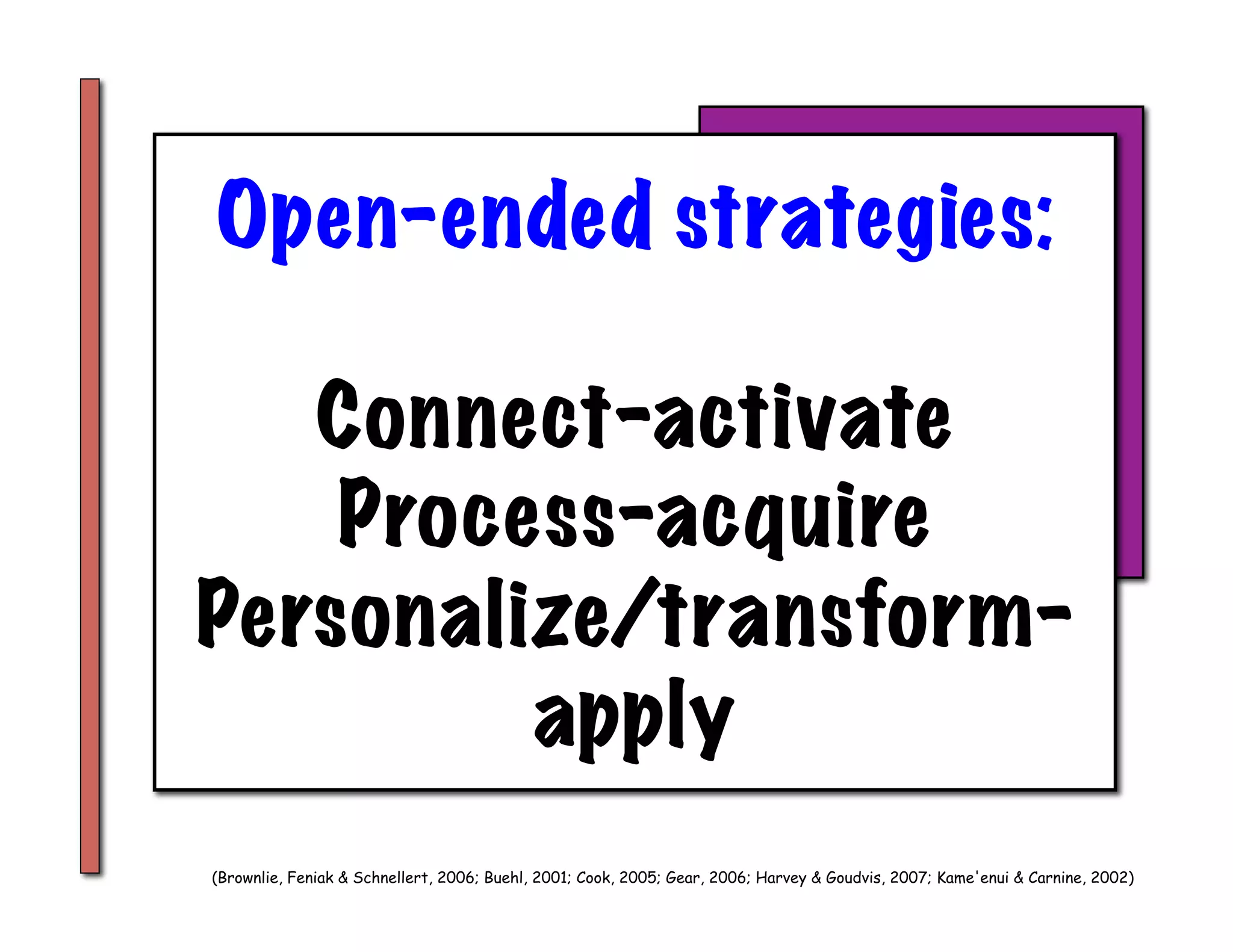
Open-ended strategies:

   Connect-activate
    Process-acquire
Personalize/transform-
         apply
(Brownlie, Feniak & Schnellert, 2006; Buehl, 2001; Cook, 2005; Gear, 2006; Harvey & Goudvis, 2007; Kame'enui & Carnine, 2002)
Frameworks


It’s All about Thinking – Brownlie & Schnellert, 2009
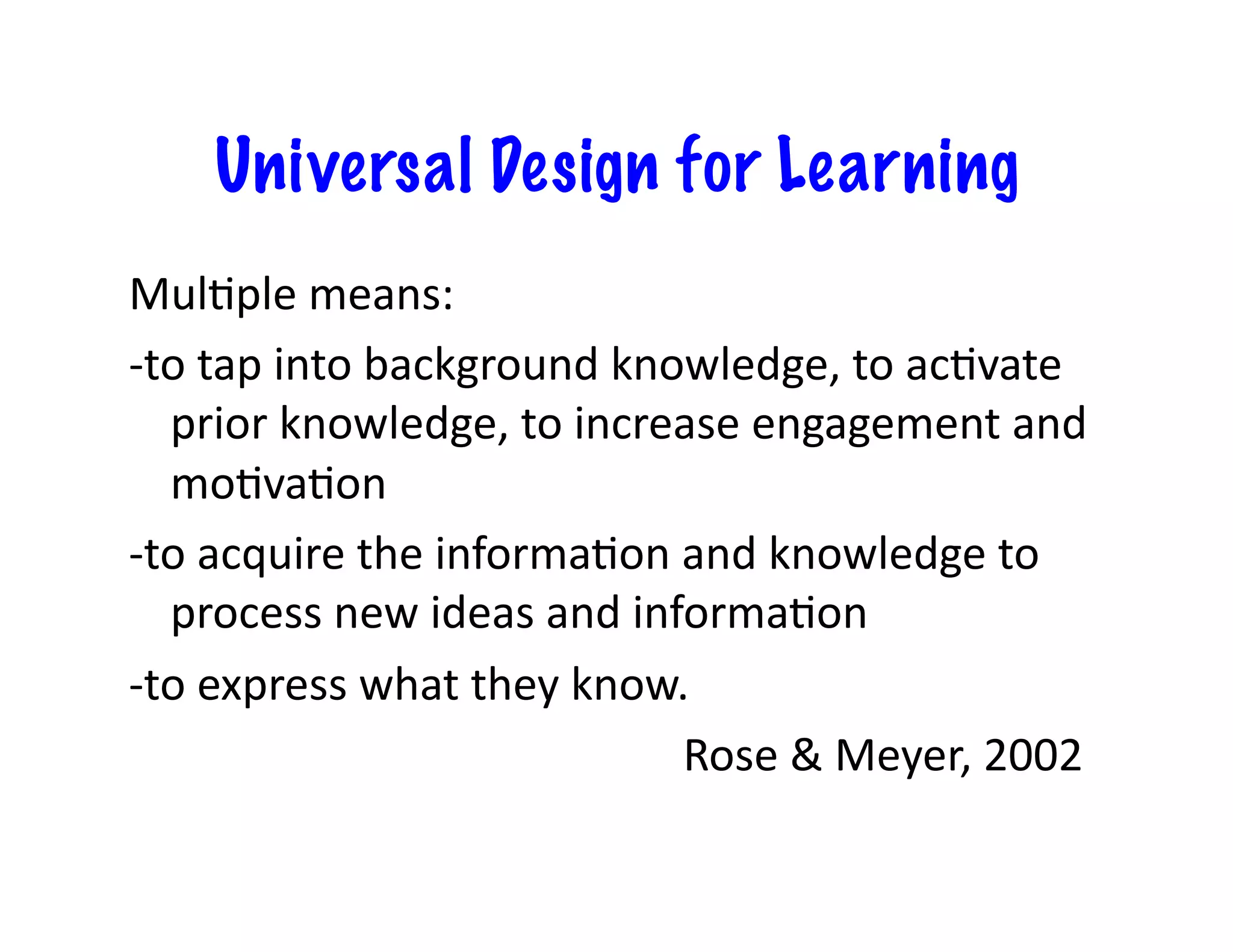
Universal Design for Learning
Mul<ple	
  means:	
  
-­‐to	
  tap	
  into	
  background	
  knowledge,	
  to	
  ac<vate	
  
        prior	
  knowledge,	
  to	
  increase	
  engagement	
  and	
  
        mo<va<on	
  
-­‐to	
  acquire	
  the	
  informa<on	
  and	
  knowledge	
  to	
  
        process	
  new	
  ideas	
  and	
  informa<on	
  
-­‐to	
  express	
  what	
  they	
  know.	


  Rose	
  &	
  Meyer,	
  2002	
  
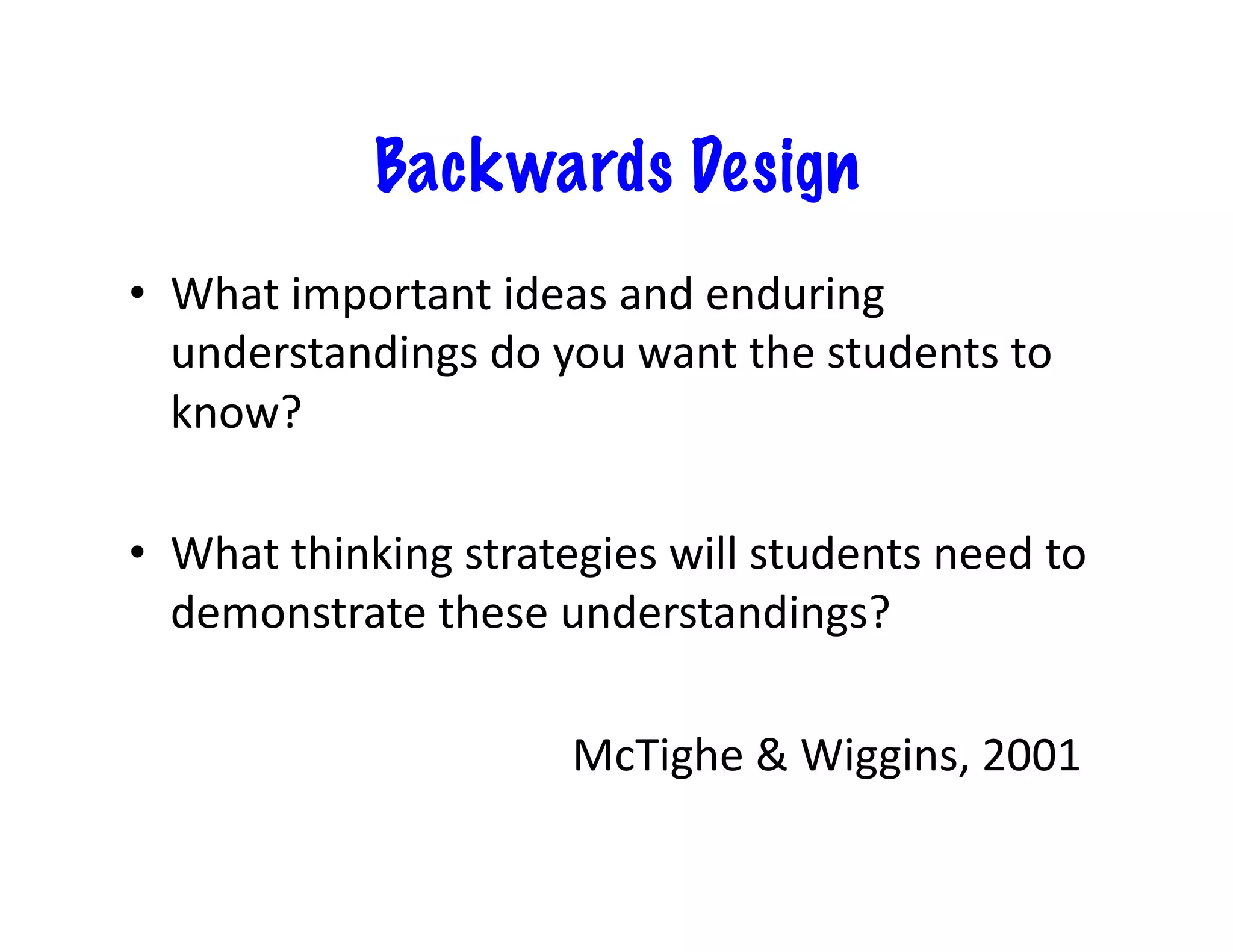
Backwards Design
•  What	
  important	
  ideas	
  and	
  enduring	
  
   understandings	
  do	
  you	
  want	
  the	
  students	
  to	
  
   know?	
  

•  What	
  thinking	
  strategies	
  will	
  students	
  need	
  to	
  
   demonstrate	
  these	
  understandings?	


  McTighe	
  &	
  Wiggins,	
  2001	
  
Know	
  your	
  kids	
  

•  Class	
  review	
  

•  Assessment	
  for	
  learning	
  –	
  the	
  grand	
  event	
  
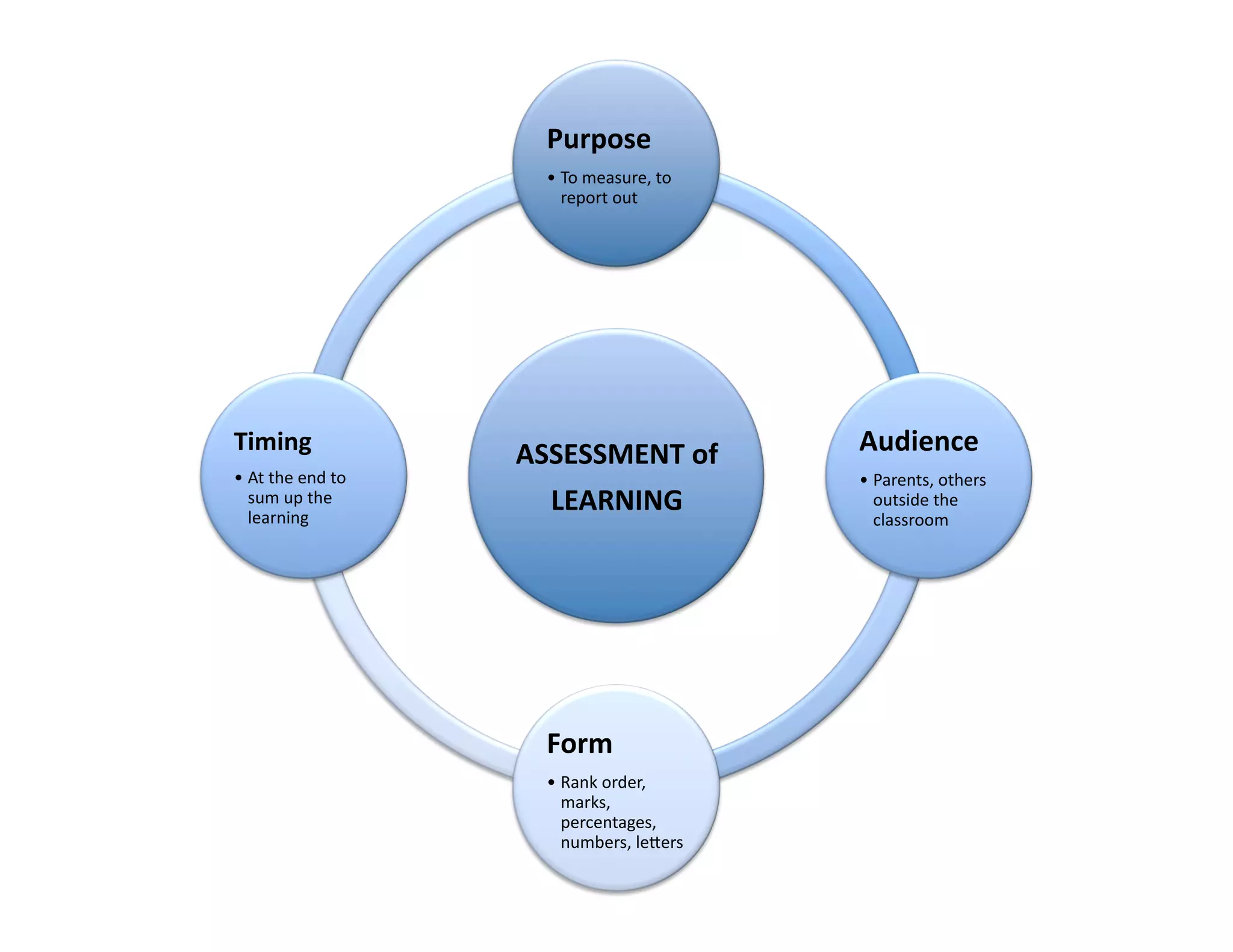
Purpose	
  
                                   •  To	
  measure,	
  to	
  
                                      report	
  out	


Timing	
                        ASSESSMENT	
  of	
  	
           Audience	
  
•  At	
  the	
  end	
  to	
                                      •  Parents,	
  others	
  
   sum	
  up	
  the	
  
   learning	
  
                                  LEARNING	
                        outside	
  the	
  
                                                                    classroom	


                                   Form	
  
                                   •  Rank	
  order,	
  
                                      marks,	
  
                                      percentages,	
  
                                      numbers,	
  leZers	
  
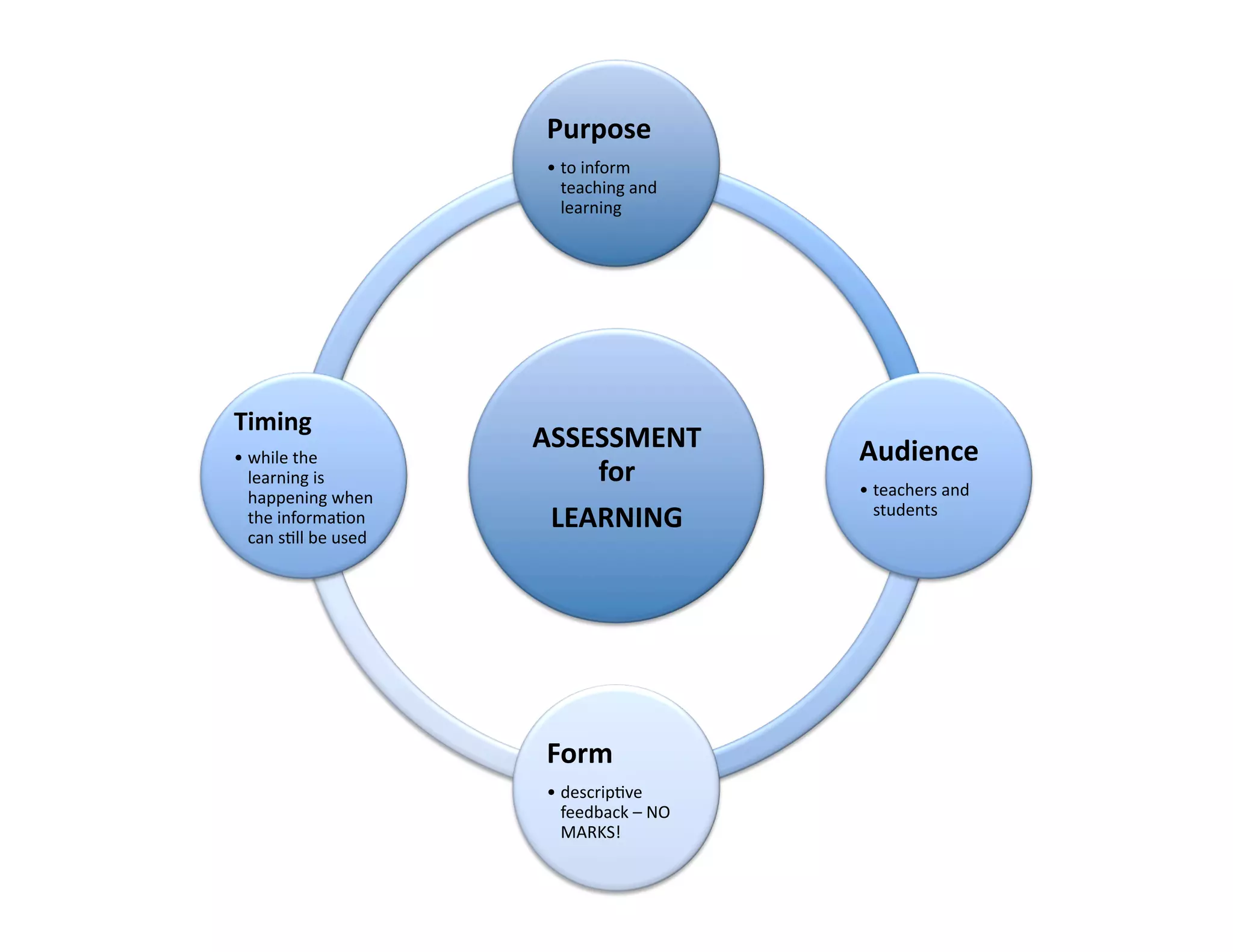
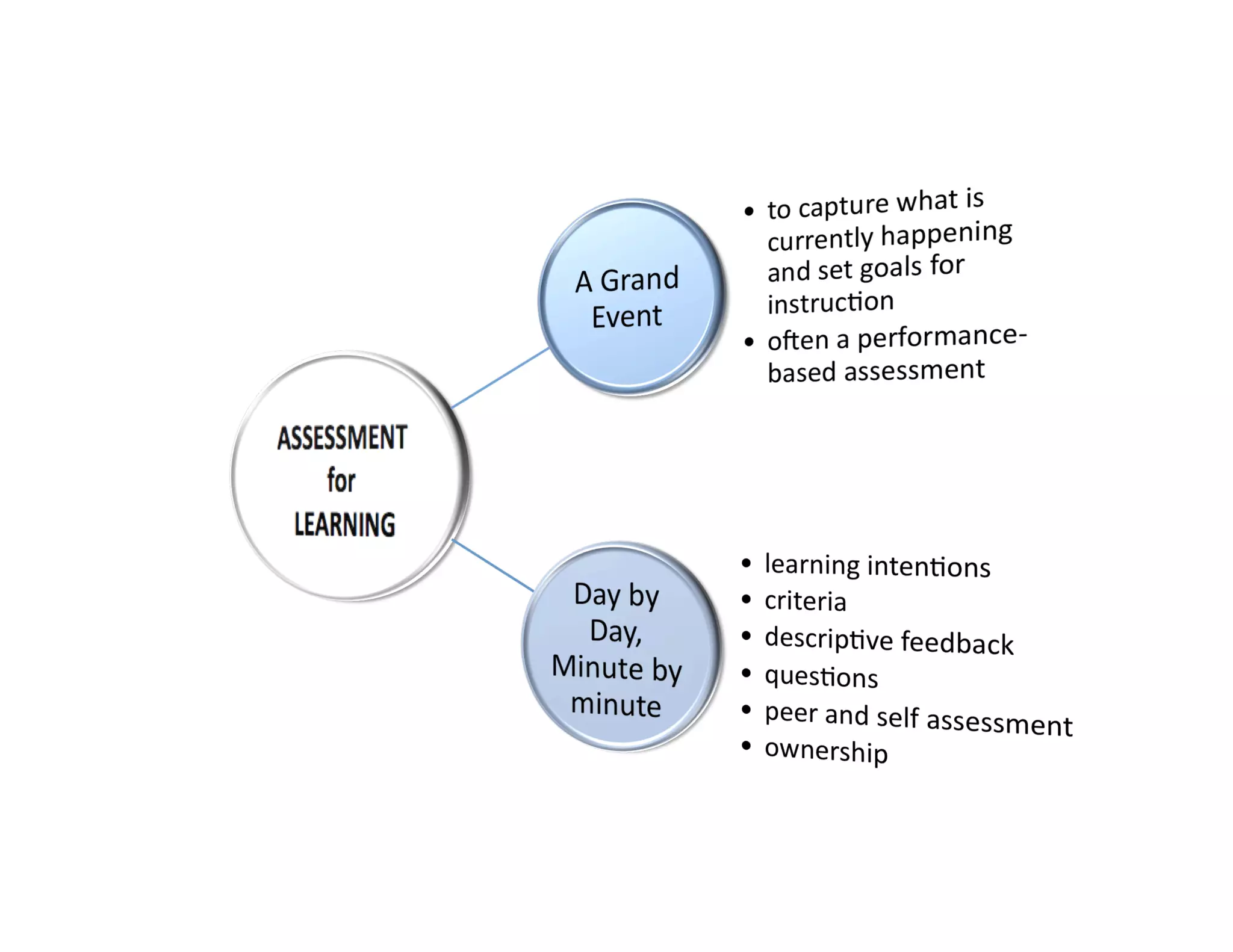
Purpose	
  
                                    •  to	
  inform	
  
                                       teaching	
  and	
  
                                       learning	


Timing	
  
                                   ASSESSMENT	
                  Audience	
  
•  while	
  the	
  
   learning	
  is	
                    for	
  	
                 •  teachers	
  and	
  
   happening	
  when	
  
   the	
  informa<on	
              LEARNING	
                      students	
  
   can	
  s<ll	
  be	
  used	


                                    Form	
  
                                    •  descrip<ve	
  
                                       feedback	
  –	
  NO	
  
                                       MARKS!	
  
Classroom	
  Examples	
  
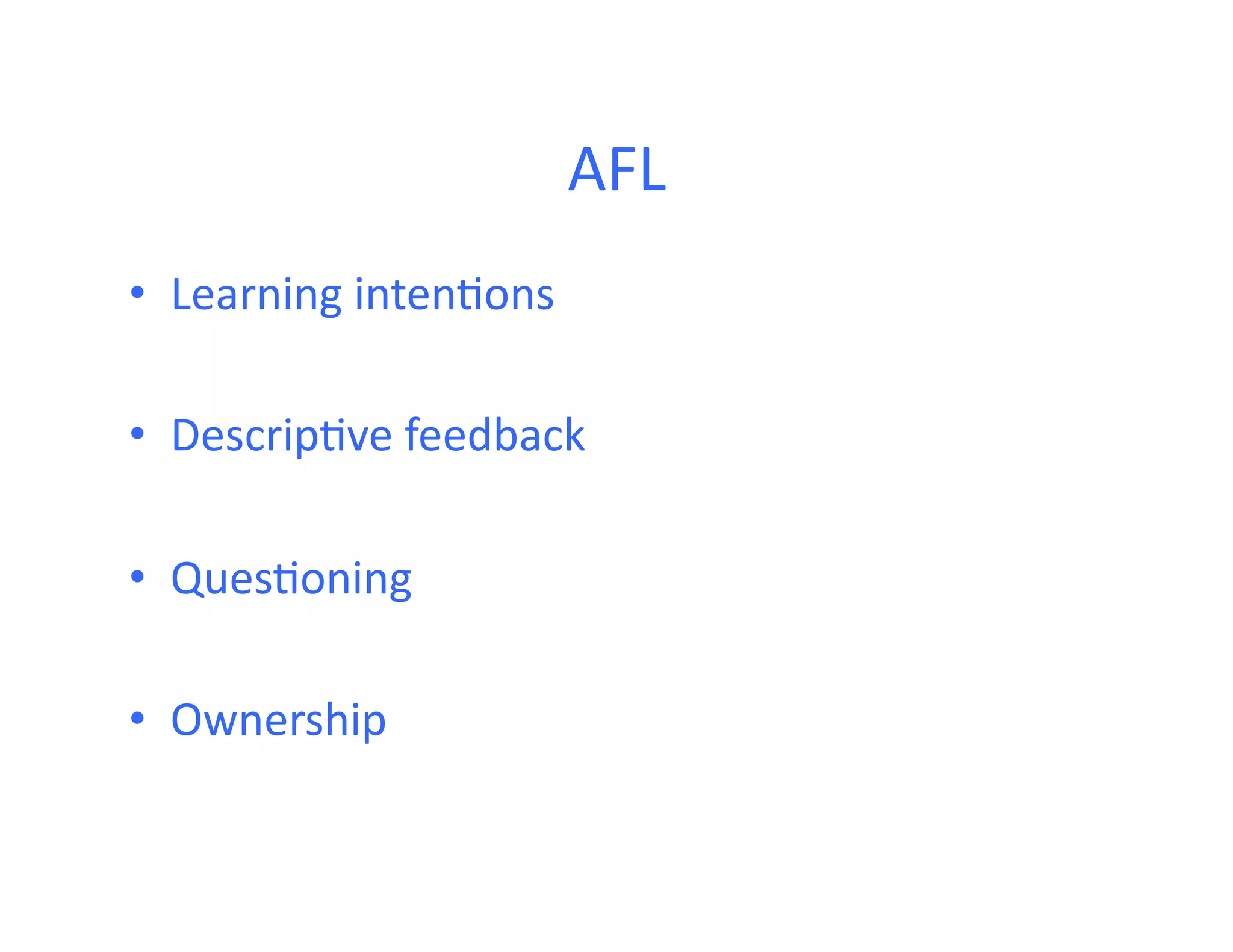
AFL	
  
•  Learning	
  inten<ons	
  

•  Descrip<ve	
  feedback	
  

•  Ques<oning	
  

•  Ownership	
  
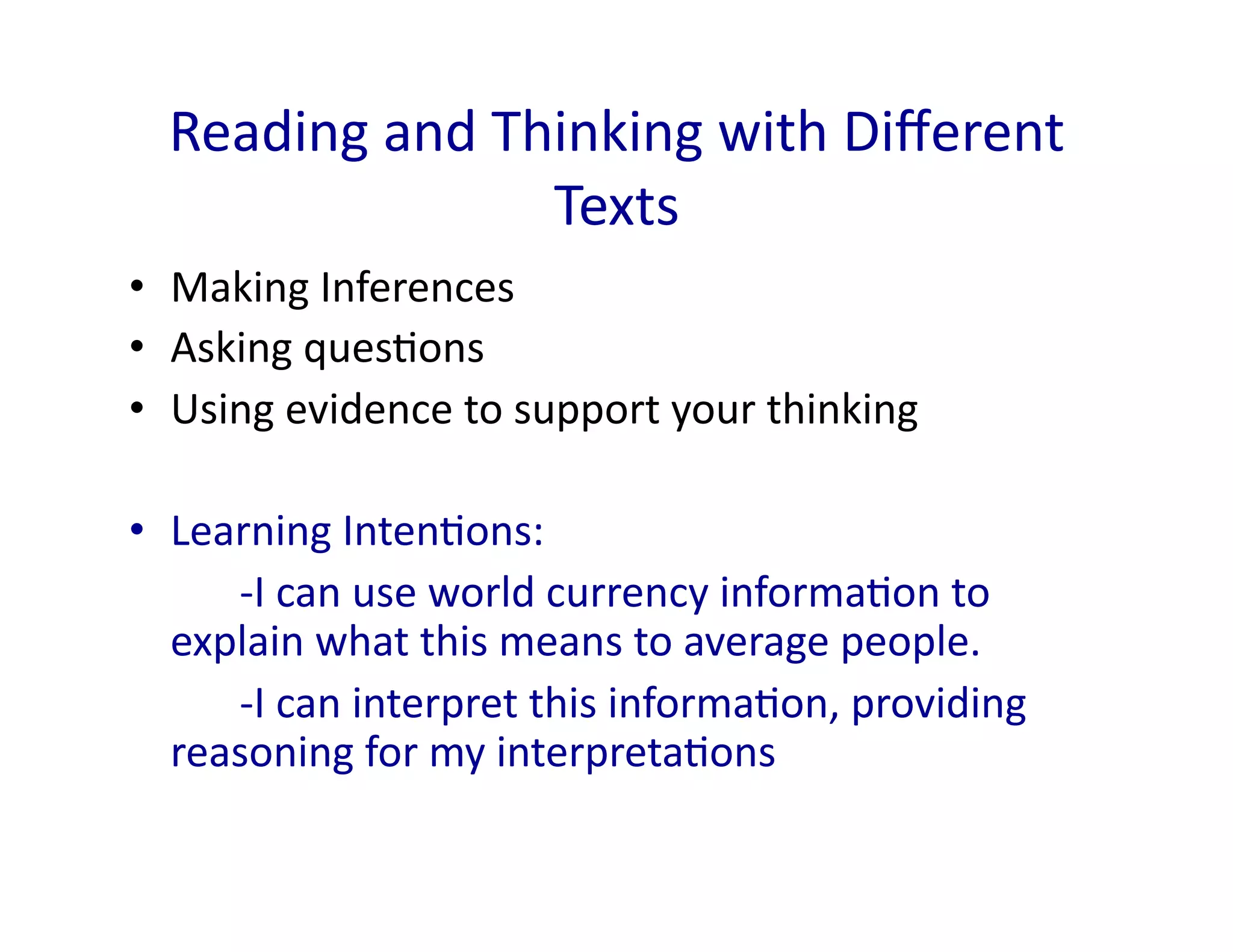
Reading	
  and	
  Thinking	
  with	
  Different	
  
                       Texts	
  
•  Making	
  Inferences	
  
•  Asking	
  ques<ons	
  
•  Using	
  evidence	
  to	
  support	
  your	
  thinking	
  

•  Learning	
  Inten<ons:	


  -­‐I	
  can	
  use	
  world	
  currency	
  informa<on	
  to	
  
     explain	
  what	
  this	
  means	
  to	
  average	
  people.	


  -­‐I	
  can	
  interpret	
  this	
  informa<on,	
  providing	
  
     reasoning	
  for	
  my	
  interpreta<ons	
  
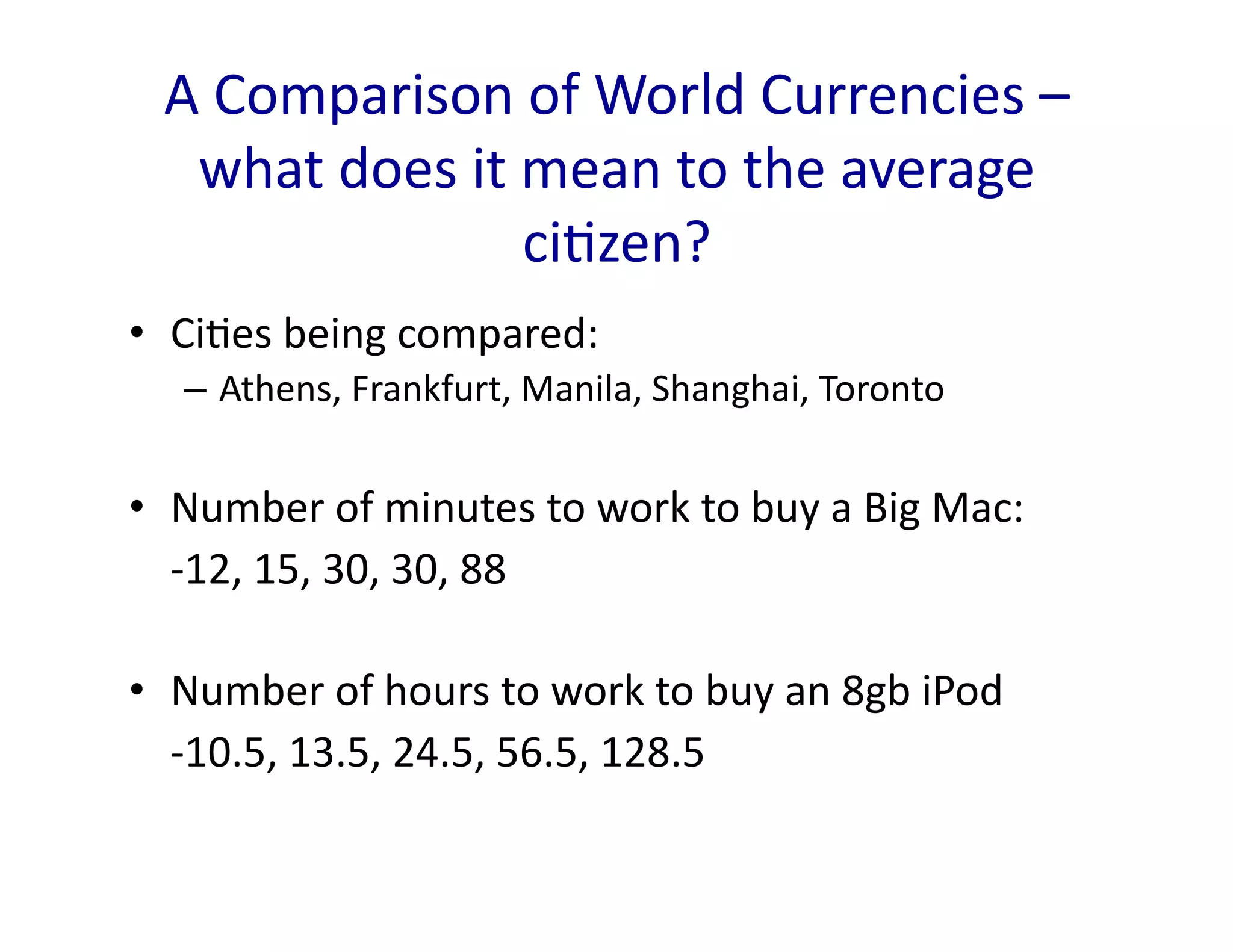
A	
  Comparison	
  of	
  World	
  Currencies	
  –	
  
    what	
  does	
  it	
  mean	
  to	
  the	
  average	
  
                          ci<zen?	
  
•  Ci<es	
  being	
  compared:	
  
    –  Athens,	
  Frankfurt,	
  Manila,	
  Shanghai,	
  Toronto	


•  Number	
  of	
  minutes	
  to	
  work	
  to	
  buy	
  a	
  Big	
  Mac:	
  
  	
  -­‐12,	
  15,	
  30,	
  30,	
  88	
  

•  Number	
  of	
  hours	
  to	
  work	
  to	
  buy	
  an	
  8gb	
  iPod	
  
  	
  -­‐10.5,	
  13.5,	
  24.5,	
  56.5,	
  128.5	
  
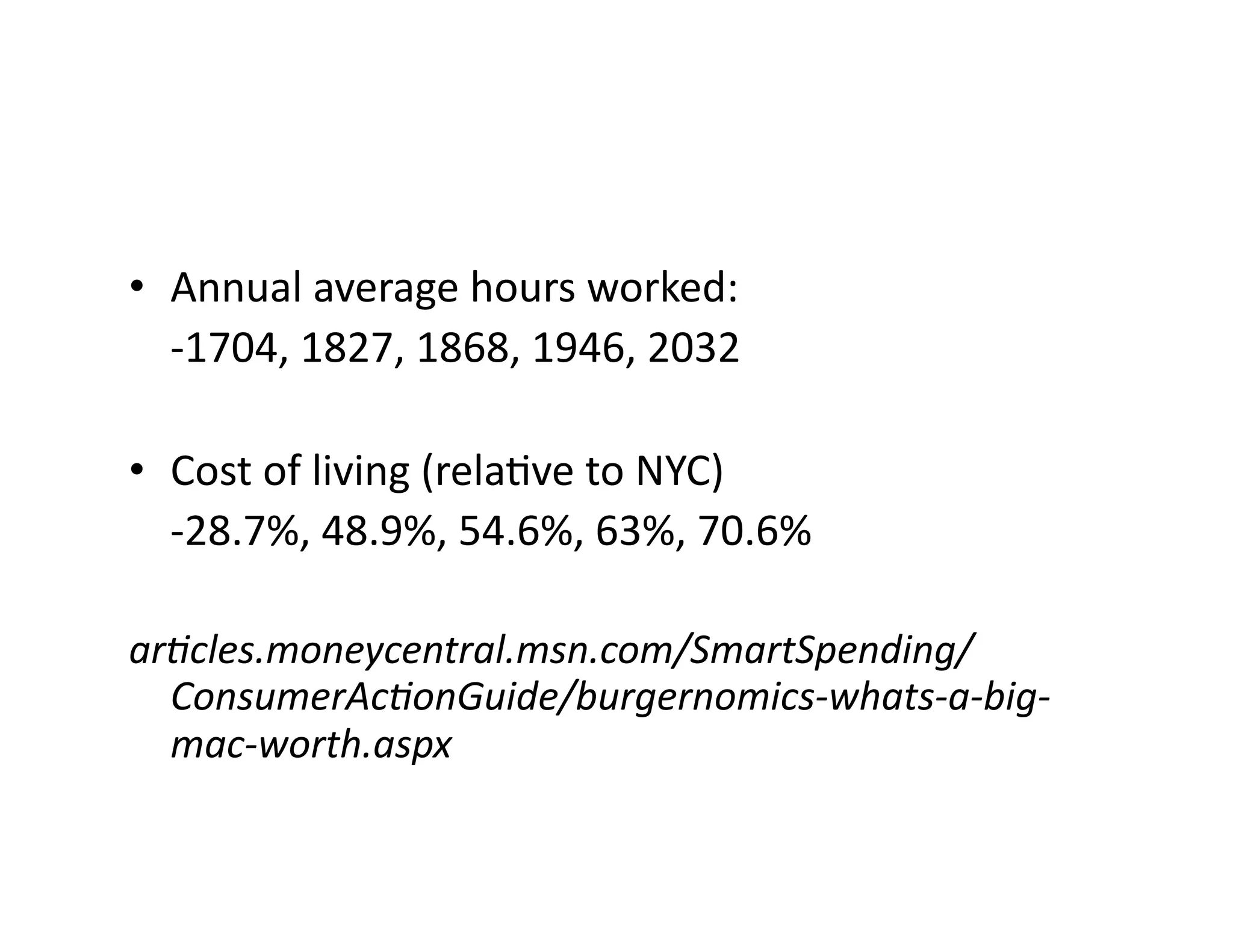
•  Annual	
  average	
  hours	
  worked:	
  
  	
  -­‐1704,	
  1827,	
  1868,	
  1946,	
  2032	
  

•  Cost	
  of	
  living	
  (rela<ve	
  to	
  NYC)	
  
  	
  -­‐28.7%,	
  48.9%,	
  54.6%,	
  63%,	
  70.6%	
  

ar#cles.moneycentral.msn.com/SmartSpending/
  ConsumerAc#onGuide/burgernomics-­‐whats-­‐a-­‐big-­‐
  mac-­‐worth.aspx	
  
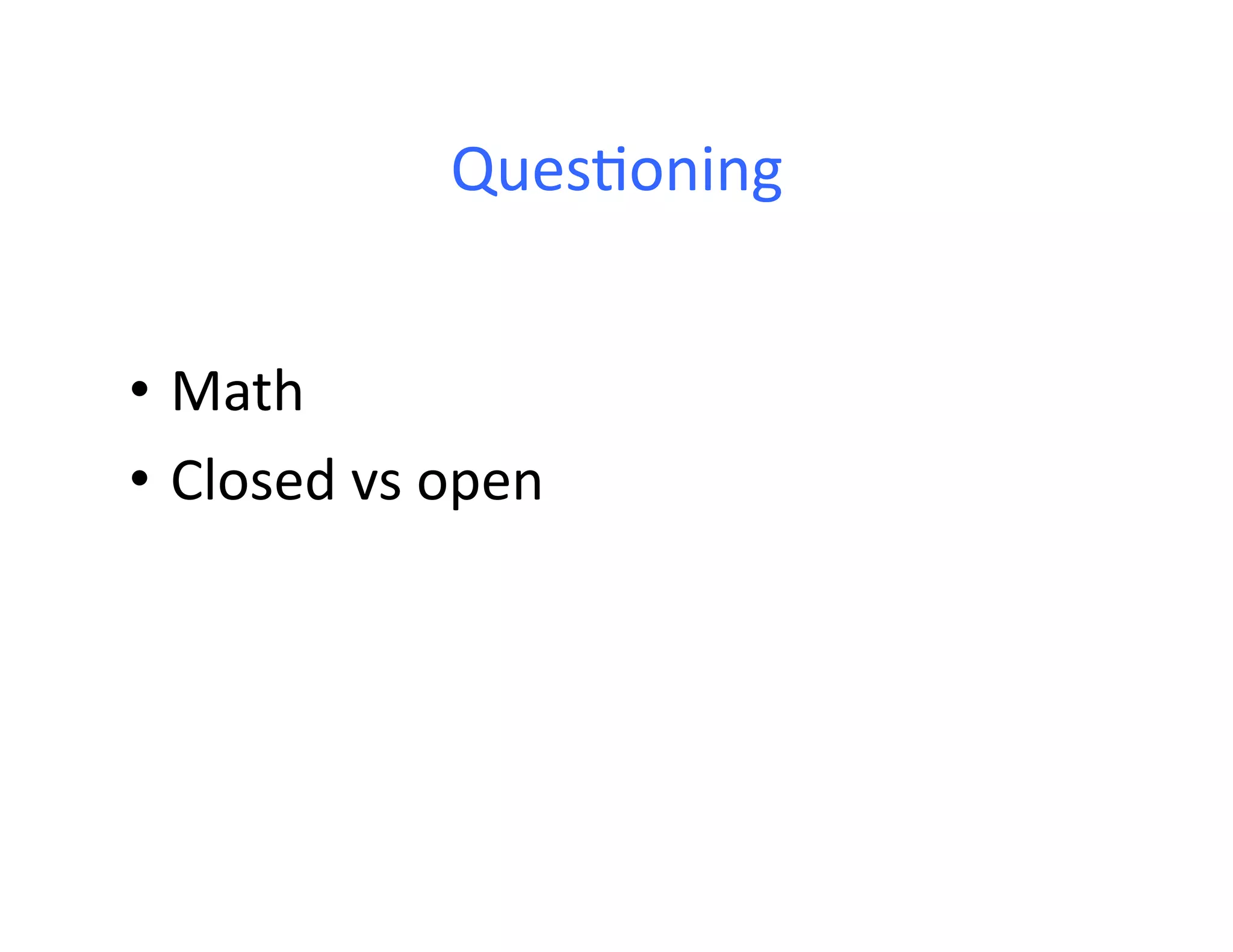
Ques<oning	


•  Math	
  
•  Closed	
  vs	
  open	
  
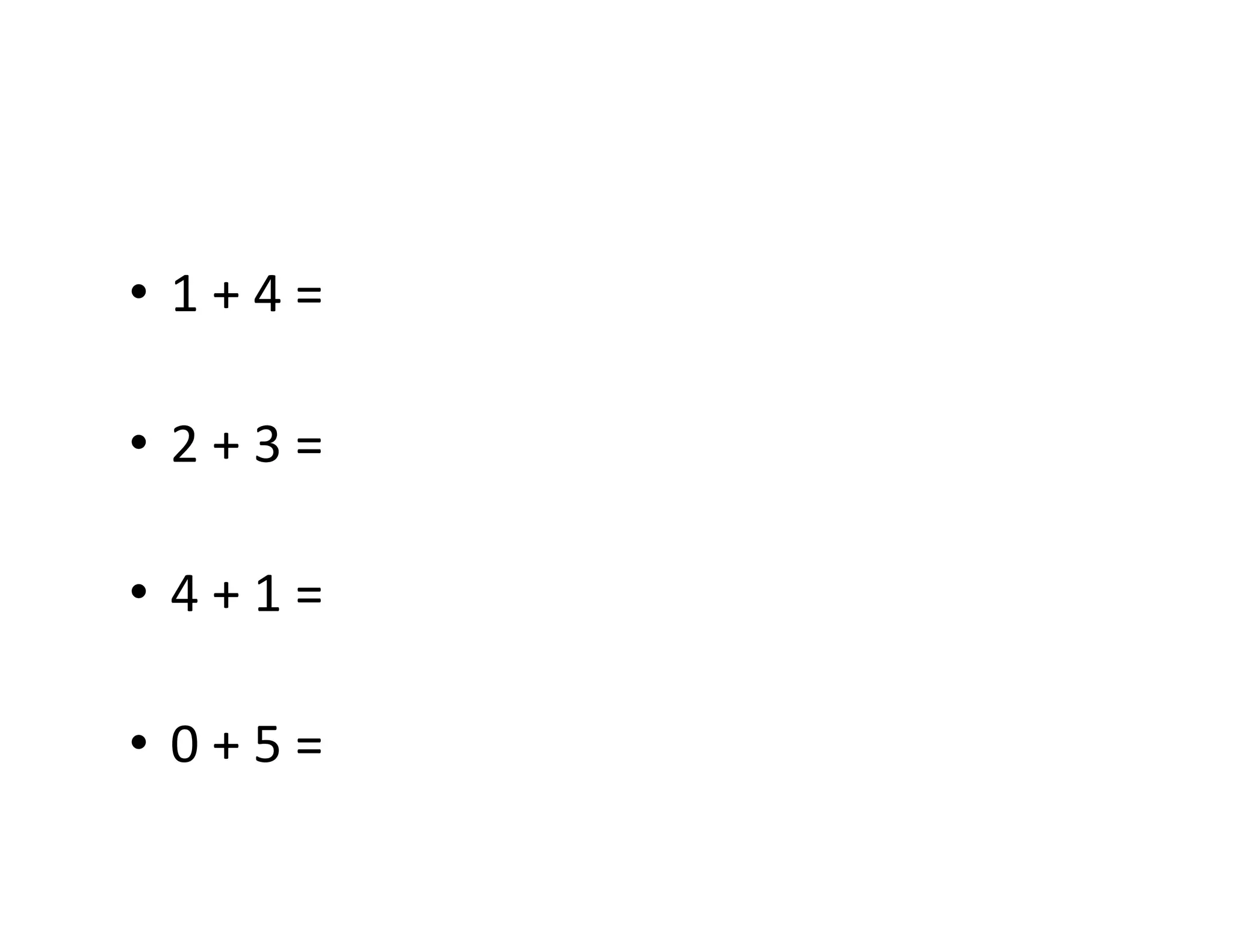
•  1	
  +	
  4	
  =	


•  2	
  +	
  3	
  =	
  

•  4	
  +	
  1	
  =	
  

•  0	
  +	
  5	
  =	
  
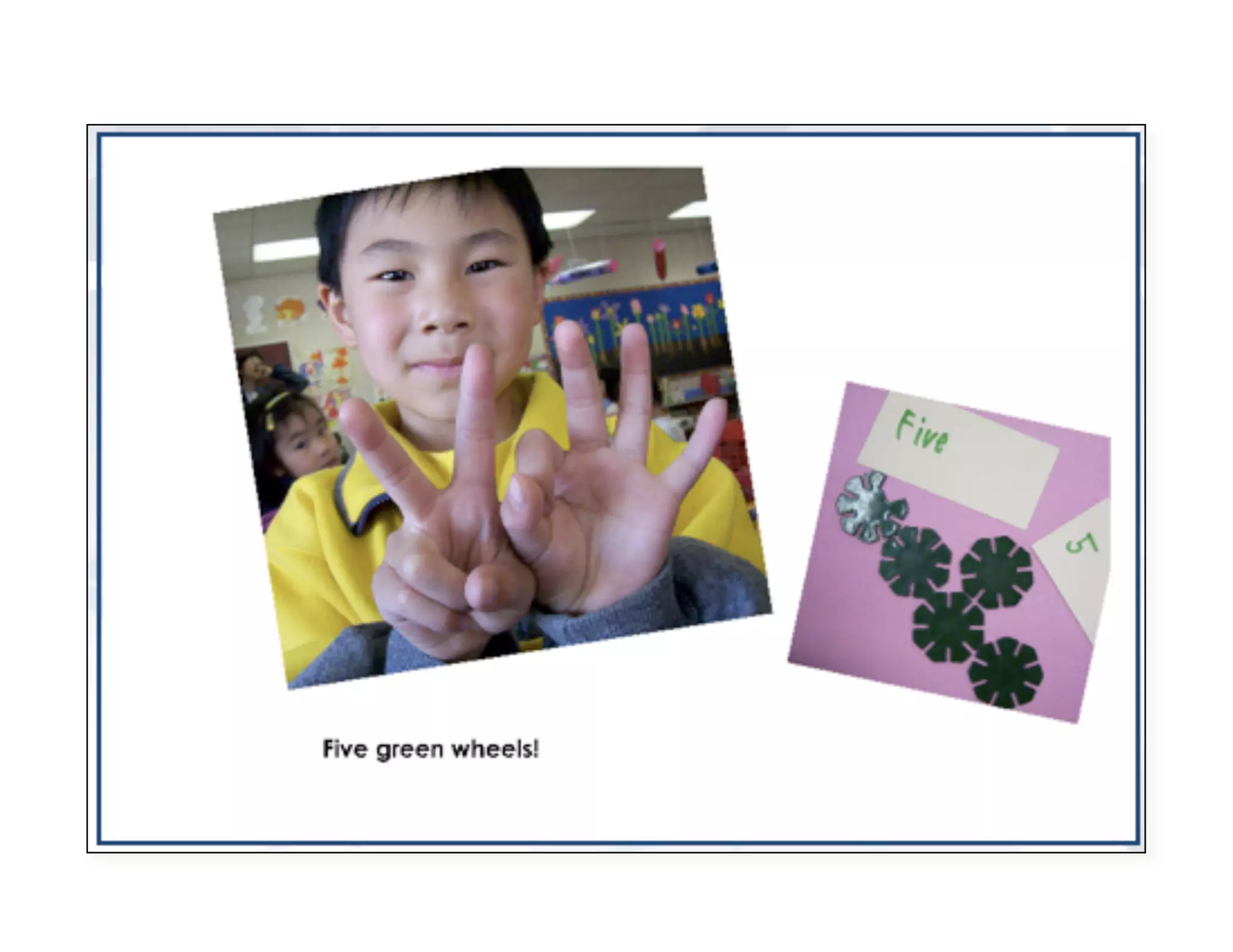
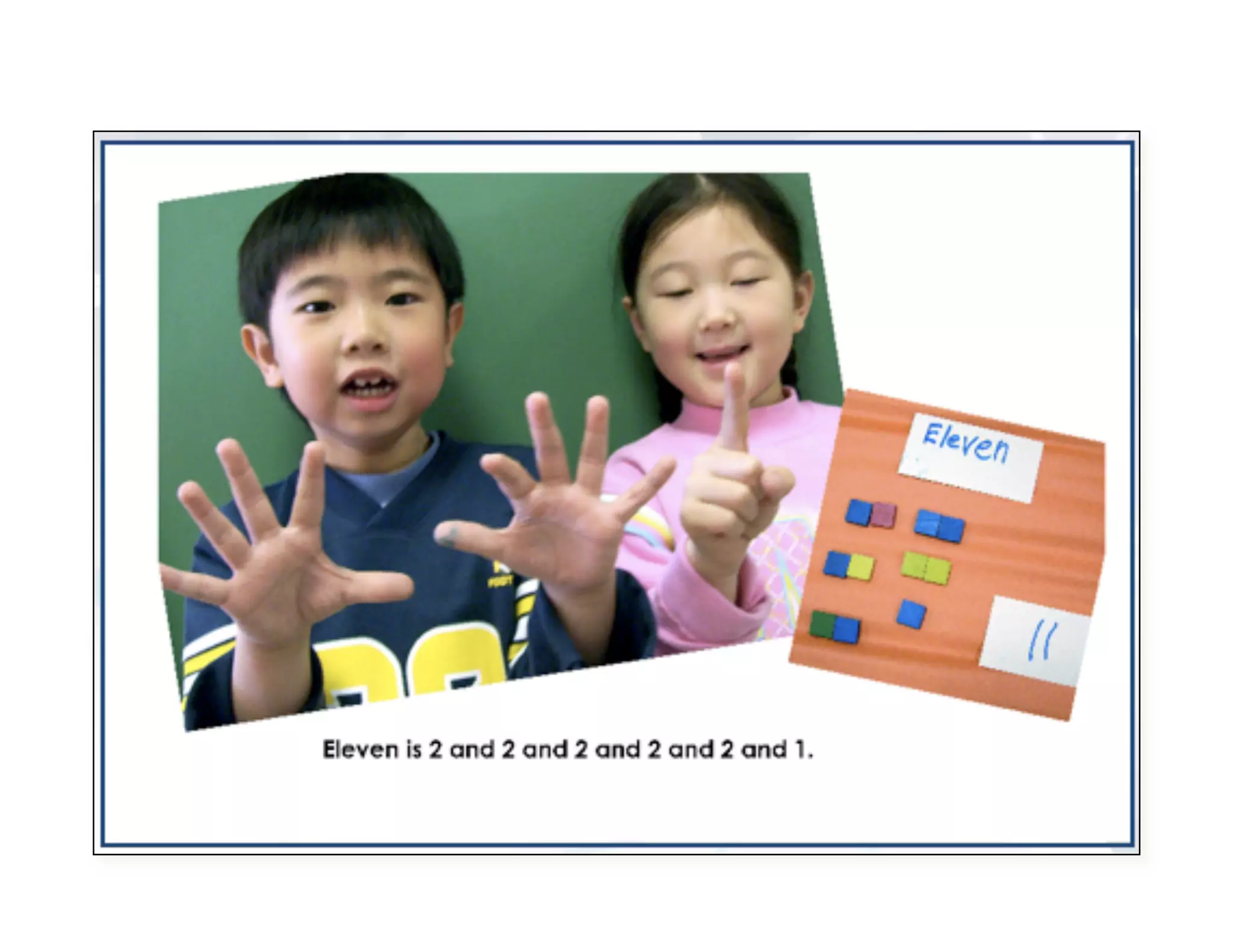
How can you show your
number for our number
        book?
Ques<oning	


•  Who	
  is	
  answering	
  your	
  ques<ons?	
  

•  Who	
  is	
  asking	
  the	
  ques<ons?	
  
AFL	
  
•  Learning	
  inten<ons	
  

•  Criteria	
  –	
  co-­‐created	
  

•  Descrip<ve	
  feedback	
  

•  Peer	
  assessment,	
  then	
  self	
  assessment	
  

•  Ownership	
  
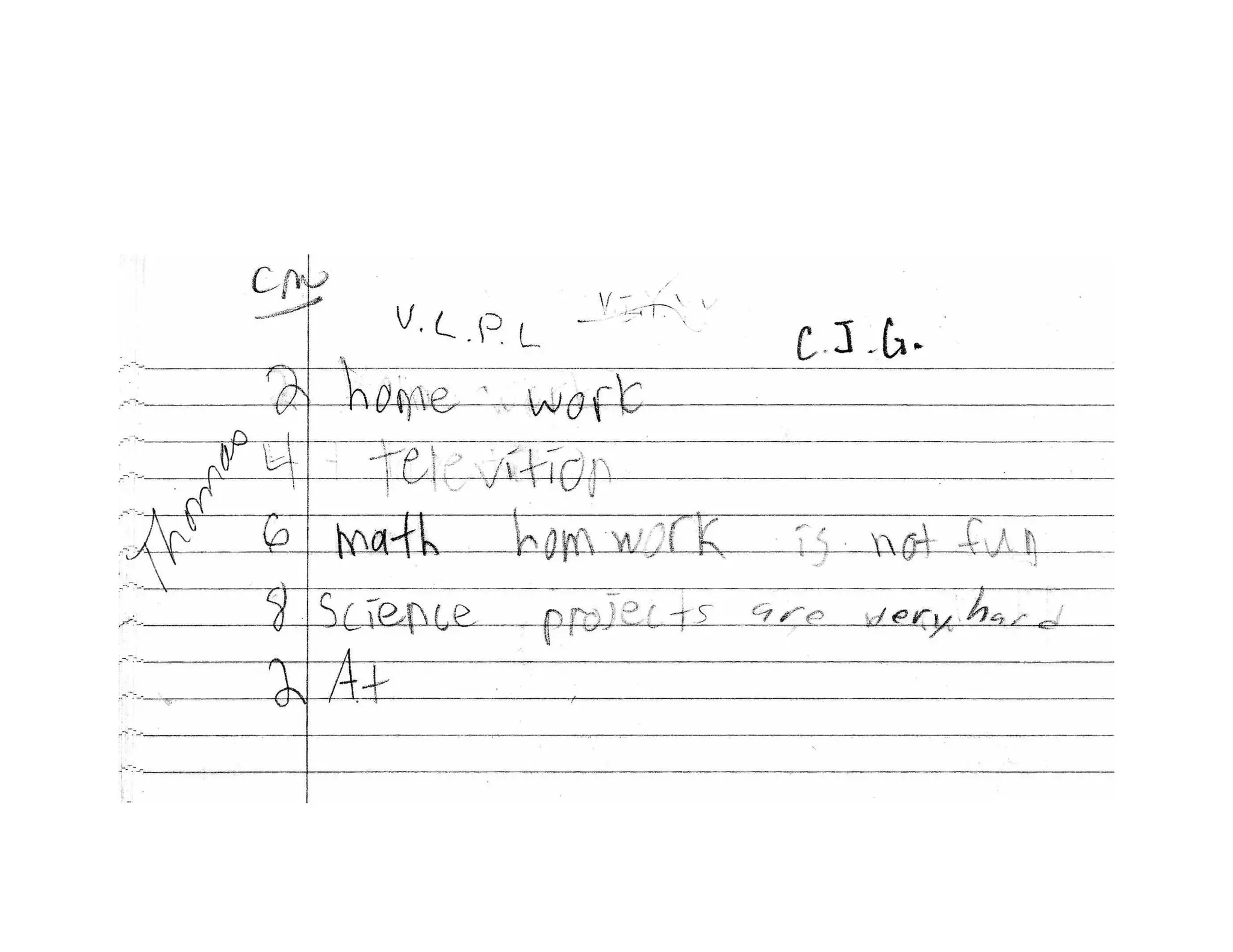
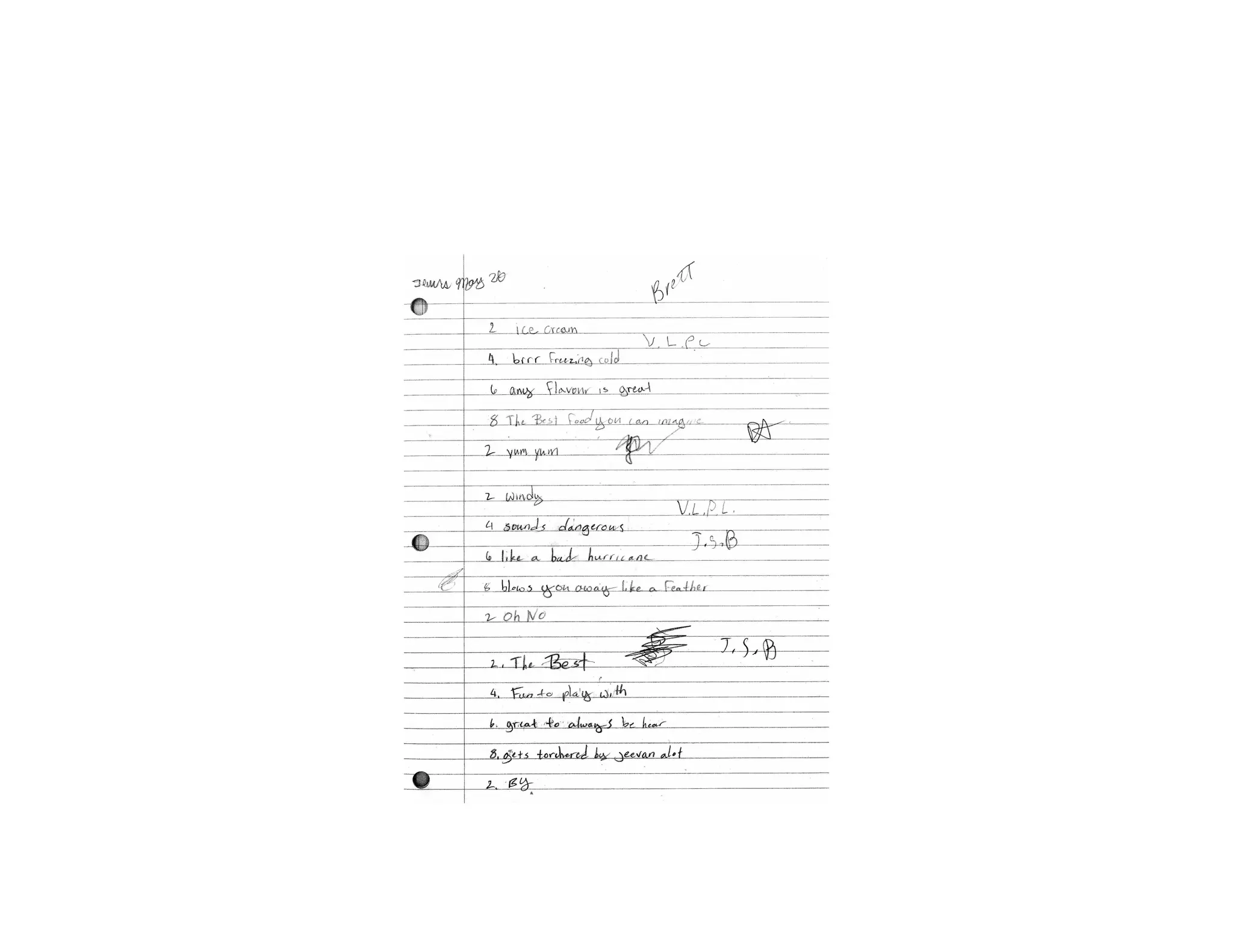
Cinquain Poems
•  Show	
  a	
  poem	
  to	
  the	
  students	
  and	
  have	
  them	
  see	
  if	
  
   they	
  can	
  find	
  the	
  paZern	
  –	
  5	
  lines	
  with	
  2,4,6,8,2	
  
   syllables	
  
•  Create	
  a	
  cinquain	
  poem	
  together	
  
•  No<ce	
  literacy	
  elements	
  used	
  
•  Brainstorm	
  for	
  a	
  list	
  of	
  poten<al	
  topics	
  
•  Alone	
  or	
  in	
  partners,	
  students	
  write	
  several	
  poems	
  
•  Read	
  each	
  poem	
  to	
  2	
  other	
  students,	
  check	
  the	
  
   syllables	
  and	
  the	
  word	
  choices,	
  then	
  check	
  with	
  a	
  
   teacher	
  
Garnet’s	
  4/5s	
  Literary	
  Elements	


•    Simile	
  
•    Rhyme	
  
•    Allitera<on	
  
•    Assonance	
  
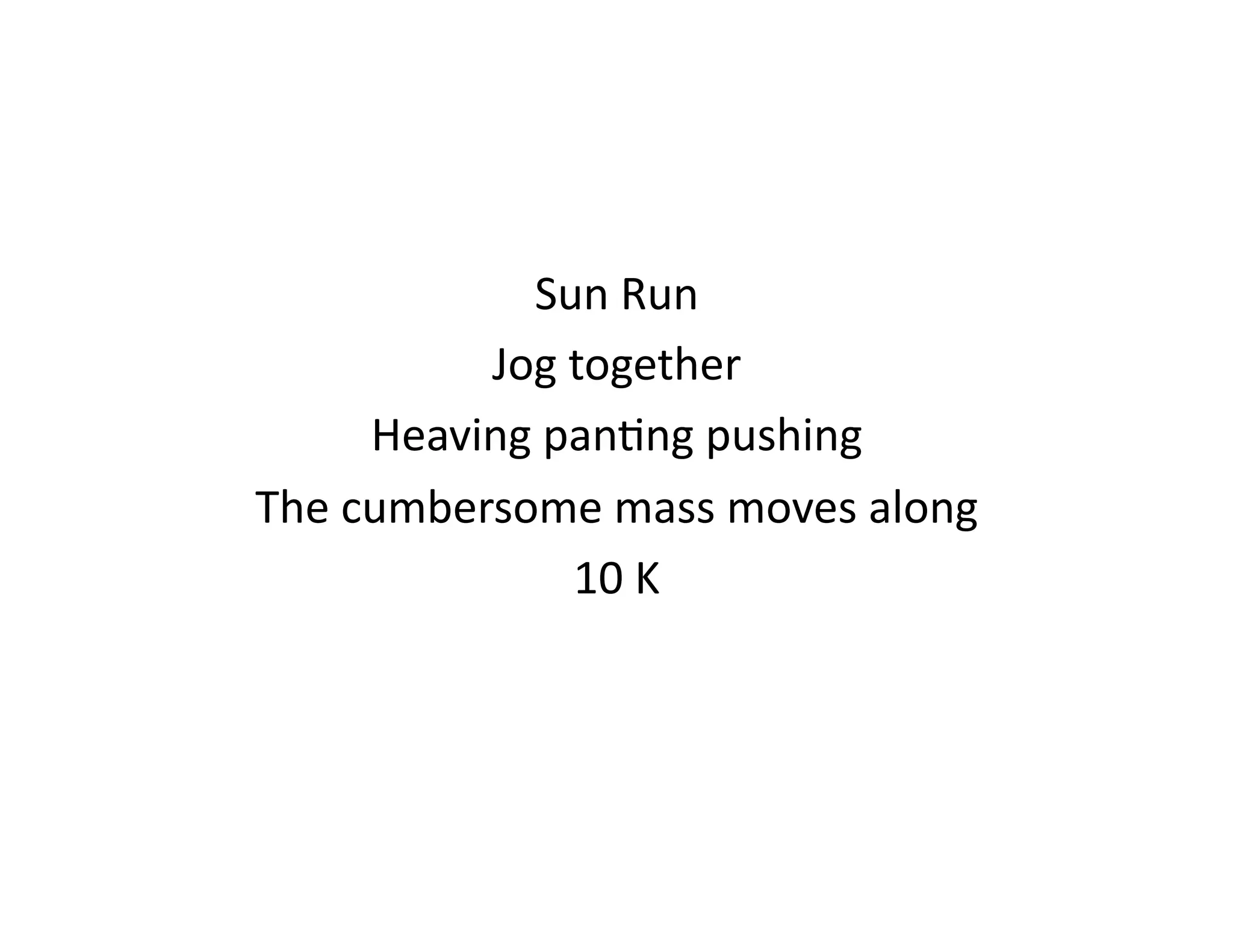
Sun	
  Run	
  
             Jog	
  together	
  
        Heaving	
  pan<ng	
  pushing	
  
The	
  cumbersome	
  mass	
  moves	
  along	
  
                    10	
  K	
  
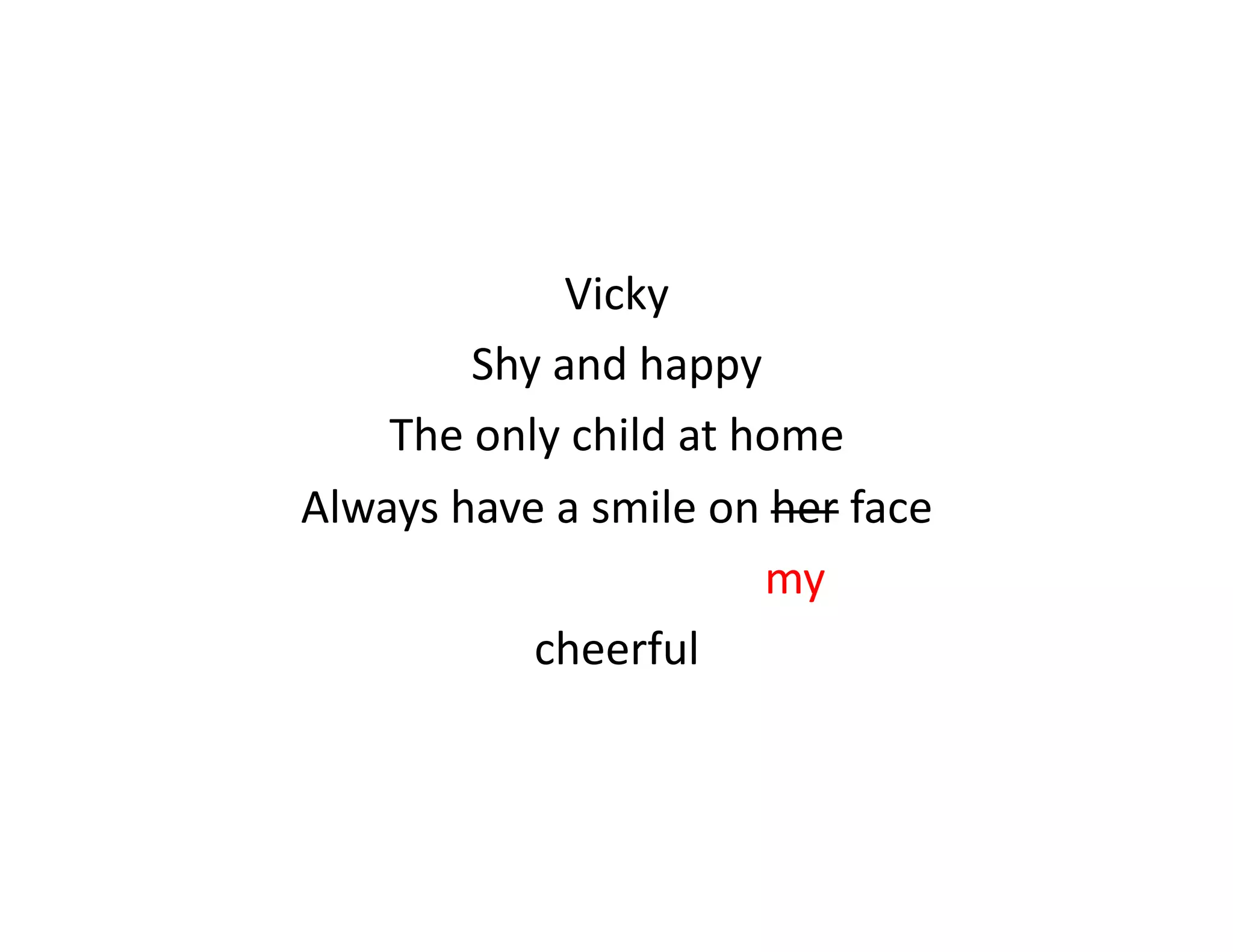
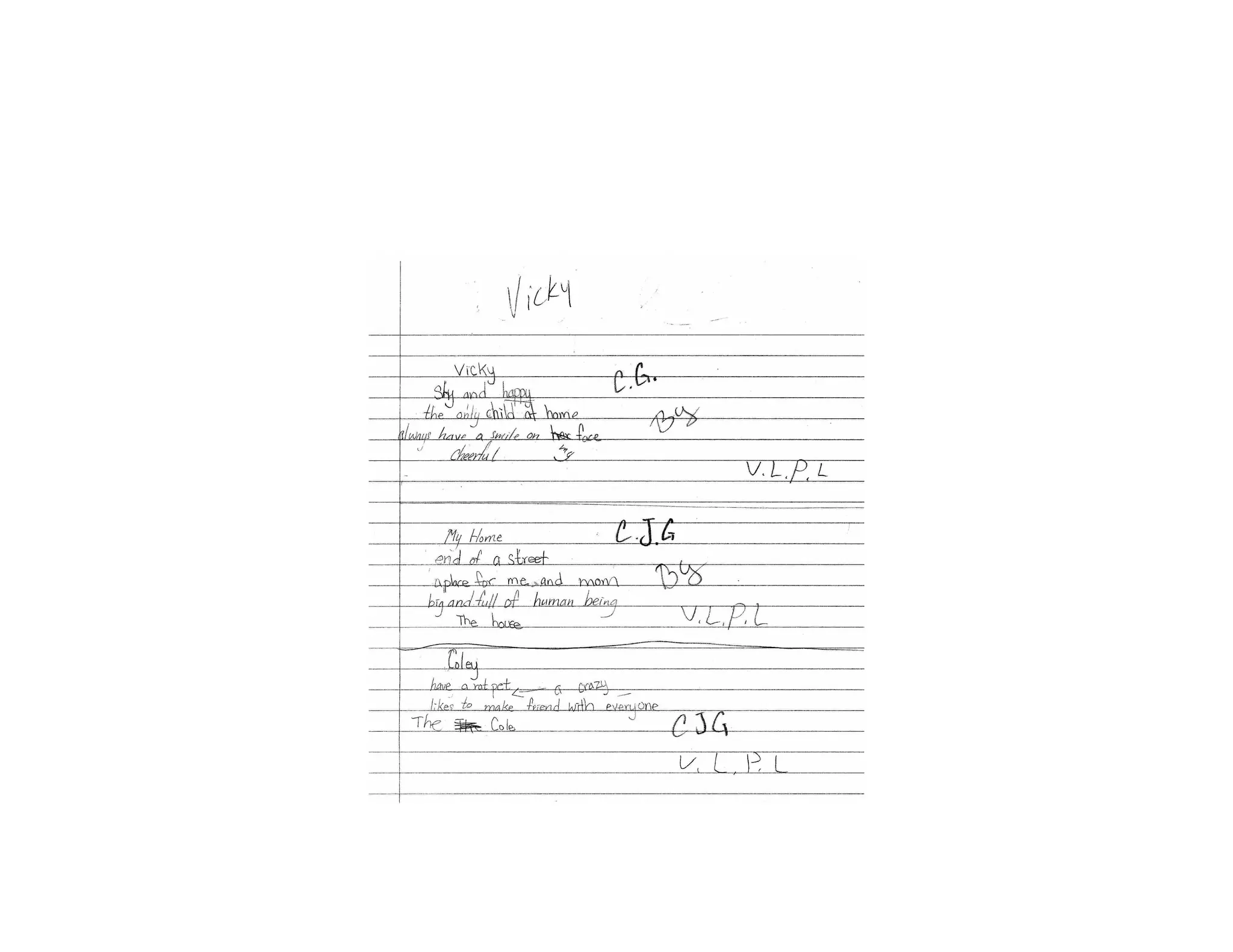
Vicky	
  
                            Shy	
  and	
  happy	
  
    The	
  only	
  child	
  at	
  home	
  
Always	
  have	
  a	
  smile	
  on	
  her	
  face	


  my	
  
                                                  cheerful	
  
Candy	
  
       Choclate	
  bars	
  
Tastes	
  like	
  a	
  gummy	
  drop	
  
Lickrish	
  hard	
  like	
  gummys	
  
                  Eat	
  

             Thomas	
  
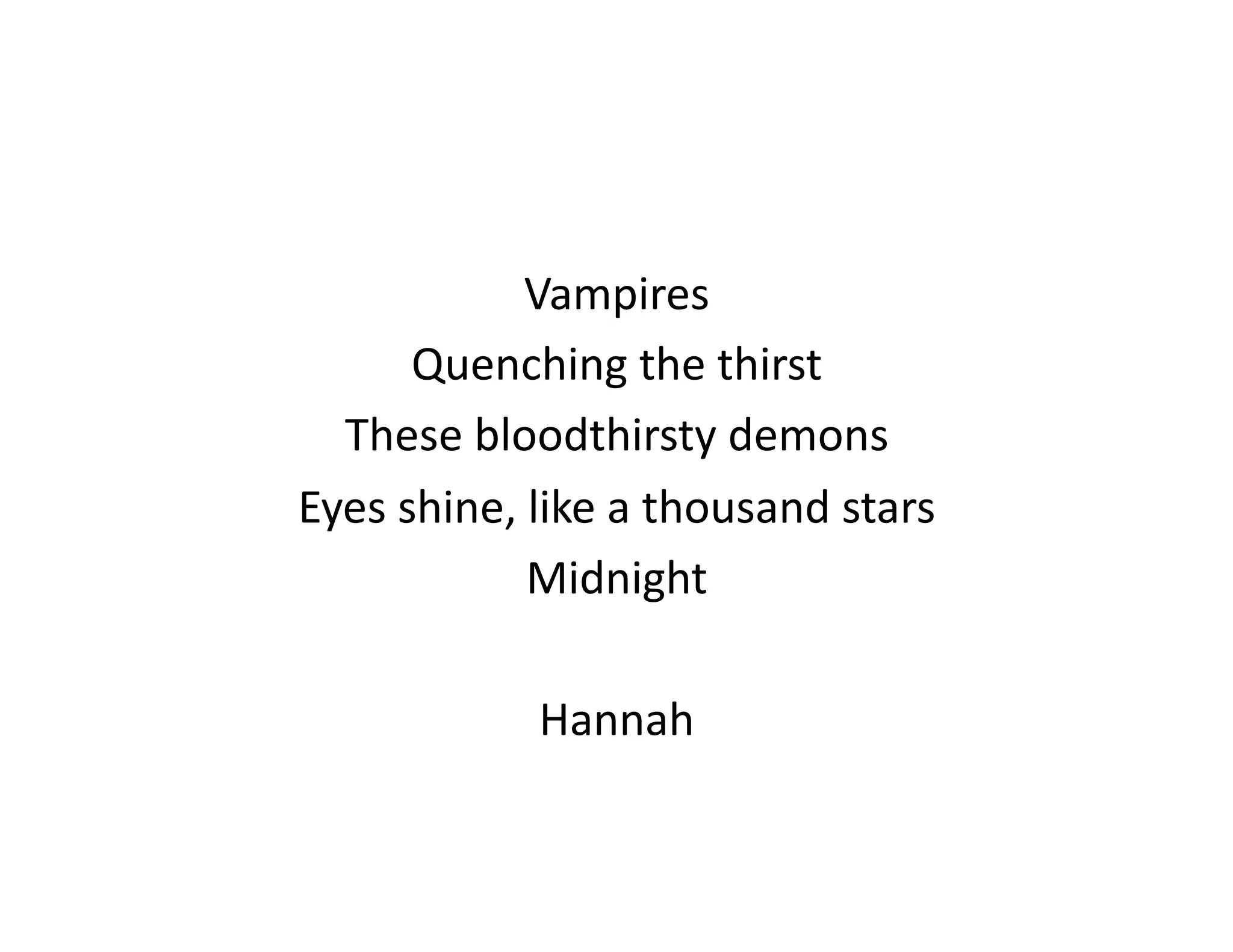
Vampires	
  
         Quenching	
  the	
  thirst	
  
  These	
  bloodthirsty	
  demons	
  
Eyes	
  shine,	
  like	
  a	
  thousand	
  stars	
  
                 Midnight	
  

                   Hannah	
  
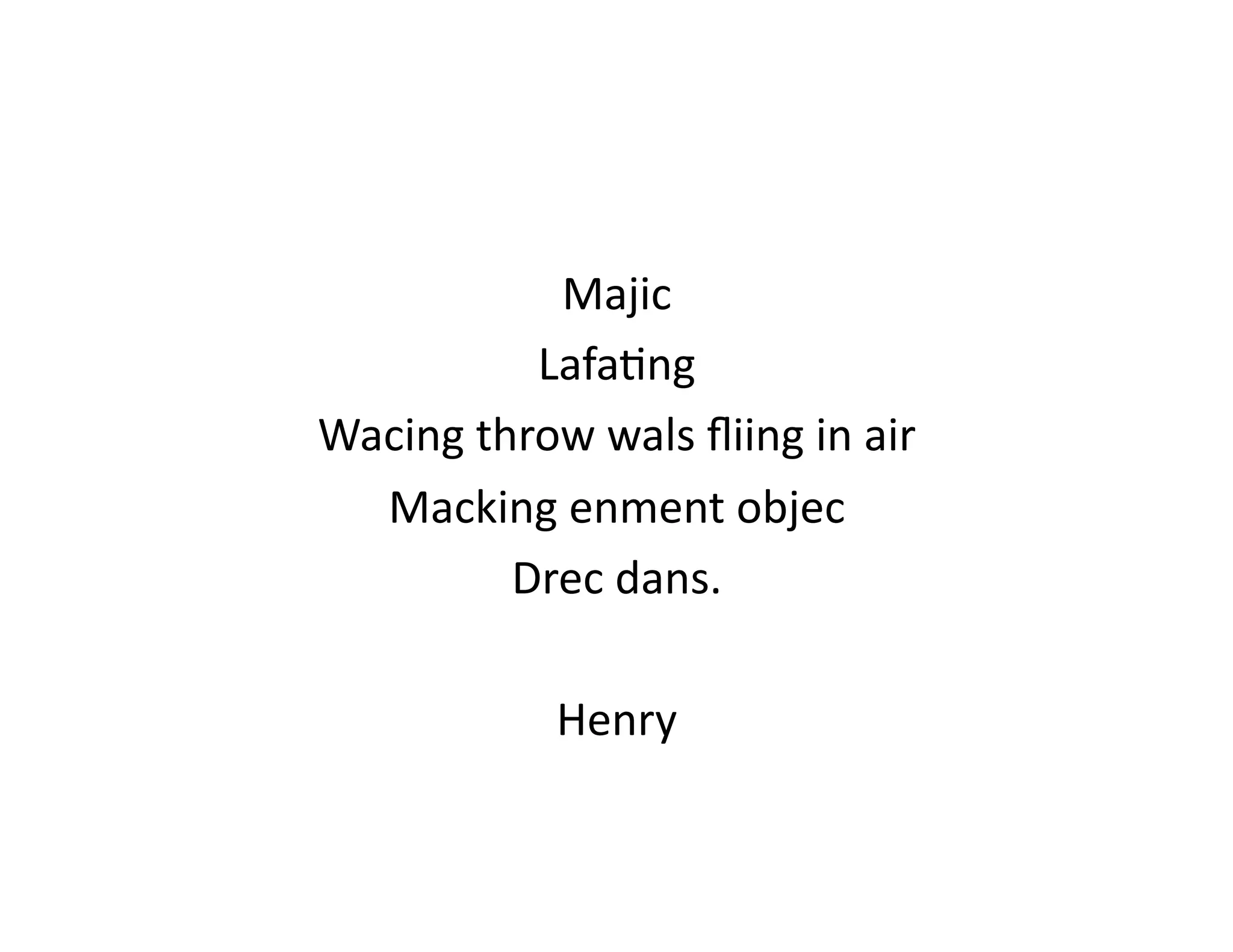
Majic	
  
             Lafa<ng	
  
Wacing	
  throw	
  wals	
  fliing	
  in	
  air	
  
  Macking	
  enment	
  objec	
  
            Drec	
  dans.	
  

                   Henry	
  
AFL	
  
•  Criteria	
  

•  Descrip<ve	
  feedback	
  

•  Ownership	
  
AFL	
  
•  Ques<oning	
  

•  Self	
  and	
  peer	
  assessment	
  

•  Ownership	
  
How	
  can	
  I	
  help	
  my	
  students	
  learn	
  the	
  vocabulary	
  
 they	
  need	
  in	
  science?	
  
How	
  can	
  I	
  help	
  my	
  students	
  link	
  what	
  they	
  have	
  
 learned	
  in	
  one	
  chapter	
  to	
  the	
  next?	
  
Students	
  need:	
  
•  Prac<ce	
  using	
  the	
  vocabulary	
  
•  To	
  link	
  new	
  vocabulary	
  to	
  what	
  they	
  already	
  
   know,	
  then	
  to	
  add	
  on	
  or	
  refine	
  their	
  
   understanding	
  of	
  the	
  words	
  
•  To	
  make	
  connec<ons	
  among	
  the	
  words	
  in	
  
   order	
  to	
  retain	
  the	
  vocabulary	
  
The	
  Plan	
  
•  Choose	
  2	
  key	
  words	
  from	
  previous	
  chapter	
  
   and	
  have	
  students	
  brainstorm	
  what	
  they	
  know	
  
   about	
  each	
  –	
  2	
  min.	
  each	
  –	
  add	
  ideas	
  from	
  
   partners	
  
•  Class	
  share	
  10	
  key	
  ideas	
  and	
  clarify	
  
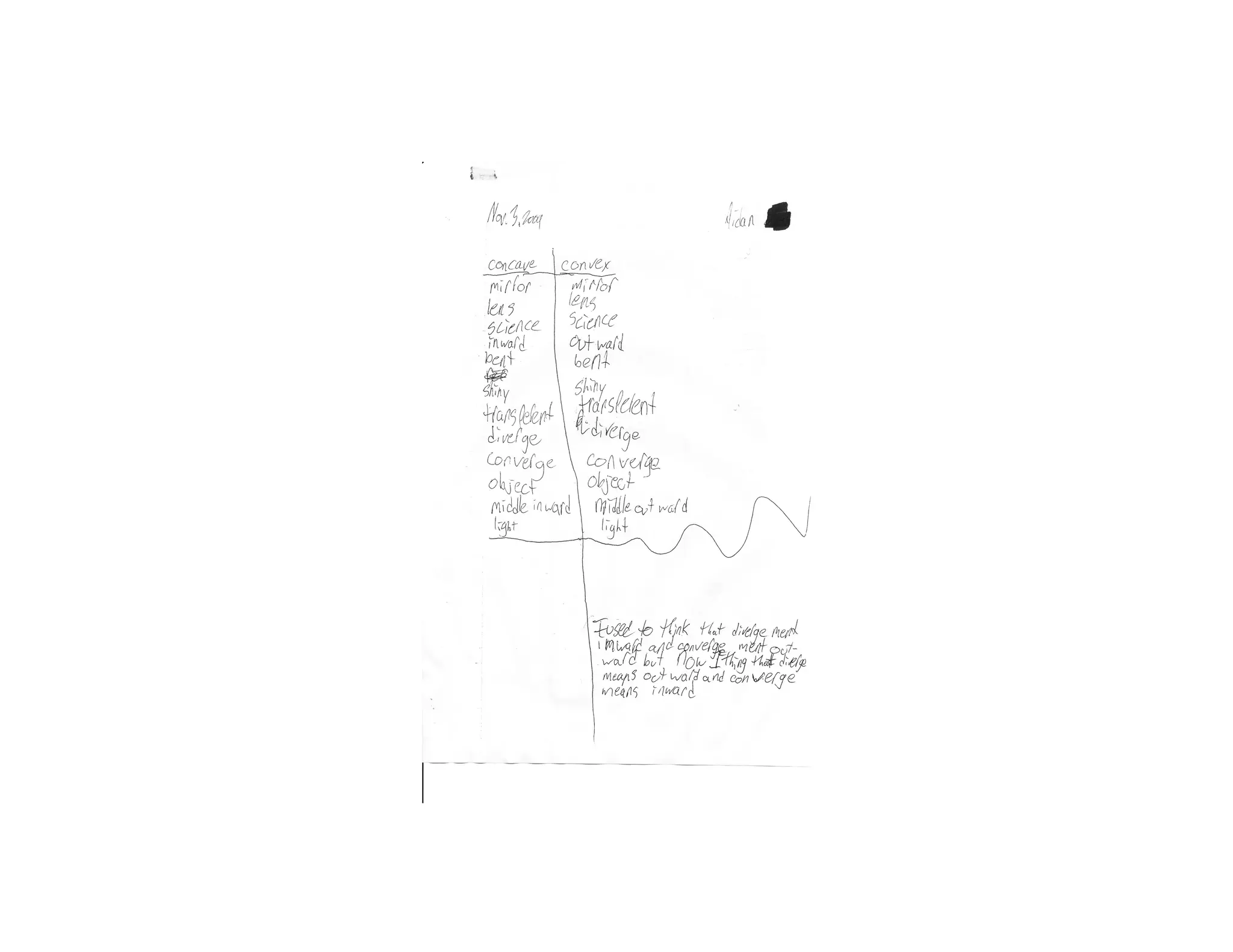
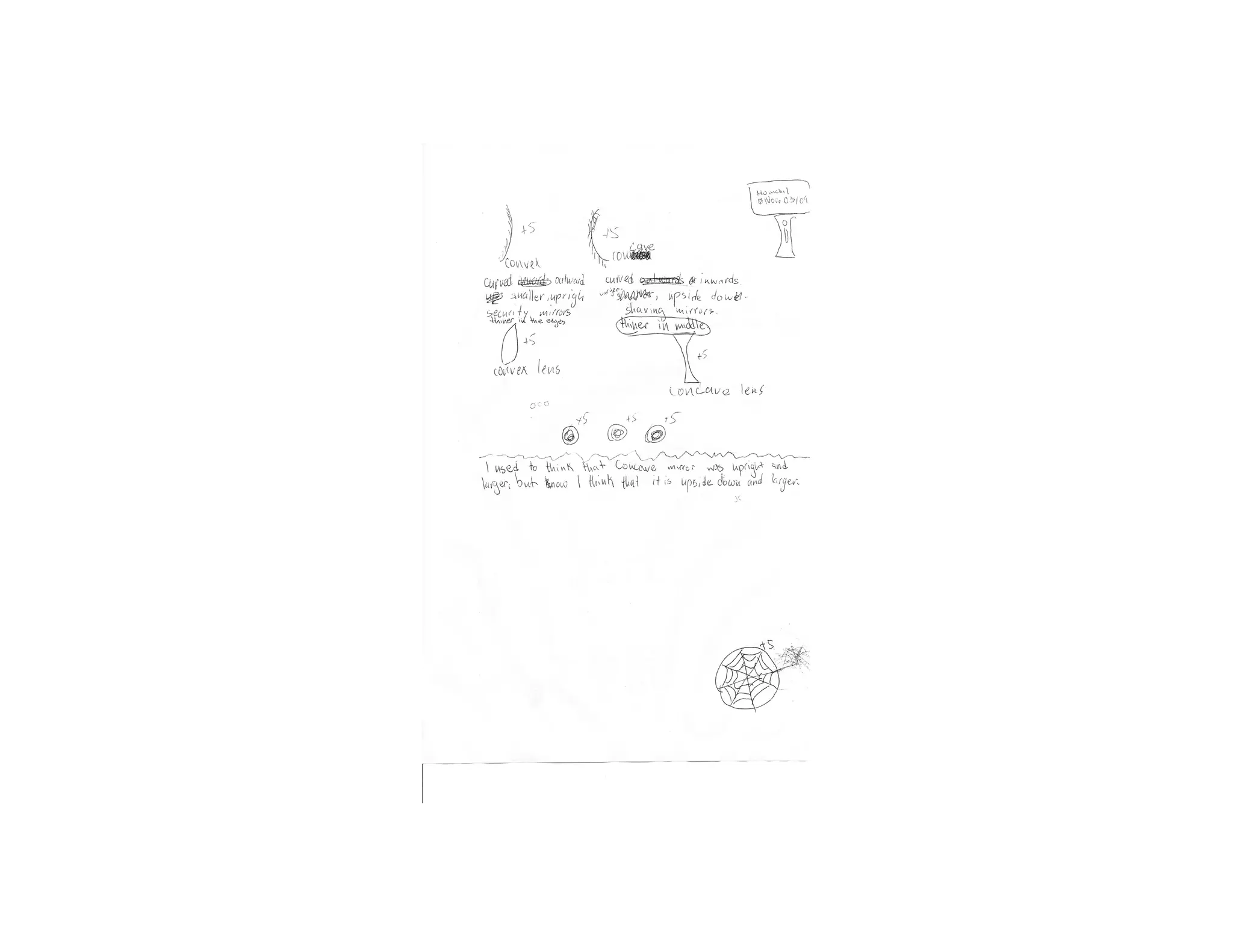
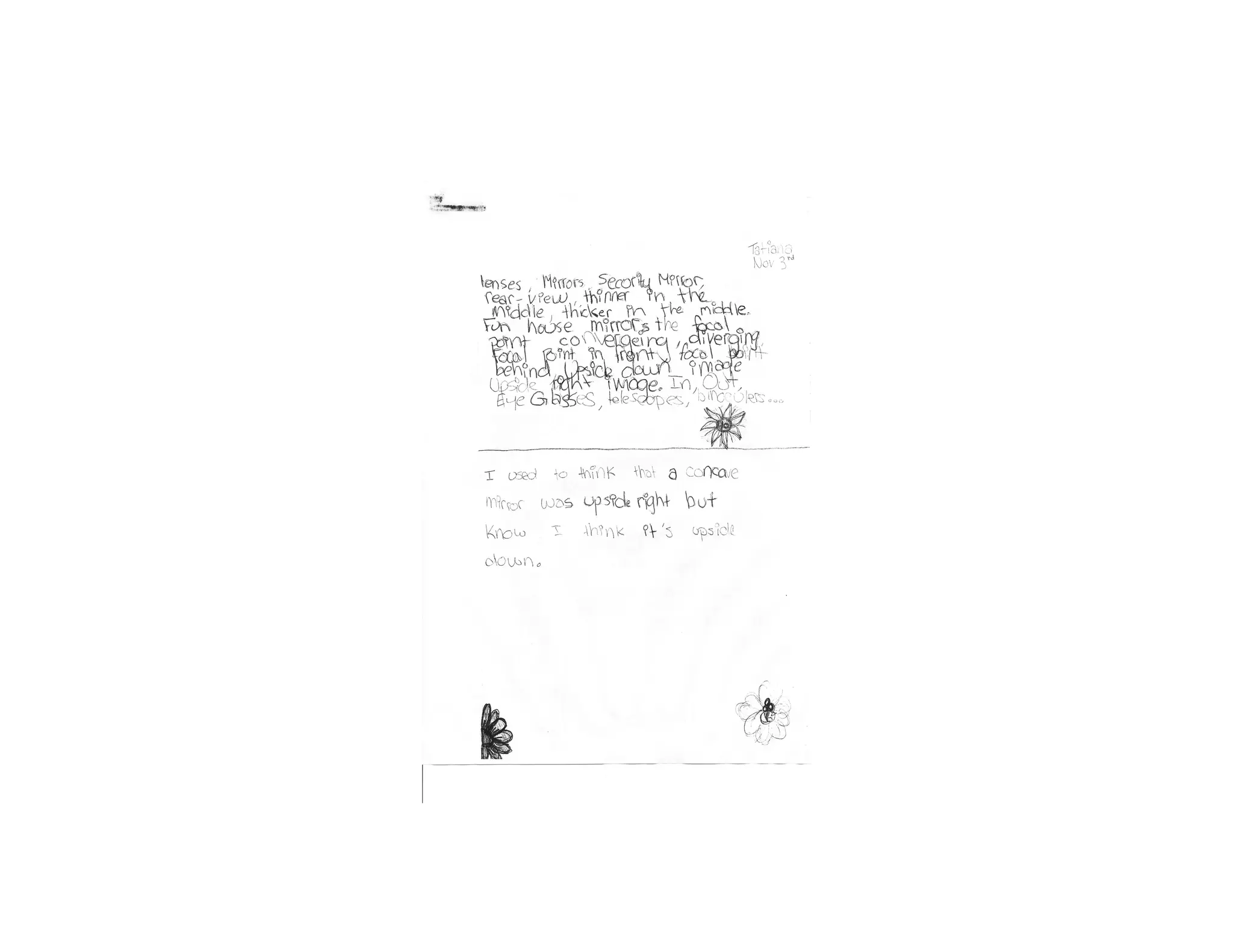
•  “I	
  used	
  to	
  think…but	
  now…”	
  
•  Introduce	
  new	
  chapter	
  words	
  with	
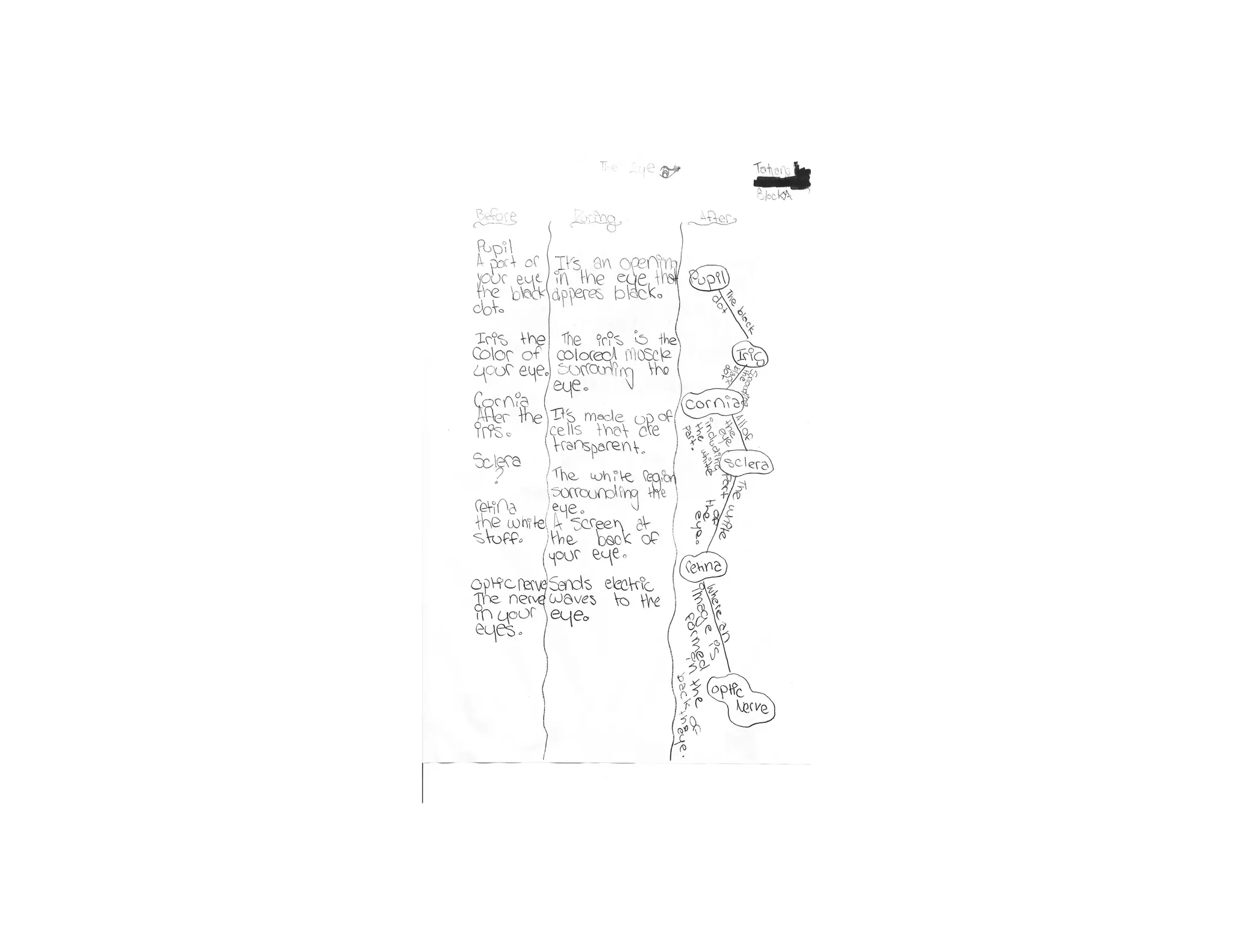
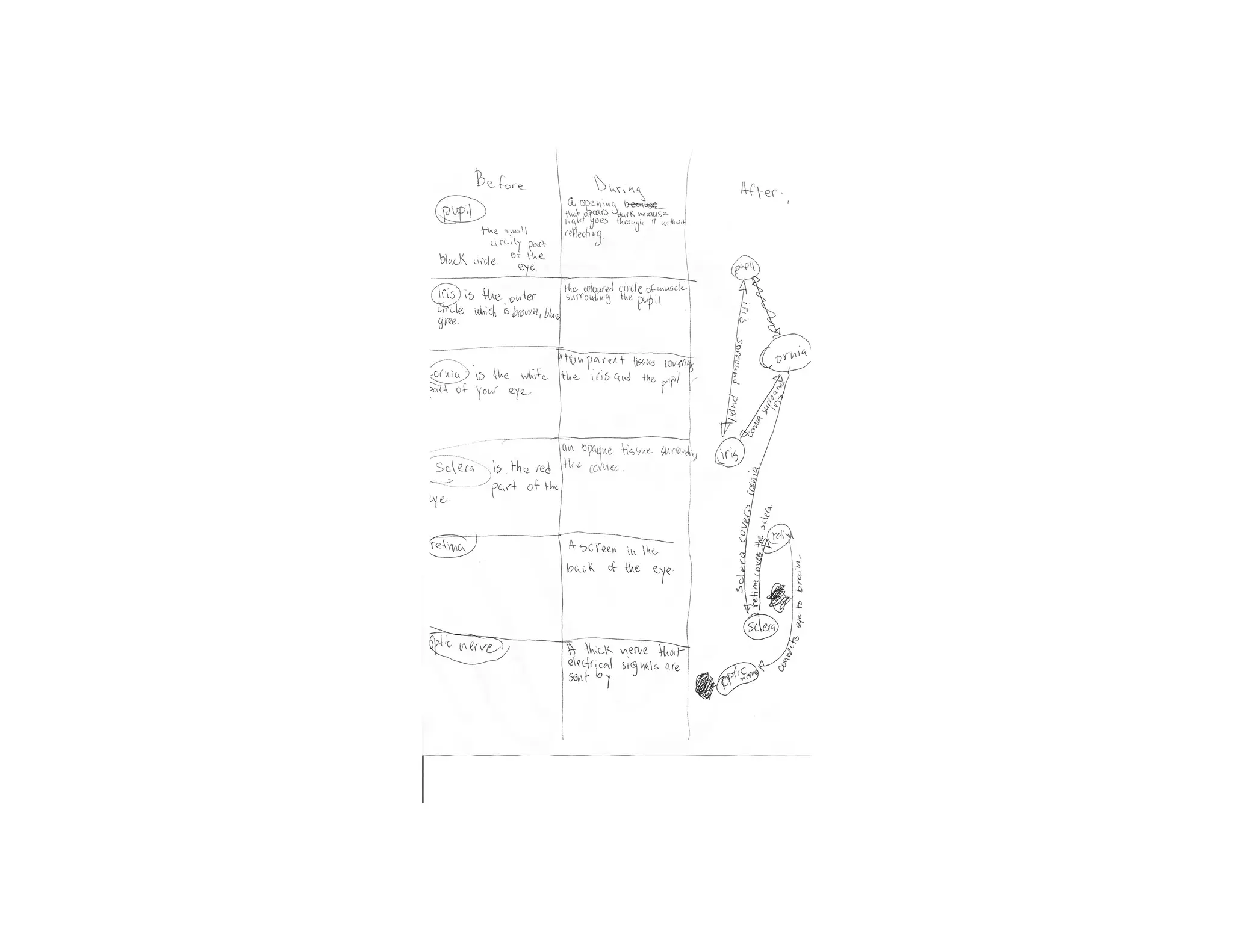
  3	
  column	
  
   notes:	
  
    –  Before/during/aver	
  
The	
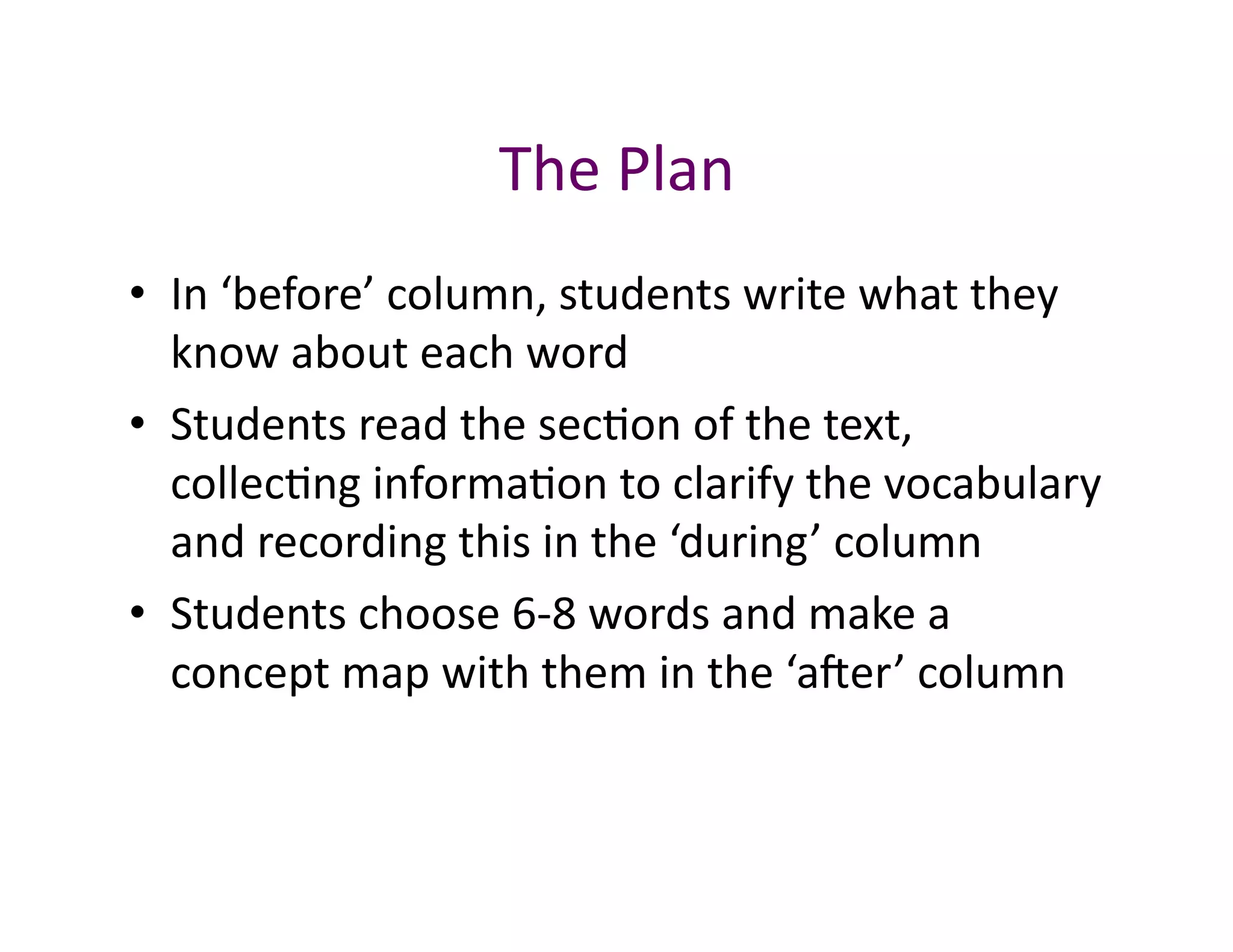
  Plan	
  
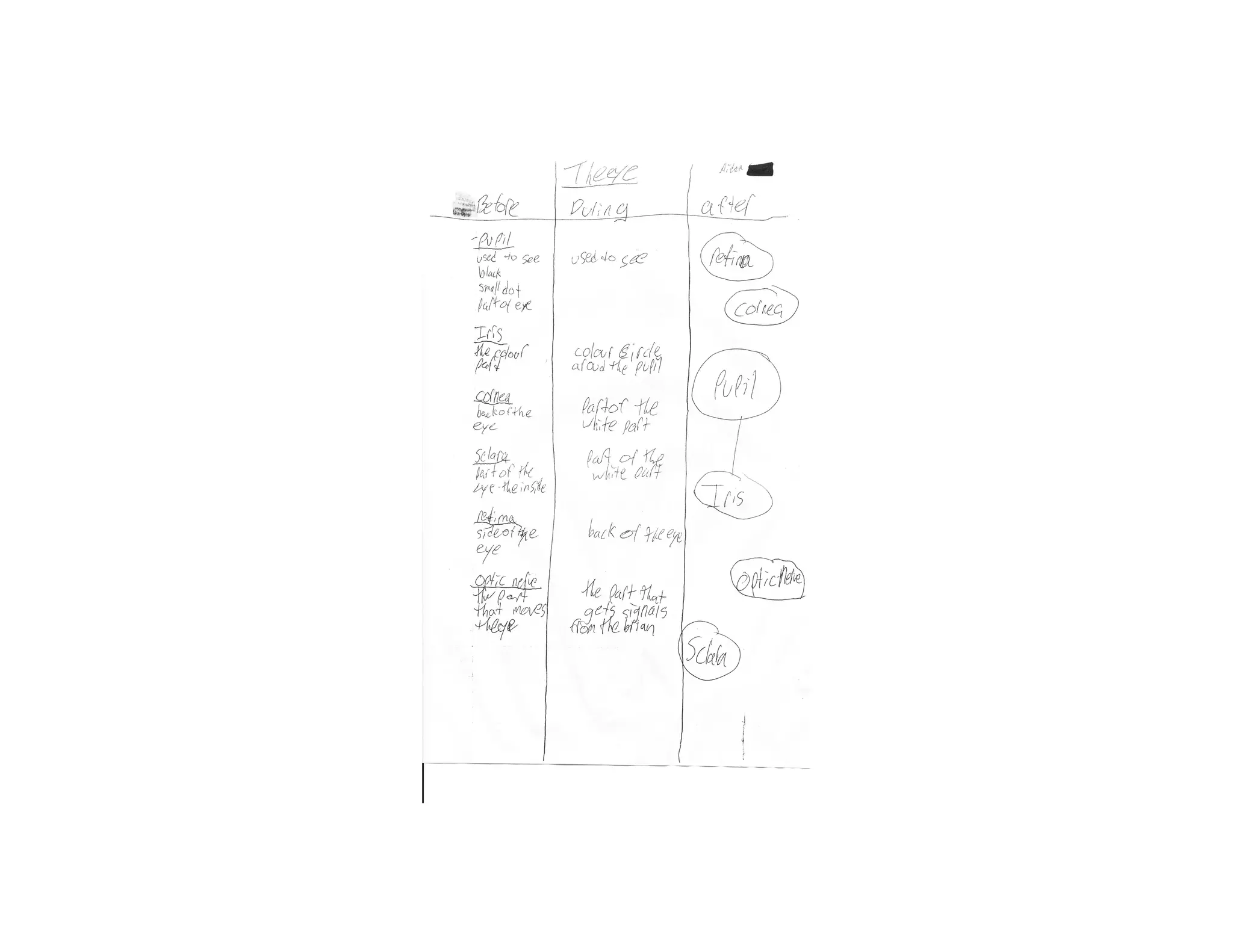
•  In	
  ‘before’	
  column,	
  students	
  write	
  what	
  they	
  
   know	
  about	
  each	
  word	
  
•  Students	
  read	
  the	
  sec<on	
  of	
  the	
  text,	
  
   collec<ng	
  informa<on	
  to	
  clarify	
  the	
  vocabulary	
  
   and	
  recording	
  this	
  in	
  the	
  ‘during’	
  column	
  
•  Students	
  choose	
  6-­‐8	
  words	
  and	
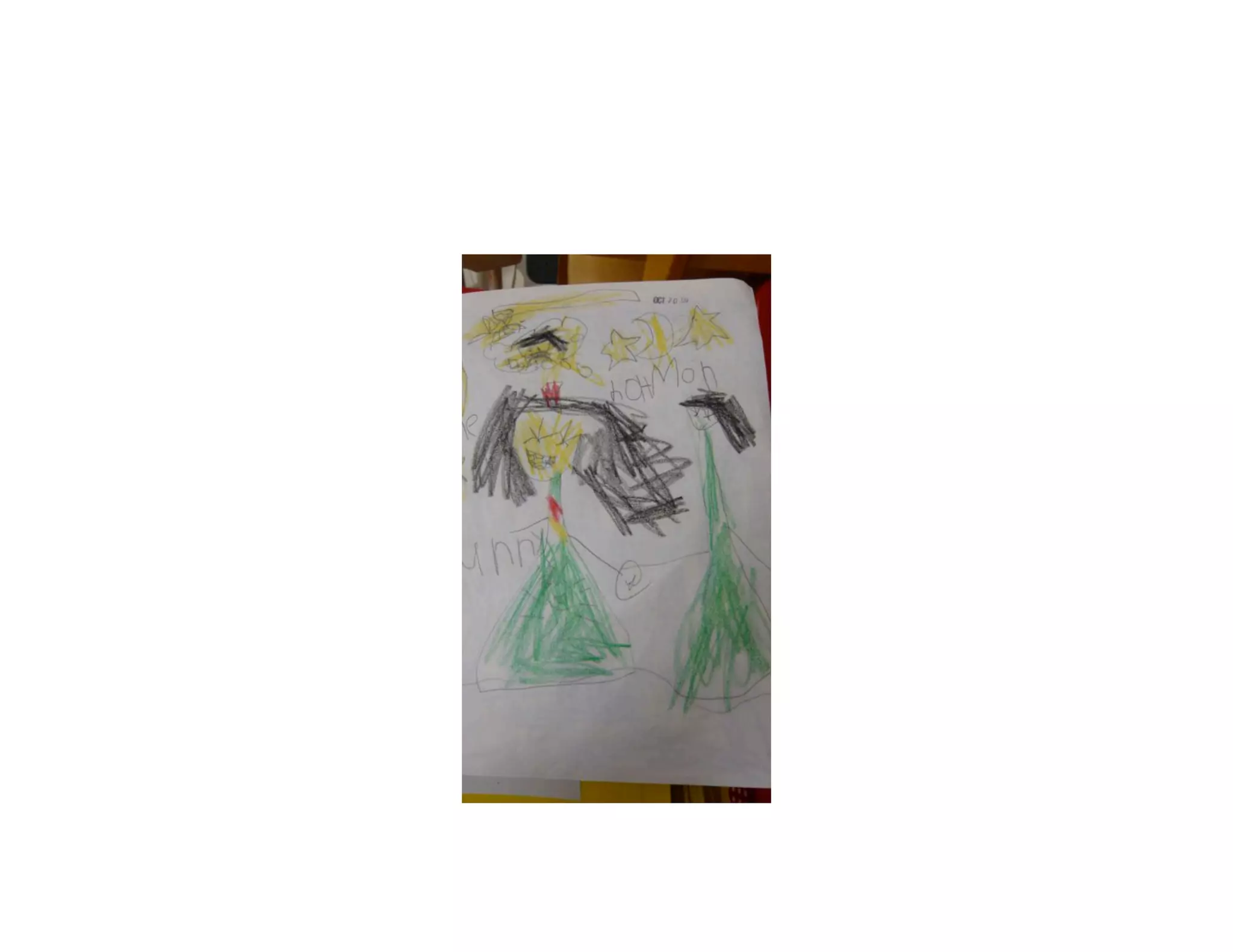
  make	
  a	
  
   concept	
  map	
  with	
  them	
  in	
  the	
  ‘aver’	
  column	
  
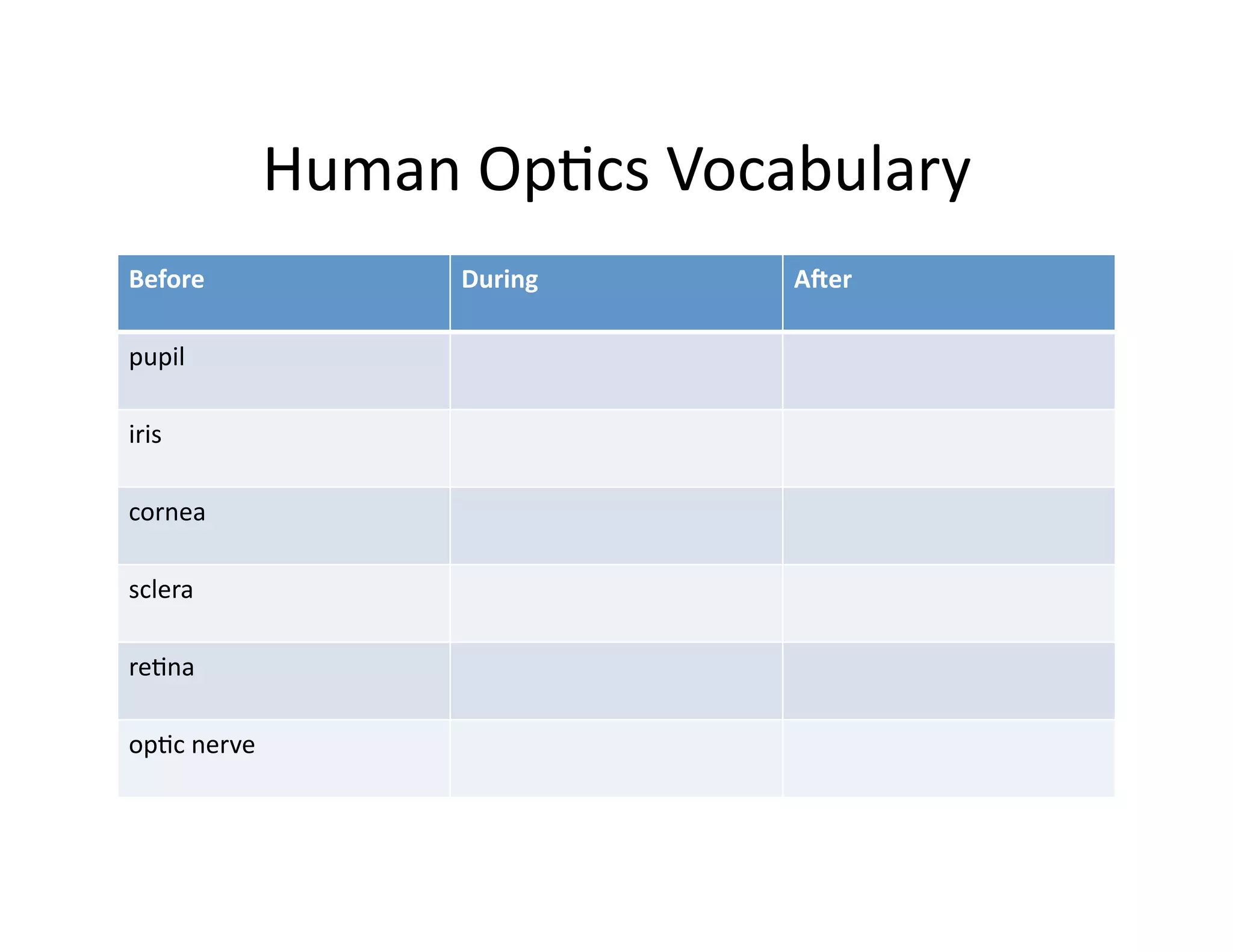
Human	
  Op<cs	
  Vocabulary	
  
Before	
                    During	
       A@er	
  

pupil	
  

iris	
  

cornea	
  

sclera	
  

re<na	
  

op<c	
  nerve	
  
Planning
      Goals What do we want to develop/
                 explore/change/ refine to better
                 meet the diverse needs of diverse
                 learners?	


Rationale     Why are we choosing this focus?	


       Plan      How will we do this?

Coquitlam/Burnaby Performance Network Series,Sept.2011

  • 1.
    Formative Assessment andQuality Teaching in Inclusive Classrooms and Schools: A Community of Professionals Coquitlam Sept. 24, 2010 Presented by Faye Brownlie
  • 2.
    Learning  Inten+ons   •     I  can  explain  current  theories  of   teaching  and  learning.   •  I  can  understand  and  can  explain  to  others   the  concepts  of  Assessment  for  Learning  (AFL)   •     I  can  iden<fy  and  give  specific  examples  of   the  six  big  AFL  strategies   •  I  have  a  plan  to  implement  a  strategy  which  is   new  to  me.     •  I  can  determine  a  next  step  
  • 3.
    Know  your  content   •  Research  –  effec<ve  programming   •  Curriculum  –  key  concepts,  learning  outcomes  
  • 4.
    Model Guided practice Independent practice Independent application   Pearson  &  Gallagher  (1983)  
  • 5.
    Teaching  Content  to  All   Open-­‐ended          teaching   adapted   modified  
  • 6.
    Open-ended strategies: Connect-activate Process-acquire Personalize/transform- apply (Brownlie, Feniak & Schnellert, 2006; Buehl, 2001; Cook, 2005; Gear, 2006; Harvey & Goudvis, 2007; Kame'enui & Carnine, 2002)
  • 7.
    Frameworks It’s All aboutThinking – Brownlie & Schnellert, 2009
  • 8.
    Universal Design forLearning Mul<ple  means:   -­‐to  tap  into  background  knowledge,  to  ac<vate   prior  knowledge,  to  increase  engagement  and   mo<va<on   -­‐to  acquire  the  informa<on  and  knowledge  to   process  new  ideas  and  informa<on   -­‐to  express  what  they  know.                        Rose  &  Meyer,  2002  
  • 9.
    Backwards Design •  What  important  ideas  and  enduring   understandings  do  you  want  the  students  to   know?   •  What  thinking  strategies  will  students  need  to   demonstrate  these  understandings?                      McTighe  &  Wiggins,  2001  
  • 10.
    Know  your  kids   •  Class  review   •  Assessment  for  learning  –  the  grand  event  
  • 11.
    Purpose   •  To  measure,  to   report  out   Timing   ASSESSMENT  of     Audience   •  At  the  end  to   •  Parents,  others   sum  up  the   learning   LEARNING   outside  the   classroom   Form   •  Rank  order,   marks,   percentages,   numbers,  leZers  
  • 12.
    Purpose   •  to  inform   teaching  and   learning   Timing   ASSESSMENT   Audience   •  while  the   learning  is   for     •  teachers  and   happening  when   the  informa<on   LEARNING   students   can  s<ll  be  used   Form   •  descrip<ve   feedback  –  NO   MARKS!  
  • 14.
  • 15.
    AFL   •  Learning  inten<ons   •  Descrip<ve  feedback   •  Ques<oning   •  Ownership  
  • 16.
    Reading  and  Thinking  with  Different   Texts   •  Making  Inferences   •  Asking  ques<ons   •  Using  evidence  to  support  your  thinking   •  Learning  Inten<ons:            -­‐I  can  use  world  currency  informa<on  to   explain  what  this  means  to  average  people.        -­‐I  can  interpret  this  informa<on,  providing   reasoning  for  my  interpreta<ons  
  • 17.
    A  Comparison  of  World  Currencies  –   what  does  it  mean  to  the  average   ci<zen?   •  Ci<es  being  compared:   –  Athens,  Frankfurt,  Manila,  Shanghai,  Toronto   •  Number  of  minutes  to  work  to  buy  a  Big  Mac:    -­‐12,  15,  30,  30,  88   •  Number  of  hours  to  work  to  buy  an  8gb  iPod    -­‐10.5,  13.5,  24.5,  56.5,  128.5  
  • 18.
    •  Annual  average  hours  worked:    -­‐1704,  1827,  1868,  1946,  2032   •  Cost  of  living  (rela<ve  to  NYC)    -­‐28.7%,  48.9%,  54.6%,  63%,  70.6%   ar#cles.moneycentral.msn.com/SmartSpending/ ConsumerAc#onGuide/burgernomics-­‐whats-­‐a-­‐big-­‐ mac-­‐worth.aspx  
  • 19.
    Ques<oning   •  Math   •  Closed  vs  open  
  • 20.
    •  1  +  4  =     •  2  +  3  =   •  4  +  1  =   •  0  +  5  =  
  • 21.
    How can youshow your number for our number book?
  • 24.
    Ques<oning   •  Who  is  answering  your  ques<ons?   •  Who  is  asking  the  ques<ons?  
  • 25.
    AFL   •  Learning  inten<ons   •  Criteria  –  co-­‐created   •  Descrip<ve  feedback   •  Peer  assessment,  then  self  assessment   •  Ownership  
  • 26.
    Cinquain Poems •  Show  a  poem  to  the  students  and  have  them  see  if   they  can  find  the  paZern  –  5  lines  with  2,4,6,8,2   syllables   •  Create  a  cinquain  poem  together   •  No<ce  literacy  elements  used   •  Brainstorm  for  a  list  of  poten<al  topics   •  Alone  or  in  partners,  students  write  several  poems   •  Read  each  poem  to  2  other  students,  check  the   syllables  and  the  word  choices,  then  check  with  a   teacher  
  • 27.
    Garnet’s  4/5s  Literary  Elements   •  Simile   •  Rhyme   •  Allitera<on   •  Assonance  
  • 28.
    Sun  Run   Jog  together   Heaving  pan<ng  pushing   The  cumbersome  mass  moves  along   10  K  
  • 29.
    Vicky   Shy  and  happy   The  only  child  at  home   Always  have  a  smile  on  her  face                                                                  my   cheerful  
  • 33.
    Candy   Choclate  bars   Tastes  like  a  gummy  drop   Lickrish  hard  like  gummys   Eat   Thomas  
  • 34.
    Vampires   Quenching  the  thirst   These  bloodthirsty  demons   Eyes  shine,  like  a  thousand  stars   Midnight   Hannah  
  • 35.
    Majic   Lafa<ng   Wacing  throw  wals  fliing  in  air   Macking  enment  objec   Drec  dans.   Henry  
  • 36.
    AFL   •  Criteria   •  Descrip<ve  feedback   •  Ownership  
  • 41.
    AFL   •  Ques<oning   •  Self  and  peer  assessment   •  Ownership  
  • 42.
    How  can  I  help  my  students  learn  the  vocabulary   they  need  in  science?   How  can  I  help  my  students  link  what  they  have   learned  in  one  chapter  to  the  next?  
  • 43.
    Students  need:   • Prac<ce  using  the  vocabulary   •  To  link  new  vocabulary  to  what  they  already   know,  then  to  add  on  or  refine  their   understanding  of  the  words   •  To  make  connec<ons  among  the  words  in   order  to  retain  the  vocabulary  
  • 44.
    The  Plan   • Choose  2  key  words  from  previous  chapter   and  have  students  brainstorm  what  they  know   about  each  –  2  min.  each  –  add  ideas  from   partners   •  Class  share  10  key  ideas  and  clarify   •  “I  used  to  think…but  now…”   •  Introduce  new  chapter  words  with  3  column   notes:   –  Before/during/aver  
  • 45.
    The  Plan   • In  ‘before’  column,  students  write  what  they   know  about  each  word   •  Students  read  the  sec<on  of  the  text,   collec<ng  informa<on  to  clarify  the  vocabulary   and  recording  this  in  the  ‘during’  column   •  Students  choose  6-­‐8  words  and  make  a   concept  map  with  them  in  the  ‘aver’  column  
  • 46.
    Human  Op<cs  Vocabulary   Before   During   A@er   pupil   iris   cornea   sclera   re<na   op<c  nerve  
  • 53.
    Planning Goals What do we want to develop/ explore/change/ refine to better meet the diverse needs of diverse learners? Rationale Why are we choosing this focus? Plan How will we do this?