Professional Learning
Network: effective learning in
inclusive classrooms
Brighouse
November 22, 2019
Faye Brownlie
slideshare.net/fayebrownlie.Richmond.nov.2019
Shape of the Day
• 8:30-10:10 – Keynote
• 10:20-11:05 - Break out #1
• 11:15 - 12:00 - Break out #2
• 12:00 - 12:30 – Nutrition Break
• 12:30 - 1:30 Keynote
Learning Intentions
• I am more convinced that I know enough, especially when working with
others, to teach all the students in my care.
• I have a better idea of ‘what counts’ in effective literacy instruction.
• Every Child, Every Day
• CR4YR
• The Relationship between Teacher Support and Student Control
• I have a plan to try something new to me.
• I have a question to continue to ponder.
• I have a practice that I will let go of.
Curriculum Design and Instructional
Strategies:
Strategic Planning
• Who is doing the cognitive work?
• Is there an access point for all learners?
• Is there an opportunity for growth for all learners?
• Does the task the student is engaged in grow competency and
thinking?
Curriculum Design and Instructional
Strategies:
Strategic Planning
• Start with your end in mind
• Consider your learners’ strengths and stretches
• What will you do to mediate their learning? i.e., choose your
strategies
• How will you incrementally remove supports to enable the learners to
use the thinking behind the strategies independently?
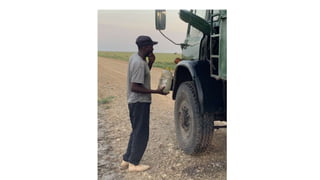
The Story behind the Picture
• Look closely at the pictures, silently, thinking about:
• What do you think is happening?
• What happened before?
• What might happen next?
• How are they connected?
• In partners, share your thinking.
• Did your thinking grow when you heard from your partner?
• What do you think is the story behind these pictures?
• Quick write: 2/3 minutes. Begin the story.
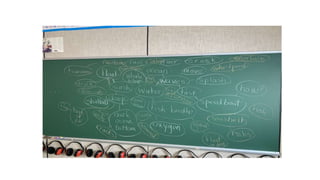
• Choose a word or a phrase that you particularly like from your quick write. If you can’t decide,
read your first 3 words
• Whip around, listening to each.
• What do you notice about these words and phrases? (This is the first step in building criteria.)
• Add on background information about the picture sequence.
• With this new information, add on to your writing or begin again – 5 minutes. Feel free to use
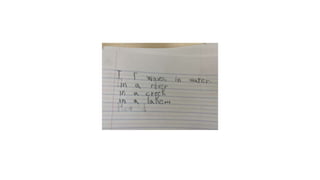
anything you heard that sparked your thinking!
Visible Learning
…understanding the impact that instructional efforts have on student
learning
John Hattie
Collective Teacher Efficacy –
John Hattie, Collaborative Impact Conference, 2017
• …the collective belief of teachers in their ability to
positively affect students
• Effect size of d=1.57
• New #1 influence related to student achievement
• It is more than just belief; it is a collaborative
conversation based on evidence.
Big Ideas
• Teaching counts!
• Our instructional choices impact significantly on student
learning
• We teach responsively
• We need a mental model of ‘what works’ to guide our
teaching
• All kids can learn and we know enough collectively to
teach all kids!
• An unwavering belief that everyone has the right to be
included socially, emotionally, and intellectually
Big Ideas
• Reading and writing
• ‘float on a sea of talk’ – James Britton
• Are apprenticeships – Frank Smith
• Engage the learners!
• If you are not engaged, you can’t be learning
• Thinking is the basis of all our learning
• Provide access for all!
• Low floor, high ceiling
• Work tirelessly to keep students within the community of the
classroom
Ministry of Education’s Definition of Literacy
Literacy is the ability and willingness to make meaning from
text and express oneself in a variety of modes and for a
variety of purposes.
Literacy includes making connections, analyzing critically,
comprehending, creating, and communicating.
B.C. Ministry of Education, 2017
17
What counts?
Teachers’ Reflections
• What made a difference for vulnerable learners
(CR4YR, 2012-2013)
• 1:1 support
• Relationship
• Choice
• Focus on meaning
“Every Child, Every Day” – Richard Allington and
Rachael Gabriel
In Educational Leadership, March 2012
6 elements of instruction for ALL students!
1. Every child reads something he or she chooses.
2. Every child reads accurately.
-intensity and volume count!
-98% accuracy
-less than 90% accuracy, doesn’t improve reading at all
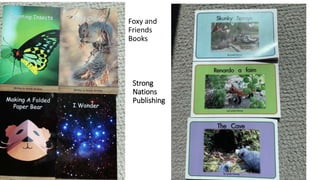
Strong
Nations
Publishing
Foxy and
Friends
Books
• Island Literacy Net Book Catalogue – SD 71
• Easy, affordable books for Vancouver Island readers
3. Every child reads something he or she understands.
-at least 2/3 of time spent reading and rereading NOT
doing isolated skill practice or worksheets
-build background knowledge before entering the text
-read with questions in mind
• Recycled
• 5 cents a pound
• Garbage trucks
• 1500 tons each day
• Paraguay
4. Every child writes about something personally meaningful.
-connected to text
-connected to themselves
-real purpose, real audience
Writers’ Workshop – Student Diversity 3rd
ed
• The foundation of your literacy programming
• Establish this first!!!!
• K/1 – begin with interactive writing, writing/drawing/creating
text in front of your learners, representing thinking with
drawing, adding letters and sounds
• 2-7 – write in front of your students, at least 2 whole class
writing in response to experiences, read alouds, classroom
inquiries each week
•When students write, they generate deeper
thinking in any content area.
• Kelly Gallagher “The Writing Journey” EL, Feb 17
•Improvement in writing is grounded in
practice, in getting words on the page –
lots of them. There are no shortcuts.
• Gallagher & Kittle, EL, April 18
• Focus on ideas
• Do not focus on transcription – punctuation,
capitalization, spacing, spelling, handwriting,
high-frequency words
• “…compositional skills develop, and are
mastered, long before transcription skills”
(Flower & Hayes, 1981; Ray & Glover,2008;
Roberts & Wibens, 2010)
• Auguste, “The Balancing Act of Kindergarten Writing Instruction”, EL,
April 2018
The Water Cycle: Water is essential to all
living things and it cycles through the
environment
• Grade 2 with Andrea Vanderkruyk – September 17
• Strengths:
• Excited and want to learn
• Chatty and love to share
• Practicing read to self
• Stretches:
• Hesitant to write
• Listening to each other
• Staying focused
• Several generally don’t make it through a class and need to leave the room
Previously…
• Brainstormed questions about water
• Examined images of water in different forms
• Brainstormed what they knew about water
• Had been on a field trip to Kootenay Lake the previous day
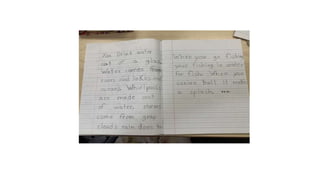
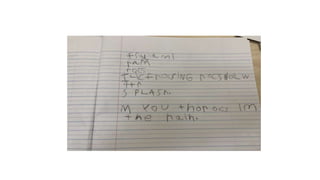
This class:
• Whip around
• Write in response:
• Know about water
• Are curious about water
• What you are becoming expert on
5. Every child talks with peers about reading and writing.
6. Every child listens to a fluent adult read aloud.
-different kinds of text
-with some commentary
1. Every child reads something he or she chooses.
2. Every child reads accurately.
3. Every child reads something he or she understands.
4. Every child writes about something personally
meaningful.
5. Every child talks with peers about reading and
writing.
6. Every child listens to a fluent adult read aloud.
Some NOT best practices in
literacy
-no research support for decades!
-over-used, under-supported
• Teaching grammar in isolation
• Friday spelling lists
• Assigning topics in writing, with no 1:1 no conferencing,
just collecting the work
• Too much teacher-talk
• Fill in the blanks, MC, closed thinking exercises
• Children identifying themselves by their reading level
• Round robin reading – even in guided reading groups!!!
• Lack of consistency in the programming for vulnerable
learners
Questions to leave with…
• What would happen if…?
• With whom will you work?
• How will you know if what you are doing is making a difference?
• Something to hang on to…
• Something to let go of…
• Something to try…
Richmond PLN NOV 2020

Richmond PLN NOV 2020

  • 1.
    Professional Learning Network: effectivelearning in inclusive classrooms Brighouse November 22, 2019 Faye Brownlie slideshare.net/fayebrownlie.Richmond.nov.2019
  • 2.
    Shape of theDay • 8:30-10:10 – Keynote • 10:20-11:05 - Break out #1 • 11:15 - 12:00 - Break out #2 • 12:00 - 12:30 – Nutrition Break • 12:30 - 1:30 Keynote
  • 3.
    Learning Intentions • Iam more convinced that I know enough, especially when working with others, to teach all the students in my care. • I have a better idea of ‘what counts’ in effective literacy instruction. • Every Child, Every Day • CR4YR • The Relationship between Teacher Support and Student Control • I have a plan to try something new to me. • I have a question to continue to ponder. • I have a practice that I will let go of.
  • 10.
    Curriculum Design andInstructional Strategies: Strategic Planning • Who is doing the cognitive work? • Is there an access point for all learners? • Is there an opportunity for growth for all learners? • Does the task the student is engaged in grow competency and thinking?
  • 11.
    Curriculum Design andInstructional Strategies: Strategic Planning • Start with your end in mind • Consider your learners’ strengths and stretches • What will you do to mediate their learning? i.e., choose your strategies • How will you incrementally remove supports to enable the learners to use the thinking behind the strategies independently?
  • 12.
    The Story behindthe Picture • Look closely at the pictures, silently, thinking about: • What do you think is happening? • What happened before? • What might happen next? • How are they connected? • In partners, share your thinking. • Did your thinking grow when you heard from your partner? • What do you think is the story behind these pictures? • Quick write: 2/3 minutes. Begin the story. • Choose a word or a phrase that you particularly like from your quick write. If you can’t decide, read your first 3 words • Whip around, listening to each. • What do you notice about these words and phrases? (This is the first step in building criteria.) • Add on background information about the picture sequence. • With this new information, add on to your writing or begin again – 5 minutes. Feel free to use anything you heard that sparked your thinking!
  • 13.
    Visible Learning …understanding theimpact that instructional efforts have on student learning John Hattie
  • 14.
    Collective Teacher Efficacy– John Hattie, Collaborative Impact Conference, 2017 • …the collective belief of teachers in their ability to positively affect students • Effect size of d=1.57 • New #1 influence related to student achievement • It is more than just belief; it is a collaborative conversation based on evidence.
  • 15.
    Big Ideas • Teachingcounts! • Our instructional choices impact significantly on student learning • We teach responsively • We need a mental model of ‘what works’ to guide our teaching • All kids can learn and we know enough collectively to teach all kids! • An unwavering belief that everyone has the right to be included socially, emotionally, and intellectually
  • 16.
    Big Ideas • Readingand writing • ‘float on a sea of talk’ – James Britton • Are apprenticeships – Frank Smith • Engage the learners! • If you are not engaged, you can’t be learning • Thinking is the basis of all our learning • Provide access for all! • Low floor, high ceiling • Work tirelessly to keep students within the community of the classroom
  • 17.
    Ministry of Education’sDefinition of Literacy Literacy is the ability and willingness to make meaning from text and express oneself in a variety of modes and for a variety of purposes. Literacy includes making connections, analyzing critically, comprehending, creating, and communicating. B.C. Ministry of Education, 2017 17
  • 18.
  • 19.
    Teachers’ Reflections • Whatmade a difference for vulnerable learners (CR4YR, 2012-2013) • 1:1 support • Relationship • Choice • Focus on meaning
  • 20.
    “Every Child, EveryDay” – Richard Allington and Rachael Gabriel In Educational Leadership, March 2012 6 elements of instruction for ALL students!
  • 21.
    1. Every childreads something he or she chooses.
  • 22.
    2. Every childreads accurately. -intensity and volume count! -98% accuracy -less than 90% accuracy, doesn’t improve reading at all
  • 23.
  • 24.
    • Island LiteracyNet Book Catalogue – SD 71 • Easy, affordable books for Vancouver Island readers
  • 25.
    3. Every childreads something he or she understands. -at least 2/3 of time spent reading and rereading NOT doing isolated skill practice or worksheets -build background knowledge before entering the text -read with questions in mind
  • 26.
    • Recycled • 5cents a pound • Garbage trucks • 1500 tons each day • Paraguay
  • 28.
    4. Every childwrites about something personally meaningful. -connected to text -connected to themselves -real purpose, real audience
  • 29.
    Writers’ Workshop –Student Diversity 3rd ed • The foundation of your literacy programming • Establish this first!!!! • K/1 – begin with interactive writing, writing/drawing/creating text in front of your learners, representing thinking with drawing, adding letters and sounds • 2-7 – write in front of your students, at least 2 whole class writing in response to experiences, read alouds, classroom inquiries each week
  • 30.
    •When students write,they generate deeper thinking in any content area. • Kelly Gallagher “The Writing Journey” EL, Feb 17
  • 31.
    •Improvement in writingis grounded in practice, in getting words on the page – lots of them. There are no shortcuts. • Gallagher & Kittle, EL, April 18
  • 32.
    • Focus onideas • Do not focus on transcription – punctuation, capitalization, spacing, spelling, handwriting, high-frequency words • “…compositional skills develop, and are mastered, long before transcription skills” (Flower & Hayes, 1981; Ray & Glover,2008; Roberts & Wibens, 2010) • Auguste, “The Balancing Act of Kindergarten Writing Instruction”, EL, April 2018
  • 33.
    The Water Cycle:Water is essential to all living things and it cycles through the environment • Grade 2 with Andrea Vanderkruyk – September 17 • Strengths: • Excited and want to learn • Chatty and love to share • Practicing read to self • Stretches: • Hesitant to write • Listening to each other • Staying focused • Several generally don’t make it through a class and need to leave the room
  • 34.
    Previously… • Brainstormed questionsabout water • Examined images of water in different forms • Brainstormed what they knew about water • Had been on a field trip to Kootenay Lake the previous day
  • 35.
    This class: • Whiparound • Write in response: • Know about water • Are curious about water • What you are becoming expert on
  • 41.
    5. Every childtalks with peers about reading and writing.
  • 42.
    6. Every childlistens to a fluent adult read aloud. -different kinds of text -with some commentary
  • 43.
    1. Every childreads something he or she chooses. 2. Every child reads accurately. 3. Every child reads something he or she understands. 4. Every child writes about something personally meaningful. 5. Every child talks with peers about reading and writing. 6. Every child listens to a fluent adult read aloud.
  • 44.
    Some NOT bestpractices in literacy -no research support for decades! -over-used, under-supported • Teaching grammar in isolation • Friday spelling lists • Assigning topics in writing, with no 1:1 no conferencing, just collecting the work • Too much teacher-talk • Fill in the blanks, MC, closed thinking exercises • Children identifying themselves by their reading level • Round robin reading – even in guided reading groups!!! • Lack of consistency in the programming for vulnerable learners
  • 45.
    Questions to leavewith… • What would happen if…? • With whom will you work? • How will you know if what you are doing is making a difference? • Something to hang on to… • Something to let go of… • Something to try…

Editor's Notes

  • #14 Knowing what counts and doing what counts Noticing your impact by always keeping your eyes on the students and their changes
  • #18  In order to explore and understand the constructs of Numeracy and Literacy , a pan-Canadian and limited international review was completed to determine how these constructs are defined and assessed in leading jurisdictions The definitions of the constructs of Numeracy and Literacy emerged from this research and through shaping it via consultations with educators and academics Here is the Literacy definition Some subjects are more text heavy than others … for example, there is less actual text in a PE class, but making meaning still has a place Home Ec there is less text than a SS class, but those texts are very important!! Less room for error -literacy across discplines as supported by the new literacy assessment
  • #22 Show a few books and market them. Help kids choose a just right book. Note the different kinds of text. Can be guided choice, but also need some time of free-er choice. Colleen’s story of taking the guided reading group to the bookroom and every child choosing the book or 2 they he wanted to read in their group next. Then voting on which to read first. All for her most reluctant reader. While they are reading, we conference. Those who are needing more support and read with every day – by teacher, resource teacher, para…who reinforces the skills that were introduced and taught in the group lessons. Robo-Rex, Flags, Kay McKeever – p.1, Special Tricks – blue-tailed lizard
  • #23 No point in being left in too hard text. Lisa image here…repeated readings Could be class names, reading together, rereading books from GR group, echo reading, poems, songs…
  • #26 Give example of building BK … In whole group and small group. Introduce how to talk about what you know with a buddy before you begin independent or partner reading. What do you know? How does it connect? What does it remind you of? Why did you choose this book? What do you wonder about?
  • #29 NOT a journal about what you did on the weekend. Tied to content, tied to books you are reading, experiences you are having – often shared because this builds up the background knowledge.
  • #33 Not about copying my words after I have scribed! Not about tracing and calling it writing. Better to tell a story, draw a picture, build something – and add some letters or sounds – than have it all scribed.
  • #43 Read from 2-3 different texts – poem, recipe, newspaper, graph, chart Brussels advertisement and picture book – tea monkeys
  • #44 98% accuracy Note text complexity with sentence structure, background knowledge – Jasmine and polar bears as whale predators – just saw first snowflakes Writes – connected to the learning – and with voice – not a scripted piece Talks – brainstorm-categorize and circle to rebuild text from clues Read – different texts
  • #45 Jess’ every morning journal – 10-15 minutes. Hmmm.