
11/14/2007 Carla Fair-Wright Decision Models RAISING PERFORMANCE. TOGETHER TM Performance T H R O U G H  L E A D E R S H I P COMPRESSION SYSTEMS
Decision Models Using Models to Improve the  Decision Process RAISING PERFORMANCE. TOGETHER TM COMPRESSION SYSTEMS
Decision Making Techniques Types Pareto Analysis  - Choosing what to change Paired Comparison Analysis  - Working out the relative importance of different options Grid Analysis  - Making a choice taking into account many factors  Force Field Analysis -  Analyzing the pressures for and against change  Six Thinking Hats  -  Looking at a decision from different perspective
Decision Making Techniques Pareto Analysis Most Important Changes to Make   It uses the Pareto principle - the idea that by doing 20% of work you can generate 80% of the advantage of doing the entire job*. A formal technique for finding the changes that will give the biggest benefits.  How to Use the Tool: write out a list of the changes you could make. group it into related changes. Then score the items or groups.
Example: Pareto Analysis A manager has taken over a failing service center.  He commissions research to find out why customers think that service is poor. Comments back from the customers:
Example: Pareto Analysis 1) Phones are only answered after many rings.  2) Staff seem distracted and under pressure.  3) Engineers do not appear to be well organized. They need second visits to bring extra parts. This means that customers have to take more holiday to be there a second time. 4) Staff members do not always seem to know what they are doing. 5) Sometimes when staff members arrive, the customer finds that the problem could have been solved over the phone. 6) They do not know what time they will arrive. This means that customers may have to be in all day for an engineer to visit.
Example: Pareto Analysis Lack of staff training: items 5 and 6:  51 complaints Too few staff: items 1, 2 and 4:  21 complaints Poor organization and preparation: item 3:  2 complaints By doing the Pareto analysis above, the manager can better see that the vast majority of problems (69%) can be solved by improving staff skills.
Decision Making Techniques Paired Comparison Analysis  Working out the relative importance of different options Follow these steps to use the technique: List the options you will compare. Assign a letter to each option. Mark the options as row and column headings on the worksheet. Within the remaining cells compare the option in the row with the one in the column. Add up the total of all the values
Example:  Paired Comparison Analysis  As a simple example, an entrepreneur is looking at ways in which she can expand her business.  She has  limited resources , but also has the options she lists below: Expand into overseas markets Expand in home markets Improve customer service Improve quality
Example:  Paired Comparison Analysis
Example:  Paired Comparison Analysis  Finally she adds up the A, B, C and D values, and converts each into a percentage of the total. This gives these totals: A = 3 (37.5%) B = 1 (12.5%) C = 4 (50%) D = 0. Here it is most important to improve customer service (C) and then to tackle export markets (A). Quality is not a high priority - perhaps it is good already.
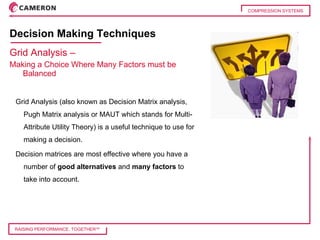
Decision Making Techniques Grid Analysis –  Making a Choice Where Many Factors must be Balanced Grid Analysis (also known as Decision Matrix analysis, Pugh Matrix analysis or MAUT which stands for Multi-Attribute Utility Theory) is a useful technique to use for making a decision.  Decision matrices are most effective where you have a number of  good alternatives  and  many factors  to take into account.
Grid Analysis  The first step is to list your options and then the factors that are important for making the decision  Lay the options  (options as the row labels, and factors as the column headings.) The next step is to work your way across your table, scoring each option for each of the important factors in your decision.
Grid Analysis  Score each option from 0 (poor) to 3 (very good).  Now multiply each of your scores by the values for your relative importance. This will give them the correct overall weight in your decision.
Example: Grid Analysis  A windsurfing enthusiast is about to replace his car. He needs one that not only  carries a board  and sails, but also that will be good for  business travel . He has always  loved  open-topped  sports cars . No car he can find is good for all three things. His options are: An SUV/4x4, hard topped vehicle A comfortable 'family car' A station wagon/estate car A sports car
Example: Grid Analysis  Criteria that he wants to consider are: Cost Ability to  carry  a sail board at normal driving Speed Ability to store sails and equipment securely Comfort over long distances Fun! Nice  look  and build quality to car
Example: Grid Analysis  Next he decides the relative weights for each of the factors. He multiplies these by the scores already entered, and totals them   Score each option from 0 (poor) to 3 (very good).
Example: Grid Analysis  This gives an interesting result: Despite its lack of fun, a station wagon may be the best choice. If the wind-surfer still feels unhappy with the decision, maybe he has underestimated the  importance  of one of the factors. Perhaps he should weight 'fun' by 7!
Decision Making Techniques Steps of Decision Making Identify the problem Agree on the Goal Determine Possible Actions Predict the Outcome Pick the Alternative Implement the Decision
Decision Making Techniques Speed vs Accuracy Choosing between A and B 20%  - Must be correct  15% -  Must be correct as long as it takes 60% -  Will work either way 5%  -  Decision does not need to be made
Decision Making Techniques Final Thoughts Decisions making skills can be nurtured Know your skill level and improve it Recognize your biases and correct them Evaluate the critical success factors: Accuracy, speed, popularity, flexibility Intuition is a tool that can be honed
11/14/2007 Carla Fair-Wright Decision Models RAISING PERFORMANCE. TOGETHER TM Performance T H R O U G H  L E A D E R S H I P COMPRESSION SYSTEMS
Decision Making Techniques Types Force Field Analysis -  Analyzing the pressures for and against change  Six Thinking Hats  -  Looking at a decision from different perspective
Decision Making Techniques Force Field Analysis  Analyzing the pressures for and against change  Force Field Analysis is a useful technique for looking at all the forces for and against a decision. In effect, it is a specialized method of weighing  pros and cons. By carrying out the analysis you can plan to strengthen the forces supporting a decision, and reduce the impact of opposition to it.
Decision Making Techniques Force Field Analysis  Analyzing the pressures for and against change  How to Use the Tool: • Describe your plan or proposal for change in the middle. • List all forces for change in one column, and all forces against change in another column. • Assign a score to each force, from 1 (weak) to 5 (strong).
Example: Force Field Analysis  For example, imagine that you are a manager deciding whether to reorganize your department:
Example: Force Field Analysis  What the Forces for Change  Better Flow of Work Eliminate Redundancy Promote Top Talent Plan  Reorganize  Office
Example: Force Field Analysis  Better Flow of Work Eliminate Redundancy Promote Top Talent Plan  Reorganize  Office Administrative Cultural Impact Lost Work What the Forces for Change vs. Forces Against
Force Field Analysis
Decision Making Techniques 6 Thinking Hats  Looking at a Decision From All Points of View 'Six Thinking Hats' is a powerful technique that helps you look at important decisions from a number of different perspectives. It helps you make better decisions by forcing you to move outside your habitual ways of thinking. As such, it helps you understand the  full complexity  of the decision, and spot issues and opportunities to which you might otherwise be blind.
Decision Making Techniques 6 Thinking Hats  Looking at a Decision From All Points of View How to Use the Tool: You can use the Six Thinking Hats technique in meetings or on your own. In meetings it has the benefit of blocking the confrontations that happen when people with different thinking styles discuss the same problem. Each 'Thinking Hat' is a different style of thinking. These are explained below:

Decisions

  • 1.
    11/14/2007 Carla Fair-WrightDecision Models RAISING PERFORMANCE. TOGETHER TM Performance T H R O U G H L E A D E R S H I P COMPRESSION SYSTEMS
  • 2.
    Decision Models UsingModels to Improve the Decision Process RAISING PERFORMANCE. TOGETHER TM COMPRESSION SYSTEMS
  • 3.
    Decision Making TechniquesTypes Pareto Analysis - Choosing what to change Paired Comparison Analysis - Working out the relative importance of different options Grid Analysis - Making a choice taking into account many factors Force Field Analysis - Analyzing the pressures for and against change Six Thinking Hats - Looking at a decision from different perspective
  • 4.
    Decision Making TechniquesPareto Analysis Most Important Changes to Make It uses the Pareto principle - the idea that by doing 20% of work you can generate 80% of the advantage of doing the entire job*. A formal technique for finding the changes that will give the biggest benefits. How to Use the Tool: write out a list of the changes you could make. group it into related changes. Then score the items or groups.
  • 5.
    Example: Pareto AnalysisA manager has taken over a failing service center. He commissions research to find out why customers think that service is poor. Comments back from the customers:
  • 6.
    Example: Pareto Analysis1) Phones are only answered after many rings. 2) Staff seem distracted and under pressure. 3) Engineers do not appear to be well organized. They need second visits to bring extra parts. This means that customers have to take more holiday to be there a second time. 4) Staff members do not always seem to know what they are doing. 5) Sometimes when staff members arrive, the customer finds that the problem could have been solved over the phone. 6) They do not know what time they will arrive. This means that customers may have to be in all day for an engineer to visit.
  • 7.
    Example: Pareto AnalysisLack of staff training: items 5 and 6: 51 complaints Too few staff: items 1, 2 and 4: 21 complaints Poor organization and preparation: item 3: 2 complaints By doing the Pareto analysis above, the manager can better see that the vast majority of problems (69%) can be solved by improving staff skills.
  • 8.
    Decision Making TechniquesPaired Comparison Analysis Working out the relative importance of different options Follow these steps to use the technique: List the options you will compare. Assign a letter to each option. Mark the options as row and column headings on the worksheet. Within the remaining cells compare the option in the row with the one in the column. Add up the total of all the values
  • 9.
    Example: PairedComparison Analysis As a simple example, an entrepreneur is looking at ways in which she can expand her business. She has limited resources , but also has the options she lists below: Expand into overseas markets Expand in home markets Improve customer service Improve quality
  • 10.
    Example: PairedComparison Analysis
  • 11.
    Example: PairedComparison Analysis Finally she adds up the A, B, C and D values, and converts each into a percentage of the total. This gives these totals: A = 3 (37.5%) B = 1 (12.5%) C = 4 (50%) D = 0. Here it is most important to improve customer service (C) and then to tackle export markets (A). Quality is not a high priority - perhaps it is good already.
  • 12.
    Decision Making TechniquesGrid Analysis – Making a Choice Where Many Factors must be Balanced Grid Analysis (also known as Decision Matrix analysis, Pugh Matrix analysis or MAUT which stands for Multi-Attribute Utility Theory) is a useful technique to use for making a decision. Decision matrices are most effective where you have a number of good alternatives and many factors to take into account.
  • 13.
    Grid Analysis The first step is to list your options and then the factors that are important for making the decision Lay the options (options as the row labels, and factors as the column headings.) The next step is to work your way across your table, scoring each option for each of the important factors in your decision.
  • 14.
    Grid Analysis Score each option from 0 (poor) to 3 (very good). Now multiply each of your scores by the values for your relative importance. This will give them the correct overall weight in your decision.
  • 15.
    Example: Grid Analysis A windsurfing enthusiast is about to replace his car. He needs one that not only carries a board and sails, but also that will be good for business travel . He has always loved open-topped sports cars . No car he can find is good for all three things. His options are: An SUV/4x4, hard topped vehicle A comfortable 'family car' A station wagon/estate car A sports car
  • 16.
    Example: Grid Analysis Criteria that he wants to consider are: Cost Ability to carry a sail board at normal driving Speed Ability to store sails and equipment securely Comfort over long distances Fun! Nice look and build quality to car
  • 17.
    Example: Grid Analysis Next he decides the relative weights for each of the factors. He multiplies these by the scores already entered, and totals them Score each option from 0 (poor) to 3 (very good).
  • 18.
    Example: Grid Analysis This gives an interesting result: Despite its lack of fun, a station wagon may be the best choice. If the wind-surfer still feels unhappy with the decision, maybe he has underestimated the importance of one of the factors. Perhaps he should weight 'fun' by 7!
  • 19.
    Decision Making TechniquesSteps of Decision Making Identify the problem Agree on the Goal Determine Possible Actions Predict the Outcome Pick the Alternative Implement the Decision
  • 20.
    Decision Making TechniquesSpeed vs Accuracy Choosing between A and B 20% - Must be correct 15% - Must be correct as long as it takes 60% - Will work either way 5% - Decision does not need to be made
  • 21.
    Decision Making TechniquesFinal Thoughts Decisions making skills can be nurtured Know your skill level and improve it Recognize your biases and correct them Evaluate the critical success factors: Accuracy, speed, popularity, flexibility Intuition is a tool that can be honed
  • 22.
    11/14/2007 Carla Fair-WrightDecision Models RAISING PERFORMANCE. TOGETHER TM Performance T H R O U G H L E A D E R S H I P COMPRESSION SYSTEMS
  • 23.
    Decision Making TechniquesTypes Force Field Analysis - Analyzing the pressures for and against change Six Thinking Hats - Looking at a decision from different perspective
  • 24.
    Decision Making TechniquesForce Field Analysis Analyzing the pressures for and against change Force Field Analysis is a useful technique for looking at all the forces for and against a decision. In effect, it is a specialized method of weighing pros and cons. By carrying out the analysis you can plan to strengthen the forces supporting a decision, and reduce the impact of opposition to it.
  • 25.
    Decision Making TechniquesForce Field Analysis Analyzing the pressures for and against change How to Use the Tool: • Describe your plan or proposal for change in the middle. • List all forces for change in one column, and all forces against change in another column. • Assign a score to each force, from 1 (weak) to 5 (strong).
  • 26.
    Example: Force FieldAnalysis For example, imagine that you are a manager deciding whether to reorganize your department:
  • 27.
    Example: Force FieldAnalysis What the Forces for Change Better Flow of Work Eliminate Redundancy Promote Top Talent Plan Reorganize Office
  • 28.
    Example: Force FieldAnalysis Better Flow of Work Eliminate Redundancy Promote Top Talent Plan Reorganize Office Administrative Cultural Impact Lost Work What the Forces for Change vs. Forces Against
  • 29.
  • 30.
    Decision Making Techniques6 Thinking Hats Looking at a Decision From All Points of View 'Six Thinking Hats' is a powerful technique that helps you look at important decisions from a number of different perspectives. It helps you make better decisions by forcing you to move outside your habitual ways of thinking. As such, it helps you understand the full complexity of the decision, and spot issues and opportunities to which you might otherwise be blind.
  • 31.
    Decision Making Techniques6 Thinking Hats Looking at a Decision From All Points of View How to Use the Tool: You can use the Six Thinking Hats technique in meetings or on your own. In meetings it has the benefit of blocking the confrontations that happen when people with different thinking styles discuss the same problem. Each 'Thinking Hat' is a different style of thinking. These are explained below:

Editor's Notes

  • #8 The manager groups these problems together. He then scores each group by the number of complaints, and orders the list: Lack of staff training: items 5 and 6: 51 complaints Too few staff: items 1, 2 and 4: 21 complaints Poor organization and preparation: item 3: 2 complaints By doing the Pareto analysis above, the manager can better see that the vast majority of problems (69%) can be solved by improving staff skills. Once this is done, it may be worth looking at increasing the number of staff members. Alternatively, as staff members become more able to solve problems over the phone, maybe the need for new staff members may decline. It looks as if comments on poor organization and preparation may be rare, and could be caused by problems beyond the manager's control. By carrying out a Pareto Analysis, the manager is able to focus on training as an issue, rather than spreading effort over training, taking on new staff members, and possibly installing a new computer system.
  • #32 White Hat: With this thinking hat you focus on the data available. Look at the information you have, and see what you can learn from it. Look for gaps in your knowledge, and either try to fill them or take account of them. This is where you analyze past trends, and try to extrapolate from historical data. Red Hat: 'Wearing' the red hat, you look at problems using intuition, gut reaction, and emotion. Also try to think how other people will react emotionally. Try to understand the responses of people who do not fully know your reasoning. Black Hat: Using black hat thinking, look at all the bad points of the decision. Look at it cautiously and defensively. Try to see why it might not work. This is important because it highlights the weak points in a plan. It allows you to eliminate them, alter them, or prepare contingency plans to counter them. Black Hat thinking helps to make your plans 'tougher' and more resilient. It can also help you to spot fatal flaws and risks before you embark on a course of action. Black Hat thinking is one of the real benefits of this technique, as many successful people get so used to thinking positively that often they cannot see problems in advance. This leaves them under-prepared for difficulties. Yellow Hat: The yellow hat helps you to think positively. It is the optimistic viewpoint that helps you to see all the benefits of the decision and the value in it. Yellow Hat thinking helps you to keep going when everything looks gloomy and difficult. Green Hat: The Green Hat stands for creativity. This is where you can develop creative solutions to a problem. It is a freewheeling way of thinking, in which there is little criticism of ideas. A whole range of creativity tools can help you here. Blue Hat: The Blue Hat stands for process control. This is the hat worn by people chairing meetings. When running into difficulties because ideas are running dry, they may direct activity into Green Hat thinking. When contingency plans are needed, they will ask for Black Hat thinking, etc.