UNIT II
ELECTRICAL AND ELECTRONICS INSTRUMENTS
20/11/2018
KONGUNADU COLLEGE OF ENGINEERING
AND TECHNOLOGY
Introduction
• The Instruments which are used for such a measurements are
called measuring instruments.
The necessary requirements of a measuring instrument are
• (i) That its introduction into the circuit, where measurements
are to be made, does not alter the circuit conditions ;
• (ii) The power consumed by them for their operation is small.
20/11/2018
KONGUNADU COLLEGE OF ENGINEERING
AND TECHNOLOGY
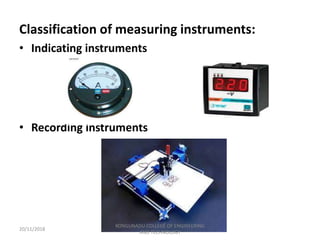
Classification of measuring instruments:
• Indicating instruments
• Recording instruments
20/11/2018
KONGUNADU COLLEGE OF ENGINEERING
AND TECHNOLOGY
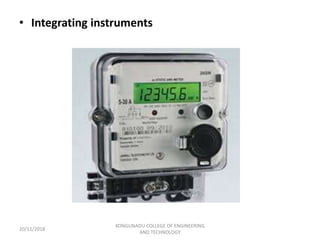
• Integrating instruments
20/11/2018
KONGUNADU COLLEGE OF ENGINEERING
AND TECHNOLOGY
Essential requirements of indicating instrument:
• An indicating instrument essentially consists of a moving system
pivoted in jewel bearings.
• A pointer is attached to the moving system which indicates the
electrical quantity to be measured, on a graduated scale.
• In order to ensure the proper operation of the indicating
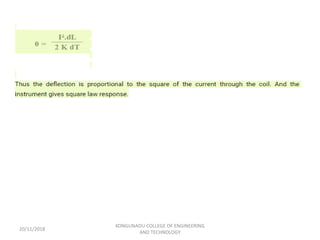
instruments , the following three torques are required.
1. deflecting system producing deflecting torque Td.
2. controlling system producing controlling torque Tc.
3. damping system producing damping torque
20/11/2018
KONGUNADU COLLEGE OF ENGINEERING
AND TECHNOLOGY
Deflecting torque:
• The deflecting torque is produced by utilizing the various
effects (magnetic effect, induction effect, thermal effect, hall
effect) of electric current or voltage, and causes the moving
system and hence the pointer to move from zero position.
controlling torque:
• The controlling torque is produced by spring or gravity and
opposes the deflecting torque. The pointer comes to rest at a
position, where these two opposing torques are equal.
Damping torque:
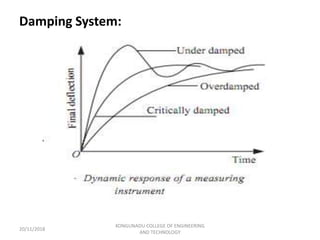
• Damping torque is provided by air friction or eddy currents. It
ensures that, the pointer comes to the final position, without
oscillations, thus enabling accurate and quick readings to be
taken.
20/11/2018
KONGUNADU COLLEGE OF ENGINEERING
AND TECHNOLOGY
Deflecting system:
• In most of the indicating instruments the mechanical force
proportional to the quantity to be measured is generated.
This force or torque deflects the pointer.
The deflecting torque overcomes,
1) The inertia of the moving system
2) The controlling torque provided by controlling system.
3) The damping torque provided by damping system.
The deflecting system uses on of the following effects produced
by current or voltage, to produce deflecting torque.
a) Magnetic effect
b) Thermal effect
c) Electrostatic effect
d) Induction effect
e) Hall effect
20/11/2018
KONGUNADU COLLEGE OF ENGINEERING
AND TECHNOLOGY
Controlling system:
• The controlling torque (Tc) opposes the deflecting torque and
increases with the deflection of the moving system. The
pointer comes to rest at a position where the two opposing
torques are equal i.e. Td = Tc.
The controlling torque performs two functions.
• Controlling torque increases with the deflection of the
moving system so that the final position of the pointer on
the scale will be according to the magnitude of an electrical
quantity (i.e. current or voltage or power) to be measured.
• Controlling torque brings the pointer back to zero when the
deflecting torque is removed. If it were not provided, the
pointer once deflected would not return to zero position on
removing the deflecting torque. The controlling torque in
indicating instruments may be provided by one of the
following two methods:
• (i) Spring control.
(ii) Gravity control.
20/11/2018
KONGUNADU COLLEGE OF ENGINEERING
AND TECHNOLOGY
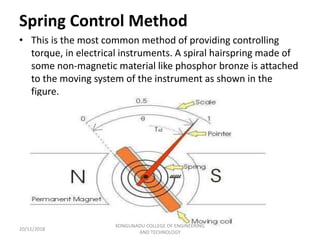
Spring Control Method
• This is the most common method of providing controlling
torque, in electrical instruments. A spiral hairspring made of
some non-magnetic material like phosphor bronze is attached
to the moving system of the instrument as shown in the
figure.
20/11/2018
KONGUNADU COLLEGE OF ENGINEERING
AND TECHNOLOGY
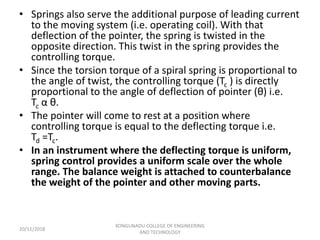
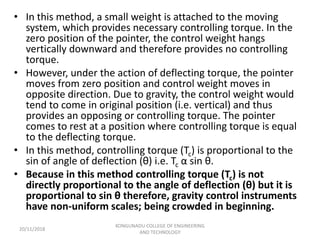
• Springs also serve the additional purpose of leading current
to the moving system (i.e. operating coil). With that
deflection of the pointer, the spring is twisted in the
opposite direction. This twist in the spring provides the
controlling torque.
• Since the torsion torque of a spiral spring is proportional to
the angle of twist, the controlling torque (Tc ) is directly
proportional to the angle of deflection of pointer (θ) i.e.
Tc α θ.
• The pointer will come to rest at a position where
controlling torque is equal to the deflecting torque i.e.
Td =Tc.
• In an instrument where the deflecting torque is uniform,
spring control provides a uniform scale over the whole
range. The balance weight is attached to counterbalance
the weight of the pointer and other moving parts.
20/11/2018
KONGUNADU COLLEGE OF ENGINEERING
AND TECHNOLOGY
Gravity Control Method:
20/11/2018
KONGUNADU COLLEGE OF ENGINEERING
AND TECHNOLOGY
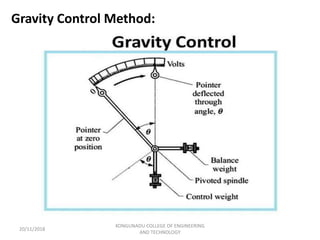
• In this method, a small weight is attached to the moving
system, which provides necessary controlling torque. In the
zero position of the pointer, the control weight hangs
vertically downward and therefore provides no controlling
torque.
• However, under the action of deflecting torque, the pointer
moves from zero position and control weight moves in
opposite direction. Due to gravity, the control weight would
tend to come in original position (i.e. vertical) and thus
provides an opposing or controlling torque. The pointer
comes to rest at a position where controlling torque is equal
to the deflecting torque.
• In this method, controlling torque (Tc) is proportional to the
sin of angle of deflection (θ) i.e. Tc α sin θ.
• Because in this method controlling torque (Tc) is not
directly proportional to the angle of deflection (θ) but it is
proportional to sin θ therefore, gravity control instruments
have non-uniform scales; being crowded in beginning.
20/11/2018
KONGUNADU COLLEGE OF ENGINEERING
AND TECHNOLOGY
Damping System:
20/11/2018
KONGUNADU COLLEGE OF ENGINEERING
AND TECHNOLOGY
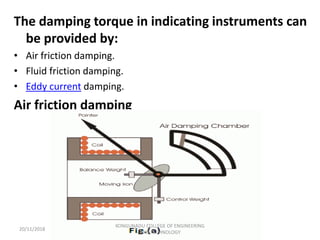
The damping torque in indicating instruments can
be provided by:
• Air friction damping.
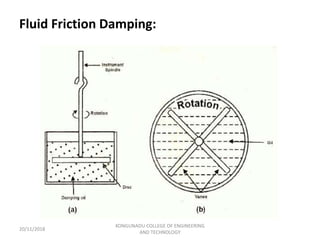
• Fluid friction damping.
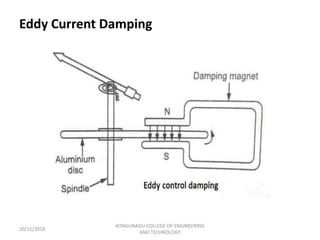
• Eddy current damping.
Air friction damping
20/11/2018
KONGUNADU COLLEGE OF ENGINEERING
AND TECHNOLOGY
Fluid Friction Damping:
20/11/2018
KONGUNADU COLLEGE OF ENGINEERING
AND TECHNOLOGY
Eddy Current Damping
20/11/2018
KONGUNADU COLLEGE OF ENGINEERING
AND TECHNOLOGY
Permanent Magnet Moving Coil Instrument (PMMC):
• The permanent magnet moving coil instrument is the most accurate type for
d.c. measurements. The working principle of these instruments is the
same as that of the d’Arsonval type of galvanometers, the difference being
that a direct reading instrument is provided with a pointer and a scale.
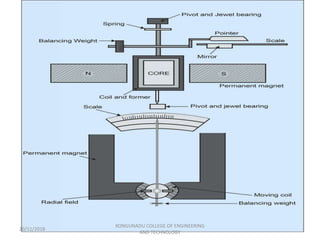
Construction of PMMC Instruments
• The constructional features of this instrument are shown in Fig.
• The moving coil is wound with many turns of enameled or silk covered
copper wire.
• The coil is mounted on a rectangular aluminum former which is pivoted on
jewelled bearings.
• The coils move freely in the field of a permanent magnet.
• Most voltmeter coils are wound on metal frames to provide the required
electro-magnetic damping.
• Most ammeter coils, however, are wound on non -magnetic formers, because
coil turns are effectively shorted by the ammeter shunt.
• The coil itself, therefore, provides electro magnetic damping.
20/11/2018
KONGUNADU COLLEGE OF ENGINEERING
AND TECHNOLOGY
20/11/2018
KONGUNADU COLLEGE OF ENGINEERING
AND TECHNOLOGY
Magnet Systems
• Old style magnet system consisted of relatively long U
shaped permanent magnets having soft iron pole pieces.
• Owing to development of materials like Alcona and Alnico,
which have a high co-ercive force, it is possible to use
smaller magnet lengths and high field intensities.
• The flux densities used in PMIMC instruments vary from
0.1 W b/m to 1Wb/m.
Control
• When the coil is supported between two jewel bearings the
control torque is provided by two phosphor bronze hair
springs.
• These springs also serve to lead current in and out of the
coil. The control torque is provided by the ribbon
suspension as shown.
• This method is comparatively new and is claimed to be
advantageous as it eliminates bearing friction.
20/11/2018
KONGUNADU COLLEGE OF ENGINEERING
AND TECHNOLOGY
Damping
• Damping torque is produced by movement of the aluminum
former moving in the magnetic field of the permanent
magnet.
Pointer and Scale
• The pointer is carried by the spindle and moves over a
graduated scale.
• The pointer is of light-weight construction and, apart from
those used in some inexpensive instruments has the section
over the scale twisted to form a fine blade.
• This helps to reduce parallax errors in the reading of the
scale. When the coil is supported between two jewel
bearings the control torque is provided by two phosphor
bronze hair springs.
• These springs also serve to lead current in and out of the
coil.
20/11/2018
KONGUNADU COLLEGE OF ENGINEERING
AND TECHNOLOGY
Torque Equation for PMMC
The equation for the developed torque of the PMMC can be
obtained from the basic law of electromagnetic torque. The
deflecting torque is given by,
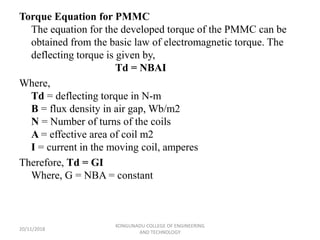
Td = NBAI
Where,
Td = deflecting torque in N-m
B = flux density in air gap, Wb/m2
N = Number of turns of the coils
A = effective area of coil m2
I = current in the moving coil, amperes
Therefore, Td = GI
Where, G = NBA = constant
20/11/2018
KONGUNADU COLLEGE OF ENGINEERING
AND TECHNOLOGY
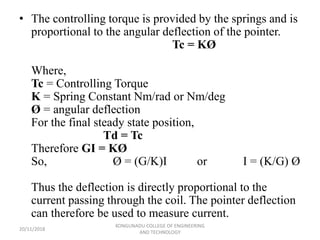
• The controlling torque is provided by the springs and is
proportional to the angular deflection of the pointer.
Tc = KØ
Where,
Tc = Controlling Torque
K = Spring Constant Nm/rad or Nm/deg
Ø = angular deflection
For the final steady state position,
Td = Tc
Therefore GI = KØ
So, Ø = (G/K)I or I = (K/G) Ø
Thus the deflection is directly proportional to the
current passing through the coil. The pointer deflection
can therefore be used to measure current.
20/11/2018
KONGUNADU COLLEGE OF ENGINEERING
AND TECHNOLOGY
Errors in PMMC Instruments
• The main sources of errors in moving coil instruments are due to
Weakening of permanent magnets due to ageing at temperature
effects.
• Weakening of springs due to ageing and temperature effects.
• Change of resistance of the moving coil with temperature.
Advantages and Disadvantages of PMMC Instruments
The main advantages of PMMC instruments are
• The scale is uniformly divided.
• The power consumption is very low
• The torque-weight ratio is high which gives a high accuracy. The
accuracy is of the order of generally 2 percent of full scale
deflection.
• A single instrument may be used for many different current and
voltage ranges by using different values for shunts and multipliers.
• Self-shielding magnets make the core magnet mechanism
particularly useful in aircraft and aerospace applications.
20/11/2018
KONGUNADU COLLEGE OF ENGINEERING
AND TECHNOLOGY
The disadvantages are
• These instruments are useful only for d.c. The
torque reverses if the current reverses. If the
instrument is connected to a.c., the pointer
cannot follow the rapid reversals and the
deflection corresponds to mean torque, which
is zero. Hence these instruments cannot be
used for a.c.
• The cost of these instruments is higher than
that of moving iron instruments.
20/11/2018
KONGUNADU COLLEGE OF ENGINEERING
AND TECHNOLOGY
Moving Iron Instruments
Classification of Moving Iron Instruments
Moving iron instruments are of two types
(i) Attraction type.
(ii) Repulsion type.
Attraction Type
20/11/2018
KONGUNADU COLLEGE OF ENGINEERING
AND TECHNOLOGY
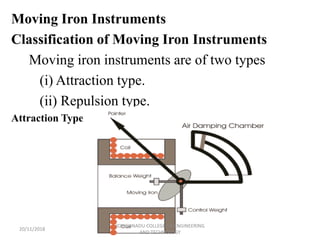
• The coil is flat and has a narrow slot like opening.
• The moving iron is a flat disc or a sector eccentrically
mounted.
• When the current flows through the coil, a magnetic
field is produced and the moving iron moves from the
weaker field outside the coil to the Stronger field inside
it or in other words the moving iron is attracted in.
• The controlling torque is provide by springs hut gravity
control can be used for panel type of instruments which
are vertically mounted.
• Damping is provided by air friction with the help of a
light aluminum piston (attached to the moving system)
which move in a fixed chamber closed at one end as
shown in Fig. or with the help of a vane (attached to the
moving system) which moves in a fixed sector shaped
chamber a shown.
20/11/2018
KONGUNADU COLLEGE OF ENGINEERING
AND TECHNOLOGY
Repulsion Type
• In the repulsion type, there are two vanes inside
the coil one fixed and other movable. These are
similarly magnetized when the current flows
through the coil and there is a force of repulsion
between the two vane s resulting in the movement
of the moving vane. Two different designs are in
common use
(I) Radial Vane Type
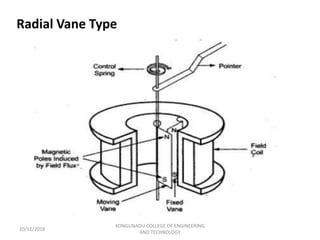
• In this type, the vanes are radial strips of iron.
• The strips are placed within the coil as shown in
Fig The fixed vane is attached to the coil and the
movable one to the spindle of the instrument.
20/11/2018
KONGUNADU COLLEGE OF ENGINEERING
AND TECHNOLOGY
Radial Vane Type
20/11/2018
KONGUNADU COLLEGE OF ENGINEERING
AND TECHNOLOGY
(ii) Co-axial Vane Type
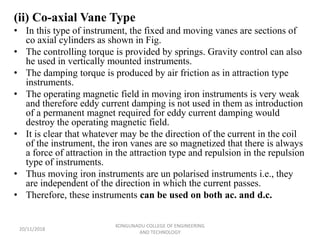
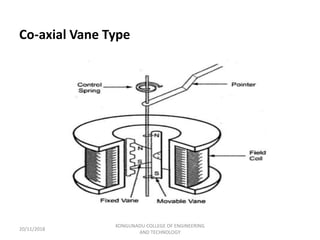
• In this type of instrument, the fixed and moving vanes are sections of
co axial cylinders as shown in Fig.
• The controlling torque is provided by springs. Gravity control can also
he used in vertically mounted instruments.
• The damping torque is produced by air friction as in attraction type
instruments.
• The operating magnetic field in moving iron instruments is very weak
and therefore eddy current damping is not used in them as introduction
of a permanent magnet required for eddy current damping would
destroy the operating magnetic field.
• It is clear that whatever may be the direction of the current in the coil
of the instrument, the iron vanes are so magnetized that there is always
a force of attraction in the attraction type and repulsion in the repulsion
type of instruments.
• Thus moving iron instruments are un polarised instruments i.e., they
are independent of the direction in which the current passes.
• Therefore, these instruments can be used on both ac. and d.c.
20/11/2018
KONGUNADU COLLEGE OF ENGINEERING
AND TECHNOLOGY
Co-axial Vane Type
20/11/2018
KONGUNADU COLLEGE OF ENGINEERING
AND TECHNOLOGY
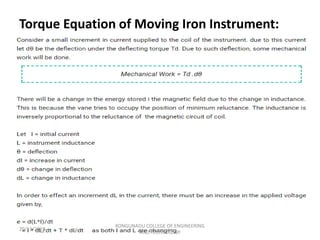
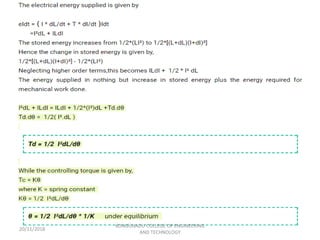
Torque Equation of Moving Iron Instrument:
20/11/2018
KONGUNADU COLLEGE OF ENGINEERING
AND TECHNOLOGY
20/11/2018
KONGUNADU COLLEGE OF ENGINEERING
AND TECHNOLOGY
20/11/2018
KONGUNADU COLLEGE OF ENGINEERING
AND TECHNOLOGY
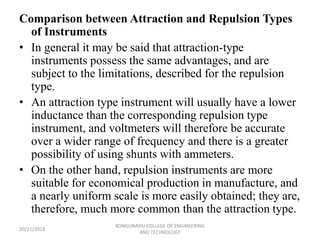
Comparison between Attraction and Repulsion Types
of Instruments
• In general it may be said that attraction-type
instruments possess the same advantages, and are
subject to the limitations, described for the repulsion
type.
• An attraction type instrument will usually have a lower
inductance than the corresponding repulsion type
instrument, and voltmeters will therefore be accurate
over a wider range of frequency and there is a greater
possibility of using shunts with ammeters.
• On the other hand, repulsion instruments are more
suitable for economical production in manufacture, and
a nearly uniform scale is more easily obtained; they are,
therefore, much more common than the attraction type.
20/11/2018
KONGUNADU COLLEGE OF ENGINEERING
AND TECHNOLOGY
Errors in Moving Iron Instruments
• There are two types of errors which occur in
moving iron instruments errors occur with both
a.c. and d.c. and the other which occur only
with ac. only.
Errors with both D.C. and A.C
• i) Hysteresis Error
• ii) Temperature error
• iii) Stray magnetic field
Errors with only A.C
• Frequency errors
20/11/2018
KONGUNADU COLLEGE OF ENGINEERING
AND TECHNOLOGY
Advantages
The various advantages of moving iron instruments are,
1) The instruments can be used for both a.c. and d.c.
measurements.
2)As the torque to weight ratio is high, errors due to the
friction are very less.
3) A single type of moving element can cover the wide
range hence these instruments are cheaper than other types
of if instruments.
4) There are no current carrying parts in the moving
system hence these meters are extremely rugged and
reliable.
5) These are capable of giving good accuracy. Modern
moving iron instruments have a d.c. error of 2% or less.
6) These can withstand large loads and are not damaged
even under sever overload conditions.
7) The range of instruments can be extended.
20/11/2018
KONGUNADU COLLEGE OF ENGINEERING
AND TECHNOLOGY
Disadvantages
The various disadvantages of moving iron instruments are,
1) The scale of moving iron instruments is not uniform and is
cramped at the lower end. Hence accurate readings are not possible
at this end.
2) There are serious errors due to hysteresis, frequency changes and
stray magnetic fields.
3) The increase in temperature increases the resistance of coil,
decreases stiffness of the springs, decreases the permeability and
hence affect the reading severely.
4) Due to the non linearity of B-H curve, the deflecting torque is not
exactly proportional to the square of the current.
5) There is a difference between a.c. and d.c. calibration on account
of the effect of inductance of the meter. Hence these meters must
always be calibrated at the frequency at which they are to be used.
The usual commercial moving iron instrument may be used within
its specified accuracy from 25 to 125 HZ frequency range.
6) Power consumption is on higher side.
20/11/2018
KONGUNADU COLLEGE OF ENGINEERING
AND TECHNOLOGY

Unit 2

  • 1.
    UNIT II ELECTRICAL ANDELECTRONICS INSTRUMENTS 20/11/2018 KONGUNADU COLLEGE OF ENGINEERING AND TECHNOLOGY
  • 2.
    Introduction • The Instrumentswhich are used for such a measurements are called measuring instruments. The necessary requirements of a measuring instrument are • (i) That its introduction into the circuit, where measurements are to be made, does not alter the circuit conditions ; • (ii) The power consumed by them for their operation is small. 20/11/2018 KONGUNADU COLLEGE OF ENGINEERING AND TECHNOLOGY
  • 3.
    Classification of measuringinstruments: • Indicating instruments • Recording instruments 20/11/2018 KONGUNADU COLLEGE OF ENGINEERING AND TECHNOLOGY
  • 4.
    • Integrating instruments 20/11/2018 KONGUNADUCOLLEGE OF ENGINEERING AND TECHNOLOGY
  • 5.
    Essential requirements ofindicating instrument: • An indicating instrument essentially consists of a moving system pivoted in jewel bearings. • A pointer is attached to the moving system which indicates the electrical quantity to be measured, on a graduated scale. • In order to ensure the proper operation of the indicating instruments , the following three torques are required. 1. deflecting system producing deflecting torque Td. 2. controlling system producing controlling torque Tc. 3. damping system producing damping torque 20/11/2018 KONGUNADU COLLEGE OF ENGINEERING AND TECHNOLOGY
  • 6.
    Deflecting torque: • Thedeflecting torque is produced by utilizing the various effects (magnetic effect, induction effect, thermal effect, hall effect) of electric current or voltage, and causes the moving system and hence the pointer to move from zero position. controlling torque: • The controlling torque is produced by spring or gravity and opposes the deflecting torque. The pointer comes to rest at a position, where these two opposing torques are equal. Damping torque: • Damping torque is provided by air friction or eddy currents. It ensures that, the pointer comes to the final position, without oscillations, thus enabling accurate and quick readings to be taken. 20/11/2018 KONGUNADU COLLEGE OF ENGINEERING AND TECHNOLOGY
  • 7.
    Deflecting system: • Inmost of the indicating instruments the mechanical force proportional to the quantity to be measured is generated. This force or torque deflects the pointer. The deflecting torque overcomes, 1) The inertia of the moving system 2) The controlling torque provided by controlling system. 3) The damping torque provided by damping system. The deflecting system uses on of the following effects produced by current or voltage, to produce deflecting torque. a) Magnetic effect b) Thermal effect c) Electrostatic effect d) Induction effect e) Hall effect 20/11/2018 KONGUNADU COLLEGE OF ENGINEERING AND TECHNOLOGY
  • 8.
    Controlling system: • Thecontrolling torque (Tc) opposes the deflecting torque and increases with the deflection of the moving system. The pointer comes to rest at a position where the two opposing torques are equal i.e. Td = Tc. The controlling torque performs two functions. • Controlling torque increases with the deflection of the moving system so that the final position of the pointer on the scale will be according to the magnitude of an electrical quantity (i.e. current or voltage or power) to be measured. • Controlling torque brings the pointer back to zero when the deflecting torque is removed. If it were not provided, the pointer once deflected would not return to zero position on removing the deflecting torque. The controlling torque in indicating instruments may be provided by one of the following two methods: • (i) Spring control. (ii) Gravity control. 20/11/2018 KONGUNADU COLLEGE OF ENGINEERING AND TECHNOLOGY
  • 9.
    Spring Control Method •This is the most common method of providing controlling torque, in electrical instruments. A spiral hairspring made of some non-magnetic material like phosphor bronze is attached to the moving system of the instrument as shown in the figure. 20/11/2018 KONGUNADU COLLEGE OF ENGINEERING AND TECHNOLOGY
  • 10.
    • Springs alsoserve the additional purpose of leading current to the moving system (i.e. operating coil). With that deflection of the pointer, the spring is twisted in the opposite direction. This twist in the spring provides the controlling torque. • Since the torsion torque of a spiral spring is proportional to the angle of twist, the controlling torque (Tc ) is directly proportional to the angle of deflection of pointer (θ) i.e. Tc α θ. • The pointer will come to rest at a position where controlling torque is equal to the deflecting torque i.e. Td =Tc. • In an instrument where the deflecting torque is uniform, spring control provides a uniform scale over the whole range. The balance weight is attached to counterbalance the weight of the pointer and other moving parts. 20/11/2018 KONGUNADU COLLEGE OF ENGINEERING AND TECHNOLOGY
  • 11.
    Gravity Control Method: 20/11/2018 KONGUNADUCOLLEGE OF ENGINEERING AND TECHNOLOGY
  • 12.
    • In thismethod, a small weight is attached to the moving system, which provides necessary controlling torque. In the zero position of the pointer, the control weight hangs vertically downward and therefore provides no controlling torque. • However, under the action of deflecting torque, the pointer moves from zero position and control weight moves in opposite direction. Due to gravity, the control weight would tend to come in original position (i.e. vertical) and thus provides an opposing or controlling torque. The pointer comes to rest at a position where controlling torque is equal to the deflecting torque. • In this method, controlling torque (Tc) is proportional to the sin of angle of deflection (θ) i.e. Tc α sin θ. • Because in this method controlling torque (Tc) is not directly proportional to the angle of deflection (θ) but it is proportional to sin θ therefore, gravity control instruments have non-uniform scales; being crowded in beginning. 20/11/2018 KONGUNADU COLLEGE OF ENGINEERING AND TECHNOLOGY
  • 13.
    Damping System: 20/11/2018 KONGUNADU COLLEGEOF ENGINEERING AND TECHNOLOGY
  • 14.
    The damping torquein indicating instruments can be provided by: • Air friction damping. • Fluid friction damping. • Eddy current damping. Air friction damping 20/11/2018 KONGUNADU COLLEGE OF ENGINEERING AND TECHNOLOGY
  • 15.
    Fluid Friction Damping: 20/11/2018 KONGUNADUCOLLEGE OF ENGINEERING AND TECHNOLOGY
  • 16.
    Eddy Current Damping 20/11/2018 KONGUNADUCOLLEGE OF ENGINEERING AND TECHNOLOGY
  • 17.
    Permanent Magnet MovingCoil Instrument (PMMC): • The permanent magnet moving coil instrument is the most accurate type for d.c. measurements. The working principle of these instruments is the same as that of the d’Arsonval type of galvanometers, the difference being that a direct reading instrument is provided with a pointer and a scale. Construction of PMMC Instruments • The constructional features of this instrument are shown in Fig. • The moving coil is wound with many turns of enameled or silk covered copper wire. • The coil is mounted on a rectangular aluminum former which is pivoted on jewelled bearings. • The coils move freely in the field of a permanent magnet. • Most voltmeter coils are wound on metal frames to provide the required electro-magnetic damping. • Most ammeter coils, however, are wound on non -magnetic formers, because coil turns are effectively shorted by the ammeter shunt. • The coil itself, therefore, provides electro magnetic damping. 20/11/2018 KONGUNADU COLLEGE OF ENGINEERING AND TECHNOLOGY
  • 18.
    20/11/2018 KONGUNADU COLLEGE OFENGINEERING AND TECHNOLOGY
  • 19.
    Magnet Systems • Oldstyle magnet system consisted of relatively long U shaped permanent magnets having soft iron pole pieces. • Owing to development of materials like Alcona and Alnico, which have a high co-ercive force, it is possible to use smaller magnet lengths and high field intensities. • The flux densities used in PMIMC instruments vary from 0.1 W b/m to 1Wb/m. Control • When the coil is supported between two jewel bearings the control torque is provided by two phosphor bronze hair springs. • These springs also serve to lead current in and out of the coil. The control torque is provided by the ribbon suspension as shown. • This method is comparatively new and is claimed to be advantageous as it eliminates bearing friction. 20/11/2018 KONGUNADU COLLEGE OF ENGINEERING AND TECHNOLOGY
  • 20.
    Damping • Damping torqueis produced by movement of the aluminum former moving in the magnetic field of the permanent magnet. Pointer and Scale • The pointer is carried by the spindle and moves over a graduated scale. • The pointer is of light-weight construction and, apart from those used in some inexpensive instruments has the section over the scale twisted to form a fine blade. • This helps to reduce parallax errors in the reading of the scale. When the coil is supported between two jewel bearings the control torque is provided by two phosphor bronze hair springs. • These springs also serve to lead current in and out of the coil. 20/11/2018 KONGUNADU COLLEGE OF ENGINEERING AND TECHNOLOGY
  • 21.
    Torque Equation forPMMC The equation for the developed torque of the PMMC can be obtained from the basic law of electromagnetic torque. The deflecting torque is given by, Td = NBAI Where, Td = deflecting torque in N-m B = flux density in air gap, Wb/m2 N = Number of turns of the coils A = effective area of coil m2 I = current in the moving coil, amperes Therefore, Td = GI Where, G = NBA = constant 20/11/2018 KONGUNADU COLLEGE OF ENGINEERING AND TECHNOLOGY
  • 22.
    • The controllingtorque is provided by the springs and is proportional to the angular deflection of the pointer. Tc = KØ Where, Tc = Controlling Torque K = Spring Constant Nm/rad or Nm/deg Ø = angular deflection For the final steady state position, Td = Tc Therefore GI = KØ So, Ø = (G/K)I or I = (K/G) Ø Thus the deflection is directly proportional to the current passing through the coil. The pointer deflection can therefore be used to measure current. 20/11/2018 KONGUNADU COLLEGE OF ENGINEERING AND TECHNOLOGY
  • 23.
    Errors in PMMCInstruments • The main sources of errors in moving coil instruments are due to Weakening of permanent magnets due to ageing at temperature effects. • Weakening of springs due to ageing and temperature effects. • Change of resistance of the moving coil with temperature. Advantages and Disadvantages of PMMC Instruments The main advantages of PMMC instruments are • The scale is uniformly divided. • The power consumption is very low • The torque-weight ratio is high which gives a high accuracy. The accuracy is of the order of generally 2 percent of full scale deflection. • A single instrument may be used for many different current and voltage ranges by using different values for shunts and multipliers. • Self-shielding magnets make the core magnet mechanism particularly useful in aircraft and aerospace applications. 20/11/2018 KONGUNADU COLLEGE OF ENGINEERING AND TECHNOLOGY
  • 24.
    The disadvantages are •These instruments are useful only for d.c. The torque reverses if the current reverses. If the instrument is connected to a.c., the pointer cannot follow the rapid reversals and the deflection corresponds to mean torque, which is zero. Hence these instruments cannot be used for a.c. • The cost of these instruments is higher than that of moving iron instruments. 20/11/2018 KONGUNADU COLLEGE OF ENGINEERING AND TECHNOLOGY
  • 25.
    Moving Iron Instruments Classificationof Moving Iron Instruments Moving iron instruments are of two types (i) Attraction type. (ii) Repulsion type. Attraction Type 20/11/2018 KONGUNADU COLLEGE OF ENGINEERING AND TECHNOLOGY
  • 26.
    • The coilis flat and has a narrow slot like opening. • The moving iron is a flat disc or a sector eccentrically mounted. • When the current flows through the coil, a magnetic field is produced and the moving iron moves from the weaker field outside the coil to the Stronger field inside it or in other words the moving iron is attracted in. • The controlling torque is provide by springs hut gravity control can be used for panel type of instruments which are vertically mounted. • Damping is provided by air friction with the help of a light aluminum piston (attached to the moving system) which move in a fixed chamber closed at one end as shown in Fig. or with the help of a vane (attached to the moving system) which moves in a fixed sector shaped chamber a shown. 20/11/2018 KONGUNADU COLLEGE OF ENGINEERING AND TECHNOLOGY
  • 27.
    Repulsion Type • Inthe repulsion type, there are two vanes inside the coil one fixed and other movable. These are similarly magnetized when the current flows through the coil and there is a force of repulsion between the two vane s resulting in the movement of the moving vane. Two different designs are in common use (I) Radial Vane Type • In this type, the vanes are radial strips of iron. • The strips are placed within the coil as shown in Fig The fixed vane is attached to the coil and the movable one to the spindle of the instrument. 20/11/2018 KONGUNADU COLLEGE OF ENGINEERING AND TECHNOLOGY
  • 28.
    Radial Vane Type 20/11/2018 KONGUNADUCOLLEGE OF ENGINEERING AND TECHNOLOGY
  • 29.
    (ii) Co-axial VaneType • In this type of instrument, the fixed and moving vanes are sections of co axial cylinders as shown in Fig. • The controlling torque is provided by springs. Gravity control can also he used in vertically mounted instruments. • The damping torque is produced by air friction as in attraction type instruments. • The operating magnetic field in moving iron instruments is very weak and therefore eddy current damping is not used in them as introduction of a permanent magnet required for eddy current damping would destroy the operating magnetic field. • It is clear that whatever may be the direction of the current in the coil of the instrument, the iron vanes are so magnetized that there is always a force of attraction in the attraction type and repulsion in the repulsion type of instruments. • Thus moving iron instruments are un polarised instruments i.e., they are independent of the direction in which the current passes. • Therefore, these instruments can be used on both ac. and d.c. 20/11/2018 KONGUNADU COLLEGE OF ENGINEERING AND TECHNOLOGY
  • 30.
    Co-axial Vane Type 20/11/2018 KONGUNADUCOLLEGE OF ENGINEERING AND TECHNOLOGY
  • 31.
    Torque Equation ofMoving Iron Instrument: 20/11/2018 KONGUNADU COLLEGE OF ENGINEERING AND TECHNOLOGY
  • 32.
    20/11/2018 KONGUNADU COLLEGE OFENGINEERING AND TECHNOLOGY
  • 33.
    20/11/2018 KONGUNADU COLLEGE OFENGINEERING AND TECHNOLOGY
  • 34.
    Comparison between Attractionand Repulsion Types of Instruments • In general it may be said that attraction-type instruments possess the same advantages, and are subject to the limitations, described for the repulsion type. • An attraction type instrument will usually have a lower inductance than the corresponding repulsion type instrument, and voltmeters will therefore be accurate over a wider range of frequency and there is a greater possibility of using shunts with ammeters. • On the other hand, repulsion instruments are more suitable for economical production in manufacture, and a nearly uniform scale is more easily obtained; they are, therefore, much more common than the attraction type. 20/11/2018 KONGUNADU COLLEGE OF ENGINEERING AND TECHNOLOGY
  • 35.
    Errors in MovingIron Instruments • There are two types of errors which occur in moving iron instruments errors occur with both a.c. and d.c. and the other which occur only with ac. only. Errors with both D.C. and A.C • i) Hysteresis Error • ii) Temperature error • iii) Stray magnetic field Errors with only A.C • Frequency errors 20/11/2018 KONGUNADU COLLEGE OF ENGINEERING AND TECHNOLOGY
  • 36.
    Advantages The various advantagesof moving iron instruments are, 1) The instruments can be used for both a.c. and d.c. measurements. 2)As the torque to weight ratio is high, errors due to the friction are very less. 3) A single type of moving element can cover the wide range hence these instruments are cheaper than other types of if instruments. 4) There are no current carrying parts in the moving system hence these meters are extremely rugged and reliable. 5) These are capable of giving good accuracy. Modern moving iron instruments have a d.c. error of 2% or less. 6) These can withstand large loads and are not damaged even under sever overload conditions. 7) The range of instruments can be extended. 20/11/2018 KONGUNADU COLLEGE OF ENGINEERING AND TECHNOLOGY
  • 37.
    Disadvantages The various disadvantagesof moving iron instruments are, 1) The scale of moving iron instruments is not uniform and is cramped at the lower end. Hence accurate readings are not possible at this end. 2) There are serious errors due to hysteresis, frequency changes and stray magnetic fields. 3) The increase in temperature increases the resistance of coil, decreases stiffness of the springs, decreases the permeability and hence affect the reading severely. 4) Due to the non linearity of B-H curve, the deflecting torque is not exactly proportional to the square of the current. 5) There is a difference between a.c. and d.c. calibration on account of the effect of inductance of the meter. Hence these meters must always be calibrated at the frequency at which they are to be used. The usual commercial moving iron instrument may be used within its specified accuracy from 25 to 125 HZ frequency range. 6) Power consumption is on higher side. 20/11/2018 KONGUNADU COLLEGE OF ENGINEERING AND TECHNOLOGY