SUBMITTED TO –
Mrs. UPAMA DAS
DEPARTMENT OF ELECTRICAL AND ELECTRONIC
ENGINEERING
SUBMITTED BY –
SUDHANSHU KHICHI
BT17EE006
ELECTRICAL AND ELECTRONIC ENGINEERING
IV YEAR (VII SEMESTER)
NATIONAL INSTITUTE OF TECHNOLOGY MIZORAM
Introduction
Types of Actuator
Principle
Construction
Working
Calibration
Advantages
Disadvantages
Reference
 Actuators are devices used to produce action or
motion.
 Input(mainly electrical signal , air, fluids)Electrical
signal can be low power or high power.
 Actuators output can be position or rate i.
e.linear displacement or velocity.
 Actuation can be from few microns to few meters
Hydraulic actuator
Pneumatic actuator
Mechanical actuator
Electrical actuator
 Linear actuator: solenoid, Hydraulic/Pneumatic.
 Rotary actuator: motor, Hydraulic/Pneumatic.
 A linear actuator is an actuator that creates
motion in a straight line, in contrast to the circular
motion of a conventional electric motor.
 Linear actuators are used in machine tools and
industrial machinery
 In computer peripherals such as disk drives and
printers, in valves and dampers, and in many
other places where linear motion is required.
 A rotary actuator is an actuator that produces
a rotary motion or torque.
 The simplest actuator is purely mechanical,
where linear motion in one direction gives rise
to rotation. The most common actuators are
electrically powered; others may be powered
pneumatically or hydraulically, or use energy
stored in springs.
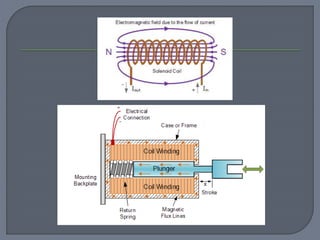
A solenoid is a coil wound into a tightly
packed helix.
In physics, the term solenoid refers to a
long, thin loop of wire, and wrapped
around a metallic core.
which produces a magnetic field when an
electric current is passed through it.
Pneumatic valve.
Car door openers.
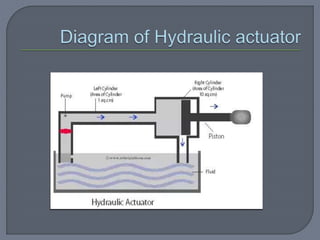
 Hydraulic systems are used to control & transmit
power.
 A pump driven by prime mover (electric motor)
creates flow of fluid
Linear actuator (hydraulic cylinder)
 Provides motion in straight line.
 Linear displacement depends on stroke length.
 Usually referred to as cylinders, rams (single
acting cylinders) or jacks.
Rotary actuators (Hydraulic motors)-
 Produces continuous rotational motion.
 Pump shaft is rotated to generate flow.
 A motor shaft is caused to rotate by fluid being
forced into the driving chambers.
 Hydraulic jack.
 Hydraulic brake.
 Hydraulic ram.
 Used as sensor.
Close loop velocity controlling.
Highly precise positioning for heavy loads.
 Advantage-Very high forces possible.
Relatively high power to size ratio (or power
density)
 Disadvantage-Can leak. Requires position
feedback for repeatability.
External hydraulic pump required.
Some designs good in compression only.
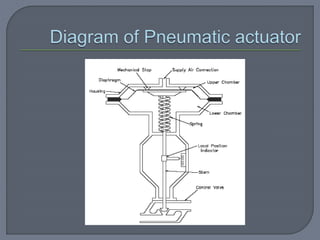
 A Pneumatic actuator mainly consists of a piston or
a diaphragm which develops the motive power. It
keeps the air in the upper portion of the cylinder,
allowing air pressure to force the diaphragm or
piston to move the valve stem or rotate the valve
control element
 It convert energy formed by compressed air at high
pressure into ether linear or rotary motion.
 Quickly respond in operation.
 simplicity of realization relatively to small back
and forth motions
 sophisticated transfer mechanisms are not requir
ed
 low cost
 high speed of moving
 ease at reversion movements
 tolerance to overloads, up to a full stop
 high reliability of work
 explosion and fire safety
 ecological purity
 ability to accumulation and transportation.
 compressibility of the air
 impossibility to receive uniform and constant
speed of the working bodies movement
 difficulties in performance at slow speed
 limited conditions – use of compressed air is
beneficial up to the definite values of pressure
 compressed air requires good preparation
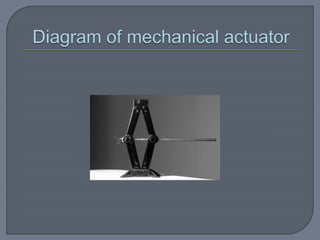
 Mechanical actuators convert a mechanical input
into linear or rotary motion. A common example
of a mechanical actuator is a screw jack. top
point of the jack, this mechanical rotational input
is converted into linear mechanical motion.
Screw
Wheel and axle
Cam
 Advantage- Cheap. Repeatable.
No power source required. Self-contained.
Identical behaviour extending or retracting.
 Disadvantage - Manual operation only. No
automation
 Electric actuators use electricity or electrical
energy to create motion. An electric motor is a
type of an electric actuator.
 electric motor is a transducer and actuator
because it converts electrical energy to magnetic
energy to mechanical energy or motion.
D.C. motor
A.C. motor
Stepper motor
 Pierre and Jacques Curie discovered the
piezoelectric effect in 1880.
 The application of an electric field to a
piezoelectric crystal leads to a physical
deformation of the crystal.
 Piezoelectric materials are: Quartz, Ceramics,
PZT(lead zirconate titanade).
short response time.
An ability to create high forces.
A high efficiency and a high mechanical
durability.
Have small strains. (0.1-.2%)
High supply voltage needed.(60-1000V)
Large hysteresis.(actuator doesn’t go back
to exactly where it started).
 A piezo ceramic crystal is coated with silver on
both sides
 Glued to a brass, nickel alloy, or stainless steel
disk.
 Brass: -Commercial & industrial use.(not
subjected to environment )
 Nickel alloy: -Use where it subjected to
environment.
 Stainless steel: -Uses where it subjected to
solvent, corrosive chemical, Underwater .
Medical fields.
 Heaters - used with temperature sensors And
temperature controller to control the temperature in
automated moulding Equipment and in soldering
operation.
 Lights - Lights are used on almost all machines to
indicate the machine state and provide feedback to the
operator.
 LED
 LCD’s
 Gas plasma display
 CRT
 Sirens/Horns - Sirens or horns can be useful for
unattended or dangerous machines to make conditions
well known.
THANK YOU

Actuator

  • 1.
    SUBMITTED TO – Mrs.UPAMA DAS DEPARTMENT OF ELECTRICAL AND ELECTRONIC ENGINEERING SUBMITTED BY – SUDHANSHU KHICHI BT17EE006 ELECTRICAL AND ELECTRONIC ENGINEERING IV YEAR (VII SEMESTER) NATIONAL INSTITUTE OF TECHNOLOGY MIZORAM
  • 3.
  • 4.
     Actuators aredevices used to produce action or motion.  Input(mainly electrical signal , air, fluids)Electrical signal can be low power or high power.  Actuators output can be position or rate i. e.linear displacement or velocity.  Actuation can be from few microns to few meters
  • 5.
  • 6.
     Linear actuator:solenoid, Hydraulic/Pneumatic.  Rotary actuator: motor, Hydraulic/Pneumatic.
  • 7.
     A linearactuator is an actuator that creates motion in a straight line, in contrast to the circular motion of a conventional electric motor.  Linear actuators are used in machine tools and industrial machinery  In computer peripherals such as disk drives and printers, in valves and dampers, and in many other places where linear motion is required.
  • 8.
     A rotaryactuator is an actuator that produces a rotary motion or torque.  The simplest actuator is purely mechanical, where linear motion in one direction gives rise to rotation. The most common actuators are electrically powered; others may be powered pneumatically or hydraulically, or use energy stored in springs.
  • 9.
    A solenoid isa coil wound into a tightly packed helix. In physics, the term solenoid refers to a long, thin loop of wire, and wrapped around a metallic core. which produces a magnetic field when an electric current is passed through it.
  • 11.
  • 12.
     Hydraulic systemsare used to control & transmit power.  A pump driven by prime mover (electric motor) creates flow of fluid
  • 14.
    Linear actuator (hydrauliccylinder)  Provides motion in straight line.  Linear displacement depends on stroke length.  Usually referred to as cylinders, rams (single acting cylinders) or jacks. Rotary actuators (Hydraulic motors)-  Produces continuous rotational motion.  Pump shaft is rotated to generate flow.  A motor shaft is caused to rotate by fluid being forced into the driving chambers.
  • 15.
     Hydraulic jack. Hydraulic brake.  Hydraulic ram.  Used as sensor. Close loop velocity controlling. Highly precise positioning for heavy loads.
  • 16.
     Advantage-Very highforces possible. Relatively high power to size ratio (or power density)  Disadvantage-Can leak. Requires position feedback for repeatability. External hydraulic pump required. Some designs good in compression only.
  • 17.
     A Pneumaticactuator mainly consists of a piston or a diaphragm which develops the motive power. It keeps the air in the upper portion of the cylinder, allowing air pressure to force the diaphragm or piston to move the valve stem or rotate the valve control element  It convert energy formed by compressed air at high pressure into ether linear or rotary motion.  Quickly respond in operation.
  • 19.
     simplicity ofrealization relatively to small back and forth motions  sophisticated transfer mechanisms are not requir ed  low cost  high speed of moving  ease at reversion movements  tolerance to overloads, up to a full stop  high reliability of work  explosion and fire safety  ecological purity  ability to accumulation and transportation.
  • 20.
     compressibility ofthe air  impossibility to receive uniform and constant speed of the working bodies movement  difficulties in performance at slow speed  limited conditions – use of compressed air is beneficial up to the definite values of pressure  compressed air requires good preparation
  • 21.
     Mechanical actuatorsconvert a mechanical input into linear or rotary motion. A common example of a mechanical actuator is a screw jack. top point of the jack, this mechanical rotational input is converted into linear mechanical motion.
  • 23.
  • 24.
     Advantage- Cheap.Repeatable. No power source required. Self-contained. Identical behaviour extending or retracting.  Disadvantage - Manual operation only. No automation
  • 25.
     Electric actuatorsuse electricity or electrical energy to create motion. An electric motor is a type of an electric actuator.  electric motor is a transducer and actuator because it converts electrical energy to magnetic energy to mechanical energy or motion.
  • 26.
  • 27.
     Pierre andJacques Curie discovered the piezoelectric effect in 1880.  The application of an electric field to a piezoelectric crystal leads to a physical deformation of the crystal.  Piezoelectric materials are: Quartz, Ceramics, PZT(lead zirconate titanade).
  • 28.
    short response time. Anability to create high forces. A high efficiency and a high mechanical durability.
  • 29.
    Have small strains.(0.1-.2%) High supply voltage needed.(60-1000V) Large hysteresis.(actuator doesn’t go back to exactly where it started).
  • 30.
     A piezoceramic crystal is coated with silver on both sides  Glued to a brass, nickel alloy, or stainless steel disk.  Brass: -Commercial & industrial use.(not subjected to environment )  Nickel alloy: -Use where it subjected to environment.  Stainless steel: -Uses where it subjected to solvent, corrosive chemical, Underwater . Medical fields.
  • 31.
     Heaters -used with temperature sensors And temperature controller to control the temperature in automated moulding Equipment and in soldering operation.  Lights - Lights are used on almost all machines to indicate the machine state and provide feedback to the operator.  LED  LCD’s  Gas plasma display  CRT  Sirens/Horns - Sirens or horns can be useful for unattended or dangerous machines to make conditions well known.
  • 32.