Citizenship in the Digital AgeJeff Suzik, ChrissyLaycob, Patrick WoessnerMary Institute & St. Louis Country Day School2/8/20101
2Teens, Technology & Us(we’ve been here before…)Millennials “…have grown up mastering rapidly changing technology and constant multitasking.  For them, a world without cell phones or Internet access is unimaginable.  With family and friends only a few buttons or keystrokes away, telephoning or emailing—if only to discuss something as mundane as the weather—is such an ingrained habit, it’s almost second nature.”
3Howe and Strauss, Millennials Rising:“For those parents who, as children, spent whole weekends away from home, the thought of not knowing what their nine-year-old is doing for eight hours at a stretch is unfathomable today.”Neil Howe and William Strauss, quoted by Bridget Booher, “Helicopter Parents.”  Duke Magazine online, January-February 2007.  http://www.dukemagazine.duke.edu/cgi-bin/printout.pl?date=010207&article=parents(accessed January 3, 2008).
4Generational Fears/Concerns about YouthAre not new!Late-19th-century industrialization and urbanization led to a new pattern for relations between “teens” and their parentsEmergence of the comprehensive public high school in the early 20th centuryThe long-term effects of the G.I. Bill and Post-World War II affluence on teen/adult relationsInvention of the “Teen-ager”Development of a broad-based “youth culture”
5Since the turn-of-the-twentieth century, then—and lasting right up until today—generation after generation of young people and adults have increasingly come into conflict, and it probably is not going to change anytime soon!
6Example #1: What was it??It “encourages isolation and splitting”of families, and “puts children on a narrowly defined developmental path, and contributes little to social skills.”It is “corrupting our youth”and “is not wholesome”.It “mesmerizes our children…teaches gambling and breeds aggressive behavior.”
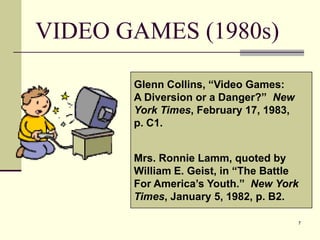
7VIDEO GAMES (1980s)Glenn Collins, “Video Games:A Diversion or a Danger?”  NewYork Times, February 17, 1983,p. C1.Mrs. Ronnie Lamm, quoted by William E. Geist, in “The BattleFor America’s Youth.”  New YorkTimes, January 5, 1982, p. B2.
8Example #2: What was it??	It “exerts a harmful influence…upon the public mind and morals, and particularly upon the minds of youth and children.”and it has “steeped the youth of our country in filth and degradation.”
9MOVIES (1930s)Central Conference of AmericanRabbis, quoted in “RabbisDenounce ‘Harmful’ Movies.”New York Times, June 19, 1934,p. 24.Reverend Dr. S. Parkes Cadman,quoted in “Cadman at DrexelDenounces Movies.”  New YorkTimes, June 19, 1934, p. 15.
10Example #3: What was it??It “may well be…an insidious force that causes children to be more aggressive, fearful, materialistic and callous, while at the same time makes them more passive, less robust and damages their educational potential.”
11TELEVISION (1970s)Richard Flaste, “Screening TVFor Uncritical Young Eyes.”  New York Times, March 11, 1977, p. 31.
12Example #4: What was it??is “a communicable disease”is “cannibalistic and tribalistic”and just “another form of adolescent rebellion.”
13ROCK-N-ROLL (1950s)“Rock-and-Roll called ‘Communicable Disease’.”  New York Times, March 28, 1956, p. 33.
14What do all of these examples have in common?Young people embracing new forms of technology/activity that adults do not understand or know about (early adopters)New technologies/activities involving thematic content with which adults are uncomfortableThrough these new technologies/activities, young people form “community” and speak a “language” that is theirs & theirs aloneAdults feel confused and left out of the picture, begin to worry and/or get angry about their loss of influence over “kids today”
15SOUND FAMILIAR???
16Millennials & Technology TodayLike previous generations of 20th and early-21st century teens, Millennials embrace technological innovations and use technology far more readily than their parents and other adultsHowever, having been born after 1990, Millennials have never really had to adapt to technologies of various types—technology has been a part of their world & their culture for their entire lives
17Millennials	Gen.X/Boomers55% have a socialnetworking page28% write blogs27% have produced web pages64% of teens 12-17 Have some personal online content20% have a social networking page 8% write blogs14% have produced web pagesPew Internet & American Life Project, cited by Rhonda Bodfield Bloom, “Grown-UpsHave Long Way to Go to Rival Teens’ Technology Grasp.”  Arizona Daily Star online,January 3, 2008.  http://www.azstarnet.com/business/218901 (accessed January 3, 2008).
18Why does this concern us?SafetyProprietyCivilityUncomfortability with the “unknown” & the “unmonitorable”
Parent Education
It IS a parent’s Responsibility!Don’t expect that children and teens will “make good choices”Get involved as much as possibleSet the standards immediately and when your children are young.Don’t leave the parenting to monitoring software
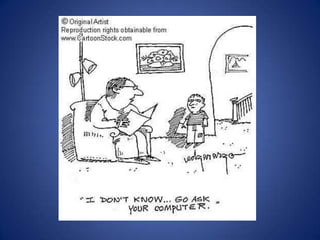
How much do parents know?93% of parents felt they knew what their children were doing on the internet.41% of students grades 5-12 said they do NOT share information with their parents about what they are doing online.	(I-Safe, 2005-2006)
Moral DevelopmentAdolescence is the time to develop moral identityMoral Development closely tied to brain developmentMoral IdentityPersonal, internalized values about what is safe and unsafe, right vs. wrongOnline World = Lack of inhibitionDo things online you would never do in personYou can’t see me, I can’t see youNeed to develop standards and values for safe and responsible online choices
Developing Moral Compass OnlineFocus on values and standards you have established – do you talk openly about them?Shift away from rules and threats to emphasis on values and standards.What happens when values and standards are violated – can cause harm to self or others.Help child understand how actions can cause harm even if you don’t see person.
Online Moral Development (Cont.)Discuss pitfalls of making decisions when emotionalChallenge unhealthy values and standards in the media Teach ethical decision-making guidelinesIs it kind and respectful to others?How would I feel if someone did this to me?What would a trusted adult think if they saw this?Would I do this in the real world, face to face?
Tips for Parents
How can Parents monitor their kids online?Start as early as possibleMake it an enjoyable experienceAsk questionsFind out who they are talking to and what are they posting onlineBe positive about the good choices they makeThe goal is to have your child regularly invite you into their online world.
What about privacy?There is no such thing as privacy online!Yes, even with privacy features. All their activities should be under your open and direct supervision.Your children should be able to earn the right to greater privacy as they get older.
Establishing a Digital Citizenship Program
A Comparison of FrameworksFramework Comparison Matrix
A Closer Look: Digital Citizenship in Schools
Digital Citizenship: Ribble and BaileyDigital citizenship can be described as the norms of appropriate, responsible behavior with regard to technology use.In their book Digital Citizenship in Schools, Gerald Bailey and Mike Ribble identify nine elements of digital citizenship that can be grouped into three broad categories:Student Learning and Academic PerformanceDigital Access: full electronic participation in societyDigital Literacy: the process of teaching and learning about technology and the use of technologyDigital Communication: electronic exchange of information
School Environment and Student BehaviorDigital Security and Safety: electronic precautions to guarantee safety/physical well-being in a digital technology worldDigital Etiquette: electronic standards of conduct or procedureDigital Rights and Responsibilities: those freedoms extended to everyone in a digital world
Student Life Outside the School EnvironmentDigital Commerce: electronic buying and selling of goodsDigital Health and Wellness: physical and psychological well-beingDigital Law: rights and restrictions
A Closer Look: Protecting Students in the 21st Century
Simple K12’s PS21 ProgramOnline, web-basedComprehensive: Offers components for students, teachers, and parents Addresses all topics required by law Covers the latest technologies and 21st century concerns facing our teensPS21 Overview
The MICDS FrameworkAUPEthnicsCyber SafetyCyber SecurityCyber-bullyingCopyright and Fair UseElectronic CommunicationSocial Networking  and ORMGrades 5-8MICDS Framework with Activities
Program Resources
Lessons LearnedUtilize a variety of instructional strategies; a standard format is simple but not always effective Need to weigh benefits/drawbacks of large vs. small group setting; consistency or intimacyScope, sequence, and timeframe; how much, how deep, and how often
Questions or Comments?Session Wiki with Additional InformationJeff Suzik: jsuzik@micds.orgChrissyLaycob: claycob@micds.orgPatrick Woessner: pwoessner@micds.org
Citizenship Digital Age

Citizenship Digital Age

  • 1.
    Citizenship in theDigital AgeJeff Suzik, ChrissyLaycob, Patrick WoessnerMary Institute & St. Louis Country Day School2/8/20101
  • 2.
    2Teens, Technology &Us(we’ve been here before…)Millennials “…have grown up mastering rapidly changing technology and constant multitasking. For them, a world without cell phones or Internet access is unimaginable. With family and friends only a few buttons or keystrokes away, telephoning or emailing—if only to discuss something as mundane as the weather—is such an ingrained habit, it’s almost second nature.”
  • 3.
    3Howe and Strauss,Millennials Rising:“For those parents who, as children, spent whole weekends away from home, the thought of not knowing what their nine-year-old is doing for eight hours at a stretch is unfathomable today.”Neil Howe and William Strauss, quoted by Bridget Booher, “Helicopter Parents.” Duke Magazine online, January-February 2007. http://www.dukemagazine.duke.edu/cgi-bin/printout.pl?date=010207&article=parents(accessed January 3, 2008).
  • 4.
    4Generational Fears/Concerns aboutYouthAre not new!Late-19th-century industrialization and urbanization led to a new pattern for relations between “teens” and their parentsEmergence of the comprehensive public high school in the early 20th centuryThe long-term effects of the G.I. Bill and Post-World War II affluence on teen/adult relationsInvention of the “Teen-ager”Development of a broad-based “youth culture”
  • 5.
    5Since the turn-of-the-twentiethcentury, then—and lasting right up until today—generation after generation of young people and adults have increasingly come into conflict, and it probably is not going to change anytime soon!
  • 6.
    6Example #1: Whatwas it??It “encourages isolation and splitting”of families, and “puts children on a narrowly defined developmental path, and contributes little to social skills.”It is “corrupting our youth”and “is not wholesome”.It “mesmerizes our children…teaches gambling and breeds aggressive behavior.”
  • 7.
    7VIDEO GAMES (1980s)GlennCollins, “Video Games:A Diversion or a Danger?” NewYork Times, February 17, 1983,p. C1.Mrs. Ronnie Lamm, quoted by William E. Geist, in “The BattleFor America’s Youth.” New YorkTimes, January 5, 1982, p. B2.
  • 8.
    8Example #2: Whatwas it?? It “exerts a harmful influence…upon the public mind and morals, and particularly upon the minds of youth and children.”and it has “steeped the youth of our country in filth and degradation.”
  • 9.
    9MOVIES (1930s)Central Conferenceof AmericanRabbis, quoted in “RabbisDenounce ‘Harmful’ Movies.”New York Times, June 19, 1934,p. 24.Reverend Dr. S. Parkes Cadman,quoted in “Cadman at DrexelDenounces Movies.” New YorkTimes, June 19, 1934, p. 15.
  • 10.
    10Example #3: Whatwas it??It “may well be…an insidious force that causes children to be more aggressive, fearful, materialistic and callous, while at the same time makes them more passive, less robust and damages their educational potential.”
  • 11.
    11TELEVISION (1970s)Richard Flaste,“Screening TVFor Uncritical Young Eyes.” New York Times, March 11, 1977, p. 31.
  • 12.
    12Example #4: Whatwas it??is “a communicable disease”is “cannibalistic and tribalistic”and just “another form of adolescent rebellion.”
  • 13.
    13ROCK-N-ROLL (1950s)“Rock-and-Roll called‘Communicable Disease’.” New York Times, March 28, 1956, p. 33.
  • 14.
    14What do allof these examples have in common?Young people embracing new forms of technology/activity that adults do not understand or know about (early adopters)New technologies/activities involving thematic content with which adults are uncomfortableThrough these new technologies/activities, young people form “community” and speak a “language” that is theirs & theirs aloneAdults feel confused and left out of the picture, begin to worry and/or get angry about their loss of influence over “kids today”
  • 15.
  • 16.
    16Millennials & TechnologyTodayLike previous generations of 20th and early-21st century teens, Millennials embrace technological innovations and use technology far more readily than their parents and other adultsHowever, having been born after 1990, Millennials have never really had to adapt to technologies of various types—technology has been a part of their world & their culture for their entire lives
  • 17.
    17Millennials Gen.X/Boomers55% have asocialnetworking page28% write blogs27% have produced web pages64% of teens 12-17 Have some personal online content20% have a social networking page 8% write blogs14% have produced web pagesPew Internet & American Life Project, cited by Rhonda Bodfield Bloom, “Grown-UpsHave Long Way to Go to Rival Teens’ Technology Grasp.” Arizona Daily Star online,January 3, 2008. http://www.azstarnet.com/business/218901 (accessed January 3, 2008).
  • 18.
    18Why does thisconcern us?SafetyProprietyCivilityUncomfortability with the “unknown” & the “unmonitorable”
  • 19.
  • 21.
    It IS aparent’s Responsibility!Don’t expect that children and teens will “make good choices”Get involved as much as possibleSet the standards immediately and when your children are young.Don’t leave the parenting to monitoring software
  • 22.
    How much doparents know?93% of parents felt they knew what their children were doing on the internet.41% of students grades 5-12 said they do NOT share information with their parents about what they are doing online. (I-Safe, 2005-2006)
  • 23.
    Moral DevelopmentAdolescence isthe time to develop moral identityMoral Development closely tied to brain developmentMoral IdentityPersonal, internalized values about what is safe and unsafe, right vs. wrongOnline World = Lack of inhibitionDo things online you would never do in personYou can’t see me, I can’t see youNeed to develop standards and values for safe and responsible online choices
  • 24.
    Developing Moral CompassOnlineFocus on values and standards you have established – do you talk openly about them?Shift away from rules and threats to emphasis on values and standards.What happens when values and standards are violated – can cause harm to self or others.Help child understand how actions can cause harm even if you don’t see person.
  • 25.
    Online Moral Development(Cont.)Discuss pitfalls of making decisions when emotionalChallenge unhealthy values and standards in the media Teach ethical decision-making guidelinesIs it kind and respectful to others?How would I feel if someone did this to me?What would a trusted adult think if they saw this?Would I do this in the real world, face to face?
  • 26.
  • 27.
    How can Parentsmonitor their kids online?Start as early as possibleMake it an enjoyable experienceAsk questionsFind out who they are talking to and what are they posting onlineBe positive about the good choices they makeThe goal is to have your child regularly invite you into their online world.
  • 28.
    What about privacy?Thereis no such thing as privacy online!Yes, even with privacy features. All their activities should be under your open and direct supervision.Your children should be able to earn the right to greater privacy as they get older.
  • 29.
    Establishing a DigitalCitizenship Program
  • 30.
    A Comparison ofFrameworksFramework Comparison Matrix
  • 31.
    A Closer Look:Digital Citizenship in Schools
  • 32.
    Digital Citizenship: Ribbleand BaileyDigital citizenship can be described as the norms of appropriate, responsible behavior with regard to technology use.In their book Digital Citizenship in Schools, Gerald Bailey and Mike Ribble identify nine elements of digital citizenship that can be grouped into three broad categories:Student Learning and Academic PerformanceDigital Access: full electronic participation in societyDigital Literacy: the process of teaching and learning about technology and the use of technologyDigital Communication: electronic exchange of information
  • 33.
    School Environment andStudent BehaviorDigital Security and Safety: electronic precautions to guarantee safety/physical well-being in a digital technology worldDigital Etiquette: electronic standards of conduct or procedureDigital Rights and Responsibilities: those freedoms extended to everyone in a digital world
  • 34.
    Student Life Outsidethe School EnvironmentDigital Commerce: electronic buying and selling of goodsDigital Health and Wellness: physical and psychological well-beingDigital Law: rights and restrictions
  • 35.
    A Closer Look:Protecting Students in the 21st Century
  • 36.
    Simple K12’s PS21ProgramOnline, web-basedComprehensive: Offers components for students, teachers, and parents Addresses all topics required by law Covers the latest technologies and 21st century concerns facing our teensPS21 Overview
  • 37.
    The MICDS FrameworkAUPEthnicsCyberSafetyCyber SecurityCyber-bullyingCopyright and Fair UseElectronic CommunicationSocial Networking and ORMGrades 5-8MICDS Framework with Activities
  • 38.
  • 39.
    Lessons LearnedUtilize avariety of instructional strategies; a standard format is simple but not always effective Need to weigh benefits/drawbacks of large vs. small group setting; consistency or intimacyScope, sequence, and timeframe; how much, how deep, and how often
  • 40.
    Questions or Comments?SessionWiki with Additional InformationJeff Suzik: jsuzik@micds.orgChrissyLaycob: claycob@micds.orgPatrick Woessner: pwoessner@micds.org

Editor's Notes

  • #31 Popular models/frameworks for Digital Citizenship:NETS for StudentsRibble and BaileyC3 Matricx from iSafeMicrosoft’s DC and Creative ContentSimple K12 PS21 Program
  • #33 There a many models for articulatingdigital citizenship; Bailey and Ribble’s is one of the more established frameworksCitizenship applies to all grade levels/disciplines; every teacher must bear responsibility for making responsible behavior part of their classroom experience
  • #34 Student learning and academic performance are the reasons we provide students with access to technology1. Digital Access: skype, twitter del.icio.us, blogger2. Digital Literacy: Using technology wisely  - understanding where to get information, how to evaluate it for authority and usefulness to the task; e.g. Creative Commons, Google, website eval.3. Digital Communication: Web 2.0 is the participatory web, you and the students can contribute the information, conversation, ideas that make up the wwwe.g. wikipedia, blogger
  • #35 This category typically receives the most attention in schools b/c we focus on behavior and not learning outcomesNo shortage of hype and bad data regarding these elements4. Digital Security and Safety: electronic precautions to guarantee safety/physical well-being in a digital technology worldtopics: myspace / facebook safety, cyberbullying, sextingcyberstalking, password securityAlso about how to keep your machine safe from viruses, worms, spam etc5. Digital Etiquette: electronic standards of conduct or proceduretext message bullying, how to consider audience when blogging for the outside world,6. Digital Rights and Responsibilities: those freedoms extended to everyone in a digital worldcopyright, plagiarism, finding cc images, how to cite, citation generating sites (citations machine, easybib 
  • #36 7. Digital Commerce: electronic buying and selling of goodspassword security, how to tell if a website is secure, pfishingschmes 8. Digital Health and Wellness: physical and psychological well-beingErgonomics, screen timeArticle of CyberSafety tips by age 9. Digital Law: rights and restrictions All of these topics are important but often only digital law is addressed in many schools 
  • #37 The nine themes of digital citizenship are broad and require more specific implementation strategies to live in the academic program. The PS21 program from SimpleK12 includes interactive lessons on all major digital citizenship topicds.
  • #38 Is subscription based and we are doing a four month pilot.
  • #40 The eight themes/topics are derived from the major frameworks we explored and are adapted to meet the needs of our school community. The are supported by specific activities at each grade level; the goal is a spiraled scope-sequence.
  • #41 In addition to drawing from activities developed by PS21 and iSafe, we utilized a number of additional (and free) resources