Digital Citizenship
By Mann Rentoy
Raising Children of
Character in a
Wired World
www.mannrentoy.com
“For the first
time we are
preparing
students for a
future we
cannot clearly
describe.”
- David Warlick
SteveWheeler,UniversityofPlymouth,2011
The 21st Century isn’t “coming”
– it’s here.
http://www.flickr.com/photos/20884341@N00/302931951
Teachers will not be replaced by
technology, but teachers who
don’t use technology will be
replaced by those who do.
-Sheryl Nussbaum-Beach
LOGO
Pageantry of
Vanity
SELFIE
use of the word increased by 17,000%
in 1 year
SELFIE
Google Search will reap more than
230 million hits
SELFIE
Oxford Dictionary word of the year in 2014
Borba’s 4 Reasons We
Should Be Concerned
1
Measurable dip in empathy
among today’s youth
Rise in narcissism among college students
Teens now 40% lower in empathy level
58% increase in narcissism
“Empathy: College Students Don’t Have as Much as They Used to”, Science Daily,
May 29, 2010
2
Clear increase in peer
cruelty
Bullying increased by 52% in just four
years (2003 to 2007)
Bullying now starts in children as young as
three
Cyberbullying tripled within a single year in
2014
“Is There Bullying Epidemic”, E-PAS2011. May 1, 2011 & “Bullying Behavior
Starting in Children as Young as Three”, Herald Sun, August 5, 2014
3
More cheating and weaker
moral reasoning in young
people
Sharp Decline in Morals in the last two
decades
Large majority of college students say
cheating is necessary to get ahead
70% admit to cheating
publicagenda.org, Press Release of June 26, 1997
4
Mental Health Epidemic
among the young
1 in 5 US youth meets the criteria for a
mental disorder in their lifetime
Teen stress is now at higher levels
As anxiety increases, empathy wanes
Prevalence of Mental Disorders in US Adolescents, Journal of the American
Academy of Child & Adolescent Psychiatry, October 2010
The M
Generation
“digital natives”
coined and popularized by education
consultant Marc Prensky (2001 article
Digital Natives, Digital Immigrants)
“the contemporary decline in American
education is related to the educators'
failure to understand the needs of modern
students”
We have rules regarding use of TV:
YES 32
NO 21
We have rules regarding use of the
Internet:
YES 42
NO 23
We have rules regarding use of the
Video Games:
YES 42
NO 37
Historically...
Pernicious
Environment
Insidious
Clandestine
Assault on Today’s Children
Video
GamesYour
student
Violence
in Media
PornographyMaterialism
Hedonism
Assault on Today’s Children
Religious Indifference
False
Heroes
Softness
Divorce Alcoholism
Moral
Relativism
Drug
Addiction
The TRUTH About
Today’s Digital Natives
Sense of
Entitlement
www.themegallery.co Company Logo
No Concept of Sharing
www.themegallery.co Company Logo
The average eight- to eighteen-year-old
plugged in to a digital media
device about 7 hours and 38
minutes a day
(that doesn’t count time spent texting or
talking on cell phones).
Almost 75 percent of children aged
eight and younger have access to
some type of “smart” mobile device
at home.
Preschoolers spend 4.6 hours per day
using screen media, and almost
40 percent of two- to four-year-olds use
a smartphone, MP3 player, or tablet.
A new study found that 30 percent of
children first play with mobile devices when
they’re in diapers.
A survey by the Center for the Digital Future
found that the percentage of parents who
say they now spend less time
socializing as a family tripledin just two
years.
Parents also say that the loss
of family time is largely due to
the increase of internet time.
I Own the following items:
Cellphone: 42
Laptop/PC: 9
Game Boy: 12
Xbox: 32
Wii: 24
PSP: 28
In the past month, I visited a
pornographic site:
NO
YES
70
6
I consider myself addicted to internet use:
NO
YES
35
41
Understand.
Be patient.
Totally Different Generation
LOGO
Now more than ever,
this work of formation is
urgent and important.
Hapag Usapan
•Let the kids play
Positive Side
 Accessing information, writing stories and
research papers
 Learning programs to teach or reinforce skills in
math, language, reading and other subjects
 Softwares that allow children to draw pictures,
create visual works of art and self-expression
Positive Side
 Quicktrax and DJ Megamix to create original
soundtracks
 Communication and networking: email, Facebook,
Twitter, Instagram, etc.
 Writing and expression of oneself through
blogging
McCann Erickson Youth Studies
... and the McCann Erickson Inter-
generation Study... tell us that the
16.5 million Filipino “youth” below
the age of 21 are “technocentric”:
spending an inordinate amount of
time in front of either the computer
monitor or the TV set, surfing the
Internet, text messaging or playing
computer and video games.
↑ Information
but
↓ Knowledge
“60% of all
Internet pages
contain
misleading
information.”
- Thomas Edison
Learners need digital wisdom
SteveWheeler,PlymouthUniversity,2011
Email Website creation
Podcasts Blogs
Wikis Chat rooms
VOIP—and Skype Social networks
Online games YouTube
Online music
Multifunctional mobile phones
digital cameras electronic calculators
data projectors Printers and scanners
digital ‘video’ portable digital storage
computer games
interactive multimedia teaching resources
Skype
Viber
FaceTime
FaceBook Phone
WeChat
we think
digital citizenship
Principle
Take control.
Principle
Internet addiction is
damaging.
Can they put
down their
phones or
tablets when
asked to do so?
Can they focus on
a conversation
without having to
check their gadget
every few
minutes?
Can they handle
the peer
pressure related
to owning the
latest gadgets?
Can they share
devices with
their siblings?
Do they have a
balanced set of
interests?
It’s interest, not age.
http://www.flickr.com/photos/lyza/276990225/sizes/o/
Why we should
Did You Know 3.0
Why do students need us in the age of
http://www.flickr.com/photos/manfrys/2226178289/sizes/l/
Give students tools to succeed in life
http://www.flickr.com/photos/julielindsay/3241222078/sizes/l/
Give students tools to make good decisions
http://www.flickr.com/photos/dominik99/1403329318/sizes/o/
Expand our student’s view of the world
http://www.flickr.com/photos/julielindsay/3241736396/sizes/l/
Prepare students for college
Prepare students for jobs
http://www.flickr.com/photos/roadtripmemories/517066135/sizes/o/
Need another reason?
http://www.flickr.com/photos/obliterated/3189753315/sizes/l/
Partnership for 21st Century Skills
DON’T GET STUCK IN THE PRESENT
Life & Career Skills
Digital Footprint
http://www.flickr.com/photos/stevedave/3250080709/sizes/o/
Netetiquette
http://www.flickr.com/photos/escapethematrix/2149921039/sizes/o/
Critical
Thinking
http://en.wikipedia.org/wiki/File:The_Thinker_close.jpg
Communication & Collaboration
http://www.flickr.com/photos/julielindsay/3049218069/sizes/l/in/set-72157609661303135/
Information, Media & Technology Skills
http://www.flickr.com/photos/25211216@N00/258331658
Copyright
Ethics
http://www.flickr.com/photos/51035555243@N01/21151707
If it’s on the Internet, it must be real
http://en.wikipedia.org/wiki/File:Internet_dog.jpg
Integration
http://www.flickr.com/photos/13763932@N04/1401862296/sizes/o/
How do I get the tools I need?
http://www.flickr.com/photos/36045027@N00/2054989998
Start Small, but Dream Big
http://www.flickr.com/photos/73645804@N00/2222523486
21st Century Skills are all about
teaching our kids to navigate the
world as THEY are experiencing it,
not the world WE experienced.
-Wil Richardson
Kohlberg’s
Six Levels
of
Moral
Development
Level I
I don’t want
to get into trouble.
Level 2
I want a reward.
Level 3
I want
to please somebody.
Level 4
I follow the rules.
Level 5
I am considerate
of other people.
Level 6
I have a personal
code of behavior and
I follow it.
Level 1: I don’t want to get in trouble.
Level 2: I want a reward.
Level 3: I want to please somebody.
Level 4: I follow the rules.
Level 5: I am considerate of other people.
Level 6: I have a personal code of behavior and I follow
it.
"The presents that we live in,
are the futures that our pasts
have imagined."
"Let us hope that the
technologies of the future will
also be designed to protect that
which is sacred, and that which
is important in our own
understanding of being human."
Nishant Shah, Director at the Centre for Internet and Society in India
Absolute Surprise
info@mannrentoy.com
0908-864-84-91
www.mannrentoy.com
Digital Citizenship
By Mann Rentoy
PROGRAM OVERVIEW
140
Students in schools of character feel safe, respected, and connected to
those around them, allowing them to thrive academically and socially
and be motivated to give back to their communities.
141
Positive results:
• Academics
• Behavior
• Culture/climate
OUR GOAL:
To bring these dramatic improvements to as many schools
as possible.
CEP’s National Schools of Character program offers K-12 public
and private schools across the Philippines a path to school
improvement and excellence through high-quality character
education.
When schools engage in the schools of character process and
seek to implement CEP’s framework for success (11
Principles), they:
 Bring stakeholders together
to identify a common set of
core values and unite around a
common purpose
142
CEP’s National Schools of Character program offers K-12 public
and private schools across the Philippines a path to school
improvement and excellence through high-quality character
education.
When schools engage in the schools of character process and
seek to implement CEP’s framework for success (11
Principles), they:
 Go through a process of
reflection and self-
assessment that helps the
school community identify
143
CEP’s National Schools of Character program offers K-12 public
and private schools across the Philippines a path to school
improvement and excellence through high-quality character
education.
When schools engage in the schools of character process and
seek to implement CEP’s framework for success (11
Principles), they:
 Receive professional
feedback on their programs as
well as suggestions for growth
144
145
The ‘C’ Word
Character Education is a heart issue.
It is not a policy or a program but an internal,
personal heart issue that reflects
how we believe we
ought to act.
11 Principles
These principles are also not a policy or program, but a
guide to help focus on the things that matter when trying
to alter a school’s culture.
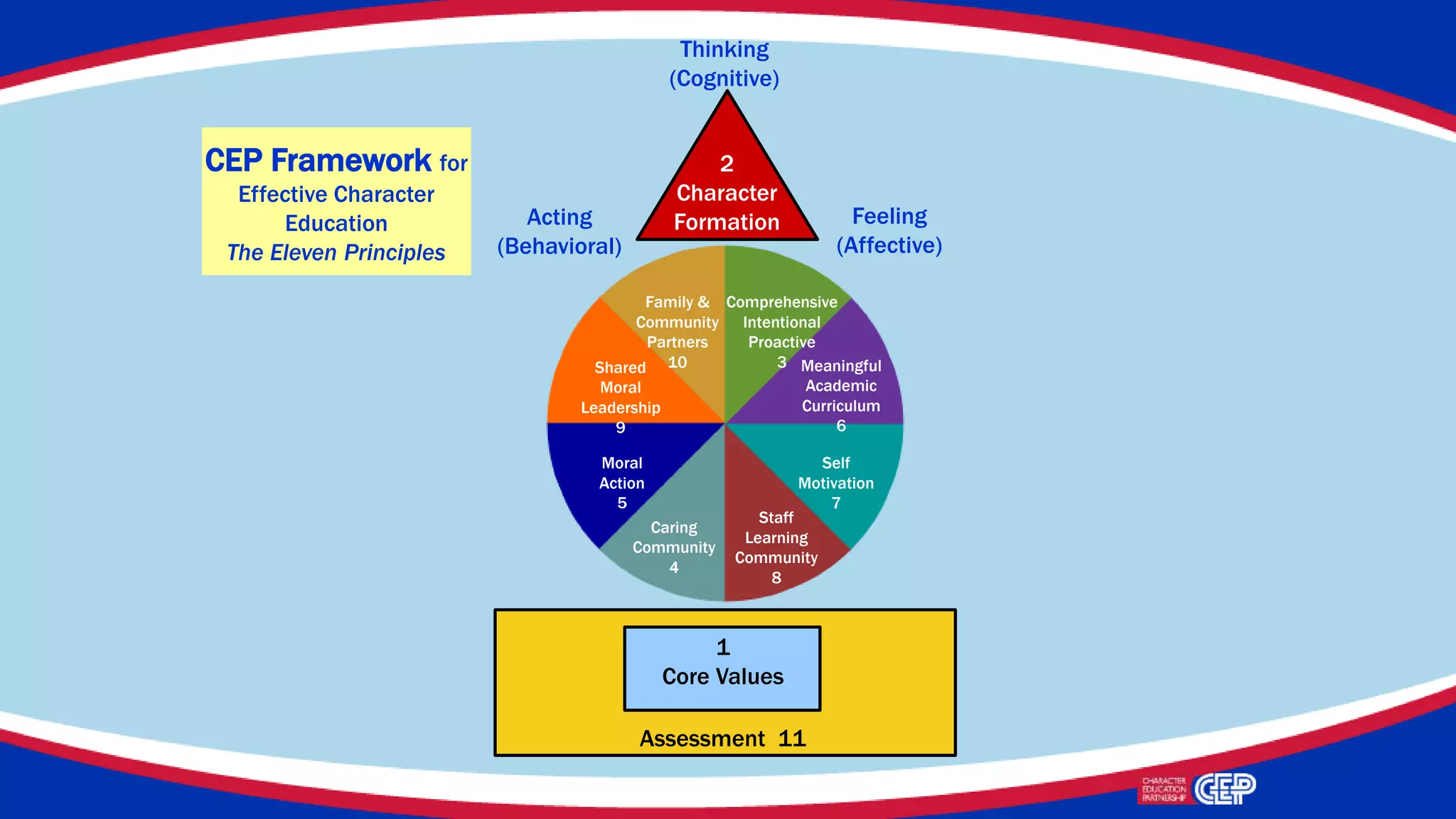
CEP Framework for
Effective Character
Education
The Eleven Principles
Family &
Community
Partners
10
Comprehensive
Intentional
Proactive
3 Meaningful
Academic
Curriculum
6
Self
Motivation
7
Thinking
(Cognitive)
Staff
Learning
Community
8
Caring
Community
4
Moral
Action
5
Shared
Moral
Leadership
9
Feeling
(Affective)
Acting
(Behavioral)
2
Character
Formation
Assessment 11
1
Core Values
149
Promotes core ethical and
performance values
1.1: Stakeholders select core values
1.2: Core values guide everything
1.3: Core values are visible
Principle 1
150
Defines “character”
comprehensively to include
thinking, feeling, and doing.
2.1: Thinking (understanding)
2.2: Feeling (reflection, appreciation)
2.3: Doing (behavior, students practice)
Principle 2
151
Uses a comprehensive,
intentional, and
proactive approach
3.1: Intentional at all levels
3.2: Integrated into academic content
3.3: Integrated into classroom routines
3.4: Integrated throughout total program
Principle 3
152
Creates a caring
community.
4.1: Student – staff relationships
4.2: Student – student relationships
4.3: Peer cruelty prevention
4.4: Adult relationships
Principle 4
153
Provides students with
opportunities for moral
action.
5.1: Clear expectations
5.2: Moral action within school; tied to the curriculum
5.3: Moral action in community; tied to the curriculum
Principle 5
154
Offers a meaningful and
challenging academic
curriculum that respects all
learners
6.1: Challenging curriculum
6.2: Meeting diverse student needs
6.3: Addresses performance character
Principle 6
155
Fosters students’
self-motivation
7.1: Students intrinsically NOT extrinsically
motivated.
7.2: Behavior management and discipline tied to
core values; academic integrity stressed.
Principle 7
156
Staff is an ethical learning
community that shares
responsibility for character
education and adheres to core
values
8.1: Staff modeling
8.2: Staff development for ALL; staff is ethical
learning community
8.3: Staff planning and reflection;
enough time for character education.
Principle 8
157
Fosters shared leadership
and long-range support of
the character initiative.
9.1: Leaders champion effort
9.2: Leadership group plans
9.3: Student leadership
Principle 9
158
Engages families and
community members as
partners in the character-
building effort
10.1: Engages families
10.2: Communicates with families
10:3: Involves community
Principle 10
159
Assesses school
culture/climate, staff’s
functioning, and
students‘ character11.1: Assesses culture/climate
11.2: Staff report on progress
11.3: Assesses student progress /
behavior
Principle 11
160
Reviewers look for evidence of
each key indicator and assign
a score of 1 to 4 for each
scoring item based on the
evidence they find.
161
The 11 Principles as the Scoring Rubric
Principle #1: The school community promotes core ethical and
performance values as the foundation of good character.
Each Principle has 2 to 4 numbered Scoring Items.
1.1 Stakeholders in the school community select or
assent to a set of core values
Key Indicators of exemplary implementation:
 A highly inclusive representative group of stakeholders (professional and other staff,
parents, students, and community members) have had input into or at least assented to
the school’s core ethical and performance values. If the founders selected the values or if
the values have been in place for some time, current stakeholders have been involved in
ongoing reflection on the values.
 Staff understand how and why the school selected its core values.
Each Scoring Item lists:
References:
Social, Digital, and Mobile in APAC, by We are Social
http://wearesocial.sg/blog/2014/01/social-digital-mobile-apac-2014/
Our Mobile Planet, by Google
http://think.withgoogle.com/mobileplanet/en/downloads/
The Myth of Mutitasking, by Christine Rosen
http://www.thenewatlantis.com/publications/the-myth-of-
multitasking
People of the Screen, by Christine Rosen
http://www.thenewatlantis.com/publications/people-of-the-screen
Exploiting the Neuroscience of Internet Addiction, by Bill Davidow
http://www.theatlantic.com/health/archive/2012/07/exploiting-the-
neuroscience-of-internet-addiction/259820/
Educating in the New Technologies, Opus Dei web site
http://opusdei.org/en/article/educating-in-the-new-technologies/
DIGITAL CITIZENSHIP www.mannrentoy.com

DIGITAL CITIZENSHIP www.mannrentoy.com