Fostering Digital Literacy Through Passion-Based Learning Patrick WoessnerLausanne Laptop Institute 2011http://bit.ly/passionbasedlearning
Session GoalsRecognize the importance of passion in learning
Empower students to identify their passion(s)
Design learning experiences that leverage passion
Enable students to share their passion with the worldSuccess is 10% inspiration, 90% last-minute changes.  ~From a billboard advertisement
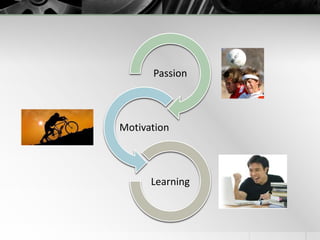
What is Passion?Robert J. Vallerand, Professor of Psychology at Universite du Quebec a Montreal defines passion as  “a strong inclination toward an activity that people like, find important, and in which they invest time and energy.”What is your definition of passion?My definition: “Passion is motivation in action.”
What is Your Passion?
Why Passion Matters
Factors that Influence LearningSchool-Level Factors:• A Guaranteed and Viable Curriculum• Challenging Goals and Effective Feedback• Parent and Community Involvement• Safe and Orderly Environment• Collegiality and ProfessionalismSource: What Works in Schools: Translating Research into Action by: Robert J. Marzano
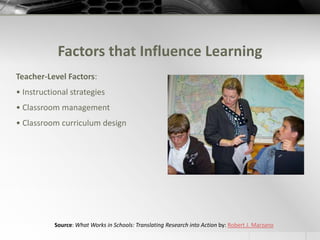
Factors that Influence LearningTeacher-Level Factors:• Instructional strategies• Classroom management• Classroom curriculum designSource: What Works in Schools: Translating Research into Action by: Robert J. Marzano
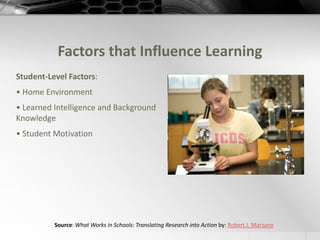
Factors that Influence LearningStudent-Level Factors:• Home Environment• Learned Intelligence and Background Knowledge• Student MotivationSource: What Works in Schools: Translating Research into Action by: Robert J. Marzano
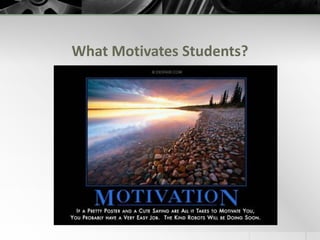
What Motivates Students?
What Motivates Students?Students respond positively to tasks that they perceive as challenging but “do-able” and that have relevance (value) to them.  Also, creative tasks, which provide the student a degree of freedom in their resolution (e.g., creating artworks that use design principles and functions to solve specific visual art problems embodied in the standards; composing a musical composition) can be a source of personal pride and intrinsic motivation.  To maximize motivation, then, teachers should develop tasks that are authentic, appropriately challenging, relevant, and creative.Passion Motivates Students!Kellaghan, T., Madaus, G.F., & Raczek, A. (1996). The use of external examinations to improve student motivation. Washington, DC: American Educational Research Association.
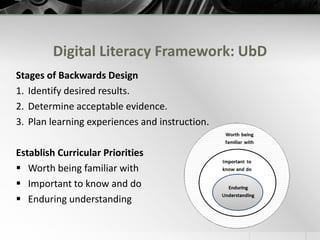
Digital Literacy Framework: UbDStages of Backwards DesignIdentify desired results.Determine acceptable evidence.Plan learning experiences and instruction.Establish Curricular PrioritiesWorth being familiar withImportant to know and doEnduring understanding
Digital Literacy: Essential QuestionsOver the course of this trimester, you will work toward answering two essential questions:How does technology affect and reflect who you are as a person and learner?How does your passion affect and reflect who you are as a person and learner?
Digital Literacy: Enduring UnderstandingsTo answer these important questions, you must come to understand that:learning can be informal, social, and networked.information serves as the basis for understanding our world.content creators have rights; content consumers have responsibilities.
Digital Literacy: Evidence/OutcomesBy the end of the course, you will be able to:identify your personal interests/passion(s).communicate and collaborate in an online environment.locate, evaluate, utilize, and cite information.identify your personal expression style.create and share a product that answers the essential questions.
Digital Literacy: Course OutlinePassion-Based LearningNetworkingSocial BookmarkingEffective Search StrategiesWebsite EvaluationCopyright, Fair Use, and Creative CommonsExpression StylesFinal Product Presentation
Digital Literacy: Course OutlinePassion-Based LearningNetworkingSocial BookmarkingEffective Search StrategiesWebsite EvaluationCopyright, Fair Use, and Creative CommonsExpressionStylesFinal Product Presentation
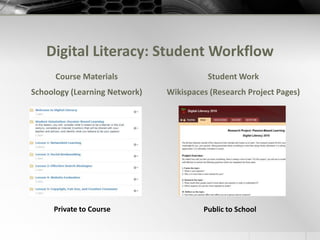
Digital Literacy: Student WorkflowCourse MaterialsSchoology (Learning Network)Student WorkWikispaces (Research Project Pages)Private to CoursePublic to School
Lesson: Passion-Based LearningPassion-Based Learning is an experience that empowers students to Discover and Consume, Communicate and Connect, and Create and Produce based on their deep-seated interests.The primary purpose of this exercise to identify students’ interest areas is to stimulate thought and discussion. Students not only come to know themselves better, but also get a chance to share their discoveries with both teachers and peers.
Interest-A-Lyzer Sample QuestionsYou are a photographer and you have one picture left to take on your roll of film. What will it be of? Why?Teenagers in your community have been asked to prepare individual time capsules for future generations. You are allowed to include 10 personal possessions that are representative of you. What would you include in your capsule?You are fed up with the course offerings at your school. Your principal has asked you to design the perfect course for people with your same interests. What would the course be called? What would be taught?Adapted from The Interest-A-Lyzer, by J.S. Renzulli (Mansfield Center, CT: Creative Learning Press, 1997)
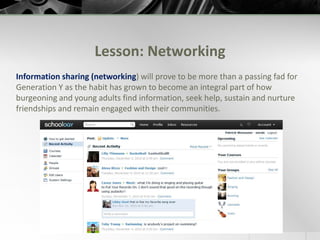
Lesson: NetworkingInformation sharing (networking) will prove to be more than a passing fad for Generation Y as the habit has grown to become an integral part of how burgeoning and young adults find information, seek help, sustain and nurture friendships and remain engaged with their communities.
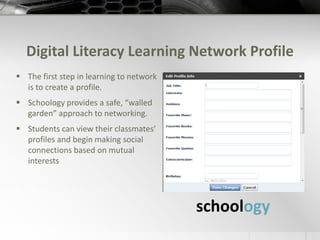
Digital Literacy Learning Network ProfileThe first step in learning to network is to create a profile.Schoology provides a safe, “walled garden” approach to networking.Students can view their classmates’ profiles and begin making social connections based on mutual interestsschoology
Digital Literacy: Topic OutlinePassion-Based LearningNetworkingSocial BookmarkingEffective Search StrategiesWebsite EvaluationCopyright, Fair Use, and Creative CommonsExpression StylesFinal Product Presentation
Digital Literacy: Research ProjectPassion-Based LearningNetworkingSocial BookmarkingEffective Search StrategiesWebsite EvaluationCopyright, Fair Use, and Creative CommonsExpression StylesFinal Product Presentation
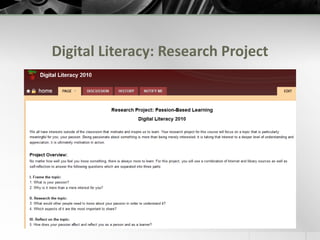
Digital Literacy: Research Project
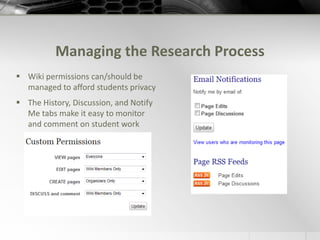
Managing the Research ProcessWiki permissions can/should be managed to afford students privacyThe History, Discussion, and Notify Me tabs make it easy to monitor and comment on student work
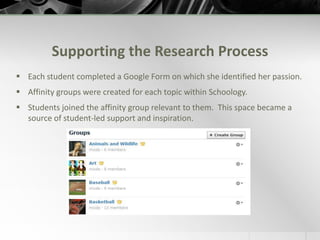
Supporting the Research ProcessEach student completed a Google Form on which she identified her passion. Affinity groups were created for each topic within Schoology.Students joined the affinity group relevant to them.  This space became a source of student-led support and inspiration.
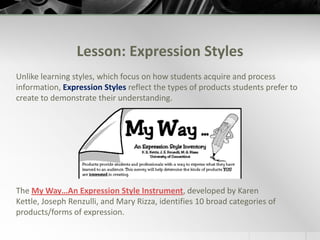
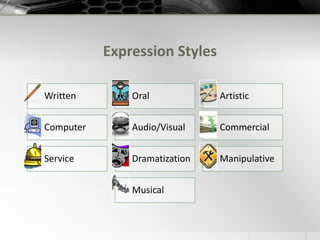
Lesson: Expression StylesUnlike learning styles, which focus on how students acquire and process information, Expression Styles reflect the types of products students prefer to create to demonstrate their understanding.The My Way…An Expression Style Instrument, developed by Karen Kettle, Joseph Renzulli, and Mary Rizza, identifies 10 broad categories of products/forms of expression.
Expression Styles
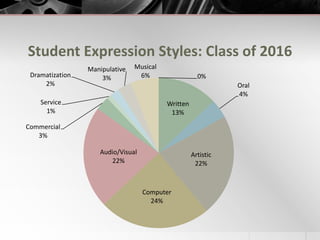
Student Expression Styles: Class of 2016
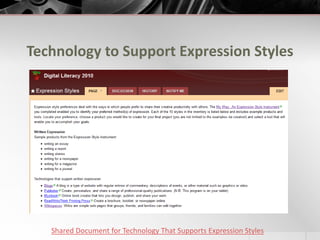
Technology to Support Expression StylesShared Document for Technology That Supports Expression Styles
Final Project RequirementsYour research project will culminate in a final product that will be shared with your advisory. Although you have a great deal of flexibility, your final project must:Reflect your preferred expression style (e.g. if Written Expression is your preference, your final product should take a written form) and have been created (at least in part) by technology (e.g. no dioramas).Address/answer (directly or indirectly) all five driving questions What is your passion?Why is it more than a mere interest for you?What would other people need to know about your passion in order to understand it?Which aspects of it are the most important to share?How does your passion affect and reflect you as a person and as a learner?Be uploaded/embedded/linked/displayed on your personal Digital Literacy wiki page and include a description of the project (i.e. what the project is all about).
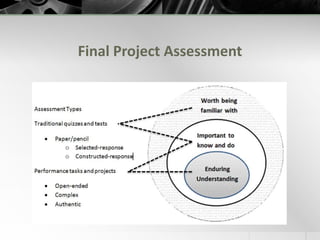
Final Project Assessment
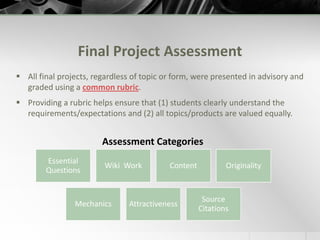
Final Project AssessmentAll final projects, regardless of topic or form, were presented in advisory and graded using a common rubric.Providing a rubric helps ensure that (1) students clearly understand the requirements/expectations and (2) all topics/products are valued equally.Assessment Categories
Final Project Assessment
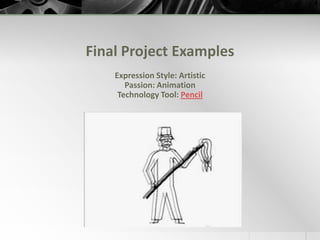
Final Project ExamplesExpression Style: ArtisticPassion: AnimationTechnology Tool: Pencil
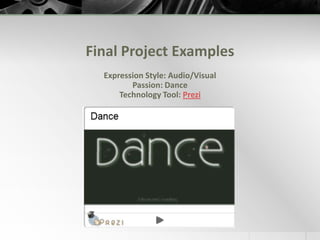
Final Project ExamplesExpression Style: Audio/VisualPassion: DanceTechnology Tool: Prezi
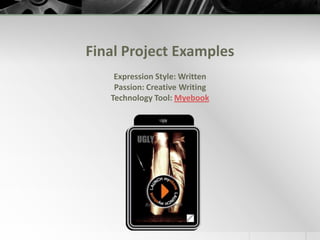
Final Project ExamplesExpression Style: WrittenPassion: Creative WritingTechnology Tool: Myebook
What Did the Students REALLY Think?Several months after the course ended, a brief, anonymous survey was sent to all students:How important was the role of passion in your learning?	Did you notice a different level of commitment or engagement during this passion-based project compared to past project work?	How many other times in your schooling have you had a chance to formally explore and share your passion with others?
Student Survey Results: How important was the role of passion in your learning?My passion moves me along and keeps me happy and helps me to learn. I can think in terms of my passion to understand something better and that helps me learn.Very important. Passion is everything.Learning my passion was important to me because I got to learn how I learn and more about my self that I didn't realize before.It was very helpful for extending my learning in other subjectsIt was very important because the fact that it was about me made me more motivated to research and participate.
Student Survey Results: Did you notice a different level of commitment or engagement?Yes, because your passion is something that interests you and sometimes school projects do not.It encouraged me to make it good since it was about something I loved.Yes, because it was on a more personal level, instead of "homework".  Also, it was fun to do because it was about things we like to do.Yes, I learned more because I actually cared about the topic I was researching and making a final project for.No.  I say this because I give a full amount of effort and commitment to ALL of my work.
Student Survey Results: How many other times in school have you explored/shared your passion?None.  I haven’t had any chances to do that at all so far in my learning life.Not any other ones, it was only this project.None other times besides people asking "oh what do you like to do?" or "what are some of your favorite things?" and stuff like that.Not a lot, if at all.This is the first time, and I really enjoyed it!Rarely ever. The only times 'passions' come up are with conversations with friends, and they are usually labeled as fun activities

Passion-Based Learning Workshop

  • 1.
    Fostering Digital LiteracyThrough Passion-Based Learning Patrick WoessnerLausanne Laptop Institute 2011http://bit.ly/passionbasedlearning
  • 2.
    Session GoalsRecognize theimportance of passion in learning
  • 3.
    Empower students toidentify their passion(s)
  • 4.
    Design learning experiencesthat leverage passion
  • 5.
    Enable students toshare their passion with the worldSuccess is 10% inspiration, 90% last-minute changes. ~From a billboard advertisement
  • 6.
    What is Passion?RobertJ. Vallerand, Professor of Psychology at Universite du Quebec a Montreal defines passion as “a strong inclination toward an activity that people like, find important, and in which they invest time and energy.”What is your definition of passion?My definition: “Passion is motivation in action.”
  • 7.
    What is YourPassion?
  • 8.
  • 9.
    Factors that InfluenceLearningSchool-Level Factors:• A Guaranteed and Viable Curriculum• Challenging Goals and Effective Feedback• Parent and Community Involvement• Safe and Orderly Environment• Collegiality and ProfessionalismSource: What Works in Schools: Translating Research into Action by: Robert J. Marzano
  • 10.
    Factors that InfluenceLearningTeacher-Level Factors:• Instructional strategies• Classroom management• Classroom curriculum designSource: What Works in Schools: Translating Research into Action by: Robert J. Marzano
  • 11.
    Factors that InfluenceLearningStudent-Level Factors:• Home Environment• Learned Intelligence and Background Knowledge• Student MotivationSource: What Works in Schools: Translating Research into Action by: Robert J. Marzano
  • 12.
  • 13.
    What Motivates Students?Studentsrespond positively to tasks that they perceive as challenging but “do-able” and that have relevance (value) to them. Also, creative tasks, which provide the student a degree of freedom in their resolution (e.g., creating artworks that use design principles and functions to solve specific visual art problems embodied in the standards; composing a musical composition) can be a source of personal pride and intrinsic motivation. To maximize motivation, then, teachers should develop tasks that are authentic, appropriately challenging, relevant, and creative.Passion Motivates Students!Kellaghan, T., Madaus, G.F., & Raczek, A. (1996). The use of external examinations to improve student motivation. Washington, DC: American Educational Research Association.
  • 15.
    Digital Literacy Framework:UbDStages of Backwards DesignIdentify desired results.Determine acceptable evidence.Plan learning experiences and instruction.Establish Curricular PrioritiesWorth being familiar withImportant to know and doEnduring understanding
  • 16.
    Digital Literacy: EssentialQuestionsOver the course of this trimester, you will work toward answering two essential questions:How does technology affect and reflect who you are as a person and learner?How does your passion affect and reflect who you are as a person and learner?
  • 17.
    Digital Literacy: EnduringUnderstandingsTo answer these important questions, you must come to understand that:learning can be informal, social, and networked.information serves as the basis for understanding our world.content creators have rights; content consumers have responsibilities.
  • 18.
    Digital Literacy: Evidence/OutcomesBythe end of the course, you will be able to:identify your personal interests/passion(s).communicate and collaborate in an online environment.locate, evaluate, utilize, and cite information.identify your personal expression style.create and share a product that answers the essential questions.
  • 19.
    Digital Literacy: CourseOutlinePassion-Based LearningNetworkingSocial BookmarkingEffective Search StrategiesWebsite EvaluationCopyright, Fair Use, and Creative CommonsExpression StylesFinal Product Presentation
  • 20.
    Digital Literacy: CourseOutlinePassion-Based LearningNetworkingSocial BookmarkingEffective Search StrategiesWebsite EvaluationCopyright, Fair Use, and Creative CommonsExpressionStylesFinal Product Presentation
  • 21.
    Digital Literacy: StudentWorkflowCourse MaterialsSchoology (Learning Network)Student WorkWikispaces (Research Project Pages)Private to CoursePublic to School
  • 22.
    Lesson: Passion-Based LearningPassion-BasedLearning is an experience that empowers students to Discover and Consume, Communicate and Connect, and Create and Produce based on their deep-seated interests.The primary purpose of this exercise to identify students’ interest areas is to stimulate thought and discussion. Students not only come to know themselves better, but also get a chance to share their discoveries with both teachers and peers.
  • 23.
    Interest-A-Lyzer Sample QuestionsYouare a photographer and you have one picture left to take on your roll of film. What will it be of? Why?Teenagers in your community have been asked to prepare individual time capsules for future generations. You are allowed to include 10 personal possessions that are representative of you. What would you include in your capsule?You are fed up with the course offerings at your school. Your principal has asked you to design the perfect course for people with your same interests. What would the course be called? What would be taught?Adapted from The Interest-A-Lyzer, by J.S. Renzulli (Mansfield Center, CT: Creative Learning Press, 1997)
  • 24.
    Lesson: NetworkingInformation sharing(networking) will prove to be more than a passing fad for Generation Y as the habit has grown to become an integral part of how burgeoning and young adults find information, seek help, sustain and nurture friendships and remain engaged with their communities.
  • 25.
    Digital Literacy LearningNetwork ProfileThe first step in learning to network is to create a profile.Schoology provides a safe, “walled garden” approach to networking.Students can view their classmates’ profiles and begin making social connections based on mutual interestsschoology
  • 26.
    Digital Literacy: TopicOutlinePassion-Based LearningNetworkingSocial BookmarkingEffective Search StrategiesWebsite EvaluationCopyright, Fair Use, and Creative CommonsExpression StylesFinal Product Presentation
  • 27.
    Digital Literacy: ResearchProjectPassion-Based LearningNetworkingSocial BookmarkingEffective Search StrategiesWebsite EvaluationCopyright, Fair Use, and Creative CommonsExpression StylesFinal Product Presentation
  • 28.
  • 29.
    Managing the ResearchProcessWiki permissions can/should be managed to afford students privacyThe History, Discussion, and Notify Me tabs make it easy to monitor and comment on student work
  • 30.
    Supporting the ResearchProcessEach student completed a Google Form on which she identified her passion. Affinity groups were created for each topic within Schoology.Students joined the affinity group relevant to them. This space became a source of student-led support and inspiration.
  • 31.
    Lesson: Expression StylesUnlikelearning styles, which focus on how students acquire and process information, Expression Styles reflect the types of products students prefer to create to demonstrate their understanding.The My Way…An Expression Style Instrument, developed by Karen Kettle, Joseph Renzulli, and Mary Rizza, identifies 10 broad categories of products/forms of expression.
  • 32.
  • 33.
  • 34.
    Technology to SupportExpression StylesShared Document for Technology That Supports Expression Styles
  • 35.
    Final Project RequirementsYourresearch project will culminate in a final product that will be shared with your advisory. Although you have a great deal of flexibility, your final project must:Reflect your preferred expression style (e.g. if Written Expression is your preference, your final product should take a written form) and have been created (at least in part) by technology (e.g. no dioramas).Address/answer (directly or indirectly) all five driving questions What is your passion?Why is it more than a mere interest for you?What would other people need to know about your passion in order to understand it?Which aspects of it are the most important to share?How does your passion affect and reflect you as a person and as a learner?Be uploaded/embedded/linked/displayed on your personal Digital Literacy wiki page and include a description of the project (i.e. what the project is all about).
  • 36.
  • 37.
    Final Project AssessmentAllfinal projects, regardless of topic or form, were presented in advisory and graded using a common rubric.Providing a rubric helps ensure that (1) students clearly understand the requirements/expectations and (2) all topics/products are valued equally.Assessment Categories
  • 38.
  • 39.
    Final Project ExamplesExpressionStyle: ArtisticPassion: AnimationTechnology Tool: Pencil
  • 40.
    Final Project ExamplesExpressionStyle: Audio/VisualPassion: DanceTechnology Tool: Prezi
  • 41.
    Final Project ExamplesExpressionStyle: WrittenPassion: Creative WritingTechnology Tool: Myebook
  • 42.
    What Did theStudents REALLY Think?Several months after the course ended, a brief, anonymous survey was sent to all students:How important was the role of passion in your learning? Did you notice a different level of commitment or engagement during this passion-based project compared to past project work? How many other times in your schooling have you had a chance to formally explore and share your passion with others?
  • 43.
    Student Survey Results:How important was the role of passion in your learning?My passion moves me along and keeps me happy and helps me to learn. I can think in terms of my passion to understand something better and that helps me learn.Very important. Passion is everything.Learning my passion was important to me because I got to learn how I learn and more about my self that I didn't realize before.It was very helpful for extending my learning in other subjectsIt was very important because the fact that it was about me made me more motivated to research and participate.
  • 44.
    Student Survey Results:Did you notice a different level of commitment or engagement?Yes, because your passion is something that interests you and sometimes school projects do not.It encouraged me to make it good since it was about something I loved.Yes, because it was on a more personal level, instead of "homework". Also, it was fun to do because it was about things we like to do.Yes, I learned more because I actually cared about the topic I was researching and making a final project for.No. I say this because I give a full amount of effort and commitment to ALL of my work.
  • 45.
    Student Survey Results:How many other times in school have you explored/shared your passion?None. I haven’t had any chances to do that at all so far in my learning life.Not any other ones, it was only this project.None other times besides people asking "oh what do you like to do?" or "what are some of your favorite things?" and stuff like that.Not a lot, if at all.This is the first time, and I really enjoyed it!Rarely ever. The only times 'passions' come up are with conversations with friends, and they are usually labeled as fun activities

Editor's Notes

  • #2 IntroductionThis presentation draws upon my experiences teaching a 7th grade Digital Literacy course
  • #3 Digital Literacy course:1 Trimester9 lessons10 sections~150 studentsPass/Fail
  • #4 Question: What is your definition of passion?Remember: we are focusing on STUDENT passion, not YOUR passion or making them passionate about your class
  • #5 Take a moment and share with the person next to you a little bit about your passion.Question: how many of you listed something academic-school related?Question: how often do we give students opportunities to explore and share their passion?Question: how many of you found your partner’s passion interesting?
  • #6 This clip is from Office Space; do you see any parallels with your students and/or have you ever taught a student like him?
  • #7 In What Works in Schools, Marzano identified three types of factors that influence learning. Admins focus on School-level factors
  • #8 PD often focuses on teacher-level factors
  • #9 We can’t overlook the student-level factors because motivation affects learning.
  • #10 If it were only this easy…
  • #13 It’s important to have a framework for designing learning experiences.I chose UbD to bring structure to the course.
  • #14 causes genuine and relevant inquiry into the big ideas and core content;provokes deep thought, lively discussion, sustained inquiry, and new understanding as well as more questions;requires students to consider alternatives, weigh evidence, support their ideas, and justify their answers;stimulates vital, on-going rethinking of big ideas, assumptions, and prior lessons;sparks meaningful connections with prior learning and personal experiences;naturally recurs, creating opportunities for transfer to other situations and subjects.
  • #15 These are the big content and skills “take-aways” from the course
  • #16 This is how we’ll know if we achieved our goals.
  • #18 These four topics are our focus today
  • #19 It’s important to understand that the DL course has two strands for student work(flow): Internal and External
  • #20 Developed by University of Connecticut professor Joseph S. Renzulli, the Interest-A-Lyzer is a questionnaire devised to help students examine and focus their interests.There are versions for younger students, MS/HS Students, and AdultsThis activity takes TIME because it causes the students to reflectStudents were asked to share their results with their advisor, friends, and familyThe results could ultimately be added to a student portfolio
  • #22 Educators frequently speak about the power of networks; how many use them with students?The Digital Literacy Learning Network, powered by Schoology, connects students in a walled garden
  • #23 Students complete their profile and discuss what/what not to shareStudents can browse classmates’ profiles and make connectionsCreating this network provides perfect opportunity to discuss online behavior
  • #24 These topics are fairly mainstream but students need a context for exploring them.Ideally, they would be connected to the other core subjects but this isn’t always feasible given the varying pace of curricula
  • #25 The research project is used to teach/connect the important digital literacy skillsThe topic for the project is the student’s choice (i.e. his passion)Each student learns the same core course content and skills but within the context of his topic of choice
  • #26 The research project was outlined on our DL Wiki (Wikispaces Private Label)Each student has his/her own pageThis made it easy to monitor student progress and provide feedback
  • #27 We chose to make the wiki public to the school but private to the outside world. At present the wiki is open for the benefit of this presentation.Displaying work online helps students develop a sense of audience.
  • #28 The affinity groups remove the teacher as the content-area expertThis is one of the hardest, but most important, aspects of this projectHenry Jenkins would refer to this as a participatory culture
  • #29 Although students have diverse expression styles, we often limit their forms of expression to oral and written work.
  • #30 These 10 styles represent the most common forms of student expression.This approach facilitates differentiation and provides CHOICEQuestion: Which style(s) would you expect to be the most popular?
  • #31 Question: which style(s) do you use most frequently with your students?Question: Which styles(s) do you use most often as a teacher?
  • #32 Once students identified their preferred ES, they were directed to supporting technologies.https://docs.google.com/document/d/1OnRMXvjsgJiR9OPTLgYRM2zWsFIGIFfmN6m84oipQA0/edit?hl=en_US
  • #33 These projects were visible to the School only but have been opened up for this presentation
  • #34 Because the course focused on enduring understandings, the final project/assessment was performance-based
  • #35 Creating a rubric to assess different project types is challenging, but if you have the UbD framework it’s a lot easier.
  • #36 I graded each project (pass/fail) and wrote a comment to the studentEach student presented his project to his advisoryThe public nature of presentations cuts both ways; some kids were outstanding, some were lacking, but most enjoyed the experience and learned a lot about themselves and each otherWe now have a window into each student
  • #39 This student’s project was featured in a local paper and has been viewed >10,000 times online since it was published in Nov 2010
  • #42 Remember: passion was used to master the content and skills more deeply; they can now be applied to other subjects
  • #45 The more support you get from colleagues the more powerful the learning experience