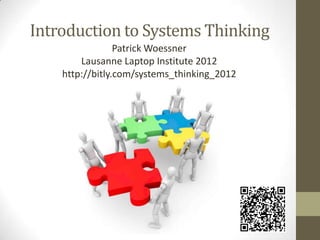
Introduction to Systems Thinking
                 Patrick Woessner
        Lausanne Laptop Institute 2012
    http://bitly.com/systems_thinking_2012
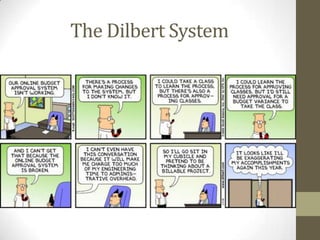
The Dilbert System
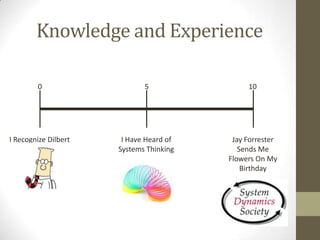
Knowledge and Experience

        0                    5                10


I Recognize Dilbert    I Have Heard of    Jay Forrester
                      Systems Thinking      Sends Me
                                         Flowers On My
                                             Birthday
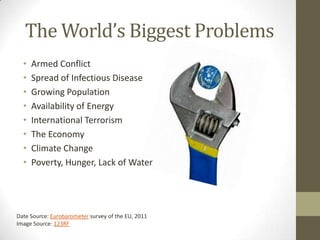
The World’s Biggest Problems
  •   Armed Conflict
  •   Spread of Infectious Disease
  •   Growing Population
  •   Availability of Energy
  •   International Terrorism
  •   The Economy
  •   Climate Change
  •   Poverty, Hunger, Lack of Water


Date Source: Eurobarometer survey of the EU, 2011
Image Source: 123RF
Why Do These Problems Persist?
Schools Have Not Prepared
  Students to Solve Them
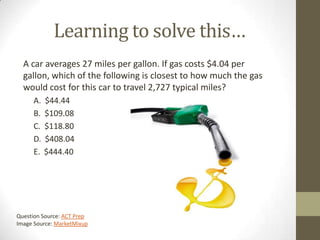
Learning to solve this…
  A car averages 27 miles per gallon. If gas costs $4.04 per
  gallon, which of the following is closest to how much the gas
  would cost for this car to travel 2,727 typical miles?
     A.   $44.44
     B.   $109.08
     C.   $118.80
     D.   $408.04
     E.   $444.40


Question Source: ACT Prep
Image Source: MarketMixup
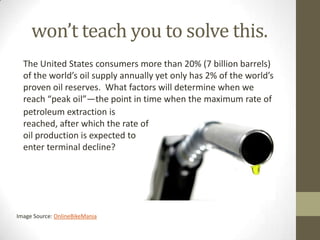
won’t teach you to solve this.
  The United States consumers more than 20% (7 billion barrels)
  of the world’s oil supply annually yet only has 2% of the world’s
  proven oil reserves. What factors will determine when we
  reach “peak oil”—the point in time when the maximum rate of
  petroleum extraction is
  reached, after which the rate of
  oil production is expected to
  enter terminal decline?


Image Source: OnlineBikeMania
Systems Thinking
  Traditional analysis focuses on the individual pieces of what is
  being studied. Systems thinking focuses on how the things
  being studied interact with the other constituents of the system.

  Instead of isolating smaller
  and smaller parts of the
  system being studied, systems
  thinking works by expanding
  its view to consider larger and
  larger numbers of interactions
  as an issue is being studied.


Image Source: Flickr Creative Commons, by erwlas
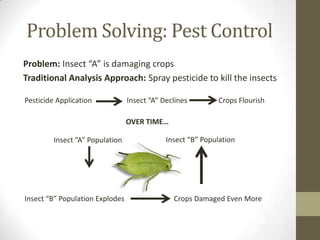
Problem Solving: Pest Control
Problem: Insect “A” is damaging crops
Traditional Analysis Approach: Spray pesticide to kill the insects

Pesticide Application            Insect “A” Declines        Crops Flourish

                                 OVER TIME…

         Insect “A” Population               Insect “B” Population


Insect “B” Population Explodes                 Crops Damaged Even More
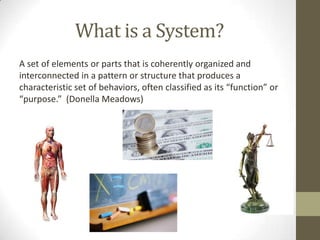
What is a System?
A set of elements or parts that is coherently organized and
interconnected in a pattern or structure that produces a
characteristic set of behaviors, often classified as its “function” or
“purpose.” (Donella Meadows)
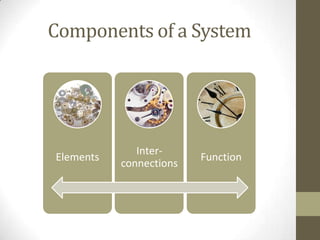
Components of a System


              Inter-
Elements                 Function
           connections
Elements

                            • Typically the most obvious part of
                              a dynamic system
                            • Changing elements often has
                              very little effect on the system


             Elements


Image Source: Armchair GM
Interconnections

                                    • Often involve the flow of
                                      information
                                    • Changing relationships usually
                                      changes system behavior


              Inter-
           connections


Image Source: Creative Commons by ~IconTexto
Function

                               • Typically the least obvious part of
                                 a dynamic system
                               • A change in purpose changes a
                                 system profoundly


              Function


Image Source: Antique Radios
Systems: Key Points
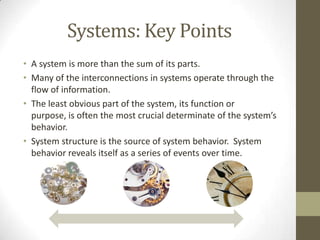
• A system is more than the sum of its parts.
• Many of the interconnections in systems operate through the
  flow of information.
• The least obvious part of the system, its function or
  purpose, is often the most crucial determinate of the system’s
  behavior.
• System structure is the source of system behavior. System
  behavior reveals itself as a series of events over time.
A System Case Study
What is Thinking?
  “Thinking consists of two activities: constructing mental models
  and then simulating them in order to draw conclusions and
  make decisions.” – Barry Richmond


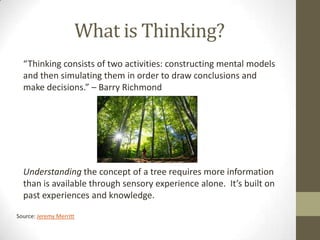
  Understanding the concept of a tree requires more information
  than is available through sensory experience alone. It’s built on
  past experiences and knowledge.

Source: Jeremy Merritt
Mental Models


Image Source: Flickr Creative Commons, by Dave Hosford
Mental Models


Image Source: Sports in Wisconsin
Mental Models


Image Source: The Baby Proofing Blog
Changing Thinking
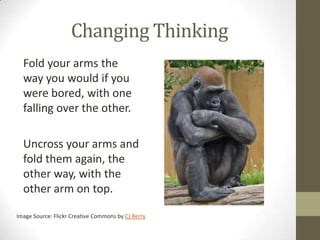
  Fold your arms the
  way you would if you
  were bored, with one
  falling over the other.

  Uncross your arms and
  fold them again, the
  other way, with the
  other arm on top.

Image Source: Flickr Creative Commons by CJ Berry
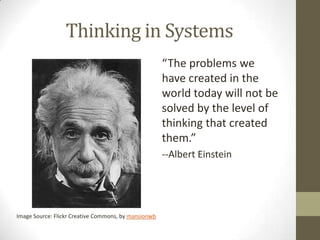
Thinking in Systems
                                                      “The problems we
                                                      have created in the
                                                      world today will not be
                                                      solved by the level of
                                                      thinking that created
                                                      them.”
                                                      --Albert Einstein


Image Source: Flickr Creative Commons, by mansionwb
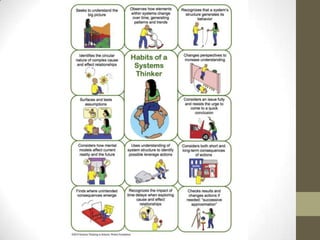
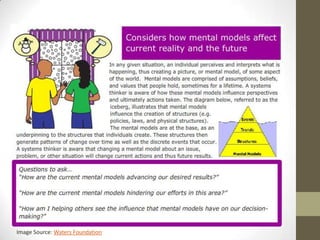
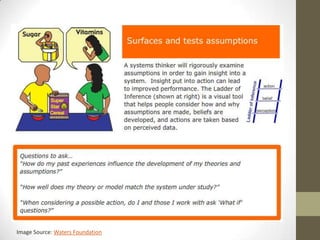
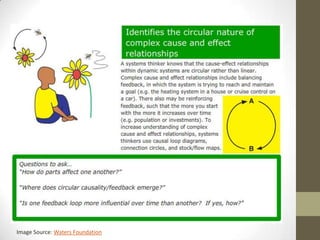
Image Source: Waters Foundation
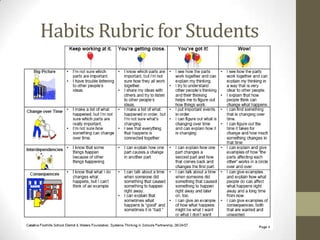
Habits Rubric for Students
Modeling Systems
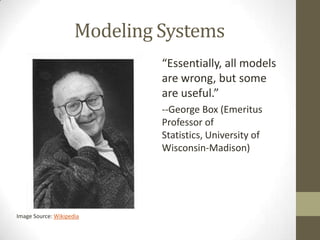
                              “Essentially, all models
                              are wrong, but some
                              are useful.”
                              --George Box (Emeritus
                              Professor of
                              Statistics, University of
                              Wisconsin-Madison)


Image Source: Wikipedia
Modeling Systems
We are limited in our capacity to form and reform mental
models. Systems modeling allows us to move from “what” to
“what if” and make our thinking visible

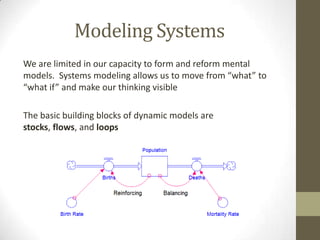
The basic building blocks of dynamic models are
stocks, flows, and loops
Stocks
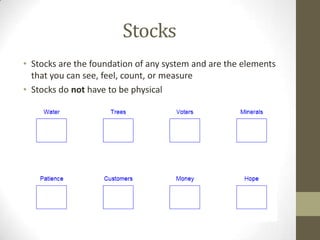
• Stocks are the foundation of any system and are the elements
  that you can see, feel, count, or measure
• Stocks do not have to be physical
Flows
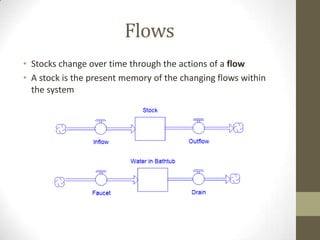
• Stocks change over time through the actions of a flow
• A stock is the present memory of the changing flows within
  the system
Loops
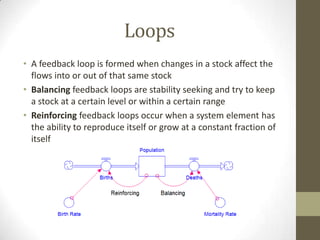
• A feedback loop is formed when changes in a stock affect the
  flows into or out of that same stock
• Balancing feedback loops are stability seeking and try to keep
  a stock at a certain level or within a certain range
• Reinforcing feedback loops occur when a system element has
  the ability to reproduce itself or grow at a constant fraction of
  itself
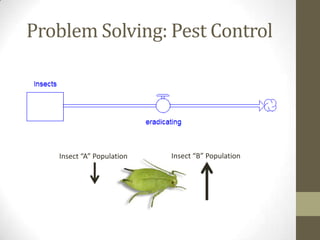
Problem Solving: Pest Control


   Insect “A” Population   Insect “B” Population
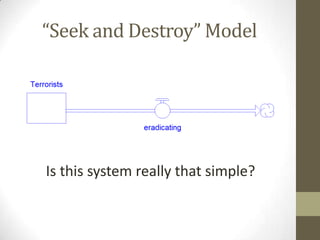
“Seek and Destroy” Model


Is this system really that simple?
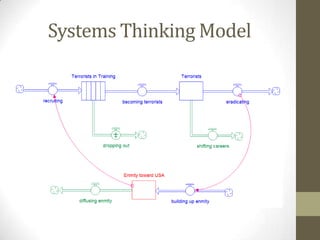
Systems Thinking Model
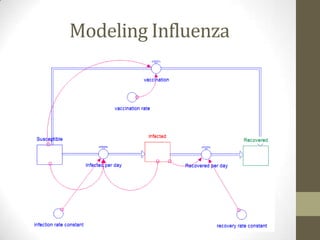
Modeling Influenza
Exploring Models
• Forio NetSim
• MIT Sloan
• ISEE STELLA Models

 Complete List of Models and Simulations

 http://bitly.com/systems_thinking_2012
Getting Started
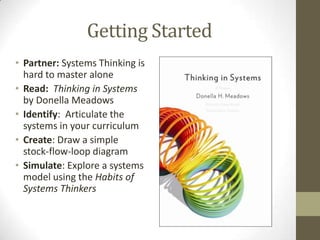
• Partner: Systems Thinking is
  hard to master alone
• Read: Thinking in Systems
  by Donella Meadows
• Identify: Articulate the
  systems in your curriculum
• Create: Draw a simple
  stock-flow-loop diagram
• Simulate: Explore a systems
  model using the Habits of
  Systems Thinkers
Contact Information
• Presentation Resources:
  http://bitly.com/systems_thinking_2012
• Email: pwoessner@micds.org
• Twitter: http://twitter.com/pcwoessner
• Blog: http://pwoessner.com/
• Skype: pwoessner
• Office: 314-995-7375

Intro to Systems Thinking

  • 1.
    Introduction to SystemsThinking Patrick Woessner Lausanne Laptop Institute 2012 http://bitly.com/systems_thinking_2012
  • 2.
  • 3.
    Knowledge and Experience 0 5 10 I Recognize Dilbert I Have Heard of Jay Forrester Systems Thinking Sends Me Flowers On My Birthday
  • 4.
    The World’s BiggestProblems • Armed Conflict • Spread of Infectious Disease • Growing Population • Availability of Energy • International Terrorism • The Economy • Climate Change • Poverty, Hunger, Lack of Water Date Source: Eurobarometer survey of the EU, 2011 Image Source: 123RF
  • 5.
    Why Do TheseProblems Persist?
  • 6.
    Schools Have NotPrepared Students to Solve Them
  • 7.
    Learning to solvethis… A car averages 27 miles per gallon. If gas costs $4.04 per gallon, which of the following is closest to how much the gas would cost for this car to travel 2,727 typical miles? A. $44.44 B. $109.08 C. $118.80 D. $408.04 E. $444.40 Question Source: ACT Prep Image Source: MarketMixup
  • 8.
    won’t teach youto solve this. The United States consumers more than 20% (7 billion barrels) of the world’s oil supply annually yet only has 2% of the world’s proven oil reserves. What factors will determine when we reach “peak oil”—the point in time when the maximum rate of petroleum extraction is reached, after which the rate of oil production is expected to enter terminal decline? Image Source: OnlineBikeMania
  • 9.
    Systems Thinking Traditional analysis focuses on the individual pieces of what is being studied. Systems thinking focuses on how the things being studied interact with the other constituents of the system. Instead of isolating smaller and smaller parts of the system being studied, systems thinking works by expanding its view to consider larger and larger numbers of interactions as an issue is being studied. Image Source: Flickr Creative Commons, by erwlas
  • 11.
    Problem Solving: PestControl Problem: Insect “A” is damaging crops Traditional Analysis Approach: Spray pesticide to kill the insects Pesticide Application Insect “A” Declines Crops Flourish OVER TIME… Insect “A” Population Insect “B” Population Insect “B” Population Explodes Crops Damaged Even More
  • 12.
    What is aSystem? A set of elements or parts that is coherently organized and interconnected in a pattern or structure that produces a characteristic set of behaviors, often classified as its “function” or “purpose.” (Donella Meadows)
  • 13.
    Components of aSystem Inter- Elements Function connections
  • 14.
    Elements • Typically the most obvious part of a dynamic system • Changing elements often has very little effect on the system Elements Image Source: Armchair GM
  • 15.
    Interconnections • Often involve the flow of information • Changing relationships usually changes system behavior Inter- connections Image Source: Creative Commons by ~IconTexto
  • 16.
    Function • Typically the least obvious part of a dynamic system • A change in purpose changes a system profoundly Function Image Source: Antique Radios
  • 17.
    Systems: Key Points •A system is more than the sum of its parts. • Many of the interconnections in systems operate through the flow of information. • The least obvious part of the system, its function or purpose, is often the most crucial determinate of the system’s behavior. • System structure is the source of system behavior. System behavior reveals itself as a series of events over time.
  • 18.
  • 19.
    What is Thinking? “Thinking consists of two activities: constructing mental models and then simulating them in order to draw conclusions and make decisions.” – Barry Richmond Understanding the concept of a tree requires more information than is available through sensory experience alone. It’s built on past experiences and knowledge. Source: Jeremy Merritt
  • 20.
    Mental Models Image Source:Flickr Creative Commons, by Dave Hosford
  • 21.
    Mental Models Image Source:Sports in Wisconsin
  • 22.
    Mental Models Image Source:The Baby Proofing Blog
  • 23.
    Changing Thinking Fold your arms the way you would if you were bored, with one falling over the other. Uncross your arms and fold them again, the other way, with the other arm on top. Image Source: Flickr Creative Commons by CJ Berry
  • 24.
    Thinking in Systems “The problems we have created in the world today will not be solved by the level of thinking that created them.” --Albert Einstein Image Source: Flickr Creative Commons, by mansionwb
  • 26.
  • 27.
  • 28.
  • 29.
  • 30.
  • 31.
  • 32.
  • 33.
  • 34.
  • 35.
  • 36.
  • 37.
  • 38.
  • 39.
  • 40.
    Modeling Systems “Essentially, all models are wrong, but some are useful.” --George Box (Emeritus Professor of Statistics, University of Wisconsin-Madison) Image Source: Wikipedia
  • 41.
    Modeling Systems We arelimited in our capacity to form and reform mental models. Systems modeling allows us to move from “what” to “what if” and make our thinking visible The basic building blocks of dynamic models are stocks, flows, and loops
  • 42.
    Stocks • Stocks arethe foundation of any system and are the elements that you can see, feel, count, or measure • Stocks do not have to be physical
  • 43.
    Flows • Stocks changeover time through the actions of a flow • A stock is the present memory of the changing flows within the system
  • 44.
    Loops • A feedbackloop is formed when changes in a stock affect the flows into or out of that same stock • Balancing feedback loops are stability seeking and try to keep a stock at a certain level or within a certain range • Reinforcing feedback loops occur when a system element has the ability to reproduce itself or grow at a constant fraction of itself
  • 45.
    Problem Solving: PestControl Insect “A” Population Insect “B” Population
  • 46.
    “Seek and Destroy”Model Is this system really that simple?
  • 47.
  • 48.
  • 50.
    Exploring Models • ForioNetSim • MIT Sloan • ISEE STELLA Models Complete List of Models and Simulations http://bitly.com/systems_thinking_2012
  • 51.
    Getting Started • Partner:Systems Thinking is hard to master alone • Read: Thinking in Systems by Donella Meadows • Identify: Articulate the systems in your curriculum • Create: Draw a simple stock-flow-loop diagram • Simulate: Explore a systems model using the Habits of Systems Thinkers
  • 52.
    Contact Information • PresentationResources: http://bitly.com/systems_thinking_2012 • Email: pwoessner@micds.org • Twitter: http://twitter.com/pcwoessner • Blog: http://pwoessner.com/ • Skype: pwoessner • Office: 314-995-7375

Editor's Notes

  • #5 What do you consider to be the world’s biggest problems? Are these problems “new”?
  • #8 How common is this type of problem in school?How common/important is this type of problem in life?
  • #9 How common is this type of problem in school?How common/important is this type of problem in life?
  • #10 Both types of analysis/thinking are important but the latter is often missing from schoolsSystems thinking is the process of understanding how a group of interacting, interrelated, interdependent components influence each other within the whole.Traditional analysis can’t always see the forest for the trees
  • #12 Some studies suggest that the majority of the 25 insects that cause the most crop damage became problems because of exactly this type of approach
  • #13 What are some common systems? What do they have in common?
  • #14 A system is more than the sum of its partsMany of the interconnections in systems operate through the flow of informationThe least obvious part of the system, its function or purpose, is often the most crucial determinate of the system’s behaviorSystem structure is the source of system behavior. System behavior reveals itself as a series of events over time.
  • #15 Textbooks, curriculum, administrators, presidents, etc. don’t affect major change within a system.Ex: Tony LaRussa and Albert Pujols left the Cardinals, but they are still the 11 time World Champs
  • #16 Interconnects are often difficult to see but have great impact on the system.Ex: The shift from Web 1.0 to Web 2.0 changed the nature of the Internet, information, and online interactions
  • #17 System functions seem obvious but may not be clear to all observersEx: Raytheon Company began as the American Appliance Company, a maker of machinery, motors and components (vacuum tubes). Today they make weapon defense systems (Patriot Missles).
  • #18 If you want to change (or understand) a system, you MUST focus on system structure because structure drives behavior.
  • #19 What are the Elements in this system? The Interactions? The Function?What are the problems with this system? What change(s) would make it better?
  • #20 Barry Richmond is known as leader in the field of systems thinking and system dynamics[1] and for the development of the STELLA/IThinkmodelling environment for simulation.[2]The tree is actually a concept of something that exists in physical reality.  The “tree concept” is a model. 
  • #21 Take a look at these images for a few moments and then think about what is happening inside your mind as you look at them. My guess is that with each image you thought about what happens next.  If so, you were actually simulating a mental model forward in time.  The images don’t show you what happened next, but you can probably make a pretty good guess.  This guess is the result of simulating a mental model of what is depicted.  And, you can simulate different outcomes. Notes Source: Jeremy Merritt
  • #22 Take a look at these images for a few moments and then think about what is happening inside your mind as you look at them. My guess is that with each image you thought about what happens next.  If so, you were actually simulating a mental model forward in time.  The images don’t show you what happened next, but you can probably make a pretty good guess.  This guess is the result of simulating a mental model of what is depicted.  And, you can simulate different outcomes. Notes Source: Jeremy Merritt
  • #23 Take a look at these images for a few moments and then think about what is happening inside your mind as you look at them. My guess is that with each image you thought about what happens next.  If so, you were actually simulating a mental model forward in time.  The images don’t show you what happened next, but you can probably make a pretty good guess.  This guess is the result of simulating a mental model of what is depicted.  And, you can simulate different outcomes. Notes Source: Jeremy Merritt
  • #24 Step 1: Look at your arms and notice which one is on top. Notice how this feels? Is it comfortable? Does it feel normal?Step 2: How does that feel? What do you notice?Activity source: The Systems Thinking Playbook by Sweeney and Meadows
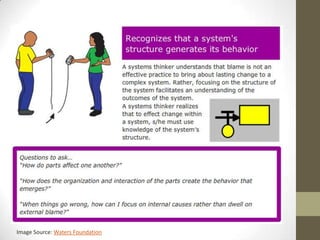
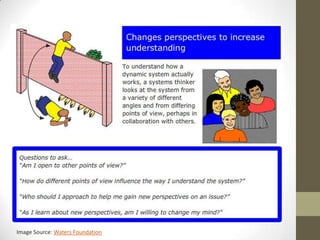
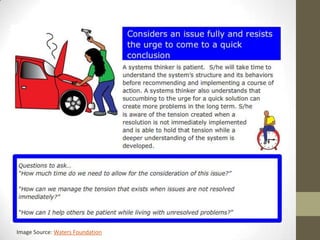
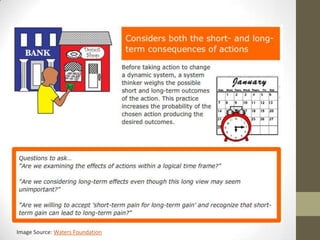
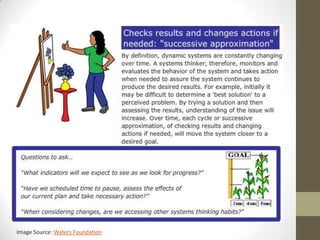
  • #26  The Habits of a Systems Thinker, developed by the Waters Foundation, encompass a spectrum of thinking strategies that foster problem-solving and encourage questioning. Though “habit” is defined as a usual way of doing things, the Habits of a Systems Thinker do not suggest that systems thinkers are limited by routine ways of thinking. Rather, the Habits encourage flexible thinking and appreciation of new, emerging insights and multiple perspectives.
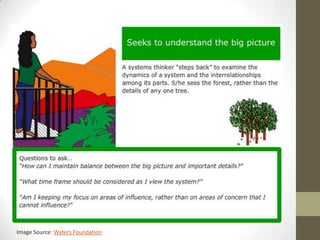
  • #27 Note: The following “notes” for the Habits slides refer to the I Love Lucy clip shown on an earlier slide.Does the person in charge of that assembly line/factory system have the big picture? Do Lucy or Ethel?
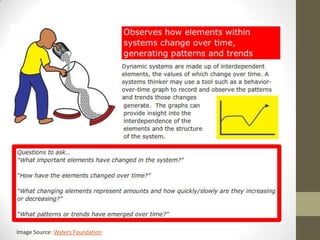
  • #28 What elements changed in the system?
  • #29 Think about the structure of the assembly line; how does its structure affect its behavior?
  • #30 What should the supervisor have done to gain better perspective and increase understanding?
  • #31 What example of this did you see in the film clip?
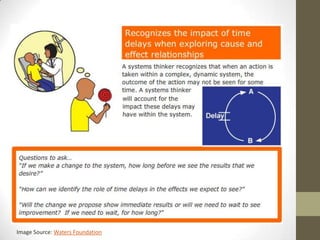
  • #32 Would the short term actions (gain) taken by the supervisor lead to long term pain?
  • #33 How did the supervisor measure success?
  • #34 It’s important to note that time delays work in both directions (before and after making changes).
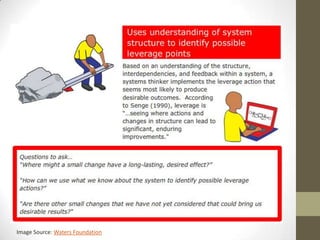
  • #35 What did the supervisor see as the leverage point in the system?
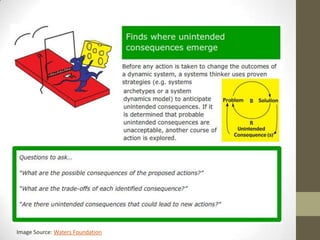
  • #36 What unintended consequence(s) can you identify from the example clip?
  • #37 What was the supervisor’s mental model of how the system worked? Did it account for different outcomes?
  • #38 Examples from the clip?
  • #39 The I Love Lucy clip illustrated a linear process (assembly line) driven by linear thinking. The cause-effect cycle was never considered.
  • #40 A detailed rubric for LS, MS, US is available on the session wiki.
  • #42 Everything we think we know about the world is a model. Our models have a strong congruence with the world, but fall far short of representing the real world fully.
  • #43 Think of a stock as a container (e.g. bathtub) that can “hold” a measurable amount of something (e.g. water)
  • #44 A stock takes time to change because a flow takes time to flow
  • #45 The information delivered by a feedback loop can only affect future behavior; it cannot send a signal fast enough to correct behavior that drove the current feedback
  • #46 Think back to our earlier example of insect control; what was the problem with that approach (Seek and Destroy) to resolving the problem?
  • #48 This model from “Tracing Connections: Voices of Systems Thinkers” illustrates a more complete picture of the factors (elements) that influence this systemThese types of models can be created by students and are very helpful in identifying the important pieces (elements) and relationships.Creating a model for faculty morale or student achievement can be a great exercise for introducing teachers to ST principles.
  • #49 This simple model (which I will demonstrate via STELLA) illustrates the spread of a disease through a population.What are the stocks? Flows? Loops?