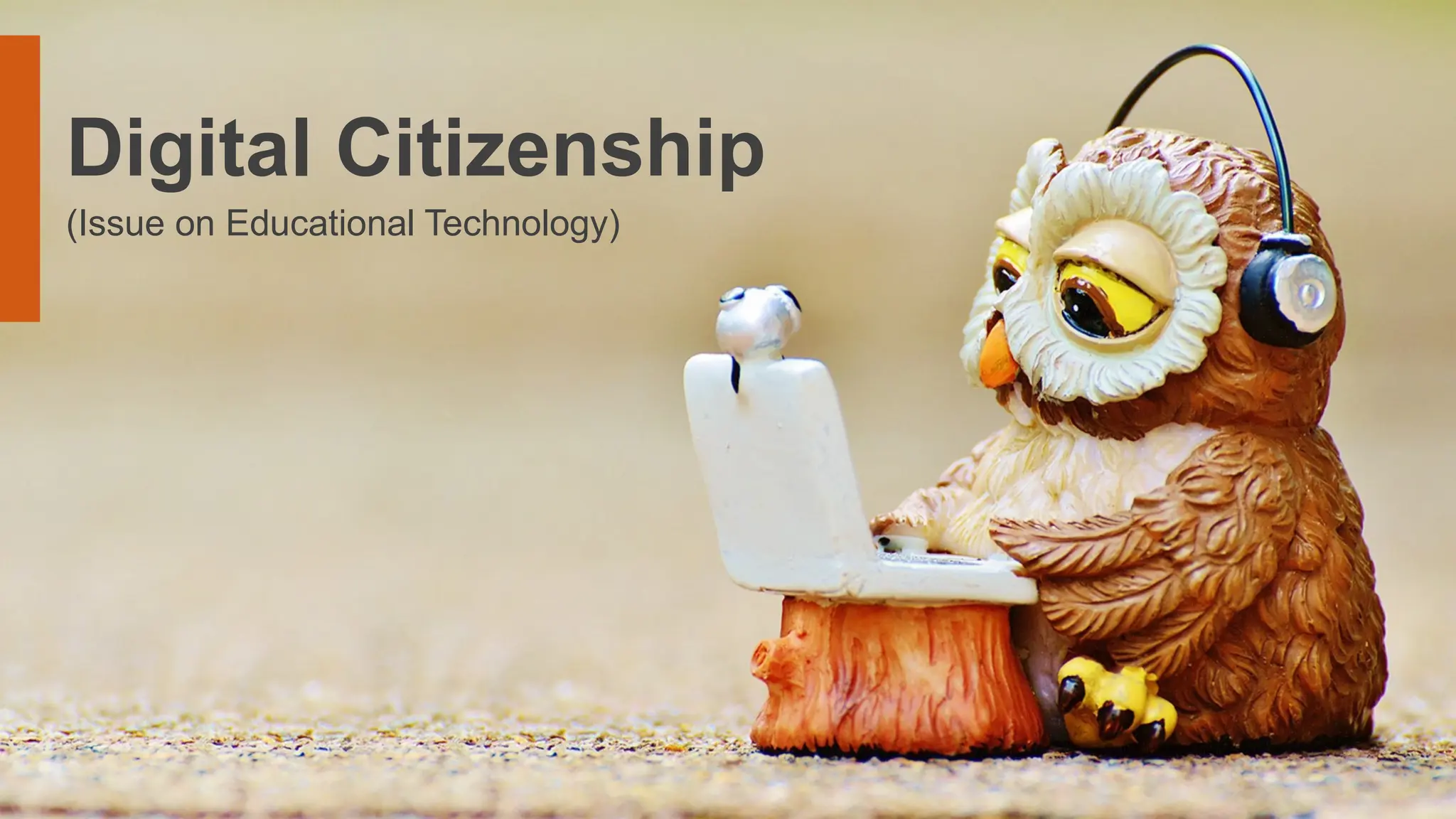
Digital Citizenship
(Issue on Educational Technology)
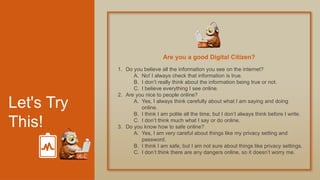
Let's Try
This!
1. Do you believe all the information you see on the internet?
A. No! I always check that information is true.
B. I don’t really think about the information being true or not.
C. I believe everything I see online.
2. Are you nice to people online?
A. Yes, I always think carefully about what I am saying and doing
online.
B. I think I am polite all the time, but I don’t always think before I write.
C. I don’t think much what I say or do online.
3. Do you know how to safe online?
A. Yes, I am very careful about things like my privacy setting and
password.
B. I think I am safe, but I am not sure about things like privacy settings.
C. I don’t think there are any dangers online, so it doesn’t worry me.
Are you a good Digital Citizen?
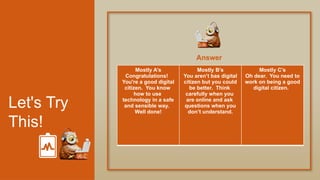
Let's Try
This!
Answer
Mostly A’s
Congratulations!
You're a good digital
citizen. You know
how to use
technology in a safe
and sensible way.
Well done!
Mostly B’s
You aren’t bas digital
citizen but you could
be better. Think
carefully when you
are online and ask
questions when you
don’t understand.
Mostly C’s
Oh dear. You need to
work on being a good
digital citizen.
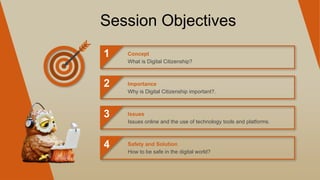
Session Objectives
1
2
3
4
What is Digital Citizenship?
Concept
Why is Digital Citizenship important?.
Importance
Issues online and the use of technology tools and platforms.
Issues
How to be safe in the digital world?
Safety and Solution
Digital Citizenship
1. Meaning and Concept
Digital citizenship can be defined as the norms
of behavior with regard to technology use.
1. What is Digital Citizenship?
Concept
1
Digital Citizenship
A closer look…
?
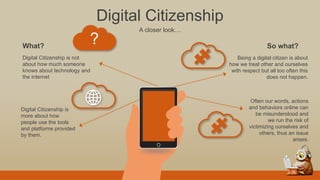
Digital Citizenship is not
about how much someone
knows about technology and
the internet
Digital Citizenship is
more about how
people use the tools
and platforms provided
by them.
What?
Being a digital citizen is about
how we treat other and ourselves
with respect but all too often this
does not happen.
Often our words, actions
and behaviors online can
be misunderstood and
we run the risk of
victimizing ourselves and
others, thus an issue
arises.
So what?
Digital Citizenship
2. Importance
Children are growing up on the Internet. Children
need to learn what it means to be good people
online as well as in real life.
Why is Digital Citizenship important?
Importance
2
Digital Citizenship
2. Importance
“Kids’ use if technology is not the problem. The problem is our kids’
extreme overuse of entertainment technologies that is displacing the
experiences that are fundamental to a strong mind and a happy
successful life.” ~ Richard Freed, Wired Child
Why is Digital Citizenship important?
Importance
2
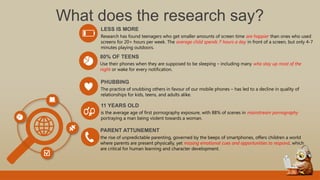
What does the research say?
Research has found teenagers who get smaller amounts of screen time are happier than ones who used
screens for 20+ hours per week. The average child spends 7 hours a day in front of a screen, but only 4-7
minutes playing outdoors.
LESS IS MORE
The practice of snubbing others in favour of our mobile phones – has led to a decline in quality of
relationships for kids, teens, and adults alike.
PHUBBING
Use their phones when they are supposed to be sleeping – including many who stay up most of the
night or wake for every notification.
80% OF TEENS
is the average age of first pornography exposure, with 88% of scenes in mainstream pornography
portraying a man being violent towards a woman.
11 YEARS OLD
the rise of unpredictable parenting, governed by the beeps of smartphones, offers children a world
where parents are present physically, yet missing emotional cues and opportunities to respond, which
are critical for human learning and character development.
PARENT ATTUNEMENT
Empower
Digital Citizen
through Education is a must!
Digital Citizenship
3. Issues and Concerns
3.1 Respect on People’s Feelings
A. “Drama” – is a term that is used to describe when young
people get into fights or arguments with friends or other people
they know. It can get pretty serious online, and can sometimes
turn into cyberbullying.
3.1 Respect on People’s Feelings
Issues
3
Digital Citizenship
3. Issues and Concerns
3.1 Respect on People’s Feelings
B. Cyberbullying – is when a person or a group are helping
intentionally mean to someone online. Like drama, cyberbullying
usually happens with people kids know in real life, though it can
also happen in online games and other platforms they only know
online.
3.1 Respect on People’s Feelings
Issues
3
Digital Citizenship
3. Issues and Concerns
3.1 Respect on People’s Feelings
C. Influence – happens when kids imitate social media
influencer online. Most of the time kids sees negative attitude on
social media that greatly affect their way of thinking about things.
Thus we all have duty to make sure cyberbullying, racism,
sexism aren’t acceptable anywhere.
3.1 Respect on People’s Feelings
Issues
3
Digital Citizenship
3. Issues and Concerns
3.1 Respect on People’s Feelings
D. Online Relationship and Harassment – romantic
relationship may happen online. It is important to tell teens to
talk to their parent or an adult they trust if they’re being pressured
or sexually harassed.
3.1 Respect on People’s Feelings
Issues
3
Digital Citizenship
3. Issues and Concerns
3.2 Respect for Privacy
A. Privacy Online – students need to learn to be careful about
sharing personal information online because most of the apps
and websites today request personal information including their
family information.
3.2 Respect for Privacy
Issues
3
Digital Citizenship
3. Issues and Concerns
3.2 Respect for Privacy
● One of the great things about being online is the ability to share
videos and photos with your friends and seeing their response.
● Everything you post online combines to make your digital footprint.
● Remember that what you share online may be seen by people you
don’t know, and once its online, it could be there forever.
3.2 Respect for Privacy
Issues
3
B. Digital Footprint
Digital Citizenship
3. Issues and Concerns
3.2 Respect for Privacy
Refers to sending, receiving, or forwarding sexually explicit messages.
Photographs, or videos, primarily between mobile phones, of oneself to
others. One of the most important thing to tell students is that it is not
common as they probably think it is: fewer than one in ten students have
sent one.
3.2 Respect for Privacy
Issues
3
C. Sexting
Digital Citizenship
3. Issues and Concerns
3.3 Respect for Property
A. Illegal Downloading – Because of so much stuff online is free, most
students think that everything is free. Make sure to remind students that
the artist own the work they create and have the rights to earn money
from it.
3.3 Respect for Property
Issues
3
Digital Citizenship
3. Issues and Concerns
3.3 Respect for Property
B. Plagiarism – Because people call todays students the “cut and
paste” generation. Make sure that copying anything, even a single
sentence can be plagiarism if they don’t say where it came from.
(sometimes I'm guilty of this, hihi)
3.3 Respect for Property
Issues
3
Digital Citizenship
3. Issues and Concerns
3.3 Respect for Property
C. Hacking – comes from a simple finding ways to get past somebody’s
internet filters to all the way to breaking into government system and
financial institutions. Students talent for computer programming can take
them a long way, but sometimes its in the wrong direction.
3.3 Respect for Property
Issues
3
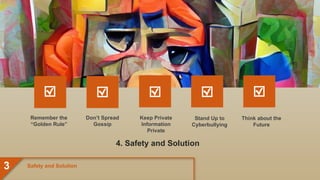
Remember the
“Golden Rule”
Don’t Spread
Gossip
Keep Private
Information
Private
Stand Up to
Cyberbullying
4. Safety and Solution
Think about the
Future
Safety and Solution
3
Safety
and
Solution
● The traditional “Golden Rule” is as
true online as it is in real life: Treat
people the way you hope to be
treated.
● There’s no place for name-calling on
the Web. It’s ok to report abusive
behavior.
● Even though other people don’t use
manners online, you can.
Remember the “Golden Rule” -
Netiquette
Safety
and
Solution
● Make sure our student know how to
discern whether information online is true
or false, and teach them to be skeptical
of what they read online.
● Let student know that passing on false
information is as bad as telling a lie.
● Gossip can destroy a person’s reputation,
and it isn’t something we should take
lightly.
Don’t Spread Gossip
Safety
and
Solution
Responsible digital citizens don’t share private
information on Facebook or anywhere else.
Remind them that the information they share
online not only affects them but could affect
their entire family.
Keep Private Information Private
Safety
and
Solution
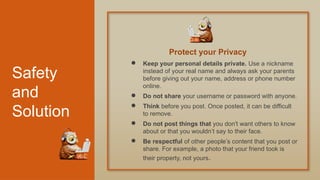
● Keep your personal details private. Use a nickname
instead of your real name and always ask your parents
before giving out your name, address or phone number
online.
● Do not share your username or password with anyone.
● Think before you post. Once posted, it can be difficult
to remove.
● Do not post things that you don't want others to know
about or that you wouldn’t say to their face.
● Be respectful of other people’s content that you post or
share. For example, a photo that your friend took is
their property, not yours.
Protect your Privacy
Safety
and
Solution
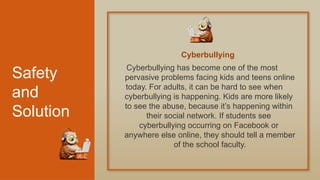
Cyberbullying has become one of the most
pervasive problems facing kids and teens online
today. For adults, it can be hard to see when
cyberbullying is happening. Kids are more likely
to see the abuse, because it’s happening within
their social network. If students see
cyberbullying occurring on Facebook or
anywhere else online, they should tell a member
of the school faculty.
Cyberbullying
Safety
and
Solution
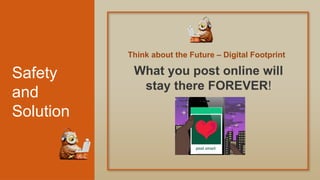
Think about the Future – Digital Footprint
What you post online will
stay there FOREVER!
Q & A
Part
You may now ask questions
for clarification.
References:
www.britishcouncil.org/learningnglishteens
https://doi.org/10.1787/b7f33425-e
https://www.netsafe.org.nz/the-kit/netsafe-schools
http://www.reputation.com/reputationwatch/articles/top-five-tips-help-your-child-
become-responsible-digital-citizen
https://www.researchgate.net/publication/277984736_Digital_citizenship
https://www.researchgate.net/publication/326083989
http://www.slideshare.net/courosa/understanding-digital-citizenship-updated-ma
rch-14
http://www.slideshare.net/courosa/understanding-digital-citizenship-updated-ma
rch-14
https://www.slideshare.net/vskills/what-is-digital-citizen?qid=6e994bef-e7df-442
a-acdd-a34260de546d&v=&b=&from_search=7
Thank you!

EDUC 214A digital citizenship EXPLAINED.pptx

  • 1.
    Digital Citizenship (Issue onEducational Technology)
  • 2.
    Let's Try This! 1. Doyou believe all the information you see on the internet? A. No! I always check that information is true. B. I don’t really think about the information being true or not. C. I believe everything I see online. 2. Are you nice to people online? A. Yes, I always think carefully about what I am saying and doing online. B. I think I am polite all the time, but I don’t always think before I write. C. I don’t think much what I say or do online. 3. Do you know how to safe online? A. Yes, I am very careful about things like my privacy setting and password. B. I think I am safe, but I am not sure about things like privacy settings. C. I don’t think there are any dangers online, so it doesn’t worry me. Are you a good Digital Citizen?
  • 3.
    Let's Try This! Answer Mostly A’s Congratulations! You'rea good digital citizen. You know how to use technology in a safe and sensible way. Well done! Mostly B’s You aren’t bas digital citizen but you could be better. Think carefully when you are online and ask questions when you don’t understand. Mostly C’s Oh dear. You need to work on being a good digital citizen.
  • 4.
    Session Objectives 1 2 3 4 What isDigital Citizenship? Concept Why is Digital Citizenship important?. Importance Issues online and the use of technology tools and platforms. Issues How to be safe in the digital world? Safety and Solution
  • 5.
    Digital Citizenship 1. Meaningand Concept Digital citizenship can be defined as the norms of behavior with regard to technology use. 1. What is Digital Citizenship? Concept 1
  • 6.
    Digital Citizenship A closerlook… ? Digital Citizenship is not about how much someone knows about technology and the internet Digital Citizenship is more about how people use the tools and platforms provided by them. What? Being a digital citizen is about how we treat other and ourselves with respect but all too often this does not happen. Often our words, actions and behaviors online can be misunderstood and we run the risk of victimizing ourselves and others, thus an issue arises. So what?
  • 7.
    Digital Citizenship 2. Importance Childrenare growing up on the Internet. Children need to learn what it means to be good people online as well as in real life. Why is Digital Citizenship important? Importance 2
  • 8.
    Digital Citizenship 2. Importance “Kids’use if technology is not the problem. The problem is our kids’ extreme overuse of entertainment technologies that is displacing the experiences that are fundamental to a strong mind and a happy successful life.” ~ Richard Freed, Wired Child Why is Digital Citizenship important? Importance 2
  • 9.
    What does theresearch say? Research has found teenagers who get smaller amounts of screen time are happier than ones who used screens for 20+ hours per week. The average child spends 7 hours a day in front of a screen, but only 4-7 minutes playing outdoors. LESS IS MORE The practice of snubbing others in favour of our mobile phones – has led to a decline in quality of relationships for kids, teens, and adults alike. PHUBBING Use their phones when they are supposed to be sleeping – including many who stay up most of the night or wake for every notification. 80% OF TEENS is the average age of first pornography exposure, with 88% of scenes in mainstream pornography portraying a man being violent towards a woman. 11 YEARS OLD the rise of unpredictable parenting, governed by the beeps of smartphones, offers children a world where parents are present physically, yet missing emotional cues and opportunities to respond, which are critical for human learning and character development. PARENT ATTUNEMENT
  • 10.
  • 11.
    Digital Citizenship 3. Issuesand Concerns 3.1 Respect on People’s Feelings A. “Drama” – is a term that is used to describe when young people get into fights or arguments with friends or other people they know. It can get pretty serious online, and can sometimes turn into cyberbullying. 3.1 Respect on People’s Feelings Issues 3
  • 12.
    Digital Citizenship 3. Issuesand Concerns 3.1 Respect on People’s Feelings B. Cyberbullying – is when a person or a group are helping intentionally mean to someone online. Like drama, cyberbullying usually happens with people kids know in real life, though it can also happen in online games and other platforms they only know online. 3.1 Respect on People’s Feelings Issues 3
  • 13.
    Digital Citizenship 3. Issuesand Concerns 3.1 Respect on People’s Feelings C. Influence – happens when kids imitate social media influencer online. Most of the time kids sees negative attitude on social media that greatly affect their way of thinking about things. Thus we all have duty to make sure cyberbullying, racism, sexism aren’t acceptable anywhere. 3.1 Respect on People’s Feelings Issues 3
  • 14.
    Digital Citizenship 3. Issuesand Concerns 3.1 Respect on People’s Feelings D. Online Relationship and Harassment – romantic relationship may happen online. It is important to tell teens to talk to their parent or an adult they trust if they’re being pressured or sexually harassed. 3.1 Respect on People’s Feelings Issues 3
  • 15.
    Digital Citizenship 3. Issuesand Concerns 3.2 Respect for Privacy A. Privacy Online – students need to learn to be careful about sharing personal information online because most of the apps and websites today request personal information including their family information. 3.2 Respect for Privacy Issues 3
  • 16.
    Digital Citizenship 3. Issuesand Concerns 3.2 Respect for Privacy ● One of the great things about being online is the ability to share videos and photos with your friends and seeing their response. ● Everything you post online combines to make your digital footprint. ● Remember that what you share online may be seen by people you don’t know, and once its online, it could be there forever. 3.2 Respect for Privacy Issues 3 B. Digital Footprint
  • 17.
    Digital Citizenship 3. Issuesand Concerns 3.2 Respect for Privacy Refers to sending, receiving, or forwarding sexually explicit messages. Photographs, or videos, primarily between mobile phones, of oneself to others. One of the most important thing to tell students is that it is not common as they probably think it is: fewer than one in ten students have sent one. 3.2 Respect for Privacy Issues 3 C. Sexting
  • 18.
    Digital Citizenship 3. Issuesand Concerns 3.3 Respect for Property A. Illegal Downloading – Because of so much stuff online is free, most students think that everything is free. Make sure to remind students that the artist own the work they create and have the rights to earn money from it. 3.3 Respect for Property Issues 3
  • 19.
    Digital Citizenship 3. Issuesand Concerns 3.3 Respect for Property B. Plagiarism – Because people call todays students the “cut and paste” generation. Make sure that copying anything, even a single sentence can be plagiarism if they don’t say where it came from. (sometimes I'm guilty of this, hihi) 3.3 Respect for Property Issues 3
  • 20.
    Digital Citizenship 3. Issuesand Concerns 3.3 Respect for Property C. Hacking – comes from a simple finding ways to get past somebody’s internet filters to all the way to breaking into government system and financial institutions. Students talent for computer programming can take them a long way, but sometimes its in the wrong direction. 3.3 Respect for Property Issues 3
  • 21.
    Remember the “Golden Rule” Don’tSpread Gossip Keep Private Information Private Stand Up to Cyberbullying 4. Safety and Solution Think about the Future Safety and Solution 3
  • 22.
    Safety and Solution ● The traditional“Golden Rule” is as true online as it is in real life: Treat people the way you hope to be treated. ● There’s no place for name-calling on the Web. It’s ok to report abusive behavior. ● Even though other people don’t use manners online, you can. Remember the “Golden Rule” - Netiquette
  • 23.
    Safety and Solution ● Make sureour student know how to discern whether information online is true or false, and teach them to be skeptical of what they read online. ● Let student know that passing on false information is as bad as telling a lie. ● Gossip can destroy a person’s reputation, and it isn’t something we should take lightly. Don’t Spread Gossip
  • 24.
    Safety and Solution Responsible digital citizensdon’t share private information on Facebook or anywhere else. Remind them that the information they share online not only affects them but could affect their entire family. Keep Private Information Private
  • 25.
    Safety and Solution ● Keep yourpersonal details private. Use a nickname instead of your real name and always ask your parents before giving out your name, address or phone number online. ● Do not share your username or password with anyone. ● Think before you post. Once posted, it can be difficult to remove. ● Do not post things that you don't want others to know about or that you wouldn’t say to their face. ● Be respectful of other people’s content that you post or share. For example, a photo that your friend took is their property, not yours. Protect your Privacy
  • 26.
    Safety and Solution Cyberbullying has becomeone of the most pervasive problems facing kids and teens online today. For adults, it can be hard to see when cyberbullying is happening. Kids are more likely to see the abuse, because it’s happening within their social network. If students see cyberbullying occurring on Facebook or anywhere else online, they should tell a member of the school faculty. Cyberbullying
  • 27.
    Safety and Solution Think about theFuture – Digital Footprint What you post online will stay there FOREVER!
  • 28.
    Q & A Part Youmay now ask questions for clarification.
  • 29.
  • 30.