Essential
21st Century Skills
21st
Century Education
• revolves around the notion that schooling as we
have known it for the last 150 years is a 19th
century invention that must change to keep pace
with the demands of the new economy
• learning must leverage the affordances of new
technologies, employ better pedagogies based
on recent research on how people learn, and be
cognizant of the characteristics of a new breed
of learners
Core Subjects
• English, reading or language arts
• World languages
• Arts
• Mathematics
• Economics
• Science
• Geography
• History
• Government and Civics
Schools must move to include not only a
focus on mastery of core subjects, but also
promote understanding of academic
content at much higher levels by weaving
21st century interdisciplinary themes
into core subjects.
21st
Century Themes
Global Awareness
• Using 21st century skills to understand and address
global issues
• Learning from and working collaboratively with
individuals representing diverse cultures, religions and
lifestyles in a spirit of mutual respect and open dialogue
in personal, work and community contexts
• Understanding other nations and cultures, including the
use of non-English languages
21st
Century Themes
Financial, Economic, Business and
Entrepreneurial Literacy
• Knowing how to make appropriate personal economic
choices
• Understanding the role of the economy in society
• Using entrepreneurial skills to enhance workplace
productivity and career options
21st
Century Themes
Civic Literacy
• Participating effectively in civic life through knowing how
to stay informed and understanding governmental
processes
• Exercising the rights and obligations of citizenship at
local, state, national and global levels
• Understanding the local and global implications of civic
decisions
21st
Century Themes
Health Literacy
• Obtaining, interpreting and understanding basic health information
and services and using such information and services in ways that
enhance health
• Understanding preventive physical and mental health measures
• Using available information to make appropriate health-related
decisions
• Establishing and monitoring personal and family health goals
• Understanding national and international public health and safety
issues
21st
Century Themes
Environmental Literacy
• Demonstrate knowledge and understanding of the environment and
the circumstances and conditions affecting it, particularly as relates
to air, climate, land, food, energy, water and ecosystems
• Demonstrate knowledge and understanding of society’s impact on
the natural world (e.g., population growth, population development,
resource consumption rate, etc.)
• Investigate and analyze environmental issues, and make accurate
conclusions about effective solutions
• Take individual and collective action towards addressing
environmental challenges (e.g., participating in global actions,
designing solutions that inspire action on environmental issues)
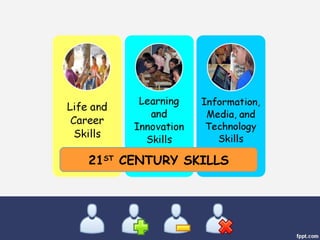
21ST
CENTURY SKILLS
Learning and Innovation Skills
Creativity and Innovation
- demonstrating
originality and
inventiveness in work
- being open and
responsive to new and
diverse perspectives
Learning and Innovation Skills
Critical Thinking and
Problem Solving
- exercising sound reasoning
in understanding
- framing, analyzing, and
synthesizing information in
order to solve problems and
answer questions
Learning and Innovation Skills
Communication and Collaboration
- articulating thoughts and ideas
clearly and effectively through
speaking and writing
- demonstrating ability to work
effectively with diverse teams
Information, Media and
Technology Skills
Information Literacy
- accessing info efficiently and
effectively, evaluating info critically
and competently and using info
accurately and creatively for the
issue or problem at hand
- possessing a fundamental
understanding of the ethical /legal
issues surrounding the access and
use of information
Information, Media and
Technology Skills
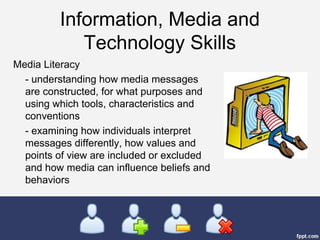
Media Literacy
- understanding how media messages
are constructed, for what purposes and
using which tools, characteristics and
conventions
- examining how individuals interpret
messages differently, how values and
points of view are included or excluded
and how media can influence beliefs and
behaviors
Information, Media and
Technology Skills
ICT Literacy
- using digital technology,
communication tools and / or
networks appropriately
- possess a fundamental
understanding of the ethical /
legal issues surrounding the
access and use of information
Life and Career Skills
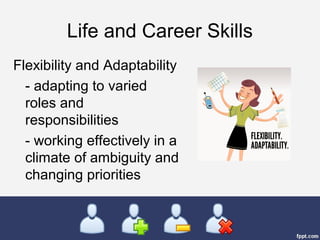
Flexibility and Adaptability
- adapting to varied
roles and
responsibilities
- working effectively in a
climate of ambiguity and
changing priorities
Life and Career Skills
Initiative and Self-Direction
- monitoring one’s own understanding
and learning needs
- going beyond basic mastery of skills
and/or curriculum to explore and
expand one’s own learning and
opportunities to gain expertise
- utilizing time efficiently and managing
workload
- demonstrating commitment to
learning as a lifelong process
Life and Career Skills
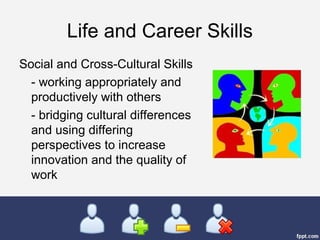
Social and Cross-Cultural Skills
- working appropriately and
productively with others
- bridging cultural differences
and using differing
perspectives to increase
innovation and the quality of
work
Life and Career Skills
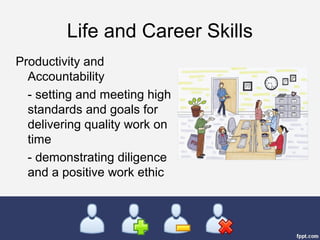
Productivity and
Accountability
- setting and meeting high
standards and goals for
delivering quality work on
time
- demonstrating diligence
and a positive work ethic
Life and Career Skills
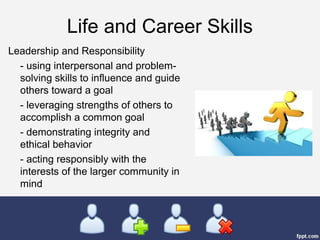
Leadership and Responsibility
- using interpersonal and problem-
solving skills to influence and guide
others toward a goal
- leveraging strengths of others to
accomplish a common goal
- demonstrating integrity and
ethical behavior
- acting responsibly with the
interests of the larger community in
mind
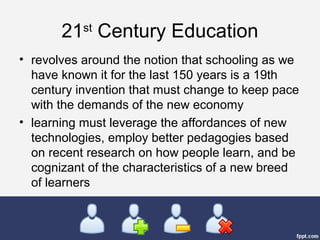
21st
Century Support Systems
• 21st
Century Standards
• Assessment of 21st
Century Skills
• 21st
Century Curriculum and Instruction
• 21st
Century Professional Development

21st century skills

  • 1.
  • 2.
    21st Century Education • revolvesaround the notion that schooling as we have known it for the last 150 years is a 19th century invention that must change to keep pace with the demands of the new economy • learning must leverage the affordances of new technologies, employ better pedagogies based on recent research on how people learn, and be cognizant of the characteristics of a new breed of learners
  • 4.
    Core Subjects • English,reading or language arts • World languages • Arts • Mathematics • Economics • Science • Geography • History • Government and Civics
  • 5.
    Schools must moveto include not only a focus on mastery of core subjects, but also promote understanding of academic content at much higher levels by weaving 21st century interdisciplinary themes into core subjects.
  • 6.
    21st Century Themes Global Awareness •Using 21st century skills to understand and address global issues • Learning from and working collaboratively with individuals representing diverse cultures, religions and lifestyles in a spirit of mutual respect and open dialogue in personal, work and community contexts • Understanding other nations and cultures, including the use of non-English languages
  • 7.
    21st Century Themes Financial, Economic,Business and Entrepreneurial Literacy • Knowing how to make appropriate personal economic choices • Understanding the role of the economy in society • Using entrepreneurial skills to enhance workplace productivity and career options
  • 8.
    21st Century Themes Civic Literacy •Participating effectively in civic life through knowing how to stay informed and understanding governmental processes • Exercising the rights and obligations of citizenship at local, state, national and global levels • Understanding the local and global implications of civic decisions
  • 9.
    21st Century Themes Health Literacy •Obtaining, interpreting and understanding basic health information and services and using such information and services in ways that enhance health • Understanding preventive physical and mental health measures • Using available information to make appropriate health-related decisions • Establishing and monitoring personal and family health goals • Understanding national and international public health and safety issues
  • 10.
    21st Century Themes Environmental Literacy •Demonstrate knowledge and understanding of the environment and the circumstances and conditions affecting it, particularly as relates to air, climate, land, food, energy, water and ecosystems • Demonstrate knowledge and understanding of society’s impact on the natural world (e.g., population growth, population development, resource consumption rate, etc.) • Investigate and analyze environmental issues, and make accurate conclusions about effective solutions • Take individual and collective action towards addressing environmental challenges (e.g., participating in global actions, designing solutions that inspire action on environmental issues)
  • 11.
  • 12.
    Learning and InnovationSkills Creativity and Innovation - demonstrating originality and inventiveness in work - being open and responsive to new and diverse perspectives
  • 13.
    Learning and InnovationSkills Critical Thinking and Problem Solving - exercising sound reasoning in understanding - framing, analyzing, and synthesizing information in order to solve problems and answer questions
  • 14.
    Learning and InnovationSkills Communication and Collaboration - articulating thoughts and ideas clearly and effectively through speaking and writing - demonstrating ability to work effectively with diverse teams
  • 15.
    Information, Media and TechnologySkills Information Literacy - accessing info efficiently and effectively, evaluating info critically and competently and using info accurately and creatively for the issue or problem at hand - possessing a fundamental understanding of the ethical /legal issues surrounding the access and use of information
  • 16.
    Information, Media and TechnologySkills Media Literacy - understanding how media messages are constructed, for what purposes and using which tools, characteristics and conventions - examining how individuals interpret messages differently, how values and points of view are included or excluded and how media can influence beliefs and behaviors
  • 17.
    Information, Media and TechnologySkills ICT Literacy - using digital technology, communication tools and / or networks appropriately - possess a fundamental understanding of the ethical / legal issues surrounding the access and use of information
  • 18.
    Life and CareerSkills Flexibility and Adaptability - adapting to varied roles and responsibilities - working effectively in a climate of ambiguity and changing priorities
  • 19.
    Life and CareerSkills Initiative and Self-Direction - monitoring one’s own understanding and learning needs - going beyond basic mastery of skills and/or curriculum to explore and expand one’s own learning and opportunities to gain expertise - utilizing time efficiently and managing workload - demonstrating commitment to learning as a lifelong process
  • 20.
    Life and CareerSkills Social and Cross-Cultural Skills - working appropriately and productively with others - bridging cultural differences and using differing perspectives to increase innovation and the quality of work
  • 21.
    Life and CareerSkills Productivity and Accountability - setting and meeting high standards and goals for delivering quality work on time - demonstrating diligence and a positive work ethic
  • 22.
    Life and CareerSkills Leadership and Responsibility - using interpersonal and problem- solving skills to influence and guide others toward a goal - leveraging strengths of others to accomplish a common goal - demonstrating integrity and ethical behavior - acting responsibly with the interests of the larger community in mind
  • 23.
    21st Century Support Systems •21st Century Standards • Assessment of 21st Century Skills • 21st Century Curriculum and Instruction • 21st Century Professional Development