

Digital Citizenship @
your school
June Wall
Consultant in eLearning and
Libraries
Overview of
webinars
1. Digital Citizenship @ your school.
 What is the purpose of Digital Citizenship in the
context of learning and safe and ethical use of
technologies in schools. Who is the Digital
Citizenship for – students, staff, parents or
everyone?
2. Tools, strategies and resources for digital citizenship.
 Engaging teaching resources and strategies
3. Designing a digital citizenship program.
 Explore how to design a digital citizenship program
for your school.
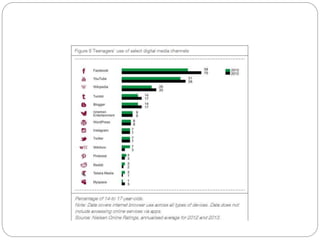
A 2010 ACMA research report, Australia in the
digital economy: The shift to the online
environment, shows the internet is becoming
increasingly important in the daily lives of
Australians. More than 70 per cent of those
aged 14 to 17 now spend more than seven
hours online each week, while one in three aged
over 14 years is online for more than 15 hours
each week.
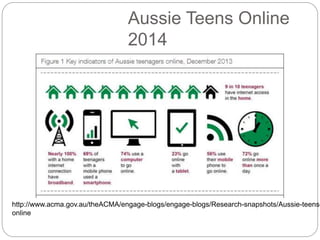
Aussie Teens Online
2014
http://www.acma.gov.au/theACMA/engage-blogs/engage-blogs/Research-snapshots/Aussie-teens-
online
Aussie Teens Online 2014
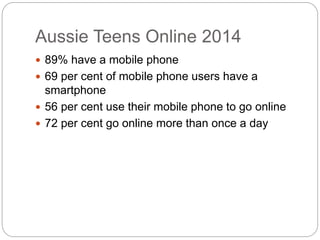
 89% have a mobile phone
 69 per cent of mobile phone users have a
smartphone
 56 per cent use their mobile phone to go online
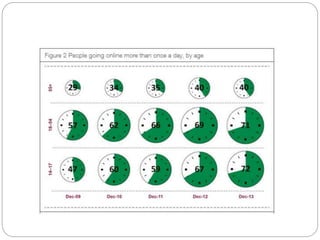
 72 per cent go online more than once a day
Aussie Teens Online 2014
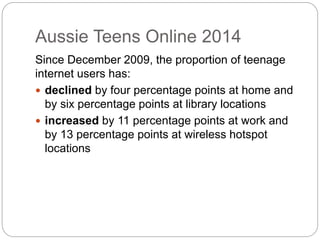
Since December 2009, the proportion of teenage
internet users has:
 declined by four percentage points at home and
by six percentage points at library locations
 increased by 11 percentage points at work and
by 13 percentage points at wireless hotspot
locations
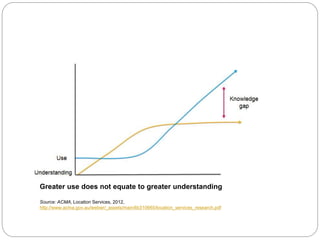
Greater use does not equate to greater understanding
Source: ACMA, Location Services, 2012,
http://www.acma.gov.au/webwr/_assets/main/lib310665/location_services_research.pdf
Digital life in 2025. Net Threats
1. Actions by nation-states to maintain security and political
control will lead to more blocking, filtering, segmentation,
and balkanization of the Internet.
2. Trust will evaporate in the wake of revelations about
government and corporate surveillance and likely greater
surveillance in the future.
3. Commercial pressures affecting everything from Internet
architecture to the flow of information will endanger the open
structure of online life.
4. Efforts to fix the TMI (too much information) problem might
over-compensate and actually thwart content sharinghttp://www.pewinternet.org/files/2014/07/Future-of-the-Internet_Net-
Threats_070314.pdf
Protective measures?
“I remember the first time a student sent me a Facebook
friend request. In considering how to answer, I was not
concerned about what he might learn about me. I am
very conservative about what I share on Facebook and
even personal comments are not very personal. Instead,
I was concerned about what I might learn about
him. Although I have not had a problem with students
whose friend requests I have accepted, I am sure that
most of my student friends are not aware that I am legally
required to report certain incidents if they share them in
an on-line post—even if they consider the post to be
private or for “friends only.” “ Steven Berghttp://www.hastac.org/blogs/steven-l-berg/2013/08/04/high-cost-digital-illiteracy
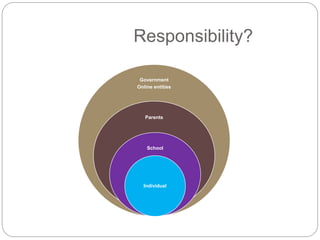
Responsibility?
Government
Online entities
Parents
School
Individual
 In the Digital Australians research the respective roles of industry and
government in protecting children online were explored. Participants were
clear that protecting children from accessing inappropriate or unsuitable
content online is particularly important. While many saw this as the primary
responsibility of parents, participants thought there was also a responsibility
for both content service providers and government.
 In earlier research with parents, the majority preferred to receive cybersafety
information from a government agency, or source it themselves through an
internet search. Around one third of parents reported that a government
agency or an internet search were their preferred first line source of
cybersafety information.
Citizenship -“the quality of an
individual’s response to membership
in a community.”
What is your definition of digital
citizenship?
 Digital citizenship can be defined as the norms of appropriate, responsible
behaviour with regard to technology use.
Or
 “The quality of habits, actions, and consumption patterns that impact the ecology
of digital content and communities.”
Or
 Digital Citizenship is the concept of educating students (and all technology users)
about how to use technology appropriately. This involves using technology
effectively and not misusing it to disadvantage others. Digital Citizenship consists
of numerous themes including appropriate online etiquette, literacy in how digital
technology works and how to use it, an understanding of ethics and the law as it
relates to technology, knowing how to stay safe online, and advice on health
issues relating to the use of technology.
Or
 “Digital citizenship isn’t just about recognising and dealing with online hazards.
It’s about building safe spaces and communities, understanding how to manage
personal information, and about being internet savvy - using your online
presence to grow and shape your world in a safe, creative way, and inspiring
others to do the same.”
digizen.org
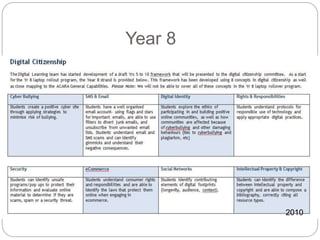
Year 8
2010
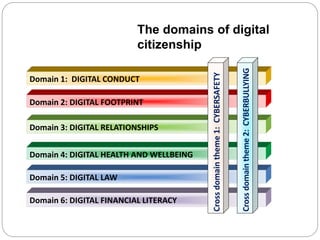
Domain 1: DIGITAL CONDUCT
Domain 2: DIGITAL FOOTPRINT
Domain 3: DIGITAL RELATIONSHIPS
Domain 5: DIGITAL LAW
Domain 4: DIGITAL HEALTH AND WELLBEING
Domain 6: DIGITAL FINANCIAL LITERACY
Crossdomaintheme2:CYBERBULLYING
Crossdomaintheme1:CYBERSAFETY
The domains of digital
citizenship
Digital citizenship – 9 elements
1. Digital access - full electronic participation in society.
2. Digital commerce - electronic buying and selling of goods.
3. Digital communication - electronic exchange of information.
4. Digital literacy - process of teaching and learning about
technology and the use of technology.
5. Digital etiquette - electronic standards of conduct or
procedure.
6. Digital law - electronic responsibility for actions and deeds
7. Digital rights & responsibilities - those freedoms extended to
everyone in a digital world.
8. Digital health & wellness - physical and psychological well-
being in a digital technology world.
9. Digital security - electronic precautions to guarantee safety.
http://www.digitalcitizenship.net/Nine_Elements.html
21st century citizenship
A 21st century citizen is:
 Informed, engaged and active
 Literate in civics
 Proficient in core academic subjects and
interdisciplinary knowledge, such environmental
literacy; financial, economic, business and
entrepreneurial literacy; and health literacy
 Empowered with global competencies and 21st
century skills
 Capable of participating safely, intelligently,
productively and responsibly in the digital world
Preparing for a global and unknown
future
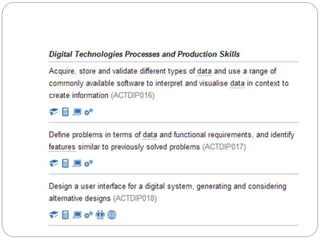
 The Australian Curriculum has Digital
Citizenship (DC) as a concept and sub
categories within DC across the General
Capabilities and the Digital Technologies
curriculum
Purpose of DC for learning
Authentic learning needs a safe environment and trusting
relationships
Authentic learning is experiential learning located in settings that reflect
complex real world problems. It is characterized by:
 Situated learning contexts within which the application of knowledge
and skills may be demonstrated
 Tasks with ill defined real world problems
 Sustained investigation (i.e., time and effort) to arrive at solutions
 Scenarios with multiple roles and perspectives and where expert
performances and processes are modeled (i.e., making tacit
knowledge explicit)
 Collaborative activities to produce real world 'products' or
'performances'
 Reflective practice (as a basis for professional learning)
 Scaffolding and coaching at critical times. Assessment of authentic
learning should be seamlessly integrated with a learning activity that
is practical, realistic and challenging.http://otl.curtin.edu.au/teaching_learning_practice/student_centred/authentic.cf
m
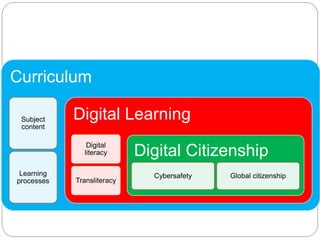
Curriculum
Subject
content
Learning
processes
Digital Learning
Digital
literacy
Transliteracy
Digital Citizenship
Cybersafety Global citizenship
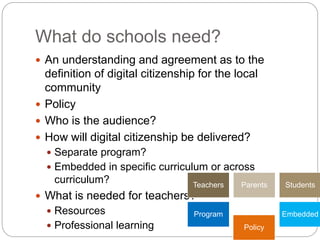
What do schools need?
 An understanding and agreement as to the
definition of digital citizenship for the local
community
 Policy
 Who is the audience?
 How will digital citizenship be delivered?
 Separate program?
 Embedded in specific curriculum or across
curriculum?
 What is needed for teachers?
 Resources
 Professional learning
Teachers Parents Students
Program
Policy
Embedded
Next steps
1. Engage positively
2. Know your online world
3. Choose consciously
Some resources
Cyber bullying an issue for sport
https://secure.ausport.gov.au/sports_coach/technology2/cyber_bullying_an_issue_for
_sport
Check out http://theinnovativeeducator.blogspot.com.au/2011/08/discover-what-your-
digital-footprint.html
www.acma.gov.au/theACMA/engage-blogs/engage-blogs/Cybersmart/Cultivating-
Digital-Citizenship-Together
Cyber smart http://www.cybersmart.gov.au/cybersmart-citizens.aspx
My contact details
june@junewall.com.au
Twitter @junewall
http://www.slideshare.net/junewal
l/

Digital citizenship @ your school

  • 1.
    Digital Citizenship @ yourschool June Wall Consultant in eLearning and Libraries
  • 2.
    Overview of webinars 1. DigitalCitizenship @ your school.  What is the purpose of Digital Citizenship in the context of learning and safe and ethical use of technologies in schools. Who is the Digital Citizenship for – students, staff, parents or everyone? 2. Tools, strategies and resources for digital citizenship.  Engaging teaching resources and strategies 3. Designing a digital citizenship program.  Explore how to design a digital citizenship program for your school.
  • 3.
    A 2010 ACMAresearch report, Australia in the digital economy: The shift to the online environment, shows the internet is becoming increasingly important in the daily lives of Australians. More than 70 per cent of those aged 14 to 17 now spend more than seven hours online each week, while one in three aged over 14 years is online for more than 15 hours each week.
  • 4.
  • 5.
    Aussie Teens Online2014  89% have a mobile phone  69 per cent of mobile phone users have a smartphone  56 per cent use their mobile phone to go online  72 per cent go online more than once a day
  • 6.
    Aussie Teens Online2014 Since December 2009, the proportion of teenage internet users has:  declined by four percentage points at home and by six percentage points at library locations  increased by 11 percentage points at work and by 13 percentage points at wireless hotspot locations
  • 9.
    Greater use doesnot equate to greater understanding Source: ACMA, Location Services, 2012, http://www.acma.gov.au/webwr/_assets/main/lib310665/location_services_research.pdf
  • 10.
    Digital life in2025. Net Threats 1. Actions by nation-states to maintain security and political control will lead to more blocking, filtering, segmentation, and balkanization of the Internet. 2. Trust will evaporate in the wake of revelations about government and corporate surveillance and likely greater surveillance in the future. 3. Commercial pressures affecting everything from Internet architecture to the flow of information will endanger the open structure of online life. 4. Efforts to fix the TMI (too much information) problem might over-compensate and actually thwart content sharinghttp://www.pewinternet.org/files/2014/07/Future-of-the-Internet_Net- Threats_070314.pdf
  • 11.
    Protective measures? “I rememberthe first time a student sent me a Facebook friend request. In considering how to answer, I was not concerned about what he might learn about me. I am very conservative about what I share on Facebook and even personal comments are not very personal. Instead, I was concerned about what I might learn about him. Although I have not had a problem with students whose friend requests I have accepted, I am sure that most of my student friends are not aware that I am legally required to report certain incidents if they share them in an on-line post—even if they consider the post to be private or for “friends only.” “ Steven Berghttp://www.hastac.org/blogs/steven-l-berg/2013/08/04/high-cost-digital-illiteracy
  • 13.
  • 14.
     In theDigital Australians research the respective roles of industry and government in protecting children online were explored. Participants were clear that protecting children from accessing inappropriate or unsuitable content online is particularly important. While many saw this as the primary responsibility of parents, participants thought there was also a responsibility for both content service providers and government.  In earlier research with parents, the majority preferred to receive cybersafety information from a government agency, or source it themselves through an internet search. Around one third of parents reported that a government agency or an internet search were their preferred first line source of cybersafety information.
  • 15.
    Citizenship -“the qualityof an individual’s response to membership in a community.”
  • 16.
    What is yourdefinition of digital citizenship?
  • 17.
     Digital citizenshipcan be defined as the norms of appropriate, responsible behaviour with regard to technology use. Or  “The quality of habits, actions, and consumption patterns that impact the ecology of digital content and communities.” Or  Digital Citizenship is the concept of educating students (and all technology users) about how to use technology appropriately. This involves using technology effectively and not misusing it to disadvantage others. Digital Citizenship consists of numerous themes including appropriate online etiquette, literacy in how digital technology works and how to use it, an understanding of ethics and the law as it relates to technology, knowing how to stay safe online, and advice on health issues relating to the use of technology. Or  “Digital citizenship isn’t just about recognising and dealing with online hazards. It’s about building safe spaces and communities, understanding how to manage personal information, and about being internet savvy - using your online presence to grow and shape your world in a safe, creative way, and inspiring others to do the same.” digizen.org
  • 18.
  • 19.
    Domain 1: DIGITALCONDUCT Domain 2: DIGITAL FOOTPRINT Domain 3: DIGITAL RELATIONSHIPS Domain 5: DIGITAL LAW Domain 4: DIGITAL HEALTH AND WELLBEING Domain 6: DIGITAL FINANCIAL LITERACY Crossdomaintheme2:CYBERBULLYING Crossdomaintheme1:CYBERSAFETY The domains of digital citizenship
  • 20.
    Digital citizenship –9 elements 1. Digital access - full electronic participation in society. 2. Digital commerce - electronic buying and selling of goods. 3. Digital communication - electronic exchange of information. 4. Digital literacy - process of teaching and learning about technology and the use of technology. 5. Digital etiquette - electronic standards of conduct or procedure. 6. Digital law - electronic responsibility for actions and deeds 7. Digital rights & responsibilities - those freedoms extended to everyone in a digital world. 8. Digital health & wellness - physical and psychological well- being in a digital technology world. 9. Digital security - electronic precautions to guarantee safety. http://www.digitalcitizenship.net/Nine_Elements.html
  • 21.
    21st century citizenship A21st century citizen is:  Informed, engaged and active  Literate in civics  Proficient in core academic subjects and interdisciplinary knowledge, such environmental literacy; financial, economic, business and entrepreneurial literacy; and health literacy  Empowered with global competencies and 21st century skills  Capable of participating safely, intelligently, productively and responsibly in the digital world
  • 23.
    Preparing for aglobal and unknown future  The Australian Curriculum has Digital Citizenship (DC) as a concept and sub categories within DC across the General Capabilities and the Digital Technologies curriculum
  • 25.
    Purpose of DCfor learning Authentic learning needs a safe environment and trusting relationships Authentic learning is experiential learning located in settings that reflect complex real world problems. It is characterized by:  Situated learning contexts within which the application of knowledge and skills may be demonstrated  Tasks with ill defined real world problems  Sustained investigation (i.e., time and effort) to arrive at solutions  Scenarios with multiple roles and perspectives and where expert performances and processes are modeled (i.e., making tacit knowledge explicit)  Collaborative activities to produce real world 'products' or 'performances'  Reflective practice (as a basis for professional learning)  Scaffolding and coaching at critical times. Assessment of authentic learning should be seamlessly integrated with a learning activity that is practical, realistic and challenging.http://otl.curtin.edu.au/teaching_learning_practice/student_centred/authentic.cf m
  • 26.
  • 27.
    What do schoolsneed?  An understanding and agreement as to the definition of digital citizenship for the local community  Policy  Who is the audience?  How will digital citizenship be delivered?  Separate program?  Embedded in specific curriculum or across curriculum?  What is needed for teachers?  Resources  Professional learning Teachers Parents Students Program Policy Embedded
  • 28.
    Next steps 1. Engagepositively 2. Know your online world 3. Choose consciously
  • 29.
    Some resources Cyber bullyingan issue for sport https://secure.ausport.gov.au/sports_coach/technology2/cyber_bullying_an_issue_for _sport Check out http://theinnovativeeducator.blogspot.com.au/2011/08/discover-what-your- digital-footprint.html www.acma.gov.au/theACMA/engage-blogs/engage-blogs/Cybersmart/Cultivating- Digital-Citizenship-Together Cyber smart http://www.cybersmart.gov.au/cybersmart-citizens.aspx
  • 30.
    My contact details june@junewall.com.au Twitter@junewall http://www.slideshare.net/junewal l/

Editor's Notes

  • #10 With rapidly evolving technologies and services, it is difficult to keep up with the implications, as well as the potential threats. Scams and online fraud are becoming more sophisticated – and target businesses as well as individuals. There is no ‘set and forget’ in developing consumer education. For example, recently the ACMA commissioned community research to explore Australians concerns and understanding of the risks associated with the use of location services – there is a vast array of commercial applications and tools which use people’s location to add value and provide tailored information or services to users. These services are growing in popularity, especially among smartphone users and there are currently few guidelines or consumer safeguards in place. Our research with location services users found that greater use of location services (either more often or accessing a wider range of services) does not equate to a greater understanding of these services, as shown in the slide. Interest in and understanding of personal information security was relatively low and appeared to remain static, despite increased time exposed to Location Services. At the same time, our quantitative research found there was considerable concern amongst users about data security and the security of personal information when accessing services. Ultimately, despite their concerns, the desire to obtain the Location Service outweighed the risks and any conditions attached to downloading the service.
  • #20 The program is based on six domains and two cross-domain themes. It covers safety, security and the law, as well as positive online roles and relationships. These have been developed by the Department of Education and Training as part of the Digital Education Revolution – NSW. More detailed information on the domains can be explored in a Prezi, available from: http://prezi.com/cesxdf3f-f8q/shifting-from-cyber-bully-to-digital-citizen/ and at http://www.digitalcitizenship.nsw.edu.au/Sec_Splash/documents/domains_and_themes.pdf