Thematic Approach
This way of teaching and
learning , whereby different
areas of the curriculum are
related together and
integrated to a central
theme.
•It allows literacy to grow
progressively.
•It guides connected ideas to
follow on easily.
•Loughran (2005) similarly reiterates that the
idea of teaching with themes as a means of
integrating curriculum can be traced back to
the reforms of 1930’s (Lipson et al. 1993).
•Dewey (1990,140) discussed “meaningful
learning” for young children as their attempt
to “seek wholes, varied through episode,
enlivened with action, and defined in salient
features”
Thematic teaching is about
students actively constructing
their own knowledge.
Piaget (1962) believed that knowledge is
built in a slow, continuous construction
of skills and understanding that each
child brings to each situation as he or
she matures.
Vygotsky (1997, 175) suggested
that social interaction and
collaboration were powerful
sources of transformation in the
child's thinking.
Thematic Approach
-is the process of integrating and
linking multiple elements of a
curriculum in an ongoing
exploration of many different
aspects of a topic or subject.
Elements that foster success in a
thematic project.
•initiation of the theme
•the teacher’s role
•group exploration
•Integrating the theme with curriculum
and learning centers
•Building and maintaining spirit and
enthusiasm
CONSTRUCTIVISM APPROACH
•Understanding the
world through refection
of one's experiences.
•Wilson (2003)
-Constructivists see reading as a social
practice which affect when you read, what you
read, where you read, who you read with and
why and how you read.
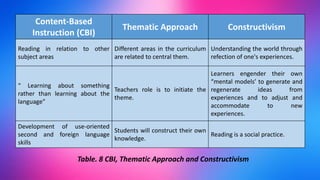
Content-Based
Instruction (CBI)
Thematic Approach Constructivism
Reading in relation to other
subject areas
Different areas in the curriculum
are related to central them.
Understanding the world through
refection of one's experiences.
“ Learning about something
rather than learning about the
language”
Teachers role is to initiate the
theme.
Learners engender their own
“mental models’ to generate and
regenerate ideas from
experiences and to adjust and
accommodate to new
experiences.
Development of use-oriented
second and foreign language
skills
Students will construct their own
knowledge.
Reading is a social practice.
Table. 8 CBI, Thematic Approach and Constructivism

Thematic approach

  • 1.
  • 2.
    This way ofteaching and learning , whereby different areas of the curriculum are related together and integrated to a central theme.
  • 3.
    •It allows literacyto grow progressively. •It guides connected ideas to follow on easily.
  • 4.
    •Loughran (2005) similarlyreiterates that the idea of teaching with themes as a means of integrating curriculum can be traced back to the reforms of 1930’s (Lipson et al. 1993). •Dewey (1990,140) discussed “meaningful learning” for young children as their attempt to “seek wholes, varied through episode, enlivened with action, and defined in salient features”
  • 5.
    Thematic teaching isabout students actively constructing their own knowledge.
  • 6.
    Piaget (1962) believedthat knowledge is built in a slow, continuous construction of skills and understanding that each child brings to each situation as he or she matures.
  • 7.
    Vygotsky (1997, 175)suggested that social interaction and collaboration were powerful sources of transformation in the child's thinking.
  • 8.
    Thematic Approach -is theprocess of integrating and linking multiple elements of a curriculum in an ongoing exploration of many different aspects of a topic or subject.
  • 9.
    Elements that fostersuccess in a thematic project. •initiation of the theme •the teacher’s role •group exploration •Integrating the theme with curriculum and learning centers •Building and maintaining spirit and enthusiasm
  • 10.
  • 11.
    •Understanding the world throughrefection of one's experiences.
  • 12.
    •Wilson (2003) -Constructivists seereading as a social practice which affect when you read, what you read, where you read, who you read with and why and how you read.
  • 13.
    Content-Based Instruction (CBI) Thematic ApproachConstructivism Reading in relation to other subject areas Different areas in the curriculum are related to central them. Understanding the world through refection of one's experiences. “ Learning about something rather than learning about the language” Teachers role is to initiate the theme. Learners engender their own “mental models’ to generate and regenerate ideas from experiences and to adjust and accommodate to new experiences. Development of use-oriented second and foreign language skills Students will construct their own knowledge. Reading is a social practice. Table. 8 CBI, Thematic Approach and Constructivism

Editor's Notes

  • #3 It allows learning to be more relaxed and less scrappy than when school day time is divided into different subject areas and practice exercisec which frequently relate to nothing other than what the teacher thinks of, as he/she write them on the black board.
  • #5 There must be movement, the sense of use and operation-inspection of things separated from the ideas by which they are carried
  • #12 Learners engender their own “mental models’ to generate and regenerate ideas from experiences and to adjust and accommodate to new experiences.
  • #13 Interacting with text can involve practices as diverse as reading instructions, scanning a newspaper or reading an academic article.