REFERENCING STYLES
Presented by:
Prakash Aryal
P299.SPRING Programme 2013/14
School of Urban and Regional Planning
University of Philippines. Dilimian. Quezon city
December 12, 2013
Referencing Styles
• What is it?
• Difference between reference and bibliography
• Why we need to reference
• What to reference
• When to reference

• How to reference
• Difference referencing styles
• More Examples about APA
• Referencing tools
• Summary
Reference and Citing
• REFERENCE: the detailed description of the

document from which you have obtained your
information. Referencing is a way of demonstrating
that you have done that reading.
• CITING: acknowledging within your text the

document from which you have obtained your
information.
http://iskillzone.uwe.ac.uk/RenderPages/RenderConstellation.aspx?Context=10&Area=8&Room=25&Constellation=80
Reference Vs. Bibliography
• The terms „References‟ and „Bibliography‟

are often used synonymously, but there is a
difference in meaning between them.
• References are the items you have read and

specifically referred to (or cited) in your work
, and your list of sources at the end of the
assignment will be headed „References‟.
http://www.brad.ac.uk/management/media/management/els/References-and-Bibliographies.pdf
Reference vs. Bibliography
• Bibliography is a list of everything you read -

whether or not you referred specifically to it .
• Normally contain sources that have been cited
and also those found to be influential, but
decided not to cite.
• A bibliography can give a tutor an overview of
which authors have influenced your ideas and
arguments even if you do not specifically refer
to them.
http://iskillzone.uwe.ac.uk/RenderPages/RenderConstellation.aspx?Context=10&Area=8&Room=25&Constellation=80
Why do we need reference?
• To acknowledge others works

• To allow others (readers) to find the original

sources easily (cited reference)
• To get recognition & authentication of the
work.
• To make the work informative. (Quality)
• To trace the intellectual development of the
ideas you present.

• To avoid plagiarism
Plagiarism
Examples:
• the verbatim copying of others work
withoutacknowledgement.
• the close paraphrasing of others work by
simply changing a few words of altering the
order of presentation.
• Coping others idea
• the unacknowledged quotation of phrases.
WHAT NEEDS TO BE REFERENCED?
• Has it been presented formally into the public

domain in some way?
• Has it been presented in a tangible form? (Printed
material, the Internet, a public talk/lecture etc).
• Does someone have an ownership of it? Look for
a named author or writer, or
organization, including a website or host?
• Is the information presented in the source in
question outside the realm of „common
knowledge‟ ?
http://www.brad.ac.uk/management/media/management/els/References-and-Bibliographies.pdf
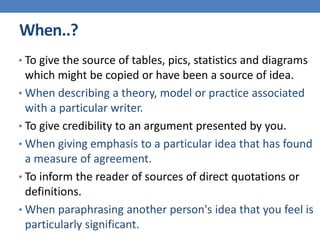
When..?
• To give the source of tables, pics, statistics and diagrams

which might be copied or have been a source of idea.
• When describing a theory, model or practice associated
with a particular writer.
• To give credibility to an argument presented by you.
• When giving emphasis to a particular idea that has found
a measure of agreement.
• To inform the reader of sources of direct quotations or
definitions.
• When paraphrasing another person's idea that you feel is
particularly significant.
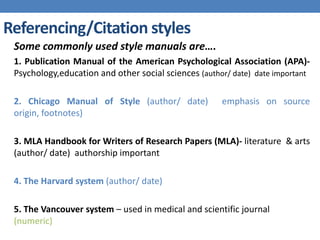
Referencing/Citation styles
Some commonly used style manuals are….
1. Publication Manual of the American Psychological Association (APA)Psychology,education and other social sciences (author/ date) date important
2. Chicago Manual of Style (author/ date)
origin, footnotes)

emphasis on source

3. MLA Handbook for Writers of Research Papers (MLA)- literature & arts
(author/ date) authorship important
4. The Harvard system (author/ date)
5. The Vancouver system – used in medical and scientific journal
(numeric)
Author date Vs Numeric Styles
Example of Numeric Styles
• According to Myers[1] the reason for….
The reference is presented as a footnote at the bottom
of the page or at the end of your work:
[1]Myers, D. (2008) Construction economics: a new
approach, 2nd ed., London: Taylor and Francis, p.159
Author date style
Barter (2003, p.258) has shown that…..
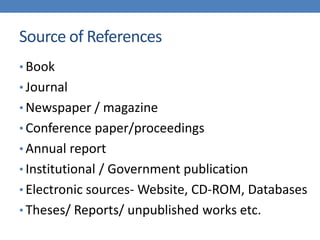
Source of References
• Book

• Journal
• Newspaper / magazine
• Conference paper/proceedings
• Annual report
• Institutional / Government publication
• Electronic sources- Website, CD-ROM, Databases
• Theses/ Reports/ unpublished works etc.
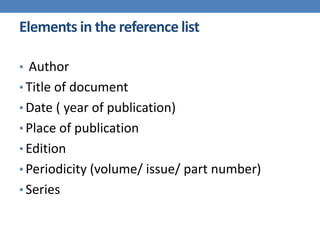
Elements in the reference list
• Author

• Title of document
• Date ( year of publication)
• Place of publication
• Edition
• Periodicity (volume/ issue/ part number)
• Series
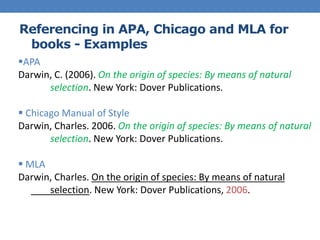
Referencing in APA, Chicago and MLA for
books - Examples
APA
Darwin, C. (2006). On the origin of species: By means of natural
selection. New York: Dover Publications.
 Chicago Manual of Style
Darwin, Charles. 2006. On the origin of species: By means of natural
selection. New York: Dover Publications.
 MLA
Darwin, Charles. On the origin of species: By means of natural
selection. New York: Dover Publications, 2006.
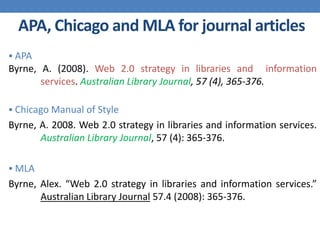
APA, Chicago and MLA for journal articles
 APA

Byrne, A. (2008). Web 2.0 strategy in libraries and information
services. Australian Library Journal, 57 (4), 365-376.
 Chicago Manual of Style

Byrne, A. 2008. Web 2.0 strategy in libraries and information services.
Australian Library Journal, 57 (4): 365-376.
 MLA

Byrne, Alex. “Web 2.0 strategy in libraries and information services.”
Australian Library Journal 57.4 (2008): 365-376.
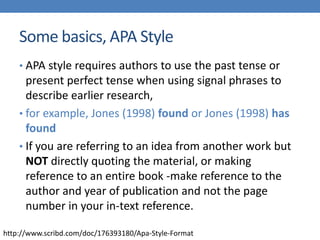
Some basics, APA Style
• APA style requires authors to use the past tense or

present perfect tense when using signal phrases to
describe earlier research,
• for example, Jones (1998) found or Jones (1998) has
found
• If you are referring to an idea from another work but
NOT directly quoting the material, or making
reference to an entire book -make reference to the
author and year of publication and not the page
number in your in-text reference.
http://www.scribd.com/doc/176393180/Apa-Style-Format
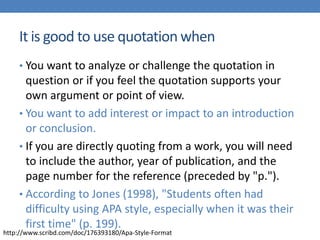
It is good to use quotation when
• You want to analyze or challenge the quotation in

question or if you feel the quotation supports your
own argument or point of view.
• You want to add interest or impact to an introduction
or conclusion.
• If you are directly quoting from a work, you will need
to include the author, year of publication, and the
page number for the reference (preceded by "p.").
• According to Jones (1998), "Students often had
difficulty using APA style, especially when it was their
first time" (p. 199).

http://www.scribd.com/doc/176393180/Apa-Style-Format
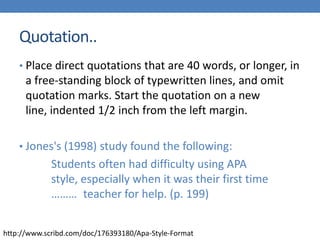
Quotation..
• Place direct quotations that are 40 words, or longer, in

a free-standing block of typewritten lines, and omit
quotation marks. Start the quotation on a new
line, indented 1/2 inch from the left margin.
• Jones's (1998) study found the following:

Students often had difficulty using APA
style, especially when it was their first time
……… teacher for help. (p. 199)
http://www.scribd.com/doc/176393180/Apa-Style-Format
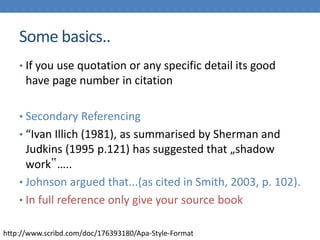
Some basics..
• If you use quotation or any specific detail its good

have page number in citation
• Secondary Referencing
• “Ivan Illich (1981), as summarised by Sherman and

Judkins (1995 p.121) has suggested that „shadow
work‟…..
• Johnson argued that...(as cited in Smith, 2003, p. 102).
• In full reference only give your source book
http://www.scribd.com/doc/176393180/Apa-Style-Format
Some basics
• A Work by Three to Five Authors:
• List all the authors the first time you cite the source.

(Kernis, Cornell, Sun, Berry, & Harlow, 1993)
• In subsequent citations, (Kernis et al., 1993)
• Organization as an Author:
• If the author is an organization or a government
agency, According to the American Psychological
Association (2000),...
• If the organization has a well-known abbreviation
• First citation: (Mothers Against Drunk Driving
[MADD], 2000) Second citation: (MADD, 2000)
http://www.scribd.com/doc/176393180/Apa-Style-Format
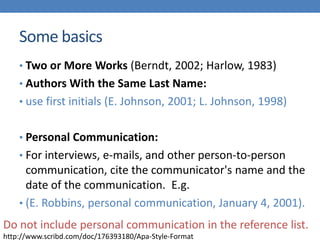
Some basics
• Two or More Works (Berndt, 2002; Harlow, 1983)

• Authors With the Same Last Name:
• use first initials (E. Johnson, 2001; L. Johnson, 1998)

• Personal Communication:
• For interviews, e-mails, and other person-to-person

communication, cite the communicator's name and the
date of the communication. E.g.
• (E. Robbins, personal communication, January 4, 2001).
Do not include personal communication in the reference list.
http://www.scribd.com/doc/176393180/Apa-Style-Format
APA Style
Some Examples
Books

Reference list

Citation

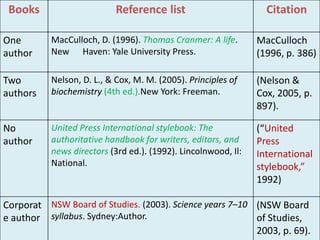
One
author

MacCulloch, D. (1996). Thomas Cranmer: A life.
New Haven: Yale University Press.

MacCulloch
(1996, p. 386)

Two
authors

Nelson, D. L., & Cox, M. M. (2005). Principles of
biochemistry (4th ed.).New York: Freeman.

(Nelson &
Cox, 2005, p.
897).

No
author

United Press International stylebook: The
authoritative handbook for writers, editors, and
news directors (3rd ed.). (1992). Lincolnwood, Il:
National.

(“United
Press
International
stylebook,”
1992)

Corporat NSW Board of Studies. (2003). Science years 7–10 (NSW Board
e author syllabus. Sydney:Author.
of Studies,
2003, p. 69).
Books

Reference list

Citation

Edited
book

Burchfield, R. W. (Ed.). (1996). The new Fowler’s
modern English usage
(3rd ed.). Oxford: Oxford University Press.

(Burchfield,
1996, p. 707).

Article or
chapter
in an
edited
book

Rospond, R. M. (2003). Pain assessment. In R. M.
Jones & R. M. Rospond (Eds.), Patient assessment
in pharmacy practice (pp. 160–170). Baltimore:
Lippincott Williams & Wilkins.

(Rospond,
2003)

1. Introduction written by someone other than
the author of the book.
Fuller, R. B. (1971). [Introduction]. In V.
Papanek, Design for the real world (pp. vii–xix).
New York: Pantheon.

(Fuller, 1971,
p. xi)

http://www.csu.edu.au/division/studserv/my-studies/learning/pdfs/apa.pdf
Journal
& Mag.

Reference list

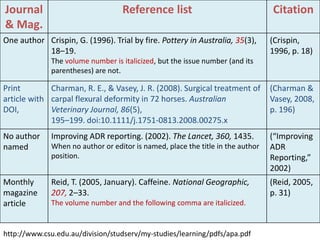
One author Crispin, G. (1996). Trial by fire. Pottery in Australia, 35(3),
18–19.

Citation
(Crispin,
1996, p. 18)

The volume number is italicized, but the issue number (and its
parentheses) are not.

Print
Charman, R. E., & Vasey, J. R. (2008). Surgical treatment of
article with carpal flexural deformity in 72 horses. Australian
DOI,
Veterinary Journal, 86(5),
195–199. doi:10.1111/j.1751-0813.2008.00275.x

(Charman &
Vasey, 2008,
p. 196)

No author
named

Improving ADR reporting. (2002). The Lancet, 360, 1435.
When no author or editor is named, place the title in the author
position.

(“Improving
ADR
Reporting,”
2002)

Monthly
magazine
article

Reid, T. (2005, January). Caffeine. National Geographic,
207, 2–33.

(Reid, 2005,
p. 31)

The volume number and the following comma are italicized.

http://www.csu.edu.au/division/studserv/my-studies/learning/pdfs/apa.pdf
Journal

Reference list

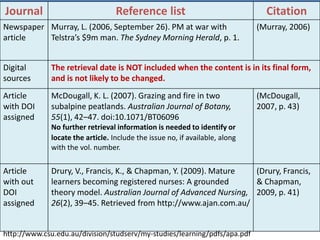
Newspaper Murray, L. (2006, September 26). PM at war with
article
Telstra’s $9m man. The Sydney Morning Herald, p. 1.

Citation
(Murray, 2006)

Digital
sources

The retrieval date is NOT included when the content is in its final form,
and is not likely to be changed.

Article
with DOI
assigned

McDougall, K. L. (2007). Grazing and fire in two
subalpine peatlands. Australian Journal of Botany,
55(1), 42–47. doi:10.1071/BT06096

(McDougall,
2007, p. 43)

No further retrieval information is needed to identify or
locate the article. Include the issue no, if available, along
with the vol. number.

Article
with out
DOI
assigned

Drury, V., Francis, K., & Chapman, Y. (2009). Mature
(Drury, Francis,
learners becoming registered nurses: A grounded
& Chapman,
theory model. Australian Journal of Advanced Nursing, 2009, p. 41)
26(2), 39–45. Retrieved from http://www.ajan.com.au/

http://www.csu.edu.au/division/studserv/my-studies/learning/pdfs/apa.pdf
Ebook

Reference list

Citation

(Book
through
database

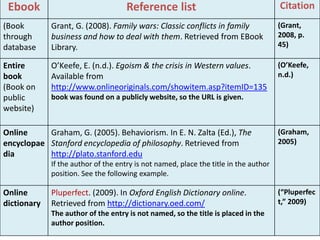
Grant, G. (2008). Family wars: Classic conflicts in family
business and how to deal with them. Retrieved from EBook
Library.

(Grant,
2008, p.
45)

Entire
book
(Book on
public
website)

O’Keefe, E. (n.d.). Egoism & the crisis in Western values.
Available from
http://www.onlineoriginals.com/showitem.asp?itemID=135

(O’Keefe,
n.d.)

book was found on a publicly website, so the URL is given.

Online
Graham, G. (2005). Behaviorism. In E. N. Zalta (Ed.), The
encyclopae Stanford encyclopedia of philosophy. Retrieved from
dia
http://plato.stanford.edu

(Graham,
2005)

If the author of the entry is not named, place the title in the author
position. See the following example.

Online
dictionary

Pluperfect. (2009). In Oxford English Dictionary online.
Retrieved from http://dictionary.oed.com/
The author of the entry is not named, so the title is placed in the
author position.

(“Pluperfec
t,” 2009)
Ebook

Reference list

Citation

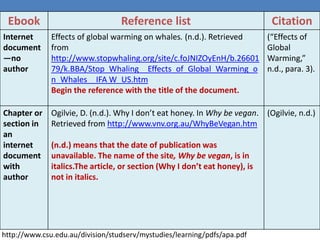
Internet
document
—no
author

Effects of global warming on whales. (n.d.). Retrieved
from
http://www.stopwhaling.org/site/c.foJNIZOyEnH/b.26601
79/k.BBA/Stop_Whaling__Effects_of_Global_Warming_o
n_Whales__IFA W_US.htm
Begin the reference with the title of the document.

(“Effects of
Global
Warming,”
n.d., para. 3).

Chapter or
section in
an
internet
document
with
author

Ogilvie, D. (n.d.). Why I don’t eat honey. In Why be vegan. (Ogilvie, n.d.)
Retrieved from http://www.vnv.org.au/WhyBeVegan.htm

(n.d.) means that the date of publication was
unavailable. The name of the site, Why be vegan, is in
italics.The article, or section (Why I don’t eat honey), is
not in italics.

http://www.csu.edu.au/division/studserv/mystudies/learning/pdfs/apa.pdf
Referencing Tools
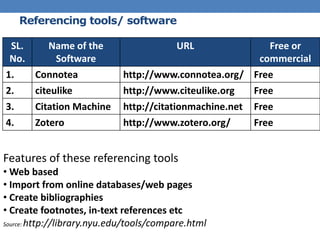
Referencing tools/ software

SL.
No.
1.
2.
3.
4.

Name of the
Software
Connotea
citeulike
Citation Machine
Zotero

URL

Free or
commercial
http://www.connotea.org/ Free
http://www.citeulike.org
Free
http://citationmachine.net Free
http://www.zotero.org/
Free

Features of these referencing tools
• Web based
• Import from online databases/web pages
• Create bibliographies
• Create footnotes, in-text references etc
Source: http://library.nyu.edu/tools/compare.html
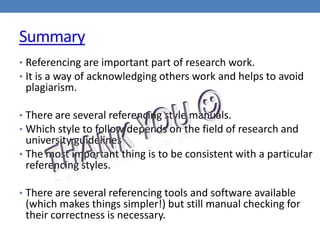
Summary
• Referencing are important part of research work.
• It is a way of acknowledging others work and helps to avoid

plagiarism.

• There are several referencing style manuals.
• Which style to follow depends on the field of research and

university guidelines
• The most important thing is to be consistent with a particular
referencing styles.
• There are several referencing tools and software available

(which makes things simpler!) but still manual checking for
their correctness is necessary.

Referencing styles & Bibliography

  • 1.
    REFERENCING STYLES Presented by: PrakashAryal P299.SPRING Programme 2013/14 School of Urban and Regional Planning University of Philippines. Dilimian. Quezon city December 12, 2013
  • 2.
    Referencing Styles • Whatis it? • Difference between reference and bibliography • Why we need to reference • What to reference • When to reference • How to reference • Difference referencing styles • More Examples about APA • Referencing tools • Summary
  • 3.
    Reference and Citing •REFERENCE: the detailed description of the document from which you have obtained your information. Referencing is a way of demonstrating that you have done that reading. • CITING: acknowledging within your text the document from which you have obtained your information. http://iskillzone.uwe.ac.uk/RenderPages/RenderConstellation.aspx?Context=10&Area=8&Room=25&Constellation=80
  • 4.
    Reference Vs. Bibliography •The terms „References‟ and „Bibliography‟ are often used synonymously, but there is a difference in meaning between them. • References are the items you have read and specifically referred to (or cited) in your work , and your list of sources at the end of the assignment will be headed „References‟. http://www.brad.ac.uk/management/media/management/els/References-and-Bibliographies.pdf
  • 5.
    Reference vs. Bibliography •Bibliography is a list of everything you read - whether or not you referred specifically to it . • Normally contain sources that have been cited and also those found to be influential, but decided not to cite. • A bibliography can give a tutor an overview of which authors have influenced your ideas and arguments even if you do not specifically refer to them. http://iskillzone.uwe.ac.uk/RenderPages/RenderConstellation.aspx?Context=10&Area=8&Room=25&Constellation=80
  • 6.
    Why do weneed reference? • To acknowledge others works • To allow others (readers) to find the original sources easily (cited reference) • To get recognition & authentication of the work. • To make the work informative. (Quality) • To trace the intellectual development of the ideas you present. • To avoid plagiarism
  • 7.
    Plagiarism Examples: • the verbatimcopying of others work withoutacknowledgement. • the close paraphrasing of others work by simply changing a few words of altering the order of presentation. • Coping others idea • the unacknowledged quotation of phrases.
  • 8.
    WHAT NEEDS TOBE REFERENCED? • Has it been presented formally into the public domain in some way? • Has it been presented in a tangible form? (Printed material, the Internet, a public talk/lecture etc). • Does someone have an ownership of it? Look for a named author or writer, or organization, including a website or host? • Is the information presented in the source in question outside the realm of „common knowledge‟ ? http://www.brad.ac.uk/management/media/management/els/References-and-Bibliographies.pdf
  • 9.
    When..? • To givethe source of tables, pics, statistics and diagrams which might be copied or have been a source of idea. • When describing a theory, model or practice associated with a particular writer. • To give credibility to an argument presented by you. • When giving emphasis to a particular idea that has found a measure of agreement. • To inform the reader of sources of direct quotations or definitions. • When paraphrasing another person's idea that you feel is particularly significant.
  • 10.
    Referencing/Citation styles Some commonlyused style manuals are…. 1. Publication Manual of the American Psychological Association (APA)Psychology,education and other social sciences (author/ date) date important 2. Chicago Manual of Style (author/ date) origin, footnotes) emphasis on source 3. MLA Handbook for Writers of Research Papers (MLA)- literature & arts (author/ date) authorship important 4. The Harvard system (author/ date) 5. The Vancouver system – used in medical and scientific journal (numeric)
  • 11.
    Author date VsNumeric Styles Example of Numeric Styles • According to Myers[1] the reason for…. The reference is presented as a footnote at the bottom of the page or at the end of your work: [1]Myers, D. (2008) Construction economics: a new approach, 2nd ed., London: Taylor and Francis, p.159 Author date style Barter (2003, p.258) has shown that…..
  • 12.
    Source of References •Book • Journal • Newspaper / magazine • Conference paper/proceedings • Annual report • Institutional / Government publication • Electronic sources- Website, CD-ROM, Databases • Theses/ Reports/ unpublished works etc.
  • 13.
    Elements in thereference list • Author • Title of document • Date ( year of publication) • Place of publication • Edition • Periodicity (volume/ issue/ part number) • Series
  • 14.
    Referencing in APA,Chicago and MLA for books - Examples APA Darwin, C. (2006). On the origin of species: By means of natural selection. New York: Dover Publications.  Chicago Manual of Style Darwin, Charles. 2006. On the origin of species: By means of natural selection. New York: Dover Publications.  MLA Darwin, Charles. On the origin of species: By means of natural selection. New York: Dover Publications, 2006.
  • 15.
    APA, Chicago andMLA for journal articles  APA Byrne, A. (2008). Web 2.0 strategy in libraries and information services. Australian Library Journal, 57 (4), 365-376.  Chicago Manual of Style Byrne, A. 2008. Web 2.0 strategy in libraries and information services. Australian Library Journal, 57 (4): 365-376.  MLA Byrne, Alex. “Web 2.0 strategy in libraries and information services.” Australian Library Journal 57.4 (2008): 365-376.
  • 16.
    Some basics, APAStyle • APA style requires authors to use the past tense or present perfect tense when using signal phrases to describe earlier research, • for example, Jones (1998) found or Jones (1998) has found • If you are referring to an idea from another work but NOT directly quoting the material, or making reference to an entire book -make reference to the author and year of publication and not the page number in your in-text reference. http://www.scribd.com/doc/176393180/Apa-Style-Format
  • 17.
    It is goodto use quotation when • You want to analyze or challenge the quotation in question or if you feel the quotation supports your own argument or point of view. • You want to add interest or impact to an introduction or conclusion. • If you are directly quoting from a work, you will need to include the author, year of publication, and the page number for the reference (preceded by "p."). • According to Jones (1998), "Students often had difficulty using APA style, especially when it was their first time" (p. 199). http://www.scribd.com/doc/176393180/Apa-Style-Format
  • 18.
    Quotation.. • Place directquotations that are 40 words, or longer, in a free-standing block of typewritten lines, and omit quotation marks. Start the quotation on a new line, indented 1/2 inch from the left margin. • Jones's (1998) study found the following: Students often had difficulty using APA style, especially when it was their first time ……… teacher for help. (p. 199) http://www.scribd.com/doc/176393180/Apa-Style-Format
  • 19.
    Some basics.. • Ifyou use quotation or any specific detail its good have page number in citation • Secondary Referencing • “Ivan Illich (1981), as summarised by Sherman and Judkins (1995 p.121) has suggested that „shadow work‟….. • Johnson argued that...(as cited in Smith, 2003, p. 102). • In full reference only give your source book http://www.scribd.com/doc/176393180/Apa-Style-Format
  • 20.
    Some basics • AWork by Three to Five Authors: • List all the authors the first time you cite the source. (Kernis, Cornell, Sun, Berry, & Harlow, 1993) • In subsequent citations, (Kernis et al., 1993) • Organization as an Author: • If the author is an organization or a government agency, According to the American Psychological Association (2000),... • If the organization has a well-known abbreviation • First citation: (Mothers Against Drunk Driving [MADD], 2000) Second citation: (MADD, 2000) http://www.scribd.com/doc/176393180/Apa-Style-Format
  • 21.
    Some basics • Twoor More Works (Berndt, 2002; Harlow, 1983) • Authors With the Same Last Name: • use first initials (E. Johnson, 2001; L. Johnson, 1998) • Personal Communication: • For interviews, e-mails, and other person-to-person communication, cite the communicator's name and the date of the communication. E.g. • (E. Robbins, personal communication, January 4, 2001). Do not include personal communication in the reference list. http://www.scribd.com/doc/176393180/Apa-Style-Format
  • 22.
  • 23.
    Books Reference list Citation One author MacCulloch, D.(1996). Thomas Cranmer: A life. New Haven: Yale University Press. MacCulloch (1996, p. 386) Two authors Nelson, D. L., & Cox, M. M. (2005). Principles of biochemistry (4th ed.).New York: Freeman. (Nelson & Cox, 2005, p. 897). No author United Press International stylebook: The authoritative handbook for writers, editors, and news directors (3rd ed.). (1992). Lincolnwood, Il: National. (“United Press International stylebook,” 1992) Corporat NSW Board of Studies. (2003). Science years 7–10 (NSW Board e author syllabus. Sydney:Author. of Studies, 2003, p. 69).
  • 24.
    Books Reference list Citation Edited book Burchfield, R.W. (Ed.). (1996). The new Fowler’s modern English usage (3rd ed.). Oxford: Oxford University Press. (Burchfield, 1996, p. 707). Article or chapter in an edited book Rospond, R. M. (2003). Pain assessment. In R. M. Jones & R. M. Rospond (Eds.), Patient assessment in pharmacy practice (pp. 160–170). Baltimore: Lippincott Williams & Wilkins. (Rospond, 2003) 1. Introduction written by someone other than the author of the book. Fuller, R. B. (1971). [Introduction]. In V. Papanek, Design for the real world (pp. vii–xix). New York: Pantheon. (Fuller, 1971, p. xi) http://www.csu.edu.au/division/studserv/my-studies/learning/pdfs/apa.pdf
  • 25.
    Journal & Mag. Reference list Oneauthor Crispin, G. (1996). Trial by fire. Pottery in Australia, 35(3), 18–19. Citation (Crispin, 1996, p. 18) The volume number is italicized, but the issue number (and its parentheses) are not. Print Charman, R. E., & Vasey, J. R. (2008). Surgical treatment of article with carpal flexural deformity in 72 horses. Australian DOI, Veterinary Journal, 86(5), 195–199. doi:10.1111/j.1751-0813.2008.00275.x (Charman & Vasey, 2008, p. 196) No author named Improving ADR reporting. (2002). The Lancet, 360, 1435. When no author or editor is named, place the title in the author position. (“Improving ADR Reporting,” 2002) Monthly magazine article Reid, T. (2005, January). Caffeine. National Geographic, 207, 2–33. (Reid, 2005, p. 31) The volume number and the following comma are italicized. http://www.csu.edu.au/division/studserv/my-studies/learning/pdfs/apa.pdf
  • 26.
    Journal Reference list Newspaper Murray,L. (2006, September 26). PM at war with article Telstra’s $9m man. The Sydney Morning Herald, p. 1. Citation (Murray, 2006) Digital sources The retrieval date is NOT included when the content is in its final form, and is not likely to be changed. Article with DOI assigned McDougall, K. L. (2007). Grazing and fire in two subalpine peatlands. Australian Journal of Botany, 55(1), 42–47. doi:10.1071/BT06096 (McDougall, 2007, p. 43) No further retrieval information is needed to identify or locate the article. Include the issue no, if available, along with the vol. number. Article with out DOI assigned Drury, V., Francis, K., & Chapman, Y. (2009). Mature (Drury, Francis, learners becoming registered nurses: A grounded & Chapman, theory model. Australian Journal of Advanced Nursing, 2009, p. 41) 26(2), 39–45. Retrieved from http://www.ajan.com.au/ http://www.csu.edu.au/division/studserv/my-studies/learning/pdfs/apa.pdf
  • 27.
    Ebook Reference list Citation (Book through database Grant, G.(2008). Family wars: Classic conflicts in family business and how to deal with them. Retrieved from EBook Library. (Grant, 2008, p. 45) Entire book (Book on public website) O’Keefe, E. (n.d.). Egoism & the crisis in Western values. Available from http://www.onlineoriginals.com/showitem.asp?itemID=135 (O’Keefe, n.d.) book was found on a publicly website, so the URL is given. Online Graham, G. (2005). Behaviorism. In E. N. Zalta (Ed.), The encyclopae Stanford encyclopedia of philosophy. Retrieved from dia http://plato.stanford.edu (Graham, 2005) If the author of the entry is not named, place the title in the author position. See the following example. Online dictionary Pluperfect. (2009). In Oxford English Dictionary online. Retrieved from http://dictionary.oed.com/ The author of the entry is not named, so the title is placed in the author position. (“Pluperfec t,” 2009)
  • 28.
    Ebook Reference list Citation Internet document —no author Effects ofglobal warming on whales. (n.d.). Retrieved from http://www.stopwhaling.org/site/c.foJNIZOyEnH/b.26601 79/k.BBA/Stop_Whaling__Effects_of_Global_Warming_o n_Whales__IFA W_US.htm Begin the reference with the title of the document. (“Effects of Global Warming,” n.d., para. 3). Chapter or section in an internet document with author Ogilvie, D. (n.d.). Why I don’t eat honey. In Why be vegan. (Ogilvie, n.d.) Retrieved from http://www.vnv.org.au/WhyBeVegan.htm (n.d.) means that the date of publication was unavailable. The name of the site, Why be vegan, is in italics.The article, or section (Why I don’t eat honey), is not in italics. http://www.csu.edu.au/division/studserv/mystudies/learning/pdfs/apa.pdf
  • 29.
  • 30.
    Referencing tools/ software SL. No. 1. 2. 3. 4. Nameof the Software Connotea citeulike Citation Machine Zotero URL Free or commercial http://www.connotea.org/ Free http://www.citeulike.org Free http://citationmachine.net Free http://www.zotero.org/ Free Features of these referencing tools • Web based • Import from online databases/web pages • Create bibliographies • Create footnotes, in-text references etc Source: http://library.nyu.edu/tools/compare.html
  • 31.
    Summary • Referencing areimportant part of research work. • It is a way of acknowledging others work and helps to avoid plagiarism. • There are several referencing style manuals. • Which style to follow depends on the field of research and university guidelines • The most important thing is to be consistent with a particular referencing styles. • There are several referencing tools and software available (which makes things simpler!) but still manual checking for their correctness is necessary.

Editor's Notes

  • #10 Like the names of authors who coined words to label particular phenomena.