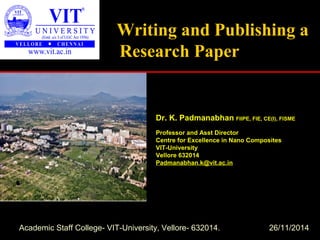
Writing and Publishing a
Research Paper
Dr. K. Padmanabhan FIIPE, FIE, CE(I), FISME
Professor and Asst Director
Centre for Excellence in Nano Composites
VIT-University
Vellore 632014
Padmanabhan.k@vit.ac.in
Academic Staff College- VIT-University, Vellore- 632014. 26/11/2014
Why write and publish research
papers?
Ideally –
to share research findings and discoveries
with the hope of improving knowledge base
Practically –
to get funding
to get promoted
to get recognition
for knowledge sharing and achievement
“ You are rated by
what you produce,
not by what you
attempt”
Getting a paper published
 Competition for space in journals is intense
 Cost of publication is high.
 Rejection rates vary
 Journal X = 50%
 Journal Y= 65%
 Science, Nature = 90%
Tips
1. Know the journal, its editors, and submit the paper
2. Pay close attention to spelling, grammar, and
punctuation
3. Make sure references are comprehensive and accurate
4. Avoid careless mistakes
5. Read and conform to “Instructions for Authors”
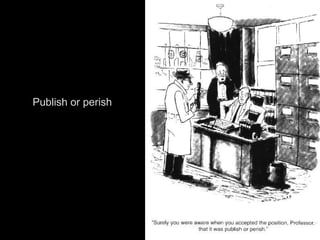
Publish or perish
What constitutes good science?
Novel – new and not resembling something
formerly known or used (can be novel but not
important)
Mechanistic – testing a hypothesis - determining
the fundamental processes involved in or
responsible for an action, reaction, or other natural
phenomenon
Descriptive – describes how things are but does
not test how things work – hypotheses are not
tested.
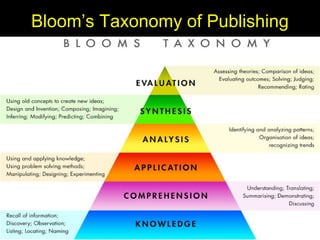
Bloom’s Taxonomy of Publishing
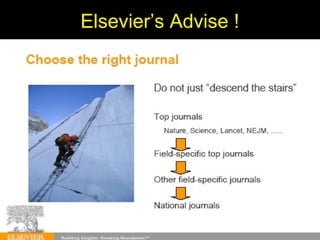
Elsevier’s Advise !
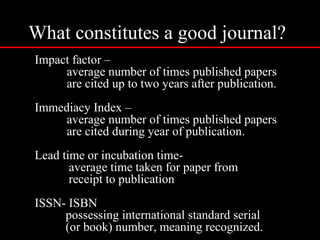
What constitutes a good journal?
Impact factor –
average number of times published papers
are cited up to two years after publication.
Immediacy Index –
average number of times published papers
are cited during year of publication.
Lead time or incubation time-
average time taken for paper from
receipt to publication
ISSN- ISBN
possessing international standard serial
(or book) number, meaning recognized.
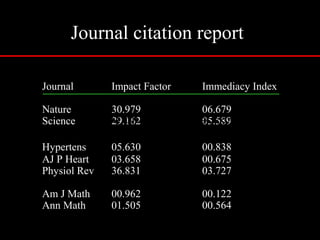
Journal citation report
Journal Impact Factor Immediacy Index
Nature 30.979 06.679
Science 29.162 05.589
Hypertens 05.630 00.838
AJ P Heart 03.658 00.675
Physiol Rev 36.831 03.727
Am J Math 00.962 00.122
Ann Math 01.505 00.564
AM J MATH 0002-9327 002353 00.962 00.122AM J MATH 0002-9327 002353 00.962 00.122
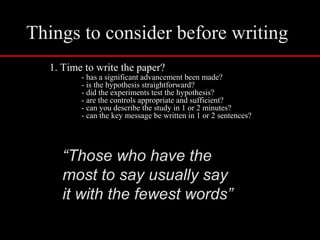
Things to consider before writing
1. Time to write the paper?
- has a significant advancement been made?
- is the hypothesis straightforward?
- did the experiments test the hypothesis?
- are the controls appropriate and sufficient?
- can you describe the study in 1 or 2 minutes?
- can the key message be written in 1 or 2 sentences?
“Those who have the
most to say usually say
it with the fewest words”
Things to consider before writing
1. Time to write the paper?
- has a significant advancement been made?
- is the hypothesis straightforward?
- did the experiments test the hypothesis?
- are the controls appropriate and sufficient?
- can you describe the study in 1 or 2 minutes?
- can the key message be written in 1 or 2 sentences?
2. Tables and figures
- must be clear and concise
- should be self-explanatory
3. Read references
- will help in choosing journal
- better insight into possible reviewers
Things to consider before writing
4. Choose journal
- study “instructions to authors”
- think about possible reviewers
- quality of journal “impact factor”
5. Tentative title and summary
6. Has considerable work been done to
warrant a publication ?
7. Aim and scope of the journal. Does it go
with your definition?
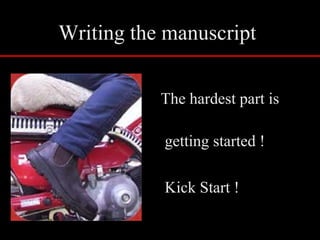
Writing the manuscript
The hardest part is
getting started !
Kick Start !
Types of journal papers
• Letters to the editor/Commentary
• Science and technology articles
• Short communication
• Technical note/case study
• Original paper/research paper !
• Review Opinion, Brief notes.
• paper , Book Reviews.
• Monographs and Books.
• STP papers, Theme papers in special issues !
• Online journal paper articles.
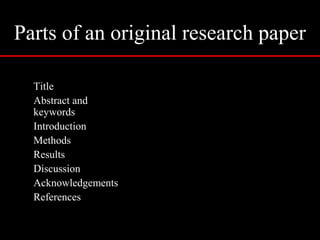
Parts of an original research paper
Title
Abstract and
keywords
Introduction
Methods
Results
Discussion
Acknowledgements
References
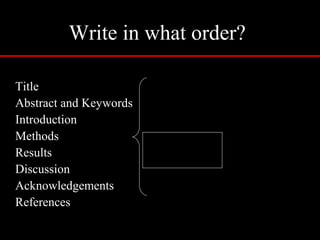
Write in what order?
Title
Abstract and Keywords
Introduction
Methods
Results
Discussion
Acknowledgements
References
Theoretical Considerations
• Sometimes you need this section !
• Build a theory or buy a theory [Refer] !
• Give relevant formulae
• Give relevant equations with symbols defined
• Number them all in sequence
• Discuss parameters to be evaluated
• Justify your choices
• This should precede your experimental details
or methods section !
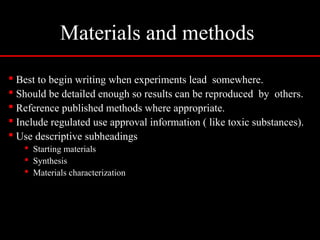
Materials and methods
 Best to begin writing when experiments lead somewhere.
 Should be detailed enough so results can be reproduced by others.
 Reference published methods where appropriate.
 Include regulated use approval information ( like toxic substances).
 Use descriptive subheadings
 Starting materials
 Synthesis
 Materials characterization
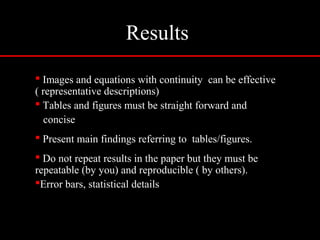
Results
 Images and equations with continuity can be effective
( representative descriptions)
 Tables and figures must be straight forward and
concise
 Present main findings referring to tables/figures.
 Do not repeat results in the paper but they must be
repeatable (by you) and reproducible ( by others).
Error bars, statistical details
Introduction
 Build case for why study is important/necessary
 Provide brief background
 State hypothesis / central question or theme
 Give a paragraph about what the investigation
proposes to do
Discussion
 First answer questions posed in introduction
 Discuss the possible mechanisms
 Discuss weaknesses and discrepancies
 Explain what is new without exaggerating
 Do not repeat discussion or speculate too much
Conclusions/Summary
 Conclusions
 Summary
 Perspectives
 Implications
 Suggestions for future work
References
 Relevant references
 Be selective based on credibility
 Read the references before referring
 Do not misquote
 Use correct style and format for journal
 Cite patents carefully, don’t misquote (IP rights)
Abstract
 Critical part of the paper
 State main objective
 Summarize most important results
 State major conclusions and significance
 Avoid acronyms
 Write and rewrite until flawless
 Provide the right keywords for indexing
Title
 Will determine whether paper gets read
 Avoid long titles (see journal rules)
 Avoid abbreviations
 Title format:
“The effects of heat on ice”
“Heat melts ice”
“The role of heat in melting ice”
Acknowledgements
Grant funding.
People who read the paper or
contributed to discussion and/or
ideas. People who gave tools e.g.
probes
Technical and secretarial
assistance
Revise, Revise and Revise
 All authors should participate, only one is the
corresponding author.
 Review order of data presentation
 Polish the writing style
 Double check references
 Look for typos
 Double check spelling ( UK ?, American ? )
WHATEVER TENSE IS USED, BE
CONSISTENT AND
DON’T SWITCH BACK AND FORTH
IN THE SAME
PARAGRAPH !!!
What you did can be in past tense
but what you found out ( eternal
truths ) must be in present tense !
Avoid long passive voices in
technical writing!
Develop a good writing style
•Read well written articles
•Try to get good writers to review
•Learn from editing changes
•Learn editing and correcting symbols
•Learn proof reading and correcting
•Good copy-editing and formatting according to
journal requirement !
•Avoid plagiarism ( copying other papers)
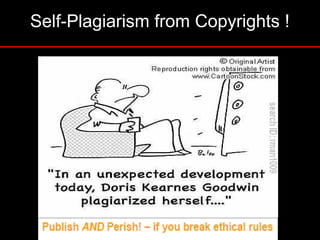
Self-Plagiarism from Copyrights !
Journal Paper Formats
• American Chemical Society, Siva (1994),
Alphabetical order…..
• Psychological Society Format, ( Closer to Am.
Ch.Soc format)
• Modern Language Association, Purdue University’s
OWL ( On-line Writing Lab) format.
• American Ceramic Society [ Ref. Nos. in square
brackets ]. Very popular !
• Vancouver Format, ( Issue, Vol:, pp, Year )
• Nature journals , Ref .Nos. in superscripts
.
Submission
1. Read instructions carefully
2. Fill out all necessary forms ( Some times before
acceptance )
Copyright transfer
Conflict of interest
3. Write covering letter (suggest reviewers if
possible)
4. Confirm receipt , follow up communication,
acknowledge
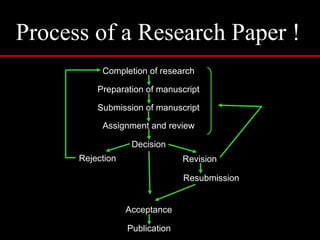
Process of a Research Paper !
Completion of research
Preparation of manuscript
Submission of manuscript
Assignment and review
Decision
Revision
Resubmission
Acceptance
Publication
Rejection
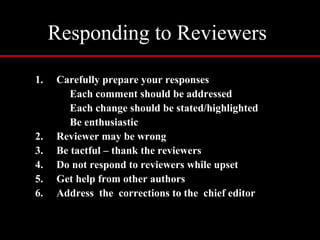
Responding to Reviewers
1. Carefully prepare your responses
Each comment should be addressed
Each change should be stated/highlighted
Be enthusiastic
2. Reviewer may be wrong
3. Be tactful – thank the reviewers
4. Do not respond to reviewers while upset
5. Get help from other authors
6. Address the corrections to the chief editor
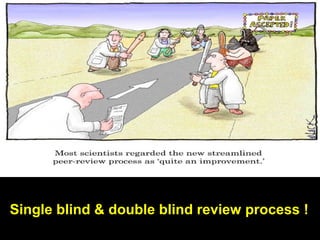
Single blind & double blind review process !
Conference Papers
• International conference papers appearing in a
special issue of a journal (reviewed)
• International conference papers in conference
proceedings ( reviewed), CD or hardcopy
• National conference papers (reviewed)
• International/national seminar papers
• International/national workshop papers
• Symposium papers
• Review meeting/Society AGM presentations …..
Technical reports
• Thesis, dissertation
• Funded project reports and documents
• Consultancy project reports
• Interim reports ( Annual, bi-annual….)
• PG/UG project reports
• Mini project reports
• Case studies
• Feasibility reports
The Science Citation Index
• The Science Citation Index (SCI) is a citation index originally
produced by the Institute for Scientific Information (ISI) and
created by Eugene Garfield in 1960, which is now owned by
Thomson Reuters. The larger version (Science Citation Index
Expanded) covers more than 6,500 notable and significant
journals, across 150 disciplines, from 1900 to the present.
These are alternately described as the world's leading journals
of science and technology, because of a rigorous selection
process. The index is made available online through the Web of
Science database, a part of the Web of Knowledge collection of
databases. (There are also CD and printed editions, covering a
smaller number of journals). This database allows a researcher
to identify which later articles have cited any particular earlier
article, or cited the articles of any particular author, or
determine which articles have been cited most frequently.
Thomson Reuters also markets several subsets of this
database, termed "Specialty Citation Indexes", such as the
Neuroscience Citation Index and the Chemistry Citation Index
Journals Search
• RSC journals search engines
• Scopus , Thomson- Reuter search engines
• Springer link
• Science direct
• Publishing houses search like Elsevier, Taylor
and Francis, Inderscience, IGI Global, Nova,
ASM, ASTM, ASME, Tata McGraw-Hill, Wiley
Eastern, Pearson Education….
• Other society or organization journal sites,
publishing house catalogues
• Google and other search engines !
h- Index
• The h-index is an index that attempts to measure
both the productivity and impact of the published
work of a scientist or scholar. The index is based on
the set of the scientist's most cited papers and the
number of citations that they have received in other
people's publications. The index can also be applied
to the productivity and impact of a group of
scientists, such as a department or university or
country. The index was suggested by Jorge E.
Hirsch, a physicist at UCSD, as a tool for
determining theoretical physicists' relative quality
and is sometimes called the Hirsch index or Hirsch
number.
h- Index
• The index is based on the distribution of citations
received by a given researcher's publications.
Hirsch writes:
– A scientist has index h if h of [his/her] Np papers have
at least h citations each, and the other (Np − h)
papers have at most h citations each.
• In other words, a scholar with an index of h has
published h papers each of which has been cited
by others at least h times. Thus, the h-index
reflects both the number of publications and the
number of citations per publication.
The other indices !
• g-index: Egghe proposed the g-index as a modification of the h-
index to give more weight to highly cited papers. It is defined
"the highest number g of papers that together received g2
or
more citations (Egge L (2006) Theory and practise of the g-
index. Scientometrics 69(1):131-152)
• m quotient: In his orginal paper, Hirsch considered the rate of
increase of h with career length. Hirsch proposed dividing the
h-index by number of years since a scientist's first publication
and called this quotient m.(Hirsch JE (2005) An index to
quantify an individual's scientific research output. PNAS
102:16569-16572)
• i10 index: is the number of publications with at least 10
citations. It was introduced in July 2011 by Google as part of
their work on Google Scholar, a search engine dedicated to
academic and related papers ("Google Scholar Citations Open
To All", Google, 16 November 2011) .
• The statistical R and AR indices are also being used recently !
As a general principle, a
single metric such as the
h-index should not be used
to rank job candidates,
promotions or research
grant applications,
because research
performance is multi-
faceted !
An example of a successful paper, now !
The Most cited Papers are Natural !
“The lowry paper,” as it is known, stands head-and-shoulders above all others. This 1951
article by Oliver H. Lowry Nira J. Rosenbrough, A. Lewis Farr, and R.J. Randall,
published in the Journal of Biological Chemistry, 193,265-75, reported an improved
procedure for measuring proteins. It still ranks as the King of the Classics, with over
180,000 citations by the end of 1987. It continues to receive 10,000 citations per year.
Why is this the most cited paper? Lowry observed: “It filled a need in the beginning—and a
lot of people measure proteins. Once it became established... other people may have
thought it was the method to use, or at least checked the procedure they were using
against it.” At about the same time—in 1976— Marion M. Bradford published “A rapid and
sensitive method for the quantitation of microgram quantities of protein utilizing the
principle of protein dye-binding” in Analytical Biochemistry, 72, 248-54. Many now cite the
Bradford paper instead of the lowry paper—more and more all the time. With about 20,000
citations by the end of last year, the Bradford paper is now the fourth most cited paper in
the SCI. The runner-up to Lowry, written by Ulrich Karl Laemmli, was published in
Nature, 227, 680-5. “Cleavage of structural proteins during the assembly of the head of
bacteriophage T4” accumulated nearly 50,000 citations between its publication in 1970
and the end of 1987. This procedure has not been superseded, which explains its steady
rise in the chart. The third most cited article, with just over 20,000 citations is “Reliability of
molecular weight determinations by dodecyl sulfate-polyacrylamide gel electrophoresis,”
by K. Weber and M. Osborn, published in 1969 in the Journal of Biological Chemistry,
244, 4406-12. The record of citations to this article shows a more typical pattern for well-
known and highly cited
Most of the top ten highly cited papers are
about nature and biology !
Rig Veda on Infinity
pûrnamadah pûrnamidam pûrnât
pûrnamudacyate pûrnâsya
pûrnamadaya pûrnamevâvasishyate
From infinity is born infinity.
When infinity is taken out of infinity,
only infinity is left over.
Thank You and Questions ?

Writing and Publishing a Research Paper

  • 1.
    Writing and Publishinga Research Paper Dr. K. Padmanabhan FIIPE, FIE, CE(I), FISME Professor and Asst Director Centre for Excellence in Nano Composites VIT-University Vellore 632014 Padmanabhan.k@vit.ac.in Academic Staff College- VIT-University, Vellore- 632014. 26/11/2014
  • 2.
    Why write andpublish research papers? Ideally – to share research findings and discoveries with the hope of improving knowledge base Practically – to get funding to get promoted to get recognition for knowledge sharing and achievement
  • 3.
    “ You arerated by what you produce, not by what you attempt”
  • 4.
    Getting a paperpublished  Competition for space in journals is intense  Cost of publication is high.  Rejection rates vary  Journal X = 50%  Journal Y= 65%  Science, Nature = 90%
  • 5.
    Tips 1. Know thejournal, its editors, and submit the paper 2. Pay close attention to spelling, grammar, and punctuation 3. Make sure references are comprehensive and accurate 4. Avoid careless mistakes 5. Read and conform to “Instructions for Authors”
  • 6.
  • 7.
    What constitutes goodscience? Novel – new and not resembling something formerly known or used (can be novel but not important) Mechanistic – testing a hypothesis - determining the fundamental processes involved in or responsible for an action, reaction, or other natural phenomenon Descriptive – describes how things are but does not test how things work – hypotheses are not tested.
  • 8.
  • 9.
  • 10.
    What constitutes agood journal? Impact factor – average number of times published papers are cited up to two years after publication. Immediacy Index – average number of times published papers are cited during year of publication. Lead time or incubation time- average time taken for paper from receipt to publication ISSN- ISBN possessing international standard serial (or book) number, meaning recognized.
  • 11.
    Journal citation report JournalImpact Factor Immediacy Index Nature 30.979 06.679 Science 29.162 05.589 Hypertens 05.630 00.838 AJ P Heart 03.658 00.675 Physiol Rev 36.831 03.727 Am J Math 00.962 00.122 Ann Math 01.505 00.564 AM J MATH 0002-9327 002353 00.962 00.122AM J MATH 0002-9327 002353 00.962 00.122
  • 12.
    Things to considerbefore writing 1. Time to write the paper? - has a significant advancement been made? - is the hypothesis straightforward? - did the experiments test the hypothesis? - are the controls appropriate and sufficient? - can you describe the study in 1 or 2 minutes? - can the key message be written in 1 or 2 sentences? “Those who have the most to say usually say it with the fewest words”
  • 13.
    Things to considerbefore writing 1. Time to write the paper? - has a significant advancement been made? - is the hypothesis straightforward? - did the experiments test the hypothesis? - are the controls appropriate and sufficient? - can you describe the study in 1 or 2 minutes? - can the key message be written in 1 or 2 sentences? 2. Tables and figures - must be clear and concise - should be self-explanatory 3. Read references - will help in choosing journal - better insight into possible reviewers
  • 14.
    Things to considerbefore writing 4. Choose journal - study “instructions to authors” - think about possible reviewers - quality of journal “impact factor” 5. Tentative title and summary 6. Has considerable work been done to warrant a publication ? 7. Aim and scope of the journal. Does it go with your definition?
  • 15.
    Writing the manuscript Thehardest part is getting started ! Kick Start !
  • 16.
    Types of journalpapers • Letters to the editor/Commentary • Science and technology articles • Short communication • Technical note/case study • Original paper/research paper ! • Review Opinion, Brief notes. • paper , Book Reviews. • Monographs and Books. • STP papers, Theme papers in special issues ! • Online journal paper articles.
  • 17.
    Parts of anoriginal research paper Title Abstract and keywords Introduction Methods Results Discussion Acknowledgements References
  • 18.
    Write in whatorder? Title Abstract and Keywords Introduction Methods Results Discussion Acknowledgements References
  • 19.
    Theoretical Considerations • Sometimesyou need this section ! • Build a theory or buy a theory [Refer] ! • Give relevant formulae • Give relevant equations with symbols defined • Number them all in sequence • Discuss parameters to be evaluated • Justify your choices • This should precede your experimental details or methods section !
  • 20.
    Materials and methods Best to begin writing when experiments lead somewhere.  Should be detailed enough so results can be reproduced by others.  Reference published methods where appropriate.  Include regulated use approval information ( like toxic substances).  Use descriptive subheadings  Starting materials  Synthesis  Materials characterization
  • 21.
    Results  Images andequations with continuity can be effective ( representative descriptions)  Tables and figures must be straight forward and concise  Present main findings referring to tables/figures.  Do not repeat results in the paper but they must be repeatable (by you) and reproducible ( by others). Error bars, statistical details
  • 22.
    Introduction  Build casefor why study is important/necessary  Provide brief background  State hypothesis / central question or theme  Give a paragraph about what the investigation proposes to do
  • 23.
    Discussion  First answerquestions posed in introduction  Discuss the possible mechanisms  Discuss weaknesses and discrepancies  Explain what is new without exaggerating  Do not repeat discussion or speculate too much
  • 24.
    Conclusions/Summary  Conclusions  Summary Perspectives  Implications  Suggestions for future work
  • 25.
    References  Relevant references Be selective based on credibility  Read the references before referring  Do not misquote  Use correct style and format for journal  Cite patents carefully, don’t misquote (IP rights)
  • 26.
    Abstract  Critical partof the paper  State main objective  Summarize most important results  State major conclusions and significance  Avoid acronyms  Write and rewrite until flawless  Provide the right keywords for indexing
  • 27.
    Title  Will determinewhether paper gets read  Avoid long titles (see journal rules)  Avoid abbreviations  Title format: “The effects of heat on ice” “Heat melts ice” “The role of heat in melting ice”
  • 28.
    Acknowledgements Grant funding. People whoread the paper or contributed to discussion and/or ideas. People who gave tools e.g. probes Technical and secretarial assistance
  • 29.
    Revise, Revise andRevise  All authors should participate, only one is the corresponding author.  Review order of data presentation  Polish the writing style  Double check references  Look for typos  Double check spelling ( UK ?, American ? )
  • 30.
    WHATEVER TENSE ISUSED, BE CONSISTENT AND DON’T SWITCH BACK AND FORTH IN THE SAME PARAGRAPH !!! What you did can be in past tense but what you found out ( eternal truths ) must be in present tense ! Avoid long passive voices in technical writing!
  • 31.
    Develop a goodwriting style •Read well written articles •Try to get good writers to review •Learn from editing changes •Learn editing and correcting symbols •Learn proof reading and correcting •Good copy-editing and formatting according to journal requirement ! •Avoid plagiarism ( copying other papers)
  • 32.
  • 33.
    Journal Paper Formats •American Chemical Society, Siva (1994), Alphabetical order….. • Psychological Society Format, ( Closer to Am. Ch.Soc format) • Modern Language Association, Purdue University’s OWL ( On-line Writing Lab) format. • American Ceramic Society [ Ref. Nos. in square brackets ]. Very popular ! • Vancouver Format, ( Issue, Vol:, pp, Year ) • Nature journals , Ref .Nos. in superscripts .
  • 34.
    Submission 1. Read instructionscarefully 2. Fill out all necessary forms ( Some times before acceptance ) Copyright transfer Conflict of interest 3. Write covering letter (suggest reviewers if possible) 4. Confirm receipt , follow up communication, acknowledge
  • 35.
    Process of aResearch Paper ! Completion of research Preparation of manuscript Submission of manuscript Assignment and review Decision Revision Resubmission Acceptance Publication Rejection
  • 36.
    Responding to Reviewers 1.Carefully prepare your responses Each comment should be addressed Each change should be stated/highlighted Be enthusiastic 2. Reviewer may be wrong 3. Be tactful – thank the reviewers 4. Do not respond to reviewers while upset 5. Get help from other authors 6. Address the corrections to the chief editor
  • 37.
    Single blind &double blind review process !
  • 38.
    Conference Papers • Internationalconference papers appearing in a special issue of a journal (reviewed) • International conference papers in conference proceedings ( reviewed), CD or hardcopy • National conference papers (reviewed) • International/national seminar papers • International/national workshop papers • Symposium papers • Review meeting/Society AGM presentations …..
  • 39.
    Technical reports • Thesis,dissertation • Funded project reports and documents • Consultancy project reports • Interim reports ( Annual, bi-annual….) • PG/UG project reports • Mini project reports • Case studies • Feasibility reports
  • 40.
    The Science CitationIndex • The Science Citation Index (SCI) is a citation index originally produced by the Institute for Scientific Information (ISI) and created by Eugene Garfield in 1960, which is now owned by Thomson Reuters. The larger version (Science Citation Index Expanded) covers more than 6,500 notable and significant journals, across 150 disciplines, from 1900 to the present. These are alternately described as the world's leading journals of science and technology, because of a rigorous selection process. The index is made available online through the Web of Science database, a part of the Web of Knowledge collection of databases. (There are also CD and printed editions, covering a smaller number of journals). This database allows a researcher to identify which later articles have cited any particular earlier article, or cited the articles of any particular author, or determine which articles have been cited most frequently. Thomson Reuters also markets several subsets of this database, termed "Specialty Citation Indexes", such as the Neuroscience Citation Index and the Chemistry Citation Index
  • 41.
    Journals Search • RSCjournals search engines • Scopus , Thomson- Reuter search engines • Springer link • Science direct • Publishing houses search like Elsevier, Taylor and Francis, Inderscience, IGI Global, Nova, ASM, ASTM, ASME, Tata McGraw-Hill, Wiley Eastern, Pearson Education…. • Other society or organization journal sites, publishing house catalogues • Google and other search engines !
  • 42.
    h- Index • Theh-index is an index that attempts to measure both the productivity and impact of the published work of a scientist or scholar. The index is based on the set of the scientist's most cited papers and the number of citations that they have received in other people's publications. The index can also be applied to the productivity and impact of a group of scientists, such as a department or university or country. The index was suggested by Jorge E. Hirsch, a physicist at UCSD, as a tool for determining theoretical physicists' relative quality and is sometimes called the Hirsch index or Hirsch number.
  • 43.
    h- Index • Theindex is based on the distribution of citations received by a given researcher's publications. Hirsch writes: – A scientist has index h if h of [his/her] Np papers have at least h citations each, and the other (Np − h) papers have at most h citations each. • In other words, a scholar with an index of h has published h papers each of which has been cited by others at least h times. Thus, the h-index reflects both the number of publications and the number of citations per publication.
  • 44.
    The other indices! • g-index: Egghe proposed the g-index as a modification of the h- index to give more weight to highly cited papers. It is defined "the highest number g of papers that together received g2 or more citations (Egge L (2006) Theory and practise of the g- index. Scientometrics 69(1):131-152) • m quotient: In his orginal paper, Hirsch considered the rate of increase of h with career length. Hirsch proposed dividing the h-index by number of years since a scientist's first publication and called this quotient m.(Hirsch JE (2005) An index to quantify an individual's scientific research output. PNAS 102:16569-16572) • i10 index: is the number of publications with at least 10 citations. It was introduced in July 2011 by Google as part of their work on Google Scholar, a search engine dedicated to academic and related papers ("Google Scholar Citations Open To All", Google, 16 November 2011) . • The statistical R and AR indices are also being used recently !
  • 45.
    As a generalprinciple, a single metric such as the h-index should not be used to rank job candidates, promotions or research grant applications, because research performance is multi- faceted ! An example of a successful paper, now !
  • 46.
    The Most citedPapers are Natural ! “The lowry paper,” as it is known, stands head-and-shoulders above all others. This 1951 article by Oliver H. Lowry Nira J. Rosenbrough, A. Lewis Farr, and R.J. Randall, published in the Journal of Biological Chemistry, 193,265-75, reported an improved procedure for measuring proteins. It still ranks as the King of the Classics, with over 180,000 citations by the end of 1987. It continues to receive 10,000 citations per year. Why is this the most cited paper? Lowry observed: “It filled a need in the beginning—and a lot of people measure proteins. Once it became established... other people may have thought it was the method to use, or at least checked the procedure they were using against it.” At about the same time—in 1976— Marion M. Bradford published “A rapid and sensitive method for the quantitation of microgram quantities of protein utilizing the principle of protein dye-binding” in Analytical Biochemistry, 72, 248-54. Many now cite the Bradford paper instead of the lowry paper—more and more all the time. With about 20,000 citations by the end of last year, the Bradford paper is now the fourth most cited paper in the SCI. The runner-up to Lowry, written by Ulrich Karl Laemmli, was published in Nature, 227, 680-5. “Cleavage of structural proteins during the assembly of the head of bacteriophage T4” accumulated nearly 50,000 citations between its publication in 1970 and the end of 1987. This procedure has not been superseded, which explains its steady rise in the chart. The third most cited article, with just over 20,000 citations is “Reliability of molecular weight determinations by dodecyl sulfate-polyacrylamide gel electrophoresis,” by K. Weber and M. Osborn, published in 1969 in the Journal of Biological Chemistry, 244, 4406-12. The record of citations to this article shows a more typical pattern for well- known and highly cited Most of the top ten highly cited papers are about nature and biology !
  • 48.
    Rig Veda onInfinity pûrnamadah pûrnamidam pûrnât pûrnamudacyate pûrnâsya pûrnamadaya pûrnamevâvasishyate From infinity is born infinity. When infinity is taken out of infinity, only infinity is left over.
  • 49.
    Thank You andQuestions ? Thank You and Questions ?

Editor's Notes

  • #2 So, first things first – who am I talking to? How many graduate students? Research technicians? Post-docts? Assistant profs? Associates Profs? How many of you have published a research paper? How many of you have had a paper rejected?
  • #8 What is a descriptive study?
  • #11 Immediacy Index – number of times articles published in 2003 (by a journal) that were cited in 2003 divided by number of articles that were published in 2003 (by the journal)
  • #12 Published by Thomas Scientific (formally Institute for Scientific Information) Lots of debate on impact factor – Review journals have very high impact factor because they are often quoted instead of original paper Number of citations to a journal does not necessarily reflect the quality of the journal. Journals with low circulation will never have high impact factor regardless of the quality of its publications. Window for citation is too short. Many classic papers are cited frequently several decades after publication More researchers in a particular field lead to high impact journals in the field. Example, medical journals have higher impact factors compared to mathematical journals and engineering journals