What is plagiarism?


 (And why you should care!)
Definition:


  Plagiarism is the act of presenting the
    words, ideas, images, sounds, or
    the creative expression of others as
    your own.
How often does it happen?
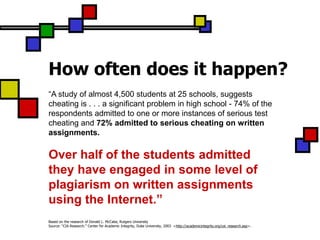
“A study of almost 4,500 students at 25 schools, suggests
cheating is . . . a significant problem in high school - 74% of the
respondents admitted to one or more instances of serious test
cheating and 72% admitted to serious cheating on written
assignments.

Over half of the students admitted
they have engaged in some level of
plagiarism on written assignments
using the Internet.”
Based on the research of Donald L. McCabe, Rutgers University
Source: “CIA Research.” Center for Academic Integrity, Duke University, 2003 <http://academicintegrity.org/cai_research.asp>.
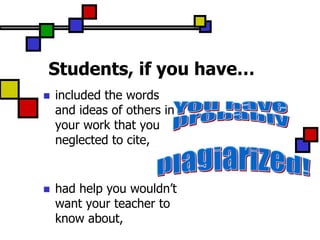
Students, if you have…
   included the words
    and ideas of others in
    your work that you
    neglected to cite,


   had help you wouldn‟t
    want your teacher to
    know about,
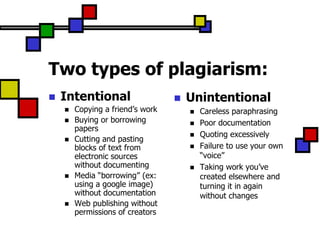
Two types of plagiarism:
   Intentional                      Unintentional
       Copying a friend‟s work          Careless paraphrasing
       Buying or borrowing              Poor documentation
        papers
                                         Quoting excessively
       Cutting and pasting
        blocks of text from              Failure to use your own
        electronic sources                “voice”
        without documenting              Taking work you‟ve
       Media “borrowing” (ex:            created elsewhere and
        using a google image)             turning it in again
        without documentation             without changes
       Web publishing without
        permissions of creators
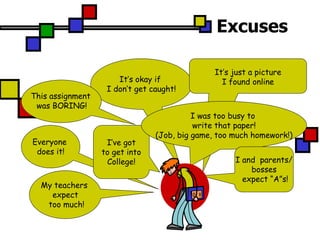
Excuses

                                               It’s just a picture
                      It’s okay if               I found online
                   I don’t get caught!
This assignment
 was BORING!
                                          I was too busy to
                                          write that paper!
                                (Job, big game, too much homework!)
Everyone           I’ve got
 does it!         to get into
                   College!                         I and parents/
                                                        bosses
                                                      expect “A”s!
  My teachers
    expect
   too much!
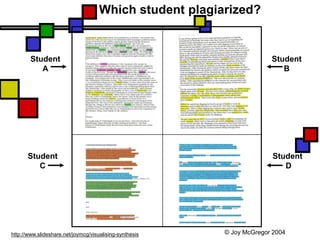
Which student plagiarized?


        Student                                                        Student
           A                                                              B


       Student                                                          Student
          C                                                                D


http://www.slideshare.net/joymcg/visualising-synthesis   © Joy McGregor 2004
Is your
                                           academic reputation
Why choose                                      valuable
                                                 to you?
academic integrity
    When you copy you cheat yourself.
     You limit your own learning.
    The consequences are not worth
     the risks!
    It is only right to give credit to
     authors whose ideas you use
    Citing gives authority to the
     information you present
    Citing makes it possible for your
     readers to locate your source
    Education is not an “us vs. them”
     game! It‟s about learning to learn!
    Cheating is unethical behavior
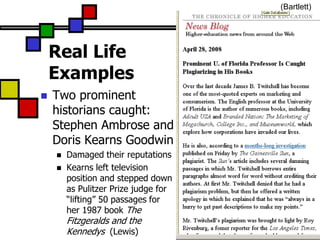
(Bartlett)


    Real Life
    Examples
   Two prominent
    historians caught:
    Stephen Ambrose and
    Doris Kearns Goodwin
       Damaged their reputations
       Kearns left television
        position and stepped down
        as Pulitzer Prize judge for
        “lifting” 50 passages for
        her 1987 book The
        Fitzgeralds and the
        Kennedys (Lewis)
Real Life Consequences
   New York Times senior reporter Jayson
    Blair forced to resign after being accused
    of plagiarism and fraud.
       “The newspaper said at least 36 of the 73 articles he
        had written had problems with accuracy, calling the
        deception a "low point" in the newspaper's history.”
        (“New York Times Exposes Fraud of Own Reporter”)


   Students at UVA– face immediate
    expulsion / degrees revoked if found
    guilty of cheating (Epstein)
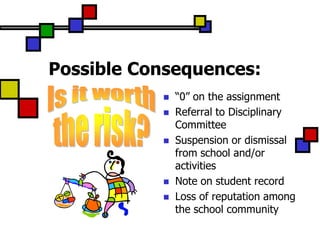
Possible Consequences:
              “0” on the assignment
              Referral to Disciplinary
               Committee
              Suspension or dismissal
               from school and/or
               activities
              Note on student record
              Loss of reputation among
               the school community
Do I have
  to cite
everything?
Hooray
    Nope!                            for
                                   common
   Facts that are widely known   knowledge
   Information or judgments          !
    considered “common
    knowledge”


Need no documentation!
However, when in doubt,
cite!
Common Knowledge Examples
   John Adams was our second president.
   The Japanese attacked Pearl Harbor on
    December 7, 1941.

  If you see a fact in three or more sources, and you are
fairly certain your readers already know this information, it
           is likely to be “common knowledge.”

         However, when in doubt, cite!
No need to document when:

   You are discussing your own experiences,
    observations, or reactions

   Compiling the results of original research, from
    science experiments, etc.

   You are using common knowledge
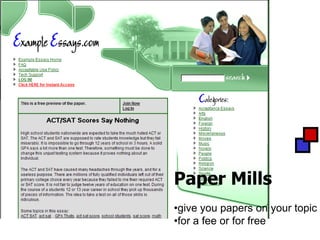
Paper Mills
•give you papers on your topic
•for a fee or for free
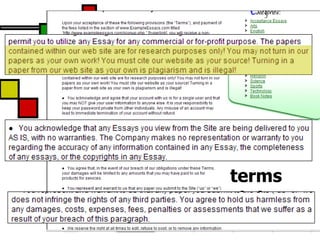
But
terms
state:
You can “borrow” from the
works of others in your own
           work!

 But you have to give the
       others credit.
This is why we cite our sources!


  at the end of a project/paper (Works Cited page)
                        AND
  within the project/paper (parenthetical citations)
Use in-text / in-project
documentation when:
   You use an original idea from one of your
    sources, whether a quote or paraphrase
   You summarize original ideas from one of
    your sources
   You use factual information that is not
    common knowledge (Cite to be safe.)
   You quote directly from a source
   You use a date or fact that might be disputed
Test your skills


           The Cite is Right Quiz
http://library.camden.rutgers.edu/Educat
 ionalModule/Plagiarism/citeisright.html
In-text / in-project MLA
documentation
   Purpose--to give immediate source information
    without interrupting the flow of paper or
    project.

   Brief information in in-text documentation
    should match full source information in Works
    Cited
How do I cite in my papers?
   Parenthetical citations are usually placed at the
    end of a sentence & before the period.

       Cite the author's last name and the page number
        (Meyer 33).
       In the absence of an author, cite the title and the
        page number (Breaking Dawn 134).
       If you are using more than one book by the same
        author, list the last name, comma, the title, and the
        page (Meyer, “Edwards Side” 4).
       If you identify the author and title in the text, just list
        the page number (65).
But, what about Websites
or Images?
   When citing any Web source (photos, art, text,
    videos) in your work, you are not likely to have
    page numbers. Just include the first part of the
    entry.
                          (Smith)
                            or
               (“Plagiarism and the Web”)
                            or
                 (Oodles of Noodletools)
For example:
   In paragraph:
       “The purpose for following up is that a student who
        drops out can return later, whereas a student found
        guilty by a student jury is banned for life. „The overall
        idea is that the strict honor committee enforces the
        overall community of trust that governs the
        university,‟ Hobbs said. ” (Epstein)

   In works cited:
       Epstein, David. “Cheating Scandal at Virginia.” Inside
        Higher Ed. 30 June 2005. 16 Jan 2009.
        <http://www.insidehighered.com/news/2005/06/30/u
        va>.
How to avoid plagairism
   Take notes and keep them organized
       Noodletools can help with this

   Give other people credit
       In-text and in-project credit
       For paraphrases and summaries too

   Cite the sources you use
       Images too!
       Use Noodletools for help
       Double check your sources & make sure you wrote down the
        information correctly
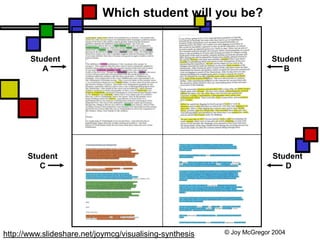
Which student will you be?


       Student                                                         Student
          A                                                               B


      Student                                                           Student
         C                                                                 D


http://www.slideshare.net/joymcg/visualising-synthesis   © Joy McGregor 2004
Yada, yada, yada…
   What if:
       Your architect cheated his way through math class.
        Will your new home be safe?
       Your lawyer paid for a copy of the bar exam to study.
        Will the contract she wrote for you stand up in court?
       The accountant who does your taxes hired someone
        to write his papers and paid a stand-in to take his
        major tests? Does he know enough to complete your
        tax forms properly?
                                             (Lathrop and Foss 87)
Works Cited
   Bartlett, Thomas. “Prominent U. of Florida Professor is Caught Plagiarizing His
    Books.” 28 Apr. 2008 News Blog for Chronicle of Higher Education. 16 Jan 2009.
    <http://chronicle.com/news/article/4390/prominent-u-of-florida-professor-is-
    caught-plagiarizing-in-his-books>.
   “Boston Columnist Resigns Amid New Plagiarism Charges.” CNN.com 19 Aug. 1998
    3 March 2003 <http://www.cnn.com/US/9808/19/barnicle/>.
   Epstein, David. “Cheating Scandal at Virginia.” Inside Higher Ed. 30 June 2005. 16
    Jan 2009. <http://www.insidehighered.com/news/2005/06/30/uva>.
   Example Essays.com 16 Jan 2009 <http://www.exampleessays.com/>.
   Fain, Margaret. “Internet Paper Mills.” Kimbal Library. 12 Feb. 2003.
    <http://www.coastal.edu/library/mills2.htm>.
   Lathrop, Ann and Kathleen Foss. Student Cheating and Plagiarism in the Internet
    Era. Englewood, CO: Libraries Unlimited, 2000.
   Lewis, Mark. “Doris Kearns Goodwin And The Credibility Gap.” Forbes.com 2 Feb.
    2002. <http://www.forbes.com/2002/02/27/0227goodwin.html>.
   “New York Times Exposes Fraud of own Reporter.” ABC News Online. 12 May,
    2003.
This slide show created
    by Joyce Valenza
                     Media Specialist
            Springfield Township High School


Modified by C. Tomlinson 4-2-05
  http://www.slideshare.net/ctomlins/what-is-plagiarism
                    WITCC Adjunct


    Modified by K. Covintree 1-16-09
                 BFHS Library Teacher

What is plagiarism?

  • 1.
    What is plagiarism? (And why you should care!)
  • 2.
    Definition: Plagiarismis the act of presenting the words, ideas, images, sounds, or the creative expression of others as your own.
  • 3.
    How often doesit happen? “A study of almost 4,500 students at 25 schools, suggests cheating is . . . a significant problem in high school - 74% of the respondents admitted to one or more instances of serious test cheating and 72% admitted to serious cheating on written assignments. Over half of the students admitted they have engaged in some level of plagiarism on written assignments using the Internet.” Based on the research of Donald L. McCabe, Rutgers University Source: “CIA Research.” Center for Academic Integrity, Duke University, 2003 <http://academicintegrity.org/cai_research.asp>.
  • 4.
    Students, if youhave…  included the words and ideas of others in your work that you neglected to cite,  had help you wouldn‟t want your teacher to know about,
  • 5.
    Two types ofplagiarism:  Intentional  Unintentional  Copying a friend‟s work  Careless paraphrasing  Buying or borrowing  Poor documentation papers  Quoting excessively  Cutting and pasting blocks of text from  Failure to use your own electronic sources “voice” without documenting  Taking work you‟ve  Media “borrowing” (ex: created elsewhere and using a google image) turning it in again without documentation without changes  Web publishing without permissions of creators
  • 6.
    Excuses It’s just a picture It’s okay if I found online I don’t get caught! This assignment was BORING! I was too busy to write that paper! (Job, big game, too much homework!) Everyone I’ve got does it! to get into College! I and parents/ bosses expect “A”s! My teachers expect too much!
  • 7.
    Which student plagiarized? Student Student A B Student Student C D http://www.slideshare.net/joymcg/visualising-synthesis © Joy McGregor 2004
  • 8.
    Is your academic reputation Why choose valuable to you? academic integrity  When you copy you cheat yourself. You limit your own learning.  The consequences are not worth the risks!  It is only right to give credit to authors whose ideas you use  Citing gives authority to the information you present  Citing makes it possible for your readers to locate your source  Education is not an “us vs. them” game! It‟s about learning to learn!  Cheating is unethical behavior
  • 9.
    (Bartlett) Real Life Examples  Two prominent historians caught: Stephen Ambrose and Doris Kearns Goodwin  Damaged their reputations  Kearns left television position and stepped down as Pulitzer Prize judge for “lifting” 50 passages for her 1987 book The Fitzgeralds and the Kennedys (Lewis)
  • 10.
    Real Life Consequences  New York Times senior reporter Jayson Blair forced to resign after being accused of plagiarism and fraud.  “The newspaper said at least 36 of the 73 articles he had written had problems with accuracy, calling the deception a "low point" in the newspaper's history.” (“New York Times Exposes Fraud of Own Reporter”)  Students at UVA– face immediate expulsion / degrees revoked if found guilty of cheating (Epstein)
  • 11.
    Possible Consequences:  “0” on the assignment  Referral to Disciplinary Committee  Suspension or dismissal from school and/or activities  Note on student record  Loss of reputation among the school community
  • 12.
    Do I have to cite everything?
  • 13.
    Hooray Nope! for common  Facts that are widely known knowledge  Information or judgments ! considered “common knowledge” Need no documentation! However, when in doubt, cite!
  • 14.
    Common Knowledge Examples  John Adams was our second president.  The Japanese attacked Pearl Harbor on December 7, 1941. If you see a fact in three or more sources, and you are fairly certain your readers already know this information, it is likely to be “common knowledge.” However, when in doubt, cite!
  • 15.
    No need todocument when:  You are discussing your own experiences, observations, or reactions  Compiling the results of original research, from science experiments, etc.  You are using common knowledge
  • 16.
    Paper Mills •give youpapers on your topic •for a fee or for free
  • 17.
  • 19.
    You can “borrow”from the works of others in your own work! But you have to give the others credit.
  • 20.
    This is whywe cite our sources! at the end of a project/paper (Works Cited page) AND within the project/paper (parenthetical citations)
  • 21.
    Use in-text /in-project documentation when:  You use an original idea from one of your sources, whether a quote or paraphrase  You summarize original ideas from one of your sources  You use factual information that is not common knowledge (Cite to be safe.)  You quote directly from a source  You use a date or fact that might be disputed
  • 22.
    Test your skills The Cite is Right Quiz http://library.camden.rutgers.edu/Educat ionalModule/Plagiarism/citeisright.html
  • 23.
    In-text / in-projectMLA documentation  Purpose--to give immediate source information without interrupting the flow of paper or project.  Brief information in in-text documentation should match full source information in Works Cited
  • 24.
    How do Icite in my papers?  Parenthetical citations are usually placed at the end of a sentence & before the period.  Cite the author's last name and the page number (Meyer 33).  In the absence of an author, cite the title and the page number (Breaking Dawn 134).  If you are using more than one book by the same author, list the last name, comma, the title, and the page (Meyer, “Edwards Side” 4).  If you identify the author and title in the text, just list the page number (65).
  • 25.
    But, what aboutWebsites or Images?  When citing any Web source (photos, art, text, videos) in your work, you are not likely to have page numbers. Just include the first part of the entry. (Smith) or (“Plagiarism and the Web”) or (Oodles of Noodletools)
  • 26.
    For example:  In paragraph:  “The purpose for following up is that a student who drops out can return later, whereas a student found guilty by a student jury is banned for life. „The overall idea is that the strict honor committee enforces the overall community of trust that governs the university,‟ Hobbs said. ” (Epstein)  In works cited:  Epstein, David. “Cheating Scandal at Virginia.” Inside Higher Ed. 30 June 2005. 16 Jan 2009. <http://www.insidehighered.com/news/2005/06/30/u va>.
  • 27.
    How to avoidplagairism  Take notes and keep them organized  Noodletools can help with this  Give other people credit  In-text and in-project credit  For paraphrases and summaries too  Cite the sources you use  Images too!  Use Noodletools for help  Double check your sources & make sure you wrote down the information correctly
  • 28.
    Which student willyou be? Student Student A B Student Student C D http://www.slideshare.net/joymcg/visualising-synthesis © Joy McGregor 2004
  • 29.
    Yada, yada, yada…  What if:  Your architect cheated his way through math class. Will your new home be safe?  Your lawyer paid for a copy of the bar exam to study. Will the contract she wrote for you stand up in court?  The accountant who does your taxes hired someone to write his papers and paid a stand-in to take his major tests? Does he know enough to complete your tax forms properly? (Lathrop and Foss 87)
  • 30.
    Works Cited  Bartlett, Thomas. “Prominent U. of Florida Professor is Caught Plagiarizing His Books.” 28 Apr. 2008 News Blog for Chronicle of Higher Education. 16 Jan 2009. <http://chronicle.com/news/article/4390/prominent-u-of-florida-professor-is- caught-plagiarizing-in-his-books>.  “Boston Columnist Resigns Amid New Plagiarism Charges.” CNN.com 19 Aug. 1998 3 March 2003 <http://www.cnn.com/US/9808/19/barnicle/>.  Epstein, David. “Cheating Scandal at Virginia.” Inside Higher Ed. 30 June 2005. 16 Jan 2009. <http://www.insidehighered.com/news/2005/06/30/uva>.  Example Essays.com 16 Jan 2009 <http://www.exampleessays.com/>.  Fain, Margaret. “Internet Paper Mills.” Kimbal Library. 12 Feb. 2003. <http://www.coastal.edu/library/mills2.htm>.  Lathrop, Ann and Kathleen Foss. Student Cheating and Plagiarism in the Internet Era. Englewood, CO: Libraries Unlimited, 2000.  Lewis, Mark. “Doris Kearns Goodwin And The Credibility Gap.” Forbes.com 2 Feb. 2002. <http://www.forbes.com/2002/02/27/0227goodwin.html>.  “New York Times Exposes Fraud of own Reporter.” ABC News Online. 12 May, 2003.
  • 31.
    This slide showcreated by Joyce Valenza Media Specialist Springfield Township High School Modified by C. Tomlinson 4-2-05 http://www.slideshare.net/ctomlins/what-is-plagiarism WITCC Adjunct Modified by K. Covintree 1-16-09 BFHS Library Teacher