Citing and Referencing
in APA Style
(American Psychological Association )
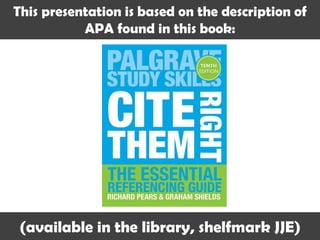
This presentation is based on the description of
APA found in this book:
(available in the library, shelfmark JJE)
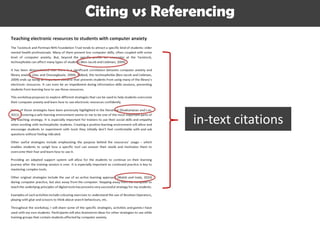
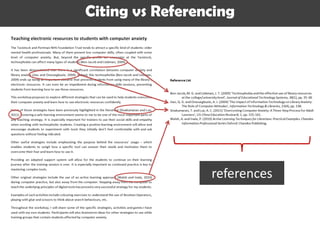
Citing vs Referencing
in-text citations
Citing vs Referencing
references
In-Text Citations in APA
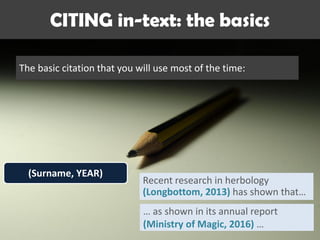
CITING in-text: the basics
The basic citation that you will use most of the time:
Recent research in herbology
(Longbottom, 2013) has shown that…
(Surname, YEAR)
… as shown in its annual report
(Ministry of Magic, 2016) …
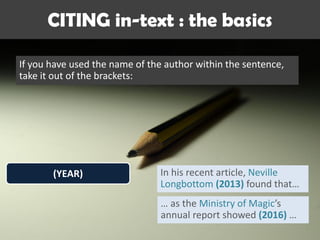
CITING in-text : the basics
If you have used the name of the author within the sentence,
take it out of the brackets:
(YEAR) In his recent article, Neville
Longbottom (2013) found that…
… as the Ministry of Magic’s
annual report showed (2016) …
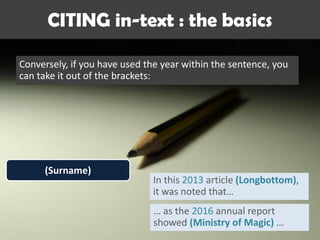
CITING in-text : the basics
Conversely, if you have used the year within the sentence, you
can take it out of the brackets:
(Surname)
In this 2013 article (Longbottom),
it was noted that…
… as the 2016 annual report
showed (Ministry of Magic) …
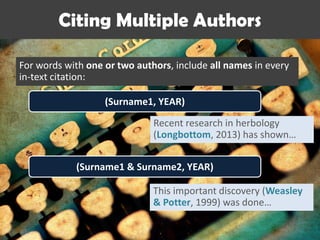
Citing Multiple Authors
For words with one or two authors, include all names in every
in-text citation:
(Surname1, YEAR)
Recent research in herbology
(Longbottom, 2013) has shown…
(Surname1 & Surname2, YEAR)
This important discovery (Weasley
& Potter, 1999) was done…
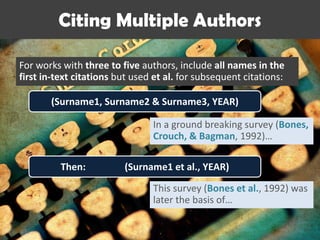
Citing Multiple Authors
For works with three to five authors, include all names in the
first in-text citations but used et al. for subsequent citations:
(Surname1, Surname2 & Surname3, YEAR)
This survey (Bones et al., 1992) was
later the basis of…
Then: (Surname1 et al., YEAR)
In a ground breaking survey (Bones,
Crouch, & Bagman, 1992)…
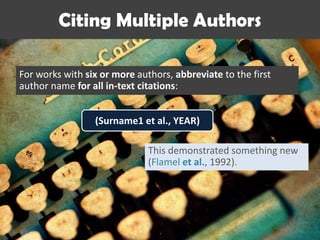
Citing Multiple Authors
For works with six or more authors, abbreviate to the first
author name for all in-text citations:
This demonstrated something new
(Flamel et al., 1992).
(Surname1 et al., YEAR)
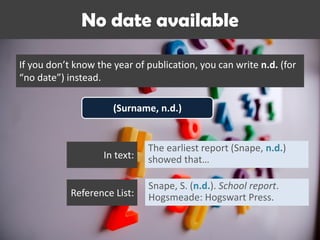
The earliest report (Snape, n.d.)
showed that…
(Surname, n.d.)
No date available
If you don’t know the year of publication, you can write n.d. (for
“no date”) instead.
In text:
Reference List:
Snape, S. (n.d.). School report.
Hogsmeade: Hogswart Press.
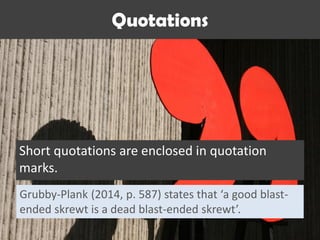
Quotations
Short quotations are enclosed in quotation
marks.
Grubby-Plank (2014, p. 587) states that ‘a good blast-
ended skrewt is a dead blast-ended skrewt’.
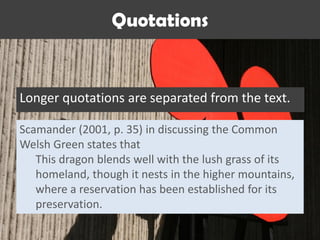
Quotations
Longer quotations are separated from the text.
Scamander (2001, p. 35) in discussing the Common
Welsh Green states that
This dragon blends well with the lush grass of its
homeland, though it nests in the higher mountains,
where a reservation has been established for its
preservation.
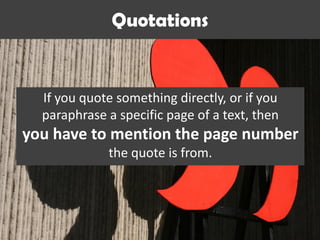
Quotations
If you quote something directly, or if you
paraphrase a specific page of a text, then
you have to mention the page number
the quote is from.
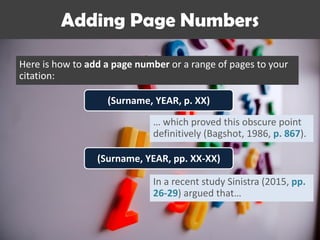
Adding Page Numbers
Here is how to add a page number or a range of pages to your
citation:
(Surname, YEAR, p. XX)
In a recent study Sinistra (2015, pp.
26-29) argued that…
… which proved this obscure point
definitively (Bagshot, 1986, p. 867).
(Surname, YEAR, pp. XX-XX)
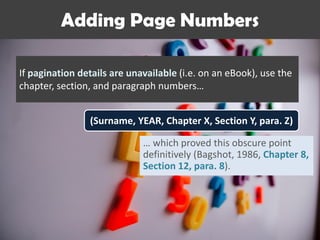
Adding Page Numbers
If pagination details are unavailable (i.e. on an eBook), use the
chapter, section, and paragraph numbers…
(Surname, YEAR, Chapter X, Section Y, para. Z)
… which proved this obscure point
definitively (Bagshot, 1986, Chapter 8,
Section 12, para. 8).
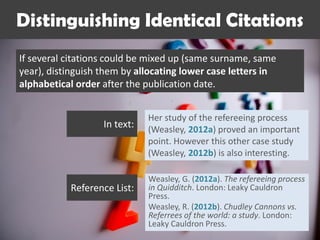
Her study of the refereeing process
(Weasley, 2012a) proved an important
point. However this other case study
(Weasley, 2012b) is also interesting.
Distinguishing Identical Citations
If several citations could be mixed up (same surname, same
year), distinguish them by allocating lower case letters in
alphabetical order after the publication date.
In text:
Reference List:
Weasley, G. (2012a). The refereeing process
in Quidditch. London: Leaky Cauldron
Press.
Weasley, R. (2012b). Chudley Cannons vs.
Referrees of the world: a study. London:
Leaky Cauldron Press.
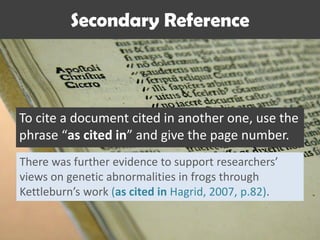
Secondary Reference
To cite a document cited in another one, use the
phrase “as cited in” and give the page number.
There was further evidence to support researchers’
views on genetic abnormalities in frogs through
Kettleburn’s work (as cited in Hagrid, 2007, p.82).
Referencing in APA
Referencing a book
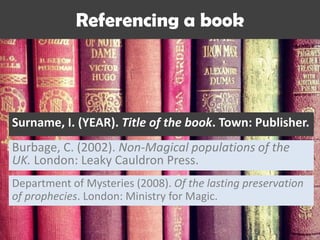
Referencing a book
Surname, I. (YEAR). Title of the book. Town: Publisher.
Burbage, C. (2002). Non-Magical populations of the
UK. London: Leaky Cauldron Press.
Department of Mysteries (2008). Of the lasting preservation
of prophecies. London: Ministry for Magic.
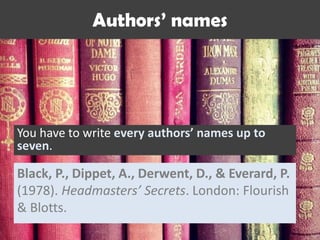
Authors’ names
You have to write every authors’ names up to
seven.
Black, P., Dippet, A., Derwent, D., & Everard, P.
(1978). Headmasters’ Secrets. London: Flourish
& Blotts.
Authors’ names
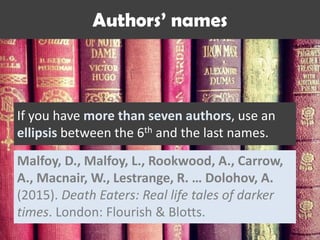
If you have more than seven authors, use an
ellipsis between the 6th and the last names.
Malfoy, D., Malfoy, L., Rookwood, A., Carrow,
A., Macnair, W., Lestrange, R. … Dolohov, A.
(2015). Death Eaters: Real life tales of darker
times. London: Flourish & Blotts.
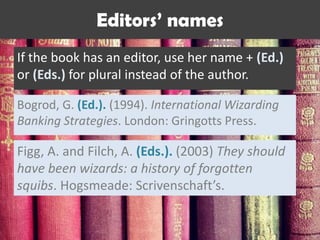
If the book has an editor, use her name + (Ed.)
or (Eds.) for plural instead of the author.
Bogrod, G. (Ed.). (1994). International Wizarding
Banking Strategies. London: Gringotts Press.
Editors’ names
Figg, A. and Filch, A. (Eds.). (2003) They should
have been wizards: a history of forgotten
squibs. Hogsmeade: Scrivenschaft’s.
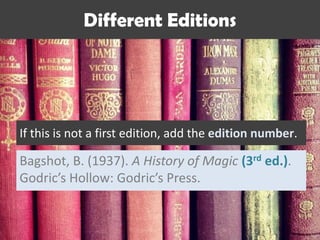
If this is not a first edition, add the edition number.
Different Editions
Bagshot, B. (1937). A History of Magic (3rd ed.).
Godric’s Hollow: Godric’s Press.
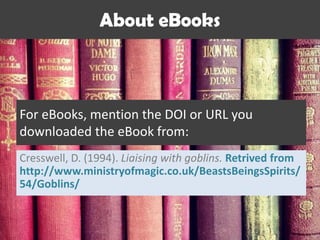
For eBooks, mention the DOI or URL you
downloaded the eBook from:
About eBooks
Cresswell, D. (1994). Liaising with goblins. Retrived from
http://www.ministryofmagic.co.uk/BeastsBeingsSpirits/
54/Goblins/
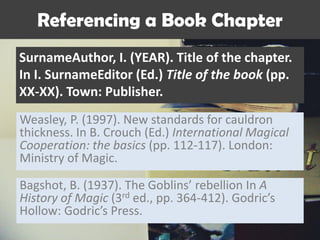
Referencing a Book Chapter
SurnameAuthor, I. (YEAR). Title of the chapter.
In I. SurnameEditor (Ed.) Title of the book (pp.
XX-XX). Town: Publisher.
Bagshot, B. (1937). The Goblins’ rebellion In A
History of Magic (3rd ed., pp. 364-412). Godric’s
Hollow: Godric’s Press.
Weasley, P. (1997). New standards for cauldron
thickness. In B. Crouch (Ed.) International Magical
Cooperation: the basics (pp. 112-117). London:
Ministry of Magic.
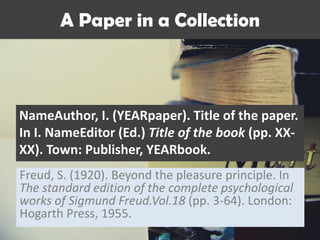
A Paper in a Collection
NameAuthor, I. (YEARpaper). Title of the paper.
In I. NameEditor (Ed.) Title of the book (pp. XX-
XX). Town: Publisher, YEARbook.
Freud, S. (1920). Beyond the pleasure principle. In
The standard edition of the complete psychological
works of Sigmund Freud.Vol.18 (pp. 3-64). London:
Hogarth Press, 1955.
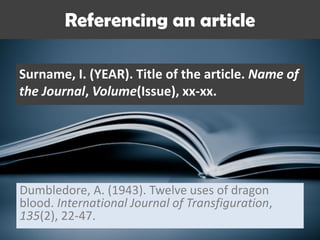
Referencing an article
Surname, I. (YEAR). Title of the article. Name of
the Journal, Volume(Issue), xx-xx.
Dumbledore, A. (1943). Twelve uses of dragon
blood. International Journal of Transfiguration,
135(2), 22-47.
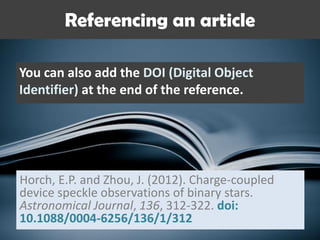
Referencing an article
You can also add the DOI (Digital Object
Identifier) at the end of the reference.
Horch, E.P. and Zhou, J. (2012). Charge-coupled
device speckle observations of binary stars.
Astronomical Journal, 136, 312-322. doi:
10.1088/0004-6256/136/1/312
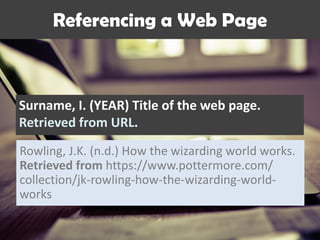
Referencing a Web Page
Surname, I. (YEAR) Title of the web page.
Retrieved from URL.
Referencing a Web Page
Rowling, J.K. (n.d.) How the wizarding world works.
Retrieved from https://www.pottermore.com/
collection/jk-rowling-how-the-wizarding-world-
works
Surname, I. (YEAR) Title of the blog post [Blog
post]. Retrieved from URL.
Referencing a Web Page
Storie, C. (2016). A very happy belated birthday to
Rebeus Hagrid [Blog post]. Retrieved from
http://www.the-leaky-cauldron.org/2016/12/07/a-
very-happy-belated-birthday-to-rubeus-Hagrid/
Good luck with your referencing!
For more information,
have a look at the
information skills
Moodle page!
Pictures used in this presentation
Slide 1: Photo by dierk schaefer - Creative Commons Attribution License
Slide 5: Photo by A. Birkan ÇAGHAN - Creative Commons Attribution License
Slide 6: Photo by Simone Bosotti - Creative Commons Attribution ShareAlike License
Slide 9: Photo by Thomas Hawk - Creative Commons Attribution NonCommercial License
Slide 12: Photo by Jani Halinen - Creative Commons Attribution NonCommercial
ShareAlike License
Slide 13: Photo by Quinn Dombrowski - Creative Commons Attribution-ShareAlike
Slide 18: Photo by Joe King - Creative Commons Attribution NonCommercial License
Slide 20: Photo by Moi of Ra - Creative Commons Attribution NonCommercial ShareAlike
License
Slide 27: Photo by Nilufer Gadgieva - Creative Commons Attribution NonCommercial
License
Slide 30: Photo by Mike Haufe - Creative Commons Attribution NonCommercial
ShareAlike License
Slide 33: Photo by Markus Spiske - Creative Commons Attribution License
Slide 36: Photo by RodrigoVazquez - Creative Commons Attribution NonCommercial
ShareAlike License

How to cite and reference in APA style

  • 1.
    Citing and Referencing inAPA Style (American Psychological Association )
  • 2.
    This presentation isbased on the description of APA found in this book: (available in the library, shelfmark JJE)
  • 3.
  • 4.
  • 5.
  • 6.
    CITING in-text: thebasics The basic citation that you will use most of the time: Recent research in herbology (Longbottom, 2013) has shown that… (Surname, YEAR) … as shown in its annual report (Ministry of Magic, 2016) …
  • 7.
    CITING in-text :the basics If you have used the name of the author within the sentence, take it out of the brackets: (YEAR) In his recent article, Neville Longbottom (2013) found that… … as the Ministry of Magic’s annual report showed (2016) …
  • 8.
    CITING in-text :the basics Conversely, if you have used the year within the sentence, you can take it out of the brackets: (Surname) In this 2013 article (Longbottom), it was noted that… … as the 2016 annual report showed (Ministry of Magic) …
  • 9.
    Citing Multiple Authors Forwords with one or two authors, include all names in every in-text citation: (Surname1, YEAR) Recent research in herbology (Longbottom, 2013) has shown… (Surname1 & Surname2, YEAR) This important discovery (Weasley & Potter, 1999) was done…
  • 10.
    Citing Multiple Authors Forworks with three to five authors, include all names in the first in-text citations but used et al. for subsequent citations: (Surname1, Surname2 & Surname3, YEAR) This survey (Bones et al., 1992) was later the basis of… Then: (Surname1 et al., YEAR) In a ground breaking survey (Bones, Crouch, & Bagman, 1992)…
  • 11.
    Citing Multiple Authors Forworks with six or more authors, abbreviate to the first author name for all in-text citations: This demonstrated something new (Flamel et al., 1992). (Surname1 et al., YEAR)
  • 12.
    The earliest report(Snape, n.d.) showed that… (Surname, n.d.) No date available If you don’t know the year of publication, you can write n.d. (for “no date”) instead. In text: Reference List: Snape, S. (n.d.). School report. Hogsmeade: Hogswart Press.
  • 13.
    Quotations Short quotations areenclosed in quotation marks. Grubby-Plank (2014, p. 587) states that ‘a good blast- ended skrewt is a dead blast-ended skrewt’.
  • 14.
    Quotations Longer quotations areseparated from the text. Scamander (2001, p. 35) in discussing the Common Welsh Green states that This dragon blends well with the lush grass of its homeland, though it nests in the higher mountains, where a reservation has been established for its preservation.
  • 15.
    Quotations If you quotesomething directly, or if you paraphrase a specific page of a text, then you have to mention the page number the quote is from.
  • 16.
    Adding Page Numbers Hereis how to add a page number or a range of pages to your citation: (Surname, YEAR, p. XX) In a recent study Sinistra (2015, pp. 26-29) argued that… … which proved this obscure point definitively (Bagshot, 1986, p. 867). (Surname, YEAR, pp. XX-XX)
  • 17.
    Adding Page Numbers Ifpagination details are unavailable (i.e. on an eBook), use the chapter, section, and paragraph numbers… (Surname, YEAR, Chapter X, Section Y, para. Z) … which proved this obscure point definitively (Bagshot, 1986, Chapter 8, Section 12, para. 8).
  • 18.
    Her study ofthe refereeing process (Weasley, 2012a) proved an important point. However this other case study (Weasley, 2012b) is also interesting. Distinguishing Identical Citations If several citations could be mixed up (same surname, same year), distinguish them by allocating lower case letters in alphabetical order after the publication date. In text: Reference List: Weasley, G. (2012a). The refereeing process in Quidditch. London: Leaky Cauldron Press. Weasley, R. (2012b). Chudley Cannons vs. Referrees of the world: a study. London: Leaky Cauldron Press.
  • 19.
    Secondary Reference To citea document cited in another one, use the phrase “as cited in” and give the page number. There was further evidence to support researchers’ views on genetic abnormalities in frogs through Kettleburn’s work (as cited in Hagrid, 2007, p.82).
  • 20.
  • 21.
  • 22.
    Referencing a book Surname,I. (YEAR). Title of the book. Town: Publisher. Burbage, C. (2002). Non-Magical populations of the UK. London: Leaky Cauldron Press. Department of Mysteries (2008). Of the lasting preservation of prophecies. London: Ministry for Magic.
  • 23.
    Authors’ names You haveto write every authors’ names up to seven. Black, P., Dippet, A., Derwent, D., & Everard, P. (1978). Headmasters’ Secrets. London: Flourish & Blotts.
  • 24.
    Authors’ names If youhave more than seven authors, use an ellipsis between the 6th and the last names. Malfoy, D., Malfoy, L., Rookwood, A., Carrow, A., Macnair, W., Lestrange, R. … Dolohov, A. (2015). Death Eaters: Real life tales of darker times. London: Flourish & Blotts.
  • 25.
    If the bookhas an editor, use her name + (Ed.) or (Eds.) for plural instead of the author. Bogrod, G. (Ed.). (1994). International Wizarding Banking Strategies. London: Gringotts Press. Editors’ names Figg, A. and Filch, A. (Eds.). (2003) They should have been wizards: a history of forgotten squibs. Hogsmeade: Scrivenschaft’s.
  • 26.
    If this isnot a first edition, add the edition number. Different Editions Bagshot, B. (1937). A History of Magic (3rd ed.). Godric’s Hollow: Godric’s Press.
  • 27.
    For eBooks, mentionthe DOI or URL you downloaded the eBook from: About eBooks Cresswell, D. (1994). Liaising with goblins. Retrived from http://www.ministryofmagic.co.uk/BeastsBeingsSpirits/ 54/Goblins/
  • 28.
  • 29.
    Referencing a BookChapter SurnameAuthor, I. (YEAR). Title of the chapter. In I. SurnameEditor (Ed.) Title of the book (pp. XX-XX). Town: Publisher. Bagshot, B. (1937). The Goblins’ rebellion In A History of Magic (3rd ed., pp. 364-412). Godric’s Hollow: Godric’s Press. Weasley, P. (1997). New standards for cauldron thickness. In B. Crouch (Ed.) International Magical Cooperation: the basics (pp. 112-117). London: Ministry of Magic.
  • 30.
    A Paper ina Collection NameAuthor, I. (YEARpaper). Title of the paper. In I. NameEditor (Ed.) Title of the book (pp. XX- XX). Town: Publisher, YEARbook. Freud, S. (1920). Beyond the pleasure principle. In The standard edition of the complete psychological works of Sigmund Freud.Vol.18 (pp. 3-64). London: Hogarth Press, 1955.
  • 31.
  • 32.
    Referencing an article Surname,I. (YEAR). Title of the article. Name of the Journal, Volume(Issue), xx-xx. Dumbledore, A. (1943). Twelve uses of dragon blood. International Journal of Transfiguration, 135(2), 22-47.
  • 33.
    Referencing an article Youcan also add the DOI (Digital Object Identifier) at the end of the reference. Horch, E.P. and Zhou, J. (2012). Charge-coupled device speckle observations of binary stars. Astronomical Journal, 136, 312-322. doi: 10.1088/0004-6256/136/1/312
  • 34.
  • 35.
    Surname, I. (YEAR)Title of the web page. Retrieved from URL. Referencing a Web Page Rowling, J.K. (n.d.) How the wizarding world works. Retrieved from https://www.pottermore.com/ collection/jk-rowling-how-the-wizarding-world- works
  • 36.
    Surname, I. (YEAR)Title of the blog post [Blog post]. Retrieved from URL. Referencing a Web Page Storie, C. (2016). A very happy belated birthday to Rebeus Hagrid [Blog post]. Retrieved from http://www.the-leaky-cauldron.org/2016/12/07/a- very-happy-belated-birthday-to-rubeus-Hagrid/
  • 37.
    Good luck withyour referencing! For more information, have a look at the information skills Moodle page!
  • 38.
    Pictures used inthis presentation Slide 1: Photo by dierk schaefer - Creative Commons Attribution License Slide 5: Photo by A. Birkan ÇAGHAN - Creative Commons Attribution License Slide 6: Photo by Simone Bosotti - Creative Commons Attribution ShareAlike License Slide 9: Photo by Thomas Hawk - Creative Commons Attribution NonCommercial License Slide 12: Photo by Jani Halinen - Creative Commons Attribution NonCommercial ShareAlike License Slide 13: Photo by Quinn Dombrowski - Creative Commons Attribution-ShareAlike Slide 18: Photo by Joe King - Creative Commons Attribution NonCommercial License Slide 20: Photo by Moi of Ra - Creative Commons Attribution NonCommercial ShareAlike License Slide 27: Photo by Nilufer Gadgieva - Creative Commons Attribution NonCommercial License Slide 30: Photo by Mike Haufe - Creative Commons Attribution NonCommercial ShareAlike License Slide 33: Photo by Markus Spiske - Creative Commons Attribution License Slide 36: Photo by RodrigoVazquez - Creative Commons Attribution NonCommercial ShareAlike License