Essay Writing

    Isabelle Pottinger

    Effective Learning Adviser

    Information Services


 451 3062
Definition of ‘Essay’


• A short piece of prose writing on a specific
  topic.
Essay Writing

•   Research Topic
•   Plan
•   Draft
•   Review
•   Revise
•   Edit
Getting started

• Clarify the task - seek guidance, if required.
• Clarify the word length and completion date.
Researching the Topic

• Make a start on the background reading
  required.
• Consider taking bullet point notes of technical
  content to reduce the risk of plagiarism.
• Record full references for all the books/
  journals/ websites etc. that you use.
Note Making


  with thanks to James Lamb;
     www.leapsonline.org
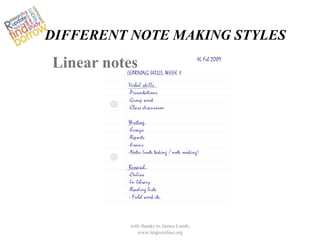
DIFFERENT NOTE MAKING STYLES
Linear notes


          with thanks to James Lamb;
             www.leapsonline.org
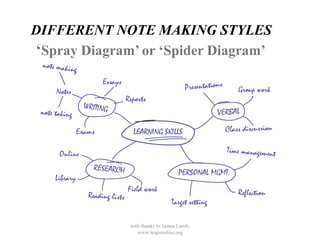
DIFFERENT NOTE MAKING STYLES
‘Spray Diagram’ or ‘Spider Diagram’


              with thanks to James Lamb;
                 www.leapsonline.org
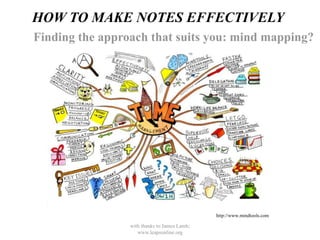
HOW TO MAKE NOTES EFFECTIVELY
Finding the approach that suits you: mind mapping?


                                              http://www.mindtools.com

                 with thanks to James Lamb;
                    www.leapsonline.org
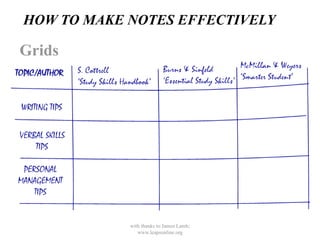
HOW TO MAKE NOTES EFFECTIVELY

Grids


            with thanks to James Lamb;
               www.leapsonline.org
Planning the essay

• Plan the whole essay before you begin to
  write it.
Planning the essay

• Start to arrange your thoughts and ideas in a
  logical, sensible order that answers the
  question.
• Order and re-order your bullet point notes to
  match this essay plan.
Planning the essay

• Ask yourself:
  – How and where within your essay might you use
    the information you have so far collected?
  – Are there still gaps in information?
  – Is further research necessary?
Planning the essay

• You may need to go around this Researching-
  and-Planning loop more than once to collect
  enough relevant information.
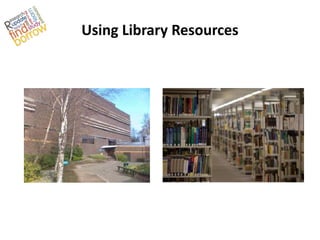
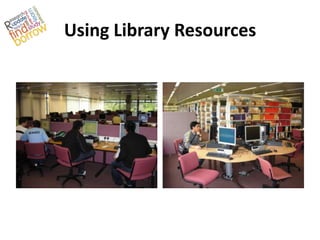
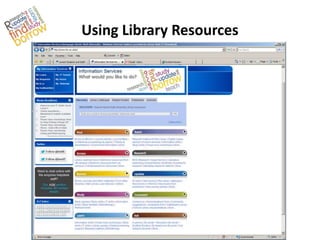
Using Library Resources
HWU Library

• Home page:

 http://www.hw.ac.uk/is/
Using Library Resources
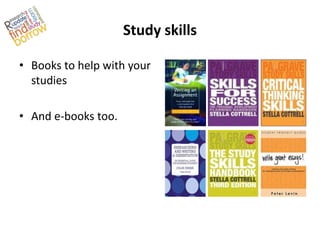
Study skills

• Books to help with your
  studies

• And e-books too.
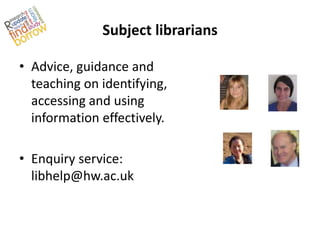
Subject librarians

• Advice, guidance and
  teaching on identifying,
  accessing and using
  information effectively.

• Enquiry service:
  libhelp@hw.ac.uk
HWU Library – Subject Librarians


Civil and Structural Engineering:
• Subject librarian: Sarah Kelly
• E-mail: S.Kelly@hw.ac.uk
• Tel: 0131 451 3574
References

• Use a suitable referencing system
  e.g. the Harvard HWU
Reference style - Book

The correct reference for a book includes author,
  initials, year of publication, title, edition (if not
  first), place of publication, publisher. e.g.

• Sime, J.D. (2005) Safety in the built
  environment, London: Spon.
- Journal/ Periodical
• The correct reference for a periodical article
  includes author’s surname and
  initial(s), year of publication, title of
  article, periodical title, specific date of
  publication, volume and part number and
  pages, e.g.
• Stamp, G. (1999) “Clouded
  vision”, Architects Journal, 177(9), 25-31.
- Website

•   The author or editor
•   Date of ‘publication’(in brackets)
•   Title (in italics or underlined)
•   The type of resource (in square brackets)
•   The URL
•   The date the resource was accessed (in square
    brackets)
Referencing websites

• University of Bradford (1999) Making the most
  of presentations [online], available:
  http://www.brad.ac.uk/admin/stedev/pres.html
  [accessed 12 August 2004].
References

• Use a suitable referencing system
  e.g. the Harvard HWU:

  http://www.hw.ac.uk/is/Harvardguide.pdf
Essay Writing
• Now let’s turn our attention to writing the
  essay.
Essay Writing

• Essay has three main sections:

• Introduction: 5% of length
• Main body: 80% of length
• Conclusion: 15% of length
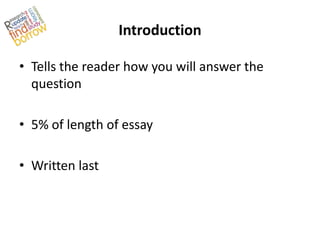
Introduction

• Tells the reader how you will answer the
  question

• 5% of length of essay

• Written last
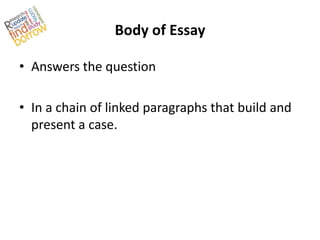
Body of Essay

• Answers the question

• In a chain of linked paragraphs that build and
  present a case.
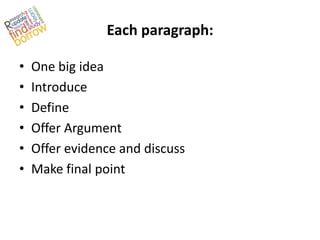
Each paragraph:

•   One big idea
•   Introduce
•   Define
•   Offer Argument
•   Offer evidence and discuss
•   Make final point
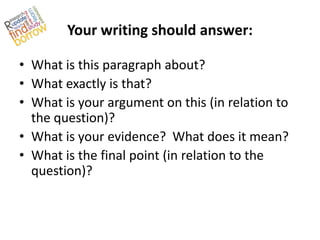
Your writing should answer:

• What is this paragraph about?
• What exactly is that?
• What is your argument on this (in relation to
  the question)?
• What is your evidence? What does it mean?
• What is the final point (in relation to the
  question)?
Linking and signposting

• Use link words and phrases
  – However; nevertheless; not only…but also
• Signposting
  – In short; as we have seen; to summarise
• Paragraphs are part of the signposting
• Vary sentence length (max 40 words)
Conclusion = 15% length

• Re-state arguments
• Re-state points
• Show that you have answered the whole
  question
• Could make recommendation
• NB: No new evidence introduced
Take-home message

• Allow adequate time to research and write the
  essay
• Follow the guidelines given
• Write in own words
• Acknowledge all sources of information
• Check that you have answered the question
Contact Details

• Isabelle Pottinger
• Effective Learning Adviser

• Level 2, Library
• Ext: 3062
• E-mail: I.Pottinger@hw.ac.uk

Essay writing workshop_sept2012

  • 1.
    Essay Writing Isabelle Pottinger Effective Learning Adviser Information Services  451 3062
  • 2.
    Definition of ‘Essay’ •A short piece of prose writing on a specific topic.
  • 3.
    Essay Writing • Research Topic • Plan • Draft • Review • Revise • Edit
  • 4.
    Getting started • Clarifythe task - seek guidance, if required. • Clarify the word length and completion date.
  • 5.
    Researching the Topic •Make a start on the background reading required. • Consider taking bullet point notes of technical content to reduce the risk of plagiarism. • Record full references for all the books/ journals/ websites etc. that you use.
  • 6.
    Note Making with thanks to James Lamb; www.leapsonline.org
  • 7.
    DIFFERENT NOTE MAKINGSTYLES Linear notes with thanks to James Lamb; www.leapsonline.org
  • 8.
    DIFFERENT NOTE MAKINGSTYLES ‘Spray Diagram’ or ‘Spider Diagram’ with thanks to James Lamb; www.leapsonline.org
  • 9.
    HOW TO MAKENOTES EFFECTIVELY Finding the approach that suits you: mind mapping? http://www.mindtools.com with thanks to James Lamb; www.leapsonline.org
  • 10.
    HOW TO MAKENOTES EFFECTIVELY Grids with thanks to James Lamb; www.leapsonline.org
  • 11.
    Planning the essay •Plan the whole essay before you begin to write it.
  • 12.
    Planning the essay •Start to arrange your thoughts and ideas in a logical, sensible order that answers the question. • Order and re-order your bullet point notes to match this essay plan.
  • 13.
    Planning the essay •Ask yourself: – How and where within your essay might you use the information you have so far collected? – Are there still gaps in information? – Is further research necessary?
  • 14.
    Planning the essay •You may need to go around this Researching- and-Planning loop more than once to collect enough relevant information.
  • 15.
  • 16.
  • 17.
    HWU Library • Homepage: http://www.hw.ac.uk/is/
  • 18.
  • 19.
    Study skills • Booksto help with your studies • And e-books too.
  • 20.
    Subject librarians • Advice,guidance and teaching on identifying, accessing and using information effectively. • Enquiry service: libhelp@hw.ac.uk
  • 21.
    HWU Library –Subject Librarians Civil and Structural Engineering: • Subject librarian: Sarah Kelly • E-mail: S.Kelly@hw.ac.uk • Tel: 0131 451 3574
  • 22.
    References • Use asuitable referencing system e.g. the Harvard HWU
  • 23.
    Reference style -Book The correct reference for a book includes author, initials, year of publication, title, edition (if not first), place of publication, publisher. e.g. • Sime, J.D. (2005) Safety in the built environment, London: Spon.
  • 24.
    - Journal/ Periodical •The correct reference for a periodical article includes author’s surname and initial(s), year of publication, title of article, periodical title, specific date of publication, volume and part number and pages, e.g. • Stamp, G. (1999) “Clouded vision”, Architects Journal, 177(9), 25-31.
  • 25.
    - Website • The author or editor • Date of ‘publication’(in brackets) • Title (in italics or underlined) • The type of resource (in square brackets) • The URL • The date the resource was accessed (in square brackets)
  • 26.
    Referencing websites • Universityof Bradford (1999) Making the most of presentations [online], available: http://www.brad.ac.uk/admin/stedev/pres.html [accessed 12 August 2004].
  • 27.
    References • Use asuitable referencing system e.g. the Harvard HWU: http://www.hw.ac.uk/is/Harvardguide.pdf
  • 28.
    Essay Writing • Nowlet’s turn our attention to writing the essay.
  • 29.
    Essay Writing • Essayhas three main sections: • Introduction: 5% of length • Main body: 80% of length • Conclusion: 15% of length
  • 30.
    Introduction • Tells thereader how you will answer the question • 5% of length of essay • Written last
  • 31.
    Body of Essay •Answers the question • In a chain of linked paragraphs that build and present a case.
  • 32.
    Each paragraph: • One big idea • Introduce • Define • Offer Argument • Offer evidence and discuss • Make final point
  • 33.
    Your writing shouldanswer: • What is this paragraph about? • What exactly is that? • What is your argument on this (in relation to the question)? • What is your evidence? What does it mean? • What is the final point (in relation to the question)?
  • 34.
    Linking and signposting •Use link words and phrases – However; nevertheless; not only…but also • Signposting – In short; as we have seen; to summarise • Paragraphs are part of the signposting • Vary sentence length (max 40 words)
  • 35.
    Conclusion = 15%length • Re-state arguments • Re-state points • Show that you have answered the whole question • Could make recommendation • NB: No new evidence introduced
  • 36.
    Take-home message • Allowadequate time to research and write the essay • Follow the guidelines given • Write in own words • Acknowledge all sources of information • Check that you have answered the question
  • 37.
    Contact Details • IsabellePottinger • Effective Learning Adviser • Level 2, Library • Ext: 3062 • E-mail: I.Pottinger@hw.ac.uk