Referencing & Citations
Vijay Joshi
Faculty, DNC, Nagpur
CONTENTS
1. Plagiarism
2. Citations, Referencing & Bibliography
3. Review Sources
4. Screen Demonstrations
I. PLAGIARISM
PLAGIARISM
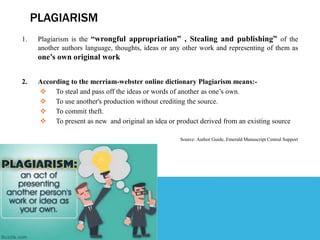
1. Plagiarism is the “wrongful appropriation” , Stealing and publishing” of the
another authors language, thoughts, ideas or any other work and representing of them as
one’s own original work
2. According to the merriam-webster online dictionary Plagiarism means:-
 To steal and pass off the ideas or words of another as one’s own.
 To use another's production without crediting the source.
 To commit theft.
 To present as new and original an idea or product derived from an existing source
Source: Author Guide, Emerald Manuscript Central Support
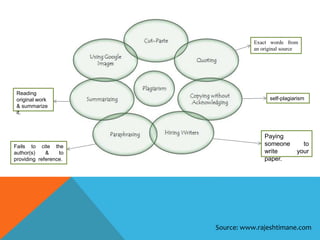
Source: www.rajeshtimane.com
Exact words from
an original source
self-plagiarism
Paying
someone to
write your
paper.
Fails to cite the
author(s) & to
providing reference.
Reading
original work
& summarize
it.
II. CITATIONS, REFERENCING&
BIBLIOGRAPHY
Citation
CITATION
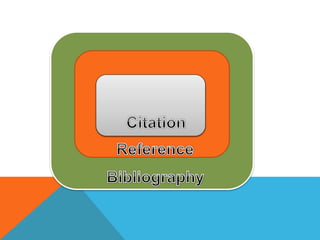
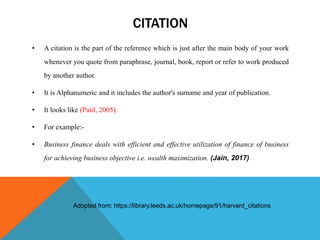
• A citation is the part of the reference which is just after the main body of your work
whenever you quote from paraphrase, journal, book, report or refer to work produced
by another author.
• It is Alphanumeric and it includes the author's surname and year of publication.
• It looks like (Patil, 2005).
• For example:-
• Business finance deals with efficient and effective utilization of finance of business
for achieving business objective i.e. wealth maximization. (Jain, 2017)
Adopted from: https://library.leeds.ac.uk/homepage/91/harvard_citations
REFERENCES
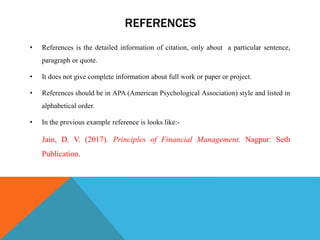
• References is the detailed information of citation, only about a particular sentence,
paragraph or quote.
• It does not give complete information about full work or paper or project.
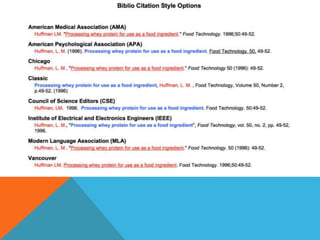
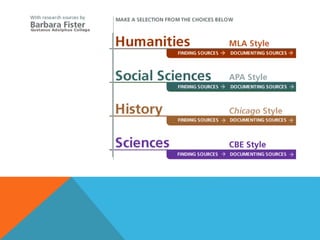
• References should be in APA (American Psychological Association) style and listed in
alphabetical order.
• In the previous example reference is looks like:-
Jain, D. V. (2017). Principles of Financial Management. Nagpur: Seth
Publication.
BIBLIOGRAPHY
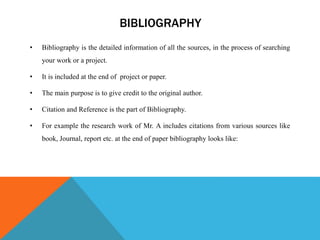
• Bibliography is the detailed information of all the sources, in the process of searching
your work or a project.
• It is included at the end of project or paper.
• The main purpose is to give credit to the original author.
• Citation and Reference is the part of Bibliography.
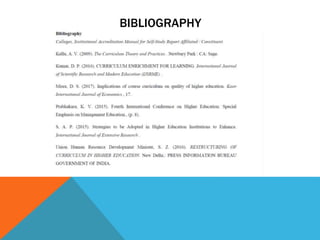
• For example the research work of Mr. A includes citations from various sources like
book, Journal, report etc. at the end of paper bibliography looks like:
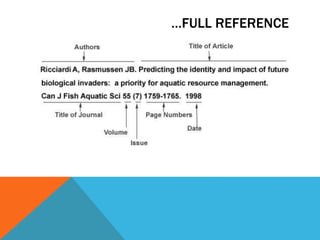
BIBLIOGRAPHY
…FULL REFERENCE
III. REVIEW
SOURCES
REVIEW SOURCES
• Books or sections of books
• Articles in Journals and Periodicals, Conference Proceedings, Case Studies and
different types of Reports.
• Websites, Documents from Websites and other web based resources.
• Art, Sound Recordings, Performance, Films and Interviews.
• Patents
• Legal cases and the judgements
REVIEW SOURCES
Books - ISBN
Articles - ISSN
Case Studies - Universities
Reports - PDF, DOC, XLS, PPT
Websites - Use Extensions like .edu, .org, .gov ...
Sound Recordings - Podcasts, British Library, Library of Congress
Films and Interviews - You Tube, Vimeo, Mega Upload
Patents - WIPO, IPINDIA
Legal cases - Indian Law Cases, Vakil No. 1
Public Opinions - Facebook, Twitter, LinkedIn, Blogs
IV. SCREEN
DEMONSTRATIONS
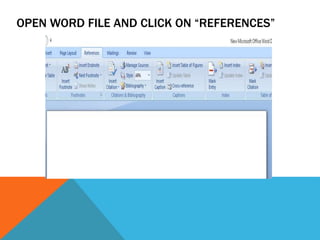
OPEN WORD FILE AND CLICK ON “REFERENCES”
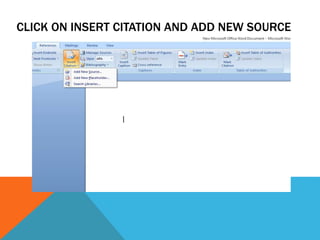
CLICK ON INSERT CITATION AND ADD NEW SOURCE
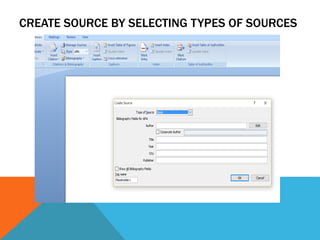
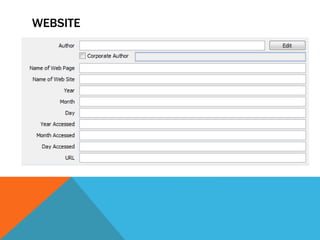
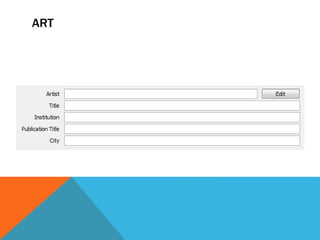
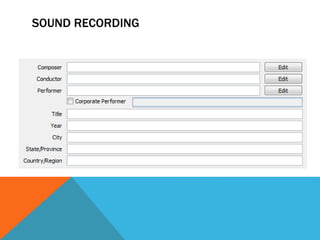
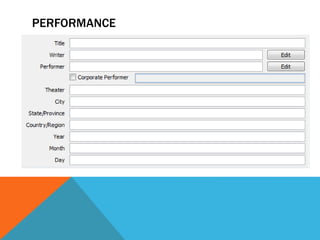
CREATE SOURCE BY SELECTING TYPES OF SOURCES
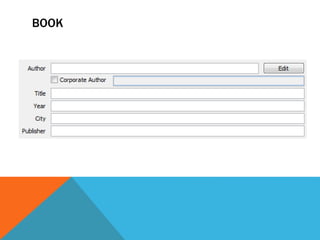
BOOK
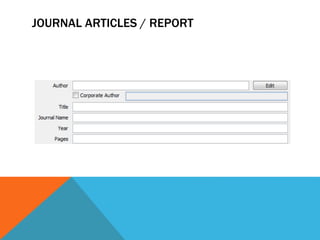
JOURNAL ARTICLES / REPORT
WEBSITE
ART
SOUND RECORDING
PERFORMANCE
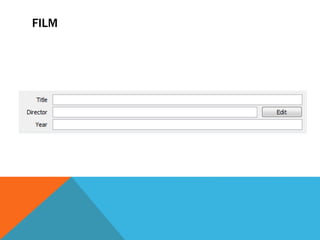
FILM
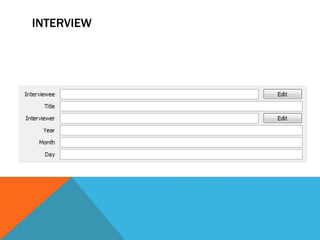
INTERVIEW
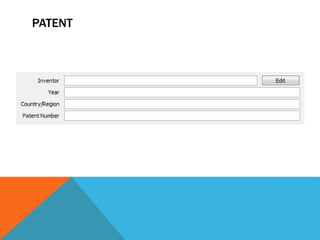
PATENT
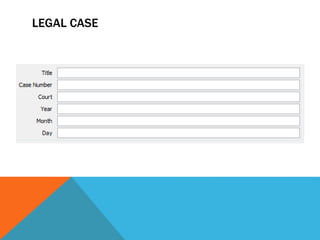
LEGAL CASE
Mr. Vijay R Joshi,
Mobile: 8484041947
E-mail : vrjoshi18@gmail.com
Twitter : @vrjoshi18

Referencing and Citation

  • 1.
    Referencing & Citations VijayJoshi Faculty, DNC, Nagpur
  • 2.
    CONTENTS 1. Plagiarism 2. Citations,Referencing & Bibliography 3. Review Sources 4. Screen Demonstrations
  • 3.
  • 4.
    PLAGIARISM 1. Plagiarism isthe “wrongful appropriation” , Stealing and publishing” of the another authors language, thoughts, ideas or any other work and representing of them as one’s own original work 2. According to the merriam-webster online dictionary Plagiarism means:-  To steal and pass off the ideas or words of another as one’s own.  To use another's production without crediting the source.  To commit theft.  To present as new and original an idea or product derived from an existing source Source: Author Guide, Emerald Manuscript Central Support
  • 5.
    Source: www.rajeshtimane.com Exact wordsfrom an original source self-plagiarism Paying someone to write your paper. Fails to cite the author(s) & to providing reference. Reading original work & summarize it.
  • 6.
  • 7.
  • 8.
    CITATION • A citationis the part of the reference which is just after the main body of your work whenever you quote from paraphrase, journal, book, report or refer to work produced by another author. • It is Alphanumeric and it includes the author's surname and year of publication. • It looks like (Patil, 2005). • For example:- • Business finance deals with efficient and effective utilization of finance of business for achieving business objective i.e. wealth maximization. (Jain, 2017) Adopted from: https://library.leeds.ac.uk/homepage/91/harvard_citations
  • 9.
    REFERENCES • References isthe detailed information of citation, only about a particular sentence, paragraph or quote. • It does not give complete information about full work or paper or project. • References should be in APA (American Psychological Association) style and listed in alphabetical order. • In the previous example reference is looks like:- Jain, D. V. (2017). Principles of Financial Management. Nagpur: Seth Publication.
  • 10.
    BIBLIOGRAPHY • Bibliography isthe detailed information of all the sources, in the process of searching your work or a project. • It is included at the end of project or paper. • The main purpose is to give credit to the original author. • Citation and Reference is the part of Bibliography. • For example the research work of Mr. A includes citations from various sources like book, Journal, report etc. at the end of paper bibliography looks like:
  • 11.
  • 12.
  • 15.
  • 16.
    REVIEW SOURCES • Booksor sections of books • Articles in Journals and Periodicals, Conference Proceedings, Case Studies and different types of Reports. • Websites, Documents from Websites and other web based resources. • Art, Sound Recordings, Performance, Films and Interviews. • Patents • Legal cases and the judgements
  • 17.
    REVIEW SOURCES Books -ISBN Articles - ISSN Case Studies - Universities Reports - PDF, DOC, XLS, PPT Websites - Use Extensions like .edu, .org, .gov ... Sound Recordings - Podcasts, British Library, Library of Congress Films and Interviews - You Tube, Vimeo, Mega Upload Patents - WIPO, IPINDIA Legal cases - Indian Law Cases, Vakil No. 1 Public Opinions - Facebook, Twitter, LinkedIn, Blogs
  • 18.
  • 19.
    OPEN WORD FILEAND CLICK ON “REFERENCES”
  • 20.
    CLICK ON INSERTCITATION AND ADD NEW SOURCE
  • 21.
    CREATE SOURCE BYSELECTING TYPES OF SOURCES
  • 22.
  • 23.
  • 24.
  • 25.
  • 26.
  • 27.
  • 28.
  • 29.
  • 30.
  • 31.
  • 32.
    Mr. Vijay RJoshi, Mobile: 8484041947 E-mail : vrjoshi18@gmail.com Twitter : @vrjoshi18