Attribution-NonCommercial-ShareAlike
Referencing
Referencing and citing
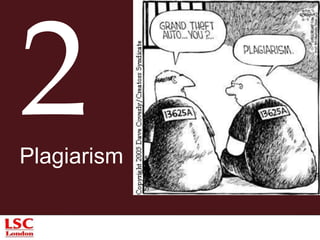
Plagiarism
Reference styles
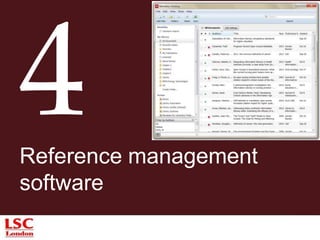
Reference management software
G. Gabriel
LSC Library
Pocock House
235 Southwark Bridge Road
London SE1 6NP
library@lsclondon.co.uk
© Thomas Hawk, Flickr
Introduction
© Capital Proximité News
What is referencing?
“Referencing is the practice of acknowledging
in your own writing the intellectual work of
others; work that has been presented in some
way into the public domain.”
(Neville, 2007, p. 1).
© Thomas Hawk via Flickr
Reference list or bibliography?
Reference list contains only the items read
and specifically cited in text.
Bibliography is a list of everything you read
in preparation for writing an assignment,
whether you found them worth citing in text
or not.
© Thomas Hawk via Flickr
Example
Why reference materials?
• Trace the origins of ideas;
• Build a web of ideas;
• Find your own voice;
• Validate arguments;
• Spread knowledge;
• Show appreciation;
• Express main influences;
• Avoid plagiarism.
(Neville, 2007, p. 8-10)
“Referencing helps create a map of knowledge, a
web of pathways in knowledge; and each researcher
helps extend that knowledge. It means that we
don't have to find out everything for ourselves all
over again; we don't have to reinvent the wheel. In
effect, referencing multiplies knowledge
exponentially.”
(Monash University, 2014).
Principles of referencing
Walker and Taylor (1998, pp.11-15) present five principles:
1. The principle of intellectual property. We acknowledge people’s right
to claim ownership of an idea/product if it has been presented in a “fixed”
way (e.g. published, presented).
2. The principle of access. Other readers will easily and quickly identify
and locate documents, thus spreading and advancing knowledge.
3. The principle of economy. A references should be presented so as to
save time with lengthy explanations in the text.
5. The principle of transparency. There must be no ambiguity in terms
and expressions used.
What to reference?
You can cite references taken from a range of sources:
• Books and chapters of books (print or online);
• Articles from journals or newspapers;
• Papers presented at conferences;
• Reports (university working papers);
• Notes supplied by a lecturer;
• Legal documents;
• Internet sources (including weblogs, email correspondence)
• DVD/CD databases;
• Radio/television/videos/audio cassette/CD-ROMS;
• Interview transcripts;
• Illustrations;
• Works of art and design.
Criteria for choosing to reference.
• Relevance: to what extent is this source relevant? Is the information
provided a partial or restricted view of the subject? Are counter-
arguments presented and treated with respect?
• Currency: when was the source published? Are there revised editions?
• Authority: is the source authoritative/credible? Do other authors refer
this source?
• Scope: how general or particular are the ideas/models/practices
described (limited in time/space/population)?
(Neville, 2007, p. 15-16)
Plagiarism
Plagiarism: what is it?
“Plagiarism is defined as submitting as one's own
work, irrespective of intent to deceive, that which
derives in part or in its entirely from the work of
others without due acknowledgement. It is both poor
scholarship and a breach of academic integrity.”
(Cambridge University, 2011)
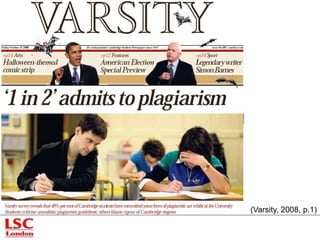
(Varsity, 2008, p.1)
Examples of plagiarism
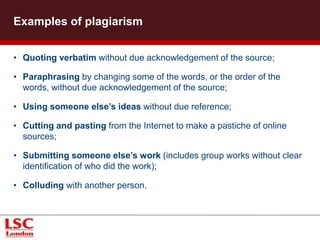
• Quoting verbatim without due acknowledgement of the source;
• Paraphrasing by changing some of the words, or the order of the
words, without due acknowledgement of the source;
• Using someone else’s ideas without due reference;
• Cutting and pasting from the Internet to make a pastiche of online
sources;
• Submitting someone else’s work (includes group works without clear
identification of who did the work);
• Colluding with another person.
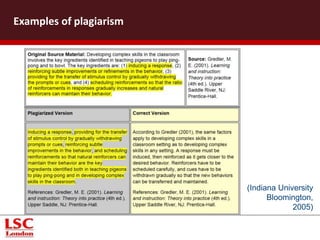
Examples of plagiarism
(Indiana University
Bloomington,
2005)
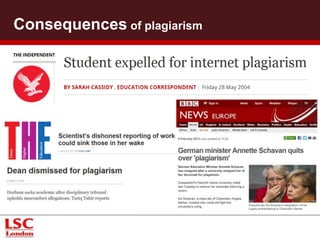
Consequences of plagiarism
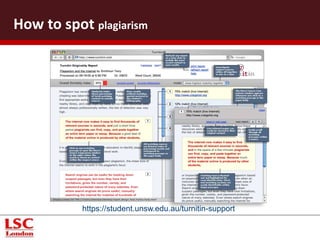
https://student.unsw.edu.au/turnitin-support
How to spot plagiarism
While you are reading/writing, make sure you identify:
• Which part is your own thought and which is taken from other
authors;
• Which parts of your own writing are a response to the argument or
directly inspired by ideas in the text;
• Which parts are paraphrases of the author’s points;
• Which parts were done in collaboration with others.
Avoiding plagiarism
Each assignment has specific learning outcomes or assessment criteria
that require you to:
• Read critically, selecting appropriate and relevant evidence;
• Write critically, exploring all aspects of an issue (positive/negative,
for/against, etc.);
• Summarise and provide an insightful analysis of a complex issue;
• Combine and relate information and ideas, and then discuss them in
your own words.
Demonstrating academic integrity
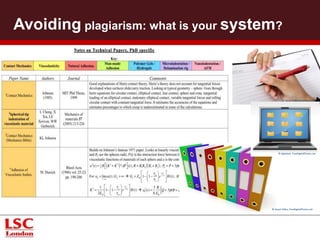
Avoiding plagiarism: what is your system?
© Pong, FreeDigitalPhotos.net
© digitalart, FreeDigitalPhotos.net
© Stuart Miles, FreeDigitalPhotos.net
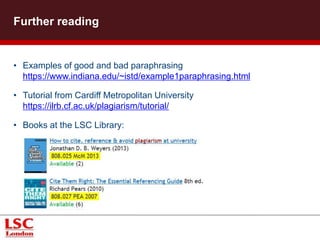
• Examples of good and bad paraphrasing
https://www.indiana.edu/~istd/example1paraphrasing.html
• Tutorial from Cardiff Metropolitan University
https://ilrb.cf.ac.uk/plagiarism/tutorial/
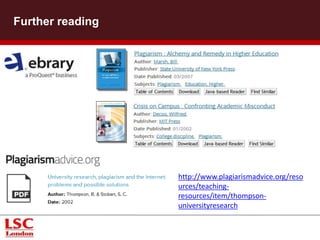
• Books at the LSC Library:
Further reading
http://www.plagiarismadvice.org/reso
urces/teaching-
resources/item/thompson-
universityresearch
Further reading
©David Castillo, FreeDigitalPhotos.net
Reference styles
Introduction
Reference styles are numerous and some standards are more
popular in certain subject areas.
Some examples:
The LSC has adopted the Harvard System of referencing and citation.
Harvard (used in Social Sciences)
IEEE (predominant in the Engineering field)
Vancouver (predominant in the Medical field)
Chicago
Oxford
…
Citing is an abbreviated form to reference contents from another
author and each citation corresponds to a full bibliographic reference.
There are generally two ways to cite:
> Citing “(Author, date, p.)” within the text
e.g. A previously study (Grover, 2005)...
> Numerical citing in the text or footnote
e.g. A previously study[1] demonstrated…
e.g. A previously study(1) demonstrated….
Library and Information Service
What is citing?
The full reference
will be presented in
the work’s
bibliography.
The full reference will
be presented in the
note field (bottom of
the page).
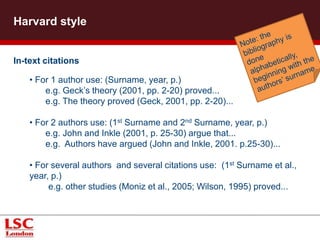
Harvard style
In-text citations
• For 1 author use: (Surname, year, p.)
e.g. Geck’s theory (2001, pp. 2-20) proved...
e.g. The theory proved (Geck, 2001, pp. 2-20)...
• For 2 authors use: (1st Surname and 2nd Surname, year, p.)
e.g. John and Inkle (2001, p. 25-30) argue that...
e.g. Authors have argued (John and Inkle, 2001. p.25-30)...
• For several authors and several citations use: (1st Surname et al.,
year, p.)
e.g. other studies (Moniz et al., 2005; Wilson, 1995) proved...
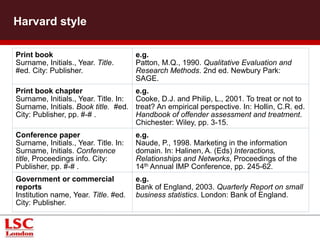
Harvard style
Print book
Surname, Initials., Year. Title.
#ed. City: Publisher.
e.g.
Patton, M.Q., 1990. Qualitative Evaluation and
Research Methods. 2nd ed. Newbury Park:
SAGE.
Print book chapter
Surname, Initials., Year. Title. In:
Surname, Initials. Book title. #ed.
City: Publisher, pp. #-# .
e.g.
Cooke, D.J. and Philip, L., 2001. To treat or not to
treat? An empirical perspective. In: Hollin, C.R. ed.
Handbook of offender assessment and treatment.
Chichester: Wiley, pp. 3-15.
Conference paper
Surname, Initials., Year. Title. In:
Surname, Initials. Conference
title, Proceedings info. City:
Publisher, pp. #-# .
e.g.
Naude, P., 1998. Marketing in the information
domain. In: Halinen, A. (Eds) Interactions,
Relationships and Networks, Proceedings of the
14th Annual IMP Conference, pp. 245-62.
Government or commercial
reports
Institution name, Year. Title. #ed.
City: Publisher.
e.g.
Bank of England, 2003. Quarterly Report on small
business statistics. London: Bank of England.
Harvard style
Printed article
Surname, Initials., Year. Title,
Journal name, Volume# No.#, pp.
#-#.
e.g.
Guthrie, J. and Parker, L., 1997. Editorial:
Celebration, reflection and a future: a decade of
AAAJ, Accounting, Auditing & Accountability
Journal, Vol.10 No.1, pp. 3-8.
Electronic article
Surname, Initials., Year. Title,
Journal name [Online], Volume#.
Available at: URL [Accessed: day
Month year].
e.g.
Merchent, A.T., 2007. Diet, physical activity, and
adiposity in children in poor and rich
neighbourhoods: a cross-sectional comparison.
Nutrition Journal [Online] 6. Available at:
http://www.nutritionj.com/content/pdf/1475-2891-6-
1.pdf [Accessed: 27 February 2007].
Website
Author/source, Year. Title [Online].
Place: Publisher (if available).
Available at: URL [Accessed: day
Month year].
e.g.
Leeds Metropolitan University, 2002, Business
Start-Up@Leeds Met. [Online] Available at:
www.lmu.ac.uk/city/bus_startup.htm [Accessed:
20 January 2014].
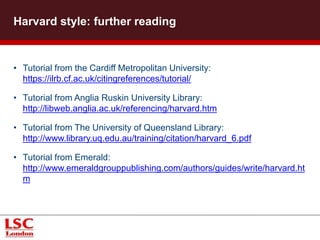
Harvard style: further reading
• Tutorial from the Cardiff Metropolitan University:
https://ilrb.cf.ac.uk/citingreferences/tutorial/
• Tutorial from Anglia Ruskin University Library:
http://libweb.anglia.ac.uk/referencing/harvard.htm
• Tutorial from The University of Queensland Library:
http://www.library.uq.edu.au/training/citation/harvard_6.pdf
• Tutorial from Emerald:
http://www.emeraldgrouppublishing.com/authors/guides/write/harvard.ht
m
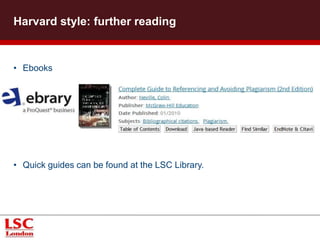
Harvard style: further reading
• Ebooks
• Quick guides can be found at the LSC Library.
Reference management
software
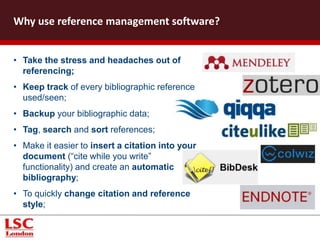
• Take the stress and headaches out of
referencing;
• Keep track of every bibliographic reference
used/seen;
• Backup your bibliographic data;
• Tag, search and sort references;
• Make it easier to insert a citation into your
document (“cite while you write”
functionality) and create an automatic
bibliography;
• To quickly change citation and reference
style;
Why use reference management software?
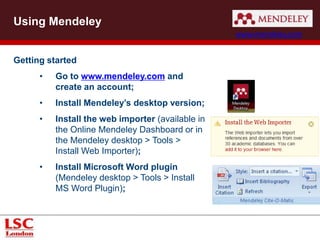
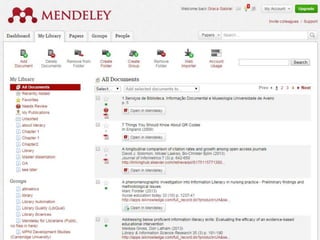
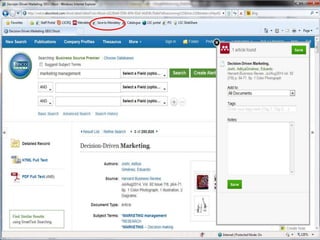
Getting started
• Go to www.mendeley.com and
create an account;
• Install Mendeley’s desktop version;
• Install the web importer (available in
the Online Mendeley Dashboard or in
the Mendeley desktop > Tools >
Install Web Importer);
• Install Microsoft Word plugin
(Mendeley desktop > Tools > Install
MS Word Plugin);
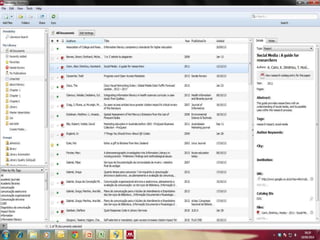
Using Mendeley
www.mendeley.com
Using Zotero
www.zotero.org
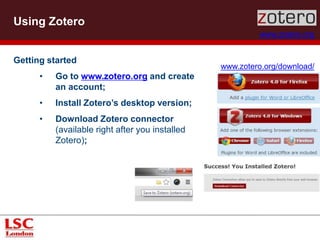
Getting started
• Go to www.zotero.org and create
an account;
• Install Zotero’s desktop version;
• Download Zotero connector
(available right after you installed
Zotero);
www.zotero.org/download/
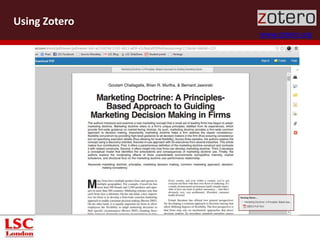
Using Zotero
www.zotero.org
Comparing reference management software
Wikipedia
http://en.wikipedia.org/wiki/Comparison_of_reference_management_sof
tware
Penn State University Libraries
http://www.libraries.psu.edu/psul/lls/choose_citation_mgr.html
Gilmour, R. and Cubus-Kuo, L., 2011. Reference management software:
a comparative analysis. Issues in Science and Technology Librarianship
[Online]. Available at: http://www.istl.org/11-summer/refereed2.html
[Accessed: 19 September 2007].
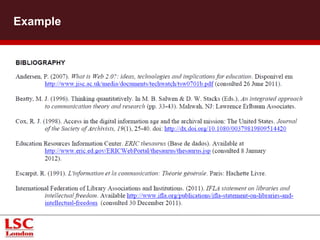
Bibliography
BBC (2013). German minister Annette Schavan quits over ‘plagiarism’. News Europe, 9 February. Retrieved 30 July 2014 from
http://www.bbc.co.uk/news/world-europe-21395102
Cassity, S. (2004). Student expelled for internet plagiarism. The Independent, 28 May. Retrieved 30 July 2014 from
http://www.independent.co.uk/news/education/education-news/student-expelled-for-internet-plagiarism-6168983.html
Coonan, E. (2013). Referencing Without Tears. Retrieved 10 August 2014 from
http://researchcentral.wordpress.com/2013/11/13/referencing/
Indiana University Bloomington, School of Education (2005). How to recognize plagiarism. Retrieved 1 August 2014 from
https://www.indiana.edu/~istd/example1paraphrasing.html
Jump, P. (2014). Scientist’s dishonest reporting of work could sink those in her wake. Times Higher Education, 9 January.
Retriaved 1 August from http://www.timeshighereducation.co.uk/news/scientists-dishonest-reporting-of-work-could-sink-those-in-
her-wake/2010319.article
Monash University. (2014). Why do we reference?. Available at
http://www.monash.edu.au/lls/llonline/writing/general/reference/index.xml (retrieved 10 August 2014).
Neville. (2007). The Complete Guide To Referencing And Avoiding Plagiarism. Open University Press. Retrieved 11 August 2014
from http://www.myilibrary.com?ID=112960
Stothard, M. (2008). ‘1 in 2’ admits to plagiarism. Varsity, 681, 1,4-5.
TSL Education Ltd. (2008). Dear dismissed for plagiarism. Times Higher Education, 6 March. Retrieved 30 July from
http://www.timeshighereducation.co.uk/news/dean-dismissed-for-plagiarism/400950.article
University of Cambridge. (2011). University-wide statement on plagiarism. Retrieved 15 July 2014 from
http://www.admin.cam.ac.uk/univ/plagiarism/students/statement.html
Walker, J.R., & Taylor, T. (1998). The Columbia guide to online style. New York: Columbia University Press.
LSC Library
Pocock House
235 Southwark Bridge Road
London
SE1 6NP
library@lsclondon.co.uk
www.slideshare.net/lsclondon
Attribution-NonCommercial-ShareAlike

Referencing

  • 1.
    Attribution-NonCommercial-ShareAlike Referencing Referencing and citing Plagiarism Referencestyles Reference management software G. Gabriel LSC Library Pocock House 235 Southwark Bridge Road London SE1 6NP library@lsclondon.co.uk © Thomas Hawk, Flickr
  • 2.
  • 3.
    What is referencing? “Referencingis the practice of acknowledging in your own writing the intellectual work of others; work that has been presented in some way into the public domain.” (Neville, 2007, p. 1). © Thomas Hawk via Flickr
  • 4.
    Reference list orbibliography? Reference list contains only the items read and specifically cited in text. Bibliography is a list of everything you read in preparation for writing an assignment, whether you found them worth citing in text or not. © Thomas Hawk via Flickr
  • 5.
  • 6.
    Why reference materials? •Trace the origins of ideas; • Build a web of ideas; • Find your own voice; • Validate arguments; • Spread knowledge; • Show appreciation; • Express main influences; • Avoid plagiarism. (Neville, 2007, p. 8-10)
  • 7.
    “Referencing helps createa map of knowledge, a web of pathways in knowledge; and each researcher helps extend that knowledge. It means that we don't have to find out everything for ourselves all over again; we don't have to reinvent the wheel. In effect, referencing multiplies knowledge exponentially.” (Monash University, 2014).
  • 8.
    Principles of referencing Walkerand Taylor (1998, pp.11-15) present five principles: 1. The principle of intellectual property. We acknowledge people’s right to claim ownership of an idea/product if it has been presented in a “fixed” way (e.g. published, presented). 2. The principle of access. Other readers will easily and quickly identify and locate documents, thus spreading and advancing knowledge. 3. The principle of economy. A references should be presented so as to save time with lengthy explanations in the text. 5. The principle of transparency. There must be no ambiguity in terms and expressions used.
  • 9.
    What to reference? Youcan cite references taken from a range of sources: • Books and chapters of books (print or online); • Articles from journals or newspapers; • Papers presented at conferences; • Reports (university working papers); • Notes supplied by a lecturer; • Legal documents; • Internet sources (including weblogs, email correspondence) • DVD/CD databases; • Radio/television/videos/audio cassette/CD-ROMS; • Interview transcripts; • Illustrations; • Works of art and design.
  • 10.
    Criteria for choosingto reference. • Relevance: to what extent is this source relevant? Is the information provided a partial or restricted view of the subject? Are counter- arguments presented and treated with respect? • Currency: when was the source published? Are there revised editions? • Authority: is the source authoritative/credible? Do other authors refer this source? • Scope: how general or particular are the ideas/models/practices described (limited in time/space/population)? (Neville, 2007, p. 15-16)
  • 11.
  • 12.
    Plagiarism: what isit? “Plagiarism is defined as submitting as one's own work, irrespective of intent to deceive, that which derives in part or in its entirely from the work of others without due acknowledgement. It is both poor scholarship and a breach of academic integrity.” (Cambridge University, 2011)
  • 13.
  • 14.
    Examples of plagiarism •Quoting verbatim without due acknowledgement of the source; • Paraphrasing by changing some of the words, or the order of the words, without due acknowledgement of the source; • Using someone else’s ideas without due reference; • Cutting and pasting from the Internet to make a pastiche of online sources; • Submitting someone else’s work (includes group works without clear identification of who did the work); • Colluding with another person.
  • 15.
    Examples of plagiarism (IndianaUniversity Bloomington, 2005)
  • 16.
  • 17.
  • 18.
    While you arereading/writing, make sure you identify: • Which part is your own thought and which is taken from other authors; • Which parts of your own writing are a response to the argument or directly inspired by ideas in the text; • Which parts are paraphrases of the author’s points; • Which parts were done in collaboration with others. Avoiding plagiarism
  • 19.
    Each assignment hasspecific learning outcomes or assessment criteria that require you to: • Read critically, selecting appropriate and relevant evidence; • Write critically, exploring all aspects of an issue (positive/negative, for/against, etc.); • Summarise and provide an insightful analysis of a complex issue; • Combine and relate information and ideas, and then discuss them in your own words. Demonstrating academic integrity
  • 20.
    Avoiding plagiarism: whatis your system? © Pong, FreeDigitalPhotos.net © digitalart, FreeDigitalPhotos.net © Stuart Miles, FreeDigitalPhotos.net
  • 21.
    • Examples ofgood and bad paraphrasing https://www.indiana.edu/~istd/example1paraphrasing.html • Tutorial from Cardiff Metropolitan University https://ilrb.cf.ac.uk/plagiarism/tutorial/ • Books at the LSC Library: Further reading
  • 22.
  • 23.
  • 24.
    Introduction Reference styles arenumerous and some standards are more popular in certain subject areas. Some examples: The LSC has adopted the Harvard System of referencing and citation. Harvard (used in Social Sciences) IEEE (predominant in the Engineering field) Vancouver (predominant in the Medical field) Chicago Oxford …
  • 25.
    Citing is anabbreviated form to reference contents from another author and each citation corresponds to a full bibliographic reference. There are generally two ways to cite: > Citing “(Author, date, p.)” within the text e.g. A previously study (Grover, 2005)... > Numerical citing in the text or footnote e.g. A previously study[1] demonstrated… e.g. A previously study(1) demonstrated…. Library and Information Service What is citing? The full reference will be presented in the work’s bibliography. The full reference will be presented in the note field (bottom of the page).
  • 26.
    Harvard style In-text citations •For 1 author use: (Surname, year, p.) e.g. Geck’s theory (2001, pp. 2-20) proved... e.g. The theory proved (Geck, 2001, pp. 2-20)... • For 2 authors use: (1st Surname and 2nd Surname, year, p.) e.g. John and Inkle (2001, p. 25-30) argue that... e.g. Authors have argued (John and Inkle, 2001. p.25-30)... • For several authors and several citations use: (1st Surname et al., year, p.) e.g. other studies (Moniz et al., 2005; Wilson, 1995) proved...
  • 27.
    Harvard style Print book Surname,Initials., Year. Title. #ed. City: Publisher. e.g. Patton, M.Q., 1990. Qualitative Evaluation and Research Methods. 2nd ed. Newbury Park: SAGE. Print book chapter Surname, Initials., Year. Title. In: Surname, Initials. Book title. #ed. City: Publisher, pp. #-# . e.g. Cooke, D.J. and Philip, L., 2001. To treat or not to treat? An empirical perspective. In: Hollin, C.R. ed. Handbook of offender assessment and treatment. Chichester: Wiley, pp. 3-15. Conference paper Surname, Initials., Year. Title. In: Surname, Initials. Conference title, Proceedings info. City: Publisher, pp. #-# . e.g. Naude, P., 1998. Marketing in the information domain. In: Halinen, A. (Eds) Interactions, Relationships and Networks, Proceedings of the 14th Annual IMP Conference, pp. 245-62. Government or commercial reports Institution name, Year. Title. #ed. City: Publisher. e.g. Bank of England, 2003. Quarterly Report on small business statistics. London: Bank of England.
  • 28.
    Harvard style Printed article Surname,Initials., Year. Title, Journal name, Volume# No.#, pp. #-#. e.g. Guthrie, J. and Parker, L., 1997. Editorial: Celebration, reflection and a future: a decade of AAAJ, Accounting, Auditing & Accountability Journal, Vol.10 No.1, pp. 3-8. Electronic article Surname, Initials., Year. Title, Journal name [Online], Volume#. Available at: URL [Accessed: day Month year]. e.g. Merchent, A.T., 2007. Diet, physical activity, and adiposity in children in poor and rich neighbourhoods: a cross-sectional comparison. Nutrition Journal [Online] 6. Available at: http://www.nutritionj.com/content/pdf/1475-2891-6- 1.pdf [Accessed: 27 February 2007]. Website Author/source, Year. Title [Online]. Place: Publisher (if available). Available at: URL [Accessed: day Month year]. e.g. Leeds Metropolitan University, 2002, Business Start-Up@Leeds Met. [Online] Available at: www.lmu.ac.uk/city/bus_startup.htm [Accessed: 20 January 2014].
  • 29.
    Harvard style: furtherreading • Tutorial from the Cardiff Metropolitan University: https://ilrb.cf.ac.uk/citingreferences/tutorial/ • Tutorial from Anglia Ruskin University Library: http://libweb.anglia.ac.uk/referencing/harvard.htm • Tutorial from The University of Queensland Library: http://www.library.uq.edu.au/training/citation/harvard_6.pdf • Tutorial from Emerald: http://www.emeraldgrouppublishing.com/authors/guides/write/harvard.ht m
  • 30.
    Harvard style: furtherreading • Ebooks • Quick guides can be found at the LSC Library.
  • 31.
  • 32.
    • Take thestress and headaches out of referencing; • Keep track of every bibliographic reference used/seen; • Backup your bibliographic data; • Tag, search and sort references; • Make it easier to insert a citation into your document (“cite while you write” functionality) and create an automatic bibliography; • To quickly change citation and reference style; Why use reference management software?
  • 33.
    Getting started • Goto www.mendeley.com and create an account; • Install Mendeley’s desktop version; • Install the web importer (available in the Online Mendeley Dashboard or in the Mendeley desktop > Tools > Install Web Importer); • Install Microsoft Word plugin (Mendeley desktop > Tools > Install MS Word Plugin); Using Mendeley www.mendeley.com
  • 37.
    Using Zotero www.zotero.org Getting started •Go to www.zotero.org and create an account; • Install Zotero’s desktop version; • Download Zotero connector (available right after you installed Zotero); www.zotero.org/download/
  • 38.
  • 39.
    Comparing reference managementsoftware Wikipedia http://en.wikipedia.org/wiki/Comparison_of_reference_management_sof tware Penn State University Libraries http://www.libraries.psu.edu/psul/lls/choose_citation_mgr.html Gilmour, R. and Cubus-Kuo, L., 2011. Reference management software: a comparative analysis. Issues in Science and Technology Librarianship [Online]. Available at: http://www.istl.org/11-summer/refereed2.html [Accessed: 19 September 2007].
  • 40.
    Bibliography BBC (2013). Germanminister Annette Schavan quits over ‘plagiarism’. News Europe, 9 February. Retrieved 30 July 2014 from http://www.bbc.co.uk/news/world-europe-21395102 Cassity, S. (2004). Student expelled for internet plagiarism. The Independent, 28 May. Retrieved 30 July 2014 from http://www.independent.co.uk/news/education/education-news/student-expelled-for-internet-plagiarism-6168983.html Coonan, E. (2013). Referencing Without Tears. Retrieved 10 August 2014 from http://researchcentral.wordpress.com/2013/11/13/referencing/ Indiana University Bloomington, School of Education (2005). How to recognize plagiarism. Retrieved 1 August 2014 from https://www.indiana.edu/~istd/example1paraphrasing.html Jump, P. (2014). Scientist’s dishonest reporting of work could sink those in her wake. Times Higher Education, 9 January. Retriaved 1 August from http://www.timeshighereducation.co.uk/news/scientists-dishonest-reporting-of-work-could-sink-those-in- her-wake/2010319.article Monash University. (2014). Why do we reference?. Available at http://www.monash.edu.au/lls/llonline/writing/general/reference/index.xml (retrieved 10 August 2014). Neville. (2007). The Complete Guide To Referencing And Avoiding Plagiarism. Open University Press. Retrieved 11 August 2014 from http://www.myilibrary.com?ID=112960 Stothard, M. (2008). ‘1 in 2’ admits to plagiarism. Varsity, 681, 1,4-5. TSL Education Ltd. (2008). Dear dismissed for plagiarism. Times Higher Education, 6 March. Retrieved 30 July from http://www.timeshighereducation.co.uk/news/dean-dismissed-for-plagiarism/400950.article University of Cambridge. (2011). University-wide statement on plagiarism. Retrieved 15 July 2014 from http://www.admin.cam.ac.uk/univ/plagiarism/students/statement.html Walker, J.R., & Taylor, T. (1998). The Columbia guide to online style. New York: Columbia University Press.
  • 41.
    LSC Library Pocock House 235Southwark Bridge Road London SE1 6NP library@lsclondon.co.uk www.slideshare.net/lsclondon Attribution-NonCommercial-ShareAlike