Presentation Skills

Isabelle Pottinger

Effective Learning Adviser

Effective Learning Service
Think about...

• Why?

• What?

• Who?

• Where?

• How?
Giving a Presentation
• Who are the members of your audience?

• Clarify your task

• Be Positive!
Establish your Aim
• Decide on central theme

• Audience will only hear each point once

• Will remember 3 - 4 points, so…

• Aim must be clear
Collect Ideas - Academic
•   Web
•   Text books
•   Journals
•   Lecture notes
•   Lecturers and other staff
Collect Further Ideas
• Any further ideas? – jot them down
• Props or visual aids you want to use?
• Lay out ideas in a logical order
  or a pattern.
Group under headings that…
• …reflect your aim

• ….correspond to a theme or topic

• …will help to ‘sign-post’ your talk
Order/ reorder
• Get headings in a logical order
• Structure talk:
   – Beginning
   – Middle
   – End
• Stick to Structure
Visual reinforcement - Why?
•   Attention grabbing
•   Bold
•   Concise
•   Dedicated
•   Easy to read
Visual reinforcement - How?
• Don’t clutter
• Words alone are not very visual
   – Use bullet points
   – Use keywords
   – Stick to the theme
• Keep visuals simple
   – Do you need each one?
   – What will each one show?
   – Any important ones missing?
• Ensure visuals are used effectively
Visual reinforcement - Types?
•   Black/ white board and/ or flip chart?
•   Magnetic or Velcro boards?
•   Samples and/ or models?
•   Slides, film and/ or video?
•   PC with data projector?
•   Overhead transparencies
    (OHTs) with overhead projector?
Using OHT/ PowerPoint
• The sequence of slides should tell a story

• Use appropriate typesize

• Use appropriate colour

• Special effects?
Using OHT/ PowerPoint
• Think about how to use the medium to its
  best advantage

  – Don’t talk to the OHT or screen
  – Don’t reveal the slide too soon
  – Don’t leave the slide still showing once you
    have moved on to your next point
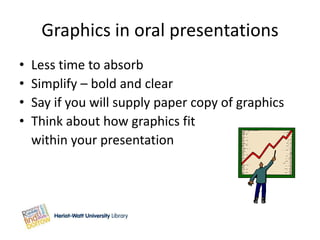
Graphics in oral presentations
•   Less time to absorb
•   Simplify – bold and clear
•   Say if you will supply paper copy of graphics
•   Think about how graphics fit
    within your presentation
Prepare final notes
• Don’t create word-for-word notes

• Use prompt cards, not sheets

• Highlight key phrases

• Keep contact with your audience
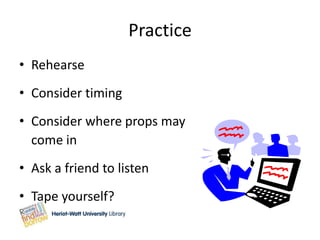
Practice
• Rehearse
• Consider timing
• Consider where props may
  come in
• Ask a friend to listen
• Tape yourself?
Conclude
• Concisely

• Confidently

• Positively
And next...
Clothes
• You are a young professional-in-training. Dress
  accordingly.
   – No offensively-sloganed tee-shirts
   – No shorts or ripped jeans
   – No low cut tops on women

• While there is no need for a suit, let your clothes
  reflect the effort you have put into preparing your
  presentation.
Voice
•   Vary pitch
•   Vary the speed
•   Watch volume
•   Speak clearly
•   Don’t try to hide
    your accent
Mannerisms
• Avoid annoying or distracting habits
• Think about your own mannerisms
• Review and control
  – Body language
  – Expressions
  – Stance
  – Movement
  – Gestures
Humour
• Can backfire – doesn’t always go down well

• May actually upset people

• If you do not feel confident with
  it, you don’t have to try
Confidence
• Everyone wants you to succeed

• Preparation will help

• You may become more
  effective as a result
  of a few nerves
Question technique
• Must allow audience questions
• Try to remain calm
  – Thank/ Acknowledge
  – Rephrase (if appropriate)
  – Answer
  – Check (by body language?)
Contact Details
• Isabelle Pottinger
• Effective Learning Adviser
• Effective Learning Service

• Ext: 3062
• E-mail: I.Pottinger@hw.ac.uk

Presentation skills feb2012

  • 1.
    Presentation Skills Isabelle Pottinger EffectiveLearning Adviser Effective Learning Service
  • 2.
    Think about... • Why? •What? • Who? • Where? • How?
  • 3.
    Giving a Presentation •Who are the members of your audience? • Clarify your task • Be Positive!
  • 4.
    Establish your Aim •Decide on central theme • Audience will only hear each point once • Will remember 3 - 4 points, so… • Aim must be clear
  • 5.
    Collect Ideas -Academic • Web • Text books • Journals • Lecture notes • Lecturers and other staff
  • 6.
    Collect Further Ideas •Any further ideas? – jot them down • Props or visual aids you want to use? • Lay out ideas in a logical order or a pattern.
  • 7.
    Group under headingsthat… • …reflect your aim • ….correspond to a theme or topic • …will help to ‘sign-post’ your talk
  • 8.
    Order/ reorder • Getheadings in a logical order • Structure talk: – Beginning – Middle – End • Stick to Structure
  • 9.
    Visual reinforcement -Why? • Attention grabbing • Bold • Concise • Dedicated • Easy to read
  • 10.
    Visual reinforcement -How? • Don’t clutter • Words alone are not very visual – Use bullet points – Use keywords – Stick to the theme • Keep visuals simple – Do you need each one? – What will each one show? – Any important ones missing? • Ensure visuals are used effectively
  • 11.
    Visual reinforcement -Types? • Black/ white board and/ or flip chart? • Magnetic or Velcro boards? • Samples and/ or models? • Slides, film and/ or video? • PC with data projector? • Overhead transparencies (OHTs) with overhead projector?
  • 12.
    Using OHT/ PowerPoint •The sequence of slides should tell a story • Use appropriate typesize • Use appropriate colour • Special effects?
  • 13.
    Using OHT/ PowerPoint •Think about how to use the medium to its best advantage – Don’t talk to the OHT or screen – Don’t reveal the slide too soon – Don’t leave the slide still showing once you have moved on to your next point
  • 14.
    Graphics in oralpresentations • Less time to absorb • Simplify – bold and clear • Say if you will supply paper copy of graphics • Think about how graphics fit within your presentation
  • 15.
    Prepare final notes •Don’t create word-for-word notes • Use prompt cards, not sheets • Highlight key phrases • Keep contact with your audience
  • 16.
    Practice • Rehearse • Considertiming • Consider where props may come in • Ask a friend to listen • Tape yourself?
  • 17.
  • 18.
  • 19.
    Clothes • You area young professional-in-training. Dress accordingly. – No offensively-sloganed tee-shirts – No shorts or ripped jeans – No low cut tops on women • While there is no need for a suit, let your clothes reflect the effort you have put into preparing your presentation.
  • 20.
    Voice • Vary pitch • Vary the speed • Watch volume • Speak clearly • Don’t try to hide your accent
  • 21.
    Mannerisms • Avoid annoyingor distracting habits • Think about your own mannerisms • Review and control – Body language – Expressions – Stance – Movement – Gestures
  • 22.
    Humour • Can backfire– doesn’t always go down well • May actually upset people • If you do not feel confident with it, you don’t have to try
  • 23.
    Confidence • Everyone wantsyou to succeed • Preparation will help • You may become more effective as a result of a few nerves
  • 24.
    Question technique • Mustallow audience questions • Try to remain calm – Thank/ Acknowledge – Rephrase (if appropriate) – Answer – Check (by body language?)
  • 25.
    Contact Details • IsabellePottinger • Effective Learning Adviser • Effective Learning Service • Ext: 3062 • E-mail: I.Pottinger@hw.ac.uk