Cambridge University Library


How to avoid plagiarism
Dr. Emma Coonan
Research Skills Librarian, Cambridge University Library
What is plagiarism?


        How many ways can you think of to
              commit plagiarism?
Examples of plagiarism

• quoting verbatim another person‟s work without due acknowledgement
  of the source

• paraphrasing another person‟s work by changing some of the words, or
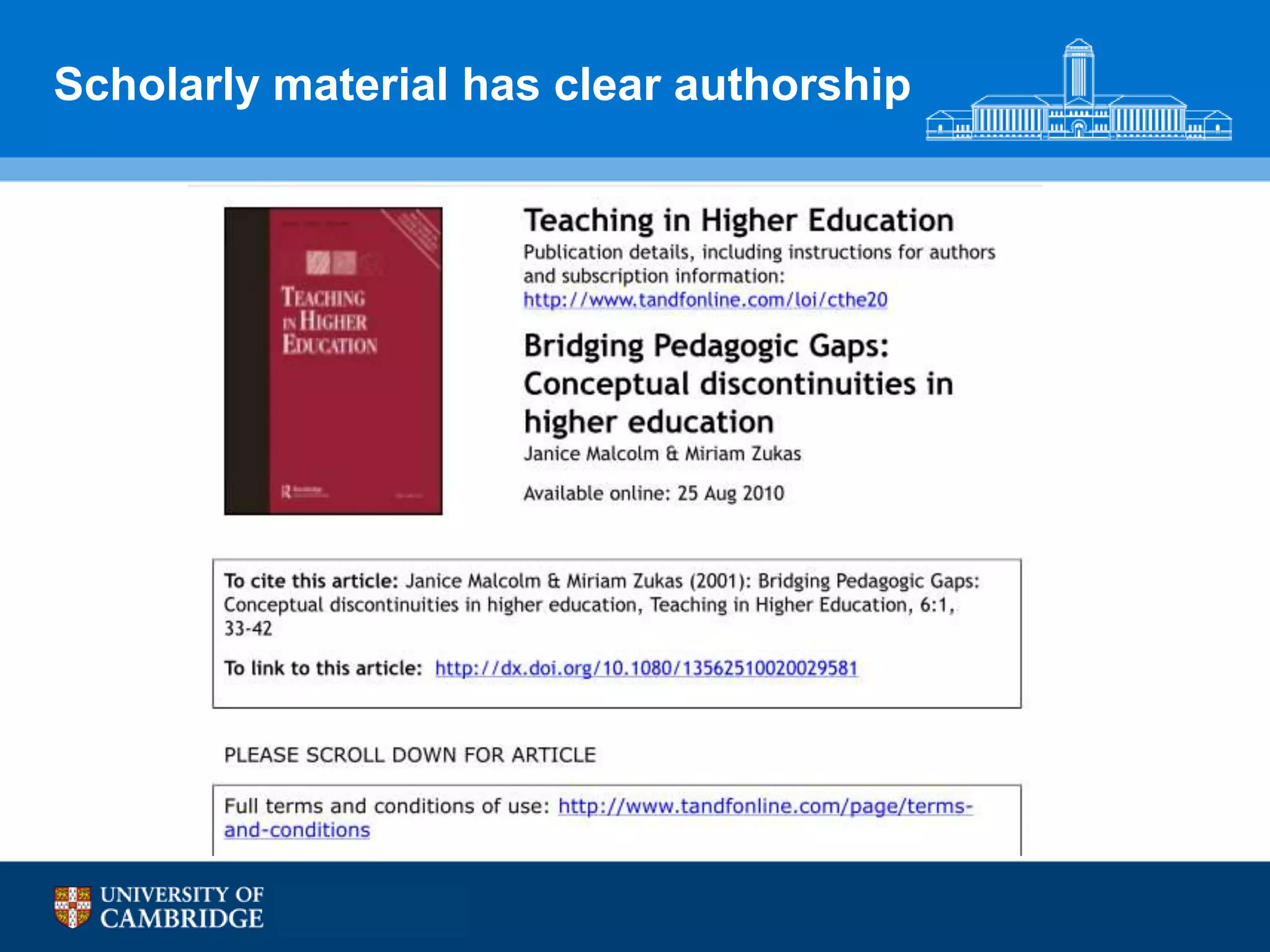
  the order of the words, without due acknowledgement of the source

• using ideas taken from someone else without reference to the originator

• cutting and pasting from the Internet to make a pastiche of online
  sources

• submitting someone else‟s work as part of a candidate‟s own without
  identifying clearly who did the work

• colluding with another person

• autoplagiarism

                                               (University of Cambridge, 2011)
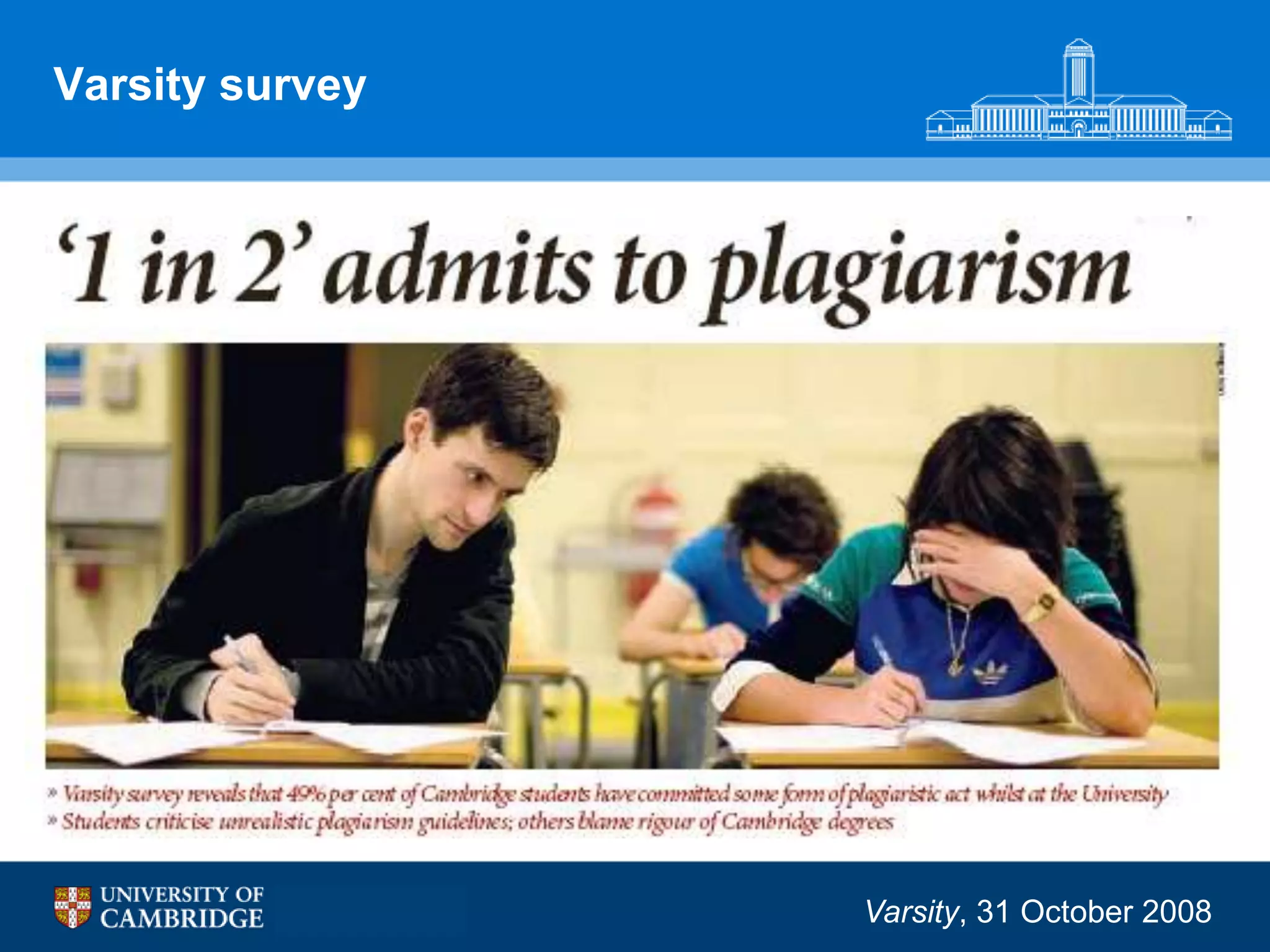
Varsity survey


                 Varsity, 31 October 2008
What is it?


     “   … submitting as one‟s own work, irrespective of
    intent to deceive, that which derives in part or in its
    entirety from the work of others without due
    acknowledgement. ”
            (University of Cambridge 2011, emphasis mine)


www.admin.cam.ac.uk/univ/plagiarism/students/statement.html
What is it?


     “ … passing off someone else‟s work as your own,
   whether intentionally or unintentionally, for your own
   benefit. ”
                                      (Carroll 2002, p.40)
The (ethical) bottom line


Ensuring that your readers can distinguish between
your own and others‟ thinking means that you:


• Give credit for the work you have built on
• Get credit for the work you have done yourself
Case study 1


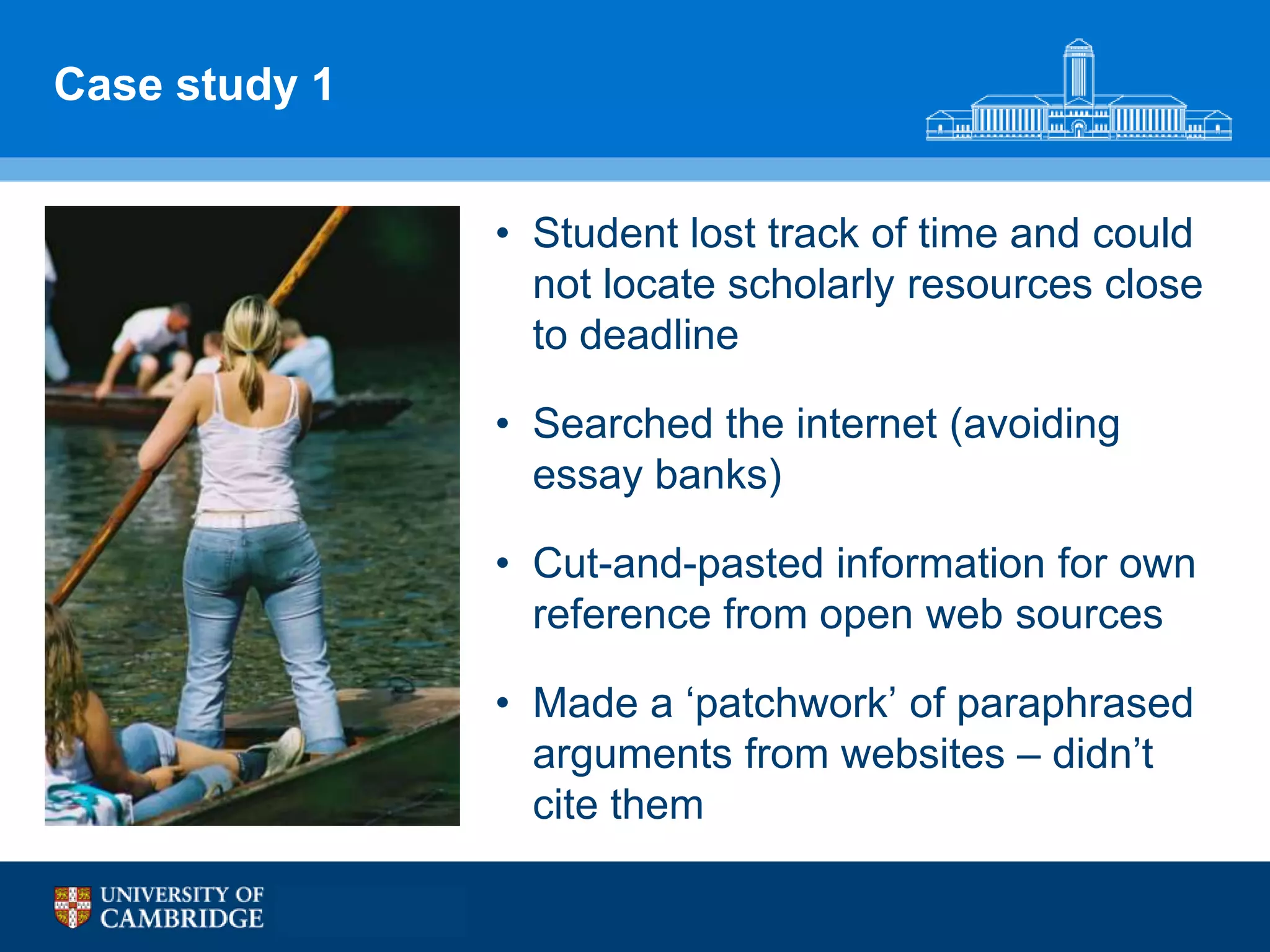
               • Student lost track of time and could
                 not locate scholarly resources close
                 to deadline

               • Searched the internet (avoiding
                 essay banks)

               • Cut-and-pasted information for own
                 reference from open web sources

               • Made a „patchwork‟ of paraphrased
                 arguments from websites – didn‟t
                 cite them
What caused it?


1. Non-scholarly information – not well „signposted‟


2. Poor citation practice
Solutions


1. Know where to find scholarly resources for your
   subject

2. Always have two ends to your reference!
Scholarly material has clear authorship
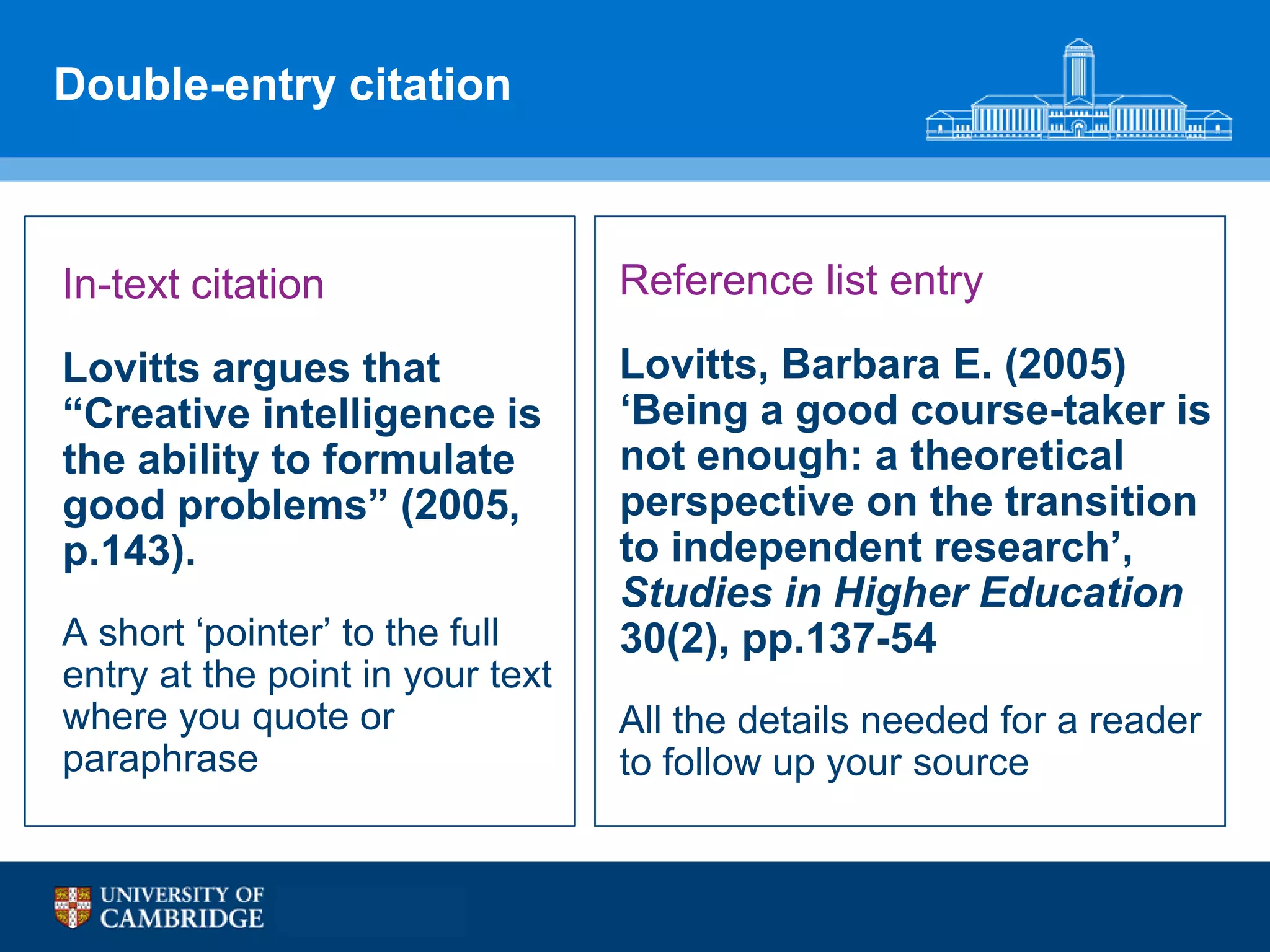
Double-entry citation


In-text citation                  Reference list entry

Lovitts argues that               Lovitts, Barbara E. (2005)
“Creative intelligence is         „Being a good course-taker is
the ability to formulate          not enough: a theoretical
good problems” (2005,             perspective on the transition
p.143).                           to independent research‟,
                                  Studies in Higher Education
A short „pointer‟ to the full     30(2), pp.137-54
entry at the point in your text
where you quote or                All the details needed for a reader
paraphrase                        to follow up your source
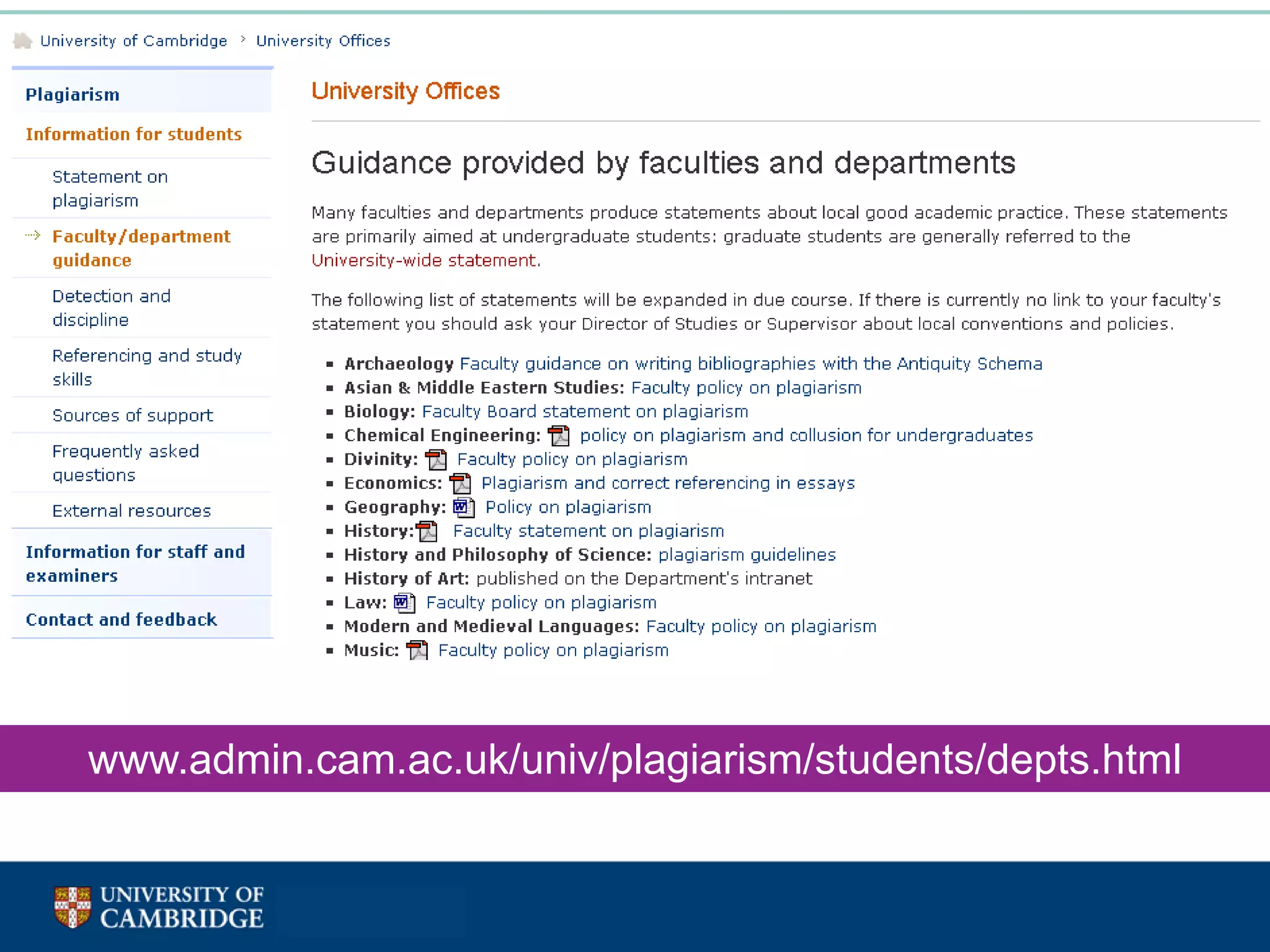
Citation styles


Your school or department will probably have a preferred or
citation style. It might even be mandatory to use a particular
style.

                       Do you know
                       which one you
                        should use?


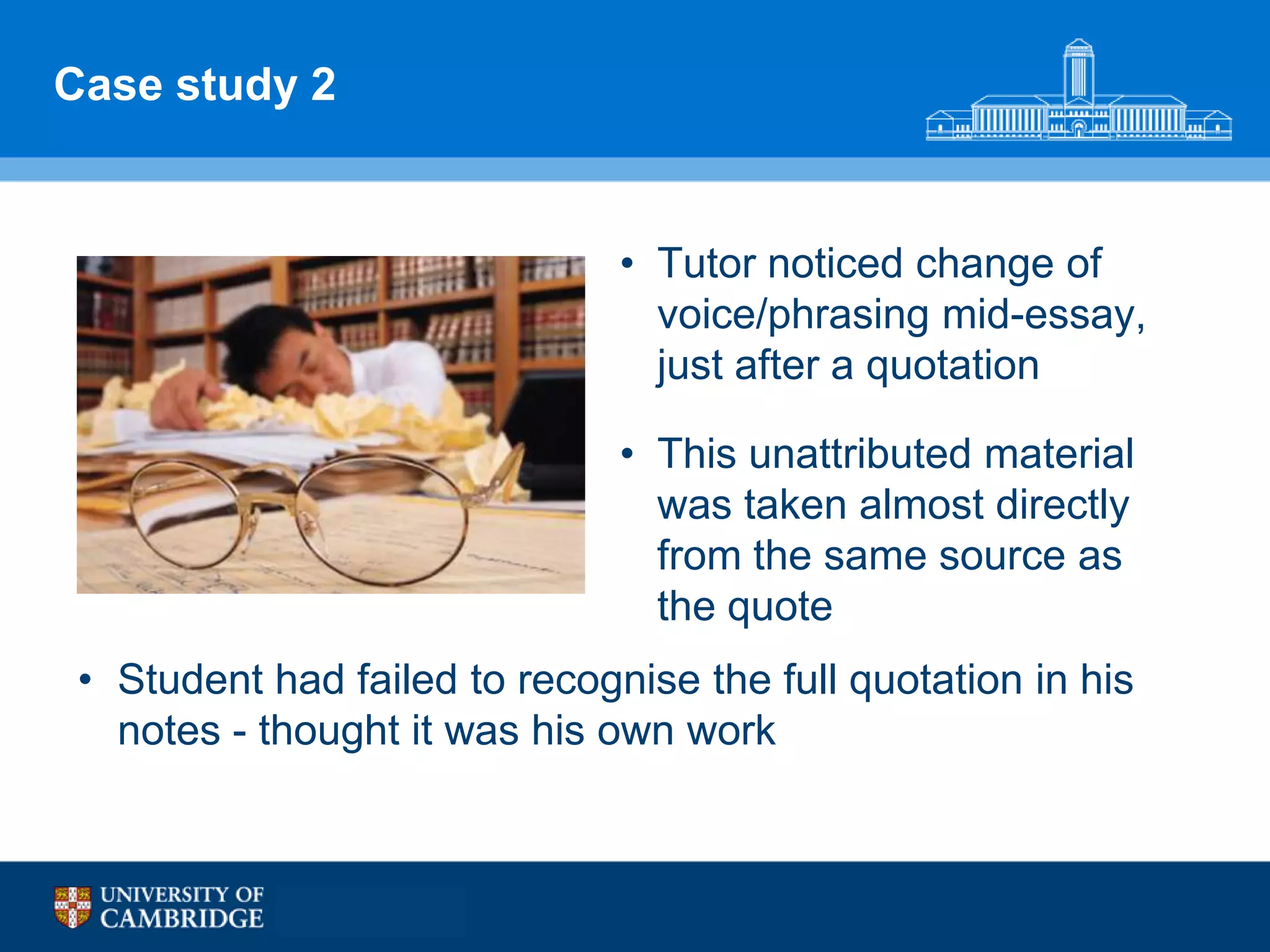
 www.admin.cam.ac.uk/univ/plagiarism/students/depts.html
www.admin.cam.ac.uk/univ/plagiarism/students/depts.html
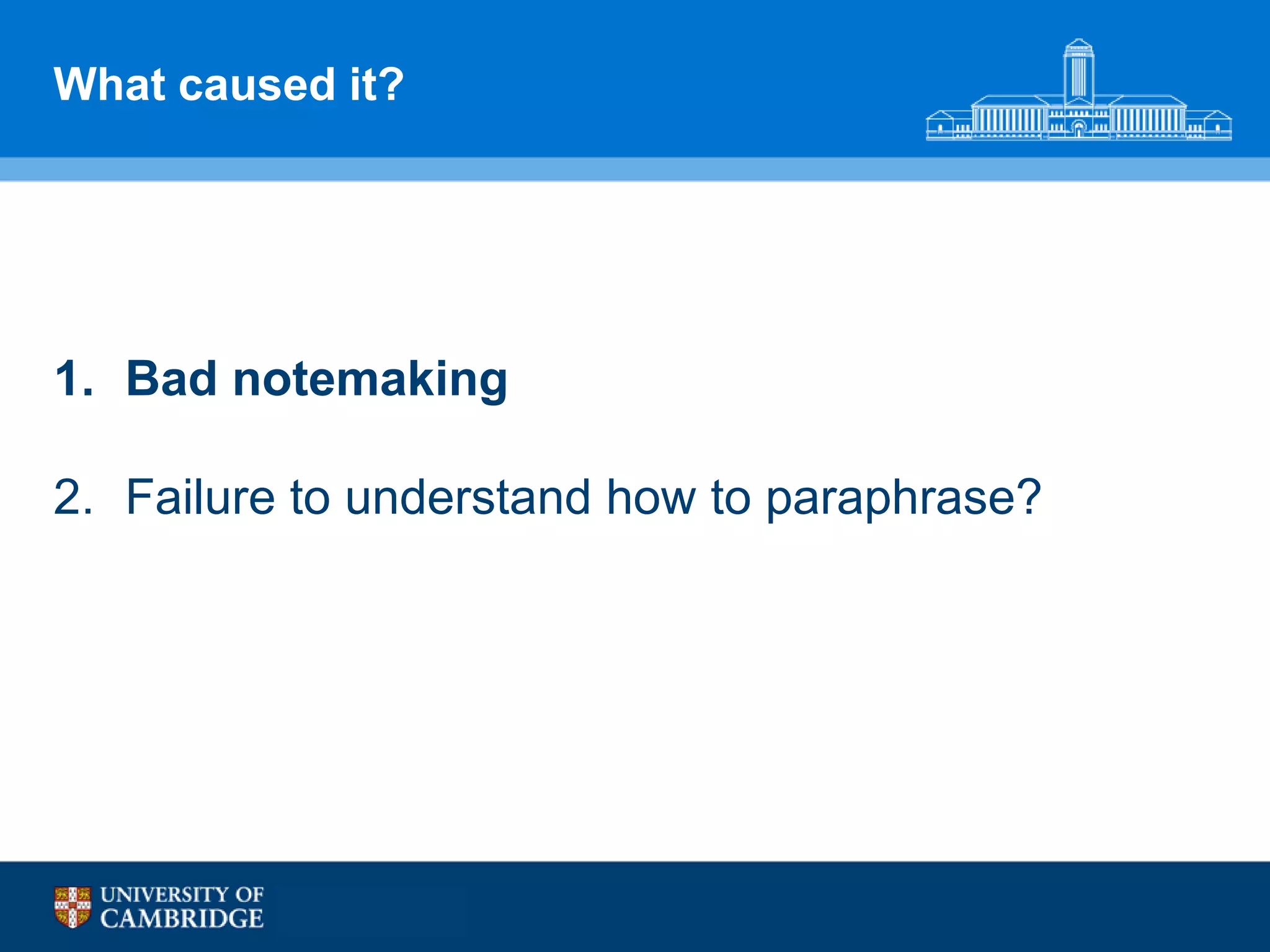
Case study 2


                               • Tutor noticed change of
                                 voice/phrasing mid-essay,
                                 just after a quotation

                               • This unattributed material
                                 was taken almost directly
                                 from the same source as
                                 the quote
 • Student had failed to recognise the full quotation in his
   notes - thought it was his own work
What caused it?


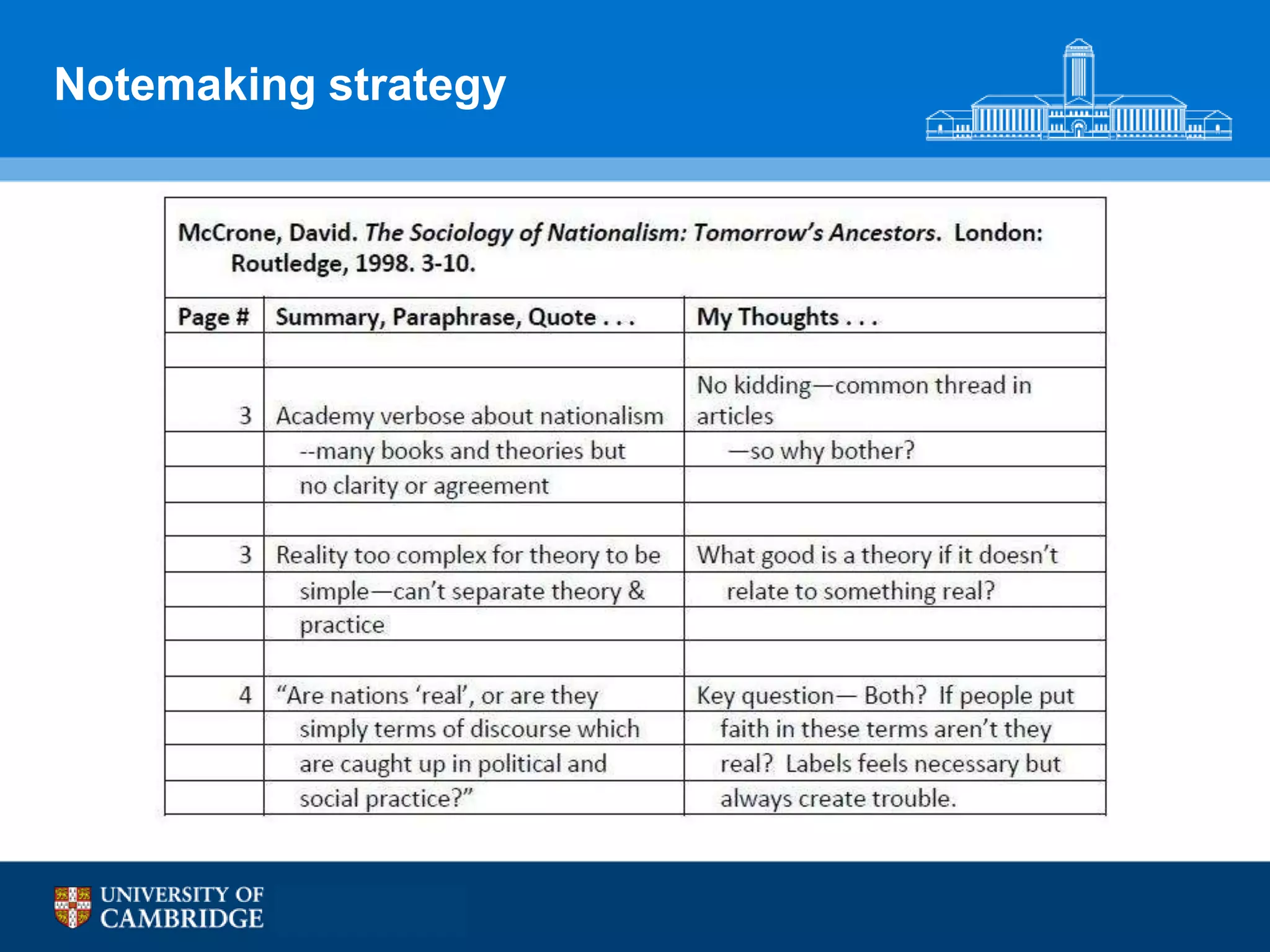
1. Bad notemaking

2. Failure to understand how to paraphrase?
Solutions


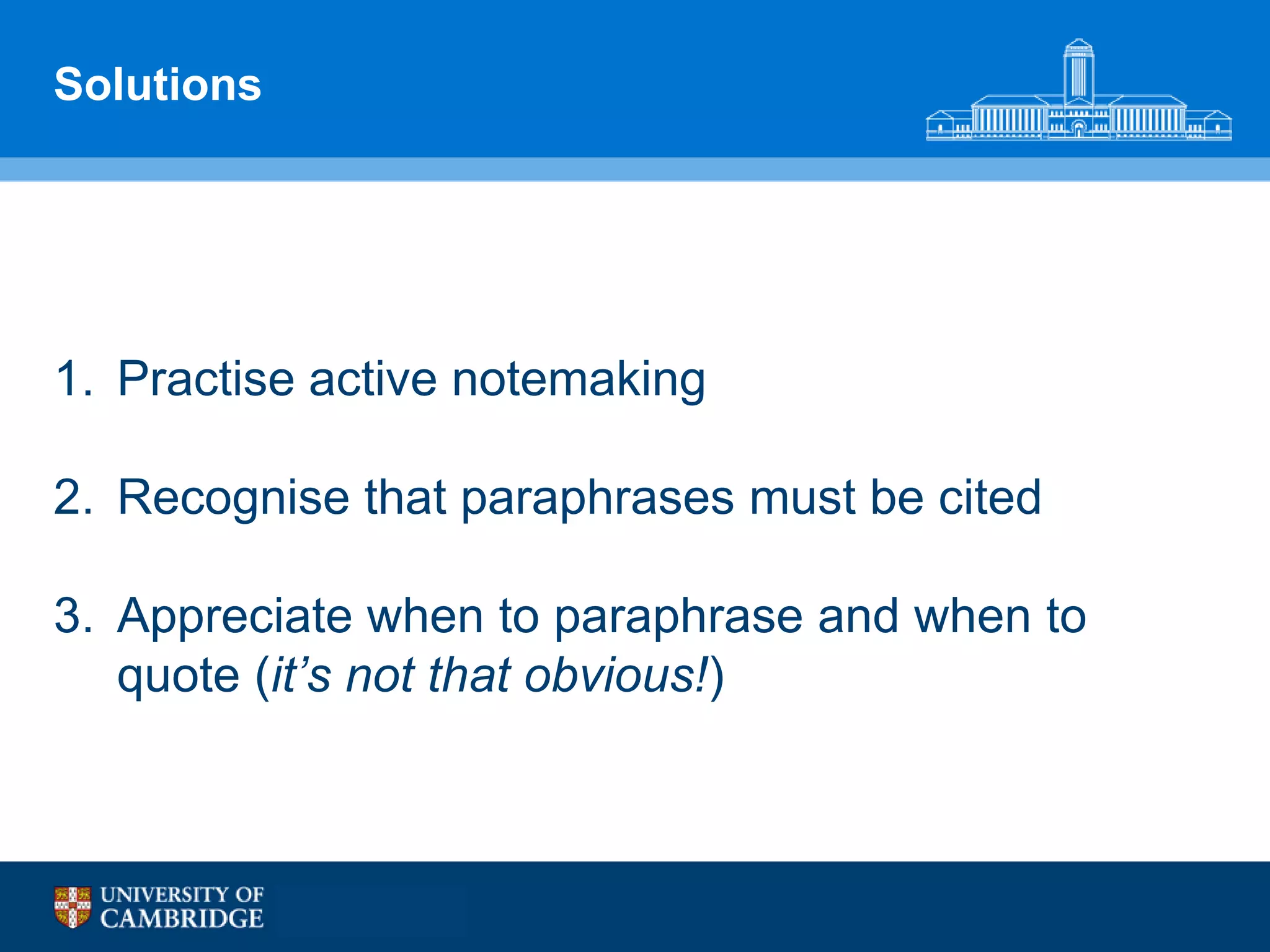
1. Practise active notemaking

2. Recognise that paraphrases must be cited

3. Appreciate when to paraphrase and when to
   quote (it’s not that obvious!)
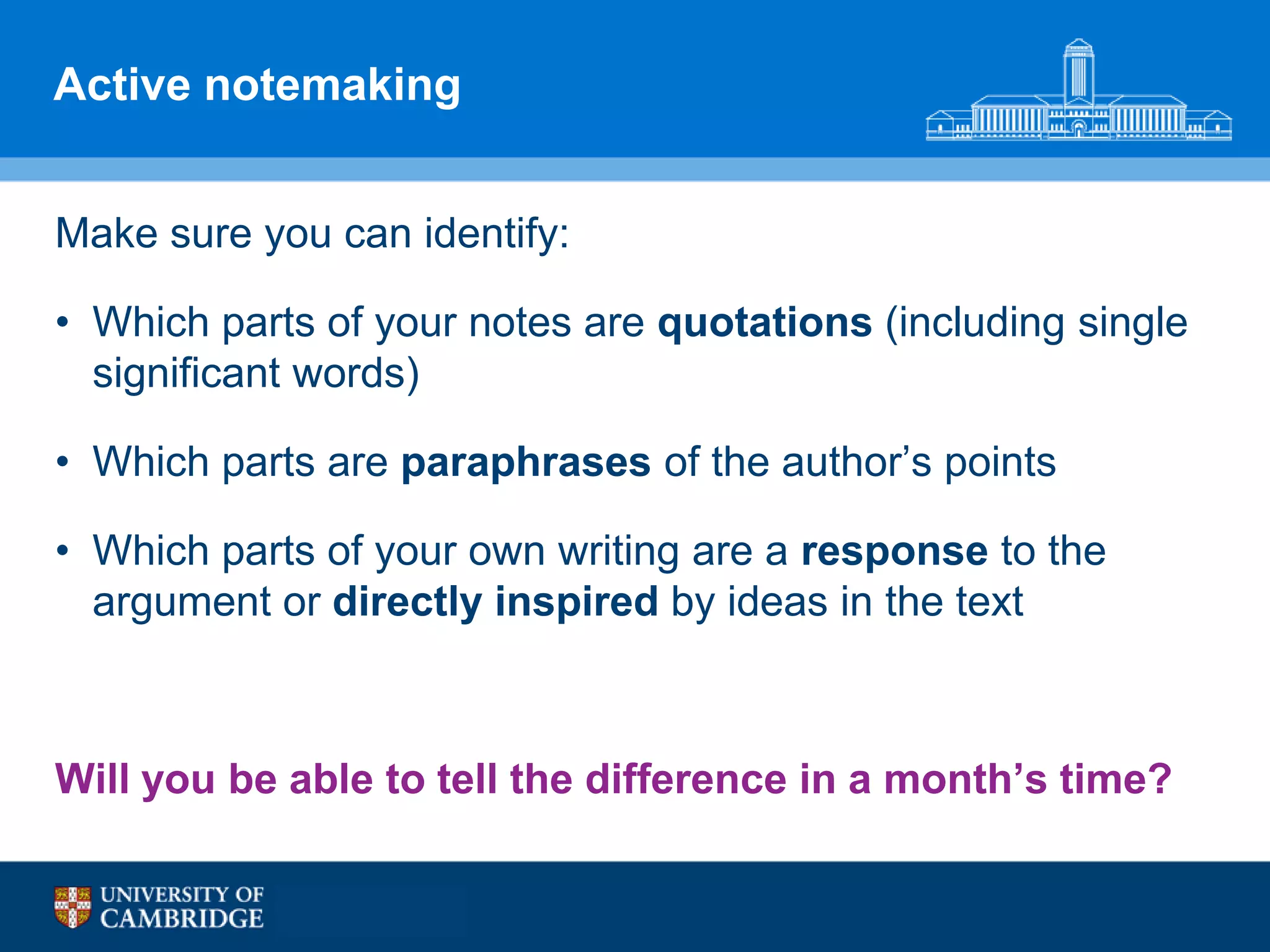
Active notemaking


Make sure you can identify:

• Which parts of your notes are quotations (including single
  significant words)

• Which parts are paraphrases of the author‟s points

• Which parts of your own writing are a response to the
  argument or directly inspired by ideas in the text


Will you be able to tell the difference in a month‟s time?
Notemaking strategy
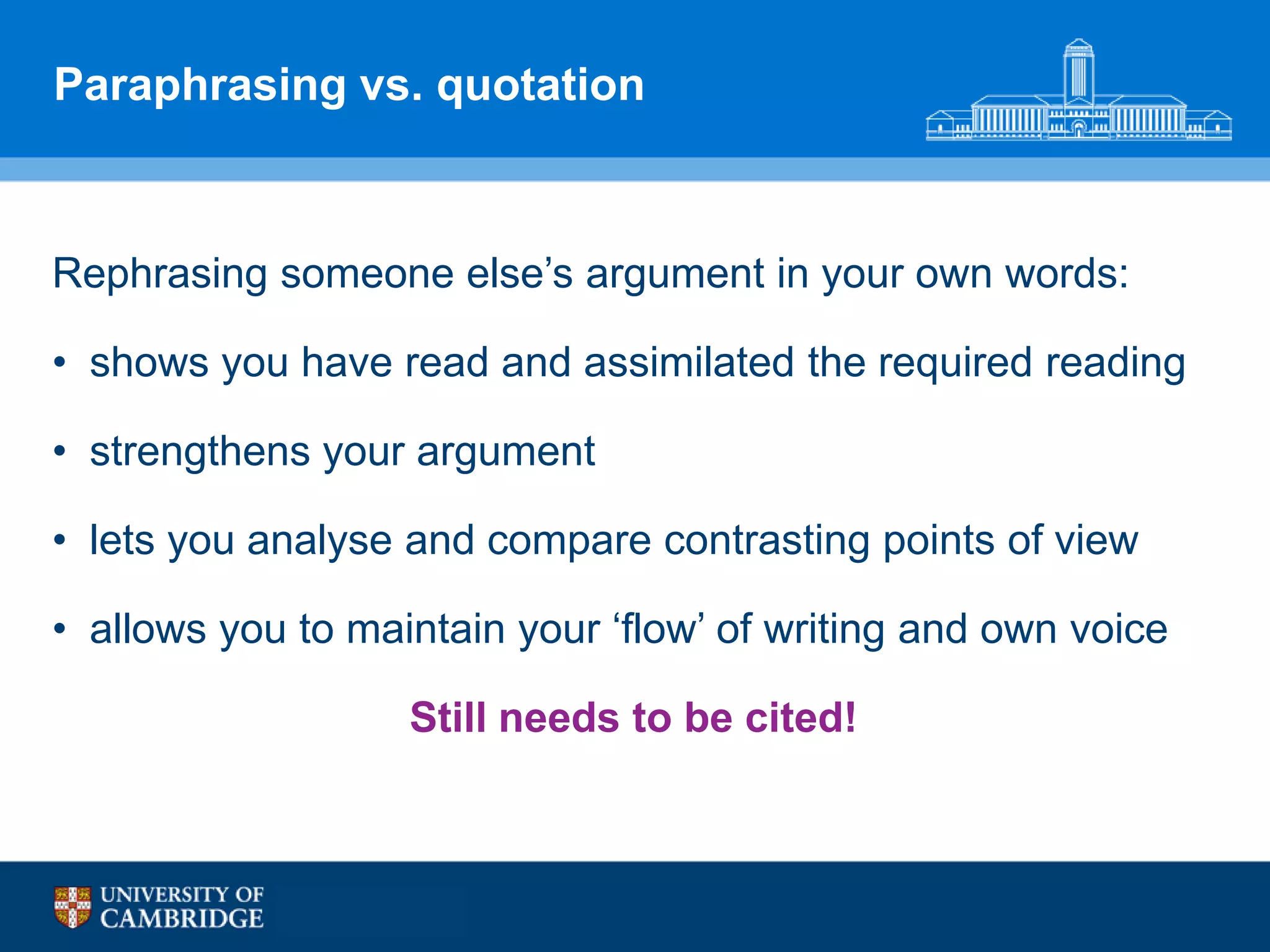
Paraphrasing vs. quotation


Rephrasing someone else‟s argument in your own words:

• shows you have read and assimilated the required reading

• strengthens your argument

• lets you analyse and compare contrasting points of view

• allows you to maintain your „flow‟ of writing and own voice

                   Still needs to be cited!
Paraphrasing vs. quotation


Rephrasing someone else‟s argument in your own words:

• gives less weight to the original author, more to your „voice‟

           Consider whether this is appropriate

• How significant is this work in your argument?
• Does the author deserve greater representation?)

Key concepts, phrases or even words in the argument should
       be placed in quotation marks if you use them
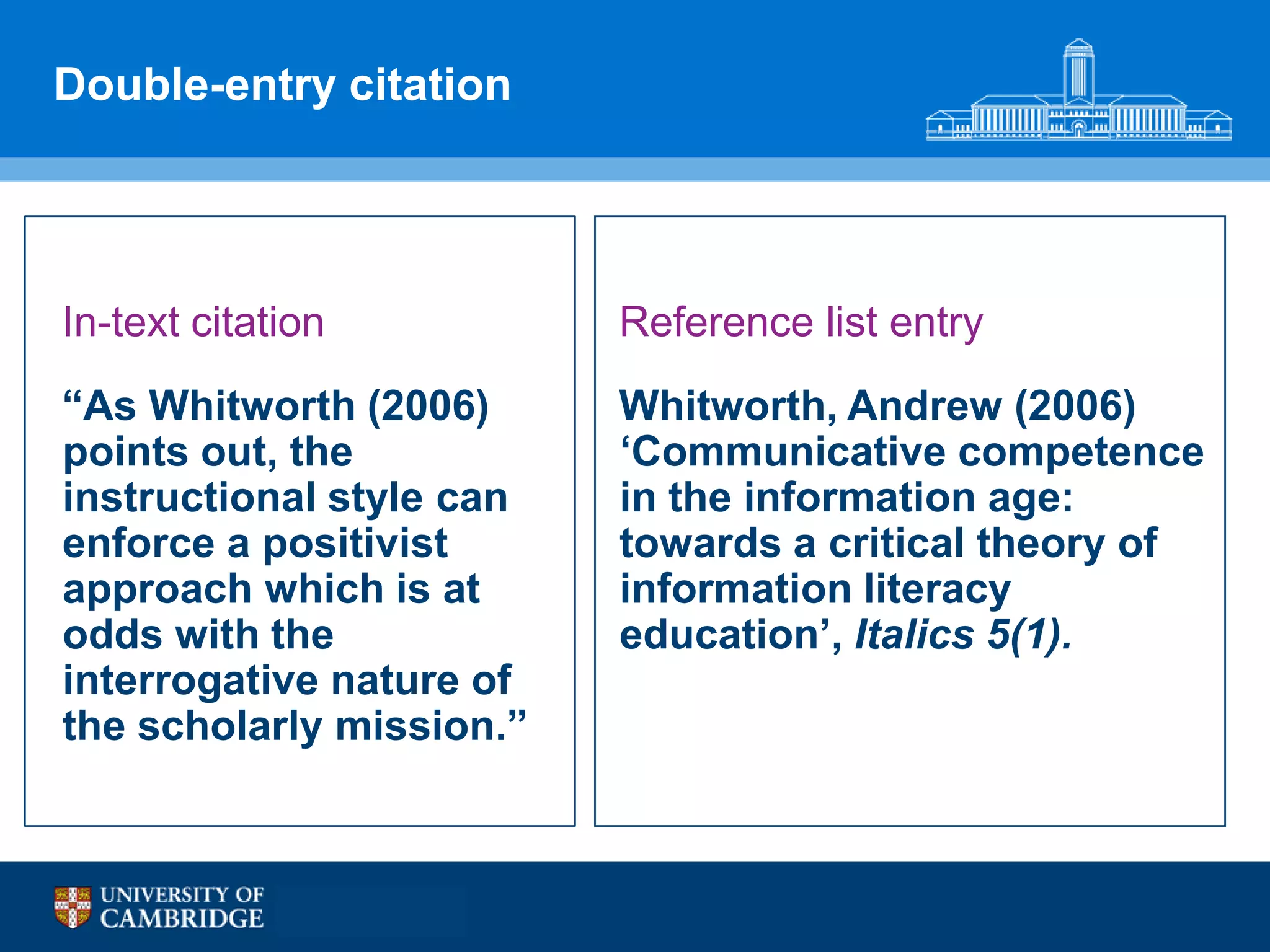
Double-entry citation


In-text citation          Reference list entry
“As Whitworth (2006)      Whitworth, Andrew (2006)
points out, the           „Communicative competence
instructional style can   in the information age:
enforce a positivist      towards a critical theory of
approach which is at      information literacy
odds with the             education‟, Italics 5(1).
interrogative nature of
the scholarly mission.”
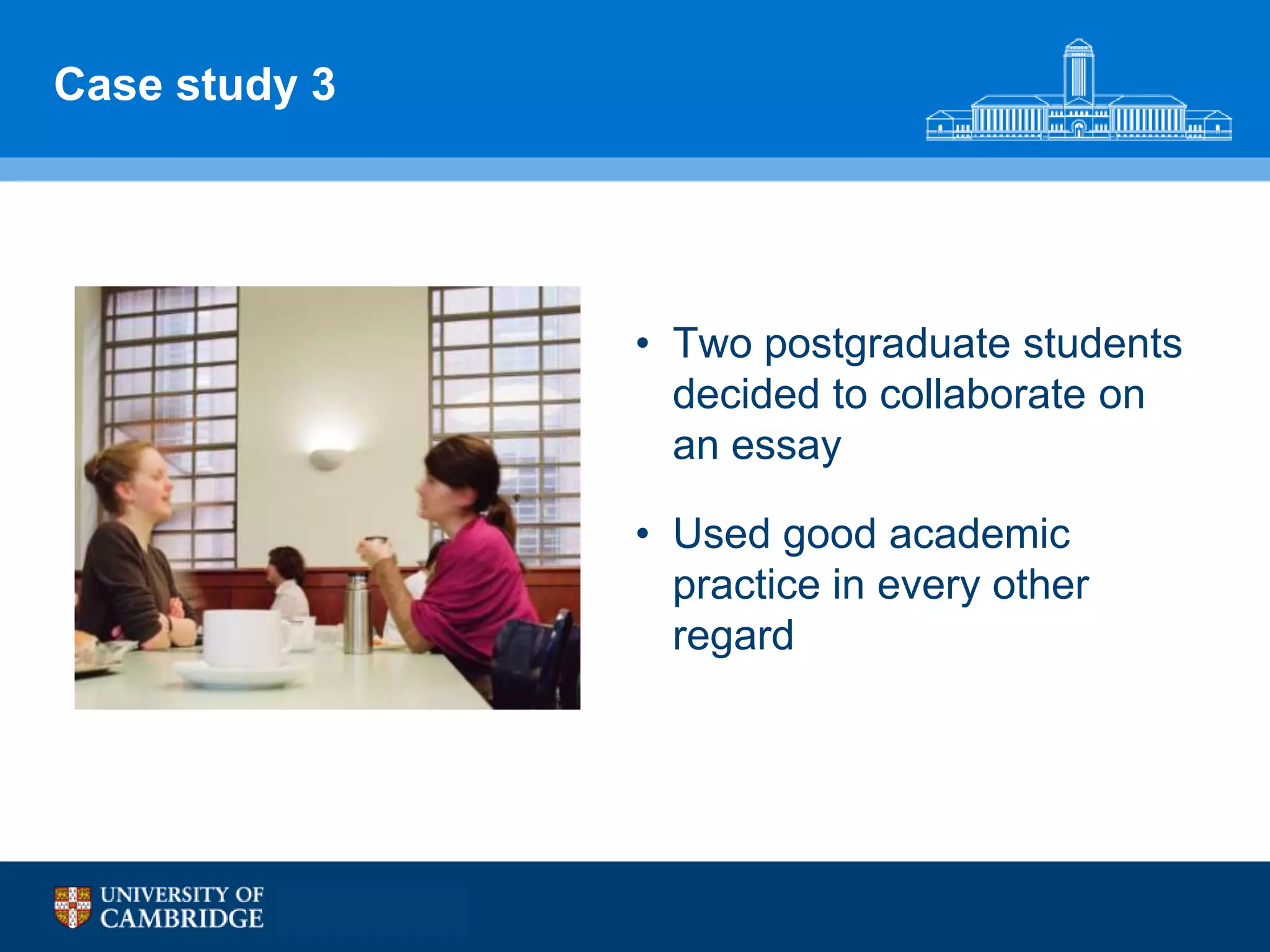
Case study 3


               • Two postgraduate students
                 decided to collaborate on
                 an essay

               • Used good academic
                 practice in every other
                 regard
What caused it?


    Students failed to understand that they were
   expected to work independently and that their
      marks would be calculated on this basis
Solutions


    • Assess whether collaboration is appropriate
      for the task at hand

    • Get authorisation (approach your supervisor
      in the first instance)

    • Acknowledge the contribution

 www.admin.cam.ac.uk/univ/plagiarism/students/referencing/peers.html
Recap


• Know where to find scholarly resources for your subject

• Always have two ends to your reference!

• Be aware of citation styles (and be consistent)

• Practice active notemaking

• Recognise when to paraphrase and when to quote

• Assess whether collaboration is appropriate for the task at hand

• Talk to your supervisor or librarian
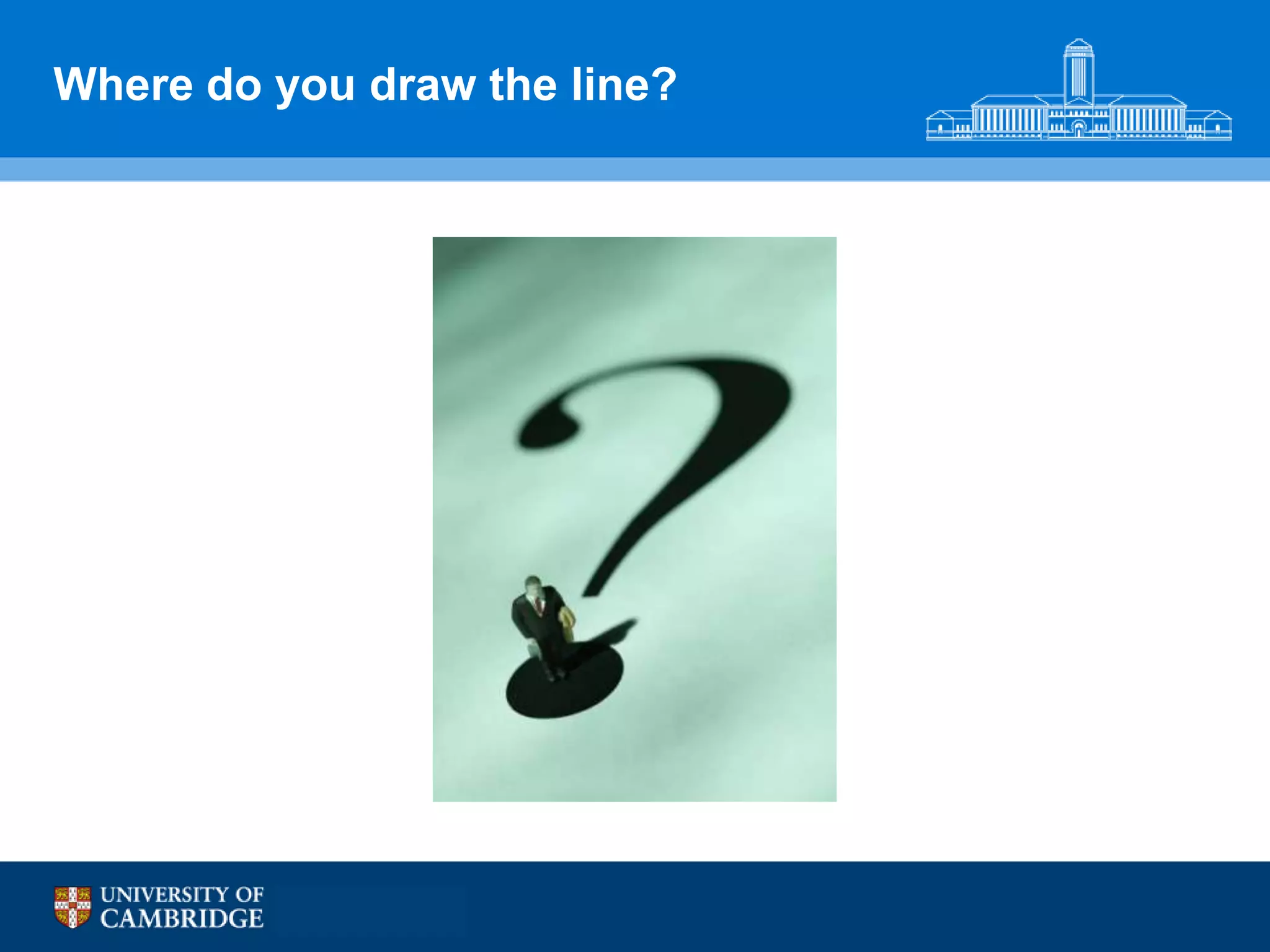
Where do you draw the line?
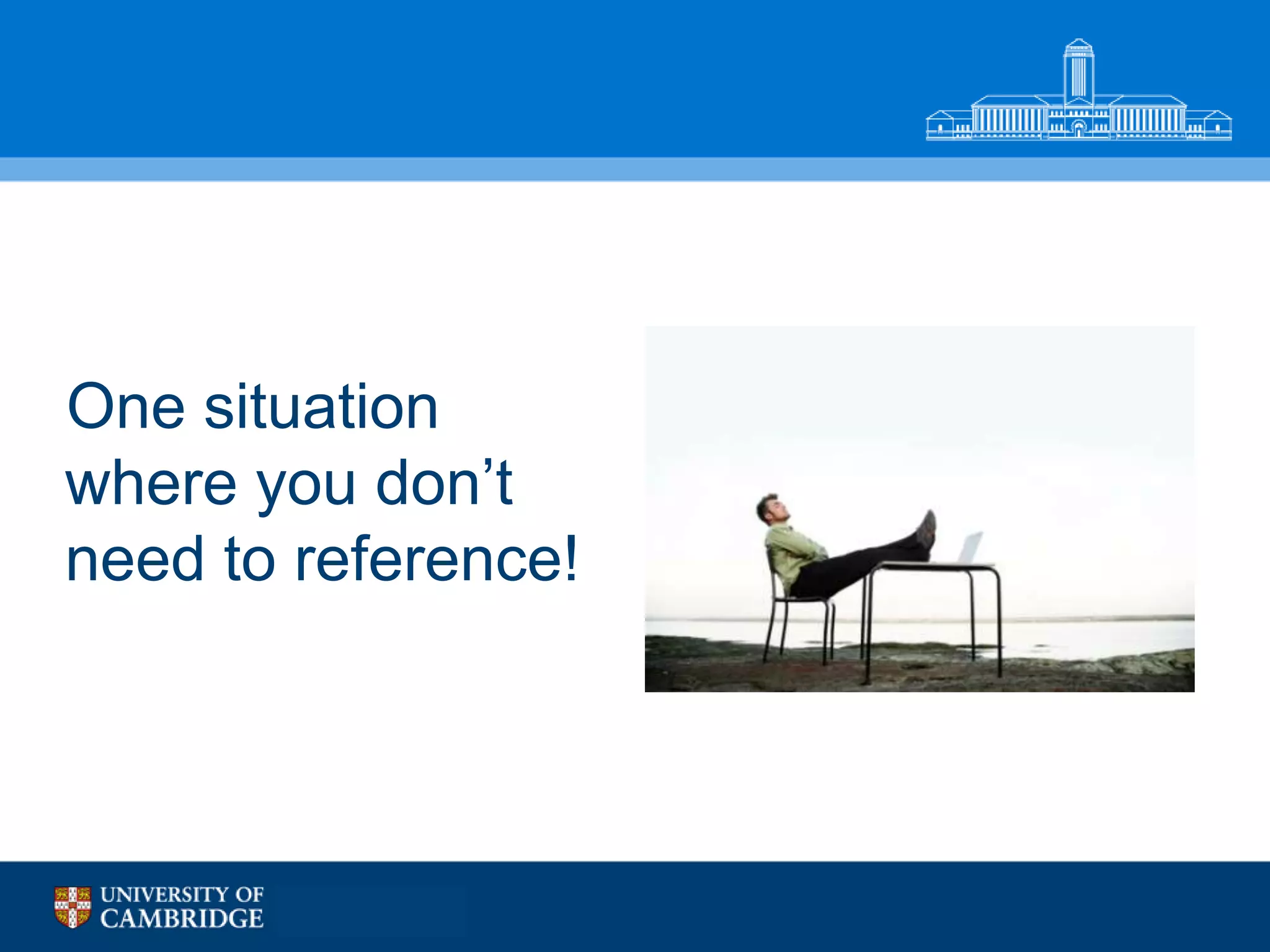
One situation
where you don‟t
need to reference!
Common knowledge


You don‟t need to cite a source if you‟re stating a fact that:

• is widely accessible - you may not know the total population of
  China, but you would be able to find the answer easily from
  numerous sources

• is likely to be known by a lot of people

• can be found in a general reference resource, such as
  a dictionary or encyclopedia

        www.admin.cam.ac.uk/univ/plagiarism/students/
            referencing/commonknowledge.html


                                             (University of Cambridge, 2011)
Common knowledge


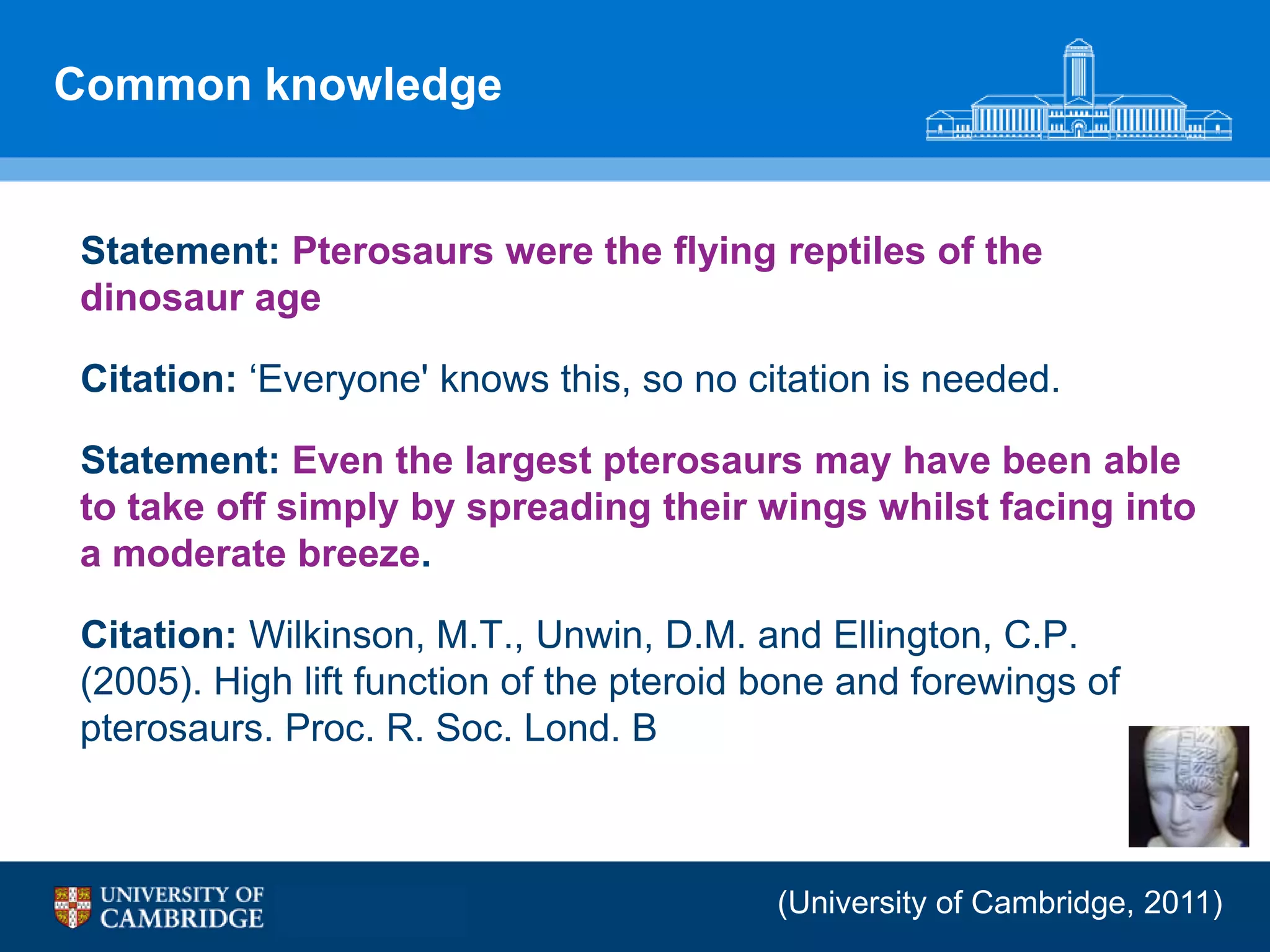
Statement: Pterosaurs were the flying reptiles of the
dinosaur age

Citation: „Everyone' knows this, so no citation is needed.

Statement: Even the largest pterosaurs may have been able
to take off simply by spreading their wings whilst facing into
a moderate breeze.

Citation: Wilkinson, M.T., Unwin, D.M. and Ellington, C.P.
(2005). High lift function of the pteroid bone and forewings of
pterosaurs. Proc. R. Soc. Lond. B


                                          (University of Cambridge, 2011)
Scenarios
Scenario 1


    “    I copied the material straight from the web
    because my English is not very good, and I wanted
    to make sure you understood what I was trying to
    say. ”


                                            (Carroll 2002, p.21)
Scenario 2


    “     I forgot to write down the page numbers, so I
    couldn‟t use quotes – so I just put the ideas in my
    own words. But I‟ve put everything in the
    bibliography! ”
Scenario 3


    “   I said it was in the Times, 1999. Surely that‟s
    enough? ”


                                               (Carroll 2002, p.51)
Scenario 4


    “     I had a student this week who admitted the
    plagiarism but said he wasn‟t to blame because the
    person he copied from didn‟t tell him it was
    plagiarised … ”


                                              (Carroll 2002, p.5)
Where to get information and help …


• School or department referencing guidelines (essential!)
• University Offices: plagarism information
  www.admin.cam.ac.uk/univ/plagiarism
• www.cusu.cam.ac.uk/academic/studyskills
• Libraries and librarians
  http://training.cam.ac.uk/cul and departmental library sites

• Academic reading and writing sessions/writing guidelines
  http://training.cam.ac.uk
Research Skills Programme
Emma Coonan
 Research Skills Librarian

research-skills@lib.cam.ac.uk
 http://training.cam.ac.uk/cul
Bibliography


Ballenger, Bruce .The Curious Researcher: a Guide to Writing
Research Papers. 7th ed. Boston: Pearson, 2012.
Carroll, Jude. A Handbook for Deterring Plagiarism in Higher
Education. Oxford: Oxford Centre for Staff and Learning
Development, 2002.
Li, Xia. Electronic Style: A Guide to Citing Electronic Information.
Westport: Meckler, 1993.
Lipson, Charles. Doing Honest Work in College: How to Prepare
Citations, Avoid Plagiarism, and Achieve Real Academic Success.
2nd ed. Chicago: U of Chicago P, 2008.
Bibliography


Neville, Colin. The Complete Guide to Referencing and Avoiding
Plagiarism. 3 January 2007.
http://www.myilibrary.com/Browse/open.asp?ID=112960&loc=i
(accessed 30 January 2009).

Pears, Richard, and Graham Shields. Cite Them Right: the
Essential Referencing Guide. Rev. ed. Newcastle: Pear Tree,
2008.

Stothard, Michael. “„1 in 2‟ Admits to Plagiarism.” Varsity 31 Oct.
2008: 1-2.

Turabian, Kate L. A Manual for Writers of Research Papers,
Theses, and Dissertations. 7th ed. Chicago: U of Chicago P, 2007.

How to avoid plagiarism

  • 1.
    Cambridge University Library Howto avoid plagiarism Dr. Emma Coonan Research Skills Librarian, Cambridge University Library
  • 2.
    What is plagiarism? How many ways can you think of to commit plagiarism?
  • 3.
    Examples of plagiarism •quoting verbatim another person‟s work without due acknowledgement of the source • paraphrasing another person‟s work by changing some of the words, or the order of the words, without due acknowledgement of the source • using ideas taken from someone else without reference to the originator • cutting and pasting from the Internet to make a pastiche of online sources • submitting someone else‟s work as part of a candidate‟s own without identifying clearly who did the work • colluding with another person • autoplagiarism (University of Cambridge, 2011)
  • 4.
    Varsity survey Varsity, 31 October 2008
  • 5.
    What is it? “ … submitting as one‟s own work, irrespective of intent to deceive, that which derives in part or in its entirety from the work of others without due acknowledgement. ” (University of Cambridge 2011, emphasis mine) www.admin.cam.ac.uk/univ/plagiarism/students/statement.html
  • 6.
    What is it? “ … passing off someone else‟s work as your own, whether intentionally or unintentionally, for your own benefit. ” (Carroll 2002, p.40)
  • 7.
    The (ethical) bottomline Ensuring that your readers can distinguish between your own and others‟ thinking means that you: • Give credit for the work you have built on • Get credit for the work you have done yourself
  • 8.
    Case study 1 • Student lost track of time and could not locate scholarly resources close to deadline • Searched the internet (avoiding essay banks) • Cut-and-pasted information for own reference from open web sources • Made a „patchwork‟ of paraphrased arguments from websites – didn‟t cite them
  • 9.
    What caused it? 1.Non-scholarly information – not well „signposted‟ 2. Poor citation practice
  • 10.
    Solutions 1. Know whereto find scholarly resources for your subject 2. Always have two ends to your reference!
  • 11.
    Scholarly material hasclear authorship
  • 12.
    Double-entry citation In-text citation Reference list entry Lovitts argues that Lovitts, Barbara E. (2005) “Creative intelligence is „Being a good course-taker is the ability to formulate not enough: a theoretical good problems” (2005, perspective on the transition p.143). to independent research‟, Studies in Higher Education A short „pointer‟ to the full 30(2), pp.137-54 entry at the point in your text where you quote or All the details needed for a reader paraphrase to follow up your source
  • 13.
    Citation styles Your schoolor department will probably have a preferred or citation style. It might even be mandatory to use a particular style. Do you know which one you should use? www.admin.cam.ac.uk/univ/plagiarism/students/depts.html
  • 14.
  • 15.
    Case study 2 • Tutor noticed change of voice/phrasing mid-essay, just after a quotation • This unattributed material was taken almost directly from the same source as the quote • Student had failed to recognise the full quotation in his notes - thought it was his own work
  • 16.
    What caused it? 1.Bad notemaking 2. Failure to understand how to paraphrase?
  • 17.
    Solutions 1. Practise activenotemaking 2. Recognise that paraphrases must be cited 3. Appreciate when to paraphrase and when to quote (it’s not that obvious!)
  • 18.
    Active notemaking Make sureyou can identify: • Which parts of your notes are quotations (including single significant words) • Which parts are paraphrases of the author‟s points • Which parts of your own writing are a response to the argument or directly inspired by ideas in the text Will you be able to tell the difference in a month‟s time?
  • 19.
  • 20.
    Paraphrasing vs. quotation Rephrasingsomeone else‟s argument in your own words: • shows you have read and assimilated the required reading • strengthens your argument • lets you analyse and compare contrasting points of view • allows you to maintain your „flow‟ of writing and own voice Still needs to be cited!
  • 21.
    Paraphrasing vs. quotation Rephrasingsomeone else‟s argument in your own words: • gives less weight to the original author, more to your „voice‟ Consider whether this is appropriate • How significant is this work in your argument? • Does the author deserve greater representation?) Key concepts, phrases or even words in the argument should be placed in quotation marks if you use them
  • 22.
    Double-entry citation In-text citation Reference list entry “As Whitworth (2006) Whitworth, Andrew (2006) points out, the „Communicative competence instructional style can in the information age: enforce a positivist towards a critical theory of approach which is at information literacy odds with the education‟, Italics 5(1). interrogative nature of the scholarly mission.”
  • 23.
    Case study 3 • Two postgraduate students decided to collaborate on an essay • Used good academic practice in every other regard
  • 24.
    What caused it? Students failed to understand that they were expected to work independently and that their marks would be calculated on this basis
  • 25.
    Solutions • Assess whether collaboration is appropriate for the task at hand • Get authorisation (approach your supervisor in the first instance) • Acknowledge the contribution www.admin.cam.ac.uk/univ/plagiarism/students/referencing/peers.html
  • 26.
    Recap • Know whereto find scholarly resources for your subject • Always have two ends to your reference! • Be aware of citation styles (and be consistent) • Practice active notemaking • Recognise when to paraphrase and when to quote • Assess whether collaboration is appropriate for the task at hand • Talk to your supervisor or librarian
  • 27.
    Where do youdraw the line?
  • 28.
    One situation where youdon‟t need to reference!
  • 29.
    Common knowledge You don‟tneed to cite a source if you‟re stating a fact that: • is widely accessible - you may not know the total population of China, but you would be able to find the answer easily from numerous sources • is likely to be known by a lot of people • can be found in a general reference resource, such as a dictionary or encyclopedia www.admin.cam.ac.uk/univ/plagiarism/students/ referencing/commonknowledge.html (University of Cambridge, 2011)
  • 30.
    Common knowledge Statement: Pterosaurswere the flying reptiles of the dinosaur age Citation: „Everyone' knows this, so no citation is needed. Statement: Even the largest pterosaurs may have been able to take off simply by spreading their wings whilst facing into a moderate breeze. Citation: Wilkinson, M.T., Unwin, D.M. and Ellington, C.P. (2005). High lift function of the pteroid bone and forewings of pterosaurs. Proc. R. Soc. Lond. B (University of Cambridge, 2011)
  • 31.
  • 32.
    Scenario 1 “ I copied the material straight from the web because my English is not very good, and I wanted to make sure you understood what I was trying to say. ” (Carroll 2002, p.21)
  • 33.
    Scenario 2 “ I forgot to write down the page numbers, so I couldn‟t use quotes – so I just put the ideas in my own words. But I‟ve put everything in the bibliography! ”
  • 34.
    Scenario 3 “ I said it was in the Times, 1999. Surely that‟s enough? ” (Carroll 2002, p.51)
  • 35.
    Scenario 4 “ I had a student this week who admitted the plagiarism but said he wasn‟t to blame because the person he copied from didn‟t tell him it was plagiarised … ” (Carroll 2002, p.5)
  • 36.
    Where to getinformation and help … • School or department referencing guidelines (essential!) • University Offices: plagarism information www.admin.cam.ac.uk/univ/plagiarism • www.cusu.cam.ac.uk/academic/studyskills • Libraries and librarians http://training.cam.ac.uk/cul and departmental library sites • Academic reading and writing sessions/writing guidelines http://training.cam.ac.uk
  • 37.
  • 38.
    Emma Coonan ResearchSkills Librarian research-skills@lib.cam.ac.uk http://training.cam.ac.uk/cul
  • 39.
    Bibliography Ballenger, Bruce .TheCurious Researcher: a Guide to Writing Research Papers. 7th ed. Boston: Pearson, 2012. Carroll, Jude. A Handbook for Deterring Plagiarism in Higher Education. Oxford: Oxford Centre for Staff and Learning Development, 2002. Li, Xia. Electronic Style: A Guide to Citing Electronic Information. Westport: Meckler, 1993. Lipson, Charles. Doing Honest Work in College: How to Prepare Citations, Avoid Plagiarism, and Achieve Real Academic Success. 2nd ed. Chicago: U of Chicago P, 2008.
  • 40.
    Bibliography Neville, Colin. TheComplete Guide to Referencing and Avoiding Plagiarism. 3 January 2007. http://www.myilibrary.com/Browse/open.asp?ID=112960&loc=i (accessed 30 January 2009). Pears, Richard, and Graham Shields. Cite Them Right: the Essential Referencing Guide. Rev. ed. Newcastle: Pear Tree, 2008. Stothard, Michael. “„1 in 2‟ Admits to Plagiarism.” Varsity 31 Oct. 2008: 1-2. Turabian, Kate L. A Manual for Writers of Research Papers, Theses, and Dissertations. 7th ed. Chicago: U of Chicago P, 2007.

Editor's Notes

  • #12 Step 1.Front page of a downloaded journal article – authorship is clearly indicated, and it even gives you a format in which to cite the article, for your bibliography.It has clear authorship because this is really the ‘currency’ of academic – how you progress/succeed/get promoted. No wonder it’s taken so seriously if you use unfair means.