PLAGIARISM
Definition:
Plagiarism is the act of presenting
the words, ideas, images, sounds,
or the creative expression of
others as your own.
Plagiarism is when a person copies the
writing of another person and submits it
as their own
How often does it happen?
“A study of almost 4,500 students at 25 schools,
suggests cheating is . . . a significant problem in high
school - 74% of the respondents admitted to one or
more instances of serious test cheating and 72%
admitted to serious cheating on written assignments.
Over half of the students admitted they have
engaged in some level of plagiarism on written
assignments using the Internet.”
Based on the research of Donald L. McCabe, Rutgers University
Source: “CIA Research.” Center for Academic Integrity, Duke University, 2003 <
http://academicintegrity.org/cai_research.asp>.
Students, if you have…
• included the words and ideas
of others in your work that
you neglected to cite,
INTENTIONALLY OR NOT…
• had help you wouldn’t want
your teacher to know about…
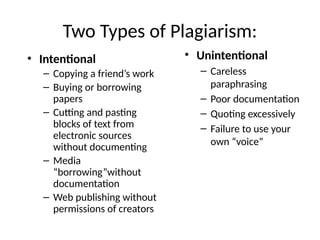
Two Types of Plagiarism:
• Intentional
– Copying a friend’s work
– Buying or borrowing
papers
– Cutting and pasting
blocks of text from
electronic sources
without documenting
– Media
“borrowing”without
documentation
– Web publishing without
permissions of creators
• Unintentional
– Careless
paraphrasing
– Poor documentation
– Quoting excessively
– Failure to use your
own “voice”
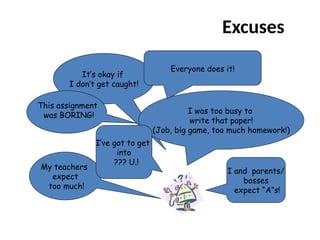
Excuses
It’s okay if
I don’t get caught!
I was too busy to
write that paper!
(Job, big game, too much homework!)
My teachers
expect
too much!
I’ve got to get
into
??? U.!
I and parents/
bosses
expect “A”s!
This assignment
was BORING!
Everyone does it!
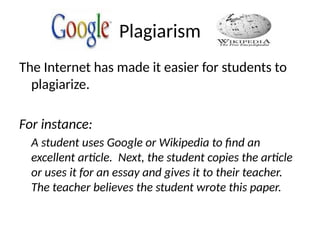
Plagiarism
The Internet has made it easier for students to
plagiarize.
For instance:
A student uses Google or Wikipedia to find an
excellent article. Next, the student copies the article
or uses it for an essay and gives it to their teacher.
The teacher believes the student wrote this paper.
Plagiarism
Published resources had made it easier for
students to plagiarize, but it has also made it
easier for teachers to uncover plagiarism.
For instance:
A student copies an article from a magazine and
gives it to their teacher. The teacher believes that the
student wrote this paper.
Plagiarism
You can only become a better writer if you do
your own work.
Do not copy or plagiarize from the Internet,
books, newspapers, magazines or any other
sources.
Rationale for academic integrity
(as if it were necessary!)
• When you copy you cheat yourself. You
limit your own learning.
• The consequences are not worth the risks!
• It is only right to give credit to authors
whose ideas you use
• Citing gives authority to the information
you present
• Citing makes it possible for your readers to
locate your source
• Education is not an “us vs. them” game!
It’s about learning to learn!
• Cheating is unethical behavior
Is your academic
reputation valuable
to you?
Real Life Consequences:
• Damaged the reputation of two prominent historians, Stephen
Ambrose and Doris Kearns Goodwin,
– Kearns left television position and stepped down as Pulitzer
Prize judge for “lifting” 50 passages for her 1987 book The
Fitzgeralds and the Kennedys (Lewis)
• Senator Joseph Biden dropped his 1987 campaign for the
Democratic presidential nomination. (Sabato)
– Copied in law school and borrowed from campaign speeches
of Robert Kennedy
• Senator Vicente Soto III was bashed by local netizens as he cited
information from a certain blog which he claimed as his own
findings (Yahoo News)
Consequences (cont’d)
• Probe of plagiarism at UVA--45 students dismissed, 3
graduate degrees revoked
– CNN Article AP. 26 Nov. 2001
• New York Times senior reporter Jayson Blair forced to
resign after being accused of plagiarism and fraud.
• “The newspaper said at least 36 of the 73 articles he had
written had problems with accuracy, calling the
deception a "low point" in the newspaper's history.”
“New York Times Exposes Fraud of Own Reporter.” ABC News Online. 12 May,
2003. http://www.pbs.org/newshour/newshour_index.html
Possible Consequences:
• “0” on the assignment
• Referral to administrators
• Suspension or dismissal from
school and/or activities
• Note on student record
• Loss of reputation among the
school community
• Loss of job
• Prosecution
Yada, yada, yada…
• What if:
– Your architect cheated his way through math class.
Will your new home be safe?
– Your lawyer paid for a copy of the bar exam to
study. Will the contract she wrote for you stand
up in court?
– The accountant who does your taxes hired
someone to write his papers and paid a stand-in
to take his major tests? Does he know enough to
complete your tax forms properly?
(Lathrop and Foss 87)
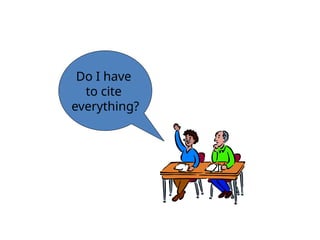
Do I have
to cite
everything?
Nope!
• Facts that are widely known
• Information or judgments considered
“common knowledge”
Need no documentation!
Hooray for
common
knowledge!
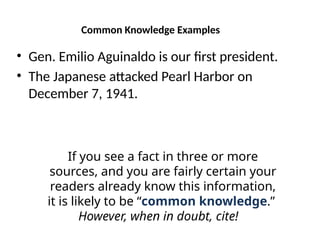
Common Knowledge Examples
• Gen. Emilio Aguinaldo is our first president.
• The Japanese attacked Pearl Harbor on
December 7, 1941.
If you see a fact in three or more
sources, and you are fairly certain your
readers already know this information,
it is likely to be “common knowledge.”
However, when in doubt, cite!
No need to document when:
• You are discussing your own experiences,
observations, or reactions
• Compiling the results of original research,
from science experiments, etc.
• You are using common knowledge
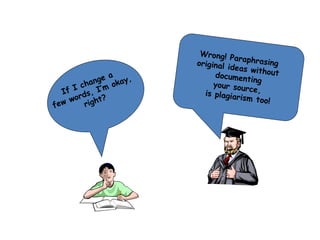
Wrong! Paraphrasing
original ideas without
documenting
your source,
is plagiarism too!
If I change a
few words, I’m okay,
right?
You can “borrow” from the
works of others in your own
work!
Three Strategies
• Quoting
• Paraphrasing
• Summarizing
Blending source materials in with your own
thoughts—making sure your own voice is
heard.
As you take notes:
• Include any direct quotes or unique phrases in
quotation marks or mark with a big Q and
make sure the speaker’s /writer’s name is
identified.
• Make sure you note a paraphrase with the
writer’s name and mark it with a big P
• Mark your summaries with an S
• Include page numbers and source references
so you can go back and check for accuracy as
you write.
In-text / in-project MLA documentation
• Purpose--to give immediate source information
without interrupting the flow of paper or
project.
• The academic world takes in-text
documentation seriously.
• Inaccurate documentation is as serious as
having no documentation at all.
• Brief information in in-text documentation
should match full source information in Works
Cited
Use in-text / in-project documentation when:
• You use an original idea from one of your
sources, whether you quote or paraphrase it
• You summarize original ideas from one of your
sources
• You use factual information that is not common
knowledge (Cite to be safe.)
• You quote directly from a source
• You use a date or fact that might be disputed
Preventing plagiarism
• Set a climate where academic integrity is valued
• Design thoughtful assignments
• Set up checkpoints throughout the process:
– Drafts, outlines, organizers, preliminary Works Cited
• Keep portfolios of student writing
• Vary assignments and topic suggestions each
semester
• Describe the degree to which collaboration is
acceptable to your students
• Require an annotated bibliography
• Shorter papers are okay
Works Cited
• “Boston Columnist Resigns Amid New Plagiarism Charges.” CNN.com 19 Aug.
1998 3 March 2003 <http://www.cnn.com/US/9808/19/barnicle/>
• Fain, Margaret. “Internet Paper Mills.” Kimbal Library. 12 Feb. 2003.
<http://www.coastal.edu/library/mills2.htm>
• Lathrop, Ann and Kathleen Foss. Student Cheating and Plagiarism in the Internet
Era. Englewood, CO: Libraries Unlimited, 2000.
• Lewis, Mark. “Doris Kearns Goodwin And The Credibility Gap.” Forbes.com 2 Feb.
2002. <http://www.forbes.com/2002/02/27/0227goodwin.html>
• “New York Times Exposes Fraud of own Reporter.” ABC News Online. 12 May,
2003.
<http://www.pbs.org/newshour/newshour_index.html>
• Sabato, Larry J. “Joseph Biden's Plagiarism; Michael Dukakis's 'Attack Video' –
1988.” Washington Post Online. 1998. 3 March 2002.
http://www.washingtonpost.com/wp-srv/politics/special/clinton/frenzy/
biden.htm
Retrieved slide show created
by Joyce Valenza
Media Specialist
Springfield Township High School
Modified by C. Tomlinson 4-2-05
WITCC Adjunct

Week 2 D1-3_PLAGIARISM - Lesson Presentation

  • 1.
  • 2.
    Definition: Plagiarism is theact of presenting the words, ideas, images, sounds, or the creative expression of others as your own. Plagiarism is when a person copies the writing of another person and submits it as their own
  • 3.
    How often doesit happen? “A study of almost 4,500 students at 25 schools, suggests cheating is . . . a significant problem in high school - 74% of the respondents admitted to one or more instances of serious test cheating and 72% admitted to serious cheating on written assignments. Over half of the students admitted they have engaged in some level of plagiarism on written assignments using the Internet.” Based on the research of Donald L. McCabe, Rutgers University Source: “CIA Research.” Center for Academic Integrity, Duke University, 2003 < http://academicintegrity.org/cai_research.asp>.
  • 4.
    Students, if youhave… • included the words and ideas of others in your work that you neglected to cite, INTENTIONALLY OR NOT… • had help you wouldn’t want your teacher to know about…
  • 5.
    Two Types ofPlagiarism: • Intentional – Copying a friend’s work – Buying or borrowing papers – Cutting and pasting blocks of text from electronic sources without documenting – Media “borrowing”without documentation – Web publishing without permissions of creators • Unintentional – Careless paraphrasing – Poor documentation – Quoting excessively – Failure to use your own “voice”
  • 6.
    Excuses It’s okay if Idon’t get caught! I was too busy to write that paper! (Job, big game, too much homework!) My teachers expect too much! I’ve got to get into ??? U.! I and parents/ bosses expect “A”s! This assignment was BORING! Everyone does it!
  • 7.
    Plagiarism The Internet hasmade it easier for students to plagiarize. For instance: A student uses Google or Wikipedia to find an excellent article. Next, the student copies the article or uses it for an essay and gives it to their teacher. The teacher believes the student wrote this paper.
  • 8.
    Plagiarism Published resources hadmade it easier for students to plagiarize, but it has also made it easier for teachers to uncover plagiarism. For instance: A student copies an article from a magazine and gives it to their teacher. The teacher believes that the student wrote this paper.
  • 9.
    Plagiarism You can onlybecome a better writer if you do your own work. Do not copy or plagiarize from the Internet, books, newspapers, magazines or any other sources.
  • 10.
    Rationale for academicintegrity (as if it were necessary!) • When you copy you cheat yourself. You limit your own learning. • The consequences are not worth the risks! • It is only right to give credit to authors whose ideas you use • Citing gives authority to the information you present • Citing makes it possible for your readers to locate your source • Education is not an “us vs. them” game! It’s about learning to learn! • Cheating is unethical behavior Is your academic reputation valuable to you?
  • 11.
    Real Life Consequences: •Damaged the reputation of two prominent historians, Stephen Ambrose and Doris Kearns Goodwin, – Kearns left television position and stepped down as Pulitzer Prize judge for “lifting” 50 passages for her 1987 book The Fitzgeralds and the Kennedys (Lewis) • Senator Joseph Biden dropped his 1987 campaign for the Democratic presidential nomination. (Sabato) – Copied in law school and borrowed from campaign speeches of Robert Kennedy • Senator Vicente Soto III was bashed by local netizens as he cited information from a certain blog which he claimed as his own findings (Yahoo News)
  • 12.
    Consequences (cont’d) • Probeof plagiarism at UVA--45 students dismissed, 3 graduate degrees revoked – CNN Article AP. 26 Nov. 2001 • New York Times senior reporter Jayson Blair forced to resign after being accused of plagiarism and fraud. • “The newspaper said at least 36 of the 73 articles he had written had problems with accuracy, calling the deception a "low point" in the newspaper's history.” “New York Times Exposes Fraud of Own Reporter.” ABC News Online. 12 May, 2003. http://www.pbs.org/newshour/newshour_index.html
  • 13.
    Possible Consequences: • “0”on the assignment • Referral to administrators • Suspension or dismissal from school and/or activities • Note on student record • Loss of reputation among the school community • Loss of job • Prosecution
  • 14.
    Yada, yada, yada… •What if: – Your architect cheated his way through math class. Will your new home be safe? – Your lawyer paid for a copy of the bar exam to study. Will the contract she wrote for you stand up in court? – The accountant who does your taxes hired someone to write his papers and paid a stand-in to take his major tests? Does he know enough to complete your tax forms properly? (Lathrop and Foss 87)
  • 15.
    Do I have tocite everything?
  • 16.
    Nope! • Facts thatare widely known • Information or judgments considered “common knowledge” Need no documentation! Hooray for common knowledge!
  • 17.
    Common Knowledge Examples •Gen. Emilio Aguinaldo is our first president. • The Japanese attacked Pearl Harbor on December 7, 1941. If you see a fact in three or more sources, and you are fairly certain your readers already know this information, it is likely to be “common knowledge.” However, when in doubt, cite!
  • 18.
    No need todocument when: • You are discussing your own experiences, observations, or reactions • Compiling the results of original research, from science experiments, etc. • You are using common knowledge
  • 19.
    Wrong! Paraphrasing original ideaswithout documenting your source, is plagiarism too! If I change a few words, I’m okay, right?
  • 20.
    You can “borrow”from the works of others in your own work!
  • 21.
    Three Strategies • Quoting •Paraphrasing • Summarizing Blending source materials in with your own thoughts—making sure your own voice is heard.
  • 22.
    As you takenotes: • Include any direct quotes or unique phrases in quotation marks or mark with a big Q and make sure the speaker’s /writer’s name is identified. • Make sure you note a paraphrase with the writer’s name and mark it with a big P • Mark your summaries with an S • Include page numbers and source references so you can go back and check for accuracy as you write.
  • 23.
    In-text / in-projectMLA documentation • Purpose--to give immediate source information without interrupting the flow of paper or project. • The academic world takes in-text documentation seriously. • Inaccurate documentation is as serious as having no documentation at all. • Brief information in in-text documentation should match full source information in Works Cited
  • 24.
    Use in-text /in-project documentation when: • You use an original idea from one of your sources, whether you quote or paraphrase it • You summarize original ideas from one of your sources • You use factual information that is not common knowledge (Cite to be safe.) • You quote directly from a source • You use a date or fact that might be disputed
  • 25.
    Preventing plagiarism • Seta climate where academic integrity is valued • Design thoughtful assignments • Set up checkpoints throughout the process: – Drafts, outlines, organizers, preliminary Works Cited • Keep portfolios of student writing • Vary assignments and topic suggestions each semester • Describe the degree to which collaboration is acceptable to your students • Require an annotated bibliography • Shorter papers are okay
  • 26.
    Works Cited • “BostonColumnist Resigns Amid New Plagiarism Charges.” CNN.com 19 Aug. 1998 3 March 2003 <http://www.cnn.com/US/9808/19/barnicle/> • Fain, Margaret. “Internet Paper Mills.” Kimbal Library. 12 Feb. 2003. <http://www.coastal.edu/library/mills2.htm> • Lathrop, Ann and Kathleen Foss. Student Cheating and Plagiarism in the Internet Era. Englewood, CO: Libraries Unlimited, 2000. • Lewis, Mark. “Doris Kearns Goodwin And The Credibility Gap.” Forbes.com 2 Feb. 2002. <http://www.forbes.com/2002/02/27/0227goodwin.html> • “New York Times Exposes Fraud of own Reporter.” ABC News Online. 12 May, 2003. <http://www.pbs.org/newshour/newshour_index.html> • Sabato, Larry J. “Joseph Biden's Plagiarism; Michael Dukakis's 'Attack Video' – 1988.” Washington Post Online. 1998. 3 March 2002. http://www.washingtonpost.com/wp-srv/politics/special/clinton/frenzy/ biden.htm Retrieved slide show created by Joyce Valenza Media Specialist Springfield Township High School Modified by C. Tomlinson 4-2-05 WITCC Adjunct