Chronic Renal Failure-UG
Lt Col (Dr)Ashutosh Ojha
Reader ,Internal Medicine
Plan
 Defn
 Etiology
 Staging
 Pathophysiology
 Clinical Features
 Investigations
 Management
 Renal Replacement
CHRONIC RENAL FAILURE
 Def:- CRF implies long standing,
progressive deterioration in renal function.
There occurs derangement of excretory,
metabolic and endocrine functions of the
kidney and when ESRD is reached the
patient becomes dependent on renal
replacement therapy to avoid life-
threatening uraemia.
CHRONIC RENAL FAILURE
 Uraemia – Uraemia is a clinical and
laboratory syndrome reflecting dysfunction
of all organ system as a result of untreated
or under treated acute or chronic renal
failure.
 Causes of CRF:-
(a) Congenital & inherited diseases
Polycystic kidney disease
Medullary cystic disease
Tuberous sclerosis
Congenital Obstructive uropathies
(b) Glomerular Diseases
Primary glomerulonephropathies
Secondary glomerular diseases
SLE, DM, HTN, TTP etc
(c) Vascular disease
Atherosclerotic renal vascular disease
(d) Tubulointerstitial disease
Tubulointertitial nephritis
( idiopalnic, drugs)
Reflux nephropathy-
TB, MM
(e) Urinary Tract obstruction – calculus, tumour, prostate
Pathophysiology
Initiating mechanism
Long term reduction of renal mass
Vasoactive molecules
cytokines, GF
Structural and functional hypertrophy of
surviving nephrons as an adaptive mechanism
Predispose to sclerosis of remaining viable nephrons
Progressive decline of residual nephron function.
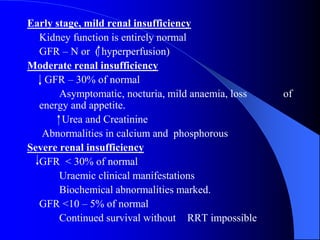
Early stage, mild renal insufficiency
Kidney function is entirely normal
GFR – N or ( hyperperfusion)
Moderate renal insufficiency
GFR – 30% of normal
Asymptomatic, nocturia, mild anaemia, loss of
energy and appetite.
Urea and Creatinine
Abnormalities in calcium and phosphorous
Severe renal insufficiency
GFR < 30% of normal
Uraemic clinical manifestations
Biochemical abnormalities marked.
GFR <10 – 5% of normal
Continued survival without RRT impossible
Deterioration
Mild to moderate renal insufficiency
Renal function is compromised by
infections
poorly controlled HTN
Hyper or Hypovolaemia
Drugs
Contrasts
Overt Uraemia
Deterioration
These processes lead to –
 Disturbance in water, electrolyte and acid-base
balance
 Accumulation of Nitrogenous waste
azotemia
 Products of protein and AA metabolism
Produce ‘Uraemic toxins’ Uraemia
(a) Clinical Abnormalities
(a) Fluid and electrolyte disturbances-
Volume expansion/ contraction
Hyper/ Hyponatremia
Hyper/ hypokalemia
metabolic acidosis
Hyperphosphotaemia
Hypocalcaemia
(b) Endocrine- metabolic disturbance –
Secondary Hyperparathyroidism
Vit D defi osteomalacia
Adynamic osteomalacia
Carbohydrate intolerance
Impaired gonadal function
(c) Neuromuscular disturbances
fatigue, sleep disorders
lethargy, impaired mentation
asterixis, peripheral neuropathy,
restless leg syndrome, myoclonus
seizures, myopathy, coma
(d) cardiovascular and pulmonary disturbances
Hypertension
CCF, pulmonary edema
Pericarditis, cardiomyophthy
Accelerated atherosclerosis
(e) Dermatological
Pallor, hyperpigmentation
Pruritus, echymosis, Uraemic frost
Clinical Features…..
(f) G.I. disturbances
Anorexia, nausea, vomiting
Uraemic fetor
Peptic ulcer, G.I Bleed
Hepatitis, Peritonitis
(g) Haematological and Imuunnologic disturbances
Anemia
Lymphocytopenia
Bleeding diathesis
Susceptibility to infection
Hypocomplementemia
Symptoms are common when Urea is > 40 mmol/L
Common symptoms-
malaise, loss of energy
loss of appetite
Insomnia
nocturia and polyuria
itching
nausea, vomiting, diarrhoea
Paraesthesia
Restless leg
Bone pain
tetany
Symptoms due to salt & water retention
Symptoms due to anaemia
Sexual dysfunction
mental slowing, clouding of consciousness, seizures coma
Examination:-
Few physical signs of Uraemia per se
 Short stature –Bi renal failure starting in childhood
 Pallor
 Pigmentation
 Scratch marks
 Signs of fluid overload
 Pericardial Friction rub
 Flow murmurs
 Peripheral neuropathy
 Kidneys – impalpable except in polycystic disease, obstn or tumour
 Physical signs of underlying disease
Cutaneous vasculitis
Retinopathy
PVD
Evidence of neurogenic bladder
Investigations
Urine analysis
Haematuria - GN
Proteinuria - glomerular disease
Glycosuria with normal BS
with BS
Urine microscopy
white cells – UTI, papillary necrosis, TB
Eosinophiluria – allergic tubulointerstitial nephritis
Granular casts – active renal disorder
Red cell casts – GN
Red blood cell
Urine biochemistry
24 hr Creatinine clearane,Severity of renal failure
Urinary electroytes
Urine osmolality
Serum biochemistry
Urea and creatinine
Electrolytes
-Hyperkalaemia
Radiological –
USG – Renal size and texture
IVU
CT – cortical scarring, retroperitoneal
fibrosis, urinary obstruction
Renal biopsy
In unexplained CRF with normal sized
kidneys
Complications of CRF
 Anaemia
– Erythropoietin def
– Bone marrow toxins
– Bone marrow fibrosis
– Heamatenic defi – iron, B6, B12
– RBC destruction
– Blood loss
 Renal osteodystrophy
Impaired renal function
Po4 Excretion 1,25 (OH)2 Cholecalciferol
Plasma Po4 Impaired mineralisation Ca
++
of bones
absorption
Stimulation of
parathyroids PTH Bone resorption Plasma Ca++
Renal osteodystrophy
High turnover – osteitis fibrosa cystica
Low turnover – osteomalacia
adynamic bone disease
Complications
Skin disorders
Pruritus
 Retention of nitrogenous waste
 Hypercalcemia
 Hyperphosphataemia
 Iron deficiency
Complications
G.I. Complications
– gastric emptying
reflux oesophagitis
– Peptic ulceration
– acute pancreatitis
– Constipation
Complications
Metabolic
Gout
Insulin requirement
Lipids –
hypercholesterolaemia
Complications
Endocrine
• Hyperprolactinaemia
• LH
• testosterone
• Abnormalities of GH
• Abnormal thyroid function
Complications
CNS
Cerebral function
Seizure threshold
Dementia
Peripheral neuropathy
Autonomic disturbances
Myopathy
Complications
CVS
 HTN
 Cardiac Hypertrophy
 Myocardial fibrosis
 Pericarditis
Management-Principles
 Identify and treat the underlying disease
 Attempt to prevent further renal damage
 Look for reversible factors which are causing
failure
 Attempt to limit the adverse effect of loss of renal
functions
 Institute RRT (Dialysis, transplantation)
RRT…..Discussed again
•Specific Therapy – Treatment should be started well before the
measurable decrease in the GFR
•Measures to mitigate the hyper filtration injury -
–Dietary proteins restriction( approx 60 gm/d)
–Pharmacological management of intraglomerular HTN
ACE Inhibitors, Diuretics, Diltiazem, Verapamil
RRT
 Should not be initiated when totally asymptomatic
 Start sufficiently early to prevent severe complications
 Clear indication for initiation
– Pericarditis
– Progressive neuropathy
– Encephalopathy
– Muscle irritability
– Fluid & electrolytes imbalance refractory to conservative management
– Sr creatinine >8 mg/dl (700 mmol/l)
– Creatinine clearence <10 ml/min (<0.17ml/sec)
Haemodialysis
 Usually for 3 – 5 hrs for 3 times a week
 Continuous Ambulatory Peritoneal Dialysis (CAPD)
Permanent silastic catheter is placed in the peritoneal
cavity
Dialysis fluid is left and drained after approx 6 hrs
 Renal Transplantation
– Cadaver Donor
– Live donor
– HLA matching
– Immunosuppressive therapy
Thank You

Chronic Renal Failure (UG)

  • 1.
    Chronic Renal Failure-UG LtCol (Dr)Ashutosh Ojha Reader ,Internal Medicine
  • 2.
    Plan  Defn  Etiology Staging  Pathophysiology  Clinical Features  Investigations  Management  Renal Replacement
  • 3.
    CHRONIC RENAL FAILURE Def:- CRF implies long standing, progressive deterioration in renal function. There occurs derangement of excretory, metabolic and endocrine functions of the kidney and when ESRD is reached the patient becomes dependent on renal replacement therapy to avoid life- threatening uraemia.
  • 4.
    CHRONIC RENAL FAILURE Uraemia – Uraemia is a clinical and laboratory syndrome reflecting dysfunction of all organ system as a result of untreated or under treated acute or chronic renal failure.
  • 5.
     Causes ofCRF:- (a) Congenital & inherited diseases Polycystic kidney disease Medullary cystic disease Tuberous sclerosis Congenital Obstructive uropathies (b) Glomerular Diseases Primary glomerulonephropathies Secondary glomerular diseases SLE, DM, HTN, TTP etc (c) Vascular disease Atherosclerotic renal vascular disease (d) Tubulointerstitial disease Tubulointertitial nephritis ( idiopalnic, drugs) Reflux nephropathy- TB, MM (e) Urinary Tract obstruction – calculus, tumour, prostate
  • 6.
    Pathophysiology Initiating mechanism Long termreduction of renal mass Vasoactive molecules cytokines, GF Structural and functional hypertrophy of surviving nephrons as an adaptive mechanism Predispose to sclerosis of remaining viable nephrons Progressive decline of residual nephron function.
  • 7.
    Early stage, mildrenal insufficiency Kidney function is entirely normal GFR – N or ( hyperperfusion) Moderate renal insufficiency GFR – 30% of normal Asymptomatic, nocturia, mild anaemia, loss of energy and appetite. Urea and Creatinine Abnormalities in calcium and phosphorous Severe renal insufficiency GFR < 30% of normal Uraemic clinical manifestations Biochemical abnormalities marked. GFR <10 – 5% of normal Continued survival without RRT impossible
  • 8.
    Deterioration Mild to moderaterenal insufficiency Renal function is compromised by infections poorly controlled HTN Hyper or Hypovolaemia Drugs Contrasts Overt Uraemia
  • 9.
    Deterioration These processes leadto –  Disturbance in water, electrolyte and acid-base balance  Accumulation of Nitrogenous waste azotemia  Products of protein and AA metabolism Produce ‘Uraemic toxins’ Uraemia
  • 10.
    (a) Clinical Abnormalities (a)Fluid and electrolyte disturbances- Volume expansion/ contraction Hyper/ Hyponatremia Hyper/ hypokalemia metabolic acidosis Hyperphosphotaemia Hypocalcaemia (b) Endocrine- metabolic disturbance – Secondary Hyperparathyroidism Vit D defi osteomalacia Adynamic osteomalacia Carbohydrate intolerance Impaired gonadal function
  • 11.
    (c) Neuromuscular disturbances fatigue,sleep disorders lethargy, impaired mentation asterixis, peripheral neuropathy, restless leg syndrome, myoclonus seizures, myopathy, coma (d) cardiovascular and pulmonary disturbances Hypertension CCF, pulmonary edema Pericarditis, cardiomyophthy Accelerated atherosclerosis (e) Dermatological Pallor, hyperpigmentation Pruritus, echymosis, Uraemic frost
  • 12.
    Clinical Features….. (f) G.I.disturbances Anorexia, nausea, vomiting Uraemic fetor Peptic ulcer, G.I Bleed Hepatitis, Peritonitis (g) Haematological and Imuunnologic disturbances Anemia Lymphocytopenia Bleeding diathesis Susceptibility to infection Hypocomplementemia
  • 13.
    Symptoms are commonwhen Urea is > 40 mmol/L Common symptoms- malaise, loss of energy loss of appetite Insomnia nocturia and polyuria itching nausea, vomiting, diarrhoea Paraesthesia Restless leg Bone pain tetany Symptoms due to salt & water retention Symptoms due to anaemia Sexual dysfunction mental slowing, clouding of consciousness, seizures coma
  • 14.
    Examination:- Few physical signsof Uraemia per se  Short stature –Bi renal failure starting in childhood  Pallor  Pigmentation  Scratch marks  Signs of fluid overload  Pericardial Friction rub  Flow murmurs  Peripheral neuropathy  Kidneys – impalpable except in polycystic disease, obstn or tumour  Physical signs of underlying disease Cutaneous vasculitis Retinopathy PVD Evidence of neurogenic bladder
  • 15.
    Investigations Urine analysis Haematuria -GN Proteinuria - glomerular disease Glycosuria with normal BS with BS Urine microscopy white cells – UTI, papillary necrosis, TB Eosinophiluria – allergic tubulointerstitial nephritis Granular casts – active renal disorder Red cell casts – GN Red blood cell Urine biochemistry 24 hr Creatinine clearane,Severity of renal failure Urinary electroytes Urine osmolality Serum biochemistry Urea and creatinine Electrolytes -Hyperkalaemia
  • 16.
    Radiological – USG –Renal size and texture IVU CT – cortical scarring, retroperitoneal fibrosis, urinary obstruction Renal biopsy In unexplained CRF with normal sized kidneys
  • 17.
    Complications of CRF Anaemia – Erythropoietin def – Bone marrow toxins – Bone marrow fibrosis – Heamatenic defi – iron, B6, B12 – RBC destruction – Blood loss  Renal osteodystrophy Impaired renal function Po4 Excretion 1,25 (OH)2 Cholecalciferol Plasma Po4 Impaired mineralisation Ca ++ of bones absorption Stimulation of parathyroids PTH Bone resorption Plasma Ca++ Renal osteodystrophy High turnover – osteitis fibrosa cystica Low turnover – osteomalacia adynamic bone disease
  • 18.
    Complications Skin disorders Pruritus  Retentionof nitrogenous waste  Hypercalcemia  Hyperphosphataemia  Iron deficiency
  • 19.
    Complications G.I. Complications – gastricemptying reflux oesophagitis – Peptic ulceration – acute pancreatitis – Constipation
  • 20.
  • 21.
    Complications Endocrine • Hyperprolactinaemia • LH •testosterone • Abnormalities of GH • Abnormal thyroid function
  • 22.
  • 23.
    Complications CVS  HTN  CardiacHypertrophy  Myocardial fibrosis  Pericarditis
  • 24.
    Management-Principles  Identify andtreat the underlying disease  Attempt to prevent further renal damage  Look for reversible factors which are causing failure  Attempt to limit the adverse effect of loss of renal functions  Institute RRT (Dialysis, transplantation)
  • 25.
    RRT…..Discussed again •Specific Therapy– Treatment should be started well before the measurable decrease in the GFR •Measures to mitigate the hyper filtration injury - –Dietary proteins restriction( approx 60 gm/d) –Pharmacological management of intraglomerular HTN ACE Inhibitors, Diuretics, Diltiazem, Verapamil
  • 26.
    RRT  Should notbe initiated when totally asymptomatic  Start sufficiently early to prevent severe complications  Clear indication for initiation – Pericarditis – Progressive neuropathy – Encephalopathy – Muscle irritability – Fluid & electrolytes imbalance refractory to conservative management – Sr creatinine >8 mg/dl (700 mmol/l) – Creatinine clearence <10 ml/min (<0.17ml/sec)
  • 27.
    Haemodialysis  Usually for3 – 5 hrs for 3 times a week  Continuous Ambulatory Peritoneal Dialysis (CAPD) Permanent silastic catheter is placed in the peritoneal cavity Dialysis fluid is left and drained after approx 6 hrs  Renal Transplantation – Cadaver Donor – Live donor – HLA matching – Immunosuppressive therapy
  • 28.