Hamza J. AlGhamdi
Supervised by:
Prof. Mohammed Alhomrani
contents


Introduction    Examination   Investigation


 epidemiology     History     Management      Conclusion
INTRODUCTION
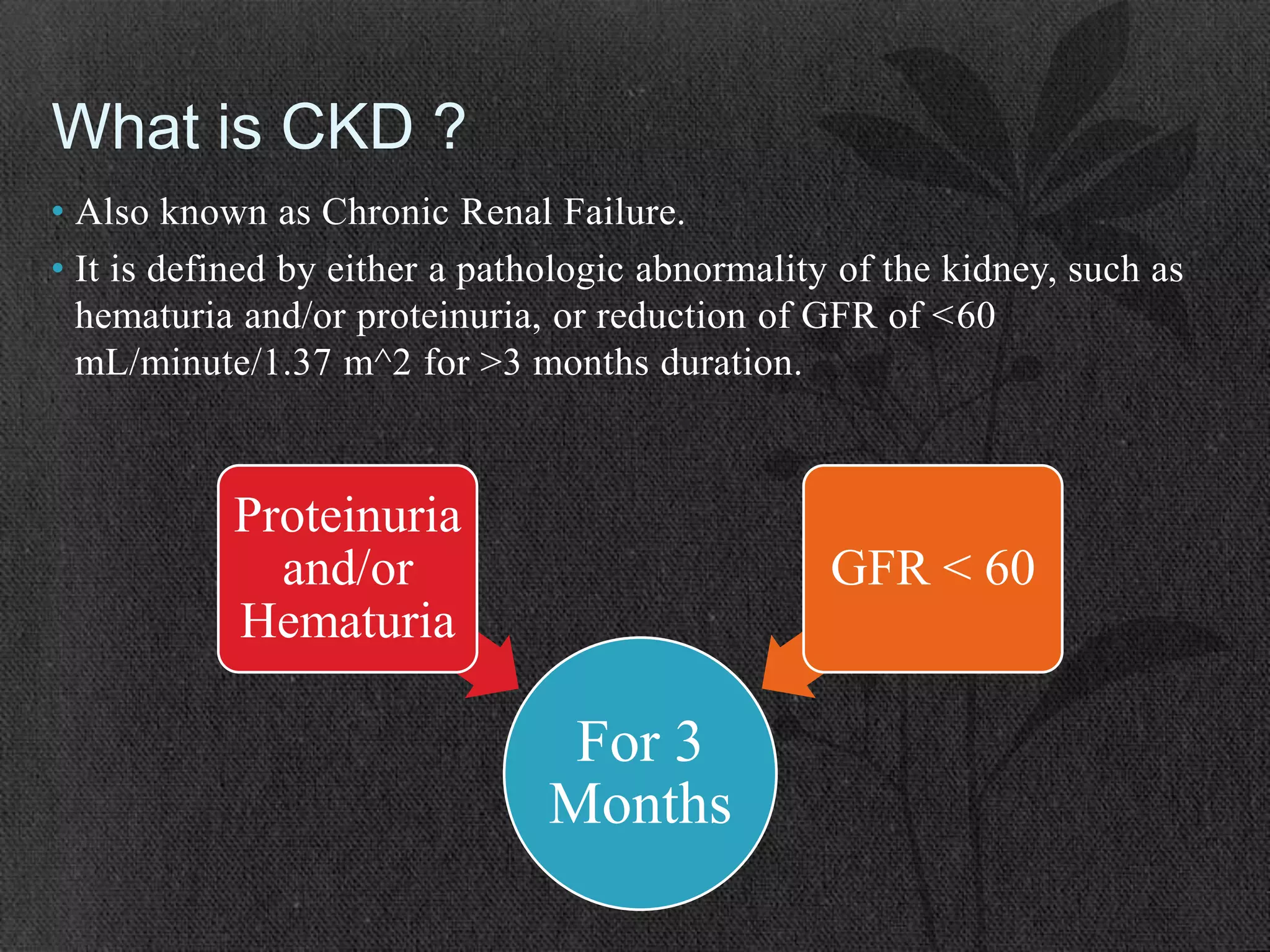
What is CKD ?
• Also known as Chronic Renal Failure.
• It is defined by either a pathologic abnormality of the kidney, such as
  hematuria and/or proteinuria, or reduction of GFR of <60
  mL/minute/1.37 m^2 for >3 months duration.


           Proteinuria
             and/or                               GFR < 60
           Hematuria

                                 For 3
                                Months
Stages
Stage 1 disease is defined by a normal GFR (greater than 90 mL/min per
1.73 m2) and persistent albuminuria


Stage 2 disease is a GFR between 60 to 89 mL/min per 1.73 m2 and
persistent albuminuria


Stage 3 disease is a GFR between 30 and 59 mL/min per 1.73 m2


Stage 4 disease is a GFR between 15 and 29 mL/min per 1.73 m2 Stage 5
disease is a GFR of less than 15 mL/min per 1.73 m2 or end-stage renal
disease
EPIDEMIOLOGY
Epidemiology
• Common condition
• Often unrecognized until advanced stages.
• It is estimated that 10% of the adult population world wide will have
  CKD
• Incidence is raising
• Due to different factors (aging population, increased incidence of DM
  & HTN, Increased incidence of glomerular diseases …….)
Epidemiology
               • conclude that prevalence of CKD in
                 the young Saudi population is
                 around 5.7%
               • Only 7.1% of the CKD patients were
                 aware of their CKD status
               • 32.1% were told that they had
                 protein or blood in their urine and
                 10.7% had known kidney stones in
                 the past.
By the end of
 2008, there
were 10,203
 patients on
hemodialysis
The question:

HOW TO
APPROACH ??
Meet Our Patient:
•   Mr. Saeed M. M.
•   73 Years old                                Aging process causes decline in
•   Saudi                                      GFR. Typically 1 per year after the
•   Male                                                  age of 50

•   From Abha
•   Admitted Feb 26th 2012.                     Men are at higher risk than women.
•   Through OPD                                The mechanism Is unknown but it is
                                               though to be related to sex hormones
•   Hx was taken from his son and is
    reliable.

• C/C
    • Itching and bruising for 1 month
    • Swelling of face and limbs for 2 weeks
HPI
• Mr. Saeed is known Diabetic for 30 years     Diabetes is the most common cause.
  on insulin and Hypertensive for 3 years
                                               It is estimated that 30% of diabetics
• He is known to have kidney disease since     will have CKD within 5 to 10 years
  3 years and following up
                                                            of Diagnosis
• Came to Nephrology clinic for regular
  follow up complaining of itching all over
  his body for 1 month.                          Second Most common cause of
• This itching started gradually and is           CKD. Accounts for 1 third of
  continuous and moderate with no rashes or        patients undergoing renal
  fever.                                              replacement therapy
• It was associated with easy bruising on
  minimal trauma over his limbs.               Thought to be due to accumulation
• he has Hx of recurrent melena for the past     of toxic waste products in the
  3 months                                          circulation such as urea
• Pt has also edema around his eye
  developed 1 month gradually with               Nitrogen retention that causes
  puffiness of the face and abdominal          impaired prothrombin consumption,
  distention                                      defect in platelet factor and
                                                 abnormal platelet aggregation
Cont
• Mr. Saeed also has chronic
  intermittent productive cough for 3
  years and it progressed in severity in
  the last year, clear to greenish yellow
  sputum of moderate amount not
  associated with fever or hemoptysis.      Associated with pulmonary edema due to
• He also has dyspnea grade 2, no                     reduced urine output
  orthopnea no PND.
• He also has vomiting for the past 3
  weeks, of food content after taking
  breakfast. No hematemesis.
• He also has anorexia and weight loss
  of 7 Kg over the last year                 Thought to be due to accumulation of
• he also has dysuria, frequency (10         toxic waste products in the circulation
  times/day), nocturia                                    such as urea
• No hematuria, flank pain or
  obstructive Lower urinary tract              Important to exclude obstructive
  symptoms.
                                                        nephropathy
• Patient is known to have kidney
                                       To confirm the chronicity. Sometimes you
  disease since 3 years ago
                                        have to look for previous investigations
• Admitted 3 years ago with LL                    and follow up notes.
  edema, ascites and treated for
  proteinuria
• Discharged after 45 days
• On follow up with nephrologist
• Was found to have very high
  creatinine in the last follow up         Incidental discovery is common
• Was admitted for management of his
  problem
Systemic enquiry
General                      GI
• Fatigue                    •   Anorexia
• Dizziness                  •   Wt loss
• No loss of consciousness   •   Melena
                             •   Abdominal distention
CVS                          •   Morning vomiting
                             •   No jaundice
•   Dyspnea
                             •   No pain
•   No chest pain            •   No dysphagia
•   Cough
•   No PND                   Nervous
•   No orthopnea             •   Headache
•   No palpitations          •   No confusion or LOC
•   No cyanosis              •   No weakness
•   No claudication          •   Other unremarkable
Respiratory
•   Productive cough
                                   Skin
•   Dyspnea
•   No chest pain                  • Easy bruising
•   No hemoptysis
•   No other symptoms              • Itching
MSK                                • no rash
•   Knee pain
•   Lower back pain                • No eruptions
•   No joint swelling of redness
•   No limitation of movement      • No ulcers
Past Medical History
Drug Hx
          Insulin Mixed 20
            a.m. 30 p.m.
           Captopril 25 mg
                BID

          Aspirin 81 mg OD

          Simvastatin 40 mg
                OD
             Phenytoin
           (Discontinued)
Past Surgical Hx


                 Little toe
    Hernia                     Cataract
                amputation
  repair – 20                 surgery – 2
                – 15 years
   years ago                   years ago
                    ago
Allergy Hx
• -ve                              People with close family member with the
                                    disease are at higher risk themselves of
                                      developing CKD. The mechanism is
Transfusion Hx                         thought to be due in part to genetic
• -ve                               susceptibility to certain diseases such as
                                      DM, HTN, PKD, Alport syndrome.
Family Hx
• His brother had renal transplantation
• History of chronic diseases, DM, HTN, IHD in first degree relatives
• No Hx of malignancy

Social
•   Married
                              Smoking has been associated as a risk factor for
•   40 pack-years Ex-smoker   the development and progression of the disease.
•   Lives in Abha             Likely because of accelerated atherosclerosis and
•   Illiterate                    vascular disease as well as exacerbating
                                              underlying HTN
On Examination
General
• Patient looks not well, not
  comfortable, lying on his side and
  tachypnic
• He is drowsy, not alert, not
  dehydrated, connected to IV line.
Vitals
• Pulse: 94 BPM regular, average
  volume, no special character, no
  radio-radial or radio-femoral delay.
• BP: 130/85 mmHg
• RR: 35 per minute – Shallow and        Indicating metabolic acidosis
  fast pattern
• O2 Saturation: 96% in room air
Hands                              Brown line of at least 1mm wide at distal
•   Clubbing in the nails             end of nail may be present in some
                                                    patients
•   Pallor in the palmar creases
•   Scratch marks over both arms   As result of pruritus Due to deposition of
•   3 echymotic patches around        calcium or phosphate in the skin or
    the elbow and the site of IV   stimulation of nerve endings due to some
    cannula- 1-3 cm in diameter                  retained toxins

•   Fine white scales over both
    arms                           Due to precipitation of high concentration
                                              of urea in the sweat
•   No astrexis
•   No liver disease stigmata
•   No A/V fistula                                For dialysis
H&N
•   Periorbital edema
•   Pallor
•   No Jaundice                                 Anemia
•   No parotid swelling
•   No uremic fetor
                                 Smell from mouth due to breakdown of
•   No oral ulcer
                                           urea to ammonia
•   Bad dental hygiene
•   JVP is raised (4+5 cm)
•   No lymph node enlargement        May be present due to dryness
•   No bruit over the carotids
•   no spider angiomata
•   Trachea is central

Fundoscopy                       To look for retinal changes of DM and
• Not done                                        HTN
Chest
• Inspection
  • No chest deformity or scars
  • Equal bilateral chest movement
  • No visible veins
  • Apex beat is not visible
• Palpation
  • Normal bilateral chest expansion
  • Normal tactile fremitus
  • No heaves
  • No thrills
  • Apex beat is palpable in the 5th IC space 3 cm
    lateral to the mid- clavicular line.
• Auscultation
  • Normal bilateral air entry
  • Coarse bilateral basal crepitation
  • Normal S1 + S2 + 0                               Due to pulmonary edema
  • No added sounds, No murmurs
  • No pericardial Rub
Abdomen
• Inspection
  • Distended flanks
  • Hernial repair scar
  • No visible veins
  • Normal umbilicus
• Palpation
  • Soft, lax
  • No masses or tenderness
  • Kidneys are not palpable
  • No hepatomegaly (liver span= 12 cm)     You may find enlarged kidneys or mass or
  • No splenomegaly                                    polycystic kidney
• Percussion
  • Ascites elicited by shifting dullness
  • No fluid thrill
  • No organomegaly
• Auscultation
  • Normal bowel sounds
  • No renal artery bruits
Back
• No renal angle tenderness
• Sacral edema
LL
•   Amputated Rt little toe
•   Wasting of muscles in both limbs              Indicator for poor control of DM
•   Bilateral pitting edema
•   Loss of hair distally
•   Scaling of the skin
•   No temperature difference
•   Dorsalis pedis pulsation is not palpable     Peripheral vasculopathy due to DM
•   Posterior tibial pulsation is not palpable
•   Popliteal artery pulsation is palpable in
    both legs
Motor and sensory examination

                            Right                             Left
                     UL              LL               UL             LL
Power                 3               5                   4          5
Tone                  +               N                   +          N
Light touch           N               N               N              N
Position              N               N               N              N
Coordination          N               N               N              N


Reflexes are ++ in right knee and Biceps. Others Normal
SUMMARY
Urea & Creatinine


         High >1.1 mg/dl in men
          >1.2 mg/dl in women


• Estimating Creatinine Clearance (ml/min)
• Cockcroft and Gault equation:
•     CrCl = (140 - age) x IBW / (Scr x 72)   (x 0.85 for females)
• In our patient = 7.24 mL/min
• Which Stage ??
Electrolytes


•   Hyponatremia is common
•   Potassium is normal until end stage
•   Calcium is low
•   Phosphate is high
Other RFT
LFT
Glucose


          HbA1C = 9 %
Investigations

        test      Value          findings
       WBC         5000
        RBC      1.71*10^6
       HGB         6 g/dl        Macro
        HCT       17.2%        Hypochrom
       MCV        100.6 fl      Anaemia

       MCH        35.1 pg
       MCHC       35 g/dl
      RDW++SD      57 fl
        PLT       90000      thrombocytopenia
ABG
           PH: 7.31

           pCO2: 34 mmHg

           pO2: 85 mmHg

           HCO3: 18 mEq/liter


Metabolic acidosis because kidney is unable to regulate acid base balance
Urinalysis
             • Screening test to determine for
               pathologic markers of kidney
               damage excreted in the urine
             • Microalbuminurea is a risk factor for
               development of progressive CKD
               and CAD associated with DM and
               HTN . Indicated in patient with DM
               .
Other Investigations
• Chest X-ray
 • pulmonary edema
• ECG                         May show abnormalities associated with electrolyte
 • Normal                                  disturbance in CKD

• Renal Ultrasound
 • Small kidneys, No obstruction, No stones
• Others
 • ?????????
Management
• Admission to MFS unit
• Investigations
• Fluid restriction
• Sliding scale (Glucose monitoring)
• Foley’s catheter
• Dietary modification:
 •   Protein restriction
 •   Potassium restriction
 •   Phosphorus restriction
 •   Diabetic diet
Management
• Drugs:
 • Replacement therapy
  • Iron 200 mg PO BID
  • Folic acid 5 mg PO OD
  • CaCO3
  • 1-alpha
                             What if the patient has
  • Hypertensive drug
                              Hyperkalemia ??
  • Captopril 50 mg PO BID


  • Pantazole 40 mg PO OD
Management
• Education about hemodialysis
• Referal for Radiology for Permacath insertion
• Preparation for hemodialysis
Hemodialysis
• method for extracorporeal removing
  waste products such as creatinine
  and urea, as well as free water from
  the blood when the kidneys are in
  renal failure. Hemodialysis is one of
  three renal replacement therapies
  (the other two being renal transplant;
  peritoneal dialysis).
Any Question ??
Chronic Kidney Disease

Chronic Kidney Disease

  • 1.
    Hamza J. AlGhamdi Supervisedby: Prof. Mohammed Alhomrani
  • 2.
    contents Introduction Examination Investigation epidemiology History Management Conclusion
  • 3.
  • 4.
    What is CKD? • Also known as Chronic Renal Failure. • It is defined by either a pathologic abnormality of the kidney, such as hematuria and/or proteinuria, or reduction of GFR of <60 mL/minute/1.37 m^2 for >3 months duration. Proteinuria and/or GFR < 60 Hematuria For 3 Months
  • 5.
    Stages Stage 1 diseaseis defined by a normal GFR (greater than 90 mL/min per 1.73 m2) and persistent albuminuria Stage 2 disease is a GFR between 60 to 89 mL/min per 1.73 m2 and persistent albuminuria Stage 3 disease is a GFR between 30 and 59 mL/min per 1.73 m2 Stage 4 disease is a GFR between 15 and 29 mL/min per 1.73 m2 Stage 5 disease is a GFR of less than 15 mL/min per 1.73 m2 or end-stage renal disease
  • 6.
  • 7.
    Epidemiology • Common condition •Often unrecognized until advanced stages. • It is estimated that 10% of the adult population world wide will have CKD • Incidence is raising • Due to different factors (aging population, increased incidence of DM & HTN, Increased incidence of glomerular diseases …….)
  • 8.
    Epidemiology • conclude that prevalence of CKD in the young Saudi population is around 5.7% • Only 7.1% of the CKD patients were aware of their CKD status • 32.1% were told that they had protein or blood in their urine and 10.7% had known kidney stones in the past.
  • 9.
    By the endof 2008, there were 10,203 patients on hemodialysis
  • 10.
  • 11.
    Meet Our Patient: • Mr. Saeed M. M. • 73 Years old Aging process causes decline in • Saudi GFR. Typically 1 per year after the • Male age of 50 • From Abha • Admitted Feb 26th 2012. Men are at higher risk than women. • Through OPD The mechanism Is unknown but it is though to be related to sex hormones • Hx was taken from his son and is reliable. • C/C • Itching and bruising for 1 month • Swelling of face and limbs for 2 weeks
  • 12.
    HPI • Mr. Saeedis known Diabetic for 30 years Diabetes is the most common cause. on insulin and Hypertensive for 3 years It is estimated that 30% of diabetics • He is known to have kidney disease since will have CKD within 5 to 10 years 3 years and following up of Diagnosis • Came to Nephrology clinic for regular follow up complaining of itching all over his body for 1 month. Second Most common cause of • This itching started gradually and is CKD. Accounts for 1 third of continuous and moderate with no rashes or patients undergoing renal fever. replacement therapy • It was associated with easy bruising on minimal trauma over his limbs. Thought to be due to accumulation • he has Hx of recurrent melena for the past of toxic waste products in the 3 months circulation such as urea • Pt has also edema around his eye developed 1 month gradually with Nitrogen retention that causes puffiness of the face and abdominal impaired prothrombin consumption, distention defect in platelet factor and abnormal platelet aggregation
  • 13.
    Cont • Mr. Saeedalso has chronic intermittent productive cough for 3 years and it progressed in severity in the last year, clear to greenish yellow sputum of moderate amount not associated with fever or hemoptysis. Associated with pulmonary edema due to • He also has dyspnea grade 2, no reduced urine output orthopnea no PND. • He also has vomiting for the past 3 weeks, of food content after taking breakfast. No hematemesis. • He also has anorexia and weight loss of 7 Kg over the last year Thought to be due to accumulation of • he also has dysuria, frequency (10 toxic waste products in the circulation times/day), nocturia such as urea • No hematuria, flank pain or obstructive Lower urinary tract Important to exclude obstructive symptoms. nephropathy
  • 14.
    • Patient isknown to have kidney To confirm the chronicity. Sometimes you disease since 3 years ago have to look for previous investigations • Admitted 3 years ago with LL and follow up notes. edema, ascites and treated for proteinuria • Discharged after 45 days • On follow up with nephrologist • Was found to have very high creatinine in the last follow up Incidental discovery is common • Was admitted for management of his problem
  • 15.
    Systemic enquiry General GI • Fatigue • Anorexia • Dizziness • Wt loss • No loss of consciousness • Melena • Abdominal distention CVS • Morning vomiting • No jaundice • Dyspnea • No pain • No chest pain • No dysphagia • Cough • No PND Nervous • No orthopnea • Headache • No palpitations • No confusion or LOC • No cyanosis • No weakness • No claudication • Other unremarkable
  • 16.
    Respiratory • Productive cough Skin • Dyspnea • No chest pain • Easy bruising • No hemoptysis • No other symptoms • Itching MSK • no rash • Knee pain • Lower back pain • No eruptions • No joint swelling of redness • No limitation of movement • No ulcers
  • 17.
  • 18.
    Drug Hx Insulin Mixed 20 a.m. 30 p.m. Captopril 25 mg BID Aspirin 81 mg OD Simvastatin 40 mg OD Phenytoin (Discontinued)
  • 19.
    Past Surgical Hx Little toe Hernia Cataract amputation repair – 20 surgery – 2 – 15 years years ago years ago ago
  • 20.
    Allergy Hx • -ve People with close family member with the disease are at higher risk themselves of developing CKD. The mechanism is Transfusion Hx thought to be due in part to genetic • -ve susceptibility to certain diseases such as DM, HTN, PKD, Alport syndrome. Family Hx • His brother had renal transplantation • History of chronic diseases, DM, HTN, IHD in first degree relatives • No Hx of malignancy Social • Married Smoking has been associated as a risk factor for • 40 pack-years Ex-smoker the development and progression of the disease. • Lives in Abha Likely because of accelerated atherosclerosis and • Illiterate vascular disease as well as exacerbating underlying HTN
  • 21.
    On Examination General • Patientlooks not well, not comfortable, lying on his side and tachypnic • He is drowsy, not alert, not dehydrated, connected to IV line. Vitals • Pulse: 94 BPM regular, average volume, no special character, no radio-radial or radio-femoral delay. • BP: 130/85 mmHg • RR: 35 per minute – Shallow and Indicating metabolic acidosis fast pattern • O2 Saturation: 96% in room air
  • 22.
    Hands Brown line of at least 1mm wide at distal • Clubbing in the nails end of nail may be present in some patients • Pallor in the palmar creases • Scratch marks over both arms As result of pruritus Due to deposition of • 3 echymotic patches around calcium or phosphate in the skin or the elbow and the site of IV stimulation of nerve endings due to some cannula- 1-3 cm in diameter retained toxins • Fine white scales over both arms Due to precipitation of high concentration of urea in the sweat • No astrexis • No liver disease stigmata • No A/V fistula For dialysis
  • 23.
    H&N • Periorbital edema • Pallor • No Jaundice Anemia • No parotid swelling • No uremic fetor Smell from mouth due to breakdown of • No oral ulcer urea to ammonia • Bad dental hygiene • JVP is raised (4+5 cm) • No lymph node enlargement May be present due to dryness • No bruit over the carotids • no spider angiomata • Trachea is central Fundoscopy To look for retinal changes of DM and • Not done HTN
  • 24.
    Chest • Inspection • No chest deformity or scars • Equal bilateral chest movement • No visible veins • Apex beat is not visible • Palpation • Normal bilateral chest expansion • Normal tactile fremitus • No heaves • No thrills • Apex beat is palpable in the 5th IC space 3 cm lateral to the mid- clavicular line. • Auscultation • Normal bilateral air entry • Coarse bilateral basal crepitation • Normal S1 + S2 + 0 Due to pulmonary edema • No added sounds, No murmurs • No pericardial Rub
  • 25.
    Abdomen • Inspection • Distended flanks • Hernial repair scar • No visible veins • Normal umbilicus • Palpation • Soft, lax • No masses or tenderness • Kidneys are not palpable • No hepatomegaly (liver span= 12 cm) You may find enlarged kidneys or mass or • No splenomegaly polycystic kidney • Percussion • Ascites elicited by shifting dullness • No fluid thrill • No organomegaly • Auscultation • Normal bowel sounds • No renal artery bruits
  • 26.
    Back • No renalangle tenderness • Sacral edema LL • Amputated Rt little toe • Wasting of muscles in both limbs Indicator for poor control of DM • Bilateral pitting edema • Loss of hair distally • Scaling of the skin • No temperature difference • Dorsalis pedis pulsation is not palpable Peripheral vasculopathy due to DM • Posterior tibial pulsation is not palpable • Popliteal artery pulsation is palpable in both legs
  • 27.
    Motor and sensoryexamination Right Left UL LL UL LL Power 3 5 4 5 Tone + N + N Light touch N N N N Position N N N N Coordination N N N N Reflexes are ++ in right knee and Biceps. Others Normal
  • 28.
  • 29.
    Urea & Creatinine High >1.1 mg/dl in men >1.2 mg/dl in women • Estimating Creatinine Clearance (ml/min) • Cockcroft and Gault equation: • CrCl = (140 - age) x IBW / (Scr x 72) (x 0.85 for females) • In our patient = 7.24 mL/min • Which Stage ??
  • 30.
    Electrolytes • Hyponatremia is common • Potassium is normal until end stage • Calcium is low • Phosphate is high
  • 31.
  • 32.
  • 33.
    Glucose HbA1C = 9 %
  • 34.
    Investigations test Value findings WBC 5000 RBC 1.71*10^6 HGB 6 g/dl Macro HCT 17.2% Hypochrom MCV 100.6 fl Anaemia MCH 35.1 pg MCHC 35 g/dl RDW++SD 57 fl PLT 90000 thrombocytopenia
  • 35.
    ABG PH: 7.31 pCO2: 34 mmHg pO2: 85 mmHg HCO3: 18 mEq/liter Metabolic acidosis because kidney is unable to regulate acid base balance
  • 36.
    Urinalysis • Screening test to determine for pathologic markers of kidney damage excreted in the urine • Microalbuminurea is a risk factor for development of progressive CKD and CAD associated with DM and HTN . Indicated in patient with DM .
  • 37.
    Other Investigations • ChestX-ray • pulmonary edema • ECG May show abnormalities associated with electrolyte • Normal disturbance in CKD • Renal Ultrasound • Small kidneys, No obstruction, No stones • Others • ?????????
  • 38.
    Management • Admission toMFS unit • Investigations • Fluid restriction • Sliding scale (Glucose monitoring) • Foley’s catheter • Dietary modification: • Protein restriction • Potassium restriction • Phosphorus restriction • Diabetic diet
  • 39.
    Management • Drugs: •Replacement therapy • Iron 200 mg PO BID • Folic acid 5 mg PO OD • CaCO3 • 1-alpha What if the patient has • Hypertensive drug Hyperkalemia ?? • Captopril 50 mg PO BID • Pantazole 40 mg PO OD
  • 40.
    Management • Education abouthemodialysis • Referal for Radiology for Permacath insertion • Preparation for hemodialysis
  • 41.
    Hemodialysis • method forextracorporeal removing waste products such as creatinine and urea, as well as free water from the blood when the kidneys are in renal failure. Hemodialysis is one of three renal replacement therapies (the other two being renal transplant; peritoneal dialysis).
  • 43.