Renal disease
Prepared by
Ibrahim Muneim Hssein
Renal system
• Group of organs whose major function is to filter out excess fluid and
other substances from the blood stream .These substances collectively
form urine.
• The major organs in this system include
– the kidneys,
– ureter,
– bladder,
– urethra.
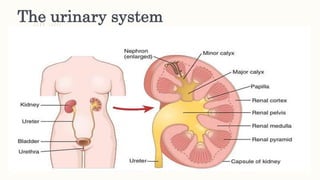
The urinary system
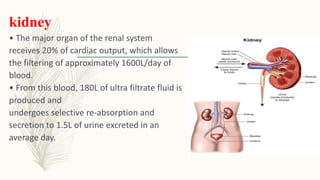
kidney
• The major organ of the renal system
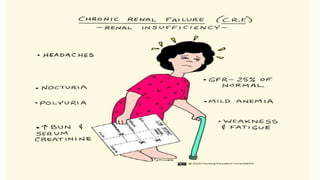
receives 20% of cardiac output, which allows
the filtering of approximately 1600L/day of
blood.
• From this blood, 180L of ultra filtrate fluid is
produced and
undergoes selective re-absorption and
secretion to 1.5L of urine excreted in an
average day.
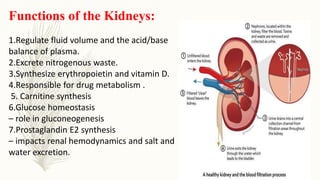
Functions of the Kidneys:
1.Regulate fluid volume and the acid/base
balance of plasma.
2.Excrete nitrogenous waste.
3.Synthesize erythropoietin and vitamin D.
4.Responsible for drug metabolism .
5. Carnitine synthesis
6.Glucose homeostasis
– role in gluconeogenesis
7.Prostaglandin E2 synthesis
– impacts renal hemodynamics and salt and
water excretion.
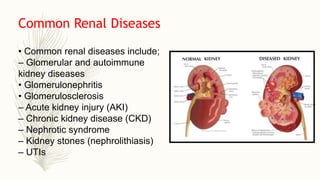
Common Renal Diseases
• Common renal diseases include;
– Glomerular and autoimmune
kidney diseases
• Glomerulonephritis
• Glomerulosclerosis
– Acute kidney injury (AKI)
– Chronic kidney disease (CKD)
– Nephrotic syndrome
– Kidney stones (nephrolithiasis)
– UTIs
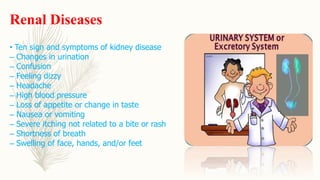
Renal Diseases
• Ten sign and symptoms of kidney disease
– Changes in urination
– Confusion
– Feeling dizzy
– Headache
– High blood pressure
– Loss of appetite or change in taste
– Nausea or vomiting
– Severe itching not related to a bite or rash
– Shortness of breath
– Swelling of face, hands, and/or feet
Renal failure: The ability of the kidney to
perform excretory, endocrine, and metabolic
functions has deteriorated beyond
compensatory mechanisms {low GFR). This
indicates inability of the kidneys to maintain
normal homeostasis. Renal failure can be either
acute or chronic.
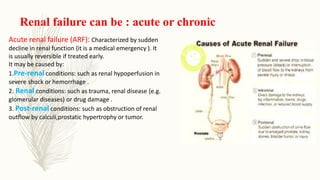
Renal failure can be : acute or chronic
Acute renal failure (ARF): Characterized by sudden
decline in renal function {it is a medical emergency ). It
is usually reversible if treated early.
It may be caused by:
1.Pre-renal conditions: such as renal hypoperfusion in
severe shock or hemorrhage .
2. Renal conditions: such as trauma, renal disease {e.g.
glomerular diseases) or drug damage .
3. Post-renal conditions: such as obstruction of renal
outflow by calculi,prostatic hypertrophy or tumor.
Chronic renal failure (CRF): It is an irreversible, advanced, and slowly progressive
renal damage and is shown by a low glomerular filtration rate {GFR) persisting for
more than 3 months.
Historically classified to : vascular , glomerular , tubulointerstitial & obstructive.
Accumulation of wastes leads to other issues.
More common among women but in men it is 50% more likely than women to
progress to renal failure.
Chronic : more common, develops slowly (Chronic renal failure CRF, Chronic kidney
disease CKD)
Renal failure leads to : Fluid retention , hypertension , acidosis ,
accumulation of metabolites & drugs , anemia , bleeding tendency , endocrine defects
Etiology of CRF
The three most common known causes are:
1. Diabetes mellitus.
2. Hypertension.
3.Chronic glomerulonephritis.
Chronic renal disease can be compensated by structural and functional
hypertrophy of surviving nephrons, to a point at which around 50% of renal
function remains, when chronic renal insufficiency (CRI) ensues. CRI inevitably
progresses to ESRD.
Early CRI often no symptoms Only blood test & urine test help the
diagnosis.
When kidney function falls below 25% of normal Nycturia and anorexia
appear & raised urea in serum Later on ::Cardiovascular disease , anemia
, bone disease & other features appear
Sign and symptoms
Fluid overload
Na-K imbalance
Bone & mineral disease
Deficient Vit D3
In advanced disease all body systems involved
Anemia ::
-toxic suppression of bone marrow
- Lack of erythropoietin
- Iron deficiency from blood loss in the gut
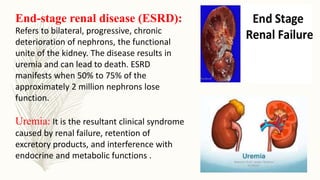
End-stage renal disease (ESRD):
Refers to bilateral, progressive, chronic
deterioration of nephrons, the functional
unite of the kidney. The disease results in
uremia and can lead to death. ESRD
manifests when 50% to 75% of the
approximately 2 million nephrons lose
function.
Uremia: It is the resultant clinical syndrome
caused by renal failure, retention of
excretory products, and interference with
endocrine and metabolic functions .
Clinical features of CRF and ESRD:
CRF is asymptomatic at first . Symptoms and signs of CRF depend on the
degree of renal malfunction, often with few symptoms until kidney
function has fallen to less than 25% of normal.
Clinical features of CRF can be summarized in the following
Laboratory findings:
DERMATOLOG ICAL
Pruritus Bru1sing
Hyperpigmentation Pallor
Uremic frost
HEMATOLOG ICAL
Bleeding, Anemia, Lymphopenia and leukopenia Splenomegaly and hypersplenism
IMMUNOLOGICAL Prone to infections
METABOLIC
Nacturia and polyuria Thirst
Glycosuria Metabolic acidosis
Raised serum urea , creatinine,
Electrolyte disturbances
Several tests, including urinalysis, blood urea nitrogen (BUN), serum creatinine, creatinine clearance, electrolyte
measurements and protein electrophoresis are used to monitor the progress of CRF.
In CRF, there will be increase in serum creatinine level (normal value is 0,6 to 1.20 mg/dL) ,BUN is above 20mg/dl and
there will be increase in the level of serum potassium and phosphate and decrease in the serum calcium.
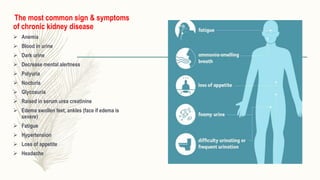
The most common sign & symptoms
of chronic kidney disease
 Anemia
 Blood in urine
 Dark urine
 Decrease mental alertness
 Polyuria
 Nocturia
 Glycosuria
 Raised in serum urea creatinine
 Edema swollen feet, ankles (face if edema is
severe)
 Fatigue
 Hypertension
 Loss of appetite
 Headache
Medical management of CRF and ESRD
The main treatment options are:
•Conservative care.
•Dialysis (peritoneal dialysis or hemodialysis).
•Renal transplant.
Conservative care:
It is the first step which is designed to slow the progression of renal disease and may be
adequate for prolonged periods. It involves:
-Dietary modification (restricting protein, low phosphate diet and
monitoring fluid, sodium and potassium intake).
-Any treatable associated condition such as diabetes, hypertension, congestive heart
failure, infection, volume depletion , urinary tract obstruction, secondary
hyperparathyroidism is corrected or controlled.
-The use of vitamin D preparations (e.g. calcitriol) that decrease serum parathyroid
hormone levels (to inhibit bone resorption).
-Avoidance of nephrotoxic drugs (such as NSAIDs and tetracyclines) or agents metabolized
principally by the kidney (such as penicillin's, cephalosporins and erythromycin).
The use of recombinant human erythropoietin
Dialysis:
It is a medical procedure that artificially filters blood. Dialysis becomes
essential if renal function deteriorate s to ESRD. The procedure can be
accomplished by peritoneal dialysis or hemodialysis
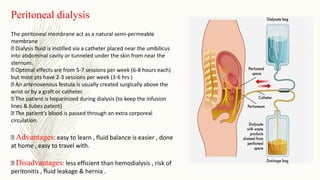
Peritoneal dialysis
The peritoneal membrane act as a natural semi-permeable
membrane
Dialysis fluid is instilled via a catheter placed near the umbilicus
into abdominal cavity or tunneled under the skin from near the
sternum.
Optimal effects are from 5-7 sessions per week (6-8 hours each)
but most pts have 2-3 sessions per week (3-6 hrs )
An arteriovenous festula is usually created surgically above the
wrist or by a graft or catheter.
The patient is heparinized during dialysis (to keep the infusion
lines & tubes patent)
The patient’s blood is passed through an extra corporeal
circulation.
Advantages: easy to learn , fluid balance is easier , done
at home , easy to travel with.
Disadvantages: less efficient than hemodialysis , risk of
peritonitis , fluid leakage & hernia .
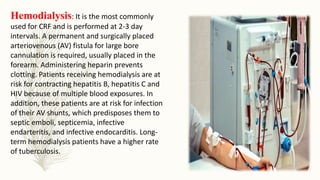
Hemodialysis: It is the most commonly
used for CRF and is performed at 2-3 day
intervals. A permanent and surgically placed
arteriovenous (AV) fistula for large bore
cannulation is required, usually placed in the
forearm. Administering heparin prevents
clotting. Patients receiving hemodialysis are at
risk for contracting hepatitis B, hepatitis C and
HIV because of multiple blood exposures. In
addition, these patients are at risk for infection
of their AV shunts, which predisposes them to
septic emboli, septicemia, infective
endarteritis, and infective endocarditis. Long-
term hemodialysis patients have a higher rate
of tuberculosis.
Oral Manifestations of CRF and ESRD:
1. Pallor of the oral mucosa related to anemia.
2.Pigmentation of oral mucosa (red-orange discoloration) caused by deposition of
carotene-like pigments.
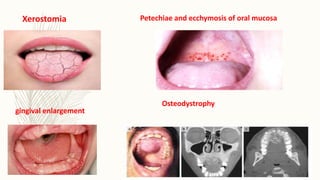
3.Xerostomia and parotid infections.
4.Candidiasis.
5.Dysgeusia (an altered or metallic taste that results from a high urea content).
6.Petechiae and ecchymosis of oral mucosa.
7.Gingival bleeding.
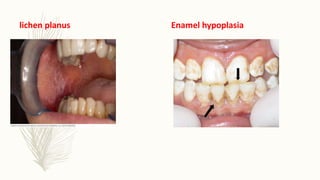
8.Oral lesions, ulcers, lichen planus lesions, hairy tongue and pyogenic granulomas have
all been noted in increased frequency in patients with CRF.
9.Enamel hypoplasia has been documented in patients with ESRD whose disease began at
an early age.
10.Osteodystrophy (radiolucent jaw lesions .....Central giant cell
granulomas; "brown tumor"). Those lytic bone lesions are the result
of hyperparathyroidism.
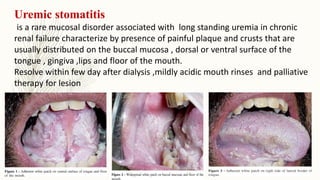
11.Uremic stomatitis.
12.There may be gingival enlargement as a result of the medication
used (cyclosporine).
Xerostomia Petechiae and ecchymosis of oral mucosa
gingival enlargement
Osteodystrophy
lichen planus Enamel hypoplasia
Uremic stomatitis
is a rare mucosal disorder associated with long standing uremia in chronic
renal failure characterize by presence of painful plaque and crusts that are
usually distributed on the buccal mucosa , dorsal or ventral surface of the
tongue , gingiva ,lips and floor of the mouth.
Resolve within few day after dialysis ,mildly acidic mouth rinses and palliative
therapy for lesion
Dental aspects of kidney disease
The is correlation between tooth loss & patients with low protein
and calorie intake.
Oral disease is common specially periodontitis Oral hygiene
measures are important.
 Dental treatment is best carried out on the day after dialysis (
maximum effect of dialysis & effect of heparin has diminished)
Dental aspects:
• Immunosuppression: Increases risk of infection.
• Excessive bleeding which is caused by adverse effects of immunosuppressant drugs that
cause bone marrow suppression (such as azathioprine) with resultant leucopenia,
thrombocytopenia and anemia .(cyclosporine also cause bleeding problems because of its
effects on the liver).
• Gingival hyperplasia caused by cyclosporine.
• Increased incidence of cancer like lip squamous cell carcinoma,
Kaposi 's sarcoma and lymphoma. Cancer is a complication of intense immunosuppression
and is not related to the use of any particular agent.
•Adrenal gland suppression caused by corticosteroids.
•Poor wound healing, osteoporosis, diabetes mellitus, hypertension and increased risk of
infection (all of them are adverse effects of corticosteroids).
Salivary glands may swell , salivary flow is reduced & there may be calculus
accumulation.
 In children with CKD we may see jaw growth retardation , delay of tooth
eruption , malocclusion & enamel hypoplasia with brownish discoloration.
 Lower caries rate & less periodontal disease have been reported in
childreb with CKD.
 Oral mucosa may be pale (anemia) & there may be oral ulceration.
Most studies show that there is more periodontal disease in CKD patients
than controls.
 Osseous lesions include; loss of lamina dura , osteoporosis & osteolytic
areas.
 Secondary hyperparathyroidism may lead to giant cell lesions.
 There may be abnormal bone repair after extractions with socket sclerosis
pts should be screened carefully for bone disease before
implant placement.
 Dry mouth , halitosis , metallic taste & purpura may be conspicuous
In patients undergoing hemodialysis there may be :
difficulties (in chewing , swallowing , tasting & speaking) .
Increased risk or oral disease & infections
 There is no effective treatment for hyposalivation in patients on chronic
hemodialysis.
 Consideration must be given to the effect on dental care of underlying
diseases ( hypertension , diabetes …)
 Major surgeries may be complicated by hyperkalemia which leads to
arrhythmias and may
cause cardiac arrest.
 Dialysis is deferred postoperatively if possible since heparinization is
required
Hemostasis
The hematologist should first be consulted about bleeding tendency .
 Hemostasis should be ensured if surgical procedures are necessary.
 If bleeding prolonged
- Desmopressin (hemostasis up to 4 hrs)
- Cryoprecipitate (peak effect at 4-12 hrs & lasts up to 36 hrs.)
- Conjugated estrogens (take 2-5 days to develop & persists for 30 days.)
Infections
Infections are poorly controlled in CKD patients (specially if
immunosuppressed)
 May spread locally or cause septicemia.
 Periodontitis can perpetuate inflammation in CKD.
 TB is more common but extrapulmonary so no risk to dental staff.
 Signs of inflammation are masked infections are difficult to be recognized.
 Hemodialysis predisposes to blood-borne viral infections as Hepatitis HIV
infection
Odontogenic infections should be treated vigorously.
 Vascular access infections are usually caused by skin organisms so
patients with most arteriovenous fistulas don’t require
antimicrobial prophylaxis before dental Tx except:
- pts with renal transplants.
- pts with polycystic kidneys (may have mitral valve prolapse)
- pts on PD or HD with prosthetic bridge grafts or tunneled cuffed
catheters.
One regimen 400 mg teicoplanin IV during dialysis.
Drugs
Erythromycin given to CKD patients has been associated with
reversible hearing loss.
 Tetracyclines can worsen nitrogen retention & acidosis so are best
avoided except (doxycycline & minocycline)
 Penicillin's (except flucloxacillin & phenoxymethylpenicillin) And
metronidazole should be given in lower doses since high levels are
toxic to CNS.
 Nephrotoxic drugs should be avoided.
 Drugs excreted by the kidneys are prescribed only after
consultation with the renal physician except in emergency
Drugs
Antihistamines & antimuscarinic drugs may cause dry mouth or urinary
retention.
Systemic fluorides should not be given because of doubt about fluoride
excretion by damaged kidneys.
Antacids containing magnesium salts should not be given ( may lead to
magnesium retention).
Antacids containing( Ca or Aluminum) & cholestyramine (used in CKD)
interfere with absorption of penicillin & sulfonamides
NSAIDs
Aspirin and other NSAIDs should be avoided since
- they aggravated GI irritation & bleeding associated with CKD.
-Their excretion may be delayed & they maybe nephrotoxic
(especially in older pts or in cardiac failure)
- they cause Na retention peripheral edema , hypertension.
-Some patients already have peptic ulceration.
 even cox-2 inhibitors maybe nephrotoxic and are best
avoided.
 Short –term NSAID use is well tolerated if the patient is well
hydrated , has good renal function & no (heart failure , diabetes or
hypertension.)
Anasthesia
Local anesthesia is safe unless there is a severe bleeding tendency.
 For conscious sedation , relative analgesia (inhalational sedation)is
preferred because the veins of the forearms & saphenous veins
are lifelines for pts on hemodialysis.
 If its necessary to give IV sedation other veins should be used to avoid
fistula infection or thrombophlebitis.
 (Midazolam is less risky than diazepam to cause thrombophlebitis.)
GA is contraindicated if hemoglobin is below 10g/dl.
 CKD pts are sensitive to myocardial depressant effects of anesthetic agents (may
develop hypotension)
 Myocardial depression & arrhythmias are likely in those with poorly controlled acidosis
&hyperkalemia.
 Enflurane is metabolized to nephrotoxic ions so should be avoided.
 Induction with thiopental the light GA with N2O is the technique of choice
CONCLUSION
A proper examination of the oral cavity in patients with CKD is invaluable to
diagnosis at an early stage of multi-system disease. Therefore, these patients
should be routinely evaluated for oral lesions and treated accordingly . The dental
management of patients with renal disease is complicated by systemic
consequences of renal failure particularly anaemia , bleeding tendency,
cardiovascular or endocrine diseases, but with the use of proper treatment
protocols , the dental management in these patients can be effective and safe. A
simple routine examination of the oral cavity should become the norm for all
clinicians caring for renal patients.
REFERENCES
1. Greenberg MS, Glick M, Ship JA. Burkets Oral Medicine Diagnosis and treatment, BC Decker Inc Hamilton,11th ed;2008.
2. Picken M. Atlas of renal pathology. Arch Pathol LabMed 2000;124:927.
3. Prabahar MR, Chandrasekaran V, Soundararajan P. Epidemic of chronic kidney disease inIndia—what can be done? Saudi J
Kidney Dis Transpl 2008;19:847-53.
4. Johnson AC, Leway AS, Coresh J, Levin A, Lau J, Eknoyan G: Clinical practical guidelines for Chronic
Kidney Disease in adults: Part I. Definition, Disease stages, Evaluation, Treatment, and Risk factors. American Family Physician
2004;70:869-876.
5. Davidson SS. Diseases of kidney and urinary system. In: Haslett C, Chilvers ER, Hunter JAA, Boon NA. Davidsons:
Principles and practice of medicine (18th ed). UK: Church Hill Livingstone 1999;417.
6.Arora P, Vasa P, Brenner D, Iglar K, McFarlane P, Morrison H and Badawi A. Prevalence estimates of chronic kidney disease
in Canada: results of a nationally representative survey. CMAJ. 2013 June;185(9):417–423.
http://www.cmaj.ca/content/185/9/E417
7.Budenz, AW. Local Anesthetics and Medically Complex Patients. Journal of the California Dental Association. 2000:Aug;28
(8):611–618.
http://www.cda.org/Portals/0/journal/journal_082000.pdf
8.Handa S, Bhayana G, Atreja G. Oral manifestations in renal disease and its related complications. International Journal of
Clinical Cases and Investigations. 2015 Oct;6(5):6–12.
http://ijcci.info/issue-index/volume-6-issue-5/281-review-article/523-oral-manifestations-in-renal-disease-and-its-
relatedcomplications-
9. Ziebolz D, Hraský V, Goralczyk A, Hornecker E, Obed A and Mausberg RF. Dental care and oral health in solid organ
transplant recipients: a single center cross-sectional study and survey of German transplant centers. Transplant International
(European Society for Organ Transplantation). 2011 Dec;24(2):1179–1188.
http://onlinelibrary.wiley.com/doi/10.1111/j.1432-2277.2011.01325.x/full
Renal disase [autosaved]

Renal disase [autosaved]

  • 1.
  • 2.
    Renal system • Groupof organs whose major function is to filter out excess fluid and other substances from the blood stream .These substances collectively form urine. • The major organs in this system include – the kidneys, – ureter, – bladder, – urethra.
  • 3.
  • 4.
    kidney • The majororgan of the renal system receives 20% of cardiac output, which allows the filtering of approximately 1600L/day of blood. • From this blood, 180L of ultra filtrate fluid is produced and undergoes selective re-absorption and secretion to 1.5L of urine excreted in an average day.
  • 5.
    Functions of theKidneys: 1.Regulate fluid volume and the acid/base balance of plasma. 2.Excrete nitrogenous waste. 3.Synthesize erythropoietin and vitamin D. 4.Responsible for drug metabolism . 5. Carnitine synthesis 6.Glucose homeostasis – role in gluconeogenesis 7.Prostaglandin E2 synthesis – impacts renal hemodynamics and salt and water excretion.
  • 6.
    Common Renal Diseases •Common renal diseases include; – Glomerular and autoimmune kidney diseases • Glomerulonephritis • Glomerulosclerosis – Acute kidney injury (AKI) – Chronic kidney disease (CKD) – Nephrotic syndrome – Kidney stones (nephrolithiasis) – UTIs
  • 7.
    Renal Diseases • Tensign and symptoms of kidney disease – Changes in urination – Confusion – Feeling dizzy – Headache – High blood pressure – Loss of appetite or change in taste – Nausea or vomiting – Severe itching not related to a bite or rash – Shortness of breath – Swelling of face, hands, and/or feet
  • 8.
    Renal failure: Theability of the kidney to perform excretory, endocrine, and metabolic functions has deteriorated beyond compensatory mechanisms {low GFR). This indicates inability of the kidneys to maintain normal homeostasis. Renal failure can be either acute or chronic.
  • 9.
    Renal failure canbe : acute or chronic Acute renal failure (ARF): Characterized by sudden decline in renal function {it is a medical emergency ). It is usually reversible if treated early. It may be caused by: 1.Pre-renal conditions: such as renal hypoperfusion in severe shock or hemorrhage . 2. Renal conditions: such as trauma, renal disease {e.g. glomerular diseases) or drug damage . 3. Post-renal conditions: such as obstruction of renal outflow by calculi,prostatic hypertrophy or tumor.
  • 10.
    Chronic renal failure(CRF): It is an irreversible, advanced, and slowly progressive renal damage and is shown by a low glomerular filtration rate {GFR) persisting for more than 3 months. Historically classified to : vascular , glomerular , tubulointerstitial & obstructive. Accumulation of wastes leads to other issues. More common among women but in men it is 50% more likely than women to progress to renal failure. Chronic : more common, develops slowly (Chronic renal failure CRF, Chronic kidney disease CKD) Renal failure leads to : Fluid retention , hypertension , acidosis , accumulation of metabolites & drugs , anemia , bleeding tendency , endocrine defects
  • 11.
    Etiology of CRF Thethree most common known causes are: 1. Diabetes mellitus. 2. Hypertension. 3.Chronic glomerulonephritis. Chronic renal disease can be compensated by structural and functional hypertrophy of surviving nephrons, to a point at which around 50% of renal function remains, when chronic renal insufficiency (CRI) ensues. CRI inevitably progresses to ESRD.
  • 12.
    Early CRI oftenno symptoms Only blood test & urine test help the diagnosis. When kidney function falls below 25% of normal Nycturia and anorexia appear & raised urea in serum Later on ::Cardiovascular disease , anemia , bone disease & other features appear
  • 13.
    Sign and symptoms Fluidoverload Na-K imbalance Bone & mineral disease Deficient Vit D3 In advanced disease all body systems involved Anemia :: -toxic suppression of bone marrow - Lack of erythropoietin - Iron deficiency from blood loss in the gut
  • 14.
    End-stage renal disease(ESRD): Refers to bilateral, progressive, chronic deterioration of nephrons, the functional unite of the kidney. The disease results in uremia and can lead to death. ESRD manifests when 50% to 75% of the approximately 2 million nephrons lose function. Uremia: It is the resultant clinical syndrome caused by renal failure, retention of excretory products, and interference with endocrine and metabolic functions .
  • 15.
    Clinical features ofCRF and ESRD: CRF is asymptomatic at first . Symptoms and signs of CRF depend on the degree of renal malfunction, often with few symptoms until kidney function has fallen to less than 25% of normal. Clinical features of CRF can be summarized in the following
  • 16.
    Laboratory findings: DERMATOLOG ICAL PruritusBru1sing Hyperpigmentation Pallor Uremic frost HEMATOLOG ICAL Bleeding, Anemia, Lymphopenia and leukopenia Splenomegaly and hypersplenism IMMUNOLOGICAL Prone to infections METABOLIC Nacturia and polyuria Thirst Glycosuria Metabolic acidosis Raised serum urea , creatinine, Electrolyte disturbances Several tests, including urinalysis, blood urea nitrogen (BUN), serum creatinine, creatinine clearance, electrolyte measurements and protein electrophoresis are used to monitor the progress of CRF. In CRF, there will be increase in serum creatinine level (normal value is 0,6 to 1.20 mg/dL) ,BUN is above 20mg/dl and there will be increase in the level of serum potassium and phosphate and decrease in the serum calcium.
  • 17.
    The most commonsign & symptoms of chronic kidney disease  Anemia  Blood in urine  Dark urine  Decrease mental alertness  Polyuria  Nocturia  Glycosuria  Raised in serum urea creatinine  Edema swollen feet, ankles (face if edema is severe)  Fatigue  Hypertension  Loss of appetite  Headache
  • 19.
    Medical management ofCRF and ESRD The main treatment options are: •Conservative care. •Dialysis (peritoneal dialysis or hemodialysis). •Renal transplant.
  • 20.
    Conservative care: It isthe first step which is designed to slow the progression of renal disease and may be adequate for prolonged periods. It involves: -Dietary modification (restricting protein, low phosphate diet and monitoring fluid, sodium and potassium intake). -Any treatable associated condition such as diabetes, hypertension, congestive heart failure, infection, volume depletion , urinary tract obstruction, secondary hyperparathyroidism is corrected or controlled. -The use of vitamin D preparations (e.g. calcitriol) that decrease serum parathyroid hormone levels (to inhibit bone resorption). -Avoidance of nephrotoxic drugs (such as NSAIDs and tetracyclines) or agents metabolized principally by the kidney (such as penicillin's, cephalosporins and erythromycin). The use of recombinant human erythropoietin
  • 21.
    Dialysis: It is amedical procedure that artificially filters blood. Dialysis becomes essential if renal function deteriorate s to ESRD. The procedure can be accomplished by peritoneal dialysis or hemodialysis
  • 22.
    Peritoneal dialysis The peritonealmembrane act as a natural semi-permeable membrane Dialysis fluid is instilled via a catheter placed near the umbilicus into abdominal cavity or tunneled under the skin from near the sternum. Optimal effects are from 5-7 sessions per week (6-8 hours each) but most pts have 2-3 sessions per week (3-6 hrs ) An arteriovenous festula is usually created surgically above the wrist or by a graft or catheter. The patient is heparinized during dialysis (to keep the infusion lines & tubes patent) The patient’s blood is passed through an extra corporeal circulation. Advantages: easy to learn , fluid balance is easier , done at home , easy to travel with. Disadvantages: less efficient than hemodialysis , risk of peritonitis , fluid leakage & hernia .
  • 23.
    Hemodialysis: It isthe most commonly used for CRF and is performed at 2-3 day intervals. A permanent and surgically placed arteriovenous (AV) fistula for large bore cannulation is required, usually placed in the forearm. Administering heparin prevents clotting. Patients receiving hemodialysis are at risk for contracting hepatitis B, hepatitis C and HIV because of multiple blood exposures. In addition, these patients are at risk for infection of their AV shunts, which predisposes them to septic emboli, septicemia, infective endarteritis, and infective endocarditis. Long- term hemodialysis patients have a higher rate of tuberculosis.
  • 24.
    Oral Manifestations ofCRF and ESRD: 1. Pallor of the oral mucosa related to anemia. 2.Pigmentation of oral mucosa (red-orange discoloration) caused by deposition of carotene-like pigments. 3.Xerostomia and parotid infections. 4.Candidiasis. 5.Dysgeusia (an altered or metallic taste that results from a high urea content). 6.Petechiae and ecchymosis of oral mucosa. 7.Gingival bleeding. 8.Oral lesions, ulcers, lichen planus lesions, hairy tongue and pyogenic granulomas have all been noted in increased frequency in patients with CRF. 9.Enamel hypoplasia has been documented in patients with ESRD whose disease began at an early age.
  • 25.
    10.Osteodystrophy (radiolucent jawlesions .....Central giant cell granulomas; "brown tumor"). Those lytic bone lesions are the result of hyperparathyroidism. 11.Uremic stomatitis. 12.There may be gingival enlargement as a result of the medication used (cyclosporine).
  • 26.
    Xerostomia Petechiae andecchymosis of oral mucosa gingival enlargement Osteodystrophy
  • 27.
  • 28.
    Uremic stomatitis is arare mucosal disorder associated with long standing uremia in chronic renal failure characterize by presence of painful plaque and crusts that are usually distributed on the buccal mucosa , dorsal or ventral surface of the tongue , gingiva ,lips and floor of the mouth. Resolve within few day after dialysis ,mildly acidic mouth rinses and palliative therapy for lesion
  • 29.
    Dental aspects ofkidney disease The is correlation between tooth loss & patients with low protein and calorie intake. Oral disease is common specially periodontitis Oral hygiene measures are important.  Dental treatment is best carried out on the day after dialysis ( maximum effect of dialysis & effect of heparin has diminished)
  • 30.
    Dental aspects: • Immunosuppression:Increases risk of infection. • Excessive bleeding which is caused by adverse effects of immunosuppressant drugs that cause bone marrow suppression (such as azathioprine) with resultant leucopenia, thrombocytopenia and anemia .(cyclosporine also cause bleeding problems because of its effects on the liver). • Gingival hyperplasia caused by cyclosporine. • Increased incidence of cancer like lip squamous cell carcinoma, Kaposi 's sarcoma and lymphoma. Cancer is a complication of intense immunosuppression and is not related to the use of any particular agent. •Adrenal gland suppression caused by corticosteroids. •Poor wound healing, osteoporosis, diabetes mellitus, hypertension and increased risk of infection (all of them are adverse effects of corticosteroids).
  • 31.
    Salivary glands mayswell , salivary flow is reduced & there may be calculus accumulation.  In children with CKD we may see jaw growth retardation , delay of tooth eruption , malocclusion & enamel hypoplasia with brownish discoloration.  Lower caries rate & less periodontal disease have been reported in childreb with CKD.  Oral mucosa may be pale (anemia) & there may be oral ulceration. Most studies show that there is more periodontal disease in CKD patients than controls.  Osseous lesions include; loss of lamina dura , osteoporosis & osteolytic areas.  Secondary hyperparathyroidism may lead to giant cell lesions.  There may be abnormal bone repair after extractions with socket sclerosis pts should be screened carefully for bone disease before implant placement.  Dry mouth , halitosis , metallic taste & purpura may be conspicuous
  • 32.
    In patients undergoinghemodialysis there may be : difficulties (in chewing , swallowing , tasting & speaking) . Increased risk or oral disease & infections  There is no effective treatment for hyposalivation in patients on chronic hemodialysis.  Consideration must be given to the effect on dental care of underlying diseases ( hypertension , diabetes …)  Major surgeries may be complicated by hyperkalemia which leads to arrhythmias and may cause cardiac arrest.  Dialysis is deferred postoperatively if possible since heparinization is required
  • 33.
    Hemostasis The hematologist shouldfirst be consulted about bleeding tendency .  Hemostasis should be ensured if surgical procedures are necessary.  If bleeding prolonged - Desmopressin (hemostasis up to 4 hrs) - Cryoprecipitate (peak effect at 4-12 hrs & lasts up to 36 hrs.) - Conjugated estrogens (take 2-5 days to develop & persists for 30 days.)
  • 34.
    Infections Infections are poorlycontrolled in CKD patients (specially if immunosuppressed)  May spread locally or cause septicemia.  Periodontitis can perpetuate inflammation in CKD.  TB is more common but extrapulmonary so no risk to dental staff.  Signs of inflammation are masked infections are difficult to be recognized.  Hemodialysis predisposes to blood-borne viral infections as Hepatitis HIV infection
  • 35.
    Odontogenic infections shouldbe treated vigorously.  Vascular access infections are usually caused by skin organisms so patients with most arteriovenous fistulas don’t require antimicrobial prophylaxis before dental Tx except: - pts with renal transplants. - pts with polycystic kidneys (may have mitral valve prolapse) - pts on PD or HD with prosthetic bridge grafts or tunneled cuffed catheters. One regimen 400 mg teicoplanin IV during dialysis.
  • 36.
    Drugs Erythromycin given toCKD patients has been associated with reversible hearing loss.  Tetracyclines can worsen nitrogen retention & acidosis so are best avoided except (doxycycline & minocycline)  Penicillin's (except flucloxacillin & phenoxymethylpenicillin) And metronidazole should be given in lower doses since high levels are toxic to CNS.  Nephrotoxic drugs should be avoided.  Drugs excreted by the kidneys are prescribed only after consultation with the renal physician except in emergency
  • 37.
    Drugs Antihistamines & antimuscarinicdrugs may cause dry mouth or urinary retention. Systemic fluorides should not be given because of doubt about fluoride excretion by damaged kidneys. Antacids containing magnesium salts should not be given ( may lead to magnesium retention). Antacids containing( Ca or Aluminum) & cholestyramine (used in CKD) interfere with absorption of penicillin & sulfonamides
  • 38.
    NSAIDs Aspirin and otherNSAIDs should be avoided since - they aggravated GI irritation & bleeding associated with CKD. -Their excretion may be delayed & they maybe nephrotoxic (especially in older pts or in cardiac failure) - they cause Na retention peripheral edema , hypertension. -Some patients already have peptic ulceration.  even cox-2 inhibitors maybe nephrotoxic and are best avoided.  Short –term NSAID use is well tolerated if the patient is well hydrated , has good renal function & no (heart failure , diabetes or hypertension.)
  • 39.
    Anasthesia Local anesthesia issafe unless there is a severe bleeding tendency.  For conscious sedation , relative analgesia (inhalational sedation)is preferred because the veins of the forearms & saphenous veins are lifelines for pts on hemodialysis.  If its necessary to give IV sedation other veins should be used to avoid fistula infection or thrombophlebitis.  (Midazolam is less risky than diazepam to cause thrombophlebitis.) GA is contraindicated if hemoglobin is below 10g/dl.  CKD pts are sensitive to myocardial depressant effects of anesthetic agents (may develop hypotension)  Myocardial depression & arrhythmias are likely in those with poorly controlled acidosis &hyperkalemia.  Enflurane is metabolized to nephrotoxic ions so should be avoided.  Induction with thiopental the light GA with N2O is the technique of choice
  • 40.
    CONCLUSION A proper examinationof the oral cavity in patients with CKD is invaluable to diagnosis at an early stage of multi-system disease. Therefore, these patients should be routinely evaluated for oral lesions and treated accordingly . The dental management of patients with renal disease is complicated by systemic consequences of renal failure particularly anaemia , bleeding tendency, cardiovascular or endocrine diseases, but with the use of proper treatment protocols , the dental management in these patients can be effective and safe. A simple routine examination of the oral cavity should become the norm for all clinicians caring for renal patients.
  • 41.
    REFERENCES 1. Greenberg MS,Glick M, Ship JA. Burkets Oral Medicine Diagnosis and treatment, BC Decker Inc Hamilton,11th ed;2008. 2. Picken M. Atlas of renal pathology. Arch Pathol LabMed 2000;124:927. 3. Prabahar MR, Chandrasekaran V, Soundararajan P. Epidemic of chronic kidney disease inIndia—what can be done? Saudi J Kidney Dis Transpl 2008;19:847-53. 4. Johnson AC, Leway AS, Coresh J, Levin A, Lau J, Eknoyan G: Clinical practical guidelines for Chronic Kidney Disease in adults: Part I. Definition, Disease stages, Evaluation, Treatment, and Risk factors. American Family Physician 2004;70:869-876. 5. Davidson SS. Diseases of kidney and urinary system. In: Haslett C, Chilvers ER, Hunter JAA, Boon NA. Davidsons: Principles and practice of medicine (18th ed). UK: Church Hill Livingstone 1999;417. 6.Arora P, Vasa P, Brenner D, Iglar K, McFarlane P, Morrison H and Badawi A. Prevalence estimates of chronic kidney disease in Canada: results of a nationally representative survey. CMAJ. 2013 June;185(9):417–423. http://www.cmaj.ca/content/185/9/E417 7.Budenz, AW. Local Anesthetics and Medically Complex Patients. Journal of the California Dental Association. 2000:Aug;28 (8):611–618. http://www.cda.org/Portals/0/journal/journal_082000.pdf 8.Handa S, Bhayana G, Atreja G. Oral manifestations in renal disease and its related complications. International Journal of Clinical Cases and Investigations. 2015 Oct;6(5):6–12. http://ijcci.info/issue-index/volume-6-issue-5/281-review-article/523-oral-manifestations-in-renal-disease-and-its- relatedcomplications- 9. Ziebolz D, Hraský V, Goralczyk A, Hornecker E, Obed A and Mausberg RF. Dental care and oral health in solid organ transplant recipients: a single center cross-sectional study and survey of German transplant centers. Transplant International (European Society for Organ Transplantation). 2011 Dec;24(2):1179–1188. http://onlinelibrary.wiley.com/doi/10.1111/j.1432-2277.2011.01325.x/full