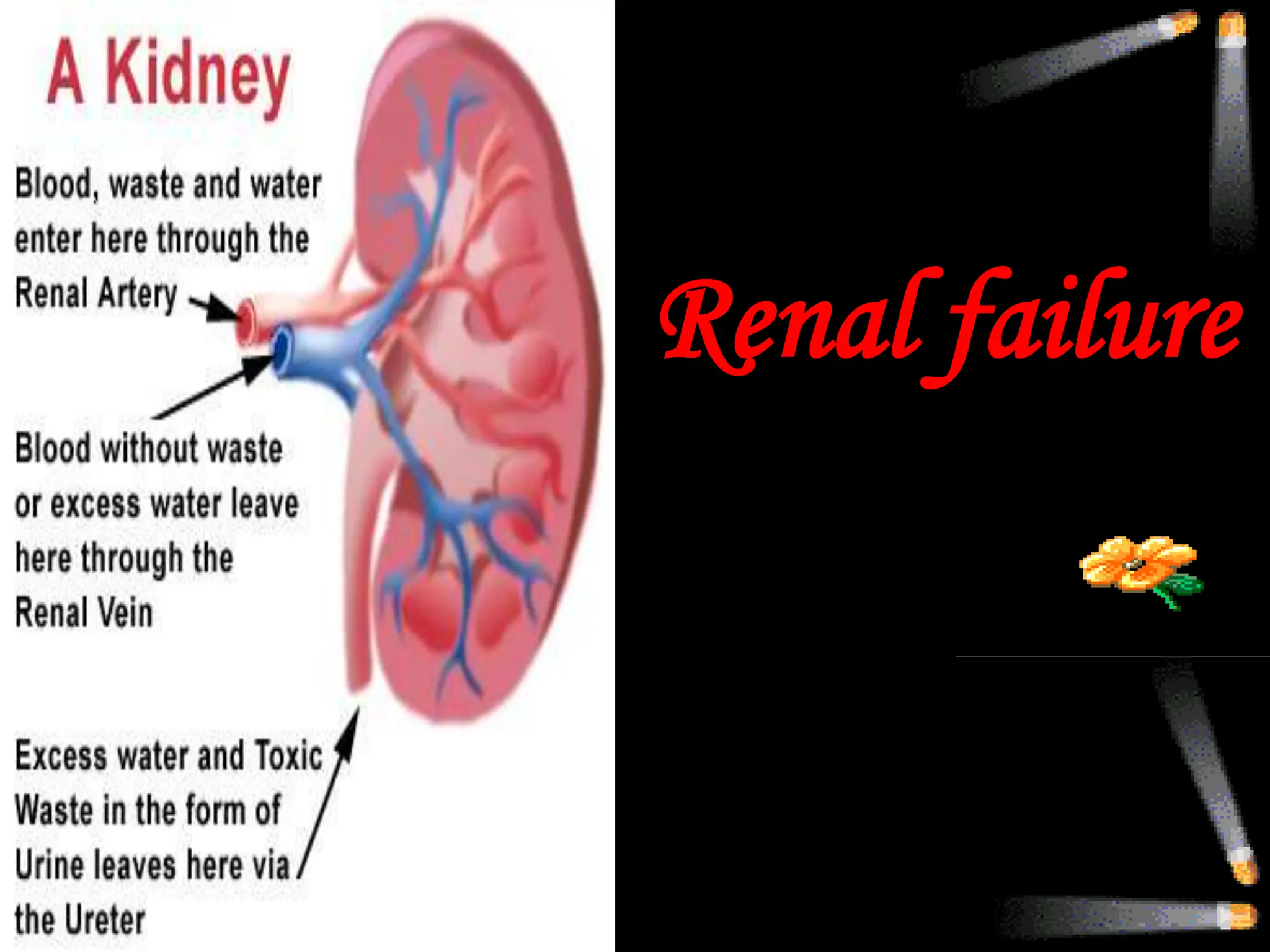
Renal failure
Introduction
 Renal failure results when the kidneys cannot remove the body’s
metabolic wastes or perform their regulatory functions.
There are two main types of renal failure
 Acute renal failure
 Chronic renal failure
1- acute renal failure
Acute renal failure (ARF) is a sudden and almost complete loss of kidney
function (decreased GFR) over a period of hours to days.
Causes of acute renal failure
• 1- Prerenal Failure
 Volume depletion resulting from
 Impaired cardiac efficiency.
 Vasodilatation
• 2. Intrarenal Failure
 Prolonged renal ischemia
 Nephrotoxic agents
 Infectious process
• 3. Postrenal Failure
• Urinary tract obstruction,
phases and clinical manifestations:
• The initiation period
– begins with the initial insult and ends with oliguria.
• The oliguria period
– Urine out put less than 400ml/ 24 hours
– Elevated serum concentration of urea, creatinine, uric acid.
– uremic symptoms
– hyperkalemia develop.
• the diuresis period.
– glomerular filtration has started to recover.
– Laboratory values stop rising.
• The recovery period
– Signals the improvement of renal function and may take 3 to 12 months.
Assessment and Diagnostic Findings
 Assessment and Diagnostic Findings
o hematuria , low urine specific gravity)
o Increase BUN and creatinine level (AZOTEMIA)
o Hyperkalemia
o Metabolic acidosis
o Elevated serum phosphate level
o Anemia
Preventionof acuterenal failure
• Provide adequate hydration to patients at risk for dehydration.
• Prevent and treat shock promptly with blood and fluid replacement.
• Monitor central venous and arterial pressures and hourly urine output of
critically ill patients to detect the onset of renal failure as early as possible.
• Continually assess renal function when appropriate.
• Prevent and treat infections promptly.
• Give meticulous care to patients with indwelling catheters.
• Remove catheters as soon as possible.
• prevent toxic drug effects.
• closely all medications metabolized or excreted by the kidneys.
Medical management
 monitor for hyperkalemia and ECG changes (tall, tented, or peaked T waves).
 Hyperkalemia is treated with glucose and insulin, calcium gluconate, or dialysis.
 Fluid and other electrolyte disturbances are often treated with dialysis.
 Sorbitol to induce a Diarrhea-type effect to decrease potassium level
 Enema may be given to fasten removal of potassium from GIT.
 medication dosages must be reduced when a patient has ARF.
 Low-dose dopamine (1 to 3 g/kg) is often used to dilate the renal arteries
 If respiratory problems develop, appropriate ventilator measures must be
instituted.
 phosphate-binding agents (aluminum hydroxide)
NUTRITIONAL THERAPY
 The patient is weighed daily and can be expected to lose 0.2 to 0.5 kg. If the
patient gains or does not lose weight or develops hypertension, fluid retention
should be suspected.
 Dietary proteins are limited to about 1 g/kg during the oliguric phase.
 Caloric requirements are met with high-carbohydrate meals.
 Foods and fluids containing potassium or phosphorus (bananas, citrus fruits and
juices, coffee) are restricted.
 Potassium intake is usually restricted to 40 to 60 mEq/day, and sodium is usually
restricted to 2 g/day.
 The patient may require parenteral nutrition.
 After the diuretic phase, the patient is placed on a high-protein, high-calorie diet
and is encouraged to resume activities gradually.
Nursing management
 monitors for complications
 participates in emergency treatment of fluid and electrolyte imbalances
 assesses progress and response to treatment
 provides physical and emotional support.
 provides psychological support.
 Parenteral fluids, all oral intake, and all medications are screened carefully to
ensure that hidden sources of potassium are not consumed.
 The nurse monitors fluid status by paying careful attention to fluid intake
(intravenous medications should be administered in the smallest volume possible),
urine output, apparent edema, distention of the jugular veins, alterations in heart
sounds and breath sounds, and increasing difficulty in breathing.
 Accurate daily weights, as well as intake and output records, are essential.
Nursingmanagement (continued)
 The nurse also directs attention to reducing the patient’s metabolic rate
during the acute stage of renal failure
 Bed rest may be indicated to reduce exertion and the metabolic rate .
 Fever and infection, are prevented or treated promptly.
 Attention is given to pulmonary function, and the patient is assisted to turn,
cough, and take deep breaths frequently
 Asepsis is essential with invasive lines and catheters to minimize the risk of
infection.
 An indwelling urinary catheter is avoided whenever possible.
 meticulous skin care is important.
 Massaging bony prominences, turning the patient frequently, and bathing the
patient with cool water are often comforting and prevent skin breakdown.
Definition
 Chronic renal failure, or ESRD, is a progressive, irreversible deterioration in renal
function in which the body’s ability to maintain metabolic, fluid and electrolyte
balance fails, resulting in uremia or azotemia.
Risk factors
 Age > 60 years
 Race or ethnic background (African-American and Hispanic)
 History of exposure to chemicals/toxins
 Cigarette smoking
 Heavy metals
 Family history of chronic kidney disease
Causes of CRF
 Diabetic Nephropathy
 Vascular Disease
 Polycystic Kidney Disease
 Obstructive nephropathy
 chronic glomerular Disorders/ Glomerulonephritis
• recurring pyelonephritis (kidney infection)
• autoimmune disorders such as systemic lupus erythematosus
Stages of chronic Kidney Disease
 Stages are based on the GFR. The normal GFR is 125 ml / min/1.73 m2
Stage 1 Kidney damage with normal or increased GFR:-
 GFR ≥ 90 ml/min/1.73 m 2
Stage 2 Mild decrease in GFR.:,
 GFR = 60-89 ml/min/1.73 m 2.
Stage 3:- Moderate decrease in GFR
 GFR= 30-59 ml/min/1.73 m 2
Stage 4:- severe decrease in GFR
 GFR= 15-29 ml/min/1.73 m 2
Stage 5:- End-stage kidney disease or chronic kidney disease
 GFR < 15 ml/min/1.73 m 2
Signs and symptoms
Every body system is affected by chronic renal failure,
• Neurologic:- Weakness and fatigue; confusion; disorientation; seizures; asterixis;
burning of soles of feet; behavior changes
• Integumentary: gray-bronze skin color; pruritus; ecchymosis; thin, brittle nails.
• Cardiovascular:- Hypertension; pitting edema; engorged neck veins,
hyperkalemia; hyperlipidemia
• Pulmonary Crackles; sputum; shortness of breath; tachypnea.
• Gastrointestinal Ammonia odor to breath, metallic taste, anorexia, nausea, and
vomiting; hiccups.
• Hematologic :- Anemia; thrombocytopenia
• Reproductive :- Amenorrhea; testicular atrophy; infertility.
• Musculoskeletal:- Muscle cramps; loss of muscle strength; renal osteodystrophy.
Diagnostic tests
1- blood tests
 Increase creatinine and BUN levels increase.
 Fasting blood glucose.
 ABG to assess for acidosis
 CBC to assess anemia
 Serum calcium and serum phosphorus
2. Urine tests
 Quantitative urine microscopy and cytology performed on fresh urine.
 24h proteinuria which validates the quality of the 24-h urine sample
 Glomerular Filtration Rate.
3- renal ultrasound and bladder scan
Complications of chronic renal failure
• Hyperkalemia
• Pericarditis, pericardial effusion, and pericardial
tamponade
• Hypertension
• Anemia
• Bone disease
Medical Management
• All factors that contribute to ESRD and all factors that are reversible (eg,
obstruction) are identified and treated.
• Management is accomplished primarily with medications and diet therapy.
• dialysis usually needed to decrease the level of uremic waste products in the blood.
• Complications can be prevented or delayed by administering prescribed
antihypertensives, erythropoietin (Epogen), iron supplements, phosphate-binding
agents, and calcium supplements.
Nutritional management
• careful regulation of protein intake, fluid intake to
balance fluid losses, sodium intake to balance sodium
losses, and some restriction of potassium.
• At the same time, adequate caloric intake and vitamin
supplementation must be ensured by Adequte intake of
calories(30-35kcal/kg/d)
Nursing management
• Nursing Diagnosis: Excess fluid volume related to decreased urine output,
dietary excesses, and retention of sodium and water
• Goal: Maintenance of ideal body weight without excess fluid
• Nursing interventions
• Assess fluid status by Daily weight, Intake and output, Distention of neck veins,
Blood pressure, pulse rate, and rhythm
• Limit fluid intake to prescribed volume.
• Explain to patient and family rationale for restriction.
• Assist patient to cope with the discomforts resulting from fluid restriction.
• Provide or encourage frequent oral hygiene.
• Identify potential sources of fluid
Nursing Diagnosis: Imbalanced nutrition; less than body requirements
related to anorexia, vomiting, dietary restrictions, and altered mucous
membranes
Goal: Maintenance of adequate nutritional intake
1. Assess nutritional status: Weight changes, and Laboratory values
2. Assess patient’s nutritional dietary patterns
3. Assess for factors contributing to altered nutritional intake.
4. Provide patient’s food preferences within dietary restrictions.
5. Promote intake of high biologic value protein: eggs, dairy products, meats.
6. Encourage high-calorie, low-protein, low-sodium, and low-potassium snacks.
7. Explain rationale for dietary restrictions and relationship to kidney disease
and increased urea and creatinine levels.
8. Provide written lists of foods allowed and suggestions for improving their
taste without use of sodium or potassium.
Nursing Diagnosis: Deficient knowledge regarding condition and treatment
Goal: Increased knowledge about condition and related treatment
 Assess understanding of cause of renal failure, consequences of renal failure, and
its treatment
 Provide explanation at patient’s level of understanding.
 Assist patient to identify ways to deal with treatment effects into lifestyle.
 Provide oral and written information as appropriate about: Renal function and
failure, Fluid and dietary restrictions, Follow-up schedule and treatment options
Nursing Diagnosis: Activity intolerance related to fatigue, anemia, retention of
waste products, and dialysis procedure
Goal: Participation in activity within tolerance
 Assess factors contributing to fatigue: anemia or Fluid and electrolyte imbalances
 Promote independence in self-care activities as tolerated; assist if fatigued.
 Encourage alternating activity with rest.
 Encourage patient to rest after dialysis treatments.
Nursing Diagnosis: Disturbed self-esteem related to dependency, role changes,
change in body image, and change in sexual function
Goal: Improved self-concept
 Assess patient’s and family’s responses and reactions to illness and treatment.
 Assess relationship of patient and significant family members.
 Assess usual coping patterns of patient and family members.
5-part 1-acute and chronic renal failure.ppt

5-part 1-acute and chronic renal failure.ppt

  • 1.
  • 2.
    Introduction  Renal failureresults when the kidneys cannot remove the body’s metabolic wastes or perform their regulatory functions. There are two main types of renal failure  Acute renal failure  Chronic renal failure 1- acute renal failure Acute renal failure (ARF) is a sudden and almost complete loss of kidney function (decreased GFR) over a period of hours to days.
  • 3.
    Causes of acuterenal failure • 1- Prerenal Failure  Volume depletion resulting from  Impaired cardiac efficiency.  Vasodilatation • 2. Intrarenal Failure  Prolonged renal ischemia  Nephrotoxic agents  Infectious process • 3. Postrenal Failure • Urinary tract obstruction,
  • 4.
    phases and clinicalmanifestations: • The initiation period – begins with the initial insult and ends with oliguria. • The oliguria period – Urine out put less than 400ml/ 24 hours – Elevated serum concentration of urea, creatinine, uric acid. – uremic symptoms – hyperkalemia develop. • the diuresis period. – glomerular filtration has started to recover. – Laboratory values stop rising. • The recovery period – Signals the improvement of renal function and may take 3 to 12 months.
  • 5.
    Assessment and DiagnosticFindings  Assessment and Diagnostic Findings o hematuria , low urine specific gravity) o Increase BUN and creatinine level (AZOTEMIA) o Hyperkalemia o Metabolic acidosis o Elevated serum phosphate level o Anemia
  • 6.
    Preventionof acuterenal failure •Provide adequate hydration to patients at risk for dehydration. • Prevent and treat shock promptly with blood and fluid replacement. • Monitor central venous and arterial pressures and hourly urine output of critically ill patients to detect the onset of renal failure as early as possible. • Continually assess renal function when appropriate. • Prevent and treat infections promptly. • Give meticulous care to patients with indwelling catheters. • Remove catheters as soon as possible. • prevent toxic drug effects. • closely all medications metabolized or excreted by the kidneys.
  • 7.
    Medical management  monitorfor hyperkalemia and ECG changes (tall, tented, or peaked T waves).  Hyperkalemia is treated with glucose and insulin, calcium gluconate, or dialysis.  Fluid and other electrolyte disturbances are often treated with dialysis.  Sorbitol to induce a Diarrhea-type effect to decrease potassium level  Enema may be given to fasten removal of potassium from GIT.  medication dosages must be reduced when a patient has ARF.  Low-dose dopamine (1 to 3 g/kg) is often used to dilate the renal arteries  If respiratory problems develop, appropriate ventilator measures must be instituted.  phosphate-binding agents (aluminum hydroxide)
  • 8.
    NUTRITIONAL THERAPY  Thepatient is weighed daily and can be expected to lose 0.2 to 0.5 kg. If the patient gains or does not lose weight or develops hypertension, fluid retention should be suspected.  Dietary proteins are limited to about 1 g/kg during the oliguric phase.  Caloric requirements are met with high-carbohydrate meals.  Foods and fluids containing potassium or phosphorus (bananas, citrus fruits and juices, coffee) are restricted.  Potassium intake is usually restricted to 40 to 60 mEq/day, and sodium is usually restricted to 2 g/day.  The patient may require parenteral nutrition.  After the diuretic phase, the patient is placed on a high-protein, high-calorie diet and is encouraged to resume activities gradually.
  • 9.
    Nursing management  monitorsfor complications  participates in emergency treatment of fluid and electrolyte imbalances  assesses progress and response to treatment  provides physical and emotional support.  provides psychological support.  Parenteral fluids, all oral intake, and all medications are screened carefully to ensure that hidden sources of potassium are not consumed.  The nurse monitors fluid status by paying careful attention to fluid intake (intravenous medications should be administered in the smallest volume possible), urine output, apparent edema, distention of the jugular veins, alterations in heart sounds and breath sounds, and increasing difficulty in breathing.  Accurate daily weights, as well as intake and output records, are essential.
  • 10.
    Nursingmanagement (continued)  Thenurse also directs attention to reducing the patient’s metabolic rate during the acute stage of renal failure  Bed rest may be indicated to reduce exertion and the metabolic rate .  Fever and infection, are prevented or treated promptly.  Attention is given to pulmonary function, and the patient is assisted to turn, cough, and take deep breaths frequently  Asepsis is essential with invasive lines and catheters to minimize the risk of infection.  An indwelling urinary catheter is avoided whenever possible.  meticulous skin care is important.  Massaging bony prominences, turning the patient frequently, and bathing the patient with cool water are often comforting and prevent skin breakdown.
  • 12.
    Definition  Chronic renalfailure, or ESRD, is a progressive, irreversible deterioration in renal function in which the body’s ability to maintain metabolic, fluid and electrolyte balance fails, resulting in uremia or azotemia. Risk factors  Age > 60 years  Race or ethnic background (African-American and Hispanic)  History of exposure to chemicals/toxins  Cigarette smoking  Heavy metals  Family history of chronic kidney disease
  • 13.
    Causes of CRF Diabetic Nephropathy  Vascular Disease  Polycystic Kidney Disease  Obstructive nephropathy  chronic glomerular Disorders/ Glomerulonephritis • recurring pyelonephritis (kidney infection) • autoimmune disorders such as systemic lupus erythematosus
  • 14.
    Stages of chronicKidney Disease  Stages are based on the GFR. The normal GFR is 125 ml / min/1.73 m2 Stage 1 Kidney damage with normal or increased GFR:-  GFR ≥ 90 ml/min/1.73 m 2 Stage 2 Mild decrease in GFR.:,  GFR = 60-89 ml/min/1.73 m 2. Stage 3:- Moderate decrease in GFR  GFR= 30-59 ml/min/1.73 m 2 Stage 4:- severe decrease in GFR  GFR= 15-29 ml/min/1.73 m 2 Stage 5:- End-stage kidney disease or chronic kidney disease  GFR < 15 ml/min/1.73 m 2
  • 15.
    Signs and symptoms Everybody system is affected by chronic renal failure, • Neurologic:- Weakness and fatigue; confusion; disorientation; seizures; asterixis; burning of soles of feet; behavior changes • Integumentary: gray-bronze skin color; pruritus; ecchymosis; thin, brittle nails. • Cardiovascular:- Hypertension; pitting edema; engorged neck veins, hyperkalemia; hyperlipidemia • Pulmonary Crackles; sputum; shortness of breath; tachypnea. • Gastrointestinal Ammonia odor to breath, metallic taste, anorexia, nausea, and vomiting; hiccups. • Hematologic :- Anemia; thrombocytopenia • Reproductive :- Amenorrhea; testicular atrophy; infertility. • Musculoskeletal:- Muscle cramps; loss of muscle strength; renal osteodystrophy.
  • 17.
    Diagnostic tests 1- bloodtests  Increase creatinine and BUN levels increase.  Fasting blood glucose.  ABG to assess for acidosis  CBC to assess anemia  Serum calcium and serum phosphorus 2. Urine tests  Quantitative urine microscopy and cytology performed on fresh urine.  24h proteinuria which validates the quality of the 24-h urine sample  Glomerular Filtration Rate. 3- renal ultrasound and bladder scan
  • 18.
    Complications of chronicrenal failure • Hyperkalemia • Pericarditis, pericardial effusion, and pericardial tamponade • Hypertension • Anemia • Bone disease
  • 19.
    Medical Management • Allfactors that contribute to ESRD and all factors that are reversible (eg, obstruction) are identified and treated. • Management is accomplished primarily with medications and diet therapy. • dialysis usually needed to decrease the level of uremic waste products in the blood. • Complications can be prevented or delayed by administering prescribed antihypertensives, erythropoietin (Epogen), iron supplements, phosphate-binding agents, and calcium supplements.
  • 20.
    Nutritional management • carefulregulation of protein intake, fluid intake to balance fluid losses, sodium intake to balance sodium losses, and some restriction of potassium. • At the same time, adequate caloric intake and vitamin supplementation must be ensured by Adequte intake of calories(30-35kcal/kg/d)
  • 21.
    Nursing management • NursingDiagnosis: Excess fluid volume related to decreased urine output, dietary excesses, and retention of sodium and water • Goal: Maintenance of ideal body weight without excess fluid • Nursing interventions • Assess fluid status by Daily weight, Intake and output, Distention of neck veins, Blood pressure, pulse rate, and rhythm • Limit fluid intake to prescribed volume. • Explain to patient and family rationale for restriction. • Assist patient to cope with the discomforts resulting from fluid restriction. • Provide or encourage frequent oral hygiene. • Identify potential sources of fluid
  • 22.
    Nursing Diagnosis: Imbalancednutrition; less than body requirements related to anorexia, vomiting, dietary restrictions, and altered mucous membranes Goal: Maintenance of adequate nutritional intake 1. Assess nutritional status: Weight changes, and Laboratory values 2. Assess patient’s nutritional dietary patterns 3. Assess for factors contributing to altered nutritional intake. 4. Provide patient’s food preferences within dietary restrictions. 5. Promote intake of high biologic value protein: eggs, dairy products, meats. 6. Encourage high-calorie, low-protein, low-sodium, and low-potassium snacks. 7. Explain rationale for dietary restrictions and relationship to kidney disease and increased urea and creatinine levels. 8. Provide written lists of foods allowed and suggestions for improving their taste without use of sodium or potassium.
  • 23.
    Nursing Diagnosis: Deficientknowledge regarding condition and treatment Goal: Increased knowledge about condition and related treatment  Assess understanding of cause of renal failure, consequences of renal failure, and its treatment  Provide explanation at patient’s level of understanding.  Assist patient to identify ways to deal with treatment effects into lifestyle.  Provide oral and written information as appropriate about: Renal function and failure, Fluid and dietary restrictions, Follow-up schedule and treatment options
  • 24.
    Nursing Diagnosis: Activityintolerance related to fatigue, anemia, retention of waste products, and dialysis procedure Goal: Participation in activity within tolerance  Assess factors contributing to fatigue: anemia or Fluid and electrolyte imbalances  Promote independence in self-care activities as tolerated; assist if fatigued.  Encourage alternating activity with rest.  Encourage patient to rest after dialysis treatments. Nursing Diagnosis: Disturbed self-esteem related to dependency, role changes, change in body image, and change in sexual function Goal: Improved self-concept  Assess patient’s and family’s responses and reactions to illness and treatment.  Assess relationship of patient and significant family members.  Assess usual coping patterns of patient and family members.