Understanding Rabies Disease and
Prevention
Dr (Lt Col) Ashutosh Ojha
151 Army Base Hospital,India
ashutosh8116@gmail.com

1
Section 1
Rabies disease background
3

Benenson 1995
M

al
a

ria

ox

ru
s
al
lp

ta
vi

gu
e

er

le
ra

No treatment

Sm

Ha
n

D
en

e

tis

fe
v

Ch
o

gi

ag
u

en
in

Pl

ax

ie
s

an
th
r

Ra
b

lo
w

.m

ic

Ye
l

M

on

at
io
n

um

ha
l

Pn
e

In

Case fatality rate

Rabies is virtually 100% fatal
Treatment

100
90
80
70
60
50
40
30
20
10
0
Rabies
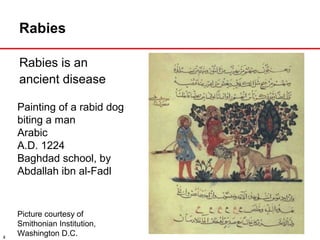
Rabies is an
ancient disease
Painting of a rabid dog
biting a man
Arabic
A.D. 1224
Baghdad school, by
Abdallah ibn al-Fadl

4

Picture courtesy of
Smithonian Institution,
Washington D.C.
The rabies virus
Taxonomy:
Family: Rhabdoviridae
Genus: Lyssavirus
Species: Rabies virus
bullet-shaped,
~180 nm long and
~75 nm wide
single-strand,
negative sense
RNA
5

CDC 2007; Bleck 2005
Pathogenesis: Exposure
Bite transmission
Human infection by rabies virus usually occurs as a
result of a transdermal bite from an infected wild or
domestic animal

Non-bite transmission
Scratches from a rabid animal
Saliva from a rabid animal comes into contact with a
victim’s mucous membranes or fresh skin lesions
Rare cases have been reported via:
Inhalation of virus-containing aerosols
Human-to-human transmission through
transplantation
6

1. Bleck 2005; 2. WHO 2004
How does the Rabies virus travel from wound
to brain
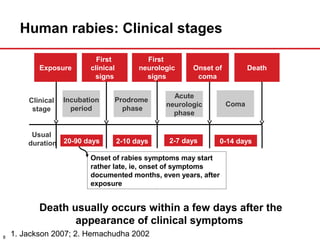
Human rabies: Clinical stages
Exposure

First
clinical
signs

First
neurologic
signs

Onset of
coma

Death

Incubation
period

Prodrome
phase

Acute
neurologic
phase

Coma

Usual
duration 20-90 days

2-10 days

2-7 days

0-14 days

Clinical
stage

Onset of rabies symptoms may start
rather late, ie, onset of symptoms
documented months, even years, after
exposure

Death usually occurs within a few days after the
appearance of clinical symptoms
8

1. Jackson 2007; 2. Hemachudha 2002
Clinical rabies in humans
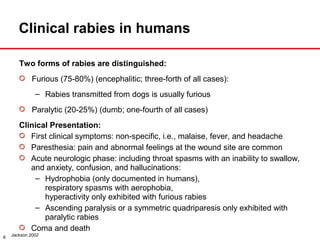
Two forms of rabies are distinguished:
Furious (75-80%) (encephalitic; three-forth of all cases):
– Rabies transmitted from dogs is usually furious
Paralytic (20-25%) (dumb; one-fourth of all cases)
Clinical Presentation:
First clinical symptoms: non-specific, i.e., malaise, fever, and headache
Paresthesia: pain and abnormal feelings at the wound site are common
Acute neurologic phase: including throat spasms with an inability to swallow,
and anxiety, confusion, and hallucinations:
– Hydrophobia (only documented in humans),
respiratory spasms with aerophobia,
hyperactivity only exhibited with furious rabies
– Ascending paralysis or a symmetric quadriparesis only exhibited with
paralytic rabies
Coma and death
9

Jackson 2002
Rabies in children
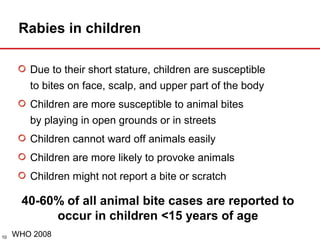
Due to their short stature, children are susceptible
to bites on face, scalp, and upper part of the body
Children are more susceptible to animal bites
by playing in open grounds or in streets
Children cannot ward off animals easily
Children are more likely to provoke animals
Children might not report a bite or scratch

40-60% of all animal bite cases are reported to
occur in children <15 years of age
10

WHO 2008
Section 2
Epidemiology of rabies
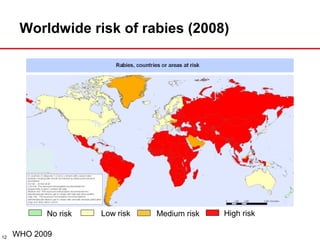
Worldwide risk of rabies (2008)

No risk
12

WHO 2009

Low risk

Medium risk

High risk
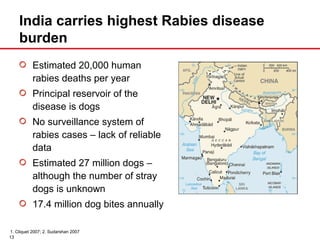
India carries highest Rabies disease
burden
Estimated 20,000 human
rabies deaths per year
Principal reservoir of the
disease is dogs
No surveillance system of
rabies cases – lack of reliable
data
Estimated 27 million dogs –
although the number of stray
dogs is unknown
17.4 million dog bites annually
1. Cliquet 2007; 2. Sudarshan 2007
13
Rabies vaccines
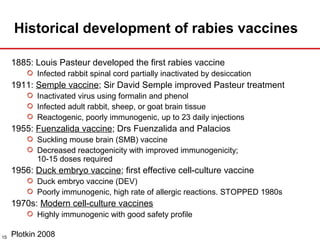
Historical development of rabies vaccines
1885: Louis Pasteur developed the first rabies vaccine
Infected rabbit spinal cord partially inactivated by desiccation

1911: Semple vaccine; Sir David Semple improved Pasteur treatment
Inactivated virus using formalin and phenol
Infected adult rabbit, sheep, or goat brain tissue
Reactogenic, poorly immunogenic, up to 23 daily injections

1955: Fuenzalida vaccine; Drs Fuenzalida and Palacios
Suckling mouse brain (SMB) vaccine
Decreased reactogenicity with improved immunogenicity;
10-15 doses required

1956: Duck embryo vaccine; first effective cell-culture vaccine
Duck embryo vaccine (DEV)
Poorly immunogenic, high rate of allergic reactions. STOPPED 1980s

1970s: Modern cell-culture vaccines
Highly immunogenic with good safety profile
15

Plotkin 2008
Currently produced rabies vaccines I
Human diploid cell vaccines
(HDCV):
First-generation cell-culture
rabies vaccine
Virus grown on human
diploid cells, Pitman-Moore
strain
Good immunogenicity and
tolerability (hypersensitivity
reactions are however
reported with the unpurified
HDCV)2
Suitable for pre-exposure
vaccination and post-exposure
prophylaxis
†

Purified Vero cell rabies
vaccines (PVRV):
Second-generation cell-culture
rabies vaccine
Continuous cell line produced
on Vero cells (vervet monkey
origin), virus grown in microcarrier
system
Good immunogenicity and
tolerability
Clinical trials not permitted in the
US; no FDA approval due to risk
of residual DNA associated with
continuous cell line

Intradermal administration is currently licensed in India, the Philippines, Sri Lanka, Thailand, and Vietnam;

regulatory approval will continue to be adapted for other countries

16

1. Plotkin 2008; 2. CDC 1988
Currently produced rabies vaccines II
Purified chick embryo cell-culture vaccine (PCECV):
Second-generation cell-culture rabies vaccine
Prepared in primary chick embryo cells using Flury LEP
strain of fixed rabies virus
Good immunogenicity and tolerability
High purity and potency
Approved by the US FDA (intramuscular regimen only)
Recommended for each and every established WHO
vaccination schedule where intradermal administration
is licensed†
Intradermal administration is currently licensed in India, Myanmar
the Philippines, Sri Lanka, Thailand, and Vietnam;
regulatory approval will continue to be adapted for other countries
†

17

Plotkin 2008
WHO categories (I-III): Schedules for
post-exposure prophylaxis
Type of contact with a suspect or confirmed
rabid domestic or wilda animal, or animal
unavailable for testing

Type of
exposure

Recommended post-exposure prophylaxis

I

Touching or feeding animals, licks on
intact skin (ie, no exposure)

None

No prophylaxis is required

II

Nibbling of uncovered skin, minor
scratches or abrasions without bleeding

Minor

Administer vaccine immediately

III

Single or multiple transdermal bites or
scratches, licks on broken skin,
contamination of mucous membrane with
saliva from licks, exposures to bats

Severe

Administer rabies immunoglobulin and vaccine
immediately.

Category

18

1. WHO 2004; 2. CDC/ACIP 2008
Post-exposure prophylaxis
Wound treatment (all WHO categories)
Vaccine administration (WHO category II and III)
– Active immunization with highly immunogenic
rabies vaccine
RIG administration, if appropriate (WHO category III)
– Passive immunization followed by administration of
specific antibodies

19
Prevention of human rabies
The 5 Important Things

Magico-Religious Practices
(e.g. witchcraft, turmeric
powder etc.) DO NOT
HELP

Do not cover or Suture
the wound

Wash the wound
thoroughly with plenty of
water and soap

Apply an antiseptic
(povidone iodine) or even
alcohol

Vaccinate Immediately
e.g. Raibipur 1 mL IM
Rabies immunoglobulin (RIG)
RIG needs to be administered to all Category III wounds
along with complete course of ARV, 5 doses
(0,3,7,14,&,28 days) for 1st exposure
Subsequent exposure will require only 2 doses of ARV (0
& 3 days) and no RIG’s
RIG infiltrated in and around wounds
Two types of RIG
–
–

Human RIG,
dose 20 IU/kg of body weight
Equine RIG,
dose 40 IU/kg of body weight

RIG provides passive immunity
–
–

21

Immediate access to rabies virus-neutralizing
antibodies (RVNA)
Provides protection until active immunity begins
(7-10 days post-vaccination)

Courtesy Medi-Vision and
B. Quiambao, RITM, Manila
Prevention of human rabies
Vaccine administration
Post-exposure prophylaxis IM regimens:
– Essen regimen: 5 doses, 5 patient visits (DCGI
approved regimen)
– Zagreb regimen: 4 doses, 3 patient visits

Post-exposure prophylaxis ID regimens:
– Updated Thai Red Cross: 8 doses, 4 patient visits
(DCGI approved regimen)
– Thai Red Cross: 8 doses, 5 patient visits
– Oxford 8-site: 14 doses, 4 patient visits
22

1. WHO 2004; 2. WHO 2007

National Guidelines for Rabies Prophylaxis and Intra-dermal Administration of Cell Culture
Rabies Vaccines, 2007
Post-exposure prophylaxis IM administration:
Essen regimen
One IM dose of vaccine on Days 0, 3, 7, 14, and 28
1 mL (IM) into
deltoid (adults)
or into
anterolateral
area of thigh
(children)

5 doses – 5 visits
RIG is always recommended for transdermal wounds
23

1. WHO 2004; 2. WHO 2007
Post-exposure prophylaxis IM administration:
Updated Thai Red Cross (2-2-2-0-2)
Days 0, 3, 7, and 28 – two 0.1 mL doses
0.1 mL per site

Administered in right
and left deltoid

8 doses – 4 visits
RIG is always recommended for transdermal wounds
24

1. WHO 2004; 2. WHO 2007
DCGI recommended post-exposure
IM and ID regimens: Summary
Regimen

Day 0

Day 3

Day 7

Day 14

Day 21

Day 28

Day 90

Vials

Visits

Essen

1.0 mL

1.0 mL

1.0 mL

1.0 mL

–

1.0 mL

–

5

5

Day 0

Day 3

Day 7

Day 14

Day 21

Day 28

Day 90

mL

Visits

Thai Red
2x
2x
Cross
0.1 mL 0.1 mL
(updated)

2x
0.1 mL

–

–

2x
0.1 mL

–

<1

4

Regimen

National Guidelines for Rabies Prophylaxis and Intra-dermal Administration of Cell Culture Rabies Vaccines, 2007
25
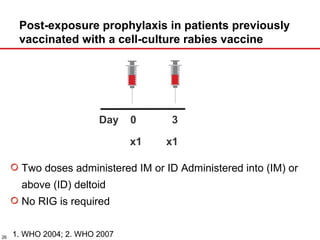
Post-exposure prophylaxis in patients previously
vaccinated with a cell-culture rabies vaccine

Day

0

3

x1

x1

Two doses administered IM or ID Administered into (IM) or
above (ID) deltoid
No RIG is required

26

1. WHO 2004; 2. WHO 2007
National Guidelines for Rabies Prophylaxis and
Intra-dermal Administration of Cell Culture Rabies Vaccines
Intra-muscular (IM) Regimen
The currently available vaccines and regimen in India for post exposure
IM administration are described below.
Vaccines
1. Cell Culture Vaccines
 Human Diploid Cell Vaccine (HDCV)
 Purified Chick Embryo Cell Vaccine (PCEC)
 Purified Vero Cell Rabies Vaccine (PVRV)
2. Purified Duck Embryo Vaccine
Regimen
Essen Schedule: Five dose intramuscular regimen on days 0, 3, 7, 14
and 28.
National Guidelines for Rabies Prophylaxis and Intra-dermal Administration of Cell Culture Rabies Vaccines, 2007
National Guidelines for Rabies Prophylaxis and Intradermal Administration of Cell Culture Rabies Vaccines
Intra-dermal (ID) Regimens
General guidelines for use of IDRV
 Vaccines to be applied by intra-dermal route of administration should be approved by
DCGI.
 The vaccine package leaflet should include a statement indicating that the potency as well
as immunogenicity and safety allow safe use of vaccine by ID pre- and post-exposure.
 Post Marketing Surveillance (PMS) data should be maintained for minimum of two years by
vaccine manufacturers on a pre-designed and approved protocol.
 Intra-dermal injections must be administered by staff trained in this technique.
 Vaccine vials must be stored at 2º to 8ºC after reconstitution.
 The total content of reconstitute vial should be used as soon as possible, within 8 hours.
 Rabies vaccines formulated with an adjuvant should not be administered intra-dermally.
 Vaccine when given intra-dermally should raise a visible and palpable bleb in the skin.
 In the event that the dose is inadvertently given subcutaneously or intra-muscularly or in
the event of spillage, a new dose should be given intradermally in near by site.
 Animal bite victims on chloroquine therapy (anti-malarial therapy) should be given ARV by
intramuscular route.
National Guidelines for Rabies Prophylaxis and Intra-dermal Administration of Cell Culture Rabies Vaccines, 2007
National Guidelines for Rabies Prophylaxis and Intradermal Administration of Cell Culture Rabies Vaccines
DCGI approved ARV for use by intra-dermal route.
•
•
•
•

PVRV – Verorab, Aventis Pasteur (Sanofi Pasteur) India Pvt. Ltd.
PCECV – Rabipur, Chiron Behring Vaccines Pvt. Ltd.
PVRV – Pasteur Institute of India, Coonoor
PVRV – Abhayrab, Human Biologicals Institute.

Regimen
Updated Thai Red Cross Schedule (2-2-2-0-2).
This involves injection of 0.1ml of reconstituted vaccine per ID site and on two
such ID sites per visit (one on each deltoid area, an inch above the insertion
of deltoid muscle) on days 0, 3, 7 and 28
(Note: A DCGI order dated 9th August 2006, has revised the eligibility criteria for intradermal
administration of tissue culture rabies vaccines at anti- rabies clinics (ARC) in India from those
with a minimum attendance of 50 patients per day to those with a minimum of 10 patients per
day) National Guidelines for Rabies Prophylaxis and Intra-dermal Administration of Cell Culture Rabies Vaccines, 2007
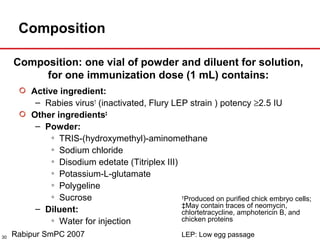
Composition
Composition: one vial of powder and diluent for solution,
for one immunization dose (1 mL) contains:
Active ingredient:
– Rabies virus† (inactivated, Flury LEP strain ) potency ≥2.5 IU
Other ingredients‡
– Powder:
◦ TRIS-(hydroxymethyl)-aminomethane
◦ Sodium chloride
◦ Disodium edetate (Titriplex III)
◦ Potassium-L-glutamate
◦ Polygeline
†
◦ Sucrose
Produced on purified chick embryo cells;
‡May contain traces of neomycin,
– Diluent:
chlortetracycline, amphotericin B, and
chicken proteins
◦ Water for injection
30

Rabipur SmPC 2007

LEP: Low egg passage
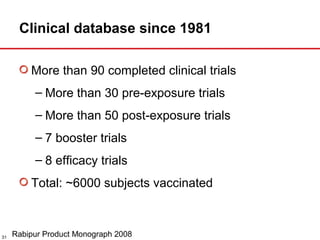
Clinical database since 1981
More than 90 completed clinical trials
– More than 30 pre-exposure trials
– More than 50 post-exposure trials
– 7 booster trials
– 8 efficacy trials
Total: ~6000 subjects vaccinated

31

Rabipur Product Monograph 2008
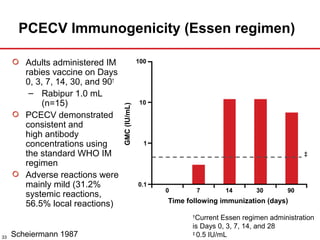
PCECV Immunogenicity (Essen regimen)
100

GMC (IU/mL)

Adults administered IM
rabies vaccine on Days
0, 3, 7, 14, 30, and 90†
– Rabipur 1.0 mL
(n=15)
PCECV demonstrated
consistent and
high antibody
concentrations using
the standard WHO IM
regimen
Adverse reactions were
mainly mild (31.2%
systemic reactions,
56.5% local reactions)

10

1
‡

0.1

0

7

Scheiermann 1987

30

90

Time following immunization (days)
Current Essen regimen administration
is Days 0, 3, 7, 14, and 28
‡
0.5 IU/mL
†

33

14
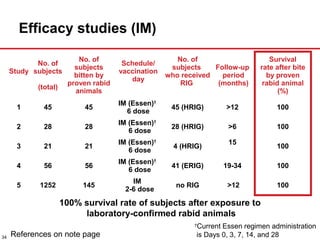
Efficacy studies (IM)
No. of
Study subjects
(total)

No. of
subjects
bitten by
proven rabid
animals

Schedule/
vaccination
day

No. of
subjects
Follow-up
who received
period
RIG
(months)

Survival
rate after bite
by proven
rabid animal
(%)

1

45

45

IM (Essen)†
6 dose

45 (HRIG)

>12

100

2

28

28

IM (Essen)†
6 dose

28 (HRIG)

>6

100

3

21

21

IM (Essen)†
6 dose

4 (HRIG)

4

56

56

IM (Essen)†
6 dose

41 (ERIG)

19-34

100

5

1252

145

IM
2-6 dose

no RIG

>12

100

15

100

100% survival rate of subjects after exposure to
laboratory-confirmed rabid animals
Current Essen regimen administration
is Days 0, 3, 7, 14, and 28

†

34

References on note page
Immunogenicity following the Thai Red
Cross ID regimen

36

Briggs 2000

100

GMC (IU/mL)

Adults who had
received WHO
Category II and III
wounds administered
ID rabies vaccine on
Days 0, 3, and 7 (two
sites) and Days 30 and
90 (one site)
– PCECV 0.1 mL
– PVRV 0.1 mL
Rabipur is welltolerated and
immunogenic when
following the Thai Red
Cross ID regimen

PCECV

PVRV

10

1
†

0.1

0

7

14

30

90

Time following immunization (days)

†

0.5 IU/mL
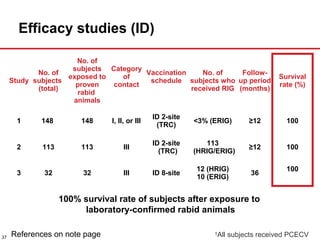
Efficacy studies (ID)
No. of
subjects Category
No. of
Vaccination
No. of
Followexposed to
of
Study subjects
schedule subjects who up period
proven
contact
(total)
received RIG (months)
rabid
animals

Survival
rate (%)

1

148

148

I, II, or III

ID 2-site
(TRC)

<3% (ERIG)

≥12

100

2

113

113

III

ID 2-site
(TRC)

113
(HRIG/ERIG)

≥12

100

3

32

32

III

ID 8-site

12 (HRIG)
10 (ERIG)

36

100

100% survival rate of subjects after exposure to
laboratory-confirmed rabid animals
37

References on note page

†

All subjects received PCECV
Post-marketing Surveillance Study

38

Sehgal 1995

10
Subjects reporting adverse events (%)

In a post-marketing
surveillance study
(n=1252) with PCECV
– 4.0% reported
adverse events, all
were mild-tomoderate
Occurred mainly after
Dose 1 or 2 but
resolved spontaneously
within 48 hours
Mild fever was the most
common systemic
adverse event,
reported by 0.5% of
individuals

8

6

4
2.1%
1.1%

2

0

Injection-site pain

Injection-site
induration
Section 6
Summary
Summary - I
Rabies is a viral zoonosis that is transmitted from animals to
humans
– Human infection usually occurs as a result of a transdermal bite
or scratch from an infected animal
Dogs are the principal vector causing transmission of rabies to
humans in Africa, Asia, and parts of Latin America
There are no immediate clinical symptoms following exposure to
rabies virus
Rabies is almost invariably fatal following the onset of clinical
symptoms
Rabies is present throughout the world and >3 billion people are at
risk of infection in >100 countries
– The WHO estimates that the annual number of human rabies
deaths worldwide is ~55,000, and most occur in Asia and Africa

40
Summary - II
There are two active immunization strategies available to prevent
rabies in humans:
– Pre-exposure vaccination protects against potential exposure
to rabies particularly vulnerable children, individuals who live in
or travel to high-risk areas or work in high-risk occupations
– Post-exposure prophylaxis (PEP) is administered following
contact with a suspected or confirmed rabid animal. The WHO
and CDC provide guidelines for both strategies
PCECV is a purified chick embryo cell-culture rabies vaccine which
provides active immunization and protection
Approved by the US FDA (intramuscular regimen only)
Recommended for each and every established WHO vaccination
schedule where intradermal vaccination licensed†
Intradermal administration is currently licensed in India,
Myanmar, the Philippines, Sri Lanka, Thailand, and Vietnam;
regulatory approval will continue to be adapted for other countries
†

41
Summary - III
PCECV has been available for post-exposure and preexposure prophylaxis since 1984
The immunogenicity, efficacy, and safety profiles of
PCECV are well established and have been evaluated
in >90 clinical trials worldwide

42

Rabies prevention

  • 1.
    Understanding Rabies Diseaseand Prevention Dr (Lt Col) Ashutosh Ojha 151 Army Base Hospital,India ashutosh8116@gmail.com 1
  • 2.
  • 3.
  • 4.
    Rabies Rabies is an ancientdisease Painting of a rabid dog biting a man Arabic A.D. 1224 Baghdad school, by Abdallah ibn al-Fadl 4 Picture courtesy of Smithonian Institution, Washington D.C.
  • 5.
    The rabies virus Taxonomy: Family:Rhabdoviridae Genus: Lyssavirus Species: Rabies virus bullet-shaped, ~180 nm long and ~75 nm wide single-strand, negative sense RNA 5 CDC 2007; Bleck 2005
  • 6.
    Pathogenesis: Exposure Bite transmission Humaninfection by rabies virus usually occurs as a result of a transdermal bite from an infected wild or domestic animal Non-bite transmission Scratches from a rabid animal Saliva from a rabid animal comes into contact with a victim’s mucous membranes or fresh skin lesions Rare cases have been reported via: Inhalation of virus-containing aerosols Human-to-human transmission through transplantation 6 1. Bleck 2005; 2. WHO 2004
  • 7.
    How does theRabies virus travel from wound to brain
  • 8.
    Human rabies: Clinicalstages Exposure First clinical signs First neurologic signs Onset of coma Death Incubation period Prodrome phase Acute neurologic phase Coma Usual duration 20-90 days 2-10 days 2-7 days 0-14 days Clinical stage Onset of rabies symptoms may start rather late, ie, onset of symptoms documented months, even years, after exposure Death usually occurs within a few days after the appearance of clinical symptoms 8 1. Jackson 2007; 2. Hemachudha 2002
  • 9.
    Clinical rabies inhumans Two forms of rabies are distinguished: Furious (75-80%) (encephalitic; three-forth of all cases): – Rabies transmitted from dogs is usually furious Paralytic (20-25%) (dumb; one-fourth of all cases) Clinical Presentation: First clinical symptoms: non-specific, i.e., malaise, fever, and headache Paresthesia: pain and abnormal feelings at the wound site are common Acute neurologic phase: including throat spasms with an inability to swallow, and anxiety, confusion, and hallucinations: – Hydrophobia (only documented in humans), respiratory spasms with aerophobia, hyperactivity only exhibited with furious rabies – Ascending paralysis or a symmetric quadriparesis only exhibited with paralytic rabies Coma and death 9 Jackson 2002
  • 10.
    Rabies in children Dueto their short stature, children are susceptible to bites on face, scalp, and upper part of the body Children are more susceptible to animal bites by playing in open grounds or in streets Children cannot ward off animals easily Children are more likely to provoke animals Children might not report a bite or scratch 40-60% of all animal bite cases are reported to occur in children <15 years of age 10 WHO 2008
  • 11.
  • 12.
    Worldwide risk ofrabies (2008) No risk 12 WHO 2009 Low risk Medium risk High risk
  • 13.
    India carries highestRabies disease burden Estimated 20,000 human rabies deaths per year Principal reservoir of the disease is dogs No surveillance system of rabies cases – lack of reliable data Estimated 27 million dogs – although the number of stray dogs is unknown 17.4 million dog bites annually 1. Cliquet 2007; 2. Sudarshan 2007 13
  • 14.
  • 15.
    Historical development ofrabies vaccines 1885: Louis Pasteur developed the first rabies vaccine Infected rabbit spinal cord partially inactivated by desiccation 1911: Semple vaccine; Sir David Semple improved Pasteur treatment Inactivated virus using formalin and phenol Infected adult rabbit, sheep, or goat brain tissue Reactogenic, poorly immunogenic, up to 23 daily injections 1955: Fuenzalida vaccine; Drs Fuenzalida and Palacios Suckling mouse brain (SMB) vaccine Decreased reactogenicity with improved immunogenicity; 10-15 doses required 1956: Duck embryo vaccine; first effective cell-culture vaccine Duck embryo vaccine (DEV) Poorly immunogenic, high rate of allergic reactions. STOPPED 1980s 1970s: Modern cell-culture vaccines Highly immunogenic with good safety profile 15 Plotkin 2008
  • 16.
    Currently produced rabiesvaccines I Human diploid cell vaccines (HDCV): First-generation cell-culture rabies vaccine Virus grown on human diploid cells, Pitman-Moore strain Good immunogenicity and tolerability (hypersensitivity reactions are however reported with the unpurified HDCV)2 Suitable for pre-exposure vaccination and post-exposure prophylaxis † Purified Vero cell rabies vaccines (PVRV): Second-generation cell-culture rabies vaccine Continuous cell line produced on Vero cells (vervet monkey origin), virus grown in microcarrier system Good immunogenicity and tolerability Clinical trials not permitted in the US; no FDA approval due to risk of residual DNA associated with continuous cell line Intradermal administration is currently licensed in India, the Philippines, Sri Lanka, Thailand, and Vietnam; regulatory approval will continue to be adapted for other countries 16 1. Plotkin 2008; 2. CDC 1988
  • 17.
    Currently produced rabiesvaccines II Purified chick embryo cell-culture vaccine (PCECV): Second-generation cell-culture rabies vaccine Prepared in primary chick embryo cells using Flury LEP strain of fixed rabies virus Good immunogenicity and tolerability High purity and potency Approved by the US FDA (intramuscular regimen only) Recommended for each and every established WHO vaccination schedule where intradermal administration is licensed† Intradermal administration is currently licensed in India, Myanmar the Philippines, Sri Lanka, Thailand, and Vietnam; regulatory approval will continue to be adapted for other countries † 17 Plotkin 2008
  • 18.
    WHO categories (I-III):Schedules for post-exposure prophylaxis Type of contact with a suspect or confirmed rabid domestic or wilda animal, or animal unavailable for testing Type of exposure Recommended post-exposure prophylaxis I Touching or feeding animals, licks on intact skin (ie, no exposure) None No prophylaxis is required II Nibbling of uncovered skin, minor scratches or abrasions without bleeding Minor Administer vaccine immediately III Single or multiple transdermal bites or scratches, licks on broken skin, contamination of mucous membrane with saliva from licks, exposures to bats Severe Administer rabies immunoglobulin and vaccine immediately. Category 18 1. WHO 2004; 2. CDC/ACIP 2008
  • 19.
    Post-exposure prophylaxis Wound treatment(all WHO categories) Vaccine administration (WHO category II and III) – Active immunization with highly immunogenic rabies vaccine RIG administration, if appropriate (WHO category III) – Passive immunization followed by administration of specific antibodies 19
  • 20.
    Prevention of humanrabies The 5 Important Things Magico-Religious Practices (e.g. witchcraft, turmeric powder etc.) DO NOT HELP Do not cover or Suture the wound Wash the wound thoroughly with plenty of water and soap Apply an antiseptic (povidone iodine) or even alcohol Vaccinate Immediately e.g. Raibipur 1 mL IM
  • 21.
    Rabies immunoglobulin (RIG) RIGneeds to be administered to all Category III wounds along with complete course of ARV, 5 doses (0,3,7,14,&,28 days) for 1st exposure Subsequent exposure will require only 2 doses of ARV (0 & 3 days) and no RIG’s RIG infiltrated in and around wounds Two types of RIG – – Human RIG, dose 20 IU/kg of body weight Equine RIG, dose 40 IU/kg of body weight RIG provides passive immunity – – 21 Immediate access to rabies virus-neutralizing antibodies (RVNA) Provides protection until active immunity begins (7-10 days post-vaccination) Courtesy Medi-Vision and B. Quiambao, RITM, Manila
  • 22.
    Prevention of humanrabies Vaccine administration Post-exposure prophylaxis IM regimens: – Essen regimen: 5 doses, 5 patient visits (DCGI approved regimen) – Zagreb regimen: 4 doses, 3 patient visits Post-exposure prophylaxis ID regimens: – Updated Thai Red Cross: 8 doses, 4 patient visits (DCGI approved regimen) – Thai Red Cross: 8 doses, 5 patient visits – Oxford 8-site: 14 doses, 4 patient visits 22 1. WHO 2004; 2. WHO 2007 National Guidelines for Rabies Prophylaxis and Intra-dermal Administration of Cell Culture Rabies Vaccines, 2007
  • 23.
    Post-exposure prophylaxis IMadministration: Essen regimen One IM dose of vaccine on Days 0, 3, 7, 14, and 28 1 mL (IM) into deltoid (adults) or into anterolateral area of thigh (children) 5 doses – 5 visits RIG is always recommended for transdermal wounds 23 1. WHO 2004; 2. WHO 2007
  • 24.
    Post-exposure prophylaxis IMadministration: Updated Thai Red Cross (2-2-2-0-2) Days 0, 3, 7, and 28 – two 0.1 mL doses 0.1 mL per site Administered in right and left deltoid 8 doses – 4 visits RIG is always recommended for transdermal wounds 24 1. WHO 2004; 2. WHO 2007
  • 25.
    DCGI recommended post-exposure IMand ID regimens: Summary Regimen Day 0 Day 3 Day 7 Day 14 Day 21 Day 28 Day 90 Vials Visits Essen 1.0 mL 1.0 mL 1.0 mL 1.0 mL – 1.0 mL – 5 5 Day 0 Day 3 Day 7 Day 14 Day 21 Day 28 Day 90 mL Visits Thai Red 2x 2x Cross 0.1 mL 0.1 mL (updated) 2x 0.1 mL – – 2x 0.1 mL – <1 4 Regimen National Guidelines for Rabies Prophylaxis and Intra-dermal Administration of Cell Culture Rabies Vaccines, 2007 25
  • 26.
    Post-exposure prophylaxis inpatients previously vaccinated with a cell-culture rabies vaccine Day 0 3 x1 x1 Two doses administered IM or ID Administered into (IM) or above (ID) deltoid No RIG is required 26 1. WHO 2004; 2. WHO 2007
  • 27.
    National Guidelines forRabies Prophylaxis and Intra-dermal Administration of Cell Culture Rabies Vaccines Intra-muscular (IM) Regimen The currently available vaccines and regimen in India for post exposure IM administration are described below. Vaccines 1. Cell Culture Vaccines  Human Diploid Cell Vaccine (HDCV)  Purified Chick Embryo Cell Vaccine (PCEC)  Purified Vero Cell Rabies Vaccine (PVRV) 2. Purified Duck Embryo Vaccine Regimen Essen Schedule: Five dose intramuscular regimen on days 0, 3, 7, 14 and 28. National Guidelines for Rabies Prophylaxis and Intra-dermal Administration of Cell Culture Rabies Vaccines, 2007
  • 28.
    National Guidelines forRabies Prophylaxis and Intradermal Administration of Cell Culture Rabies Vaccines Intra-dermal (ID) Regimens General guidelines for use of IDRV  Vaccines to be applied by intra-dermal route of administration should be approved by DCGI.  The vaccine package leaflet should include a statement indicating that the potency as well as immunogenicity and safety allow safe use of vaccine by ID pre- and post-exposure.  Post Marketing Surveillance (PMS) data should be maintained for minimum of two years by vaccine manufacturers on a pre-designed and approved protocol.  Intra-dermal injections must be administered by staff trained in this technique.  Vaccine vials must be stored at 2º to 8ºC after reconstitution.  The total content of reconstitute vial should be used as soon as possible, within 8 hours.  Rabies vaccines formulated with an adjuvant should not be administered intra-dermally.  Vaccine when given intra-dermally should raise a visible and palpable bleb in the skin.  In the event that the dose is inadvertently given subcutaneously or intra-muscularly or in the event of spillage, a new dose should be given intradermally in near by site.  Animal bite victims on chloroquine therapy (anti-malarial therapy) should be given ARV by intramuscular route. National Guidelines for Rabies Prophylaxis and Intra-dermal Administration of Cell Culture Rabies Vaccines, 2007
  • 29.
    National Guidelines forRabies Prophylaxis and Intradermal Administration of Cell Culture Rabies Vaccines DCGI approved ARV for use by intra-dermal route. • • • • PVRV – Verorab, Aventis Pasteur (Sanofi Pasteur) India Pvt. Ltd. PCECV – Rabipur, Chiron Behring Vaccines Pvt. Ltd. PVRV – Pasteur Institute of India, Coonoor PVRV – Abhayrab, Human Biologicals Institute. Regimen Updated Thai Red Cross Schedule (2-2-2-0-2). This involves injection of 0.1ml of reconstituted vaccine per ID site and on two such ID sites per visit (one on each deltoid area, an inch above the insertion of deltoid muscle) on days 0, 3, 7 and 28 (Note: A DCGI order dated 9th August 2006, has revised the eligibility criteria for intradermal administration of tissue culture rabies vaccines at anti- rabies clinics (ARC) in India from those with a minimum attendance of 50 patients per day to those with a minimum of 10 patients per day) National Guidelines for Rabies Prophylaxis and Intra-dermal Administration of Cell Culture Rabies Vaccines, 2007
  • 30.
    Composition Composition: one vialof powder and diluent for solution, for one immunization dose (1 mL) contains: Active ingredient: – Rabies virus† (inactivated, Flury LEP strain ) potency ≥2.5 IU Other ingredients‡ – Powder: ◦ TRIS-(hydroxymethyl)-aminomethane ◦ Sodium chloride ◦ Disodium edetate (Titriplex III) ◦ Potassium-L-glutamate ◦ Polygeline † ◦ Sucrose Produced on purified chick embryo cells; ‡May contain traces of neomycin, – Diluent: chlortetracycline, amphotericin B, and chicken proteins ◦ Water for injection 30 Rabipur SmPC 2007 LEP: Low egg passage
  • 31.
    Clinical database since1981 More than 90 completed clinical trials – More than 30 pre-exposure trials – More than 50 post-exposure trials – 7 booster trials – 8 efficacy trials Total: ~6000 subjects vaccinated 31 Rabipur Product Monograph 2008
  • 32.
    PCECV Immunogenicity (Essenregimen) 100 GMC (IU/mL) Adults administered IM rabies vaccine on Days 0, 3, 7, 14, 30, and 90† – Rabipur 1.0 mL (n=15) PCECV demonstrated consistent and high antibody concentrations using the standard WHO IM regimen Adverse reactions were mainly mild (31.2% systemic reactions, 56.5% local reactions) 10 1 ‡ 0.1 0 7 Scheiermann 1987 30 90 Time following immunization (days) Current Essen regimen administration is Days 0, 3, 7, 14, and 28 ‡ 0.5 IU/mL † 33 14
  • 33.
    Efficacy studies (IM) No.of Study subjects (total) No. of subjects bitten by proven rabid animals Schedule/ vaccination day No. of subjects Follow-up who received period RIG (months) Survival rate after bite by proven rabid animal (%) 1 45 45 IM (Essen)† 6 dose 45 (HRIG) >12 100 2 28 28 IM (Essen)† 6 dose 28 (HRIG) >6 100 3 21 21 IM (Essen)† 6 dose 4 (HRIG) 4 56 56 IM (Essen)† 6 dose 41 (ERIG) 19-34 100 5 1252 145 IM 2-6 dose no RIG >12 100 15 100 100% survival rate of subjects after exposure to laboratory-confirmed rabid animals Current Essen regimen administration is Days 0, 3, 7, 14, and 28 † 34 References on note page
  • 34.
    Immunogenicity following theThai Red Cross ID regimen 36 Briggs 2000 100 GMC (IU/mL) Adults who had received WHO Category II and III wounds administered ID rabies vaccine on Days 0, 3, and 7 (two sites) and Days 30 and 90 (one site) – PCECV 0.1 mL – PVRV 0.1 mL Rabipur is welltolerated and immunogenic when following the Thai Red Cross ID regimen PCECV PVRV 10 1 † 0.1 0 7 14 30 90 Time following immunization (days) † 0.5 IU/mL
  • 35.
    Efficacy studies (ID) No.of subjects Category No. of Vaccination No. of Followexposed to of Study subjects schedule subjects who up period proven contact (total) received RIG (months) rabid animals Survival rate (%) 1 148 148 I, II, or III ID 2-site (TRC) <3% (ERIG) ≥12 100 2 113 113 III ID 2-site (TRC) 113 (HRIG/ERIG) ≥12 100 3 32 32 III ID 8-site 12 (HRIG) 10 (ERIG) 36 100 100% survival rate of subjects after exposure to laboratory-confirmed rabid animals 37 References on note page † All subjects received PCECV
  • 36.
    Post-marketing Surveillance Study 38 Sehgal1995 10 Subjects reporting adverse events (%) In a post-marketing surveillance study (n=1252) with PCECV – 4.0% reported adverse events, all were mild-tomoderate Occurred mainly after Dose 1 or 2 but resolved spontaneously within 48 hours Mild fever was the most common systemic adverse event, reported by 0.5% of individuals 8 6 4 2.1% 1.1% 2 0 Injection-site pain Injection-site induration
  • 37.
  • 38.
    Summary - I Rabiesis a viral zoonosis that is transmitted from animals to humans – Human infection usually occurs as a result of a transdermal bite or scratch from an infected animal Dogs are the principal vector causing transmission of rabies to humans in Africa, Asia, and parts of Latin America There are no immediate clinical symptoms following exposure to rabies virus Rabies is almost invariably fatal following the onset of clinical symptoms Rabies is present throughout the world and >3 billion people are at risk of infection in >100 countries – The WHO estimates that the annual number of human rabies deaths worldwide is ~55,000, and most occur in Asia and Africa 40
  • 39.
    Summary - II Thereare two active immunization strategies available to prevent rabies in humans: – Pre-exposure vaccination protects against potential exposure to rabies particularly vulnerable children, individuals who live in or travel to high-risk areas or work in high-risk occupations – Post-exposure prophylaxis (PEP) is administered following contact with a suspected or confirmed rabid animal. The WHO and CDC provide guidelines for both strategies PCECV is a purified chick embryo cell-culture rabies vaccine which provides active immunization and protection Approved by the US FDA (intramuscular regimen only) Recommended for each and every established WHO vaccination schedule where intradermal vaccination licensed† Intradermal administration is currently licensed in India, Myanmar, the Philippines, Sri Lanka, Thailand, and Vietnam; regulatory approval will continue to be adapted for other countries † 41
  • 40.
    Summary - III PCECVhas been available for post-exposure and preexposure prophylaxis since 1984 The immunogenicity, efficacy, and safety profiles of PCECV are well established and have been evaluated in >90 clinical trials worldwide 42

Editor's Notes

  • #4 References 1. AS Benenson. Control of communicable disease manual. 1995
  • #5 References World Health Organization (WHO). Who expert consultation on rabies, 5-8 October 2004. Technical Report Series 931 – First Report. Switzerland: WHO Press; 2004 Nadin-Davis SA. Molecular epidemiology. In: Jackson AC, Wunner WH, eds. Rabies. 2nd edn. London: Elsevier Academic Press; 2007:69-122 3. Bleck TP, Rupprecht CE. Rhabdoviruses. In: Mandell GL, Bennett JE, Dolin R, eds. Principles and Practice of Infectious Diseases. 6th edn. Philadelphia: Churchill Livingstone Inc.; 2005:2047-56 4. Centers for Disease Control and Prevention (CDC). Rabies. http://www.cdc.gov/rabies/bats.html. Accessed March 2, 2009
  • #6 References 1. Centers for Disease Control and Prevention (CDC). Rabies. The Rabies Virus. http://www.cdc.gov/rabies/virus.html. Accessed March 2, 2009 2. Bleck TP, Rupprecht CE. Rhabdoviruses. In: Mandell GL, Bennett JE, Dolin R, eds. Principles and Practice of Infectious Diseases. 6th edn. Philadelphia: Churchill Livingstone Inc.; 2005:2047-56 3. Plotkin SA, Koprowski H, Rupprecht CE. Rabies vaccines. In: Plotkin SA, Orenstein WA, Offit PA, eds. Vaccines. 5th edn. Philadelphia: Saunders; 2008:687-714
  • #7 References 1. Bleck TP, Rupprecht CE. Rhabdoviruses. In: Mandell GL, Bennett JE, Dolin R, eds. Principles and Practice of Infectious Diseases. 6th edn. Philadelphia: Churchill Livingstone Inc.; 2005:2047-56 2. Plotkin SA, Koprowski H, Rupprecht CE. Rabies vaccines. In: Plotkin SA, Orenstein WA, Offit PA, eds. Vaccines. 5th edn. Philadelphia: Saunders; 2008:687-714
  • #9 Reference Jackson AC. Human disease. In: Jackson AC, Wunner WH, eds. Rabies. 2nd edn. London: Elsevier Academic Press; 2007:309-40 2. Hemachudha T, Laothamatas J, Rupprecht CE. Human rabies: a disease of complex neuropathogenic mechanisms and diagnostic challenges. Lancet Neurol 2002;1:101-09
  • #10 References 1. Jackson AC. Human disease. In: Jackson AC, Wunner WH, eds. Rabies. 2nd edn. London: Elsevier Academic Press; 2007:309-40
  • #11 Reference 1. World Health Organization (WHO). Rabies. Fact sheet No. 99. December 2008. http://www.who.int/mediacentre/factsheets/fs099/en/. Accessed March 2, 2009
  • #13 References World Health Organization (WHO). RABNET. Rabies, countries or areas at risk. 23 Feb 2009. http://gamapserver.who.int/mapLibrary/Files/Maps/Global_Rabies_ITHRiskMap.png. Accessed March 2, 2009
  • #14 References 1. Cliquet F, Gurbuxani JP, Pradhan HK, et al. The safety and efficacy of the oral rabies vaccine SAG2 in Indian stray dogs. Vaccine 2007;25:3409-18 2. Sudarshan MK, Madhusudana SN, Mahendra BJ, et al. Assessing the burden of human rabies in India: results of a national multi-center epidemiological survey. Int J Infect Dis 2007;11:29-35
  • #16 References 1. Plotkin SA, Koprowski H, Rupprecht CE. Rabies vaccines. In: Plotkin SA, Orenstein WA, Offit PA, eds. Vaccines. 5th edn. Philadelphia: Saunders; 2008:687-714
  • #17 References 1. Plotkin SA, Koprowski H, Rupprecht CE. Rabies vaccines. In: Plotkin SA, Orenstein WA, Offit PA, eds. Vaccines. 5th edn. Philadelphia: Saunders; 2008:687-714 2. Centers for Disease Control and Prevention (CDC). Current trends rabies vaccine, adsorbed: A new rabies vaccine for use in humans. MMWR Morb Mortal Wkly Rep 1988:37;217-18, 223
  • #18 References 1. Plotkin SA, Koprowski H, Rupprecht CE. Rabies vaccines. In: Plotkin SA, Orenstein WA, Offit PA, eds. Vaccines. 5th edn. Philadelphia: Saunders; 2008:687-714
  • #19 References 1. World Health Organization (WHO). Who expert consultation on rabies, 5-8 October 2004. Technical Report Series 931 – First Report. Switzerland: WHO Press; 2004 2. Centers for Disease Control and Prevention (CDC). Advisory Committee on Immunization Practices (ACIP) 2008. http://www.cdc.gov/vaccines/recs/acip/default.htm. Accessed 2 March, 2009
  • #22 References 1. World Health Organization (WHO). Who expert consultation on rabies, 5-8 October 2004. Technical Report Series 931 – First Report. Switzerland: WHO Press; 2004 2. World Health Organization (WHO). Rabies vaccines. WHO position paper. Wkly Epidemiol Rec 2007;82:425–35 Photos from Program 44: Dog Bites and Rabies Prevention; Prof David C. Anderson, Medi-Vision film. (http://www.medivisionfilms.com/index.php?vid=176&amp;type=ZHZk)and Dr. Beatriz Quiambao, RITM, Manila, Philippines
  • #23 References 1. World Health Organization (WHO). Who expert consultation on rabies, 5-8 October 2004. Technical Report Series 931 – First Report. Switzerland: WHO Press; 2004 2. World Health Organization (WHO). Rabies vaccines. WHO position paper. Wkly Epidemiol Rec 2007;82:425–35
  • #24 References 1. World Health Organization (WHO). Who expert consultation on rabies, 5-8 October 2004. Technical Report Series 931 – First Report. Switzerland: WHO Press; 2004 2. World Health Organization (WHO). Rabies vaccines. WHO position paper. Wkly Epidemiol Rec 2007;82:425–35
  • #25 References 1. World Health Organization (WHO). Who expert consultation on rabies, 5-8 October 2004. Technical Report Series 931 – First Report. Switzerland: WHO Press; 2004 2. World Health Organization (WHO). Rabies vaccines. WHO position paper. Wkly Epidemiol Rec 2007;82:425–35
  • #26 References 1. National Guidelines for Rabies Prophylaxis and Intra-dermal Administration of Cell Culture Rabies Vaccines, 2007
  • #27 References 1. World Health Organization (WHO). Who expert consultation on rabies, 5-8 October 2004. Technical Report Series 931 – First Report. Switzerland: WHO Press; 2004 2. World Health Organization (WHO). Rabies vaccines. WHO position paper. Wkly Epidemiol Rec 2007;82:425–35
  • #31 More information Novartis Vaccines. Rabipur® Summary of Product Characteristics, 2007
  • #35 References 1. Ljubicic M, Vodopija I, Smerdel S, et al. Efficacy of PCEC vaccine in post-exposure rabies prophylaxis. In: Vodopija I, et al. eds. Improvements in rabies post exposure treatment. Zagreb. Zagreb Institute of Public Health; 1985:95-101 2. Wasi C, Chaiprasithikul P, Puthavathana P, et al. Immunogenicity and reactogenicity of the new tissue culture rabies vaccine for human use (purified chick embryo cell-culture). In: Vodopija I, et al. eds. Improvements in rabies post exposure treatment. Zagreb. Zagreb Institute of Public Health: 1985:85-94 3. Tanphaichitra D and Siristonpun Y. Study of the efficacy of a purified chick embryo cell vaccine in patients bitten by rabid animals. Intern Med 1987:163-165 4. Sehgal S, Bhardwaj M, Bhatia R. Clinical evaluation of purified chick embryo cell antirabies vaccine for post-exposure treatment. J Commun Dis 1988;20:293-300 5. Sehgal S, Bhattacharya D, Bhardwaj M. Ten year longitudinal study of efficacy and safety of purified chick embryo cell vaccine for pre- and post-exposure prophylaxis of rabies in Indian population. J Commun Dis 1995;27:36-43
  • #37 References 1. Briggs DJ, Dreesen DW, Nicolay U, et al. Purified Chick Embryo Cell Culture Rabies Vaccine: interchangeability with Human Diploid Cell Culture Rabies Vaccine and comparison of one versus two-dose post-exposure booster regimen for previously immunized persons. Vaccine 2000;19:1055-60
  • #38 References Kamoltham T, Singhsa J, Promsaranee U, et al. Elimination of human rabies in a canine endemic province in Thailand: five-year programme. Bull World Health Organ 2003;81:375-81 Quiambo BP, Dimaanob EN, Ambasa C. Reducing the cost of post-exposure rabies prophylaxis: efficacy of 0.1 ml. PCEC rabies vaccine administered intradermally using the Thai Red Cross post-exposure regimen in patients severely exposed to laboratory-confirmed rabid animals. Vaccine 2005;23:1709–1714 3. Madhusudana SN, Anand NP, Shamsundar R. Economical multi-site intradermal regimen with purified chick embryo cell vaccine (Rabipur) prevents rabies in people bitten by confirmed rabid animals. Int J Infect Dis 2002;6:210-14
  • #39 References 1. Sehgal S, Bhattacharya D, Bhardwaj M. Ten year longitudinal study of efficacy and safety of purified chick embryo cell vaccine for pre- and post-exposure prophylaxis of rabies in Indian population. J Commun Dis 1995;27:36-43