Dr(Lt Col) Ashutosh Ojha
MD,PDCDM,(Nephrology)Gold
Medalist.FGSI.
Professor Medicine
AFMC,Pune(Retd)
Fever with Delirium
Invitation
Presentation….
 Introduction
 Definition in DSM-IV
 Incidence
 Mortality & morbidity
 Risk factor
 Approach
 Differentiation with Dementia
 History
 Clinical examn
 Management
 Adjunctive therapy
Introduction
 Common presentation
 High Mortality
 UP only more than 10000 deaths in yr2010
 Children mortality –more than 3000 in yr 2011.
 Flooded with parliamentary questions and a PIL
 Task force , program ,Funding and technical
review
DSM IV Criteria
1. Disturbance of consciousness with reduced
ability to focus, sustain or shift attention.
2. A change in cognition or development of
perceptual disturbances that is not better
accounted for a preexisting, existed or
evolving dementia.
3. The disturbance develops over a short
period of time and tends to fluctuate during
the course of the day
4. There is evidence from this hx, PE or labs
that the disturbance is caused by the
physiological consequence of a medical
condition.
Clinical characteristics
 Develops acutely (hours to days)
 Characterized by fluctuating level of
consciousness
 Reduced ability to maintain attention
 Agitation or hypersomnolence
 Extreme emotional lability
 Cognitive deficits can occur
Clinical characteristics: cognitive
deficits
 Language difficulties: word finding difficulties,
dysgraphia
 Speech disturbances: slurred, mumbling,
incoherent or disorganized
 Memory dysfunction: marked short-term
memory impairment, disorientation to person,
place, time.
 Perceptions: misinterpretations, illusions,
delusions and/or visual (more common) or
auditory hallucinations
 Constructional ability: can’t copy a pentagon
Types of delirium
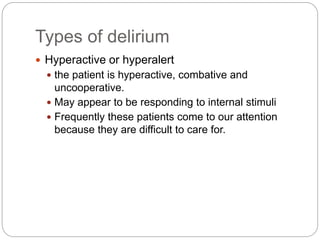
 Hyperactive or hyperalert
 the patient is hyperactive, combative and
uncooperative.
 May appear to be responding to internal stimuli
 Frequently these patients come to our attention
because they are difficult to care for.
Types of delirium….
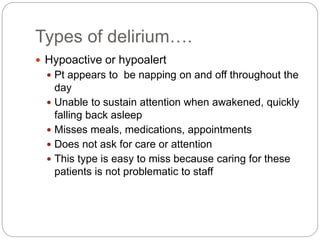
 Hypoactive or hypoalert
 Pt appears to be napping on and off throughout the
day
 Unable to sustain attention when awakened, quickly
falling back asleep
 Misses meals, medications, appointments
 Does not ask for care or attention
 This type is easy to miss because caring for these
patients is not problematic to staff
Etiology
 It is usually multifactorial
 Systemic illness
 Medications- any psychoactive medication can
cause delirium
 Presence of risk factors
Etiology:
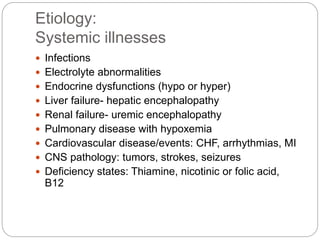
Systemic illnesses
 Infections
 Electrolyte abnormalities
 Endocrine dysfunctions (hypo or hyper)
 Liver failure- hepatic encephalopathy
 Renal failure- uremic encephalopathy
 Pulmonary disease with hypoxemia
 Cardiovascular disease/events: CHF, arrhythmias, MI
 CNS pathology: tumors, strokes, seizures
 Deficiency states: Thiamine, nicotinic or folic acid,
B12
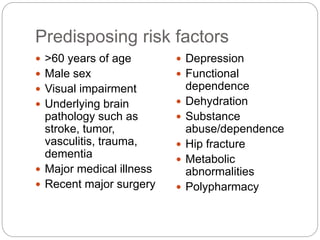
Predisposing risk factors
 >60 years of age
 Male sex
 Visual impairment
 Underlying brain
pathology such as
stroke, tumor,
vasculitis, trauma,
dementia
 Major medical illness
 Recent major surgery
 Depression
 Functional
dependence
 Dehydration
 Substance
abuse/dependence
 Hip fracture
 Metabolic
abnormalities
 Polypharmacy
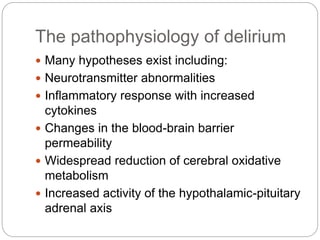
The pathophysiology of delirium
 Many hypotheses exist including:
 Neurotransmitter abnormalities
 Inflammatory response with increased
cytokines
 Changes in the blood-brain barrier
permeability
 Widespread reduction of cerebral oxidative
metabolism
 Increased activity of the hypothalamic-pituitary
adrenal axis
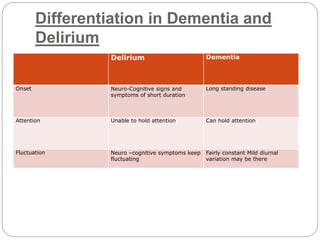
Differentiation in Dementia and
Delirium
Delirium Dementia
Onset Neuro-Cognitive signs and
symptoms of short duration
Long standing disease
Attention Unable to hold attention Can hold attention
Fluctuation Neuro –cognitive symptoms keep
fluctuating
Fairly constant Mild diurnal
variation may be there
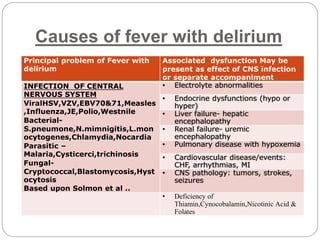
Causes of fever with delirium
Principal problem of Fever with
delirium
Associated dysfunction May be
present as effect of CNS infection
or separate accompaniment
INFECTION OF CENTRAL
NERVOUS SYSTEM
ViralHSV,VZV,EBV70&71,Measles
,Influenza,JE,Polio,Westnile
Bacterial-
S.pneumone,N.mimnigitis,L.mon
ocytogenes,Chlamydia,Nocardia
Parasitic –
Malaria,Cysticerci,trichinosis
Fungal-
Cryptococcal,Blastomycosis,Hyst
ocytosis
Based upon Solmon et al ..
• Electrolyte abnormalities
• Endocrine dysfunctions (hypo or
hyper)
• Liver failure- hepatic
encephalopathy
• Renal failure- uremic
encephalopathy
• Pulmonary disease with hypoxemia
• Cardiovascular disease/events:
CHF, arrhythmias, MI
• CNS pathology: tumors, strokes,
seizures
• Deficiency of
Thiamin,Cynocobalamin,Nicotinic Acid &
Folates
Types of delirium
Hyperactive Hypoactive
Alertness The patient is hyperactive,
combative and
uncooperative.
Patient appears to be
napping on and off
throughout the day
Response May appear to be
responding to internal
stimuli
Unable to sustain attention
when awakened, quickly
falling back asleep
Medical attention Frequently these patients
come to our attention
because they are difficult
to care for.
Misses meals, medications,
appointments
Hospital care Use of strain ,sedation Does not ask for care or
attention
Caution in Care Requires constant
attention and involvement
of family members and
security staff is required
This type is easy to miss
because caring for these
patients is not problematic
to staff
Common etiologic
factors
Viral encephalitis
,Meningo-encephalitis and
associated medical
complications are common
Common with bacterial
CNS infections associated
with septicemia
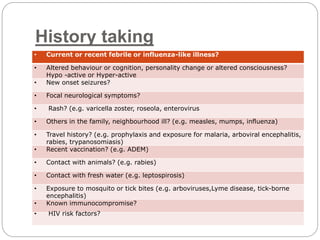
History taking
• Current or recent febrile or influenza-like illness?
• Altered behaviour or cognition, personality change or altered consciousness?
Hypo -active or Hyper-active
• New onset seizures?
• Focal neurological symptoms?
• Rash? (e.g. varicella zoster, roseola, enterovirus
• Others in the family, neighbourhood ill? (e.g. measles, mumps, influenza)
• Travel history? (e.g. prophylaxis and exposure for malaria, arboviral encephalitis,
rabies, trypanosomiasis)
• Recent vaccination? (e.g. ADEM)
• Contact with animals? (e.g. rabies)
• Contact with fresh water (e.g. leptospirosis)
• Exposure to mosquito or tick bites (e.g. arboviruses,Lyme disease, tick-borne
encephalitis)
• Known immunocompromise?
• HIV risk factors?
Initial Clinical examination-
scheme
 Airways, Breathing, Circulation
 Mini-mental state, cognitive function, behaviour (when possible)
 Evidence of prior seizures? (tongue biting, injury due to fall)
 Subtle motor seizures? (mouth, digit, eyelid twitching)
 Meningism-neck rigidity
 Focal neurological signs-monoparesis ,hemiparesis, mono or multiple cranial
nerve palsy
 Papilloedema
 Flaccid paralysis (anterior horn cell involvement)
 Rash? (purpuric e meningococcus; vesicular e hand foot and mouth disease;
varicella zoster; rickettsial disease)
 Injection sites of drug abuse?
 Bites from animals (rabies) or insects (arboviruses)
 Movement disorders, including Parkinsonism
Sinister signs –signs of Brain
stem involvement
• Suggestive clinical features
• Lower cranial nerve involvement
• Myoclonus
• Respiratory drive disturbance
• Autonomic dysfunction
• Locked-in syndrome
• MRI changes in the brainstem, with gadolinium enhancement of basal meninges
Sinister signs –signs of Brain
stem involvement
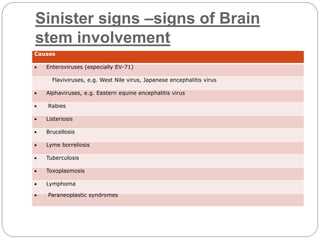
Causes
 Enteroviruses (especially EV-71)
Flaviviruses, e.g. West Nile virus, Japanese encephalitis virus
 Alphaviruses, e.g. Eastern equine encephalitis virus
 Rabies
 Listeriosis
 Brucellosis
 Lyme borreliosis
 Tuberculosis
 Toxoplasmosis
 Lymphoma
 Paraneoplastic syndromes
Management—Lumbar puncture
& Neuro-imaging
 Important
 Complementary
 Early
 Follow up
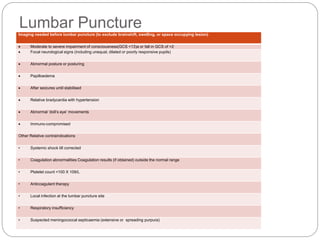
Lumbar PunctureImaging needed before lumbar puncture (to exclude brainshift, swelling, or space occupying lesion)
 Moderate to severe impairment of consciousness(GCS <13)a or fall in GCS of >2
 Focal neurological signs (including unequal, dilated or poorly responsive pupils)
 Abnormal posture or posturing
 Papilloedema
 After seizures until stabilised
 Relative bradycardia with hypertension
 Abnormal ‘doll’s eye’ movements
 Immuno-compromised
Other Relative contraindications
• Systemic shock till corrected
• Coagulation abnormalities Coagulation results (if obtained) outside the normal range
• Platelet count <100 X 109/L
• Anticoagulant therapy
• Local infection at the lumbar puncture site
• Respiratory insufficiency
• Suspected meningococcal septicaemia (extensive or spreading purpura)
Other investigations
Differential Diagnosis Suggested investigation
Infection work up Full blood count,CSF Study,PBS for Malaria
Parasite, IgM against
JE,HSV,VZV,Measles,Influenza, ADA level in CSF
. CSF culture, Nasal swab cultures.Urine culture
Metabolic screen Renal, liver, bone & thyroid profiles
Arterial blood gas analysis
Plasma and CSF lactate, ammonia, pyruvate,
amino acids, very long-chain
fatty acids, urinary organic acids
Porphyrins: blood/urine/faeces
Toxicological screen Blood film; blood or urine levels of alcohol,
Paracetamol, Salicylate, Tricyclic, heavy metals,
Urinary illicit drug screen
Septic Encephalopathy Serum microbiological cultures, serology and
PCR
Paraneoplastic Anti-neuronal and onconeuronal antibodies,CT
or PET chest, abdomen and pelvis
Biopsy of non CNS viscera, Alpha fetoprotein,
beta human chorionic gonadatrophin
Treatment -Antibiotic therapy
Indication
Antibiotic
Preterm infants to infants <1 month
Ampicillin + cefotaxime
Infants 1–3 months
Ampicillin + cefotaxime or
ceftriaxone
Immunocompetent children >3 mos and
adults <55yrs Cefotaxime or ceftriaxone +
vancomycin
Adults >55 yrs and adults of any age
with alcoholism
or other debilitating illnesses
Ampicillin + cefotaxime or
ceftriaxone + vancomycin
Hospital-acquired meningitis,
posttraumatic or
postneurosurgery meningitis,
neutropenic patients,
or patients with impaired cell-mediated
immunity
Ampicillin + ceftazidime +
vancomycin
Adjuvant Treatment-Steroid
Therapy
 02 large studies
 Vast animal experimental data
 Early recovery
 Less sequally
 Dexamethasone
 Duration -7-10days
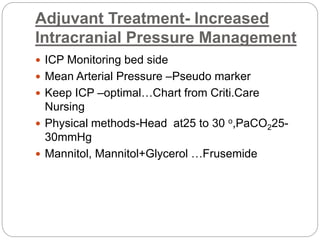
Adjuvant Treatment- Increased
Intracranial Pressure Management
 ICP Monitoring bed side
 Mean Arterial Pressure –Pseudo marker
 Keep ICP –optimal…Chart from Criti.Care
Nursing
 Physical methods-Head at25 to 30 o,PaCO225-
30mmHg
 Mannitol, Mannitol+Glycerol …Frusemide
Adjuvant Treatment- Seizure
Management
 independent risk factor of mortality and residual
neurological deficit
 no scientific evidence of starting Prophylactic
Anti-Epileptic Drug in cases of encephalitis
 Dilantin at loading doses @ 20 mg/Kg over 30
min and maintenance dose at 5mg/Kg/day be
given
Restraint ,Nursing in cool-dark
room
 treated in cool dark room with restraint
 injury due to catheters ,Ryle’s tube, IV Cannula
and other devices be done.
Adjuvant Treatment- Hydration &
nutrition
 essential part of treatment
 Ryle tube
 Aim -25 -35 Kcal/Kg/day
 Fluid-100-125ml/hr…
Conclusion
 Sinister but treatable entity
 Infection more common
 Better managed in Hosp with a team
 Concoction to definite therapy
 Adequate Rx such 14 days antibiotics and 21
days acyclovir
 Steroid shy approach condemned .enough data
to use
 Steroid prvents mortality as well as morbidity
 Supportive care and comprehensive
Rehabilitation is must
 Mortality and morbidity
 This medical effort came after a social call…
Humble thanks
 Prof E Solmon,British Neurology Society
 Prof V Bhaskaran,NAMS
 Prof. B Bharath,LHMC
 Col KM Hassan,Prof and Head
Neurology,CH(EC) Kilkata
 Thank you
 My greetings from North East …..green beautiful
part of India
 My Slides are Open…..use download and
referance

Fever with delirium apicon

  • 1.
    Dr(Lt Col) AshutoshOjha MD,PDCDM,(Nephrology)Gold Medalist.FGSI. Professor Medicine AFMC,Pune(Retd) Fever with Delirium
  • 2.
  • 3.
    Presentation….  Introduction  Definitionin DSM-IV  Incidence  Mortality & morbidity  Risk factor  Approach  Differentiation with Dementia  History  Clinical examn  Management  Adjunctive therapy
  • 4.
    Introduction  Common presentation High Mortality  UP only more than 10000 deaths in yr2010  Children mortality –more than 3000 in yr 2011.  Flooded with parliamentary questions and a PIL  Task force , program ,Funding and technical review
  • 5.
    DSM IV Criteria 1.Disturbance of consciousness with reduced ability to focus, sustain or shift attention. 2. A change in cognition or development of perceptual disturbances that is not better accounted for a preexisting, existed or evolving dementia. 3. The disturbance develops over a short period of time and tends to fluctuate during the course of the day 4. There is evidence from this hx, PE or labs that the disturbance is caused by the physiological consequence of a medical condition.
  • 6.
    Clinical characteristics  Developsacutely (hours to days)  Characterized by fluctuating level of consciousness  Reduced ability to maintain attention  Agitation or hypersomnolence  Extreme emotional lability  Cognitive deficits can occur
  • 7.
    Clinical characteristics: cognitive deficits Language difficulties: word finding difficulties, dysgraphia  Speech disturbances: slurred, mumbling, incoherent or disorganized  Memory dysfunction: marked short-term memory impairment, disorientation to person, place, time.  Perceptions: misinterpretations, illusions, delusions and/or visual (more common) or auditory hallucinations  Constructional ability: can’t copy a pentagon
  • 8.
    Types of delirium Hyperactive or hyperalert  the patient is hyperactive, combative and uncooperative.  May appear to be responding to internal stimuli  Frequently these patients come to our attention because they are difficult to care for.
  • 9.
    Types of delirium…. Hypoactive or hypoalert  Pt appears to be napping on and off throughout the day  Unable to sustain attention when awakened, quickly falling back asleep  Misses meals, medications, appointments  Does not ask for care or attention  This type is easy to miss because caring for these patients is not problematic to staff
  • 10.
    Etiology  It isusually multifactorial  Systemic illness  Medications- any psychoactive medication can cause delirium  Presence of risk factors
  • 11.
    Etiology: Systemic illnesses  Infections Electrolyte abnormalities  Endocrine dysfunctions (hypo or hyper)  Liver failure- hepatic encephalopathy  Renal failure- uremic encephalopathy  Pulmonary disease with hypoxemia  Cardiovascular disease/events: CHF, arrhythmias, MI  CNS pathology: tumors, strokes, seizures  Deficiency states: Thiamine, nicotinic or folic acid, B12
  • 12.
    Predisposing risk factors >60 years of age  Male sex  Visual impairment  Underlying brain pathology such as stroke, tumor, vasculitis, trauma, dementia  Major medical illness  Recent major surgery  Depression  Functional dependence  Dehydration  Substance abuse/dependence  Hip fracture  Metabolic abnormalities  Polypharmacy
  • 13.
    The pathophysiology ofdelirium  Many hypotheses exist including:  Neurotransmitter abnormalities  Inflammatory response with increased cytokines  Changes in the blood-brain barrier permeability  Widespread reduction of cerebral oxidative metabolism  Increased activity of the hypothalamic-pituitary adrenal axis
  • 14.
    Differentiation in Dementiaand Delirium Delirium Dementia Onset Neuro-Cognitive signs and symptoms of short duration Long standing disease Attention Unable to hold attention Can hold attention Fluctuation Neuro –cognitive symptoms keep fluctuating Fairly constant Mild diurnal variation may be there
  • 15.
    Causes of feverwith delirium Principal problem of Fever with delirium Associated dysfunction May be present as effect of CNS infection or separate accompaniment INFECTION OF CENTRAL NERVOUS SYSTEM ViralHSV,VZV,EBV70&71,Measles ,Influenza,JE,Polio,Westnile Bacterial- S.pneumone,N.mimnigitis,L.mon ocytogenes,Chlamydia,Nocardia Parasitic – Malaria,Cysticerci,trichinosis Fungal- Cryptococcal,Blastomycosis,Hyst ocytosis Based upon Solmon et al .. • Electrolyte abnormalities • Endocrine dysfunctions (hypo or hyper) • Liver failure- hepatic encephalopathy • Renal failure- uremic encephalopathy • Pulmonary disease with hypoxemia • Cardiovascular disease/events: CHF, arrhythmias, MI • CNS pathology: tumors, strokes, seizures • Deficiency of Thiamin,Cynocobalamin,Nicotinic Acid & Folates
  • 16.
    Types of delirium HyperactiveHypoactive Alertness The patient is hyperactive, combative and uncooperative. Patient appears to be napping on and off throughout the day Response May appear to be responding to internal stimuli Unable to sustain attention when awakened, quickly falling back asleep Medical attention Frequently these patients come to our attention because they are difficult to care for. Misses meals, medications, appointments Hospital care Use of strain ,sedation Does not ask for care or attention Caution in Care Requires constant attention and involvement of family members and security staff is required This type is easy to miss because caring for these patients is not problematic to staff Common etiologic factors Viral encephalitis ,Meningo-encephalitis and associated medical complications are common Common with bacterial CNS infections associated with septicemia
  • 17.
    History taking • Currentor recent febrile or influenza-like illness? • Altered behaviour or cognition, personality change or altered consciousness? Hypo -active or Hyper-active • New onset seizures? • Focal neurological symptoms? • Rash? (e.g. varicella zoster, roseola, enterovirus • Others in the family, neighbourhood ill? (e.g. measles, mumps, influenza) • Travel history? (e.g. prophylaxis and exposure for malaria, arboviral encephalitis, rabies, trypanosomiasis) • Recent vaccination? (e.g. ADEM) • Contact with animals? (e.g. rabies) • Contact with fresh water (e.g. leptospirosis) • Exposure to mosquito or tick bites (e.g. arboviruses,Lyme disease, tick-borne encephalitis) • Known immunocompromise? • HIV risk factors?
  • 18.
    Initial Clinical examination- scheme Airways, Breathing, Circulation  Mini-mental state, cognitive function, behaviour (when possible)  Evidence of prior seizures? (tongue biting, injury due to fall)  Subtle motor seizures? (mouth, digit, eyelid twitching)  Meningism-neck rigidity  Focal neurological signs-monoparesis ,hemiparesis, mono or multiple cranial nerve palsy  Papilloedema  Flaccid paralysis (anterior horn cell involvement)  Rash? (purpuric e meningococcus; vesicular e hand foot and mouth disease; varicella zoster; rickettsial disease)  Injection sites of drug abuse?  Bites from animals (rabies) or insects (arboviruses)  Movement disorders, including Parkinsonism
  • 19.
    Sinister signs –signsof Brain stem involvement • Suggestive clinical features • Lower cranial nerve involvement • Myoclonus • Respiratory drive disturbance • Autonomic dysfunction • Locked-in syndrome • MRI changes in the brainstem, with gadolinium enhancement of basal meninges
  • 20.
    Sinister signs –signsof Brain stem involvement Causes  Enteroviruses (especially EV-71) Flaviviruses, e.g. West Nile virus, Japanese encephalitis virus  Alphaviruses, e.g. Eastern equine encephalitis virus  Rabies  Listeriosis  Brucellosis  Lyme borreliosis  Tuberculosis  Toxoplasmosis  Lymphoma  Paraneoplastic syndromes
  • 21.
    Management—Lumbar puncture & Neuro-imaging Important  Complementary  Early  Follow up
  • 22.
    Lumbar PunctureImaging neededbefore lumbar puncture (to exclude brainshift, swelling, or space occupying lesion)  Moderate to severe impairment of consciousness(GCS <13)a or fall in GCS of >2  Focal neurological signs (including unequal, dilated or poorly responsive pupils)  Abnormal posture or posturing  Papilloedema  After seizures until stabilised  Relative bradycardia with hypertension  Abnormal ‘doll’s eye’ movements  Immuno-compromised Other Relative contraindications • Systemic shock till corrected • Coagulation abnormalities Coagulation results (if obtained) outside the normal range • Platelet count <100 X 109/L • Anticoagulant therapy • Local infection at the lumbar puncture site • Respiratory insufficiency • Suspected meningococcal septicaemia (extensive or spreading purpura)
  • 23.
    Other investigations Differential DiagnosisSuggested investigation Infection work up Full blood count,CSF Study,PBS for Malaria Parasite, IgM against JE,HSV,VZV,Measles,Influenza, ADA level in CSF . CSF culture, Nasal swab cultures.Urine culture Metabolic screen Renal, liver, bone & thyroid profiles Arterial blood gas analysis Plasma and CSF lactate, ammonia, pyruvate, amino acids, very long-chain fatty acids, urinary organic acids Porphyrins: blood/urine/faeces Toxicological screen Blood film; blood or urine levels of alcohol, Paracetamol, Salicylate, Tricyclic, heavy metals, Urinary illicit drug screen Septic Encephalopathy Serum microbiological cultures, serology and PCR Paraneoplastic Anti-neuronal and onconeuronal antibodies,CT or PET chest, abdomen and pelvis Biopsy of non CNS viscera, Alpha fetoprotein, beta human chorionic gonadatrophin
  • 24.
    Treatment -Antibiotic therapy Indication Antibiotic Preterminfants to infants <1 month Ampicillin + cefotaxime Infants 1–3 months Ampicillin + cefotaxime or ceftriaxone Immunocompetent children >3 mos and adults <55yrs Cefotaxime or ceftriaxone + vancomycin Adults >55 yrs and adults of any age with alcoholism or other debilitating illnesses Ampicillin + cefotaxime or ceftriaxone + vancomycin Hospital-acquired meningitis, posttraumatic or postneurosurgery meningitis, neutropenic patients, or patients with impaired cell-mediated immunity Ampicillin + ceftazidime + vancomycin
  • 25.
    Adjuvant Treatment-Steroid Therapy  02large studies  Vast animal experimental data  Early recovery  Less sequally  Dexamethasone  Duration -7-10days
  • 26.
    Adjuvant Treatment- Increased IntracranialPressure Management  ICP Monitoring bed side  Mean Arterial Pressure –Pseudo marker  Keep ICP –optimal…Chart from Criti.Care Nursing  Physical methods-Head at25 to 30 o,PaCO225- 30mmHg  Mannitol, Mannitol+Glycerol …Frusemide
  • 27.
    Adjuvant Treatment- Seizure Management independent risk factor of mortality and residual neurological deficit  no scientific evidence of starting Prophylactic Anti-Epileptic Drug in cases of encephalitis  Dilantin at loading doses @ 20 mg/Kg over 30 min and maintenance dose at 5mg/Kg/day be given
  • 28.
    Restraint ,Nursing incool-dark room  treated in cool dark room with restraint  injury due to catheters ,Ryle’s tube, IV Cannula and other devices be done.
  • 29.
    Adjuvant Treatment- Hydration& nutrition  essential part of treatment  Ryle tube  Aim -25 -35 Kcal/Kg/day  Fluid-100-125ml/hr…
  • 30.
    Conclusion  Sinister buttreatable entity  Infection more common  Better managed in Hosp with a team  Concoction to definite therapy  Adequate Rx such 14 days antibiotics and 21 days acyclovir  Steroid shy approach condemned .enough data to use  Steroid prvents mortality as well as morbidity  Supportive care and comprehensive Rehabilitation is must  Mortality and morbidity  This medical effort came after a social call…
  • 31.
    Humble thanks  ProfE Solmon,British Neurology Society  Prof V Bhaskaran,NAMS  Prof. B Bharath,LHMC  Col KM Hassan,Prof and Head Neurology,CH(EC) Kilkata
  • 32.
     Thank you My greetings from North East …..green beautiful part of India  My Slides are Open…..use download and referance