Dr(Lt Col) Ashutosh Ojha
Reader Internal Medicine
Pericardial Diseases
Pericardium -Intro
 Pericardium is a double-layered sac;
 Visceral pericardium is a serous membrane that
is separated by a small quantity (15–50 mL) of
fluid,
 Pericardial Fluid- ultrafiltrate of plasma, secreted
from the parietal pericardium.
Pericardium -Function
 Prevents sudden dilation of the cardiac chambers
 Restricts the anatomic position of the heart
 Minimizes friction between the heart and
surrounding structures
 Prevents displacement of the heart and kinking of
the great vessels, and
 Probably retards the spread of infections from
the lungs and pleural cavities to the heart.
 Nevertheless, total absence of the pericardium,
either congenital or after surgery, does not
produce obvious clinical disease.
Diseases
 Acute Pericarditis
 Cardiac Tamponade
 Chronic Pericarditis
 Pericardial Neoplasm
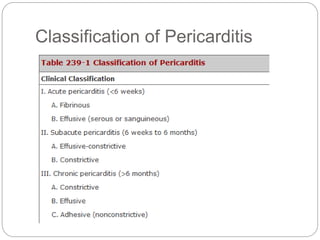
Classification of Pericarditis
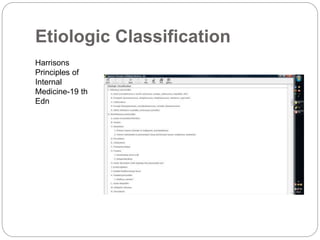
Etiologic Classification
Harrisons
Principles of
Internal
Medicine-19 th
Edn
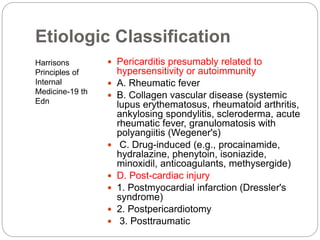
Etiologic Classification
Harrisons
Principles of
Internal
Medicine-19 th
Edn
 Pericarditis presumably related to
hypersensitivity or autoimmunity
 A. Rheumatic fever
 B. Collagen vascular disease (systemic
lupus erythematosus, rheumatoid arthritis,
ankylosing spondylitis, scleroderma, acute
rheumatic fever, granulomatosis with
polyangiitis (Wegener's)
 C. Drug-induced (e.g., procainamide,
hydralazine, phenytoin, isoniazide,
minoxidil, anticoagulants, methysergide)
 D. Post-cardiac injury
 1. Postmyocardial infarction (Dressler's
syndrome)
 2. Postpericardiotomy
 3. Posttraumatic
Acute pericarditis –Clinical
features
 most common pathologic process involving the
pericardium
 Chest pain
 pericardial friction rub
 electrocardiogram (ECG)
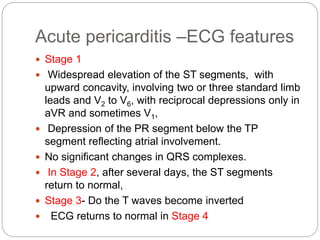
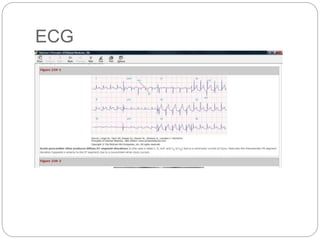
Acute pericarditis –ECG features
 Stage 1
 Widespread elevation of the ST segments, with
upward concavity, involving two or three standard limb
leads and V2 to V6, with reciprocal depressions only in
aVR and sometimes V1,
 Depression of the PR segment below the TP
segment reflecting atrial involvement.
 No significant changes in QRS complexes.
 In Stage 2, after several days, the ST segments
return to normal,
 Stage 3- Do the T waves become inverted
 ECG returns to normal in Stage 4
ECG
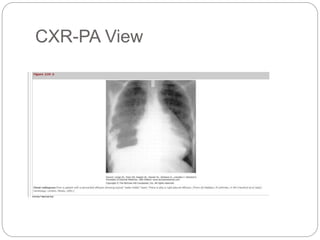
CXR-PA View
Other Bedside Inv
 Echocardiography is the most widely used
imaging technique since it is sensitive, specific,
simple, and noninvasive; may be performed at
the bedside; and can identify accompanying
cardiac tamponade .
Cardiac Tamponade
 The accumulation of fluid in the pericardial space
in a quantity sufficient to cause serious
obstruction to the inflow of blood to the ventricles
.
Cardiac Tamponade-Cl features
 Hypotension,
 Soft or absent heart sounds,
 Jugular venous distention with a prominent x
descent but an absent y descent.
 Pulsus paradoxus
 The quantity of fluid necessary to produce this
critical state may be as small as 200 mL when the
fluid develops rapidly or >2000 mL in slowly
developing effusions when the pericardium has
had the opportunity to stretch and adapt to an
increasing volume
Difficult to diagnose
 A high index of suspicion for cardiac
tamponade is required since in many
instances no obvious cause for pericardial
disease is apparent, and it should be
considered in any patient with otherwise
unexplained enlargement of the cardiac
silhouette, hypotension, and elevation of
jugular venous pressure. There may be
reduction in amplitude of the QRS complexes,
and electrical alternans of the P, QRS, or T
waves should raise the suspicion of cardiac
tamponade.
Causes
 Neoplasm
 Ideopathic
 Renal
Immediate Rx
 Pericardiocentasis
Further work up
 Pericardial fluid analysis
 ADA
 Malignant Cells
Viral or Idiopathic Form of Acute
Pericarditis
 CMV ,EBV
 Short benign course
 <4 wks
 Chest pain
 Tamponade rarely
 Extremes of Age
Acute Pericarditis-Rx
 No specific therapy,
 Bed rest
 Anti-inflammatory treatment with aspirin (2–4 g/d)
may be given.
 Glucocorticoids (e.g., prednisone, 40–80 mg daily)
usually suppress the clinical manifestations of the
acute illness.
 After the patient has been asymptomatic and afebrile
for about a week, the dose of the NSAID may be
tapered gradually.
 Colchicine may prevent recurrences,
 Multiple recurrences are frequent, and disabling;
continued beyond 2 years; and are not controlled by
glucocorticoids, pericardiectomy may be necessary to
terminate the illness
Postcardiac Injury Syndrome
 1 to 4 week later
 May occur after 3months
 Result of a hypersensitivity reaction to antigen
that originates from injured myocardial tissue
and/or pericardium
 Rx-Asprin and glucocorticoids
Chronic pericarditis
 Tb
 Collagen vascular
 Neoplastic
 Ideopathic
 Mediterranian
Rx
 Approach the primary cause
 Asprin
 Regular follow up
 Pericardiocentasis –as when required
Neoplasm
 Primary –mesotheliolma
 Secondary-mediastinum cancers, carcinoma of
the bronchus and breast, lymphoma, melanoma
Pericardial cysts
 Rare
 Rounded or lobulated deformities of the cardiac
silhouette,
 Most commonly at the right cardiophrenic angle.
 Asymptomatic, and their major clinical
significance lies in the possibility of confusion with
a tumor, ventricular aneurysm, or massive
cardiomegaly
Tuberculous Pericarditis
 Developing countries
 Fibrinous
 Chr sequale
 Diagnosis Clinical –Fluid analysis
 ATT- extended regime
 Pericardial stipping common
Uremic pericarditis
 Even in stages -4
 Florid
 Immediate tamponade
 Post dialysis also occurs
 Associated TB
 May require Surgery
My references
 Harrisons Principles of Internal Medicine -18th
Edn Chapters 239.
 Clinical Medicine –Kumar & Calrke 9th Edn
Thank
You
 Contact-9719713786
 ashutosh8116@yahoo.com
 sumitranikentanpatna@gmail.com
17 Feb2016Dr A Ojha
Available ….

Pericardial disease Undergaraduate

  • 1.
    Dr(Lt Col) AshutoshOjha Reader Internal Medicine Pericardial Diseases
  • 2.
    Pericardium -Intro  Pericardiumis a double-layered sac;  Visceral pericardium is a serous membrane that is separated by a small quantity (15–50 mL) of fluid,  Pericardial Fluid- ultrafiltrate of plasma, secreted from the parietal pericardium.
  • 3.
    Pericardium -Function  Preventssudden dilation of the cardiac chambers  Restricts the anatomic position of the heart  Minimizes friction between the heart and surrounding structures  Prevents displacement of the heart and kinking of the great vessels, and  Probably retards the spread of infections from the lungs and pleural cavities to the heart.  Nevertheless, total absence of the pericardium, either congenital or after surgery, does not produce obvious clinical disease.
  • 4.
    Diseases  Acute Pericarditis Cardiac Tamponade  Chronic Pericarditis  Pericardial Neoplasm
  • 5.
  • 6.
  • 7.
    Etiologic Classification Harrisons Principles of Internal Medicine-19th Edn  Pericarditis presumably related to hypersensitivity or autoimmunity  A. Rheumatic fever  B. Collagen vascular disease (systemic lupus erythematosus, rheumatoid arthritis, ankylosing spondylitis, scleroderma, acute rheumatic fever, granulomatosis with polyangiitis (Wegener's)  C. Drug-induced (e.g., procainamide, hydralazine, phenytoin, isoniazide, minoxidil, anticoagulants, methysergide)  D. Post-cardiac injury  1. Postmyocardial infarction (Dressler's syndrome)  2. Postpericardiotomy  3. Posttraumatic
  • 8.
    Acute pericarditis –Clinical features most common pathologic process involving the pericardium  Chest pain  pericardial friction rub  electrocardiogram (ECG)
  • 9.
    Acute pericarditis –ECGfeatures  Stage 1  Widespread elevation of the ST segments, with upward concavity, involving two or three standard limb leads and V2 to V6, with reciprocal depressions only in aVR and sometimes V1,  Depression of the PR segment below the TP segment reflecting atrial involvement.  No significant changes in QRS complexes.  In Stage 2, after several days, the ST segments return to normal,  Stage 3- Do the T waves become inverted  ECG returns to normal in Stage 4
  • 10.
  • 11.
  • 12.
    Other Bedside Inv Echocardiography is the most widely used imaging technique since it is sensitive, specific, simple, and noninvasive; may be performed at the bedside; and can identify accompanying cardiac tamponade .
  • 13.
    Cardiac Tamponade  Theaccumulation of fluid in the pericardial space in a quantity sufficient to cause serious obstruction to the inflow of blood to the ventricles .
  • 14.
    Cardiac Tamponade-Cl features Hypotension,  Soft or absent heart sounds,  Jugular venous distention with a prominent x descent but an absent y descent.  Pulsus paradoxus  The quantity of fluid necessary to produce this critical state may be as small as 200 mL when the fluid develops rapidly or >2000 mL in slowly developing effusions when the pericardium has had the opportunity to stretch and adapt to an increasing volume
  • 15.
    Difficult to diagnose A high index of suspicion for cardiac tamponade is required since in many instances no obvious cause for pericardial disease is apparent, and it should be considered in any patient with otherwise unexplained enlargement of the cardiac silhouette, hypotension, and elevation of jugular venous pressure. There may be reduction in amplitude of the QRS complexes, and electrical alternans of the P, QRS, or T waves should raise the suspicion of cardiac tamponade.
  • 16.
  • 17.
  • 18.
    Further work up Pericardial fluid analysis  ADA  Malignant Cells
  • 19.
    Viral or IdiopathicForm of Acute Pericarditis  CMV ,EBV  Short benign course  <4 wks  Chest pain  Tamponade rarely  Extremes of Age
  • 20.
    Acute Pericarditis-Rx  Nospecific therapy,  Bed rest  Anti-inflammatory treatment with aspirin (2–4 g/d) may be given.  Glucocorticoids (e.g., prednisone, 40–80 mg daily) usually suppress the clinical manifestations of the acute illness.  After the patient has been asymptomatic and afebrile for about a week, the dose of the NSAID may be tapered gradually.  Colchicine may prevent recurrences,  Multiple recurrences are frequent, and disabling; continued beyond 2 years; and are not controlled by glucocorticoids, pericardiectomy may be necessary to terminate the illness
  • 21.
    Postcardiac Injury Syndrome 1 to 4 week later  May occur after 3months  Result of a hypersensitivity reaction to antigen that originates from injured myocardial tissue and/or pericardium  Rx-Asprin and glucocorticoids
  • 22.
    Chronic pericarditis  Tb Collagen vascular  Neoplastic  Ideopathic  Mediterranian
  • 23.
    Rx  Approach theprimary cause  Asprin  Regular follow up  Pericardiocentasis –as when required
  • 24.
    Neoplasm  Primary –mesotheliolma Secondary-mediastinum cancers, carcinoma of the bronchus and breast, lymphoma, melanoma
  • 25.
    Pericardial cysts  Rare Rounded or lobulated deformities of the cardiac silhouette,  Most commonly at the right cardiophrenic angle.  Asymptomatic, and their major clinical significance lies in the possibility of confusion with a tumor, ventricular aneurysm, or massive cardiomegaly
  • 26.
    Tuberculous Pericarditis  Developingcountries  Fibrinous  Chr sequale  Diagnosis Clinical –Fluid analysis  ATT- extended regime  Pericardial stipping common
  • 27.
    Uremic pericarditis  Evenin stages -4  Florid  Immediate tamponade  Post dialysis also occurs  Associated TB  May require Surgery
  • 28.
    My references  HarrisonsPrinciples of Internal Medicine -18th Edn Chapters 239.  Clinical Medicine –Kumar & Calrke 9th Edn
  • 29.
  • 30.
     Contact-9719713786  ashutosh8116@yahoo.com sumitranikentanpatna@gmail.com 17 Feb2016Dr A Ojha Available ….