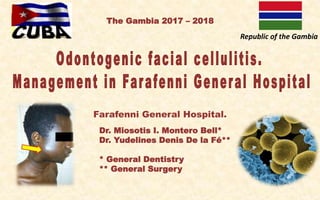
Farafenni General Hospital.
Dr. Miosotis I. Montero Bell*
Dr. Yudelines Denis De la Fé**
* General Dentistry
** General Surgery
Republic of the Gambia
The Gambia 2017 – 2018
Early diagnosis and treatment of facial cellulitis are challenging because of its
variable clinical presentations, including multiple potential sources of
infections and multiple organisms within the head and neck area.
Odontogenic cellulitis accounted for approximately 50% of total facial
infections in a hospitalized population over a 10-year period study. Despite a
significant reduction in frequency and mortality in the post-antibiotic era,
odontogenic infections can still be life threatening.
Odontogenic facial cellulitis refers to infections arising from the dentition and
its adjacent supporting periodontal structure. The infection then disseminates
beyond its source, e.g., dentoalveolar abscess, and into the surrounding
connective tissues. They may require urgent surgical intervention and ICU
management because of the potential for spread of infection into intracranial
and peritracheal neck spaces and risk of airway compromise if appropriate
management is not instituted.
Facial cellulitis is classified as nonodontogenic and odontogenic, depending
on the source of the infection, and as upper or lower face, depending on the
anatomical location.
INTRODUCTION
To determine epidemiological and
clinical characteristics of odontogenic
facial cellulitis in patients requiring
hospitalization.
OBJECTIVE
METHODS
DESCRIPTIVE
TRANSVERSAL
Farafenni General Hospital
S
T
U
D
Y
29 PATIENTS
October 2017 – May 2018
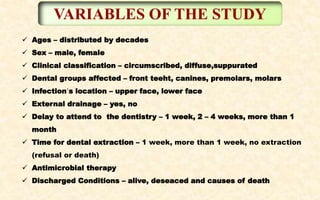
 Ages – distributed by decades
 Sex – male, female
 Clinical classification – circumscribed, diffuse,suppurated
 Dental groups affected – front teeht, canines, premolars, molars
 Infection´s location – upper face, lower face
 External drainage – yes, no
 Delay to attend to the dentistry – 1 week, 2 – 4 weeks, more than 1
month
 Time for dental extraction – 1 week, more than 1 week, no extraction
(refusal or death)
 Antimicrobial therapy
 Discharged Conditions – alive, deseaced and causes of death
VARIABLES OF THE STUDY
RESULTS
Grafic 1. Patients with odontogenic facial cellulitis. Age and
sex.
18 (62,1%)
FEMALE
0
1
2
3
4
5
6
7
0 - 10 11 - 20 21 - 30 31 - 40 41 - 50 More than
50 years
Patients
Ages
Female Male
10 (34,5%)
Patients
between 11
and 20 years
n=29 Source: folders
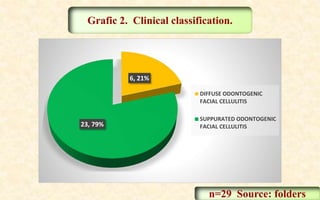
Grafic 2. Clinical classification.
n=29 Source: folders
6, 21%
23, 79%
DIFFUSE ODONTOGENIC
FACIAL CELLULITIS
SUPPURATED ODONTOGENIC
FACIAL CELLULITIS
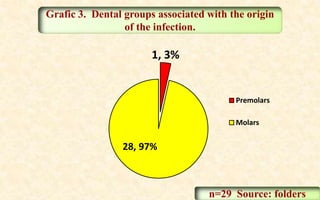
1, 3%
28, 97%
Premolars
Molars
Grafic 3. Dental groups associated with the origin
of the infection.
n=29 Source: folders
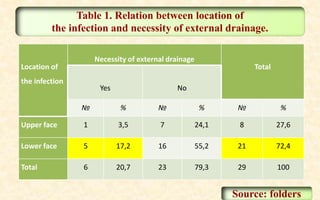
Location of
the infection
Necessity of external drainage
Total
Yes No
№ % № % № %
Upper face 1 3,5 7 24,1 8 27,6
Lower face 5 17,2 16 55,2 21 72,4
Total 6 20,7 23 79,3 29 100
Table 1. Relation between location of
the infection and necessity of external drainage.
Source: folders
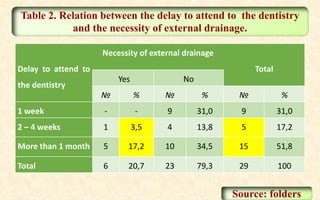
Delay to attend to
the dentistry
Necessity of external drainage
Total
Yes No
№ % № % № %
1 week - - 9 31,0 9 31,0
2 – 4 weeks 1 3,5 4 13,8 5 17,2
More than 1 month 5 17,2 10 34,5 15 51,8
Total 6 20,7 23 79,3 29 100
Source: folders
Table 2. Relation between the delay to attend to the dentistry
and the necessity of external drainage.
Delay to attend to
the dentistry
Time for dental extraction
Total1 week More than 1
week
No extraction
(refusal or
death)
№ % № % № % № %
1 week 6 20,7 3 10,3 - - 9 31,0
2 – 4 weeks 1 3,5 - - 4 13,7 5 17,2
More than 1 month - - 13 44,8 2 7,0 15 51,8
Total 7 24,1 16 55,2 6 20,7 29 100
Source: folders
Table 3. Relation between the delay to attend to the dentistry
and the time for dental extraction.
Antimicrobial therapy № %
Metronidazole 26 89,7
Gentamicine 24 82,8
Penicillin 18 62,1
Ampicillin 10 34,5
Ciprofloxacin 1 3,5
Cloxacillin 1 3,5
n=29 Source: folders
Table 4. Antimicrobial therapy.
n=29 Source: folders
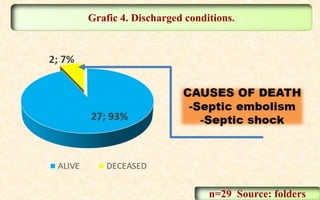
Grafic 4. Discharged conditions.
CONCLUSIONS
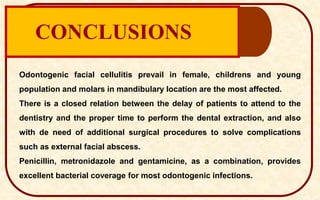
Odontogenic facial cellulitis prevail in female, childrens and young
population and molars in mandibulary location are the most affected.
There is a closed relation between the delay of patients to attend to the
dentistry and the proper time to perform the dental extraction, and also
with de need of additional surgical procedures to solve complications
such as external facial abscess.
Penicillin, metronidazole and gentamicine, as a combination, provides
excellent bacterial coverage for most odontogenic infections.
RECOMENDATIONS
It is recommended to improve in promotion and prevention
activities in Community Centers and villages in order to increase
the knowledge and culture of the population about the
importance of attending prematurely to the dentist in front of any
symptom and sign of Odontogenic facial cellulitis.
THANKS

Odontogenic facial cellulitis. Management

  • 1.
    Farafenni General Hospital. Dr.Miosotis I. Montero Bell* Dr. Yudelines Denis De la Fé** * General Dentistry ** General Surgery Republic of the Gambia The Gambia 2017 – 2018
  • 2.
    Early diagnosis andtreatment of facial cellulitis are challenging because of its variable clinical presentations, including multiple potential sources of infections and multiple organisms within the head and neck area. Odontogenic cellulitis accounted for approximately 50% of total facial infections in a hospitalized population over a 10-year period study. Despite a significant reduction in frequency and mortality in the post-antibiotic era, odontogenic infections can still be life threatening. Odontogenic facial cellulitis refers to infections arising from the dentition and its adjacent supporting periodontal structure. The infection then disseminates beyond its source, e.g., dentoalveolar abscess, and into the surrounding connective tissues. They may require urgent surgical intervention and ICU management because of the potential for spread of infection into intracranial and peritracheal neck spaces and risk of airway compromise if appropriate management is not instituted. Facial cellulitis is classified as nonodontogenic and odontogenic, depending on the source of the infection, and as upper or lower face, depending on the anatomical location. INTRODUCTION
  • 3.
    To determine epidemiologicaland clinical characteristics of odontogenic facial cellulitis in patients requiring hospitalization. OBJECTIVE
  • 4.
  • 5.
     Ages –distributed by decades  Sex – male, female  Clinical classification – circumscribed, diffuse,suppurated  Dental groups affected – front teeht, canines, premolars, molars  Infection´s location – upper face, lower face  External drainage – yes, no  Delay to attend to the dentistry – 1 week, 2 – 4 weeks, more than 1 month  Time for dental extraction – 1 week, more than 1 week, no extraction (refusal or death)  Antimicrobial therapy  Discharged Conditions – alive, deseaced and causes of death VARIABLES OF THE STUDY
  • 6.
  • 7.
    Grafic 1. Patientswith odontogenic facial cellulitis. Age and sex. 18 (62,1%) FEMALE 0 1 2 3 4 5 6 7 0 - 10 11 - 20 21 - 30 31 - 40 41 - 50 More than 50 years Patients Ages Female Male 10 (34,5%) Patients between 11 and 20 years n=29 Source: folders
  • 8.
    Grafic 2. Clinicalclassification. n=29 Source: folders 6, 21% 23, 79% DIFFUSE ODONTOGENIC FACIAL CELLULITIS SUPPURATED ODONTOGENIC FACIAL CELLULITIS
  • 9.
    1, 3% 28, 97% Premolars Molars Grafic3. Dental groups associated with the origin of the infection. n=29 Source: folders
  • 10.
    Location of the infection Necessityof external drainage Total Yes No № % № % № % Upper face 1 3,5 7 24,1 8 27,6 Lower face 5 17,2 16 55,2 21 72,4 Total 6 20,7 23 79,3 29 100 Table 1. Relation between location of the infection and necessity of external drainage. Source: folders
  • 11.
    Delay to attendto the dentistry Necessity of external drainage Total Yes No № % № % № % 1 week - - 9 31,0 9 31,0 2 – 4 weeks 1 3,5 4 13,8 5 17,2 More than 1 month 5 17,2 10 34,5 15 51,8 Total 6 20,7 23 79,3 29 100 Source: folders Table 2. Relation between the delay to attend to the dentistry and the necessity of external drainage.
  • 12.
    Delay to attendto the dentistry Time for dental extraction Total1 week More than 1 week No extraction (refusal or death) № % № % № % № % 1 week 6 20,7 3 10,3 - - 9 31,0 2 – 4 weeks 1 3,5 - - 4 13,7 5 17,2 More than 1 month - - 13 44,8 2 7,0 15 51,8 Total 7 24,1 16 55,2 6 20,7 29 100 Source: folders Table 3. Relation between the delay to attend to the dentistry and the time for dental extraction.
  • 13.
    Antimicrobial therapy №% Metronidazole 26 89,7 Gentamicine 24 82,8 Penicillin 18 62,1 Ampicillin 10 34,5 Ciprofloxacin 1 3,5 Cloxacillin 1 3,5 n=29 Source: folders Table 4. Antimicrobial therapy.
  • 14.
    n=29 Source: folders Grafic4. Discharged conditions.
  • 15.
    CONCLUSIONS Odontogenic facial cellulitisprevail in female, childrens and young population and molars in mandibulary location are the most affected. There is a closed relation between the delay of patients to attend to the dentistry and the proper time to perform the dental extraction, and also with de need of additional surgical procedures to solve complications such as external facial abscess. Penicillin, metronidazole and gentamicine, as a combination, provides excellent bacterial coverage for most odontogenic infections.
  • 16.
    RECOMENDATIONS It is recommendedto improve in promotion and prevention activities in Community Centers and villages in order to increase the knowledge and culture of the population about the importance of attending prematurely to the dentist in front of any symptom and sign of Odontogenic facial cellulitis.
  • 17.